


 journal menu


issue contents
March 2026 issue
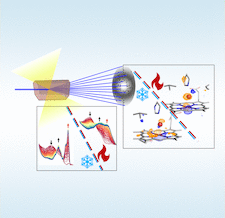
Cover illustration: For two metal-containing proteins, a coupled spectroscopic and crystallographic approach was used to show that the structural response to X-ray-induced reduction of metals in their active site is markedly different at room temperature than at cryogenic temperature, suggesting that the use of controlled specific radiation damage to mimic and study a physiological redox transition in a metal-containing protein by X-ray crystallography should preferably be performed at room temperature rather than at cryogenic temperature [Caramello et al. (2026), Acta Cryst. D82, 187–198].
scientific comment


Open  access
access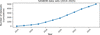
The Small-Angle Scattering Biological Data Bank (SASBDB) has surpassed 5000 deposited data sets, highlighting its role as a central open-access resource for biological small-angle scattering data and its growing impact on method development, benchmarking and data-driven analysis.
image processing for cryoem
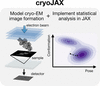
The authors have developed cryoJAX, a cryo-EM image-simulation library for developing data-analysis techniques across cryo-EM modalities. CryoJAX is built on JAX, an emerging scientific computing framework in Python well suited for cryo-EM data analysis.

Open access
access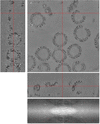
Cryo-ET is a rapidly emerging technique that enables 3D visualization of complex biological structures, but present limits on signal-to-noise ratio and reconstruction quality pose challenges for downstream analysis. Here, we present a systematic analysis of state-of-the-art deep-learning methods for contrast enhancement and propose improvements in neural network architectures and training objectives to preserve more high-resolution information.
radiation damage

Open access
access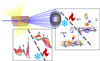
We used on-line in crystallo UV–Vis absorption spectroscopy in conjunction with X-ray crystallography on beamline BM07-FIP2 at the ESRF to compare the structural effects of specific radiation damage on two different metal-containing proteins at either room or cryogenic temperature.
PDB references: horse-heart myoglobin, room temperature, 32.5 kGy, 9t6v; 260.0 kGy, 9t6w; cryogenic temperature, 676.8 kGy, 9t6x; 14.4 kGy, 9t6y; nitrite reductase from Achromobacter cycloclastes, room temperature, 14.9 kGy, 9t6o; 283.1 kGy, 9t6p; cryogenic temperature, 33.3 kGy, 9t6q; 1332 kGy, 9t6u
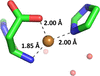
X-ray exposure influences the structures of Cu(I), Cu(II) and Zn(II) complexes of amyloid-β (Aβ) peptides in different ways. While Cu(I) and Zn(II) complexes show no detectable X-ray-induced spectral changes, Cu(II) complexes undergo significant spectral evolution under irradiation. Experiments on the truncated fragments Aβ1–6 and Aβ1–16 show that the extent of relaxation depends on the peptide length, on the binding mode and on the temperature.
Open access
access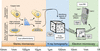
Cryo-EM analysis of apoferritin exposed to an X-ray dose of 100 MGy confirms the potential for high-resolution correlative imaging workflows combining X-ray tomography and cryo-EM.
CCP4
Open access
access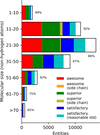
A database of validated ligand restraints computed using various levels of quantum mechanics is generated and distributed with Phenix to streamline and improve macromolecular refinement results.
Open access
access
We describe a simple test to determine whether sufficient data have been collected during a serial crystallographic experiment, and its incorporation into the autoprocessing pipeline at the T-REXX endstation on beamline P14 at the PETRA III synchrotron.
research papers
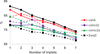
Crystal structures of proteins and nucleic acids with data resolution up to 2.2 Å are solved via a novel direct-methods program using the Pattterson map as prior information.
Open access
access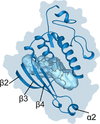
We report the crystal structure of human PITPα in complex with microcolin H at 2.0 Å resolution, revealing that microcolins bind covalently within the lipid-binding cavity and stabilize PITPα in an open conformation with a markedly enlarged cavity relative to the lipid-bound state. These results define the structural basis of PITP inhibition by microcolins and underscore the importance of using ligand-bound conformations for accurate structure-based modeling.
PDB reference: PITPα, complex with microcolin H, 9ta5
Open access
access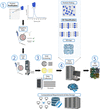
This article describes the transition of the Glass laboratory from X-ray crystallography to single-particle cryo-electron microscopy (cryo-EM) for structural studies of ATAD2B, a large AAA+ ATPase- and bromodomain-containing protein involved in chromatin regulation. It outlines practical strategies for protein expression, sample preparation, data processing and model building, offering a comprehensive workflow and troubleshooting guide for new cryo-EM users working with large, flexible macromolecular complexes.