

 journal menu


issue contents
April 2026 issue
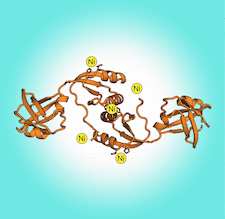
Cover illustration: Determination of the crystal structure of UreE, a key virulence factor of the urinary-tract pathogen Proteus mirabilis, and of its nickel-binding capacity by inductively coupled plasma mass spectrometry allowed the assignment of putative nickel-binding sites [Pan et al. (2026), Acta Cryst. D82, 348–357].
image processing for cryoem


Open  access
access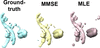
A Bayesian perspective on orientation estimation in cryo-EM is presented, with the minimum mean-square error estimator outperforming standard cross-correlation-based approaches, particularly under challenging low signal-to-noise conditions. We demonstrate that improved orientation estimation has a decisive impact on 3D reconstruction quality and structural heterogeneity recovery.
Open access
access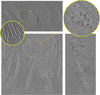
We present ICECREAM, a self-supervised approach that achieves substantially better denoising and more reliable missing-wedge recovery in cryo-ET, while reducing training and inference time relative to comparable baselines.
CCP4
Open access
access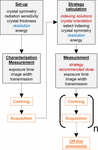
This paper presents and explains a workflow program for automatically deriving, optimizing and executing complex multi-sweep diffraction experiments for macromolecular crystallography at synchrotron beamlines.
research papers


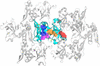
The first unbound crystal form of full-length TIMP-1 provides a platform for crystallographic fragment screening-based drug discovery in cancer and multiple sclerosis.
Open access
access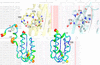
Structures of the monomer and intertwined dimer of the acylphosphatase from E. coli shed light on the molecular basis of its 3D domain swapping.
Open access
access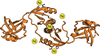
This study presents a 2.0 Å resolution crystal structure and determined the nickel-binding capacity of the P. mirabilis nickel chaperone UreE. UreE is essential for the delivery of nickel to the metalloenzyme urease, which is key for the ability of P. mirabilis to cause urinary-tract infections.
PDB reference: Proteus mirabilis UreE, 9zlo
Open access
access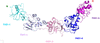
Crystal structures of the autophagy protein Fsc1 reveal conserved fasciclin features and a stable dimer interface that illuminate its possible role as a scaffold in autophagosome–vacuole membrane fusion.
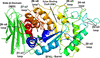
This report describes the first protein structure from a new glycoside hydrolase family 30 subfamily which specifically degrades the biomass-derived polysaccharide xylan.
PDB reference: AchXyn30A, 9ywn
Open access
access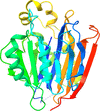
This study reports the first crystal structure of human TANGO2, mutations of which are responsible for TANGO2 deficiency disorder. The crystallographic analysis demonstrates that interactions between heme and TANGO2 are nonspecific, helping to address ongoing questions about the role of TANGO2 as a heme-trafficking protein.
PDB reference: human TANGO2, 8sv7
obituaries
Free