


 journal menu


issue contents
June 2026 issue
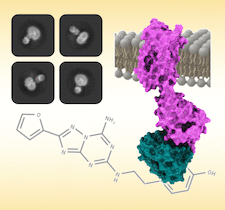
Cover illustration: A new fusion tool has been developed to enable structure determination of G protein-coupled receptors (GPCRs) in inactive conformations by cryo-EM [Shah et al. (2026), Acta Cryst. D82, 655–663]. This new fusion provides an alternative option for GPCR structure determination, with several potential benefits compared with existing tools, such as a more favourable position relative to the GPCR to reduce potential clashes.
scientific comment


Open  access
access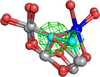
We reanalyzed our XFEL data, the results of which showed the insertion of O6 during the S2–S3 transition in water oxidation by photosystem II. These results contradict the interpretation proposed by Wang that there is no insertion of O6 during the S2–S3 transition.
SSRL/LCLS users' meeting
Open access
access
This review describes how an integrated structural biology platform at Merck Sharp & Dohme LLC, Rahway, New Jersey, USA, combining X-ray crystallography, cryo-EM, MicroED and cryo-ET, enables seamless three-dimensional insights from molecular to cellular length scales. By uniting ex situ and in situ approaches with AI/ML-enabled data integration, the platform directly informs target selection, structure-based drug design, formulation strategies and mechanism-of-action studies across multiple therapeutic areas. These advances illustrate a scalable and impactful framework for accelerating mechanism-based, next-generation therapeutic discovery and development.
research papers

Open access
access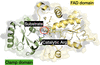
The active-site dynamics of the microbial enzyme urocanate reductase were revealed by room-temperature X-ray crystallography.
Open access
access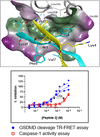
We describe the first structure of gasdermin D with a putative caspase inhibitor peptide analog at 1.6 Å resolution. This work suggests potential druggability of gasdermin D at the exosite by leveraging structure-based computational design with biochemical characterization.
PDB reference: gasdermin D bound to a peptide, 9e0v
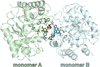
This study describes the transglycosylase activity of Ta_Cel5A, a GH5_5 cellulase from the ascomycete T. aurantiacus. Its structure was solved in complex with various ligands, revealing the displacement of catalytically relevant residues during formation of the glycosyl-enzyme intermediate.
Open access
access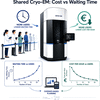
We present a quantitative framework combining cost modelling and queueing theory to estimate hourly access costs, waiting times and congestion levels for shared high-end scientific equipment. The approach is general, illustrated with cryo-electron microscopy examples, and implemented in an open-access online calculator to support evidence-based equipment planning.
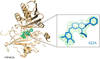
The crystal structure of PIP4K2A bound to a potent dual PIP4K2A/PIP4K2B inhibitor reveals a water-mediated interaction that constrains ligand orientation within the specificity pocket. Comparative analysis with a PIP4K2A-selective inhibitor identifies structural features that underlie isoform-dependent inhibitor binding and inform structure-guided optimization.
PDB reference: PIP4K2A–422A, 11ad
Open access
access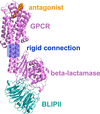
The development of a new fusion tool in which a β-lactamase fusion tag and a binding partner enabled the structure determination of an antagonist-bound G protein-coupled receptor by cryo-EM is reported.
Open access
access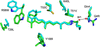
The mechanism of retinal photoswitching is illuminated in a designed rhodopsin mimic. Two mechanisms, a conventional cis–trans isomerization and an unprecedented `photodehydration', are observed at atomic resolution in single crystals.
Open access
access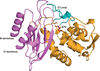
Serial cryo-crystallography reveals the structure of the extended-spectrum β-lactamase CTX-M-14 in complex with the third-generation cephalosporin antibiotic cefdinir.

Download citation


Download citation
Open access
access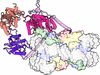
Reanalysis of a publicly available cryo-EM dataset identifies a new conformation of the oncogenic chromatin remodeler ALC1/CHD1L bound to a PARylated nucleosome. This new structure reveals the position of the macro domain in the complex, and may help to understand the large conformational change leading to the activation of ALC1.