issue contents

Journal logoSTRUCTURAL
BIOLOGY
ISSN: 2059-7983

August 2026 issue

Highlighted illustration

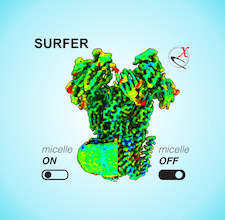
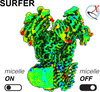
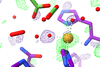
Cover illustration: SURFER is a lightweight, GPU-accelerated extension for UCSF ChimeraX that enables rapid semantic differentiation of membrane or membrane-mimic density from macromolecular signal in cryo-EM maps [Bharadwaj et al. (2026), Acta Cryst. D82, 848–861]. It operates on unfiltered maps to automatically generate segmentation masks that can be flexibly applied to any aligned target map, including reference volumes for local refinement or postprocessed maps optimized for visualization and interpretation. By allowing contextual density to be selectively toggled or subtracted, SURFER enables direct interactive comparison between representations with and without membrane-related features to facilitate consistent analysis and reporting of membrane context in cryo-EM structures.

CCPEM


link to html
SURFER performs automated segmentation of contextual membrane and membrane-mimic density in cryo-EM maps to enable robust separation of macromolecular signal from surrounding detergent or lipid–membrane features. It is conveniently distributed as a plugin for UCSF ChimeraX, allowing interactive application within standard map-visualization workflows.

CCP4


link to html
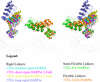
We present a new formulation for protein flexibility and learn protein motions from sparse experimental data.

radiation damage


link to html
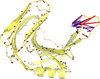
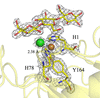
A series of 36 structures of the Neurospora crassa LPMO NcAA9D were refined against X-ray crystal datasets collected with increasing dose from a single crystal to provide insights into dose-dependent structural changes at the active site of the enzyme. The findings underscore the importance of minimizing accumulated dose during cryo-X-ray crystallographic studies of lytic polysaccharide monooxygenases to prevent the misinterpretation of radiation damage-related electron-density features.

image processing for cryoem


link to html
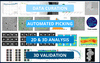
We present a fully automated, unattended cryo-EM pipeline that serves as an on-the-fly diagnostic tool, enabling rapid data-quality assessment and informed decision-making to maximize data-collection efficiency.

ISDSB2025


link to html
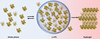
In biological systems, hydrogels often arise through liquid–liquid phase separation, where biomolecular condensates can age into gel-like states. SAXS is a key technique to probe the molecular organization of these samples. This study introduces an in-vacuum Gel-Cell for SAXS-based structural analysis of a biologically derived hydrogel formed by the thermosensory prion-like domain of EARLY FLOWERING 3 and presents a three-component model to interpret the obtained data.

research papers


link to html
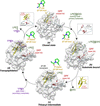
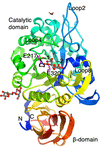
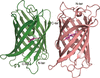
The open and closed lid conformational states of class C sortase, which catalyzes the polymerization of endocarditis and biofilm-associated pili in E. faecalis, were captured in a single crystal. Communication between the flexible lid and the dynamic active-site (β7–β8) loop, along with their synchronized motions, regulates access to the active site for primary- and secondary-substrate binding.

link to html
The crystal structure of S. avermitilis endo-β-1,6-galactanase belonging to GH30 subfamily 5 reveals the first structural framework for endo-β-1,6-galactanase. The β-1,6-galactobiose-bound complex identifies the catalytic subsites and a distal secondary sugar-binding site, providing insight into β-1,6-galactan recognition.

link to html
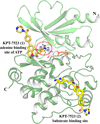
The 2-aminopyridine moiety of KPT-7523 binds p21-activated kinase 4 and nicotinamide phosphoribosyltransferase, enabling a versatile design for multi-target cancer therapy.

link to html
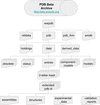
wwPDB has extended PDB IDs to 12 characters with a prefix `pdb_' followed by eight alphanumeric characters in lower case (for example pdb_1000axyz). A beta version of the PDB Archive (https://files-beta.wwpdb.org), with extended PDB IDs and an improved directory structure, is now available to help communities adopt extended PDB IDs and the PDBx/mmCIF format.

link to html
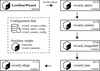
LowDoseWizard is a guided SerialEM workflow for rapid and standardized setup of low-dose cryo-TEM imaging conditions for single-particle analysis and cryo-electron tomography.

link to html
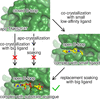
Replacement soaking, also known as cross-soaking, is a compelling method for solving complex structures in cases where traditional soaking and co-crystallization approaches fail. This method is demonstrated with human tankyrase 2, and new crystal structures of complexes with nanomolar inhibitors and an analogue of the substrate NAD+ are reported.

addenda and errata


Forthcoming special issues

CCP4SW 2025 - Using software, AI and other methods to advance crystallographic models

CCP-EM Spring Symposium 2025

CCP4SW 2024 - Decision making in MX - how to be a productive structural biologist

Radiation Damage to Biological Samples

Articles from the Seventh International Symposium on Diffraction Structural Biology

Published special issues

Image-processing methods for electron microscopy of biological specimens

CCP-EM Spring Symposium 2024

CCP-EM Spring Symposium 2023

CCP4SW 2023 - Data - subtle details to big insights

Machine Learning in Crystallography and Structural Science

Full details are available on the special issues page.

Follow Acta Cryst. D
Sign up for e-alerts
Follow Acta Cryst. on Twitter
Follow us on facebook
Sign up for RSS feeds