


 menu
menu


issue contents
September 2026 issue
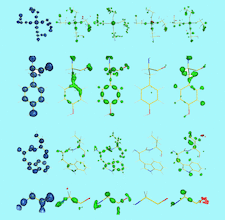
Cover illustration: The determination of the highest resolution structure in the PDB at 0.43 Å resolution is described by Paknia et al. (2026), Acta Cryst. D82, 1044–1055. Electron-density maps reveal extensive deformation electron density that is completely accounted for by performing transferable aspherical atom refinements using the DiSCaMB library in BUSTER. The image illustrates the presence of genuine deformation density in this rubredoxin structure.
CCP4


Free 
The Guest Editors introduce the special issue based on talks at the CCP4 Study Weekend 2024. The virtual issue is available at https://journals.iucr.org/special_issues/2026/CCP42024/.

Open access
access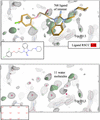
Flawed protein–ligand X-ray structures can misdirect drug discovery based on PDB-deposited models. This review uses publicly available PDB examples to highlight potential pitfalls, from absent ligands to incorrect chemistry, and presents a practical validation approach to improve model reliability.
SSRL/LCLS users' meeting
Open access
access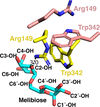
Conformational dynamics in the melibiose/Na+ cotransporter MelB significantly influence the binding of the primary sugar substrate but have minimal effect on the co-substrate Na+. Na+ acts as an allosteric activator, increasing sugar affinity by stabilizing the inner barrier and constraining conformational flexibility.
ISDSB2025

Open access
access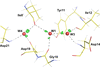
Here, we describe the determination of the highest resolution structure in the PDB at 0.43 Å resolution. Electron-density maps reveal extensive deformation electron density that is completely accounted for by performing transferable aspherical atom refinements using the DiSCaMB library in BUSTER.
cryoem in the fast lane of structural biology

Open access
access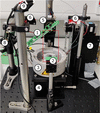
We describe a new method to prepare grids for cryoEM on the sub-millisecond timescale.
research papers
Open access
access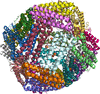
The oligomerization of B. melitensis bacterioferritin (BmBfr) was studied using X-ray crystallography, size-exclusion chromatography and thermal shift analysis. These techniques allowed the characterization of both apo and holo BmBfr, highlighting the impact of heme and pH on the oligomerization mechanism.
PDB reference: apo bacterioferritin from Brucella melitentsis, 9gzu
Open access
access
We report a room-temperature serial synchrotron X-ray crystallographic structural analysis of Nitratidesulfovibrio vulgaris formate dehydrogenase AB, an enzyme that reduces CO2 to formate.
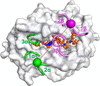
We determined crystal structures of TCR 4414A bound to HLA-A2-presented p53Y220D and of the corresponding unbound wild-type and mutant p53–HLA-A2 ligands, revealing that the Y220D driver mutation reshapes the peptide and renders a normally cryptic self-epitope visible to T cells. These structures explain how TCR 4414A achieves high specificity for mutant p53 by minimizing interactions with conserved peptide regions and instead focusing on the central Y220D mutation, providing a structural basis for mutation-specific TCR immunotherapy.
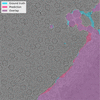
QwenCryoMarker is a universal post-processing framework that removes contamination-induced false positives from any cryo-EM particle picker. Built on the Qwen-Image-Edit vision-language model, it generates high-precision masks of carbon, ice and impurities, and then filters raw particle coordinates with negligible loss of true particles.
Open access
access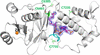
We report a novel cysteine-to-serine surface-mutation approach to determine co-crystal structures of KAT6A with small-molecule inhibitors and compare it with the previously published MYSTcryst approach which uses mutated KAT8 as a surrogate for KAT6A. A series of co-crystal structures obtained from both approaches, with three different inhibitor chemotypes, reveal alternative inhibitor conformations at the binding-site entry and the importance of filling a hydrophobic subpocket. These insights expand the experimental basis for future KAT6A inhibitor design for cancer therapy.