journal menu


issue contents
April 2026 issue
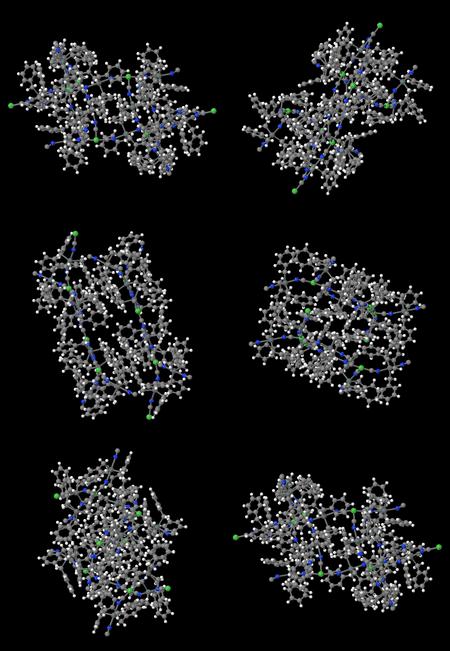
Cover illustration: The synthesis and crystal structure of a new 3D coordination polymer, {[(PhCH2)3Sn]2Ni(CN)4}n, are described. This 3D metal–organic framework (MOF) can be considered the first example of a guest-free cyanometallate network with a topology analogous to a PtS net with the vertex symbol 42.84 and based exclusively on square-planar Ni(CN)4 nodes. See: Mothi Paul & Stoeckli-Evans [Acta Cryst. (2026). E82, 357–361].
research communications


Download citation


Download citation
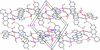
The tetracyclic ring systems of the two title structures are essentially planar. Molecules are linked by hydrogen bonds N—H⋯O=P, forming rings of graph set R22(12).
Download citation
Download citation
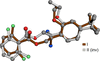
The crystal structures and Hirshfeld-surface analyses of bromide and fumarate salts of metabolite 'R7′ of the insecticide/acaricide etoxazole are presented.
Download citation
Download citation
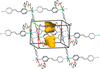
A new NiII MOF, C24H17N3NiO4S·0.205(C3H7NO), was obtained under solvothermal conditions and its structure was determined by single-crystal X-ray diffraction.
CCDC reference: 2534227
Download citation
Download citation
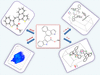
In the title compound, the two aromatic ring systems are arranged almost perpendicular to each other [dihedral angle 88.5 (2)°].
CCDC reference: 2479318
Download citation
Download citation
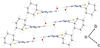
In the crystal structure of the title compound, the diaminotriazinethione (DTT) moiety and water molecules are hydrogen bonded to form ribbons.
CCDC reference: 2531186
Download citation
Download citation
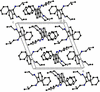
In the title compound, the dihedral angle between the phenyl rings is 89.23 (5)°. In the crystal, the molecules are elongated along the c-axis direction and stacked along the b-axis direction. Neither intra- or intermolecular hydrogen bondings nor π–π interactiones are observed. The weak C—H⋯π(ring) interactions may help in the consolidation of the packing.
CCDC reference: 2534247
Download citation
Download citation

The asymmetric unit of the title compound contains two crystallographically independent ferrocenecarboxaldehyde molecules. In the crystal, C—H⋯O hydrogen bonds link the molecules into infinite chains along the b-axis direction. The hydrogen bonding, π–π, C—H⋯π(ring) and van der Waals interactions are the dominant interactions in the crystal packing.
CCDC reference: 2534450
Download citation
Download citation
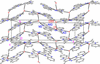
The title compound (Z)-3-{2-[(Z)-11H-indeno[1,2-b]quinoxalin-11-ylidene]hydrazinyl}-N-phenylbut-2-enamide monohydrate was synthesized and investigated using SCXRD. Except for the phenyl group, the molecule is almost planar, and includes an intramolecular Nhydrazinyl—H⋯(Ocarbonyl, Nquinoxaline) hydrogen-bond system. Hydrogen bonds combine to form a layer structure.
CCDC reference: 2535107
Download citation
Download citation
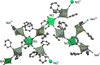
The self-assembly of K2[Ni(CN)4] with (PhCH2)3SnCl in a 1:2 molar ratio affords the title three-dimensional coordination polymer. This neutral guest-free metal–organic framework has a three-dimensional connectivity defined by the circuit symbol 42.84.
CCDC reference: 704360
Download citation
Download citation
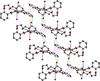
The title compound, [SmI2(C22H28O7)]·0.5C4H10O2 or Sm(dibenzo-21-crown-7)I2, was obtained as a minor product by layering dimethoxyethane solutions of SmI2 and dibenzo-21-crown-7. The asymmetric unit consists of one Sm(dibenzo-21-crown-7)I2 moiety and half a dimethoxyethane solvent molecule in the outer sphere.
CCDC reference: 2525331
Download citation
Download citation
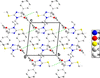
The title compound C18H16N2OS has a slightly ruffled imidazolone ring with N–C π delocalization. In the crystal, C—H⋯O dimers link into b-axis chains via C—H⋯π contacts, with H⋯H interactions dominating the packing.
CCDC reference: 2536800
Download citation
Download citation
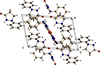
The title cocrystal was obtained by the cocrystallization of 1-phenylsemicarbazide (A) and 1-phenylpyrazolidin-3-one (B) in a 1:1 molar ratio from methanol solution. The structure features a gauche arrangement about the N—N bond in the semicarbazide fragment and a twisted conformation of the pyrazolidinone ring. In the extended structure, the molecules are linked by A → A and B → A N—H⋯O hydrogen bonds, supplemented by C—H⋯π contacts to generate a three-dimensional supramolecular framework.
CCDC reference: 2378160
Download citation
Download citation
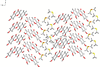
The title compound crystallizes in the monoclinic space group P21. The luteolin molecule adopts a planar conformation, and the crystal structure is consolidated by extensive hydrogen-bonding interactions.
CCDC reference: 2537224
Download citation
Download citation
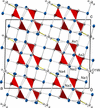
The crystal structure of Na4(As2O5)(H2O)0.5 consists of a half-eclipsed (As2O5)4– anion embedded in a framework of [NaO4] and [NaO6] polyhedra. O—H⋯O hydrogen-bonding consolidates the packing.
CCDC reference: 2538842
Download citation
Download citation
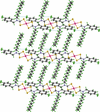
The title compound crystallizes about an inversion centre in the monoclinic space group C2/c. The PdII cation adopts a square-planar coordination geometry defined by four sulfur atoms from two N-(4-chlorobenzyl)-N-dodecyldithiocarbamate anions. The crystal packing features C—H⋯S hydrogen bonds, which form a belt motif.
CCDC reference: 2532016
Download citation
Download citation
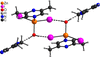
The syntheses and crystal structures of three complexes with the composition ZnCl2(2,6-dimethylpyrazine)(CH3OH) (1), ZnBr2(2,6-dimethylpyrazine)(CH3OH) (2) and ZnI2(2,6-dimethylpyrazine)(H2O) (3) are reported. Each consists of discrete complexes that are linked by hydrogen bonding.
Download citation
Download citation
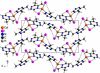
The syntheses and crystal structures of [CdI2(2,3-dimethylpyrazine)2](1) and [CdI2(2,3-dimethylpyrazine)]n (2) are reported. Compound 1 consists of discrete complexes, whereas in 2 the Cd cations are linked into chains by bridging 2,3-dimethylpyrazine ligands.
Download citation
Download citation
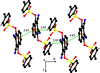
In the title compound, the pendant para toluene moieties are inclined to the central naphthalene-2,3-dicarbonitrile grouping by 45.82 (7) and 42.41 (6)°. The crystal packing features offset parallel π–π stacking and C—H⋯π interactions.
CCDC reference: 2539097
Download citation
Download citation
The synthesis and crystal structure of a new organic compound, 2,6-bis[4-(ethoxycarbonyl)-5-methylpyrazol-1-yl]pyridine is reported. A detailed analysis of the intermolecular contacts in the crystal packing was performed using Hirshfeld surface analysis.
CCDC reference: 2539018
Download citation
Download citation
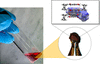
A single crystal of ferrocenyl indanone, which crystallized in the monoclinic space group P21/c was investigated by X-ray diffraction, Hirshfeld surface analysis and NMR spectroscopy. In the crystal, molecules are arranged in pairs with asymmetrical stacking by O⋯H intermolecular interactions.
CCDC reference: 2536986
Download citation
Download citation
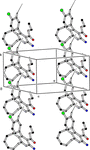
In the title compound, the cyclooctene ring has a boat–chair conformation.
CCDC reference: 2539747
Download citation
Download citation
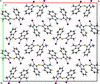
The title compound consists of two N-methyl-2-iodoindole units linked by a thioether bridge in a gauche conformation. In the crystal, short I⋯C and I⋯π contacts dominate the packing and generate a herringbone motif.
CCDC reference: 2539020