
Acta Crystallographica
Section E CRYSTALLOGRAPHIC COMMUNICATIONS


 menu


research communications
| CRYSTALLOGRAPHIC COMMUNICATIONS |
 access
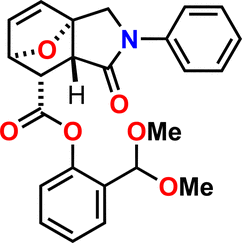
and Hirshfeld surface analysis of 2-(dimethoxymethyl)phenyl (3aRS,6SR,7RS,7aSR)-1-oxo-2-phenyl-1,2,3,6,7,7a-hexahydro-3a,6-epoxyisoindole-7-carboxylate

aRUDN University, 6 Miklukho-Maklaya St., Moscow 117198, Russian Federation, bZelinsky Institute of Organic Chemistry of RAS, Leninsky Prospect 47, Moscow 119991, Russian Federation, cDepartment of Chemical Engineering, Baku Engineering University, Hasan Aliyev str. 120, AZ0101, Khirdalan, Absheron, Azerbaijan, dDepartment of Physics, Faculty of Sciences, Erciyes University, 38039 Kayseri, Türkiye, eDepartment of Physics, Jimma University, Jimma, Ethiopia, and fAzerbaijan Medical University, Scientific Research Centre (SRC), A. Kasumzade St. 14, AZ 1022, Baku, Azerbaijan
*Correspondence e-mail: [email protected]
The molecular structure of the title compound, C24H23NO6, exhibits stability due to four intramolecular C—H⋯O interactions that form rings with S(6), S(9), S(5), and S(5) motifs. In the 7-oxabicyclo[2.2.1]hept-2-ene unit, the five-membered rings and the pyrrolidine ring all adopt envelope conformations. In the crystal, the molecules are connected by C—H⋯O interactions, creating a three-dimensional framework. The molecules are further connected by C—H⋯π interactions, forming layers parallel to the (101) plane. Important intermolecular interactions highlighted by Hirshfeld surface analysis are H⋯H (54.6%), C⋯H/H⋯C (21.6%) and O⋯H/H⋯O (21.3%) contacts.
Keywords: crystal structure; envelope conformation; C—H⋯π interactions; Hirshfeld surface analysis.
CCDC reference: 2596512
1. Chemical context
3a,6-Epoxyisoindole carboxylates are of interest as rigid polycyclic N,O-containing heterocyclic systems. Their value is related not only to their spatial structure, but also to the possibility of further functionalization: the presence of a carboxyl group makes it possible to obtain and introduce various aromatic or biologically significant fragments into the molecule (Varlamov et al., 2004 ; Zubkov et al., 2011). 3a,6-Epoxyisoindole carboxylic acids, their esters, and formylphenyl derivatives have already been described in the literature, which were then used for the synthesis of azomethines (Dikusar et al., 2024; Mamedov et al., 2024). This shows that the epoxyisoindole framework can be considered as a convenient basis for building more complex molecules, rather than just as a separate synthetic product. Salicylaldehyde is also an important and widely used fragment in organic chemistry. Its derivatives readily condense with amines to form Schiff bases, which are actively studied as ligands for metal complexes, fluorescent sensors, and compounds with potential biological activity (Afrin et al., 2023; Ceramella et al., 2022; Javadzade et al., 2026; Li et al., 2025). Therefore, the combination of the 3a,6-epoxyisoindole framework with the protected salicylaldehyde fragment in the form of acetal is justified: the epoxyisoindole sets a rigid spatial structure and increases molecular complexity, and the salicylaldehyde fragment retains the possibility of further transformations after removing the protection. Thus, the resulting ester can be considered as a hybrid of two synthetically valuable fragments, which expands the range of derivatives of 3a,6-epoxyisoindoles and may be useful for further preparation of functionalized heterocyclic compounds.
2. Structural commentary
The molecular structure of the title compound exhibits stability due to four intramolecular C—H⋯O interactions that form rings with S(6), S(9), S(5), and S(5) motifs (Fig. 1, Table 1; Bernstein et al., 1995). The pyrrolidine ring (N2/C1/C7A/C3A/C3) makes the dihedral angles of 21.14 (11) and 21.56 (10)°, respectively, with the phenyl ring (C8–C13) and the benzene ring (C15–C20), while these rings subtend a dihedral angle of 13.69 (10)° with each other. In the 7-oxabicyclo[2.2.1]hept-2-ene unit of the ten-membered fused 1,2,3,6,7,7a-hexahydro-3a,6-epoxyisoindole ring system, the (O8/C3A/C4/C5/C6) and (O8/C3A/C7A/C7/C6) rings adopt envelope conformations with the puckering parameters (Cremer & Pople, 1975) Q(2) = 0.511 (2) Å, φ(2) = 181.3 (3)° and Q(2) = 0.599 (2) Å, φ(2) = 3.6 (2)°, respectively, and atom O8 as the flap in both cases. The pyrrolidine ring (N2/C1/C7A/C3A/C3) adopts an envelope conformation on atom C3A as the flap with puckering parameters Q(2) = 0.317 (2) Å, φ(2) = 282.4 (4)°.
|
 ; (ii)
 ; (iii)
 .
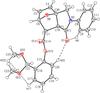 | Figure 1 Molecular structure of the title compound showing the atom labeling and ring system with displacement ellipsoids at 50% probability level. The intramolecular C9—H9⋯O1, C20—H20⋯O1, C17—H17⋯O23 and C22—H22C⋯O23 interactions, shown as dashed lines, enclose S(6), S(9), S(5) and S(5) motifs, respectively. |
3. Supramolecular features and Hirshfeld surface analysis
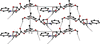
There were no classical hydrogen bonds in the crystal. The molecules are linked by C—H⋯O interactions, forming a three-dimensional network (Figs. 2, 3 and 4, Table 1). The molecules are further linked by C—H⋯π interactions, forming layers that are oriented with the (10 ) plane (Figs. 5 and 6, Table 1). No π–π interactions were observed.
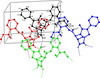 | Figure 2 Partial packing view showing the C4—H4⋯O8i, C5—H5⋯O1ii and C23—H23B⋯O14iii interactions in the Symmetry codes: (i) x −  , −y + 1, z − ; (ii) x − 1, y, z; (iii) x − , −y, z − . |
 | Figure 3 A view of the C—H⋯O interactions along the a-axis direction. |
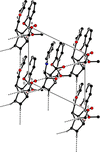 | Figure 4 A view of the C—H⋯O interactions along the b-axis direction. |
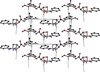 | Figure 5 A view of the C—H⋯π interactions along the a-axis direction. |
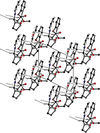 | Figure 6 A view of the C—H⋯π interactions along the b-axis direction. |
CrystalExplorer 21 (Spackman et al., 2021) was used to construct Hirshfeld surfaces and generate the related two-dimensional fingerprint plots to illustrate the intermolecular interactions for the molecules of the title compound. The dnorm mappings were conducted in the range −0.2256 to +1.3633 a.u. Bright-red circles on the dnorm surfaces (Fig. 7) represent O—H⋯O and C—H⋯O interaction zones (Table 1 and 2).
| |||||||||||||||||||||||||||||
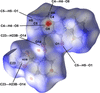 | Figure 7 View of the three-dimensional Hirshfeld surface of the title compound mapped over dnorm in the range −0.2256 to 1.3633 a.u. |
Two-dimensional fingerprint plots of the title compound together with their percentage contributions are shown in Fig. 8. The crystal packing is dominated by H⋯H contacts, representing van der Waals interactions (54.6% contribution to the overall surface), followed by C⋯H/H⋯C and O⋯H/H⋯O interactions, which contribute to 21.6% and 21.3%, respectively. The other contacts [N⋯H/H⋯N (1.3%), O⋯C/C⋯O (0.6%), C⋯C (0.5%) and N⋯C/C⋯N (0.1%)] only make a minor contribution to the crystal packing.
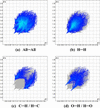 | Figure 8 The two-dimensional fingerprint plots of the title compound, showing (a) all interactions, and those delineated into (b) H⋯H, (c) C⋯H/H⋯C, (d) O⋯H/H⋯O interactions. The di and de values are the closest internal and external distances (in Å) from given points on the Hirshfeld surface. |
4. Database survey
A search of the Cambridge Structural Database (CSD version 6.01, updated February 2026; Groom et al., 2016) for the 1,2,3,6,7,7a-hexahydro-3a,6-epoxyisoindole ring system returned five matches. These are CSD refcodes ERIVIL (Temel et al., 2011), OMUTAU (Mertsalov et al., 2021), UPAQEI (Koşar et al., 2011), TIJMIK (Demircan et al., 2013), and YAXCIL (Temel et al., 2012).
ERIVIL and OMUTAU crystallize in the triclinic space group P while UPAQEI, TIJMIK and YAXCIL crystallize in the monoclinic P21/c,
In ERIVIL, the two tetrahydrofuran rings adopt envelope conformations, the pyrrolidine ring adopts a half-chair conformation and the six-membered ring is in a boat conformation. In the crystal, weak intermolecular C—H⋯O hydrogen bonds link the molecules into R22(8) and R22(14) rings along the b-axis direction.
In OMUTAU, the tetrahydrofuran rings of both molecules (A and B) in the asymmetric unit, adopt envelope conformations, the pyrrolidine rings adopt a twisted-envelope conformation and the six-membered ring is in a boat conformation. In the crystal, strong intermolecular O—H⋯O hydrogen bonds and weak intermolecular C—H⋯O contacts link the molecules, forming a three-dimensional network. In addition weak π–π stacking interactions are observed of the A molecules.
In UPAQEI, the boat form of the six-membered ring is almost symmetrical with respect to the epoxy bridge. The two five-membered rings generated by the epoxy bridge of the six-membered ring adopt envelope conformations, whereas the N-containing five-membered ring adopts a twisted conformation. In the crystal, molecules are linked by C—H⋯O hydrogen bonds.
In TIJMIK, the tetrahydrofuran ring adopts an The pyrrolidine ring adopts an In the crystal, two types of C—H⋯O hydrogen bonds generate R22(20) and R44(26) rings, with adjacent rings running parallel to ac plane. Further C—H⋯O hydrogen bonds form a C(6) chain, linking the molecules in the b-axis direction.
In YAXCIL, the six-membered ring has a boat conformation. The two five-membered rings with the bridging O atom adopt envelope conformations, whereas the N-containing five-membered ring adopts a twisted conformation. In the crystal, C—H⋯O hydrogen bonds link the molecules into a three-dimensional network.
5. Synthesis and crystallization
A solution of the 2-formylphenyl (3aRS,6SR,7RS,7aSR)-1-oxo-2-phenyl-1,2,3,6,7,7a-hexahydro-3a,6-epoxyisoindole-7-carboxylate (0.1 g, 0.27 mmol, 1.0 equiv) in methanol (3 mL) was treated with methanolic hydrogen chloride (1.25 M solution in MeOH, 22 µL, 0.027 mmol, 0.1 equiv). The reaction mixture was stirred at room temperature for 7 days (TLC control, hexane–EtOAc, 1:2). After completion of the reaction, the reaction mixture was poured into water (50 mL). The precipitate was filtered off, washed with water (3 × 5 mL), dried under vacuum, and air-dried to afford the corresponding acetal as a colorless powder, yield 25%, 28 mg (0.07 mmol), m.p. 437–440 K. Single crystals of the 2-(dimethoxymethyl)phenyl (3aRS,6SR,7RS,7aSR)-1-oxo-2-phenyl-1,2,3,6,7,7a-hexahydro-3a,6-epoxyisoindole-7-carboxylate were grown from the 1:1 v/v mixture of a CHCl3/EtOH at 281 K. 1H NMR (700.2 MHz, CDCl3), (J, Hz) 7.61–7.60 (m, 3 H, H-Ar), 7.48 (d, J = 8.1 Hz, 1 H, H-Ar), 7.41–7.36 (m, 3 H, H-Ar), 7.25 (t, J = 7.6 Hz, 1 H, H-Ar), 7.16 (t, J = 8.1 Hz, 1 H, H-Ar), 6.65 (d, J = 5.7 Hz, 1 H, H-4), 6.59 (dd, J = 5.7, 1.4 Hz, 1 H, H-5), 5.65 (s, 1 H, CH(OCH3)2), 5.43 (d, J = 1.4 Hz, 1 H, H-6), 4.50 and 4.24 (two d, J = 11.4 Hz, 2 H, H-3), 3.30 (s, 3 H, CH3), 3.26 (s, 3 H, CH3), 3.15 and 3.05 (two d, J = 9.1 Hz, 2 H, H-7,7a). 13C NMR (176.1 MHz, CDCl3) δ 170.0, 169.9, 148.8, 139.1, 137.3, 135.5, 129.8, 129.6, 128.9 (2C), 127.8, 125.5, 125.0, 123.4, 120.5 (2C), 98.7, 87.8, 81.9, 52.8, 52.4, 52.2, 50.2, 45.8. MS (ESI) m/z: [M]+ 422.
6. Refinement
Crystal data, data collection and structure details are summarized in Table 3. H atoms were placed in idealized positions and allowed to ride on their parent atoms, with C—H = 0.95, 0.98, 0.99 and 1.00 Å for aromatic, methyl, methylene and methine H respectively, and Uiso(H) = 1.5Ueq(C) for methyl H and Uiso(H) = 1.2Ueq(C) for all other H atoms.
|
Supporting information
CCDC reference: 2596512
contains datablock I. DOI: https://doi.org/10.1107/S2056989026010674/ex2108sup1.cif
Structure factors: contains datablock I. DOI: https://doi.org/10.1107/S2056989026010674/ex2108Isup2.hkl
Supporting information file. DOI: https://doi.org/10.1107/S2056989026010674/ex2108Isup3.cml
| C24H23NO6 | F(000) = 444 |
| Mr = 421.43 | Dx = 1.403 Mg m−3 |
| Monoclinic, Pn | Synchrotron radiation, λ = 0.75170 Å |
| a = 8.4620 (1) Å | Cell parameters from 1000 reflections |
| b = 13.6810 (17) Å | θ = 3.0–30.0° |
| c = 9.5690 (13) Å | µ = 0.11 mm−1 |
| β = 115.731 (6)° | T = 100 K |
| V = 997.94 (19) Å3 | Prism, colourless |
| Z = 2 | 0.12 × 0.08 × 0.06 mm |
| Rayonix SX165 CCD diffractometer | 4834 reflections with I > 2σ(I) |
| /f scan | Rint = 0.034 |
| Absorption correction: multi-scan (SCALA; Evans, 2006) | θmax = 31.1°, θmin = 3.0° |
| Tmin = 0.963, Tmax = 0.987 | h = −11→11 |
| 11428 measured reflections | k = −18→18 |
| 5347 independent reflections | l = −13→13 |
| Refinement on F2 | Secondary atom site location: difference Fourier map |
| Least-squares matrix: full | Hydrogen site location: inferred from neighbouring sites |
| R[F2 > 2σ(F2)] = 0.035 | H-atom parameters constrained |
| wR(F2) = 0.084 | w = 1/[σ2(Fo2) + (0.0432P)2 + 0.1076P] where P = (Fo2 + 2Fc2)/3 |
| S = 1.04 | (Δ/σ)max < 0.001 |
| 5347 reflections | Δρmax = 0.18 e Å−3 |
| 282 parameters | Δρmin = −0.20 e Å−3 |
| 2 restraints | Absolute structure: Flack x determined using 2152 quotients [(I+)-(I-)]/[(I+)+(I-)] (Parsons et al., 2013) |
| Primary atom site location: difference Fourier map | Absolute structure parameter: 0.2 (3) |
Geometry. All esds (except the esd in the dihedral angle between two l.s. planes) are estimated using the full covariance matrix. The cell esds are taken into account individually in the estimation of esds in distances, angles and torsion angles; correlations between esds in cell parameters are only used when they are defined by crystal symmetry. An approximate (isotropic) treatment of cell esds is used for estimating esds involving l.s. planes. |
| x | y | z | Uiso*/Ueq | ||
| C1 | 0.4961 (3) | 0.40137 (15) | 0.3223 (2) | 0.0190 (4) | |
| O1 | 0.6301 (2) | 0.35560 (11) | 0.34868 (19) | 0.0247 (3) | |
| N2 | 0.4799 (2) | 0.50154 (13) | 0.3215 (2) | 0.0201 (3) | |
| C3 | 0.3012 (3) | 0.53354 (15) | 0.2908 (3) | 0.0212 (4) | |
| H3A | 0.234768 | 0.555430 | 0.182043 | 0.025* | |
| H3B | 0.304050 | 0.587019 | 0.361521 | 0.025* | |
| C3A | 0.2241 (3) | 0.44210 (15) | 0.3220 (2) | 0.0190 (4) | |
| C4 | 0.0320 (3) | 0.41977 (16) | 0.2651 (2) | 0.0224 (4) | |
| H4 | −0.063836 | 0.449515 | 0.181188 | 0.027* | |
| C5 | 0.0260 (3) | 0.34939 (17) | 0.3580 (3) | 0.0246 (4) | |
| H5 | −0.075822 | 0.317177 | 0.352920 | 0.029* | |
| C6 | 0.2148 (3) | 0.33061 (16) | 0.4743 (2) | 0.0216 (4) | |
| H6 | 0.229673 | 0.300789 | 0.574637 | 0.026* | |
| C7 | 0.3029 (3) | 0.27320 (15) | 0.3857 (2) | 0.0186 (4) | |
| H7 | 0.221508 | 0.221351 | 0.319527 | 0.022* | |
| C7A | 0.3171 (3) | 0.35687 (15) | 0.2817 (2) | 0.0181 (4) | |
| H7A | 0.255702 | 0.339462 | 0.169199 | 0.022* | |
| O8 | 0.2907 (2) | 0.42620 (11) | 0.48675 (16) | 0.0214 (3) | |
| C8 | 0.6140 (3) | 0.57109 (15) | 0.3512 (2) | 0.0197 (4) | |
| C9 | 0.7912 (3) | 0.54460 (16) | 0.4169 (2) | 0.0235 (4) | |
| H9 | 0.824033 | 0.477938 | 0.438949 | 0.028* | |
| C10 | 0.9183 (3) | 0.61563 (18) | 0.4496 (3) | 0.0269 (5) | |
| H10 | 1.038297 | 0.596990 | 0.492347 | 0.032* | |
| C11 | 0.8743 (3) | 0.71356 (18) | 0.4212 (3) | 0.0277 (5) | |
| H11 | 0.962897 | 0.761937 | 0.445983 | 0.033* | |
| C12 | 0.6989 (3) | 0.73968 (17) | 0.3563 (3) | 0.0266 (5) | |
| H12 | 0.667261 | 0.806645 | 0.336615 | 0.032* | |
| C13 | 0.5684 (3) | 0.66946 (16) | 0.3194 (2) | 0.0234 (4) | |
| H13 | 0.448485 | 0.688281 | 0.272662 | 0.028* | |
| C14 | 0.4759 (3) | 0.22845 (14) | 0.4920 (2) | 0.0191 (4) | |
| O14 | 0.5702 (2) | 0.25257 (12) | 0.62243 (17) | 0.0266 (3) | |
| O15 | 0.50935 (19) | 0.15215 (11) | 0.41812 (16) | 0.0206 (3) | |
| C15 | 0.6653 (3) | 0.09970 (15) | 0.4948 (2) | 0.0191 (4) | |
| C16 | 0.6535 (3) | 0.00321 (15) | 0.5349 (2) | 0.0187 (4) | |
| C17 | 0.8069 (3) | −0.05195 (15) | 0.5946 (2) | 0.0203 (4) | |
| H17 | 0.803329 | −0.118128 | 0.623109 | 0.024* | |
| C18 | 0.9650 (3) | −0.01146 (16) | 0.6129 (2) | 0.0226 (4) | |
| H18 | 1.068604 | −0.050075 | 0.653582 | 0.027* | |
| C19 | 0.9727 (3) | 0.08477 (17) | 0.5722 (2) | 0.0243 (4) | |
| H19 | 1.081235 | 0.111944 | 0.584366 | 0.029* | |
| C20 | 0.8222 (3) | 0.14171 (16) | 0.5137 (2) | 0.0235 (4) | |
| H20 | 0.826585 | 0.208218 | 0.487071 | 0.028* | |
| C21 | 0.4759 (3) | −0.03941 (15) | 0.5039 (2) | 0.0189 (4) | |
| H21 | 0.402850 | −0.039989 | 0.389011 | 0.023* | |
| O22 | 0.3843 (2) | 0.01482 (12) | 0.57138 (17) | 0.0231 (3) | |
| C22 | 0.4688 (3) | 0.0178 (2) | 0.7361 (3) | 0.0304 (5) | |
| H22A | 0.395144 | 0.053485 | 0.774374 | 0.046* | |
| H22B | 0.582221 | 0.050938 | 0.770393 | 0.046* | |
| H22C | 0.487505 | −0.049026 | 0.777041 | 0.046* | |
| O23 | 0.5021 (2) | −0.13678 (11) | 0.55526 (18) | 0.0230 (3) | |
| C23 | 0.3417 (3) | −0.18961 (18) | 0.5065 (3) | 0.0287 (5) | |
| H23A | 0.366870 | −0.257094 | 0.544044 | 0.043* | |
| H23B | 0.280366 | −0.189553 | 0.392951 | 0.043* | |
| H23C | 0.267661 | −0.158497 | 0.548995 | 0.043* |
| U11 | U22 | U33 | U12 | U13 | U23 | |
| C1 | 0.0200 (9) | 0.0184 (9) | 0.0198 (9) | −0.0005 (8) | 0.0097 (7) | 0.0002 (7) |
| O1 | 0.0216 (7) | 0.0192 (7) | 0.0356 (8) | 0.0010 (6) | 0.0148 (6) | 0.0017 (6) |
| N2 | 0.0191 (8) | 0.0178 (8) | 0.0251 (8) | −0.0011 (7) | 0.0110 (7) | −0.0009 (6) |
| C3 | 0.0201 (9) | 0.0183 (10) | 0.0269 (10) | 0.0031 (8) | 0.0119 (8) | 0.0019 (8) |
| C3A | 0.0194 (9) | 0.0197 (9) | 0.0185 (9) | 0.0024 (8) | 0.0090 (7) | 0.0010 (7) |
| C4 | 0.0202 (10) | 0.0211 (10) | 0.0269 (10) | 0.0020 (8) | 0.0113 (8) | −0.0002 (8) |
| C5 | 0.0210 (10) | 0.0259 (11) | 0.0306 (11) | 0.0003 (9) | 0.0148 (8) | −0.0001 (8) |
| C6 | 0.0241 (10) | 0.0207 (10) | 0.0236 (9) | 0.0003 (8) | 0.0135 (8) | 0.0009 (7) |
| C7 | 0.0186 (9) | 0.0182 (9) | 0.0188 (8) | −0.0010 (7) | 0.0079 (7) | 0.0007 (7) |
| C7A | 0.0172 (9) | 0.0169 (9) | 0.0204 (8) | 0.0023 (7) | 0.0084 (7) | 0.0007 (7) |
| O8 | 0.0243 (7) | 0.0212 (7) | 0.0200 (7) | 0.0002 (6) | 0.0108 (6) | −0.0007 (5) |
| C8 | 0.0228 (10) | 0.0188 (9) | 0.0199 (9) | −0.0015 (8) | 0.0115 (8) | −0.0014 (7) |
| C9 | 0.0243 (11) | 0.0238 (11) | 0.0262 (10) | 0.0004 (9) | 0.0145 (9) | −0.0020 (8) |
| C10 | 0.0242 (10) | 0.0296 (12) | 0.0308 (11) | −0.0048 (9) | 0.0156 (9) | −0.0056 (8) |
| C11 | 0.0330 (12) | 0.0259 (11) | 0.0294 (11) | −0.0103 (10) | 0.0183 (9) | −0.0055 (9) |
| C12 | 0.0356 (12) | 0.0207 (10) | 0.0259 (11) | −0.0045 (9) | 0.0156 (9) | −0.0012 (8) |
| C13 | 0.0280 (10) | 0.0204 (10) | 0.0227 (9) | −0.0015 (9) | 0.0118 (8) | 0.0005 (8) |
| C14 | 0.0204 (9) | 0.0154 (9) | 0.0213 (9) | −0.0009 (7) | 0.0088 (7) | 0.0009 (7) |
| O14 | 0.0265 (8) | 0.0283 (8) | 0.0209 (7) | 0.0030 (7) | 0.0065 (6) | −0.0030 (6) |
| O15 | 0.0202 (7) | 0.0178 (7) | 0.0202 (6) | 0.0016 (6) | 0.0053 (5) | 0.0002 (5) |
| C15 | 0.0192 (9) | 0.0195 (9) | 0.0168 (8) | 0.0017 (8) | 0.0062 (7) | 0.0000 (7) |
| C16 | 0.0203 (9) | 0.0201 (9) | 0.0146 (8) | 0.0001 (8) | 0.0065 (7) | −0.0021 (7) |
| C17 | 0.0221 (9) | 0.0199 (9) | 0.0181 (9) | 0.0014 (8) | 0.0080 (7) | 0.0004 (7) |
| C18 | 0.0209 (10) | 0.0263 (10) | 0.0197 (9) | 0.0049 (8) | 0.0079 (7) | −0.0021 (7) |
| C19 | 0.0215 (10) | 0.0293 (11) | 0.0230 (9) | −0.0045 (9) | 0.0106 (8) | −0.0037 (8) |
| C20 | 0.0254 (11) | 0.0222 (10) | 0.0228 (9) | −0.0036 (9) | 0.0106 (8) | −0.0003 (8) |
| C21 | 0.0187 (9) | 0.0178 (9) | 0.0190 (8) | 0.0005 (7) | 0.0070 (7) | −0.0002 (7) |
| O22 | 0.0199 (7) | 0.0266 (8) | 0.0224 (7) | 0.0021 (6) | 0.0090 (6) | −0.0002 (6) |
| C22 | 0.0289 (11) | 0.0405 (13) | 0.0224 (10) | 0.0014 (10) | 0.0116 (9) | −0.0040 (9) |
| O23 | 0.0211 (7) | 0.0182 (7) | 0.0272 (7) | −0.0014 (6) | 0.0082 (6) | 0.0033 (6) |
| C23 | 0.0262 (11) | 0.0242 (11) | 0.0332 (12) | −0.0061 (9) | 0.0104 (9) | −0.0007 (9) |
| C1—O1 | 1.222 (3) | C11—H11 | 0.9500 |
| C1—N2 | 1.377 (3) | C12—C13 | 1.388 (3) |
| C1—C7A | 1.518 (3) | C12—H12 | 0.9500 |
| N2—C8 | 1.412 (3) | C13—H13 | 0.9500 |
| N2—C3 | 1.476 (3) | C14—O14 | 1.200 (3) |
| C3—C3A | 1.499 (3) | C14—O15 | 1.357 (2) |
| C3—H3A | 0.9900 | O15—C15 | 1.398 (2) |
| C3—H3B | 0.9900 | C15—C20 | 1.385 (3) |
| C3A—O8 | 1.442 (2) | C15—C16 | 1.390 (3) |
| C3A—C4 | 1.505 (3) | C16—C17 | 1.392 (3) |
| C3A—C7A | 1.546 (3) | C16—C21 | 1.516 (3) |
| C4—C5 | 1.326 (3) | C17—C18 | 1.387 (3) |
| C4—H4 | 0.9500 | C17—H17 | 0.9500 |
| C5—C6 | 1.521 (3) | C18—C19 | 1.382 (3) |
| C5—H5 | 0.9500 | C18—H18 | 0.9500 |
| C6—O8 | 1.439 (3) | C19—C20 | 1.387 (3) |
| C6—C7 | 1.562 (3) | C19—H19 | 0.9500 |
| C6—H6 | 1.0000 | C20—H20 | 0.9500 |
| C7—C14 | 1.503 (3) | C21—O23 | 1.404 (2) |
| C7—C7A | 1.555 (3) | C21—O22 | 1.416 (2) |
| C7—H7 | 1.0000 | C21—H21 | 1.0000 |
| C7A—H7A | 1.0000 | O22—C22 | 1.421 (3) |
| C8—C13 | 1.396 (3) | C22—H22A | 0.9800 |
| C8—C9 | 1.399 (3) | C22—H22B | 0.9800 |
| C9—C10 | 1.381 (3) | C22—H22C | 0.9800 |
| C9—H9 | 0.9500 | O23—C23 | 1.425 (3) |
| C10—C11 | 1.386 (4) | C23—H23A | 0.9800 |
| C10—H10 | 0.9500 | C23—H23B | 0.9800 |
| C11—C12 | 1.384 (4) | C23—H23C | 0.9800 |
| O1—C1—N2 | 126.32 (19) | C12—C11—C10 | 118.9 (2) |
| O1—C1—C7A | 125.50 (19) | C12—C11—H11 | 120.6 |
| N2—C1—C7A | 108.17 (17) | C10—C11—H11 | 120.6 |
| C1—N2—C8 | 126.88 (18) | C11—C12—C13 | 121.0 (2) |
| C1—N2—C3 | 112.78 (17) | C11—C12—H12 | 119.5 |
| C8—N2—C3 | 120.30 (18) | C13—C12—H12 | 119.5 |
| N2—C3—C3A | 102.07 (16) | C12—C13—C8 | 119.9 (2) |
| N2—C3—H3A | 111.4 | C12—C13—H13 | 120.1 |
| C3A—C3—H3A | 111.4 | C8—C13—H13 | 120.1 |
| N2—C3—H3B | 111.4 | O14—C14—O15 | 123.97 (19) |
| C3A—C3—H3B | 111.4 | O14—C14—C7 | 127.16 (19) |
| H3A—C3—H3B | 109.2 | O15—C14—C7 | 108.84 (16) |
| O8—C3A—C3 | 110.27 (16) | C14—O15—C15 | 118.94 (15) |
| O8—C3A—C4 | 102.26 (16) | C20—C15—C16 | 122.51 (19) |
| C3—C3A—C4 | 126.31 (18) | C20—C15—O15 | 119.22 (19) |
| O8—C3A—C7A | 99.17 (15) | C16—C15—O15 | 117.93 (18) |
| C3—C3A—C7A | 105.52 (16) | C15—C16—C17 | 117.55 (19) |
| C4—C3A—C7A | 110.09 (17) | C15—C16—C21 | 119.63 (18) |
| C5—C4—C3A | 104.76 (18) | C17—C16—C21 | 122.72 (18) |
| C5—C4—H4 | 127.6 | C18—C17—C16 | 120.80 (19) |
| C3A—C4—H4 | 127.6 | C18—C17—H17 | 119.6 |
| C4—C5—C6 | 106.21 (19) | C16—C17—H17 | 119.6 |
| C4—C5—H5 | 126.9 | C19—C18—C17 | 120.4 (2) |
| C6—C5—H5 | 126.9 | C19—C18—H18 | 119.8 |
| O8—C6—C5 | 101.32 (17) | C17—C18—H18 | 119.8 |
| O8—C6—C7 | 101.62 (16) | C18—C19—C20 | 120.1 (2) |
| C5—C6—C7 | 106.58 (16) | C18—C19—H19 | 120.0 |
| O8—C6—H6 | 115.2 | C20—C19—H19 | 120.0 |
| C5—C6—H6 | 115.2 | C15—C20—C19 | 118.7 (2) |
| C7—C6—H6 | 115.2 | C15—C20—H20 | 120.7 |
| C14—C7—C7A | 114.19 (16) | C19—C20—H20 | 120.7 |
| C14—C7—C6 | 113.07 (16) | O23—C21—O22 | 111.82 (17) |
| C7A—C7—C6 | 99.47 (16) | O23—C21—C16 | 107.70 (16) |
| C14—C7—H7 | 109.9 | O22—C21—C16 | 113.67 (17) |
| C7A—C7—H7 | 109.9 | O23—C21—H21 | 107.8 |
| C6—C7—H7 | 109.9 | O22—C21—H21 | 107.8 |
| C1—C7A—C3A | 101.11 (16) | C16—C21—H21 | 107.8 |
| C1—C7A—C7 | 118.48 (16) | C21—O22—C22 | 114.17 (17) |
| C3A—C7A—C7 | 101.94 (15) | O22—C22—H22A | 109.5 |
| C1—C7A—H7A | 111.4 | O22—C22—H22B | 109.5 |
| C3A—C7A—H7A | 111.4 | H22A—C22—H22B | 109.5 |
| C7—C7A—H7A | 111.4 | O22—C22—H22C | 109.5 |
| C6—O8—C3A | 95.62 (14) | H22A—C22—H22C | 109.5 |
| C13—C8—C9 | 119.2 (2) | H22B—C22—H22C | 109.5 |
| C13—C8—N2 | 118.94 (19) | C21—O23—C23 | 112.55 (16) |
| C9—C8—N2 | 121.80 (19) | O23—C23—H23A | 109.5 |
| C10—C9—C8 | 119.8 (2) | O23—C23—H23B | 109.5 |
| C10—C9—H9 | 120.1 | H23A—C23—H23B | 109.5 |
| C8—C9—H9 | 120.1 | O23—C23—H23C | 109.5 |
| C9—C10—C11 | 121.3 (2) | H23A—C23—H23C | 109.5 |
| C9—C10—H10 | 119.4 | H23B—C23—H23C | 109.5 |
| C11—C10—H10 | 119.4 | ||
| O1—C1—N2—C8 | −0.2 (3) | C3—N2—C8—C13 | −13.3 (3) |
| C7A—C1—N2—C8 | −179.18 (18) | C1—N2—C8—C9 | −13.4 (3) |
| O1—C1—N2—C3 | −178.0 (2) | C3—N2—C8—C9 | 164.23 (19) |
| C7A—C1—N2—C3 | 3.1 (2) | C13—C8—C9—C10 | 0.1 (3) |
| C1—N2—C3—C3A | 17.1 (2) | N2—C8—C9—C10 | −177.4 (2) |
| C8—N2—C3—C3A | −160.84 (17) | C8—C9—C10—C11 | 1.2 (3) |
| N2—C3—C3A—O8 | 76.45 (19) | C9—C10—C11—C12 | −1.2 (3) |
| N2—C3—C3A—C4 | −160.02 (18) | C10—C11—C12—C13 | −0.2 (3) |
| N2—C3—C3A—C7A | −29.7 (2) | C11—C12—C13—C8 | 1.4 (3) |
| O8—C3A—C4—C5 | −33.7 (2) | C9—C8—C13—C12 | −1.4 (3) |
| C3—C3A—C4—C5 | −160.6 (2) | N2—C8—C13—C12 | 176.19 (19) |
| C7A—C3A—C4—C5 | 70.9 (2) | C7A—C7—C14—O14 | 91.2 (3) |
| C3A—C4—C5—C6 | 1.4 (2) | C6—C7—C14—O14 | −21.6 (3) |
| C4—C5—C6—O8 | 31.3 (2) | C7A—C7—C14—O15 | −90.62 (19) |
| C4—C5—C6—C7 | −74.6 (2) | C6—C7—C14—O15 | 156.59 (17) |
| O8—C6—C7—C14 | 87.89 (19) | O14—C14—O15—C15 | −2.3 (3) |
| C5—C6—C7—C14 | −166.43 (17) | C7—C14—O15—C15 | 179.40 (17) |
| O8—C6—C7—C7A | −33.62 (18) | C14—O15—C15—C20 | −73.4 (2) |
| C5—C6—C7—C7A | 72.07 (19) | C14—O15—C15—C16 | 113.2 (2) |
| O1—C1—C7A—C3A | 159.9 (2) | C20—C15—C16—C17 | −0.7 (3) |
| N2—C1—C7A—C3A | −21.1 (2) | O15—C15—C16—C17 | 172.60 (17) |
| O1—C1—C7A—C7 | 49.6 (3) | C20—C15—C16—C21 | −177.05 (18) |
| N2—C1—C7A—C7 | −131.42 (18) | O15—C15—C16—C21 | −3.8 (3) |
| O8—C3A—C7A—C1 | −82.73 (16) | C15—C16—C17—C18 | 0.0 (3) |
| C3—C3A—C7A—C1 | 31.42 (19) | C21—C16—C17—C18 | 176.26 (18) |
| C4—C3A—C7A—C1 | 170.53 (16) | C16—C17—C18—C19 | 0.1 (3) |
| O8—C3A—C7A—C7 | 39.83 (18) | C17—C18—C19—C20 | 0.4 (3) |
| C3—C3A—C7A—C7 | 153.98 (15) | C16—C15—C20—C19 | 1.2 (3) |
| C4—C3A—C7A—C7 | −66.91 (19) | O15—C15—C20—C19 | −171.98 (18) |
| C14—C7—C7A—C1 | −14.7 (3) | C18—C19—C20—C15 | −1.1 (3) |
| C6—C7—C7A—C1 | 106.01 (19) | C15—C16—C21—O23 | −179.92 (17) |
| C14—C7—C7A—C3A | −124.49 (18) | C17—C16—C21—O23 | 3.9 (3) |
| C6—C7—C7A—C3A | −3.79 (19) | C15—C16—C21—O22 | −55.5 (2) |
| C5—C6—O8—C3A | −49.64 (17) | C17—C16—C21—O22 | 128.4 (2) |
| C7—C6—O8—C3A | 60.13 (17) | O23—C21—O22—C22 | 58.6 (2) |
| C3—C3A—O8—C6 | −172.14 (17) | C16—C21—O22—C22 | −63.6 (2) |
| C4—C3A—O8—C6 | 51.28 (17) | O22—C21—O23—C23 | 65.2 (2) |
| C7A—C3A—O8—C6 | −61.75 (17) | C16—C21—O23—C23 | −169.22 (17) |
| C1—N2—C8—C13 | 169.08 (19) |
| Cg5 and Cg6 are the centroids of the C8—C23 phenyl ring and the C15–C20 benzene ring, respectively. |
| D—H···A | D—H | H···A | D···A | D—H···A |
| C4—H4···O8i | 0.95 | 2.42 | 3.314 (3) | 156 |
| C5—H5···O1ii | 0.95 | 2.53 | 3.314 (3) | 140 |
| C9—H9···O1 | 0.95 | 2.24 | 2.863 (3) | 123 |
| C17—H17···O23 | 0.95 | 2.36 | 2.702 (3) | 101 |
| C20—H20···O1 | 0.95 | 2.58 | 3.387 (3) | 143 |
| C22—H22C···O23 | 0.98 | 2.49 | 2.823 (3) | 100 |
| C23—H23B···O14iii | 0.98 | 2.57 | 3.492 (3) | 157 |
| C7A—H7A···Cg5i | 1.00 | 2.68 | 3.564 (2) | 147 |
| C21—H21···Cg6iii | 1.00 | 2.96 | 3.912 (2) | 159 |
| Symmetry codes: (i) x−1/2, −y+1, z−1/2; (ii) x−1, y, z; (iii) x−1/2, −y, z−1/2. |
| Contact | Distance | Symmetry operation |
| H20···H5 | 2.34 | 1 + x, y, z |
| O8···H4 | 2.42 | 1/2 + x, 1 - y, 1/2 + z |
| H22B···H21 | 2.45 | 1/2 + x, -y, 1/2 + z |
| C12···H6 | 2.87 | -1/2 + x, 1-y, -1/2 + z |
| H12···C17 | 2.95 | x, 1 + y, z |
| C19···H22C | 2.92 | 1/2 + x, -y, -1/2 + z |
| H23C···H11 | 2.57 | -1 + x, -1 + y, z |
Acknowledgements
The authors' contributions are as follows; conceptualization MMW and MA; synthesis, VSM and DDS; X-ray analysis VNK; writing (review and editing of the manuscript) MA, IHM and KIH; supervision MA and KIH.
Funding information
This publication has been supported by the RUDN University Scientific Projects Grant System, project No: 021422–2–000. This work has also been supported by the Baku Engineering University and Azerbaijan Medical University.
References
 Afrin, A., Jayaraj, A., Gayathri, M. S. & Chinna Ayya Swamy, P. (2023). Sensors & Diagnostics 2, 988–1076. CrossRef CAS Google Scholar
Dikusar, E. A., Akishina, E. A., Zhukovskaya, N. A., Kolesnik, I. A., Margun, E. N., Kovalskaya, S. S., Alekseeva, K. A., Logvinenko, N. A., Menshikova, D. I., Grigoriev, M. S. & Potkin, V. I. (2024). Russ. J. Gen. Chem. 94, 786–804. Google Scholar
Battye, T. G. G., Kontogiannis, L., Johnson, O., Powell, H. R. & Leslie, A. G. W. (2011). Acta Cryst. D67, 271–281. Web of Science CrossRef CAS IUCr Journals Google Scholar
Bernstein, J., Davis, R. E., Shimoni, L. & Chang, N.-L. (1995). Angew. Chem. Int. Ed. Engl. 34, 1555–1573. CrossRef CAS Web of Science Google Scholar
Ceramella, J., Iacopetta, D., Catalano, A., Cirillo, F., Lappano, R. & Sinicropi, M. S. (2022). Antibiotics 11, 191. Web of Science CrossRef PubMed Google Scholar
Cremer, D. & Pople, J. A. (1975). J. Am. Chem. Soc. 97, 1354–1358. CrossRef CAS Web of Science Google Scholar
Demircan, A., Temel, E., Kandemir, M. K., Çolak, M. & Büyükgüngör, O. (2013). Acta Cryst. E69, o1628–o1629. CSD CrossRef IUCr Journals Google Scholar
Doyle, R. A. (2011). Marccd software manual. Rayonix LLC, Evanston, IL 60201, USA. Google Scholar
Evans, P. (2006). Acta Cryst. D62, 72–82. Web of Science CrossRef CAS IUCr Journals Google Scholar
Farrugia, L. J. (2012). J. Appl. Cryst. 45, 849–854. Web of Science CrossRef CAS IUCr Journals Google Scholar
Groom, C. R., Bruno, I. J., Lightfoot, M. P. & Ward, S. C. (2016). Acta Cryst. B72, 171–179. Web of Science CrossRef IUCr Journals Google Scholar
Javadzade, T. A., Hajiyeva, S. R., Chyragov, F. M., Nunes, A. V. M., Lasri, J., Hamidov, S. Z., Hasanov, K. I. & Mahmudov, K. T. (2026). J. Organomet. Chem. 1046, 123901. Web of Science CrossRef Google Scholar
Koşar, B., Demircan, A., Arslan, H. & Büyükgüngör, O. (2011). Acta Cryst. E67, o994–o995. Web of Science CSD CrossRef IUCr Journals Google Scholar
Li, H.-Q., Yang, S.-H., Li, Y., Ye, W.-X., Liao, Z.-Y., Lu, J.-Q. & Wang, Z.-Y. (2025). Molecules 30, 1128. CrossRef Google Scholar
Mamedov, İ. G., Khrustalev, V. N., Akkurt, M., Kerimli, F. S., Bhattarai, A., Khalilov, A. N. & Naghiyev, F. N. (2024). Acta Cryst. E80, 495–500. Web of Science CrossRef IUCr Journals Google Scholar
Mertsalov, D. F., Nadirova, M. A., Sorokina, E. A., Vinokurova, M. A., Çelikesir, S. T., Akkurt, M., Kolesnik, I. A. & Bhattarai, A. (2021). Acta Cryst. E77, 260–265. CrossRef IUCr Journals Google Scholar
Parsons, S., Flack, H. D. & Wagner, T. (2013). Acta Cryst. B69, 249–259. Web of Science CSD CrossRef CAS IUCr Journals Google Scholar
Sheldrick, G. M. (2015a). Acta Cryst. A71, 3–8. Web of Science CrossRef IUCr Journals Google Scholar
Sheldrick, G. M. (2015b). Acta Cryst. C71, 3–8. Web of Science CrossRef IUCr Journals Google Scholar
Spackman, P. R., Turner, M. J., McKinnon, J. J., Wolff, S. K., Grimwood, D. J., Jayatilaka, D. & Spackman, M. A. (2021). J. Appl. Cryst. 54, 1006–1011. Web of Science CrossRef CAS IUCr Journals Google Scholar
Spek, A. L. (2020). Acta Cryst. E76, 1–11. Web of Science CrossRef IUCr Journals Google Scholar
Temel, E., Demircan, A., Arslan, H. & Büyükgüngör, O. (2011). Acta Cryst. E67, o1304–o1305. Web of Science CSD CrossRef CAS IUCr Journals Google Scholar
Temel, E., Demircan, A., Beyazova, G. & Büyükgüngör, O. (2012). Acta Cryst. E68, o1102–o1103. CSD CrossRef CAS IUCr Journals Google Scholar
Varlamov, A. V., Boltukhina, E. V., Zubkov, F. I., Sidorenko, N. V., Chernyshev, A. I. & Grudinin, D. G. (2004). Chem. Heterocycl. Compd. 40, 22–28. CrossRef CAS Google Scholar
Zubkov, F. I., Zaytsev, V. P., Nikitina, E. V., Khrustalev, V. N., Gozun, S. V., Boltukhina, E. V. & Varlamov, A. V. (2011). Tetrahedron 67, 9148–9163. CrossRef CAS Google Scholar
This is an open-access article distributed under the terms of the Creative Commons Attribution (CC-BY) Licence, which permits unrestricted use, distribution, and reproduction in any medium, provided the original authors and source are cited.
| CRYSTALLOGRAPHIC COMMUNICATIONS |
access