
Acta Crystallographica
Section E CRYSTALLOGRAPHIC COMMUNICATIONS


 menu


research communications
| CRYSTALLOGRAPHIC COMMUNICATIONS |
 access
Crystal structure and Hirshfeld surface analysis of an erbium(III) coordination polymer based on a 2,3,5,6-tetrabromobenzene-1,4-dicarboxylate ligand

aDivision of Science and Mathematic, Faculty of Science and Technology, Rajamangala University of Technology Tawan-ok, Bangpra, Sriracha, Chonburi, 20110, Thailand, and bThammasat University Research Unit in Multifunctional Crystalline Materials, and Applications (TU-MCMA), Faculty of Science and Technology, Thammasat University, Khlong Luang, Pathum Thani, 12121, Thailand
*Correspondence e-mail: [email protected]
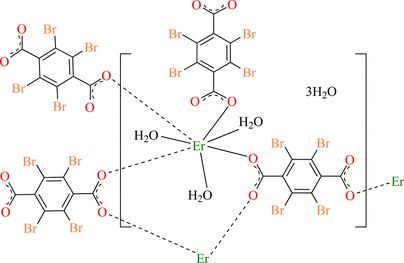
The title polymeric compound, poly[[triaqua(μ3-2,3,5,6-tetrabromobenzene-1,4-dicarboxylato)hemi(μ2-2,3,5,6-tetrabromobenzene-1,4-dicarboxylato)erbium(III)] trihydrate], {[Er(C8Br4O4)1.5(H2O)3]·3H2O}n or {[Er(Br4bdc)1.5(H2O)3]·3H2O}n (1), was hydrothermally synthesized and structurally characterized. The asymmetric unit contains one ErIII cation, one and a half Br4bdc2– dianions, three coordinated H2O molecules, and three uncoordinated solvent H2O molecules. The central ErIII cation is seven-coordinated within a distorted capped trigonal-prismatic geometry. The coordination sphere is defined by four carboxylate oxygen atoms from four Br4bdc2– ligands and three aqua oxygen atoms. The Br4bdc2– ligand occupies a general position, and acts as a μ3-bridge linking three symmetry-related ErIII cations. It coordinates via μ3-κO:κO′:κO′′ mode, using its carboxylate oxygen atoms to extend into a two-dimensional polymeric sheet parallel to the bc plane. Meanwhile, the remaining Br4bdc2− ligand is situated on a crystallographic inversion centre and adopts a μ2-κO:κO′ coordination mode linking the sheets into a three-dimensional network. The cohesion of the three-dimensional supramolecular framework is enhanced by classical O–H⋯O hydrogen bonds. The crystal packing is further consolidated by intermolecular Br⋯Br and Br⋯O halogen bonding interactions. The analysis of the Hirshfeld surface reveals that the primary contributions arise from Br⋯Br (23.5%) and O⋯H/H⋯O (20.8%) contacts. Additional contributions include Br⋯H/H⋯Br (13.2%), H⋯C/C⋯H (12.5%), Br⋯C/C⋯Br (8.4%), Br⋯O/O⋯Br (7.0%), and O⋯O (5.3%) interactions.>
Keywords: crystal structure; coordination polymer; erbium(III); carboxylate.
CCDC reference: 2595517
1. Chemical context
Lanthanide coordination polymers (LnCPs) have been widely studied and their potential applications, including electronic, optical, and magnetic properties arising from the unique 4f electronic configurations of LnIII ions (Bünzli, 2010 ; Capelo et al., 2025; Shiels et al., 2026). Unlike transition-metal ions, LnIII ions exhibit high and variable coordination numbers together with a wide range of coordination geometries. They possess robust Ln—O bonds and a hard Lewis acid character, resulting in a strong affinity for hard donor atoms, particularly oxygen-containing ligands (Cui et al., 2012; Saraci et al., 2020; Costanzo et al., 2026). These characteristics make LnIII ions attractive building units and provide flexibility in the assembly of structural diversity (Bünzli, 2014; Boone et al., 2024). Besides, the selection of ligands plays a crucial role in constructing diverse topologies and properties. Aromatic polycarboxylic acids are widely employed as organic linkers in the design and construction of CPs. In particular, terephthalic acid (H2bdc) and its functionalized derivatives display versatile coordination modes spanning monodentate, chelating, bridging, and chelating–bridging fashions, yielding structurally diverse networks upon self-assembly (Li et al., 2014; Jiajaroen et al., 2022; Nisa et al., 2024). Among these derivatives, 2,3,5,6-tetrabromobenzene-1,4-dicarboxylic acid (H2Br4bdc) is structurally significant; the four bulky, electronegative bromine substituents drastically alter the steric and electronic environment of the central aromatic core, significantly influencing both the primary coordination spheres and the secondary supramolecular interactions. The presence of bromine substituents may influence the opportunities for intermolecular halogen-related interactions, particularly Br⋯Br and other halogen-containing contacts. These may play a crucial role in crystal packing and structural stabilization. Herein, we report the synthesis and crystal structure of a new erbium(III) CP, namely, poly[[triaqua(μ3-2,3,5,6-tetrabromobenzene-4-dicarboxylato)hemi(μ2-2,3,5,6-tetrabromobenzene-1,4-dicarboxylato)erbium(III)] trihydrate] (1). The assembly of the polymeric framework and the supramolecular interactions of 1 are thoroughly elucidated and examined. Furthermore, Hirshfeld surface analysis provides a quantitative evaluation of intermolecular contacts and crystal packing interactions of 1.
2. Structural commentary
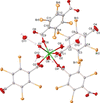
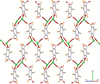
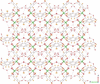
The asymmetric unit of 1 contains one ErIII atom, one and a half Br4bdc2– ligands, three coordinated water molecules, and three uncoordinated water molecules. The ErIII ion adopts an [ErO7] coordination environment with four oxygen atoms from four different Br4bdc2– ligands and three oxygen atoms from coordinated water molecules (Fig. 1), displaying a distorted capped trigonal-prismatic geometry (CTPR-7; value 4.082) (SHAPE 2.1; Llunell et al., 2013). The Er—O bond lengths fall in the range of 2.238 (2) to 2.347 (3) Å, mean 2.304 (2) Å. The O—Er—O bond angles range from 73.11 (8) to 155.44 (11)°. The fully deprotonated Br4bdc2– ligand exhibits a μ3-κO:κO′:κO′′ bridging mode, linking three symmetry-related ErIII ions to propagate a two-dimensional sheet parallel to the bc plane (Fig. 2). Within this layer, the shortest Er⋯Er separation is 4.6625 (19) Å. The sheets are further interconnected into a three-dimensional framework along the c-axis direction by the remaining Br4bdc2– ligand, which resides on a crystallographic inversion centre and acts as a μ2-κO:κO′ bridge (Fig. 3).
|
Figure 1
Molecular structure of 1, showing the asymmetric unit with the atom-labeling scheme and the coordination environment of the ErIII ion. Displacement ellipsoids are drawn at the 40% probability level. Symmetry codes: (i) 1 − x, 1 − y, 2 − z and x, ½ − y, ½ + z. |
|
Figure 2
View of the two-dimensional sheet structure of 1 in the bc plane. |
|
Figure 3
View of the three-dimensional framework of 1 along the c axis. |
3. Supramolecular features
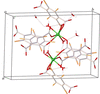
In the crystal structure, the coordinated water molecules (O7W, O8W and O9W) act as hydrogen-bond donors, forming robust intermolecular O—H⋯O hydrogen-bonding interactions with the water molecules of crystallization (O10W, O11W and O12W) serving as the hydrogen-bond acceptors (Table 1). Moreover, the carboxylate oxygen atoms of the Br4bdc2– ligands serve as hydrogen-bond acceptors for the solvent water molecules, contributing to the cohesion of the supramolecular network (Fig. 4). The crystal packing is further consolidated by intermolecular Br⋯Br and Br⋯O halogen bonding interactions (Table 2) occurring between adjacent Br4bdc2– ligands. No significant π–π stacking interactions are observed between neighboring benzene rings, as the centroid-to-centroid separations fall well outside the typical 3.3–3.8 Å range characteristic of such supramolecular contacts (Janiak, 2000).
|
 ; (ii)
 ; (iii)
 ; (iv)
 ; (v)
 .
|
 +
 −
|
Figure 4
View of the O—H⋯O hydrogen bonds involving the carboxylate groups of the Br4bdc2– ligands and water molecules of 1. Hydrogen-bonding interactions are shown as dashed lines. |
4. Hirshfeld surface analysis
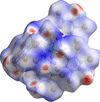
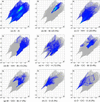
A Hirshfeld surface analysis was carried out using CrystalExplorer (Spackman et al., 2021) to examine the intermolecular interactions in 1. The 3D Hirshfeld surface mapped over dnorm highlights close intermolecular contacts as red spots, whereas white and blue regions correspond to contacts close to and longer than the sum of the van der Waals radii, respectively (Fig. 5). The analysis of the two-dimensional fingerprint plots (Fig. 6) reveals that the largest contribution arises from Br⋯Br contacts (23.5%), indicating that close halogen⋯halogen contacts constitute a significant feature of the crystal packing. The O⋯H/H⋯O contacts (20.8%) correspond to the extensive network of O–H⋯O hydrogen bonds involving carboxylate oxygen atoms, coordinated aqua ligands, and solvent water molecules. Secondary contributions to the Hirshfeld surface area include Br⋯H/H⋯Br (13.2%) and H⋯C/C⋯H (12.5%) contacts, which further consolidate the supramolecular architecture. Minor packing contributions are attributed to Br⋯C/C⋯Br (8.4%), Br⋯O/O⋯Br (7.0%), O⋯O (5.3%) and O⋯C/C⋯O (4.2%) contacts. Notably, C⋯C contacts account for only 0.7% of the Hirshfeld surface area, corroborating the absence of significant π–π stacking interactions within the crystal structure. Therefore, it can be concluded that halogen and hydrogen bonds are the major intermolecular contacts that contribute to the consolidation of the crystal packing of 1.
|
Figure 5
View of the Hirshfeld surface for 1 plotted over dnorm. |
|
Figure 6
The two-dimensional fingerprint plots for 1, showing (a) all interactions, and those delineated into (b) Br⋯Br, (c) O⋯H/H⋯O, (d) Br⋯H/H⋯Br, (e) H⋯C/C⋯H, (f) Br⋯C/C⋯Br, (g) Br⋯O/O⋯Br, (h) O⋯O, and (i) O⋯C/C⋯O interactions. The de and di values represent the closest external and internal distances (Å), respectively, from a given point on the Hirshfeld surface. |
5. Database survey
A search of the Cambridge Structural Database (CSD version 6.01, September 2026 update; Groom et al., 2016) for the structures of lanthanide complexes incorporating Br4bdc2– ligands yielded 47 hits. Among these, thirteen structures, including SITROE and SITROE01 (Wei et al., 2014; Smith et al., 2019), BIQMAS, BIQMEW, BIQMIA, BIQMUM, BIQNAT, BIQNEX, BIQNIB, and BIQNOH (Smith et al., 2019), FECFOM, FECFUS, and FECGAZ (Jiajaroen et al., 2022), display concurrent μ2-κO:κO′ and μ3-κO:κO′:κO′′ coordination modes of the Br4bdc2– ligands to bind the LnIII centres. Furthermore, the complexes BIQNUN, BIQPAV, BIQPEZ, BIQPID, and BIQPOJ (Smith et al., 2019) exclusively exhibit the μ3-κO:κO′:κO′′ bridging mode, whereas NICZOQ (Lv et al., 2013a), WIPXUQ, and WIPYAX (Lv et al., 2013b) display only the μ2-κO:κO′ coordination mode to bind the LnIII cations.
6. Synthesis and crystallization
All starting materials and reagents were of analytical grade and were used as received without further purification. A mixture of Er(NO3)3·5H2O (44.3 mg, 0.1 mmol) and H2Br4bdc (48.2 mg, 0.1 mmol) was dissolved in a solvent mixture of methanol (1 mL) and distilled water (3 mL) in a 15 mL Teflon-lined reactor. The mixture solution was stirred at room temperature for 10 min, sealed in stainless steel autoclave, and heated under autogenous pressure in a temperature-controlled oven at 373 K for 48 h. After the autoclave had cooled slowly to ambient temperature, the reaction mixture was filtered, and the filtrate was transferred to a glass vial. Slow evaporation of the mother liquor at room temperature over approximately one week yielded pink block-shaped crystals. Yield: 12.4 mg, 28% based on the Er(NO3)3·5H2O.
7. Refinement
Crystal data, data collection and structure refinement details are summarized in Table 3. The hydrogen atoms were located from difference electron-density maps. H atoms bonded to O atoms were refined with distance restraints O—H = 0.84 ± 0.02 Å and with Uiso(H) = 1.5Ueq(O) for H9A/B and H10A/B and independently refined for eight other atoms.
|
Supporting information
CCDC reference: 2595517
Crystal structure: contains datablock I. DOI: https://doi.org/10.1107/S2056989026010698/vm2337sup1.cif
Structure factors: contains datablock I. DOI: https://doi.org/10.1107/S2056989026010698/vm2337Isup2.hkl
| [Er(C8Br4O4)1.5(H2O)3]·3H2O | F(000) = 1832 |
| Mr = 994.94 | Dx = 2.766 Mg m−3 |
| Monoclinic, P21/c | Mo Kα radiation, λ = 0.71073 Å |
| a = 12.711 (5) Å | Cell parameters from 8607 reflections |
| b = 15.839 (6) Å | θ = 3.1–28.1° |
| c = 12.906 (5) Å | µ = 13.60 mm−1 |
| β = 113.171 (15)° | T = 296 K |
| V = 2388.9 (17) Å3 | Block, pink |
| Z = 4 | 0.14 × 0.12 × 0.1 mm |
| Bruker D8 QUEST CMOS PHOTON II diffractometer | 5854 independent reflections |
| Radiation source: sealed x-ray tube | 5331 reflections with I > 2σ(I) |
| Graphite monochromator | Rint = 0.055 |
| Detector resolution: 7.39 pixels mm-1 | θmax = 28.2°, θmin = 3.1° |
| φ and ω scans | h = −16→16 |
| Absorption correction: multi-scan (SADABS; Krause et al., 2015) | k = −21→21 |
| Tmin = 0.571, Tmax = 0.746 | l = −17→17 |
| 98614 measured reflections |
| Refinement on F2 | 17 restraints |
| Least-squares matrix: full | Hydrogen site location: difference Fourier map |
| R[F2 > 2σ(F2)] = 0.019 | Only H-atom coordinates refined |
| wR(F2) = 0.046 | w = 1/[σ2(Fo2) + (0.0183P)2 + 2.0786P] where P = (Fo2 + 2Fc2)/3 |
| S = 1.17 | (Δ/σ)max = 0.002 |
| 5854 reflections | Δρmax = 0.50 e Å−3 |
| 324 parameters | Δρmin = −1.21 e Å−3 |
Geometry. All esds (except the esd in the dihedral angle between two l.s. planes) are estimated using the full covariance matrix. The cell esds are taken into account individually in the estimation of esds in distances, angles and torsion angles; correlations between esds in cell parameters are only used when they are defined by crystal symmetry. An approximate (isotropic) treatment of cell esds is used for estimating esds involving l.s. planes. |
| x | y | z | Uiso*/Ueq | ||
| Er1 | 0.30558 (2) | 0.53186 (2) | 0.91422 (2) | 0.01547 (4) | |
| Br1 | 0.53394 (2) | 0.20275 (2) | 1.02462 (2) | 0.02423 (7) | |
| Br2 | 0.40531 (3) | 0.04112 (2) | 0.85749 (3) | 0.02935 (7) | |
| Br3 | 0.22167 (3) | 0.26274 (2) | 0.48667 (2) | 0.02803 (7) | |
| Br4 | 0.34474 (3) | 0.42516 (2) | 0.65020 (3) | 0.03093 (7) | |
| Br5 | 0.21775 (3) | 0.60657 (2) | 0.48962 (3) | 0.03010 (7) | |
| Br6 | 0.08858 (3) | 0.45787 (2) | 0.29799 (3) | 0.03033 (7) | |
| O1 | 0.4355 (2) | 0.43322 (13) | 0.91634 (18) | 0.0320 (5) | |
| O2 | 0.60068 (18) | 0.37370 (14) | 0.94057 (17) | 0.0273 (5) | |
| O3 | 0.16920 (18) | 0.07189 (14) | 0.5898 (2) | 0.0306 (5) | |
| O4 | 0.33523 (17) | 0.05543 (13) | 0.56882 (17) | 0.0234 (4) | |
| O5 | 0.18810 (17) | 0.60262 (14) | 0.76286 (17) | 0.0274 (5) | |
| O6 | 0.09196 (19) | 0.70465 (13) | 0.64610 (18) | 0.0297 (5) | |
| O7 | 0.42133 (19) | 0.60002 (14) | 0.83626 (18) | 0.0256 (4) | |
| H7A | 0.406 (4) | 0.6462 (18) | 0.799 (3) | 0.052 (13)* | |
| H7B | 0.4929 (17) | 0.594 (3) | 0.869 (3) | 0.045 (12)* | |
| O8 | 0.1619 (2) | 0.56996 (15) | 0.9707 (2) | 0.0317 (5) | |
| H8A | 0.116 (3) | 0.6106 (17) | 0.961 (3) | 0.031 (10)* | |
| H8B | 0.146 (4) | 0.536 (2) | 1.010 (3) | 0.056 (14)* | |
| O9 | 0.1742 (3) | 0.42709 (17) | 0.8218 (3) | 0.0565 (9) | |
| H9A | 0.177 (3) | 0.3743 (12) | 0.821 (4) | 0.085* | |
| H9B | 0.1023 (18) | 0.429 (2) | 0.783 (4) | 0.085* | |
| O10 | 0.0444 (3) | 0.2919 (2) | 0.7472 (3) | 0.0723 (11) | |
| H10A | 0.021 (5) | 0.274 (4) | 0.680 (2) | 0.108* | |
| H10B | 0.000 (4) | 0.271 (4) | 0.774 (4) | 0.108* | |
| O11 | 0.3362 (2) | 0.7592 (2) | 0.7251 (2) | 0.0456 (7) | |
| H11A | 0.2668 (19) | 0.753 (3) | 0.713 (4) | 0.057 (14)* | |
| H11B | 0.348 (5) | 0.791 (3) | 0.679 (4) | 0.10 (2)* | |
| O12 | 0.0093 (2) | 0.69470 (16) | 0.9489 (2) | 0.0341 (5) | |
| H12A | −0.045 (3) | 0.664 (2) | 0.948 (4) | 0.045 (12)* | |
| H12B | 0.032 (4) | 0.726 (3) | 1.006 (3) | 0.076 (17)* | |
| C1 | 0.4937 (2) | 0.37515 (17) | 0.8996 (2) | 0.0194 (5) | |
| C2 | 0.4312 (2) | 0.30194 (16) | 0.8252 (2) | 0.0159 (5) | |
| C3 | 0.4444 (2) | 0.21992 (16) | 0.8697 (2) | 0.0159 (5) | |
| C4 | 0.3897 (2) | 0.15226 (16) | 0.8005 (2) | 0.0174 (5) | |
| C5 | 0.3237 (2) | 0.16509 (16) | 0.6859 (2) | 0.0167 (5) | |
| C6 | 0.3104 (2) | 0.24731 (17) | 0.6421 (2) | 0.0183 (5) | |
| C7 | 0.3628 (2) | 0.31511 (16) | 0.7112 (2) | 0.0174 (5) | |
| C8 | 0.2701 (2) | 0.09094 (17) | 0.6086 (2) | 0.0179 (5) | |
| C9 | 0.1154 (2) | 0.62976 (18) | 0.6702 (2) | 0.0196 (5) | |
| C10 | 0.0550 (2) | 0.56271 (18) | 0.5812 (2) | 0.0194 (5) | |
| C11 | 0.0911 (2) | 0.54480 (18) | 0.4947 (2) | 0.0212 (6) | |
| C12 | 0.0374 (2) | 0.48307 (18) | 0.4142 (2) | 0.0206 (5) |
| U11 | U22 | U33 | U12 | U13 | U23 | |
| Er1 | 0.01698 (6) | 0.01306 (6) | 0.01333 (6) | −0.00005 (4) | 0.00272 (4) | 0.00077 (4) |
| Br1 | 0.02666 (15) | 0.02368 (14) | 0.01605 (13) | 0.00183 (11) | 0.00162 (11) | 0.00077 (10) |
| Br2 | 0.03810 (17) | 0.01532 (13) | 0.02970 (16) | 0.00103 (12) | 0.00805 (13) | 0.00287 (11) |
| Br3 | 0.02991 (16) | 0.03137 (16) | 0.01536 (13) | −0.00545 (12) | 0.00091 (11) | 0.00117 (11) |
| Br4 | 0.04617 (19) | 0.01730 (14) | 0.02426 (15) | −0.00146 (13) | 0.00843 (13) | 0.00352 (11) |
| Br5 | 0.02511 (15) | 0.03419 (17) | 0.03360 (16) | −0.01130 (12) | 0.01434 (13) | −0.00158 (13) |
| Br6 | 0.02646 (15) | 0.04207 (18) | 0.02597 (15) | −0.00518 (13) | 0.01410 (12) | −0.00478 (13) |
| O1 | 0.0503 (15) | 0.0217 (11) | 0.0255 (11) | 0.0102 (10) | 0.0164 (10) | −0.0037 (9) |
| O2 | 0.0253 (11) | 0.0292 (11) | 0.0241 (10) | −0.0101 (9) | 0.0062 (9) | −0.0075 (9) |
| O3 | 0.0215 (11) | 0.0304 (12) | 0.0410 (13) | −0.0077 (9) | 0.0134 (10) | −0.0145 (10) |
| O4 | 0.0229 (10) | 0.0239 (10) | 0.0236 (10) | −0.0031 (8) | 0.0093 (8) | −0.0105 (8) |
| O5 | 0.0223 (11) | 0.0307 (11) | 0.0192 (10) | −0.0027 (9) | −0.0025 (8) | 0.0075 (8) |
| O6 | 0.0333 (12) | 0.0235 (11) | 0.0253 (11) | 0.0019 (9) | 0.0039 (9) | 0.0034 (9) |
| O7 | 0.0238 (11) | 0.0264 (11) | 0.0267 (11) | 0.0011 (9) | 0.0101 (9) | 0.0051 (9) |
| O8 | 0.0308 (12) | 0.0286 (12) | 0.0410 (13) | 0.0127 (10) | 0.0198 (11) | 0.0143 (10) |
| O9 | 0.0589 (19) | 0.0343 (15) | 0.0499 (17) | −0.0264 (14) | −0.0068 (14) | 0.0031 (13) |
| O10 | 0.094 (3) | 0.075 (2) | 0.0420 (17) | −0.057 (2) | 0.0201 (17) | −0.0184 (16) |
| O11 | 0.0333 (15) | 0.0563 (18) | 0.0401 (15) | −0.0100 (13) | 0.0067 (12) | 0.0124 (13) |
| O12 | 0.0307 (13) | 0.0340 (13) | 0.0385 (14) | 0.0013 (10) | 0.0145 (11) | −0.0060 (11) |
| C1 | 0.0285 (15) | 0.0143 (12) | 0.0145 (12) | −0.0036 (11) | 0.0075 (11) | −0.0018 (10) |
| C2 | 0.0153 (12) | 0.0151 (12) | 0.0170 (12) | 0.0006 (9) | 0.0058 (10) | −0.0041 (10) |
| C3 | 0.0151 (12) | 0.0173 (12) | 0.0141 (12) | 0.0040 (10) | 0.0044 (10) | −0.0013 (9) |
| C4 | 0.0189 (13) | 0.0125 (12) | 0.0206 (13) | 0.0012 (10) | 0.0076 (10) | −0.0001 (10) |
| C5 | 0.0174 (12) | 0.0158 (12) | 0.0168 (12) | −0.0017 (10) | 0.0067 (10) | −0.0054 (10) |
| C6 | 0.0192 (13) | 0.0202 (13) | 0.0135 (12) | 0.0000 (10) | 0.0044 (10) | −0.0007 (10) |
| C7 | 0.0209 (13) | 0.0142 (12) | 0.0175 (12) | 0.0010 (10) | 0.0079 (10) | 0.0003 (9) |
| C8 | 0.0193 (13) | 0.0170 (12) | 0.0157 (12) | −0.0014 (10) | 0.0051 (10) | −0.0035 (10) |
| C9 | 0.0145 (12) | 0.0249 (14) | 0.0181 (13) | −0.0010 (10) | 0.0049 (10) | 0.0052 (11) |
| C10 | 0.0150 (12) | 0.0217 (13) | 0.0169 (13) | 0.0010 (10) | 0.0012 (10) | 0.0045 (10) |
| C11 | 0.0153 (13) | 0.0249 (14) | 0.0219 (14) | −0.0029 (11) | 0.0055 (11) | 0.0042 (11) |
| C12 | 0.0192 (13) | 0.0258 (14) | 0.0158 (12) | −0.0005 (11) | 0.0056 (10) | 0.0046 (10) |
| Er1—O1 | 2.266 (2) | O8—H8B | 0.820 (19) |
| Er1—O2i | 2.326 (2) | O9—H9A | 0.837 (18) |
| Er1—O4ii | 2.333 (2) | O9—H9B | 0.852 (18) |
| Er1—O5 | 2.238 (2) | O10—H10A | 0.845 (14) |
| Er1—O7 | 2.347 (2) | O10—H10B | 0.842 (14) |
| Er1—O8 | 2.297 (2) | O11—H11A | 0.838 (19) |
| Er1—O9 | 2.323 (3) | O11—H11B | 0.84 (2) |
| Br1—C3 | 1.891 (3) | O12—H12A | 0.848 (19) |
| Br2—C4 | 1.888 (3) | O12—H12B | 0.835 (19) |
| Br3—C6 | 1.891 (3) | C1—C2 | 1.516 (4) |
| Br4—C7 | 1.889 (3) | C2—C3 | 1.404 (4) |
| Br5—C11 | 1.906 (3) | C2—C7 | 1.399 (4) |
| Br6—C12 | 1.898 (3) | C3—C4 | 1.394 (4) |
| O1—C1 | 1.251 (3) | C4—C5 | 1.398 (4) |
| O2—C1 | 1.250 (4) | C5—C6 | 1.403 (4) |
| O3—C8 | 1.245 (3) | C5—C8 | 1.518 (4) |
| O4—C8 | 1.265 (3) | C6—C7 | 1.387 (4) |
| O5—C9 | 1.265 (3) | C9—C10 | 1.531 (4) |
| O6—C9 | 1.233 (3) | C10—C11 | 1.394 (4) |
| O7—H7A | 0.853 (19) | C10—C12iii | 1.401 (4) |
| O7—H7B | 0.843 (19) | C11—C12 | 1.394 (4) |
| O8—H8A | 0.841 (18) | ||
| O1—Er1—O2i | 107.08 (8) | O1—C1—C2 | 118.3 (3) |
| O1—Er1—O4ii | 73.11 (8) | O2—C1—O1 | 124.0 (3) |
| O1—Er1—O7 | 75.24 (9) | O2—C1—C2 | 117.7 (2) |
| O1—Er1—O8 | 147.57 (8) | C3—C2—C1 | 120.0 (2) |
| O1—Er1—O9 | 83.53 (11) | C7—C2—C1 | 120.4 (2) |
| O2i—Er1—O4ii | 80.38 (8) | C7—C2—C3 | 119.6 (2) |
| O2i—Er1—O7 | 80.84 (8) | C2—C3—Br1 | 119.45 (19) |
| O4ii—Er1—O7 | 136.20 (8) | C4—C3—Br1 | 120.6 (2) |
| O5—Er1—O1 | 126.07 (8) | C4—C3—C2 | 120.0 (2) |
| O5—Er1—O2i | 109.61 (8) | C3—C4—Br2 | 121.2 (2) |
| O5—Er1—O4ii | 150.60 (8) | C3—C4—C5 | 120.5 (2) |
| O5—Er1—O7 | 73.20 (8) | C5—C4—Br2 | 118.37 (19) |
| O5—Er1—O8 | 78.73 (9) | C4—C5—C6 | 119.2 (2) |
| O5—Er1—O9 | 79.14 (9) | C4—C5—C8 | 120.7 (2) |
| O8—Er1—O2i | 78.15 (9) | C6—C5—C8 | 120.1 (2) |
| O8—Er1—O4ii | 76.44 (8) | C5—C6—Br3 | 118.34 (19) |
| O8—Er1—O7 | 136.54 (8) | C7—C6—Br3 | 121.1 (2) |
| O8—Er1—O9 | 81.35 (12) | C7—C6—C5 | 120.5 (2) |
| O9—Er1—O2i | 155.44 (11) | C2—C7—Br4 | 119.9 (2) |
| O9—Er1—O4ii | 81.79 (9) | C6—C7—Br4 | 119.9 (2) |
| O9—Er1—O7 | 123.64 (11) | C6—C7—C2 | 120.2 (2) |
| C1—O1—Er1 | 169.2 (2) | O3—C8—O4 | 127.0 (2) |
| C1—O2—Er1i | 117.13 (18) | O3—C8—C5 | 118.5 (2) |
| C8—O4—Er1iv | 134.39 (18) | O4—C8—C5 | 114.5 (2) |
| C9—O5—Er1 | 169.8 (2) | O5—C9—C10 | 116.0 (2) |
| Er1—O7—H7A | 127 (3) | O6—C9—O5 | 125.4 (3) |
| Er1—O7—H7B | 118 (3) | O6—C9—C10 | 118.6 (2) |
| H7A—O7—H7B | 109 (4) | C11—C10—C9 | 121.0 (2) |
| Er1—O8—H8A | 137 (2) | C11—C10—C12iii | 118.3 (3) |
| Er1—O8—H8B | 116 (3) | C12iii—C10—C9 | 120.6 (2) |
| H8A—O8—H8B | 107 (4) | C10—C11—Br5 | 118.2 (2) |
| Er1—O9—H9A | 134 (2) | C12—C11—Br5 | 120.5 (2) |
| Er1—O9—H9B | 132 (2) | C12—C11—C10 | 121.3 (3) |
| H9A—O9—H9B | 94 (3) | C10iii—C12—Br6 | 118.6 (2) |
| H10A—O10—H10B | 106 (4) | C11—C12—Br6 | 121.1 (2) |
| H11A—O11—H11B | 114 (5) | C11—C12—C10iii | 120.3 (3) |
| H12A—O12—H12B | 111 (4) | ||
| Er1—O1—C1—O2 | 150.8 (10) | C1—C2—C7—Br4 | −1.6 (4) |
| Er1—O1—C1—C2 | −29.2 (13) | C1—C2—C7—C6 | 176.8 (2) |
| Er1i—O2—C1—O1 | 13.9 (4) | C2—C3—C4—Br2 | −179.92 (19) |
| Er1i—O2—C1—C2 | −166.12 (17) | C2—C3—C4—C5 | 1.6 (4) |
| Er1iv—O4—C8—O3 | 19.4 (5) | C3—C2—C7—Br4 | −179.82 (19) |
| Er1iv—O4—C8—C5 | −159.79 (18) | C3—C2—C7—C6 | −1.4 (4) |
| Er1—O5—C9—O6 | 174.9 (9) | C3—C4—C5—C6 | −1.9 (4) |
| Er1—O5—C9—C10 | −6.6 (13) | C3—C4—C5—C8 | 176.1 (2) |
| Br1—C3—C4—Br2 | −1.4 (3) | C4—C5—C6—Br3 | 179.5 (2) |
| Br1—C3—C4—C5 | −179.9 (2) | C4—C5—C6—C7 | 0.6 (4) |
| Br2—C4—C5—C6 | 179.6 (2) | C4—C5—C8—O3 | 95.4 (3) |
| Br2—C4—C5—C8 | −2.5 (3) | C4—C5—C8—O4 | −85.4 (3) |
| Br3—C6—C7—Br4 | 0.6 (3) | C5—C6—C7—Br4 | 179.5 (2) |
| Br3—C6—C7—C2 | −177.8 (2) | C5—C6—C7—C2 | 1.1 (4) |
| Br5—C11—C12—Br6 | 0.4 (3) | C6—C5—C8—O3 | −86.7 (3) |
| Br5—C11—C12—C10iii | 179.4 (2) | C6—C5—C8—O4 | 92.6 (3) |
| O1—C1—C2—C3 | −117.9 (3) | C7—C2—C3—Br1 | −178.5 (2) |
| O1—C1—C2—C7 | 64.0 (4) | C7—C2—C3—C4 | 0.1 (4) |
| O2—C1—C2—C3 | 62.2 (3) | C8—C5—C6—Br3 | 1.5 (3) |
| O2—C1—C2—C7 | −116.0 (3) | C8—C5—C6—C7 | −177.4 (2) |
| O5—C9—C10—C11 | −98.5 (3) | C9—C10—C11—Br5 | −0.3 (4) |
| O5—C9—C10—C12iii | 80.6 (3) | C9—C10—C11—C12 | 179.1 (3) |
| O6—C9—C10—C11 | 80.1 (4) | C10—C11—C12—Br6 | −179.1 (2) |
| O6—C9—C10—C12iii | −100.8 (3) | C10—C11—C12—C10iii | 0.0 (5) |
| C1—C2—C3—Br1 | 3.3 (3) | C12iii—C10—C11—Br5 | −179.5 (2) |
| C1—C2—C3—C4 | −178.1 (2) | C12iii—C10—C11—C12 | 0.0 (5) |
| Symmetry codes: (i) −x+1, −y+1, −z+2; (ii) x, −y+1/2, z+1/2; (iii) −x, −y+1, −z+1; (iv) x, −y+1/2, z−1/2. |
| D—H···A | D—H | H···A | D···A | D—H···A |
| O7—H7A···O11 | 0.86 (3) | 2.06 (3) | 2.892 (4) | 165 (5) |
| O7—H7B···O4v | 0.84 (3) | 2.10 (3) | 2.931 (4) | 168 (4) |
| O8—H8A···O12 | 0.84 (3) | 1.86 (3) | 2.705 (4) | 174 (3) |
| O8—H8B···O3ii | 0.82 (4) | 1.96 (3) | 2.703 (3) | 152 (5) |
| O9—H9A···O10 | 0.84 (2) | 2.05 (4) | 2.643 (5) | 128 (4) |
| O10—H10A···O12vi | 0.85 (3) | 2.00 (5) | 2.808 (4) | 160 (5) |
| O10—H10B···O6vi | 0.84 (5) | 2.12 (6) | 2.948 (5) | 171 (6) |
| O11—H11A···O6 | 0.84 (3) | 2.18 (4) | 2.989 (4) | 161 (5) |
| O11—H11B···O2v | 0.84 (5) | 2.31 (5) | 3.139 (4) | 174 (6) |
| O12—H12A···O3vii | 0.84 (4) | 2.06 (4) | 2.879 (4) | 164 (4) |
| O12—H12B···O6viii | 0.84 (4) | 1.99 (4) | 2.832 (3) | 177 (4) |
| Symmetry codes: (ii) x, −y+1/2, z+1/2; (v) −x+1, y+1/2, −z+3/2; (vi) −x, y−1/2, −z+3/2; (vii) −x, y+1/2, −z+3/2; (viii) x, −y+3/2, z+1/2. |
| C—Br···X | Br···X | C—Br···X | Type |
| C4—Br2···Br2i | 3.7469 (14) | 129.40 (7) | I |
| C6—Br3···Br6 | 3.8861 (11) | 134.30 (8) | II |
| C7—Br4···Br2ii | 3.7048 (13) | 120.25 (8) | I |
| C7—Br4···Br5 | 3.5390 (15) | 161.06 (8) | I |
| C11—Br5···Br1ii | 3.5739 (15) | 174.31 (9) | II |
| C3—Br1···O11iii | 3.054 (3) | 160.04 (10) | I |
| C12—Br6···O3iv | 3.265 (3) | 175.75 (9) | I |
| Symmetry codes: (i) 1 - x, -y, 2 - z; (ii) 1 - x, 1/2 + y, 3/2 - z; (iii) 1 - x, 1 - y, 2 - z; (iv) x, 1/2 - y, -1/2 + z. |
Acknowledgements
This project was partially supported by the Thammasat University Research Unit in Multifunctional Crystalline Materials and Applications (TU-MCMA).
References
 Boone, M., Artizzu, F., Goura, J., Mara, D., Van Deun, R. & D'hooghe, M. (2024). Coord. Chem. Rev. 501, 215525.
CrossRef
Google Scholar
Bruker (2023). APEX6 and SAINT. Bruker AXS Inc., Madison, Wisconsin, USA.
Google Scholar
Bünzli, J.-C. G. (2010). Chem. Rev. 110, 2729–2755.
Google Scholar
Bünzli, J.-C. G. (2014). J. Coord. Chem. 67, 3706–3733.
Google Scholar
Capelo, R. G., Garcia, F. D. R., Strutynski, C., Désévédavy, F., Gadret, G., da Silva, C. M., Arroyos, G., Frem, R. C. G., Orellana, G., Smektala, F. & Manzani, D. (2025). ACS Appl. Mater. Interfaces 17, 70667–70679.
CrossRef
CAS
Google Scholar
Costanzo, M., Bianco, S., Fik-Jaskółka, M. & Roviello, G. N. (2026). Int. J. Mol. Sci. 27, 1566.
CrossRef
Google Scholar
Cui, Y., Yue, Y., Qian, G. & Chen, B. (2012). Chem. Rev. 112, 1126–1162.
Web of Science
CrossRef
CAS
PubMed
Google Scholar
Dolomanov, O. V., Bourhis, L. J., Gildea, R. J., Howard, J. A. K. & Puschmann, H. (2009). J. Appl. Cryst. 42, 339–341.
Web of Science
CrossRef
CAS
IUCr Journals
Google Scholar
Groom, C. R., Bruno, I. J., Lightfoot, M. P. & Ward, S. C. (2016). Acta Cryst. B72, 171–179.
Web of Science
CrossRef
IUCr Journals
Google Scholar
Janiak, C. (2000). J. Chem. Soc. Dalton Trans. pp. 3885–3896.
Web of Science
CrossRef
Google Scholar
Jiajaroen, S., Dungkaew, W., Kielar, F., Sukwattanasinitt, M., Sahasithiwat, S., Zenno, H., Hayami, S., Azam, M., Al-Resayes, S. I. & Chainok, K. (2022). Dalton Trans. 51, 7420–7435.
Web of Science
CSD
CrossRef
CAS
PubMed
Google Scholar
Krause, L., Herbst-Irmer, R., Sheldrick, G. M. & Stalke, D. (2015). J. Appl. Cryst. 48, 3–10.
Web of Science
CSD
CrossRef
ICSD
CAS
IUCr Journals
Google Scholar
Li, M., Li, D., O'Keeffe, M. & Yaghi, O. M. (2014). Chem. Rev. 114, 1343–1370.
Web of Science
CrossRef
CAS
PubMed
Google Scholar
Llunell, M., Casanova, D., Cirera, J., AlemPny, A. & Alvarez, S. (2013). SHAPE. University of Barcelona, Barcelona, Spain.
Google Scholar
Lv, X.-Y., Ye, Q., Liu, Y., Liu, J.-F., Gao, L.-L. & Hu, T.-P. (2013a). Jiegou Huaxue 32, 439–445.
Google Scholar
Lv, X.-Y., Ye, Q., Qiao, J.-Z., Wu, J.-Y., Liu, J.-F., Xiao, L.-Q. & Hu, T.-P. (2013b). Jiegou Huaxue 32, 1185–1193.
Google Scholar
Nisa, Z. U., Ahmad, M. & Sheikh, H. N. (2024). New J. Chem. 48, 3100–3109.
CrossRef
CAS
Google Scholar
Saraci, F., Quezada-Novoa, V., Donnarumma, P. R. & Howarth, A. J. (2020). Chem. Soc. Rev. 49, 7949–7977.
Web of Science
CrossRef
CAS
PubMed
Google Scholar
Sheldrick, G. M. (2015a). Acta Cryst. A71, 3–8.
Web of Science
CrossRef
IUCr Journals
Google Scholar
Sheldrick, G. M. (2015b). Acta Cryst. C71, 3–8.
Web of Science
CrossRef
IUCr Journals
Google Scholar
Shiels, D., Gunarathna, N., Brennessel, W. W. & Matson, E. M. (2026). Inorg. Chem. 65, 12557–12573.
CrossRef
CAS
Google Scholar
Smith, J. A., Singh-Wilmot, M. A., Carter, K. P., Cahill, C. L. & Ridenour, J. A. (2019). Cryst. Growth Des. 19, 305–319.
CrossRef
CAS
Google Scholar
Spackman, P. R., Turner, M. J., McKinnon, J. J., Wolff, S. K., Grimwood, D. J., Jayatilaka, D. & Spackman, M. A. (2021). J. Appl. Cryst. 54, 1006–1011.
Web of Science
CrossRef
CAS
IUCr Journals
Google Scholar
Wei, L., Ye, Y. & Zhang, R. (2014). J. Mol. Struct. 1058, 51–55.
CrossRef
CAS
Google Scholar
This is an open-access article distributed under the terms of the Creative Commons Attribution (CC-BY) Licence, which permits unrestricted use, distribution, and reproduction in any medium, provided the original authors and source are cited.
| CRYSTALLOGRAPHIC COMMUNICATIONS |
access