
Acta Crystallographica
Section E CRYSTALLOGRAPHIC COMMUNICATIONS


 menu


research communications
| CRYSTALLOGRAPHIC COMMUNICATIONS |
 access
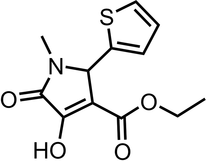
Crystal structure and Hirshfeld surface analysis of ethyl 4-hydroxy-1-methyl-5-oxo-2-(thiophen-2-yl)-2,5-dihydro-1H-pyrrole-3-carboxylate

aFaculty of Applied Sciences, Universiti Teknologi MARA Cawangan Pahang, Kampus Jengka, 26400, Bandar Pusat Jengka, Pahang, Malaysia, bAtta-ur-Rahman Institute for Natural Product Discovery (AuRIns), Universiti Teknologi MARA, Kampus Puncak Alam, 42300, Bandar Puncak Alam, Selangor, Malaysia, cFaculty of Applied Sciences, Universiti Teknologi MARA, 40450, Shah Alam, Selangor, Malaysia, and dOrganic Synthesis Research Laboratory, Institute of Science, Universiti Teknologi MARA, 42300, Bandar Puncak Alam, Selangor, Malaysia
*Correspondence e-mail: [email protected]
The molecular and crystal structure of the title compound, C12H13NO4S, has been determined via single-crystal X-ray diffraction. As the compound crystallizes in the centrosymmetric space group P21/c, the crystal is racemic and contains equal numbers of R and S enantiomers related by inversion symmetry. The thiophene substituent is positionally disordered over two orientations arising from rotation about the C4—C5 bond, with refined site occupancies of 0.929 (2) and 0.071 (2) for the major and minor components, respectively. The major thiophene ring is essentially planar and adopts a nearly orthogonal orientation with respect to the conjugated enaminone fragment. In the crystal packing, the title molecules are linked by intermolecular O—H⋯O hydrogen bonds to form one-dimensional chains, which are further supported by weak C—H⋯O interactions, giving rise to a three-dimensional supramolecular architecture. Hirshfeld surface analysis quantitatively revealed that the crystal packing is predominantly governed by H⋯H (41.5%) and H⋯O/O⋯H (31.0%) contacts, with smaller contributions from other intermolecular interactions.
Keywords: crystal structure; pyrrole; thiophenyl; multicomponent reactions; Hirshfeld surface analysis.
CCDC reference: 2583324
1. Chemical context
Pyrrole derivatives are extensively used as building blocks in pharmaceutical design due to their versatile functionalization and ability to interact with a diverse range of biological targets, as well as their antimicrobial, anticancer, anti-inflammatory and antidiabetic activities (Amina & Redouane, 2025 ; Yadavalli et al., 2024). The biological activities of thiophene-fused pyrroles are increased due to the presence of both heterocyclic systems (Rajender Kumar et al., 2004; Prashanth et al., 2025). Some derivatives are fluorescent and have been used as biomarkers for disease diagnosis (Moiseeva et al., 2024; Ferreira et al., 2020). Several key synthetic strategies for the synthesis of pyrroles and thiophene-fused pyrroles have been reported, including multicomponent reactions (MCR) (Inglebert et al., 2013), multi-step reductive aminations (Guguloth & Gubbiyappa, 2024) and modified Clauson–Kaas pyrrole ring closures on thiophene templates (Rochais et al., 2004), to advanced macrocyclic ortho-phenylene–pyrrole–thiophene icosamers (Matsuo et al., 2025).
However, there is limited empirical structural data on thiophene-substituted pyrrole derivatives although the synthesis of pyrroles is well documented. A definitive description of the molecular geometry and the supramolecular architecture of ethyl 4-hydroxy-1-methyl-5-oxo-2-(thiophen-2-yl)-2,5-dihydro-1H-pyrrole-3-carboxylate is absent in the structural chemistry literature. Thus, the objective of this study is to determine the three-dimensional crystal structure of the title compound using single-crystal X-ray diffraction and to analyze the percentage contributions of diverse intermolecular interactions to the crystal packing using Hirshfeld surface analysis.
2. Structural commentary
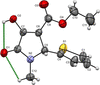
The molecular structure of the title compound, showing the atom-labelling scheme, is presented in Fig. 1. The asymmetric unit comprises one crystallographically independent molecule. The molecule possesses a single stereogenic centre at atom C5. As the structure crystallizes in the centosymmetric space group P21/c, the crystal is racemic and contains equal numbers of the R and S enantiomers related by crystallographic inversion symmetry.
|
Figure 1
The molecular structure of the title compound, showing 50% probability displacement ellipsoids. The minor component of the disordered thiophene ring has been omitted for clarity. The O—H⋯O and C—H⋯O intramolecular contacts are shown as green dashed lines. |
The thiophene substituent is positionally disordered over two orientations arising from rotation about the C4—C5 bond. The two disorder components were refined with site-occupancy factors of 0.929 (2) and 0.071 (2), respectively. For the major component, the thiophene ring (S1/C1–C4) is essentially planar, with a maximum deviation of 0.006 (1) Å for the C4 atom from the least-squares plane and it is oriented nearly perpendicular to the conjugated enaminone fragment (N2/C5–C8), with a dihedral angle of 89.94 (12)° between the planes, adopting a nearly orthogonal arrangement. The conjugated enaminone fragment is essentially planar, as indicated by the torsion angles C5—N2—C8—C7 = 1.5 (2)°, N2—C8—C7—C6 = 0.2 (2)° and C5—C6—C7—C8 = −1.7 (2)°. A weak intramolecular O2—H2⋯O1 contact is also present, generating an S(5) ring motif and contributing to the observed molecular conformation. In contrast, the tetrahedral stereogenic atom of C5 introduces a slight distortion into the molecular framework, as reflected by the torsion angles N2—C5—C4—S1 = 61.5 (2)° and C6—C5—C7—C8 = −55.9 (2)°. The carbonyl and ester bond lengths of C8—O1 = 1.229 (2) Å, C9—O3 = 1.201 (3) Å and C9—O4 = 1.323 (3) Å are within the expected range.
3. Supramolecular features
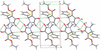
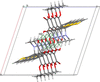
In the crystal packing, the molecules are linked through intermolecular O2—H2⋯O1 hydrogen bonds (Table 1), generating a one-dimensional hydrogen-bonded chain along the b axis. These chains are further stabilized by weak C5—H5⋯O2ii interactions, forming the three-dimensional supramolecular architecture, as shown in Figs. 2 and 3.
|
 ; (ii)
 .
|
Figure 2
The crystal packing of the title compound, viewed down the c axis, illustrating the intermolecular O—H⋯O and C—H⋯O hydrogen-bonding interactions, shown as green lines. |
|
Figure 3
The crystal packing of the title compound, viewed down the b axis, illustrating the intermolecular O—H⋯O and C—H⋯O hydrogen-bonding interactions, shown as green lines. |
4. Hirshfield surface analysis
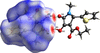
A Hirshfeld surface analysis was performed using CrystalExplorer21 to examine and quantify the intermolecular contacts governing the crystal packing (Spackman et al., 2021). Fig. 4 shows the Hirshfeld surface mapped with the normalized contact distance (dnorm) and reveals two intense red spots. On the dnorm surface, red, white and blue regions correspond to contacts shorter than, approximately equal to and longer than the sum of the van der Waals radii, respectively. Here, the two intense red spots result from the O2—H2⋯O1 hydrogen bonds (Table 1).
|
Figure 4
Hirshfeld surface of the title compound, mapped over dnorm. |
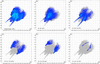
The percentage contributions of the intermolecular interactions to the total Hirshfeld surface were computed by two-dimensional fingerprint plots. As illustrated in Fig. 5, the di versus de plots show that H⋯H contacts make the largest contribution (41.5%). The H⋯O/O⋯H contacts contribute 31% to the total Hirshfeld surface and are characterized by a pair of prominent spikes in the two-dimensional fingerprint plot. These features are consistent with the O2—H2⋯O1 hydrogen bonding interaction observed in the crystal (Table 1). Other contacts contribute to a lesser extent, namely, H⋯C/C⋯H (14.5%), H⋯S/S⋯H (9.4%) and O⋯S/S⋯O (1.5%).
|
Figure 5
Comparison of the overall and prominent decomposed fingerprint plots (>1%) delineated into H⋯H, H⋯O/O⋯H, H⋯C/C⋯H, H⋯S/S⋯H and O⋯S/ S⋯O of the title compound. |
5. Database survey
A search of the Cambridge Structural Database (webCSD accessed August 2026; Groom et al., 2016) for the title compound returned no relevant hits. However, a search with generalized pyrrole derivatives returned a number of hits, including CSD refcodes OHEJIY (Abdul Rashid et al., 2024), DILYIK (Abdul Rashid et al., 2023), BOQXEN (del Corte et al., 2019), EPEVED (Ahankar et al., 2021), LIFBEJ (Sun et al., 2011) and MEFYEF (Mal & Mukhopadhyay, 2022). The structure also is consistent with thiophene-substituted pyrrole derivatives, namely, DINBUA (Fedoseev et al., 2018) and GITDEV (Saha & Das, 2017).
6. Synthesis and crystallization
The title compound was synthesized using our in-house method described by Mohammat et al. (2015) via a multiple-component reaction of methylamine, thiophene and sodium diethyl oxalacetate. A single yellow crystal of the compound, suitable for X-ray diffraction analysis, was grown by slow evaporation at room temperature from ethyl acetate/hexane (yield 0.44 g, 43%). IR (ATR): 1733 (C=O), 1663 (C=O) cm−1; 1H NMR (400 MHz, chloroform-d): δ 7.29 (dd, J = 5.0, 1.5 Hz, 1H, HC=C), 7.12–7.06 (m, 1H, HC=C), 6.98 (dd, J = 5.2, 3.5 Hz, 1H, HC=C), 5.33 (s, 1H, NCH), 4.27–4.08 (m, 2H, CH2), 2.88 (s, 3H, NCH3), 1.16 (t, J = 7.1 Hz, 3H, CH3); 13C NMR (101 MHz, chloroform-d): δ 165.19 (C=O), 163.16 (C=O), 157.99 (quat. C), 138.34 (HC=C), 127.96 (HC=C), 126.94 (HC=C), 126.34 (HC=C), 112.35 (C=C), 61.21 (CH2), 57.91 (NCH), 27.65 (NCH3), 14.06 (CH3).
7. Refinement
Crystal data, data collection and structure refinement details are summarized in Table 2. Carbon-bound H atoms were positioned geometrically and refined using a riding model, with C—H distances of 0.93 (aromatic), 0.97 (methylene), 0.98 (methine) and 0.96 Å (methyl). The methyl H atoms were refined as rotating groups. Isotropic displacement parameters were constrained to Uiso(H) = 1.2Ueq(C) for aromatic, methylene and methine H atoms, and to 1.5Ueq(C) for methyl H atoms. The hydroxyl H atom was located in a difference Fourier map and refined independently with an isotropic displacement parameter.
|
Supporting information
CCDC reference: 2583324
Crystal structure: contains datablock I. DOI: https://doi.org/10.1107/S205698902601039X/jy2077sup1.cif
Structure factors: contains datablock I. DOI: https://doi.org/10.1107/S205698902601039X/jy2077Isup3.hkl
Supporting information file. DOI: https://doi.org/10.1107/S205698902601039X/jy2077Isup3.cml
| C12H13NO4S | F(000) = 560 |
| Mr = 267.29 | Dx = 1.399 Mg m−3 |
| Monoclinic, P21/c | Mo Kα radiation, λ = 0.71073 Å |
| a = 14.3260 (4) Å | Cell parameters from 5165 reflections |
| b = 6.3501 (2) Å | θ = 2.8–24.0° |
| c = 14.7341 (4) Å | µ = 0.26 mm−1 |
| β = 108.740 (2)° | T = 298 K |
| V = 1269.32 (7) Å3 | Plate, colourless |
| Z = 4 | 0.5 × 0.15 × 0.07 mm |
| Bruker SMART APEX CCD area detector diffractometer | 2243 reflections with I > 2σ(I) |
| Radiation source: sealed tube | Rint = 0.058 |
| Graphite monochromator | θmax = 28.4°, θmin = 3.5° |
| Detector resolution: 8 pixels mm-1 | h = −19→19 |
| ω and φ scans | k = −8→8 |
| 23386 measured reflections | l = −18→19 |
| 3160 independent reflections |
| Refinement on F2 | Primary atom site location: dual |
| Least-squares matrix: full | Hydrogen site location: mixed |
| R[F2 > 2σ(F2)] = 0.043 | H atoms treated by a mixture of independent and constrained refinement |
| wR(F2) = 0.118 | w = 1/[σ2(Fo2) + (0.0497P)2 + 0.4448P] where P = (Fo2 + 2Fc2)/3 |
| S = 1.02 | (Δ/σ)max < 0.001 |
| 3160 reflections | Δρmax = 0.27 e Å−3 |
| 176 parameters | Δρmin = −0.20 e Å−3 |
| 12 restraints |
Geometry. All esds (except the esd in the dihedral angle between two l.s. planes) are estimated using the full covariance matrix. The cell esds are taken into account individually in the estimation of esds in distances, angles and torsion angles; correlations between esds in cell parameters are only used when they are defined by crystal symmetry. An approximate (isotropic) treatment of cell esds is used for estimating esds involving l.s. planes. The equation of the plane is of the form: P * x + Q * y + R * z - S = 0 where P, Q, R, S are constants and x, y, z are fractional coordinates. P = 10.577 (11), Q = 1.349 (6), R = 5.437 (13), S = 10.079 (3) Atom Distance x y z * S1: -0.005 (1) 0.7316 0.5380 0.2962 * C1: 0.003 (2) 0.7824 0.3487 0.2457 * C2: 0.001 (3) 0.7849 0.1612 0.2870 * C3: -0.005 (3) 0.7442 0.1626 0.3647 * C4: 0.006 (2) 0.7131 0.3639 0.3773 * P = -7.400 (12), Q = -2.756 (6), R = 12.745 (10), S = -0.384 (10) Atom Distance x y z * N2: -0.012 (2) 0.5654 0.5073 0.4069 * C5: 0.014 (2) 0.6665 0.4292 0.4508 * C6: -0.013 (2) 0.7152 0.6096 0.5160 * C7: 0.006 (2) 0.6481 0.7589 0.5107 * C8: 0.004 (2) 0.5518 0.6964 0.4411 * |
| x | y | z | Uiso*/Ueq | Occ. (<1) | |
| S1 | 0.73146 (5) | 0.53827 (9) | 0.29597 (5) | 0.0537 (2) | 0.929 (2) |
| O1 | 0.47515 (9) | 0.7992 (2) | 0.41956 (10) | 0.0537 (4) | |
| O2 | 0.65899 (10) | 0.9413 (2) | 0.55704 (10) | 0.0469 (3) | |
| O3 | 0.85752 (11) | 0.7521 (3) | 0.62993 (13) | 0.0744 (5) | |
| O4 | 0.86123 (10) | 0.4271 (2) | 0.57403 (10) | 0.0551 (4) | |
| N2 | 0.56557 (10) | 0.5076 (2) | 0.40703 (11) | 0.0414 (4) | |
| C11 | 1.0011 (2) | 0.2150 (5) | 0.5940 (3) | 0.0957 (9) | |
| H11A | 0.993122 | 0.232038 | 0.527155 | 0.144* | |
| H11B | 0.964010 | 0.094891 | 0.602372 | 0.144* | |
| H11C | 1.069547 | 0.194408 | 0.629167 | 0.144* | |
| C10 | 0.96487 (16) | 0.4060 (4) | 0.62976 (18) | 0.0692 (6) | |
| H10A | 0.972688 | 0.391347 | 0.697333 | 0.083* | |
| H10B | 1.001395 | 0.529001 | 0.621344 | 0.083* | |
| C9 | 0.81827 (13) | 0.6095 (3) | 0.57917 (13) | 0.0446 (4) | |
| C6 | 0.71514 (12) | 0.6098 (3) | 0.51600 (12) | 0.0381 (4) | |
| C5 | 0.66662 (12) | 0.4295 (3) | 0.45074 (12) | 0.0381 (4) | |
| H5 | 0.664628 | 0.307015 | 0.490526 | 0.046* | |
| C4 | 0.71304 (12) | 0.3640 (3) | 0.37738 (12) | 0.0383 (4) | |
| C1 | 0.7825 (2) | 0.3461 (4) | 0.24489 (18) | 0.0537 (5) | 0.929 (2) |
| H1 | 0.806754 | 0.369330 | 0.194303 | 0.064* | 0.929 (2) |
| C2 | 0.78308 (18) | 0.1595 (4) | 0.28646 (17) | 0.0537 (5) | 0.929 (2) |
| H2A | 0.806150 | 0.035786 | 0.267398 | 0.064* | 0.929 (2) |
| C3 | 0.7444 (4) | 0.1732 (5) | 0.3630 (3) | 0.0574 (8) | 0.929 (2) |
| H3 | 0.740980 | 0.057679 | 0.400569 | 0.069* | 0.929 (2) |
| C8 | 0.55184 (13) | 0.6964 (3) | 0.44110 (12) | 0.0396 (4) | |
| C7 | 0.64828 (13) | 0.7589 (3) | 0.51072 (12) | 0.0374 (4) | |
| C12 | 0.49014 (14) | 0.3923 (3) | 0.33459 (15) | 0.0537 (5) | |
| H12A | 0.427934 | 0.462546 | 0.322046 | 0.081* | |
| H12B | 0.485397 | 0.252043 | 0.357042 | 0.081* | |
| H12C | 0.507151 | 0.385933 | 0.276719 | 0.081* | |
| H2 | 0.606 (2) | 0.996 (4) | 0.5500 (17) | 0.072 (8)* | |
| C3A | 0.761 (3) | 0.499 (3) | 0.337 (2) | 0.0537 (2) | 0.071 (2) |
| H3A | 0.777749 | 0.637631 | 0.355350 | 0.064* | 0.071 (2) |
| C2A | 0.782 (3) | 0.393 (4) | 0.260 (2) | 0.0537 (5) | 0.071 (2) |
| H2AA | 0.775026 | 0.442555 | 0.199384 | 0.064* | 0.071 (2) |
| C1A | 0.814 (2) | 0.195 (4) | 0.299 (2) | 0.0537 (5) | 0.071 (2) |
| H1A | 0.864381 | 0.118193 | 0.288507 | 0.064* | 0.071 (2) |
| S1A | 0.7427 (17) | 0.1129 (18) | 0.3721 (15) | 0.0574 (8) | 0.071 (2) |
| U11 | U22 | U33 | U12 | U13 | U23 | |
| S1 | 0.0706 (4) | 0.0410 (3) | 0.0575 (4) | 0.0124 (2) | 0.0316 (3) | 0.0121 (2) |
| O1 | 0.0443 (7) | 0.0526 (8) | 0.0589 (8) | 0.0142 (6) | 0.0091 (6) | −0.0119 (6) |
| O2 | 0.0451 (7) | 0.0371 (7) | 0.0558 (8) | 0.0030 (6) | 0.0125 (6) | −0.0123 (6) |
| O3 | 0.0545 (9) | 0.0623 (10) | 0.0891 (12) | 0.0031 (7) | −0.0009 (8) | −0.0281 (9) |
| O4 | 0.0428 (7) | 0.0519 (8) | 0.0609 (8) | 0.0122 (6) | 0.0030 (6) | −0.0044 (6) |
| N2 | 0.0385 (8) | 0.0362 (8) | 0.0487 (8) | 0.0009 (6) | 0.0127 (6) | −0.0072 (6) |
| C11 | 0.0624 (15) | 0.0839 (19) | 0.133 (3) | 0.0273 (14) | 0.0205 (16) | 0.0003 (18) |
| C10 | 0.0446 (11) | 0.0753 (16) | 0.0756 (15) | 0.0139 (11) | 0.0025 (10) | 0.0026 (12) |
| C9 | 0.0442 (10) | 0.0444 (10) | 0.0446 (10) | 0.0044 (8) | 0.0133 (8) | −0.0001 (8) |
| C6 | 0.0432 (9) | 0.0339 (8) | 0.0379 (8) | 0.0038 (7) | 0.0139 (7) | 0.0012 (7) |
| C5 | 0.0412 (9) | 0.0307 (8) | 0.0435 (9) | 0.0040 (7) | 0.0151 (7) | 0.0018 (7) |
| C4 | 0.0409 (9) | 0.0331 (9) | 0.0408 (9) | 0.0042 (7) | 0.0129 (7) | 0.0007 (7) |
| C1 | 0.0596 (9) | 0.0557 (11) | 0.0507 (10) | 0.0180 (9) | 0.0245 (8) | 0.0016 (8) |
| C2 | 0.0596 (9) | 0.0557 (11) | 0.0507 (10) | 0.0180 (9) | 0.0245 (8) | 0.0016 (8) |
| C3 | 0.0816 (14) | 0.0372 (19) | 0.0626 (16) | 0.014 (2) | 0.0359 (11) | 0.0087 (18) |
| C8 | 0.0423 (9) | 0.0367 (9) | 0.0406 (9) | 0.0039 (7) | 0.0147 (7) | −0.0006 (7) |
| C7 | 0.0447 (9) | 0.0320 (8) | 0.0375 (8) | 0.0015 (7) | 0.0161 (7) | −0.0005 (7) |
| C12 | 0.0459 (10) | 0.0533 (12) | 0.0592 (12) | −0.0058 (9) | 0.0133 (9) | −0.0175 (9) |
| C3A | 0.0706 (4) | 0.0410 (3) | 0.0575 (4) | 0.0124 (2) | 0.0316 (3) | 0.0121 (2) |
| C2A | 0.0596 (9) | 0.0557 (11) | 0.0507 (10) | 0.0180 (9) | 0.0245 (8) | 0.0016 (8) |
| C1A | 0.0596 (9) | 0.0557 (11) | 0.0507 (10) | 0.0180 (9) | 0.0245 (8) | 0.0016 (8) |
| S1A | 0.0816 (14) | 0.0372 (19) | 0.0626 (16) | 0.014 (2) | 0.0359 (11) | 0.0087 (18) |
| S1—C4 | 1.7137 (17) | C5—H5 | 0.9800 |
| S1—C1 | 1.716 (2) | C5—C4 | 1.498 (2) |
| O1—C8 | 1.229 (2) | C4—C3 | 1.333 (4) |
| O2—C7 | 1.328 (2) | C4—C3A | 1.355 (16) |
| O2—H2 | 0.81 (3) | C4—S1A | 1.658 (12) |
| O3—C9 | 1.194 (2) | C1—H1 | 0.9300 |
| O4—C10 | 1.454 (2) | C1—C2 | 1.333 (3) |
| O4—C9 | 1.325 (2) | C2—H2A | 0.9300 |
| N2—C5 | 1.469 (2) | C2—C3 | 1.410 (4) |
| N2—C8 | 1.338 (2) | C3—H3 | 0.9300 |
| N2—C12 | 1.450 (2) | C8—C7 | 1.486 (2) |
| C11—H11A | 0.9600 | C12—H12A | 0.9600 |
| C11—H11B | 0.9600 | C12—H12B | 0.9600 |
| C11—H11C | 0.9600 | C12—H12C | 0.9600 |
| C11—C10 | 1.481 (4) | C3A—H3A | 0.9300 |
| C10—H10A | 0.9700 | C3A—C2A | 1.420 (18) |
| C10—H10B | 0.9700 | C2A—H2AA | 0.9300 |
| C9—C6 | 1.472 (2) | C2A—C1A | 1.393 (18) |
| C6—C5 | 1.513 (2) | C1A—H1A | 0.9300 |
| C6—C7 | 1.331 (2) | C1A—S1A | 1.778 (18) |
| C4—S1—C1 | 91.76 (11) | C3A—C4—C5 | 123.4 (10) |
| C7—O2—H2 | 110.9 (18) | C3A—C4—S1A | 114.4 (11) |
| C9—O4—C10 | 117.19 (16) | S1—C1—H1 | 124.1 |
| C8—N2—C5 | 112.38 (14) | C2—C1—S1 | 111.82 (19) |
| C8—N2—C12 | 124.32 (15) | C2—C1—H1 | 124.1 |
| C12—N2—C5 | 123.29 (14) | C1—C2—H2A | 124.3 |
| H11A—C11—H11B | 109.5 | C1—C2—C3 | 111.5 (2) |
| H11A—C11—H11C | 109.5 | C3—C2—H2A | 124.3 |
| H11B—C11—H11C | 109.5 | C4—C3—C2 | 115.0 (3) |
| C10—C11—H11A | 109.5 | C4—C3—H3 | 122.5 |
| C10—C11—H11B | 109.5 | C2—C3—H3 | 122.5 |
| C10—C11—H11C | 109.5 | O1—C8—N2 | 127.31 (17) |
| O4—C10—C11 | 106.6 (2) | O1—C8—C7 | 126.29 (16) |
| O4—C10—H10A | 110.4 | N2—C8—C7 | 106.40 (14) |
| O4—C10—H10B | 110.4 | O2—C7—C6 | 128.92 (17) |
| C11—C10—H10A | 110.4 | O2—C7—C8 | 121.08 (15) |
| C11—C10—H10B | 110.4 | C6—C7—C8 | 110.00 (15) |
| H10A—C10—H10B | 108.6 | N2—C12—H12A | 109.5 |
| O3—C9—O4 | 124.40 (17) | N2—C12—H12B | 109.5 |
| O3—C9—C6 | 124.76 (17) | N2—C12—H12C | 109.5 |
| O4—C9—C6 | 110.82 (15) | H12A—C12—H12B | 109.5 |
| C9—C6—C5 | 124.33 (15) | H12A—C12—H12C | 109.5 |
| C7—C6—C9 | 126.52 (16) | H12B—C12—H12C | 109.5 |
| C7—C6—C5 | 109.03 (15) | C4—C3A—H3A | 125.9 |
| N2—C5—C6 | 102.13 (13) | C4—C3A—C2A | 108.2 (18) |
| N2—C5—H5 | 108.4 | C2A—C3A—H3A | 125.9 |
| N2—C5—C4 | 112.38 (14) | C3A—C2A—H2AA | 128.4 |
| C6—C5—H5 | 108.4 | C1A—C2A—C3A | 103.3 (19) |
| C4—C5—C6 | 116.67 (14) | C1A—C2A—H2AA | 128.4 |
| C4—C5—H5 | 108.4 | C2A—C1A—H1A | 125.2 |
| C5—C4—S1 | 121.96 (12) | C2A—C1A—S1A | 109.5 (18) |
| C5—C4—S1A | 118.7 (6) | S1A—C1A—H1A | 125.2 |
| C3—C4—S1 | 109.9 (2) | C4—S1A—C1A | 87.2 (9) |
| C3—C4—C5 | 128.2 (2) | ||
| S1—C4—C3—C2 | −0.5 (5) | C5—N2—C8—O1 | −178.65 (17) |
| S1—C1—C2—C3 | −1.8 (4) | C5—N2—C8—C7 | 1.45 (19) |
| O1—C8—C7—O2 | −0.2 (3) | C5—C6—C7—O2 | 178.89 (16) |
| O1—C8—C7—C6 | −179.82 (17) | C5—C6—C7—C8 | −1.51 (19) |
| O3—C9—C6—C5 | 178.93 (19) | C5—C4—C3—C2 | 178.6 (3) |
| O3—C9—C6—C7 | −5.4 (3) | C5—C4—C3A—C2A | −171 (2) |
| O4—C9—C6—C5 | −2.6 (2) | C5—C4—S1A—C1A | −166.1 (12) |
| O4—C9—C6—C7 | 173.00 (16) | C4—S1—C1—C2 | 1.4 (2) |
| N2—C5—C4—S1 | 61.47 (18) | C4—C3A—C2A—C1A | −43 (4) |
| N2—C5—C4—C3 | −117.6 (4) | C1—S1—C4—C5 | −179.67 (17) |
| N2—C5—C4—C3A | 86 (2) | C1—S1—C4—C3 | −0.4 (3) |
| N2—C5—C4—S1A | −115.8 (10) | C1—C2—C3—C4 | 1.6 (5) |
| N2—C8—C7—O2 | 179.72 (15) | C8—N2—C5—C6 | −2.25 (18) |
| N2—C8—C7—C6 | 0.08 (19) | C8—N2—C5—C4 | −128.06 (15) |
| C10—O4—C9—O3 | −4.0 (3) | C7—C6—C5—N2 | 2.22 (18) |
| C10—O4—C9—C6 | 177.58 (17) | C7—C6—C5—C4 | 125.17 (16) |
| C9—O4—C10—C11 | −166.2 (2) | C12—N2—C5—C6 | 177.25 (16) |
| C9—C6—C5—N2 | 178.53 (15) | C12—N2—C5—C4 | 51.4 (2) |
| C9—C6—C5—C4 | −58.5 (2) | C12—N2—C8—O1 | 1.9 (3) |
| C9—C6—C7—O2 | 2.7 (3) | C12—N2—C8—C7 | −178.04 (16) |
| C9—C6—C7—C8 | −177.71 (16) | C3A—C4—S1A—C1A | −6 (2) |
| C6—C5—C4—S1 | −56.0 (2) | C3A—C2A—C1A—S1A | 38 (3) |
| C6—C5—C4—C3 | 124.9 (4) | C2A—C1A—S1A—C4 | −20 (2) |
| C6—C5—C4—C3A | −31 (2) | S1A—C4—C3A—C2A | 30 (3) |
| C6—C5—C4—S1A | 126.8 (10) |
| D—H···A | D—H | H···A | D···A | D—H···A |
| O2—H2···O1 | 0.77 (3) | 2.54 (3) | 2.905 (2) | 112 (3) |
| C12—H12A···O1 | 0.96 | 2.55 | 2.910 (3) | 103 |
| C12—H12A···O1i | 0.77 (3) | 1.94 (3) | 2.637 (2) | 151 (3) |
| C5—H5···O2ii | 0.98 | 2.53 | 3.489 (2) | 166 |
| Symmetry codes: (i) −x+1, y+5/2, −z+3/2; (ii) x, y−1, z. |
Acknowledgements
The authors thank the Centre of Chemical Synthesis & Polymer Technology (CCSPT), Institute of Science and Atta-ur-Rahman Institute for Natural Product Discovery (AuRIns), Universiti Teknologi MARA Puncak Alam, Selangor, Malaysia, for the provision of laboratory facilities.
Funding information
Funding for this research was provided by: Ministry of Higher Education Malaysia (KPT) (grant No. FRGS-EC/1/2024/STG04/UITM/02/21).
References
 Abdul Rashid, F. N. A., Bacho, M. Z., Slawin, A. M. Z., Abdul Manan, M. A. F., Johari, S. A. & Mohammat, M. F. (2023). Z. Kristallogr. New Cryst. Struct. 238, 113–115.
CrossRef
CAS
Google Scholar
Abdul Rashid, F. N. A., Mohammat, M. F., Abdul Manan, M. A. F., Bakhtiar Afendy, A. A. A., Cordes, D. B. & McKay, A. P. (2024). IUCrData 9, x241222.
Google Scholar
Ahankar, H., Ramazani, A., Saeidian, H., Ślepokura, K. & Lis, T. (2021). J. Struct. Chem. 62, 47–57.
CrossRef
CAS
Google Scholar
Amina, B. & Redouane, B. (2025). Curr. Top. Med. Chem. 25, 461–492.
CrossRef
CAS
PubMed
Google Scholar
Bruker (2014). APEX2 and SAINT. Bruker AXS Inc., Madison, Wisconsin, USA.
Google Scholar
Corte, X., Martinez de Marigorta, E., Palacios, F. & Vicario, J. (2019). Molecules 24, 2951, 1–11.
Google Scholar
Dolomanov, O. V., Bourhis, L. J., Gildea, R. J., Howard, J. A. K. & Puschmann, H. (2009). J. Appl. Cryst. 42, 339–341.
Web of Science
CrossRef
CAS
IUCr Journals
Google Scholar
Fedoseev, S. V., Belikov, M. Y., Ievlev, M. Y., Ershov, O. V. & Tafeenko, V. A. (2018). Res. Chem. Intermed. 44, 3565–3579.
CrossRef
CAS
Google Scholar
Ferreira, J. R. M., Nunes da Silva, R., Rocha, J., Silva, A. M. S. & Guieu, S. (2020). Synlett 31, 632–634.
CAS
Google Scholar
Groom, C. R., Bruno, I. J., Lightfoot, M. P. & Ward, S. C. (2016). Acta Cryst. B72, 171–179.
Web of Science
CrossRef
IUCr Journals
Google Scholar
Guguloth, R. & Gubbiyappa, S. K. (2024). ajc 36, 489–497.
CrossRef
CAS
Google Scholar
Inglebert, S. A., Arun, Y., Sethusankar, K. & Perumal, P. T. (2013). Acta Cryst. E69, o1585.
CrossRef
IUCr Journals
Google Scholar
Mal, K. & Mukhopadhyay, C. (2022). J. Mol. Struct. 1265, 133377–133385.
CrossRef
CAS
Google Scholar
Matsuo, Y., Nakagawa, A., Seki, S. & Tanaka, T. (2025). Beilstein J. Org. Chem. 21, 1561–1567.
CrossRef
CAS
PubMed
Google Scholar
Mohammat, M. F., Mansor, N. S., Shaameri, Z. & Hamzah, A. S. (2015). J. Korean Chem. Soc. 59, 31–35.
CrossRef
CAS
Google Scholar
Moiseeva, E. O., Gorbunova, E. A. & Dubinina, T. V. (2024). Biochemistry (Moscow), Supplement Series B: Biomedical Chemistry 18, 15–45.
Google Scholar
Prashanth, G. K., Lalithamba, H. S., Srilatha, R., Rashmi, K. V., Bhagya, N. P. & Gadewar, M. (2025). Thienopyrroles-Emerging Therapeutic Agents in Modern Medicine: A Review of Medical Applications, in Examining Biological Relevance of Fused S-Heterocycles, pp. 111–134. Hershey, USA: IGI Global Scientific Publishing.
Google Scholar
Rajender Kumar, P., Raju, S., Satish Goud, P., Sailaja, M., Sarma, M. R., Om Reddy, G., Prem Kumar, M., Reddy, V. V. R. M. K., Suresh, T. & Hegde, P. (2004). Bioorg. Med. Chem. 12, 1221–1230.
Web of Science
CrossRef
PubMed
Google Scholar
Rochais, C., Lescot, E., Lisowski, V., Lepailleur, A., Santos, J. S. O., Bureau, R., Dallemagne, P., Meijer, L. & Rault, S. (2004). J. Enzyme Inhib. Med. Chem. 19, 585–593.
CrossRef
PubMed
CAS
Google Scholar
Saha, M. & Das, A. R. (2017). ChemistrySelect 2, 10249–10260.
Web of Science
CSD
CrossRef
CAS
Google Scholar
Sheldrick, G. M. (2015a). Acta Cryst. A71, 3–8.
Web of Science
CrossRef
IUCr Journals
Google Scholar
Sheldrick, G. M. (2015b). Acta Cryst. C71, 3–8.
Web of Science
CrossRef
IUCr Journals
Google Scholar
Spackman, P. R., Turner, M. J., McKinnon, J. J., Wolff, S. K., Grimwood, D. J., Jayatilaka, D. & Spackman, M. A. (2021). J. Appl. Cryst. 54, 1006–1011.
Web of Science
CrossRef
CAS
IUCr Journals
Google Scholar
Sun, J., Wu, Q., Xia, E.-Y. & Yan, C.-G. (2011). Eur. J. Org. Chem. 2011, 2981–2986.
CrossRef
Google Scholar
Yadavalli, V. D. N., Kokkirala, S. & Avudoddi, V. (2024). Recent research advances in the aqueous phase synthesis of pyrroles, in Pyrrole: Synthesis and Applications, pp. 37–52. New York: Nova Science Publishers.
Google Scholar
This is an open-access article distributed under the terms of the Creative Commons Attribution (CC-BY) Licence, which permits unrestricted use, distribution, and reproduction in any medium, provided the original authors and source are cited.
| CRYSTALLOGRAPHIC COMMUNICATIONS |
access