
Acta Crystallographica
Section E CRYSTALLOGRAPHIC COMMUNICATIONS


 menu


research communications
| CRYSTALLOGRAPHIC COMMUNICATIONS |
 access
Cooperative sp C—H⋯N and sp2 C—H⋯N hydrogen bonding in the 1:1 cocrystal 1,2-bis(pyrimidin-5-yl)ethyne–2,6-diethynylpyridine

aDepartment of Chemistry and Biochemistry, Missouri State University, 901 South National Avenue, Springfield MO 65897, USA
*Correspondence e-mail: [email protected]
The title cocrystal C10H6N4·C9H5N, crystalizes in the monoclinic space group Pna21 with two molecules of each component in the asymmetric unit. The extended structure features four unique sp-C—H⋯N interactions between components that form zigzag hydrogen-bonded chains along the a-axis direction. Complementary pyridine and pyrimidine C—H⋯N bonds along the b-axis direction result in the formation of planar two-dimensional sheets. A Hirshfeld surface analysis and calculation of intermolecular interaction energies within the crystal structure are reported.
Keywords: crystal structure; sp2-C—H⋯N hydrogen bond; sp-C—H⋯N hydrogen bond; sp2-C—H⋯C(alkyne) interaction; 2,6-diethynyl pyridine; 1,2-bis(pyrimidin-5-yl)ethyne.
CCDC reference: 2598229
1. Chemical context
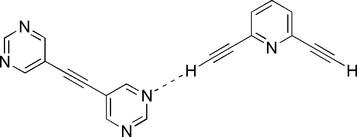
Early reports that suggested the existence of C—H⋯O hydrogen bonds within crystal structures (Sutor, 1962 ) were confirmed and comprehensively reviewed several decades ago (Desiraju, 1996; Steiner, 2003). Currently, C—H hydrogen bonding is widely accepted in both chemical and biochemical fields (Derewenda, 2023). We initially studied terminal alkynes as C—H hydrogen-bond donors since hydrogen atoms bonded to sp-C atoms are more polarized, exhibiting a pKa of approximately 25. We first focussed on sp-C—H⋯N(pyridine) interactions and noted that the vast majority of the published examples were reported in crystal structures of single molecules that included both a terminal alkyne and an amine donor. We chose to investigate the potential of these C—H⋯N hydrogen bonds to induce the formation of cocrystals between 1,4-diethynyl benzenes and aromatic amines like 1,2-bis(4-pyridyl)ethyne (Bosch, 2010, 2026). We, and others, investigated the role of phenyl C—H⋯N hydrogen bonds in cocrystals between fluorinated benzenes and pyridines (Bosch et al., 2015; Präsang et al., 2013). Here we present the cocrystallization of 1,2-bis(pyrimidin-5-yl)ethyne (BPE) with 2,6-diethynylpyridine (DEP). We expected that we would form cocrystals with π-stacked planar sheets comprising multiple cooperative sp and sp2-C—H⋯N hydrogen bonds. This was based on our knowledge of both sp-C—H⋯N hydrogen bonding and sp2-C—H⋯N hydrogen bonding of pyridines and pyrimidines within the crystal structure of 1,2-bis(pyrimidin-5-yl)ethyne and its cocrystals with 2,6-bis(iodoethynyl)pyridine (Lang et al., 2024).
2. Structural commentary
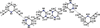
The asymmetric unit of the cocrystal BPE·DEP contains two unique molecules of each component as shown in Fig. 1. The two hydrogen-bonded pairs of molecules are in adjacent planes separated by 3.3 Å. The two BPE molecules are almost planar with dihedral angles between the pyrimidine rings in each of about 7°. The associated DEP molecules are slightly out of the plane defined by each C—H⋯N hydrogen-bonded BPE.
|
Figure 1
Labeled asymmetric unit of the cocrystal, BPE·DEP, with displacement ellipsoids drawn at the 50% level. C—H⋯N hydrogen bonds shown as dashed lines. |
3. Supramolecular features
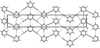
The two-dimensional planar sheet of BPE·DPE as shown in Fig. 2 features alternating rows of BPE molecules and DPE molecules along the direction of the b axis. The BPE molecules within each row are held together by self-complementary pyrimidine–pyrimidine sp2-C—H⋯N hydrogen bonds with four hydrogen bonds between each pair of BPE molecules. The DEP molecules within each row feature a single pyridine-pyridine sp2-C—H⋯N hydrogen bond. The sp-C—H⋯N (pyrimidine) hydrogen bonds effectively zipper the alternating rows together. The ten unique C—H⋯N hydrogen bonds are collated in Table 1. The first four entries in Table 1 correspond to the sp-C—H⋯N separations that range from 2.46 to 2.51 Å, 84 to 91% of the sum of the van der Waals radii (Bondi, 1964). There is a weak supporting C—H⋯π interaction between the pyrimidine C—H between the two N atoms and each alkyne (Fig. 2) with H⋯C separations ranging from 2.78 to 2.88 Å at 96–99% of the sum of the van der Waals radii. The sp-C—H⋯N hydrogen bonds, entries 5 to 8 in Table 1, have H⋯N separations between 2.32 and 2.47 Å and the pyridine–pyridine sp2C—H⋯N hydrogen bonds have H⋯N separations of 2.38 and 2.39 Å. These planar sheets are, indeed, like those we observed in the cocrystal between 2,6-bis(iodoethynyl)pyridine and BPE (Lang et al., 2024).
|
 ; (ii)
 ; (iii)
 ; (iv)
 .
|
Figure 2
View, along the c-axis, of one of the two unique planar sheets of alternating C—H⋯N and C—H⋯C hydrogen bonded molecules within the cocrystal BPE·DEP. |
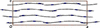
These planar sheets are π-stacked along the c-axis direction as illustrated in Fig. 3, which shows the slightly corrugated nature of the sheets.
|
Figure 3
View of the unit cell packing of the cocrystal BPE·DEP along the b axis. |
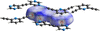
The Hirshfeld surface for one of the unique BPE molecules within the cocrystal was calculated with CrystalExplorer 17 (Spackman et al., 2021). Fig. 4 shows the five molecules in close contact to the central BPE and highlights the close contacts corresponding to the C—H⋯N hydrogen bonds in red.
|
Figure 4
Hirshfeld surface of one of the unique BPE molecules and the 5 molecules making close contact. CH⋯N hydrogen bonds shown as dashed lines. |
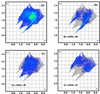
The close contacts derived from the Hirshfeld plot were analysed in terms of specific atom-to-atom contacts and the fingerprint plots in Fig. 5 calculated. The plot corresponding to all atom-to-atom contacts is shown in Fig. 5(a). H⋯H contacts, shown in Fig. 5(c), correspond to 30.5% of the surface area contacts. N⋯H/H⋯N and C⋯H/H⋯C contacts, Fig. 5(b) and 5(d), correspond 27.7 and 22.1% of the surface area, respectively. The C⋯C and C⋯N interactions that are predominantly π-stacking interactions, correspond to 10.3 and 7.8% of the surface area respectively. These latter interactions have atom-to-atom distances concentrated around 3.6 Å and appear as the central teal area in Fig. 5 (a).
|
Figure 5
Two-dimensional fingerprint plots showing the contributions of the major interactions to the total Hirshfeld surface area of a BPE in the cocrystal. (a) All atom-atom interactions, (b) N⋯H/H⋯N interactions, (c) H⋯H/H⋯H interactions and (d) C⋯H/H⋯C interactions. |
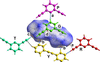
The intermolecular energy of interaction of neighbouring molecules within the crystal structure were calculated for each molecule in the asymmetric unit. Each of the major interactions is shown in Fig. 6. Thus the molecule labelled Y has two cooperative sp2-C—H⋯N hydrogen bonds to the central BPE, labelled `b' in Fig. 6. The average energy of interaction between the two BPE molecules is −21.4 kJmol−1. The DEP molecule labelled T in Fig. 6 has an sp-C—H⋯N interaction, labelled `c', with the central DPE molecule. The average energy of this interaction for the four unique alkynes is −12.7 kJmol−1. The π-stacked DEP molecule labelled G has large surface area of interaction with one alkyne lying along the BPE with the close C⋯C contact labelled `d' with an average intermolecular energy of interaction of −28.5 kJmol−1. The DEP molecule labelled R has an sp2-C—H⋯alkyne interaction labelled `e' with an average energy of interaction between these molecules of 8.0 kJmol−1. The C⋯C separation for `e' is 3.37 Å. Also shown in Fig. 6 is the sp2-C—H⋯N hydrogen bond `a' between pyridines labelled P and G with an average interaction energy of 12.7 kJmol−1.
|
Figure 6
Color-coded molecules, within 3.8 Å of a central DPE molecule in cocrystal (DPE·DEP), that have significant attractive intermolecular energies of interaction with interactions labelled and shown as dashed lines. Labels are; a pyridine-pyridine C—H⋯N, b pyrimidine-pyrimidine C—H⋯N, c alkyne C—H⋯N, d π-stacking C⋯C, e pyrimidine C—H⋯alkyne. Molecule labels (colours) are: Y (yellow), T (turquoise), G (green), P (pink) and R (red). |
4. Database survey
A search of the Cambridge Crystallographic Database (Version 2026.1.0; Groom et al., 2016) using Conquest Build 483767 (Bruno et al., 2002) for structures containing the DPE yielded 11 structures. Two of these are the structure of DPE alone, refcode AZEDAN (Meitinger et al., 2021) and AZEDAN01 (Lang et al., 2024). The coordination complexes formed between DPE and copper(I) iodide and bromide, refcodes LUMJEI and LUMJIM, were reported (Georgiev et al., 2001) as were hydrogen-bonded complexes formed between DPE and C-methyl resorcinarene, refcodes PAQYIQ, PAQYOW and PAQYUC (Georgiev et al., 2004). Recently we formed a halogen-bonded cocrystal of DPE with 1,3-diiodotetrafluorobenzene, refcode PUZGUP (Nwachukwu et al., 2020) and three halogen-bonded cocrystals of DPE with the isomeric bis(iodoethynyl)pyridines, refcodes UGUKOA, UGULAN and UGULIV (Lang et al., 2024). It is noteworthy that self-complementary pyrimidine–pyrimidine C—H⋯N hydrogen bonding, the strongest intermolecular interaction in the cocrystal DPE·DEP, is observed in the structures of DPE alone and in the halogen-bonded cocrystals of DPE. There are three structures of DEP in the database. DEP alone is refcode IDUWEJ (Ohkita et al., 2001), the cocrystal of DEP with 5-ethynylpyrimidine is refcode RUXNAA (Bosch, 2010). In these structures there are pyridine–pyridine C—H⋯N hydrogen bonds as observed in cocrystal and the cocrystal DPE·DEP. Also the cocrystal of DEP with N-iodosuccinimide is refcode DEGTAO (Bosch & Bowling, 2022).
5. Synthesis and crystallization
The compounds used in this study were available from previous studies (Lang et al., 2024). Equimolar amounts, 0.1 mmol, of each component were weighed and placed in a small screw-cap vial and 2 mL of dichloromethane were added to effect complete solution of both compounds. The lid was loosely attached to permit slow evaporation of the solvent as a homogeneous mass of colourless plates formed.
6. Refinement
Crystal data, data collection and structure refinement details are summarized in Table 2. H atoms were positioned geometrically (C—H = 0.95 Å) and refined as riding with Uiso(H) = 1.2Ueq(C).
|
Supporting information
CCDC reference: 2598229
Crystal structure: contains datablock I. DOI: https://doi.org/10.1107/S2056989026011102/jy2078sup1.cif
Structure factors: contains datablock I. DOI: https://doi.org/10.1107/S2056989026011102/jy2078Isup2.hkl
Supporting information file. DOI: https://doi.org/10.1107/S2056989026011102/jy2078Isup3.cdx
Supporting information file. DOI: https://doi.org/10.1107/S2056989026011102/jy2078Isup4.cml
| C10H6N4·C9H5N | Dx = 1.291 Mg m−3 |
| Mr = 309.33 | Mo Kα radiation, λ = 0.71073 Å |
| Orthorhombic, Pna21 | Cell parameters from 3041 reflections |
| a = 40.053 (4) Å | θ = 2.6–26.0° |
| b = 6.1144 (6) Å | µ = 0.08 mm−1 |
| c = 12.9933 (13) Å | T = 173 K |
| V = 3182.1 (5) Å3 | Plate, colourless |
| Z = 8 | 0.60 × 0.20 × 0.05 mm |
| F(000) = 1280 |
| Bruker APEXI CCD diffractometer | 6501 independent reflections |
| Radiation source: fine-focus sealed tube | 4000 reflections with I > 2σ(I) |
| Graphite monochromator | Rint = 0.075 |
| Detector resolution: 8.3660 pixels mm-1 | θmax = 26.4°, θmin = 2.6° |
| phi and ω scans | h = −50→50 |
| Absorption correction: multi-scan (SADABS; Krause et al., 2015)) | k = −7→7 |
| Tmin = 0.672, Tmax = 0.746 | l = −16→16 |
| 35545 measured reflections |
| Refinement on F2 | Hydrogen site location: inferred from neighbouring sites |
| Least-squares matrix: full | H-atom parameters constrained |
| R[F2 > 2σ(F2)] = 0.049 | w = 1/[σ2(Fo2) + (0.0462P)2 + 0.3002P] where P = (Fo2 + 2Fc2)/3 |
| wR(F2) = 0.119 | (Δ/σ)max < 0.001 |
| S = 1.01 | Δρmax = 0.20 e Å−3 |
| 6501 reflections | Δρmin = −0.15 e Å−3 |
| 434 parameters | Extinction correction: SHELXL-2019/3 (Sheldrick 2015b) |
| 1 restraint | Extinction coefficient: 0.0008 (2) |
| Primary atom site location: dual |
Geometry. All esds (except the esd in the dihedral angle between two l.s. planes) are estimated using the full covariance matrix. The cell esds are taken into account individually in the estimation of esds in distances, angles and torsion angles; correlations between esds in cell parameters are only used when they are defined by crystal symmetry. An approximate (isotropic) treatment of cell esds is used for estimating esds involving l.s. planes. |
| x | y | z | Uiso*/Ueq | ||
| N1 | 0.70954 (7) | 0.6089 (6) | 0.3405 (3) | 0.0286 (9) | |
| C1 | 0.79271 (11) | 0.4959 (7) | 0.3440 (4) | 0.0453 (12) | |
| H1 | 0.812495 | 0.410429 | 0.346813 | 0.054* | |
| N2 | 0.56656 (8) | 0.1314 (6) | 0.3982 (3) | 0.0360 (9) | |
| C2 | 0.76830 (10) | 0.6014 (7) | 0.3405 (4) | 0.0338 (10) | |
| N3 | 0.53964 (9) | −0.2145 (6) | 0.4163 (3) | 0.0377 (10) | |
| C3 | 0.73771 (9) | 0.7267 (6) | 0.3384 (3) | 0.0273 (9) | |
| N4 | 0.35714 (8) | 0.3586 (6) | 0.3636 (3) | 0.0387 (9) | |
| C4 | 0.73803 (11) | 0.9546 (7) | 0.3363 (3) | 0.0352 (11) | |
| H4 | 0.758488 | 1.032857 | 0.333021 | 0.042* | |
| N5 | 0.38130 (9) | 0.7146 (6) | 0.3674 (3) | 0.0469 (11) | |
| C5 | 0.70769 (11) | 1.0643 (8) | 0.3393 (4) | 0.0404 (11) | |
| H5 | 0.707099 | 1.219661 | 0.339138 | 0.048* | |
| N10 | −0.03096 (8) | 0.3847 (6) | 0.6537 (3) | 0.0279 (9) | |
| C6 | 0.67862 (11) | 0.9464 (7) | 0.3425 (4) | 0.0369 (11) | |
| H6 | 0.657628 | 1.018548 | 0.344935 | 0.044* | |
| N6 | 0.32429 (8) | 0.6352 (6) | 0.5975 (3) | 0.0346 (9) | |
| C7 | 0.68039 (9) | 0.7191 (7) | 0.3421 (3) | 0.0285 (9) | |
| N7 | 0.29795 (9) | 0.2857 (6) | 0.5884 (3) | 0.0354 (9) | |
| C8 | 0.65084 (10) | 0.5856 (7) | 0.3449 (4) | 0.0324 (10) | |
| N8 | 0.11432 (8) | 0.8539 (6) | 0.6121 (3) | 0.0368 (9) | |
| C9 | 0.62710 (10) | 0.4715 (7) | 0.3483 (4) | 0.0400 (11) | |
| H9 | 0.607994 | 0.379638 | 0.350950 | 0.048* | |
| N9 | 0.13825 (8) | 1.2079 (6) | 0.5975 (4) | 0.0467 (10) | |
| C10 | 0.53651 (10) | 0.2276 (8) | 0.3964 (4) | 0.0326 (11) | |
| H10 | 0.535352 | 0.382122 | 0.389686 | 0.039* | |
| C11 | 0.56605 (11) | −0.0857 (8) | 0.4072 (4) | 0.0376 (12) | |
| H11 | 0.587164 | −0.156537 | 0.407103 | 0.045* | |
| C12 | 0.51034 (11) | −0.1138 (7) | 0.4144 (3) | 0.0354 (11) | |
| H12 | 0.490637 | −0.199404 | 0.420407 | 0.042* | |
| C13 | 0.50719 (10) | 0.1103 (7) | 0.4040 (3) | 0.0288 (10) | |
| C14 | 0.47504 (10) | 0.2168 (9) | 0.3989 (4) | 0.0338 (11) | |
| C15 | 0.44856 (10) | 0.3023 (7) | 0.3928 (3) | 0.0336 (11) | |
| C16 | 0.41605 (10) | 0.3996 (7) | 0.3822 (3) | 0.0292 (10) | |
| C17 | 0.38756 (10) | 0.2721 (7) | 0.3751 (3) | 0.0344 (11) | |
| H17 | 0.389718 | 0.117567 | 0.378542 | 0.041* | |
| C18 | 0.35587 (11) | 0.5760 (8) | 0.3607 (4) | 0.0413 (12) | |
| H18 | 0.334343 | 0.639165 | 0.352911 | 0.050* | |
| C19 | 0.41140 (11) | 0.6223 (8) | 0.3783 (4) | 0.0435 (13) | |
| H19 | 0.430383 | 0.714761 | 0.383682 | 0.052* | |
| C30 | 0.05273 (11) | 0.4922 (7) | 0.6636 (3) | 0.0424 (12) | |
| H30 | 0.072646 | 0.576522 | 0.664071 | 0.051* | |
| C31 | 0.02787 (11) | 0.3870 (7) | 0.6630 (3) | 0.0326 (10) | |
| C32 | −0.00305 (9) | 0.2642 (7) | 0.6584 (3) | 0.0285 (10) | |
| C33 | −0.00334 (12) | 0.0375 (7) | 0.6581 (4) | 0.0365 (11) | |
| H33 | 0.016966 | −0.042556 | 0.660930 | 0.044* | |
| C34 | −0.03355 (11) | −0.0699 (8) | 0.6536 (4) | 0.0392 (11) | |
| H34 | −0.034419 | −0.225118 | 0.653786 | 0.047* | |
| C35 | −0.06262 (11) | 0.0523 (7) | 0.6488 (3) | 0.0363 (11) | |
| H35 | −0.083807 | −0.017340 | 0.646112 | 0.044* | |
| C36 | −0.06015 (10) | 0.2790 (7) | 0.6481 (3) | 0.0290 (10) | |
| C37 | −0.08946 (11) | 0.4157 (8) | 0.6394 (4) | 0.0360 (12) | |
| C38 | −0.11320 (11) | 0.5279 (8) | 0.6289 (4) | 0.0435 (12) | |
| H38 | −0.132307 | 0.618178 | 0.620414 | 0.052* | |
| C20 | 0.29428 (9) | 0.7296 (7) | 0.5965 (4) | 0.0318 (11) | |
| H20 | 0.292990 | 0.884667 | 0.597844 | 0.038* | |
| C21 | 0.32428 (10) | 0.4171 (7) | 0.5943 (4) | 0.0330 (10) | |
| H21 | 0.345516 | 0.347992 | 0.596533 | 0.040* | |
| C22 | 0.26834 (10) | 0.3858 (7) | 0.5880 (4) | 0.0349 (11) | |
| H22 | 0.248720 | 0.298995 | 0.583860 | 0.042* | |
| C23 | 0.26504 (9) | 0.6106 (7) | 0.5935 (3) | 0.0269 (9) | |
| C24 | 0.23295 (9) | 0.7140 (7) | 0.5960 (3) | 0.0326 (10) | |
| C25 | 0.20616 (10) | 0.7997 (9) | 0.5994 (4) | 0.0346 (11) | |
| C26 | 0.17343 (10) | 0.8939 (7) | 0.6015 (4) | 0.0302 (10) | |
| C27 | 0.14499 (9) | 0.7674 (7) | 0.6100 (4) | 0.0367 (11) | |
| H27 | 0.147299 | 0.613064 | 0.614459 | 0.044* | |
| C28 | 0.11276 (11) | 1.0713 (8) | 0.6049 (4) | 0.0417 (12) | |
| H28 | 0.091100 | 1.134503 | 0.605115 | 0.050* | |
| C29 | 0.16841 (11) | 1.1186 (8) | 0.5953 (4) | 0.0419 (12) | |
| H29 | 0.187305 | 1.211648 | 0.589241 | 0.050* |
| U11 | U22 | U33 | U12 | U13 | U23 | |
| N1 | 0.029 (2) | 0.026 (2) | 0.0311 (19) | −0.0023 (15) | 0.0006 (16) | 0.000 (2) |
| C1 | 0.029 (2) | 0.042 (3) | 0.064 (3) | −0.005 (2) | −0.001 (2) | −0.007 (3) |
| N2 | 0.030 (2) | 0.036 (2) | 0.042 (2) | −0.0029 (18) | 0.0016 (17) | 0.0004 (19) |
| C2 | 0.027 (2) | 0.033 (3) | 0.041 (3) | −0.009 (2) | 0.000 (2) | −0.006 (2) |
| N3 | 0.033 (2) | 0.027 (2) | 0.052 (3) | 0.0006 (18) | −0.0032 (18) | −0.005 (2) |
| C3 | 0.029 (2) | 0.023 (2) | 0.030 (2) | −0.0036 (18) | −0.0018 (19) | −0.003 (2) |
| N4 | 0.029 (2) | 0.036 (2) | 0.051 (3) | 0.0002 (17) | 0.0020 (18) | 0.002 (2) |
| C4 | 0.045 (3) | 0.026 (2) | 0.035 (3) | −0.012 (2) | 0.001 (2) | 0.004 (2) |
| N5 | 0.036 (2) | 0.032 (2) | 0.073 (3) | 0.0033 (19) | −0.007 (2) | 0.003 (2) |
| C5 | 0.060 (3) | 0.020 (2) | 0.041 (3) | 0.000 (2) | 0.000 (2) | 0.001 (3) |
| N10 | 0.029 (2) | 0.022 (2) | 0.033 (2) | −0.0026 (15) | 0.0013 (15) | −0.0026 (19) |
| C6 | 0.044 (3) | 0.024 (2) | 0.043 (3) | 0.006 (2) | −0.002 (2) | −0.001 (3) |
| N6 | 0.029 (2) | 0.032 (2) | 0.042 (2) | −0.0004 (16) | −0.0013 (18) | 0.001 (2) |
| C7 | 0.034 (2) | 0.024 (2) | 0.027 (2) | 0.0013 (19) | 0.002 (2) | 0.000 (2) |
| N7 | 0.0378 (19) | 0.026 (2) | 0.042 (2) | 0.0024 (18) | −0.0013 (18) | −0.003 (2) |
| C8 | 0.030 (2) | 0.031 (3) | 0.036 (2) | 0.004 (2) | 0.000 (2) | 0.001 (2) |
| N8 | 0.0276 (19) | 0.037 (2) | 0.046 (2) | 0.0010 (17) | 0.0017 (17) | −0.002 (2) |
| C9 | 0.031 (2) | 0.040 (3) | 0.049 (3) | 0.001 (2) | 0.000 (2) | −0.002 (3) |
| N9 | 0.033 (2) | 0.032 (2) | 0.074 (3) | 0.0016 (18) | 0.004 (2) | −0.004 (2) |
| C10 | 0.036 (2) | 0.028 (3) | 0.034 (3) | 0.000 (2) | −0.0024 (18) | 0.000 (2) |
| C11 | 0.030 (3) | 0.036 (3) | 0.047 (3) | 0.008 (2) | 0.003 (2) | −0.003 (2) |
| C12 | 0.033 (3) | 0.031 (3) | 0.042 (3) | −0.005 (2) | −0.004 (2) | −0.001 (2) |
| C13 | 0.025 (2) | 0.033 (3) | 0.028 (2) | 0.0022 (19) | 0.0020 (19) | −0.003 (2) |
| C14 | 0.032 (2) | 0.037 (3) | 0.033 (3) | 0.001 (2) | 0.000 (2) | −0.002 (2) |
| C15 | 0.032 (2) | 0.038 (3) | 0.030 (3) | 0.002 (2) | −0.0017 (19) | −0.002 (2) |
| C16 | 0.028 (2) | 0.031 (3) | 0.029 (2) | 0.0044 (18) | −0.0033 (17) | 0.000 (2) |
| C17 | 0.035 (2) | 0.030 (3) | 0.039 (3) | 0.002 (2) | 0.0013 (19) | 0.003 (2) |
| C18 | 0.033 (2) | 0.043 (3) | 0.048 (3) | 0.011 (2) | 0.000 (2) | 0.003 (3) |
| C19 | 0.036 (3) | 0.034 (3) | 0.060 (3) | −0.004 (2) | −0.006 (2) | 0.002 (3) |
| C30 | 0.031 (2) | 0.048 (3) | 0.048 (3) | −0.002 (2) | −0.002 (2) | −0.008 (2) |
| C31 | 0.031 (2) | 0.032 (3) | 0.034 (2) | 0.008 (2) | 0.0011 (19) | −0.001 (2) |
| C32 | 0.028 (2) | 0.029 (2) | 0.028 (2) | 0.003 (2) | 0.0002 (17) | 0.001 (2) |
| C33 | 0.042 (3) | 0.027 (2) | 0.040 (3) | 0.008 (2) | 0.004 (2) | 0.000 (3) |
| C34 | 0.057 (3) | 0.018 (2) | 0.042 (3) | 0.001 (2) | 0.001 (2) | 0.003 (2) |
| C35 | 0.043 (3) | 0.029 (3) | 0.037 (3) | −0.007 (2) | 0.000 (2) | 0.001 (2) |
| C36 | 0.032 (2) | 0.023 (2) | 0.032 (3) | 0.001 (2) | 0.0018 (19) | −0.003 (2) |
| C37 | 0.028 (2) | 0.036 (3) | 0.044 (3) | −0.008 (2) | −0.001 (2) | −0.003 (2) |
| C38 | 0.029 (2) | 0.041 (3) | 0.060 (3) | 0.002 (2) | −0.003 (2) | 0.000 (3) |
| C20 | 0.033 (2) | 0.025 (3) | 0.036 (3) | 0.002 (2) | 0.001 (2) | 0.001 (2) |
| C21 | 0.029 (2) | 0.034 (3) | 0.035 (2) | 0.0079 (19) | 0.003 (2) | 0.000 (2) |
| C22 | 0.032 (2) | 0.033 (3) | 0.040 (3) | −0.004 (2) | −0.004 (2) | 0.001 (2) |
| C23 | 0.025 (2) | 0.030 (2) | 0.026 (2) | 0.0014 (18) | 0.0002 (19) | 0.003 (2) |
| C24 | 0.032 (2) | 0.037 (3) | 0.029 (2) | 0.002 (2) | 0.000 (2) | 0.005 (2) |
| C25 | 0.034 (2) | 0.037 (3) | 0.032 (3) | 0.003 (2) | 0.000 (2) | 0.004 (2) |
| C26 | 0.026 (2) | 0.030 (2) | 0.034 (2) | 0.0014 (18) | −0.004 (2) | −0.002 (2) |
| C27 | 0.034 (2) | 0.031 (3) | 0.046 (3) | 0.001 (2) | 0.001 (2) | 0.000 (3) |
| C28 | 0.028 (2) | 0.041 (3) | 0.056 (3) | 0.006 (2) | 0.003 (2) | −0.007 (3) |
| C29 | 0.032 (2) | 0.033 (3) | 0.061 (3) | −0.004 (2) | 0.003 (2) | −0.005 (3) |
| N1—C3 | 1.339 (5) | C12—C13 | 1.383 (6) |
| N1—C7 | 1.348 (5) | C12—H12 | 0.9500 |
| C1—C2 | 1.172 (6) | C13—C14 | 1.445 (6) |
| C1—H1 | 0.9500 | C14—C15 | 1.185 (6) |
| N2—C11 | 1.333 (5) | C15—C16 | 1.438 (6) |
| N2—C10 | 1.339 (5) | C16—C19 | 1.376 (6) |
| C2—C3 | 1.445 (5) | C16—C17 | 1.385 (6) |
| N3—C11 | 1.324 (5) | C17—H17 | 0.9500 |
| N3—C12 | 1.325 (5) | C18—H18 | 0.9500 |
| C3—C4 | 1.394 (5) | C19—H19 | 0.9500 |
| N4—C18 | 1.331 (5) | C30—C31 | 1.185 (6) |
| N4—C17 | 1.337 (5) | C30—H30 | 0.9500 |
| C4—C5 | 1.389 (6) | C31—C32 | 1.450 (6) |
| C4—H4 | 0.9500 | C32—C33 | 1.386 (6) |
| N5—C18 | 1.328 (5) | C33—C34 | 1.378 (6) |
| N5—C19 | 1.339 (5) | C33—H33 | 0.9500 |
| C5—C6 | 1.370 (6) | C34—C35 | 1.385 (6) |
| C5—H5 | 0.9500 | C34—H34 | 0.9500 |
| N10—C36 | 1.338 (5) | C35—C36 | 1.389 (6) |
| N10—C32 | 1.340 (5) | C35—H35 | 0.9500 |
| C6—C7 | 1.392 (6) | C36—C37 | 1.446 (6) |
| C6—H6 | 0.9500 | C37—C38 | 1.180 (6) |
| N6—C20 | 1.334 (5) | C38—H38 | 0.9500 |
| N6—C21 | 1.334 (5) | C20—C23 | 1.379 (5) |
| C7—C8 | 1.438 (5) | C20—H20 | 0.9500 |
| N7—C21 | 1.328 (5) | C21—H21 | 0.9500 |
| N7—C22 | 1.335 (5) | C22—C23 | 1.383 (6) |
| C8—C9 | 1.180 (6) | C22—H22 | 0.9500 |
| N8—C28 | 1.334 (5) | C23—C24 | 1.433 (5) |
| N8—C27 | 1.338 (5) | C24—C25 | 1.195 (5) |
| C9—H9 | 0.9500 | C25—C26 | 1.432 (5) |
| N9—C28 | 1.322 (5) | C26—C27 | 1.381 (5) |
| N9—C29 | 1.326 (5) | C26—C29 | 1.391 (6) |
| C10—C13 | 1.380 (5) | C27—H27 | 0.9500 |
| C10—H10 | 0.9500 | C28—H28 | 0.9500 |
| C11—H11 | 0.9500 | C29—H29 | 0.9500 |
| C3—N1—C7 | 117.5 (4) | N5—C18—H18 | 116.3 |
| C2—C1—H1 | 180.0 | N4—C18—H18 | 116.3 |
| C11—N2—C10 | 115.2 (4) | N5—C19—C16 | 122.9 (4) |
| C1—C2—C3 | 178.2 (5) | N5—C19—H19 | 118.5 |
| C11—N3—C12 | 115.5 (4) | C16—C19—H19 | 118.5 |
| N1—C3—C4 | 123.1 (4) | C31—C30—H30 | 180.0 |
| N1—C3—C2 | 115.4 (4) | C30—C31—C32 | 177.4 (5) |
| C4—C3—C2 | 121.5 (4) | N10—C32—C33 | 122.9 (4) |
| C18—N4—C17 | 115.7 (4) | N10—C32—C31 | 115.5 (4) |
| C5—C4—C3 | 118.3 (4) | C33—C32—C31 | 121.7 (4) |
| C5—C4—H4 | 120.8 | C34—C33—C32 | 118.9 (4) |
| C3—C4—H4 | 120.8 | C34—C33—H33 | 120.5 |
| C18—N5—C19 | 115.4 (4) | C32—C33—H33 | 120.5 |
| C6—C5—C4 | 119.3 (4) | C33—C34—C35 | 118.9 (4) |
| C6—C5—H5 | 120.3 | C33—C34—H34 | 120.5 |
| C4—C5—H5 | 120.3 | C35—C34—H34 | 120.5 |
| C36—N10—C32 | 117.7 (4) | C34—C35—C36 | 118.6 (4) |
| C5—C6—C7 | 118.8 (4) | C34—C35—H35 | 120.7 |
| C5—C6—H6 | 120.6 | C36—C35—H35 | 120.7 |
| C7—C6—H6 | 120.6 | N10—C36—C35 | 123.0 (4) |
| C20—N6—C21 | 115.6 (4) | N10—C36—C37 | 115.7 (4) |
| N1—C7—C6 | 122.9 (4) | C35—C36—C37 | 121.3 (4) |
| N1—C7—C8 | 115.4 (4) | C38—C37—C36 | 177.8 (5) |
| C6—C7—C8 | 121.7 (4) | C37—C38—H38 | 180.0 |
| C21—N7—C22 | 115.4 (4) | N6—C20—C23 | 122.5 (4) |
| C9—C8—C7 | 178.2 (5) | N6—C20—H20 | 118.7 |
| C28—N8—C27 | 115.8 (4) | C23—C20—H20 | 118.7 |
| C8—C9—H9 | 180.0 | N7—C21—N6 | 127.3 (4) |
| C28—N9—C29 | 116.4 (4) | N7—C21—H21 | 116.3 |
| N2—C10—C13 | 122.4 (4) | N6—C21—H21 | 116.3 |
| N2—C10—H10 | 118.8 | N7—C22—C23 | 122.7 (4) |
| C13—C10—H10 | 118.8 | N7—C22—H22 | 118.6 |
| N3—C11—N2 | 127.7 (4) | C23—C22—H22 | 118.6 |
| N3—C11—H11 | 116.1 | C20—C23—C22 | 116.4 (4) |
| N2—C11—H11 | 116.1 | C20—C23—C24 | 121.9 (4) |
| N3—C12—C13 | 122.9 (4) | C22—C23—C24 | 121.7 (4) |
| N3—C12—H12 | 118.6 | C25—C24—C23 | 179.1 (5) |
| C13—C12—H12 | 118.6 | C24—C25—C26 | 177.5 (6) |
| C10—C13—C12 | 116.4 (4) | C27—C26—C29 | 116.0 (4) |
| C10—C13—C14 | 121.4 (4) | C27—C26—C25 | 122.1 (4) |
| C12—C13—C14 | 122.2 (4) | C29—C26—C25 | 121.9 (4) |
| C15—C14—C13 | 178.7 (5) | N8—C27—C26 | 122.5 (4) |
| C14—C15—C16 | 177.6 (5) | N8—C27—H27 | 118.7 |
| C19—C16—C17 | 116.3 (4) | C26—C27—H27 | 118.7 |
| C19—C16—C15 | 122.4 (4) | N9—C28—N8 | 126.8 (4) |
| C17—C16—C15 | 121.3 (4) | N9—C28—H28 | 116.6 |
| N4—C17—C16 | 122.4 (4) | N8—C28—H28 | 116.6 |
| N4—C17—H17 | 118.8 | N9—C29—C26 | 122.5 (4) |
| C16—C17—H17 | 118.8 | N9—C29—H29 | 118.8 |
| N5—C18—N4 | 127.3 (4) | C26—C29—H29 | 118.8 |
| D—H···A | D—H | H···A | D···A | D—H···A |
| C10—H10···N3i | 0.95 | 2.50 | 3.423 (6) | 165 |
| C17—H17···N5ii | 0.95 | 2.49 | 3.420 (6) | 166 |
| C20—H20···N7i | 0.95 | 2.46 | 3.405 (6) | 171 |
| C27—H27···N9ii | 0.95 | 2.51 | 3.436 (6) | 164 |
| C1—H1···N4iii | 0.95 | 2.44 | 3.380 (6) | 170 |
| C5—H5···N1i | 0.95 | 2.38 | 3.331 (6) | 176 |
| C9—H9···N2 | 0.95 | 2.33 | 3.260 (5) | 165 |
| C30—H30···N8 | 0.95 | 2.47 | 3.380 (6) | 160 |
| C34—H34···N10ii | 0.95 | 2.39 | 3.336 (6) | 175 |
| C38—H38···N6iv | 0.95 | 2.32 | 3.268 (6) | 175 |
| Symmetry codes: (i) x, y+1, z; (ii) x, y−1, z; (iii) x+1/2, −y+1/2, z; (iv) x−1/2, −y+3/2, z. |
Acknowledgements
The Missouri State University Provost Incentive Fund funded the purchase of the X-ray diffractometer.
References
 Barbour, L. J. (2020). J. Appl. Cryst. 53, 1141–1146.
Web of Science
CrossRef
CAS
IUCr Journals
Google Scholar
Bondi, A. (1964). J. Phys. Chem. 68, 441–451.
CrossRef
CAS
Web of Science
Google Scholar
Bosch, E. (2010). Cryst. Growth Des. 10, 3808–3813.
Web of Science
CSD
CrossRef
CAS
Google Scholar
Bosch, E. (2026). J. Chem. Crystallogr. 56, 35.
CrossRef
Google Scholar
Bosch, E. & Bowling, N. P. (2022). Acta Cryst. C78, 424–429.
Web of Science
CrossRef
IUCr Journals
Google Scholar
Bosch, E., Bowling, N. P. & Darko, J. (2015). Cryst. Growth Des. 15, 1634–1641.
Web of Science
CSD
CrossRef
CAS
Google Scholar
Bruker (2014). SMART and SAINT. Bruker AXS Inc., Madison, Wisconsin, USA.
Google Scholar
Bruno, I. J., Cole, J. C., Edgington, P. R., Kessler, M., Macrae, C. F., McCabe, P., Pearson, J. & Taylor, R. (2002). Acta Cryst. B58, 389–397.
Web of Science
CrossRef
CAS
IUCr Journals
Google Scholar
Derewenda, Z. S. (2023). Int. J. Mol. Sci. 24, 13165.
Web of Science
CrossRef
PubMed
Google Scholar
Desiraju, G. R. (1996). Acc. Chem. Res. 29, 441–449.
CrossRef
CAS
PubMed
Web of Science
Google Scholar
Georgiev, I., Barnes, C. L. & Bosch, E. (2001). J. Supramol. Chem. 1, 153–155.
CrossRef
CAS
Google Scholar
Georgiev, I., Bosch, E., Barnes, C. L. & Draganjac, M. (2004). Cryst. Growth Des. 4, 235–239.
Web of Science
CrossRef
CAS
Google Scholar
Groom, C. R., Bruno, I. J., Lightfoot, M. P. & Ward, S. C. (2016). Acta Cryst. B72, 171–179.
Web of Science
CrossRef
IUCr Journals
Google Scholar
Krause, L., Herbst-Irmer, R., Sheldrick, G. M. & Stalke, D. (2015). J. Appl. Cryst. 48, 3–10.
Web of Science
CSD
CrossRef
ICSD
CAS
IUCr Journals
Google Scholar
Lang, L. B., Bowling, N. P. & Bosch, E. (2024). Cryst. Growth Des. 24, 9727–9734.
CrossRef
CAS
PubMed
Google Scholar
Meitinger, N., Mengele, A. K., Nauroozi, D. & Rau, S. (2021). Org. Mater. 3, 295–302.
CAS
Google Scholar
Nwachukwu, C. I., Patton, L. J., Bowling, N. P. & Bosch, E. (2020). Acta Cryst. C76, 458–467.
Web of Science
CSD
CrossRef
IUCr Journals
Google Scholar
Ohkita, M., Suzuki, T., Nakatani, K. & Tsuji, T. (2001). Chem. Lett. 30, 988–989.
CrossRef
Google Scholar
Präsang, C., McAllister, L. J., Whitwood, A. C. & Bruce, D. W. (2013). CrystEngComm 15, 8947–8958.
Google Scholar
Sheldrick, G. M. (2015a). Acta Cryst. C71, 3–8.
Web of Science
CrossRef
IUCr Journals
Google Scholar
Sheldrick, G. M. (2015b). Acta Cryst. A71, 3–8.
Web of Science
CrossRef
IUCr Journals
Google Scholar
Spackman, P. R., Turner, M. J., McKinnon, J. J., Wolff, S. K., Grimwood, D. J., Jayatilaka, D. & Spackman, M. A. (2021). J. Appl. Cryst. 54, 1006–1011.
Web of Science
CrossRef
CAS
IUCr Journals
Google Scholar
Steiner, T. (2003). Crystallogr. Rev. 9, 177–228.
CrossRef
CAS
Google Scholar
Sutor, D. J. (1962). Nature 195, 68–69.
CAS
Google Scholar
This is an open-access article distributed under the terms of the Creative Commons Attribution (CC-BY) Licence, which permits unrestricted use, distribution, and reproduction in any medium, provided the original authors and source are cited.
| CRYSTALLOGRAPHIC COMMUNICATIONS |
access