Acta Crystallographica
Section E CRYSTALLOGRAPHIC COMMUNICATIONS


 menu


research communications
| CRYSTALLOGRAPHIC COMMUNICATIONS |
 access
Crystal structure and Hirshfeld surface analysis of phenylalanine hydrobromide

aDepartment of Chemistry, Taras Shevchenko National University of Kyiv, Volodymyrska St. 64, Kyiv 01601, Ukraine, bDepartment of Inorganic Polymers, Petru Poni Institute of Macromolecular Chemistry, Aleea Grigore Ghica Voda 41-A, Iasi 700487, Romania, cDepartment of General and Inorganic Chemistry, National Technical University of Ukraine Igor Sikorsky Kyiv Polytechnic Institute, Beresteiskyi Pr. 37, Kyiv 03056, Ukraine, dBakul Institute for Superhard Materials, National Academy of Sciences of Ukraine, Avtozavodska St. 2, Kyiv 04074, Ukraine, and eInstitute of Innovative Education of Kyiv National University of Construction and Architecture, 4 Osvity Street, Kyiv 03037, Ukraine
*Correspondence e-mail: [email protected]
Amino acid salts represent a diverse class of molecular solids in which ionic interactions and hydrogen bonding between protonated amino acid species and counter-ions govern the formation of supramolecular architectures. Phenylalanine hydrobromide (systematic name: 1-carboxy-2-phenylethan-1-aminium bromide, C9H12NO2+·Br−) crystallizes in the chiral orthorhombic space group P212121. Its structure is built from protonated phenylalaninium cations, which interact with bromide anions through a network of N—H⋯Br and O—H⋯Br hydrogen bonds, forming bilayers propagating parallel to the ab plane, with the polar groups oriented toward the interior of the bilayers. The crystal structure is additionally consolidated by three types of weak T-shaped C(sp2)—H⋯π interactions.
Keywords: crystal structure; amino acid salt; phenylalanine; bromide.
CCDC reference: 2593846
1. Chemical context
Amino acids are fundamental building blocks of living systems and play a central role in biological processes, while their diverse chemical functionality also makes them important molecular components in supramolecular and materials chemistry (Wang et al., 2024 ). In the solid state, amino acids commonly exist as zwitterions and form extended networks through hydrogen bonding and electrostatic interactions (Görbitz, 2015; Moggach et al., 2015). Consequently, knowledge of their crystal structures is essential for understanding the relationship between molecular structure, intermolecular interactions and the resulting properties of the solid phase. Amino acids have therefore long attracted attention in crystallographic studies, providing important model systems for investigating hydrogen-bonding patterns, molecular packing, polymorphism and structure–property relationships (Yamada et al., 2008; de Moraes et al., 2018). Modification of the ionic environment through protonation of the amino group and incorporation of inorganic counter-ions offers an additional means of controlling crystal packing and generating new structural motifs (Fleck & Petrosyan, 2014). In particular, halide salts of amino acids provide useful model systems in which the hydrogen-bonding functionality of the organic component is combined with different inorganic counter-ions. Their crystal structures offer insight into how the nature of the halide and the presence of solvent molecules influence intermolecular interactions, crystal packing and the resulting supramolecular organization (Petrosyan et al., 2020).
Amino acid halide salts have also emerged as useful precursors and building blocks for hybrid organic–inorganic perovskites. Hybrid halide perovskites have attracted considerable attention due to their compositional and structural tunability, which gives rise to a broad range of optical, electronic and other functional properties (Kucheriv et al., 2023; Kucheriv et al., 2025). The incorporation of amino-acid-derived cations into metal–halide frameworks enables the introduction of chirality and additional hydrogen-bonding interactions, while retaining the characteristic structural flexibility of hybrid halide materials. Sirenko and co-workers demonstrated that α-alanine can serve as an organic component of chiral lead–halide hybrid perovskites, yielding (AlaH)PbX3 compounds with distinct low-dimensional inorganic architectures and semiconducting optical properties (Sirenko et al., 2021). Similar structural principles were subsequently extended to L-histidine, affording two-dimensional hybrid perovskites in which the amino acid cations separate the inorganic layers and induce noncentrosymmetric structures (Sirenko et al., 2022). More recently, proline-based lead bromide perovskites further demonstrated the substantial structural diversity accessible through the use of amino-acid-derived organic cations (Sirenko et al., 2023). These examples highlight the importance of understanding the crystal structures and intermolecular interactions of amino acid halide salts themselves, as such structural information is relevant to their role as molecular building blocks for the rational development of functional hybrid materials.
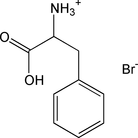
In this article, we report the crystal structure of phenylalaninium bromide and discuss its structural features and intermolecular interactions.
2. Structural commentary
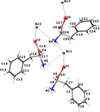
The title salt crystallizes in the space group P212121. The asymmetric unit contains three protonated phenylalaninium cations and three bromide anions (Fig. 1). All bond lengths and angles are within the expected range. The phenylalaninium cation containing the C1–C6 aromatic ring is denoted as A, C10–C15 as B and C19–C24 as C. The C1—C7—C8—N1 and C10—C16—C17—N2 torsion angles in A and B are 56.6 (3) and 57.4 (3)°, respectively, indicating that these cations adopt anticlinal conformation. The C19—C25—C26—N3 torsion angle in C is 168.8 (2)°, which is close to an antiperiplanar conformation. Due to such conformations, the A and B cations feature intermolecular C2—H2⋯O1 and C15—H15⋯O3 hydrogen bonds, while such an interaction is geometrically impossible in C. The detailed geometric parameters of the hydrogen bonds which are formed in this crystal structure are given in Table 1. The carboxylic acid group exhibits the expected asymmetric C—O bond lengths in all three types of phenylalaninium cations, with the C=O and C—OH bonds measuring ca 1.20 and 1.35 Å, respectively, in all three cases. This pronounced differentiation is consistent with the presence of a localized carbonyl and hydroxyl functionality rather than a delocalized carboxylate group.
|
 ; (ii)
 ; (iii)
 ; (iv)
 ; (v)
 .
|
Figure 1
The asymmetric unit of the title compound, showing the atom-labelling scheme. Displacement ellipsoids are drawn at the 50% probability level. |
3. Supramolecular features
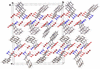
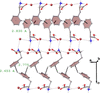
Phenylalaninium cations form an extensive network of N—H⋯Br and O—H⋯Br hydrogen bonds with bromide counter-ions (Table 1). Phenylalaninium cations are arranged in double layers propagating along the ab plane. Additional connection inside the layer is ensured by weak C8—H8⋯O2iv and C17—H17⋯O4v (Table 1) contacts. The carboxyl groups and ammonium cations face inside the double layers (Fig. 2). These double layers interact with each other by weak T-shaped C(sp2)—H⋯π interactions. In total, three types of C(sp2)—H⋯π interactions are formed: C24—H24⋯π(C) of 2.2898 (12) Å, C3—H3⋯π(B) of 2.6528 (12) Å and C14—H14⋯π(A) of 2.7747 (11) Å (Fig. 3).
|
Figure 2
Fragment of the title compound, showing propagation of the supramolecular bilayers in the ab plane. |
|
Figure 3
Fragment of the title compound showing C(sp2)—H⋯π interactions. |
4. Hirshfeld surface analysis
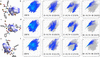
Hirshfeld surface analysis was performed separately for each crystallographically independent phenylalaninium cation. The Hirshfeld surfaces mapped over dnorm were generated at the standard resolution to visualize and characterize the intermolecular contacts in the crystal structure [Figs. 4(a)–(f)]. A fixed colour scale was used, with white regions corresponding to contacts close to the sum of the van der Waals radii, whereas shorter and longer contacts are indicated by red and blue regions, respectively. In all three cases, the most pronounced red regions correspond to the shortest N—H⋯Br and N—H⋯O contacts. The associated two-dimensional fingerprint plots provide a quantitative representation of the intermolecular contacts and their contributions to the crystal packing.
|
Figure 4
Hirshfeld surface and fingerprint plots of the (a)/(b) A, (c)/(d) B and (e)/(f) C phenylalaninium cations. |
For all three cations, the most significant weak intermolecular contacts are O⋯H/H⋯O, C⋯H/H⋯C and Br⋯H/H⋯Br, each contributing approximately 15–20% to the Hirshfeld surface. The exact contributions vary slightly among the three crystallographically independent cations and are given in Figs. 4(b)–(d). The O⋯H/H⋯O contacts arise from both C—H⋯O and N—H⋯O interactions, whereas the Br⋯H/H⋯Br contacts are primarily associated with hydrogen bonding between the protonated ammonium or hydroxyl groups and bromide anions. The C⋯H/H⋯C contacts are associated with C—H⋯π interactions present in the crystal structure.
The remaining contribution to the fingerprint plots arises predominantly from H⋯H contacts. Although these contacts contribute appreciably to the overall Hirshfeld surface, they do not correspond to specific directional intermolecular interactions and mainly originate from H atoms at the terminal positions of the molecular fragments.
5. Database survey
A survey of the Cambridge Structural Database (CSD, Version 6.01, update of Fabruary 2026; Groom et al., 2016) revealed one chemically related structure of L-phenylalanine L-phenylalaninium bromide (CADLOK01), which contained cocrystallized L-phenylalanine and L-phenylalaninium bromide in a 1:1 ratio (Surekha et al., 2014).
6. Synthesis and crystallization
100 mg of phenylalanine were dissolved in 100 µl of concentrated (48%) HBr under heating and left to cool to room temperature. Within 1 h, colourless crystals suitable for X-ray analysis formed. The obtained crystals were stired in the mother liquor prior to measurement.
7. Refinement
Crystal data, data collection and structure refinement details are summarized in Table 2. H atoms were placed at calculated positions and refined isotropically with Uiso(H) = 1.2Ueq(C), 1.2Ueq(N) or 1.5Ueq(O). Ternary CH, secondary CH2 and aromatic H were refined with riding coordinates. Idealized NH3 and idealized tetrahedral OH were refined as rotating groups with stretchable bonds.
|
Supporting information
CCDC reference: 2593846
Crystal structure: contains datablock I. DOI: https://doi.org/10.1107/S2056989026010406/nx2040sup1.cif
Structure factors: contains datablock I. DOI: https://doi.org/10.1107/S2056989026010406/nx2040Isup2.hkl
| C9H12NO2+·Br− | Dx = 1.563 Mg m−3 |
| Mr = 246.11 | Mo Kα radiation, λ = 0.71073 Å |
| Orthorhombic, P212121 | Cell parameters from 11408 reflections |
| a = 5.5716 (1) Å | θ = 2.5–29.5° |
| b = 21.6685 (4) Å | µ = 3.90 mm−1 |
| c = 25.9870 (5) Å | T = 100 K |
| V = 3137.36 (10) Å3 | Block, colourless |
| Z = 12 | 0.25 × 0.09 × 0.04 mm |
| F(000) = 1488 |
| Rigaku XtaLAB Synergy Dualflex diffractometer with a HyPix detector | 7687 independent reflections |
| Radiation source: micro-focus sealed X-ray tube, PhotonJet (Mo) X-ray Source | 6897 reflections with I > 2σ(I) |
| Mirror monochromator | Rint = 0.027 |
| Detector resolution: 10.0000 pixels mm-1 | θmax = 30.2°, θmin = 2.5° |
| ω scans | h = −6→7 |
| Absorption correction: analytical (CrysAlis PRO; Rigaku OD, 2024) | k = −24→29 |
| Tmin = 0.605, Tmax = 0.880 | l = −32→29 |
| 20376 measured reflections |
| Refinement on F2 | Hydrogen site location: inferred from neighbouring sites |
| Least-squares matrix: full | H atoms treated by a mixture of independent and constrained refinement |
| R[F2 > 2σ(F2)] = 0.026 | w = 1/[σ2(Fo2) + (0.0197P)2] where P = (Fo2 + 2Fc2)/3 |
| wR(F2) = 0.046 | (Δ/σ)max = 0.002 |
| S = 1.02 | Δρmax = 0.39 e Å−3 |
| 7687 reflections | Δρmin = −0.28 e Å−3 |
| 364 parameters | Absolute structure: Flack x determined using 2670 quotients [(I+)-(I-)]/[(I+)+(I-)] (Parsons et al., 2013) |
| 0 restraints | Absolute structure parameter: −0.008 (4) |
Geometry. All esds (except the esd in the dihedral angle between two l.s. planes) are estimated using the full covariance matrix. The cell esds are taken into account individually in the estimation of esds in distances, angles and torsion angles; correlations between esds in cell parameters are only used when they are defined by crystal symmetry. An approximate (isotropic) treatment of cell esds is used for estimating esds involving l.s. planes. |
| x | y | z | Uiso*/Ueq | ||
| Br1 | 0.17873 (4) | 0.65257 (2) | 0.67621 (2) | 0.01527 (7) | |
| Br2 | 0.78091 (5) | 0.82203 (2) | 0.80185 (2) | 0.01596 (7) | |
| Br3 | 0.25455 (4) | 0.99336 (2) | 0.68558 (2) | 0.01323 (7) | |
| O1 | 0.5903 (4) | 0.55574 (10) | 0.65121 (9) | 0.0224 (5) | |
| H1 | 0.489 (6) | 0.5774 (13) | 0.6558 (11) | 0.034* | |
| O2 | 0.3724 (3) | 0.49088 (9) | 0.70016 (9) | 0.0161 (5) | |
| O3 | 0.3734 (4) | 0.72749 (9) | 0.83319 (9) | 0.0201 (5) | |
| H3A | 0.479 (6) | 0.7486 (12) | 0.8276 (12) | 0.030* | |
| O4 | 0.5867 (3) | 0.65787 (10) | 0.78801 (8) | 0.0148 (4) | |
| O5 | 0.5947 (4) | 0.88562 (10) | 0.64538 (9) | 0.0275 (6) | |
| H5A | 0.496 (6) | 0.9136 (13) | 0.6539 (12) | 0.041* | |
| O6 | 0.3590 (3) | 0.82479 (10) | 0.69374 (8) | 0.0196 (5) | |
| N1 | 0.7272 (4) | 0.40849 (10) | 0.70936 (9) | 0.0134 (5) | |
| H1A | 0.592 (3) | 0.3912 (6) | 0.6987 (5) | 0.016* | |
| H1B | 0.712 (3) | 0.4195 (2) | 0.7421 (6) | 0.016* | |
| H1C | 0.847 (3) | 0.3817 (6) | 0.7063 (6) | 0.016* | |
| N2 | 0.2357 (4) | 0.57364 (10) | 0.78988 (9) | 0.0125 (5) | |
| H2A | 0.250 (3) | 0.58000 (18) | 0.7569 (6) | 0.015* | |
| H2B | 0.118 (2) | 0.5481 (5) | 0.7955 (6) | 0.015* | |
| H2C | 0.369 (3) | 0.5579 (5) | 0.8018 (5) | 0.015* | |
| N3 | 0.6877 (4) | 0.73528 (10) | 0.69898 (9) | 0.0140 (5) | |
| H3B | 0.546 (3) | 0.7193 (6) | 0.6942 (4) | 0.017* | |
| H3C | 0.696 (3) | 0.7508 (3) | 0.7298 (5) | 0.017* | |
| H3D | 0.796 (3) | 0.7067 (6) | 0.6954 (5) | 0.017* | |
| C1 | 0.7015 (5) | 0.40577 (13) | 0.59356 (10) | 0.0124 (6) | |
| C2 | 0.4939 (5) | 0.42966 (14) | 0.57039 (12) | 0.0149 (6) | |
| H2 | 0.459171 | 0.472434 | 0.573325 | 0.018* | |
| C3 | 0.3396 (5) | 0.39180 (16) | 0.54340 (12) | 0.0200 (7) | |
| H3 | 0.198754 | 0.408471 | 0.528201 | 0.024* | |
| C4 | 0.3900 (6) | 0.32964 (16) | 0.53849 (12) | 0.0237 (8) | |
| H4 | 0.284106 | 0.303673 | 0.519730 | 0.028* | |
| C5 | 0.5940 (6) | 0.30515 (15) | 0.56078 (12) | 0.0211 (7) | |
| H5 | 0.628197 | 0.262391 | 0.557441 | 0.025* | |
| C6 | 0.7497 (5) | 0.34346 (14) | 0.58824 (10) | 0.0174 (6) | |
| H6 | 0.890139 | 0.326542 | 0.603431 | 0.021* | |
| C7 | 0.8698 (4) | 0.44712 (14) | 0.62374 (11) | 0.0130 (6) | |
| H7A | 0.896221 | 0.485554 | 0.603939 | 0.016* | |
| H7B | 1.026675 | 0.426083 | 0.627167 | 0.016* | |
| C8 | 0.7793 (4) | 0.46417 (12) | 0.67745 (11) | 0.0124 (6) | |
| H8 | 0.909917 | 0.487770 | 0.695034 | 0.015* | |
| C9 | 0.5549 (5) | 0.50447 (13) | 0.67785 (12) | 0.0129 (6) | |
| C10 | 0.2838 (5) | 0.58765 (13) | 0.90514 (10) | 0.0113 (6) | |
| C11 | 0.2425 (5) | 0.52576 (13) | 0.91687 (11) | 0.0140 (6) | |
| H11 | 0.103093 | 0.505814 | 0.903990 | 0.017* | |
| C12 | 0.4030 (5) | 0.49308 (15) | 0.94713 (12) | 0.0181 (7) | |
| H12 | 0.374020 | 0.450834 | 0.954657 | 0.022* | |
| C13 | 0.6066 (5) | 0.52212 (14) | 0.96649 (12) | 0.0156 (7) | |
| H13 | 0.715685 | 0.499804 | 0.987537 | 0.019* | |
| C14 | 0.6502 (5) | 0.58351 (14) | 0.95512 (11) | 0.0139 (6) | |
| H14 | 0.790007 | 0.603240 | 0.968066 | 0.017* | |
| C15 | 0.4894 (4) | 0.61617 (14) | 0.92475 (11) | 0.0127 (6) | |
| H15 | 0.519442 | 0.658375 | 0.917216 | 0.015* | |
| C16 | 0.1064 (4) | 0.62332 (13) | 0.87211 (11) | 0.0109 (6) | |
| H16A | 0.078216 | 0.664093 | 0.888195 | 0.013* | |
| H16B | −0.048354 | 0.600878 | 0.871971 | 0.013* | |
| C17 | 0.1859 (4) | 0.63338 (12) | 0.81636 (11) | 0.0113 (6) | |
| H17 | 0.051278 | 0.654129 | 0.797699 | 0.014* | |
| C18 | 0.4083 (5) | 0.67351 (13) | 0.81056 (11) | 0.0120 (6) | |
| C19 | 0.8038 (5) | 0.79904 (12) | 0.56348 (10) | 0.0120 (6) | |
| C20 | 1.0195 (5) | 0.83066 (13) | 0.56674 (12) | 0.0178 (7) | |
| H20 | 1.112471 | 0.828004 | 0.597308 | 0.021* | |
| C21 | 1.1015 (5) | 0.86625 (14) | 0.52580 (13) | 0.0218 (7) | |
| H21 | 1.249390 | 0.887782 | 0.528716 | 0.026* | |
| C22 | 0.9702 (6) | 0.87050 (14) | 0.48114 (13) | 0.0219 (7) | |
| H22 | 1.026983 | 0.894670 | 0.453172 | 0.026* | |
| C23 | 0.7545 (5) | 0.83918 (14) | 0.47738 (11) | 0.0213 (7) | |
| H23 | 0.662621 | 0.841877 | 0.446675 | 0.026* | |
| C24 | 0.6716 (5) | 0.80379 (13) | 0.51828 (11) | 0.0143 (6) | |
| H24 | 0.522950 | 0.782619 | 0.515326 | 0.017* | |
| C25 | 0.7183 (5) | 0.75706 (12) | 0.60608 (10) | 0.0131 (6) | |
| H25A | 0.816393 | 0.718980 | 0.605500 | 0.016* | |
| H25B | 0.550219 | 0.745061 | 0.598786 | 0.016* | |
| C26 | 0.7294 (5) | 0.78472 (12) | 0.66055 (10) | 0.0125 (6) | |
| H26 | 0.891551 | 0.803235 | 0.666316 | 0.015* | |
| C27 | 0.5384 (5) | 0.83380 (13) | 0.66893 (11) | 0.0138 (7) |
| U11 | U22 | U33 | U12 | U13 | U23 | |
| Br1 | 0.01505 (13) | 0.01604 (15) | 0.01472 (16) | 0.00555 (11) | −0.00005 (11) | 0.00074 (13) |
| Br2 | 0.01382 (14) | 0.01551 (14) | 0.01854 (16) | −0.00551 (11) | −0.00003 (11) | −0.00128 (12) |
| Br3 | 0.01307 (12) | 0.01245 (14) | 0.01418 (15) | 0.00420 (11) | 0.00076 (12) | 0.00126 (11) |
| O1 | 0.0219 (11) | 0.0155 (12) | 0.0299 (15) | 0.0056 (9) | 0.0108 (10) | 0.0035 (11) |
| O2 | 0.0123 (9) | 0.0187 (12) | 0.0172 (12) | 0.0027 (8) | 0.0036 (8) | −0.0003 (9) |
| O3 | 0.0194 (11) | 0.0140 (11) | 0.0268 (14) | −0.0051 (9) | 0.0091 (9) | −0.0021 (10) |
| O4 | 0.0126 (9) | 0.0149 (11) | 0.0171 (12) | −0.0021 (9) | 0.0022 (8) | 0.0014 (10) |
| O5 | 0.0383 (13) | 0.0114 (12) | 0.0329 (16) | 0.0103 (10) | 0.0213 (11) | 0.0066 (11) |
| O6 | 0.0156 (10) | 0.0192 (11) | 0.0241 (13) | 0.0053 (8) | 0.0052 (9) | 0.0011 (10) |
| N1 | 0.0112 (11) | 0.0174 (13) | 0.0115 (12) | 0.0032 (10) | −0.0006 (10) | −0.0016 (10) |
| N2 | 0.0131 (11) | 0.0131 (12) | 0.0111 (12) | −0.0053 (10) | 0.0013 (10) | −0.0013 (9) |
| N3 | 0.0136 (11) | 0.0148 (13) | 0.0135 (13) | 0.0045 (9) | 0.0016 (10) | 0.0010 (10) |
| C1 | 0.0135 (13) | 0.0168 (15) | 0.0067 (15) | 0.0003 (11) | 0.0036 (11) | 0.0008 (11) |
| C2 | 0.0150 (14) | 0.0187 (17) | 0.0112 (17) | 0.0050 (12) | 0.0022 (11) | −0.0007 (13) |
| C3 | 0.0140 (14) | 0.036 (2) | 0.0105 (16) | 0.0016 (14) | −0.0001 (12) | 0.0012 (14) |
| C4 | 0.0240 (17) | 0.035 (2) | 0.0118 (18) | −0.0132 (14) | 0.0011 (13) | −0.0045 (15) |
| C5 | 0.0331 (18) | 0.0180 (17) | 0.0121 (18) | −0.0059 (14) | 0.0038 (13) | 0.0013 (14) |
| C6 | 0.0195 (14) | 0.0214 (15) | 0.0114 (15) | 0.0040 (14) | 0.0001 (12) | 0.0012 (12) |
| C7 | 0.0094 (13) | 0.0155 (16) | 0.0139 (17) | 0.0006 (11) | 0.0028 (11) | 0.0008 (13) |
| C8 | 0.0094 (12) | 0.0134 (14) | 0.0145 (15) | 0.0008 (10) | −0.0012 (12) | −0.0021 (12) |
| C9 | 0.0157 (13) | 0.0115 (16) | 0.0114 (17) | 0.0024 (11) | −0.0007 (12) | −0.0044 (14) |
| C10 | 0.0110 (13) | 0.0166 (15) | 0.0063 (14) | 0.0013 (11) | 0.0028 (11) | −0.0010 (11) |
| C11 | 0.0143 (13) | 0.0156 (14) | 0.0121 (14) | −0.0040 (12) | 0.0031 (12) | −0.0019 (11) |
| C12 | 0.0211 (15) | 0.0135 (16) | 0.020 (2) | 0.0023 (13) | 0.0024 (12) | 0.0005 (14) |
| C13 | 0.0166 (14) | 0.0188 (17) | 0.0114 (18) | 0.0039 (12) | 0.0007 (12) | 0.0004 (13) |
| C14 | 0.0112 (13) | 0.0201 (16) | 0.0103 (16) | −0.0010 (12) | 0.0012 (11) | −0.0025 (12) |
| C15 | 0.0137 (13) | 0.0128 (15) | 0.0115 (17) | −0.0017 (11) | 0.0038 (11) | −0.0004 (13) |
| C16 | 0.0104 (12) | 0.0117 (16) | 0.0107 (16) | −0.0003 (11) | 0.0024 (11) | −0.0019 (12) |
| C17 | 0.0114 (12) | 0.0102 (14) | 0.0122 (15) | 0.0011 (10) | 0.0005 (11) | 0.0005 (11) |
| C18 | 0.0151 (13) | 0.0120 (15) | 0.0089 (16) | −0.0016 (11) | −0.0038 (11) | 0.0032 (13) |
| C19 | 0.0154 (14) | 0.0111 (13) | 0.0096 (14) | 0.0043 (11) | 0.0025 (11) | −0.0031 (12) |
| C20 | 0.0147 (14) | 0.0212 (19) | 0.0176 (17) | 0.0013 (11) | −0.0010 (12) | 0.0000 (14) |
| C21 | 0.0187 (15) | 0.0173 (17) | 0.029 (2) | 0.0002 (12) | 0.0082 (13) | 0.0023 (15) |
| C22 | 0.0316 (17) | 0.0144 (18) | 0.020 (2) | 0.0043 (13) | 0.0104 (14) | 0.0030 (14) |
| C23 | 0.0325 (16) | 0.0213 (17) | 0.0100 (15) | 0.0064 (15) | −0.0024 (13) | −0.0018 (12) |
| C24 | 0.0152 (14) | 0.0143 (15) | 0.0133 (16) | −0.0010 (11) | 0.0000 (11) | −0.0039 (12) |
| C25 | 0.0152 (14) | 0.0125 (14) | 0.0116 (14) | 0.0003 (12) | 0.0003 (11) | −0.0012 (11) |
| C26 | 0.0137 (13) | 0.0133 (14) | 0.0106 (14) | −0.0002 (12) | 0.0000 (11) | 0.0013 (11) |
| C27 | 0.0174 (14) | 0.0141 (18) | 0.0100 (17) | −0.0002 (12) | −0.0038 (11) | −0.0022 (13) |
| O1—H1 | 0.75 (4) | C8—H8 | 1.0000 |
| O1—C9 | 1.324 (4) | C8—C9 | 1.525 (4) |
| O2—C9 | 1.207 (3) | C10—C11 | 1.394 (4) |
| O3—H3A | 0.76 (4) | C10—C15 | 1.398 (4) |
| O3—C18 | 1.324 (3) | C10—C16 | 1.520 (4) |
| O4—C18 | 1.203 (3) | C11—H11 | 0.9500 |
| O5—H5A | 0.85 (4) | C11—C12 | 1.385 (4) |
| O5—C27 | 1.317 (3) | C12—H12 | 0.9500 |
| O6—C27 | 1.205 (3) | C12—C13 | 1.391 (4) |
| N1—H1A | 0.887 (15) | C13—H13 | 0.9500 |
| N1—H1B | 0.887 (15) | C13—C14 | 1.384 (4) |
| N1—H1C | 0.887 (15) | C14—H14 | 0.9500 |
| N1—C8 | 1.492 (3) | C14—C15 | 1.388 (4) |
| N2—H2A | 0.872 (14) | C15—H15 | 0.9500 |
| N2—H2B | 0.872 (15) | C16—H16A | 0.9900 |
| N2—H2C | 0.872 (15) | C16—H16B | 0.9900 |
| N2—C17 | 1.492 (3) | C16—C17 | 1.531 (4) |
| N3—H3B | 0.871 (15) | C17—H17 | 1.0000 |
| N3—H3C | 0.871 (14) | C17—C18 | 1.521 (4) |
| N3—H3D | 0.871 (14) | C19—C20 | 1.386 (4) |
| N3—C26 | 1.483 (3) | C19—C24 | 1.390 (4) |
| C1—C2 | 1.403 (4) | C19—C25 | 1.510 (4) |
| C1—C6 | 1.384 (4) | C20—H20 | 0.9500 |
| C1—C7 | 1.516 (4) | C20—C21 | 1.391 (4) |
| C2—H2 | 0.9500 | C21—H21 | 0.9500 |
| C2—C3 | 1.380 (4) | C21—C22 | 1.375 (5) |
| C3—H3 | 0.9500 | C22—H22 | 0.9500 |
| C3—C4 | 1.382 (5) | C22—C23 | 1.384 (4) |
| C4—H4 | 0.9500 | C23—H23 | 0.9500 |
| C4—C5 | 1.381 (5) | C23—C24 | 1.390 (4) |
| C5—H5 | 0.9500 | C24—H24 | 0.9500 |
| C5—C6 | 1.397 (4) | C25—H25A | 0.9900 |
| C6—H6 | 0.9500 | C25—H25B | 0.9900 |
| C7—H7A | 0.9900 | C25—C26 | 1.538 (4) |
| C7—H7B | 0.9900 | C26—H26 | 1.0000 |
| C7—C8 | 1.529 (4) | C26—C27 | 1.520 (4) |
| C9—O1—H1 | 109.5 | C11—C12—H12 | 120.0 |
| C18—O3—H3A | 109.5 | C11—C12—C13 | 120.0 (3) |
| C27—O5—H5A | 109.5 | C13—C12—H12 | 120.0 |
| H1A—N1—H1B | 109.5 | C12—C13—H13 | 120.0 |
| H1A—N1—H1C | 109.5 | C14—C13—C12 | 120.0 (3) |
| H1B—N1—H1C | 109.5 | C14—C13—H13 | 120.0 |
| C8—N1—H1A | 109.5 | C13—C14—H14 | 120.1 |
| C8—N1—H1B | 109.5 | C13—C14—C15 | 119.9 (3) |
| C8—N1—H1C | 109.5 | C15—C14—H14 | 120.1 |
| H2A—N2—H2B | 109.5 | C10—C15—H15 | 119.6 |
| H2A—N2—H2C | 109.5 | C14—C15—C10 | 120.7 (3) |
| H2B—N2—H2C | 109.5 | C14—C15—H15 | 119.6 |
| C17—N2—H2A | 109.5 | C10—C16—H16A | 108.6 |
| C17—N2—H2B | 109.5 | C10—C16—H16B | 108.6 |
| C17—N2—H2C | 109.5 | C10—C16—C17 | 114.8 (2) |
| H3B—N3—H3C | 109.5 | H16A—C16—H16B | 107.6 |
| H3B—N3—H3D | 109.5 | C17—C16—H16A | 108.6 |
| H3C—N3—H3D | 109.5 | C17—C16—H16B | 108.6 |
| C26—N3—H3B | 109.5 | N2—C17—C16 | 111.5 (2) |
| C26—N3—H3C | 109.5 | N2—C17—H17 | 107.8 |
| C26—N3—H3D | 109.5 | N2—C17—C18 | 107.4 (2) |
| C2—C1—C7 | 120.9 (3) | C16—C17—H17 | 107.8 |
| C6—C1—C2 | 118.5 (3) | C18—C17—C16 | 114.3 (2) |
| C6—C1—C7 | 120.6 (2) | C18—C17—H17 | 107.8 |
| C1—C2—H2 | 119.6 | O3—C18—C17 | 110.0 (2) |
| C3—C2—C1 | 120.8 (3) | O4—C18—O3 | 125.9 (3) |
| C3—C2—H2 | 119.6 | O4—C18—C17 | 124.1 (3) |
| C2—C3—H3 | 120.0 | C20—C19—C24 | 118.3 (3) |
| C2—C3—C4 | 120.0 (3) | C20—C19—C25 | 121.8 (3) |
| C4—C3—H3 | 120.0 | C24—C19—C25 | 119.8 (2) |
| C3—C4—H4 | 119.9 | C19—C20—H20 | 119.6 |
| C5—C4—C3 | 120.2 (3) | C19—C20—C21 | 120.8 (3) |
| C5—C4—H4 | 119.9 | C21—C20—H20 | 119.6 |
| C4—C5—H5 | 120.1 | C20—C21—H21 | 119.7 |
| C4—C5—C6 | 119.8 (3) | C22—C21—C20 | 120.5 (3) |
| C6—C5—H5 | 120.1 | C22—C21—H21 | 119.7 |
| C1—C6—C5 | 120.7 (3) | C21—C22—H22 | 120.4 |
| C1—C6—H6 | 119.7 | C21—C22—C23 | 119.3 (3) |
| C5—C6—H6 | 119.7 | C23—C22—H22 | 120.4 |
| C1—C7—H7A | 108.7 | C22—C23—H23 | 119.8 |
| C1—C7—H7B | 108.7 | C22—C23—C24 | 120.4 (3) |
| C1—C7—C8 | 114.3 (2) | C24—C23—H23 | 119.8 |
| H7A—C7—H7B | 107.6 | C19—C24—H24 | 119.6 |
| C8—C7—H7A | 108.7 | C23—C24—C19 | 120.7 (3) |
| C8—C7—H7B | 108.7 | C23—C24—H24 | 119.6 |
| N1—C8—C7 | 112.1 (2) | C19—C25—H25A | 108.5 |
| N1—C8—H8 | 107.5 | C19—C25—H25B | 108.5 |
| N1—C8—C9 | 107.4 (2) | C19—C25—C26 | 115.3 (2) |
| C7—C8—H8 | 107.5 | H25A—C25—H25B | 107.5 |
| C9—C8—C7 | 114.5 (2) | C26—C25—H25A | 108.5 |
| C9—C8—H8 | 107.5 | C26—C25—H25B | 108.5 |
| O1—C9—C8 | 110.8 (2) | N3—C26—C25 | 109.4 (2) |
| O2—C9—O1 | 125.6 (3) | N3—C26—H26 | 109.3 |
| O2—C9—C8 | 123.7 (3) | N3—C26—C27 | 107.4 (2) |
| C11—C10—C15 | 118.7 (3) | C25—C26—H26 | 109.3 |
| C11—C10—C16 | 120.4 (2) | C27—C26—C25 | 112.1 (2) |
| C15—C10—C16 | 120.9 (2) | C27—C26—H26 | 109.3 |
| C10—C11—H11 | 119.7 | O5—C27—C26 | 111.3 (2) |
| C12—C11—C10 | 120.6 (3) | O6—C27—O5 | 125.8 (3) |
| C12—C11—H11 | 119.7 | O6—C27—C26 | 122.9 (3) |
| N1—C8—C9—O1 | 178.4 (2) | C11—C10—C16—C17 | −103.3 (3) |
| N1—C8—C9—O2 | −0.8 (4) | C11—C12—C13—C14 | −0.7 (5) |
| N2—C17—C18—O3 | 179.6 (2) | C12—C13—C14—C15 | 0.6 (4) |
| N2—C17—C18—O4 | 0.5 (4) | C13—C14—C15—C10 | −0.4 (4) |
| N3—C26—C27—O5 | 164.8 (2) | C15—C10—C11—C12 | −0.4 (4) |
| N3—C26—C27—O6 | −16.0 (4) | C15—C10—C16—C17 | 77.4 (3) |
| C1—C2—C3—C4 | −0.7 (5) | C16—C10—C11—C12 | −179.7 (3) |
| C1—C7—C8—N1 | 56.6 (3) | C16—C10—C15—C14 | 179.7 (3) |
| C1—C7—C8—C9 | −66.1 (3) | C16—C17—C18—O3 | −56.1 (3) |
| C2—C1—C6—C5 | −0.5 (4) | C16—C17—C18—O4 | 124.7 (3) |
| C2—C1—C7—C8 | 76.6 (3) | C19—C20—C21—C22 | −0.3 (5) |
| C2—C3—C4—C5 | 0.4 (5) | C19—C25—C26—N3 | −168.8 (2) |
| C3—C4—C5—C6 | −0.1 (5) | C19—C25—C26—C27 | 72.2 (3) |
| C4—C5—C6—C1 | 0.2 (4) | C20—C19—C24—C23 | 0.3 (4) |
| C6—C1—C2—C3 | 0.7 (4) | C20—C19—C25—C26 | 48.5 (4) |
| C6—C1—C7—C8 | −103.4 (3) | C20—C21—C22—C23 | 0.3 (5) |
| C7—C1—C2—C3 | −179.3 (3) | C21—C22—C23—C24 | 0.0 (4) |
| C7—C1—C6—C5 | 179.5 (3) | C22—C23—C24—C19 | −0.3 (4) |
| C7—C8—C9—O1 | −56.4 (3) | C24—C19—C20—C21 | 0.0 (4) |
| C7—C8—C9—O2 | 124.3 (3) | C24—C19—C25—C26 | −135.3 (3) |
| C10—C11—C12—C13 | 0.5 (4) | C25—C19—C20—C21 | 176.2 (3) |
| C10—C16—C17—N2 | 57.4 (3) | C25—C19—C24—C23 | −176.0 (2) |
| C10—C16—C17—C18 | −64.6 (3) | C25—C26—C27—O5 | −75.1 (3) |
| C11—C10—C15—C14 | 0.3 (4) | C25—C26—C27—O6 | 104.2 (3) |
| D—H···A | D—H | H···A | D···A | D—H···A |
| O1—H1···Br1 | 0.75 | 2.43 | 3.175 (2) | 175 |
| O3—H3A···Br2 | 0.76 | 2.41 | 3.165 (2) | 173 |
| O5—H5A···Br3 | 0.85 | 2.34 | 3.183 (2) | 173 |
| N1—H1A···Br2i | 0.89 | 2.56 | 3.408 (2) | 160 |
| N1—H1B···Br3i | 0.89 | 2.48 | 3.293 (2) | 154 |
| N1—H1B···O6i | 0.89 | 2.67 | 3.140 (3) | 114 |
| N1—H1C···Br2ii | 0.89 | 2.45 | 3.332 (2) | 171 |
| N2—H2A···Br1 | 0.87 | 2.65 | 3.428 (2) | 149 |
| N2—H2A···O2 | 0.87 | 2.52 | 3.038 (3) | 119 |
| N2—H2B···Br3iii | 0.87 | 2.44 | 3.301 (2) | 170 |
| N2—H2C···Br3i | 0.87 | 2.54 | 3.391 (2) | 164 |
| N3—H3B···Br1 | 0.87 | 2.55 | 3.406 (2) | 168 |
| N3—H3C···Br2 | 0.87 | 2.47 | 3.309 (2) | 162 |
| N3—H3C···O4 | 0.87 | 2.59 | 2.913 (3) | 103 |
| N3—H3D···Br1iv | 0.87 | 2.48 | 3.324 (2) | 163 |
| C2—H2···O1 | 0.95 | 2.81 | 3.487 (4) | 129 |
| C8—H8···O2iv | 1.00 | 2.58 | 3.406 (3) | 140 |
| C12—H12···O5i | 0.95 | 2.96 | 3.347 (4) | 106 |
| C15—H15···O3 | 0.95 | 2.77 | 3.449 (4) | 129 |
| C17—H17···O4v | 1.00 | 2.60 | 3.460 (3) | 144 |
| Symmetry codes: (i) −x+1, y−1/2, −z+3/2; (ii) −x+2, y−1/2, −z+3/2; (iii) −x, y−1/2, −z+3/2; (iv) x+1, y, z; (v) x−1, y, z. |
Acknowledgements
The authors are grateful to the FAIRE programme provided by the Cambridge Crystallographic Data Centre (CCDC) for the opportunity to use the Cambridge Structural Database (CSD) and associated software. AB is grateful for the support by a grant of the Ministry of Research, Innovation and Digitization, CCCDI–UEFISCDI (project No. PN-IV-P8-8.3-PM-RO-TR-2024-0046), within PNCDI IV [contract ctr.8 BMTR/2025 (SynTioPOSS)].
Funding information
Funding for this research was provided by: Ministry of Education and Science of Ukraine (grant No. 24BF037-01M).
References
 Moraes, L. S. de, Kennedy, A. R. & Logan, C. R. (2018). Acta Cryst. E74, 1619–1623.
CrossRef
IUCr Journals
Google Scholar
Dolomanov, O. V., Bourhis, L. J., Gildea, R. J., Howard, J. A. K. & Puschmann, H. (2009). J. Appl. Cryst. 42, 339–341.
Web of Science
CrossRef
CAS
IUCr Journals
Google Scholar
Fleck, M. & Petrosyan, A. M. (2014). In Salts of Amino Acids. Cham: Springer International Publishing.
Google Scholar
Görbitz, C. H. (2015). Crystallogr. Rev. 21, 160–212.
Google Scholar
Groom, C. R., Bruno, I. J., Lightfoot, M. P. & Ward, S. C. (2016). Acta Cryst. B72, 171–179.
Web of Science
CrossRef
IUCr Journals
Google Scholar
Kucheriv, O. I., Sirenko, V. Y. & Gural'skiy, I. A. (2025). Chem. A Eur. J. 31, e202500765.
Web of Science
CrossRef
Google Scholar
Kucheriv, O. I., Sirenko, V. Y., Petrosova, H. R., Pavlenko, V. A., Shova, S. & Gural'skiy, I. A. (2023). Inorg. Chem. Front. 10, 6953–6963.
Web of Science
CSD
CrossRef
CAS
Google Scholar
Moggach, S. A., Marshall, W. G., Rogers, D. M. & Parsons, S. (2015). CrystEngComm 17, 5315–5328.
CrossRef
CAS
Google Scholar
Parsons, S., Flack, H. D. & Wagner, T. (2013). Acta Cryst. B69, 249–259.
Web of Science
CSD
CrossRef
CAS
IUCr Journals
Google Scholar
Petrosyan, A. M., Giester, G., Ghazaryan, V. V. & Fleck, M. (2020). J. Mol. Struct. 1222, 128825.
CrossRef
Google Scholar
Rigaku OD (2024). CrysAlis PRO. Rigaku Oxford Diffraction Ltd, Yarnton, Oxfordshire, England.
Google Scholar
Sheldrick, G. M. (2015a). Acta Cryst. A71, 3–8.
Web of Science
CrossRef
IUCr Journals
Google Scholar
Sheldrick, G. M. (2015b). Acta Cryst. C71, 3–8.
Web of Science
CrossRef
IUCr Journals
Google Scholar
Sirenko, V. Y., Kucheriv, O. I., Fritsky, I. O., Gumienna-Kontecka, E., Dascălu, I.-A., Shova, S. & Gural'skiy, I. A. (2023). Dalton Trans. 52, 10545–10556.
Web of Science
CSD
CrossRef
PubMed
Google Scholar
Sirenko, V. Y., Kucheriv, O. I., Gumienna-Kontecka, E., Shova, S. & Gural'skiy, I. A. (2022). Dalton Trans. 51, 16536–16544.
CrossRef
CAS
Google Scholar
Sirenko, V. Y., Kucheriv, O. I., Naumova, D. D., Fesych, I. V., Linnik, R. P., Dascălu, I.-A., Shova, S., Fritsky, I. O. & Gural'skiy, I. A. (2021). New J. Chem. 45, 12606–12612.
CrossRef
CAS
Google Scholar
Surekha, R., Gunaseelan, R., Sagayaraj, P. & Ambujam, K. (2014). CrystEngComm 16, 7979–7989.
CrossRef
CAS
Google Scholar
Wang, Y., Rencus-Lazar, S., Zhou, H., Yin, Y., Jiang, X., Cai, K., Gazit, E. & Ji, W. (2024). ACS Nano 18, 1257–1288.
CrossRef
CAS
PubMed
Google Scholar
Yamada, K., Sato, A., Shimizu, T., Yamazaki, T. & Yokoyama, S. (2008). Acta Cryst. E64, o806.
Web of Science
CrossRef
IUCr Journals
Google Scholar
This is an open-access article distributed under the terms of the Creative Commons Attribution (CC-BY) Licence, which permits unrestricted use, distribution, and reproduction in any medium, provided the original authors and source are cited.
| CRYSTALLOGRAPHIC COMMUNICATIONS |
access