
Acta Crystallographica
Section E CRYSTALLOGRAPHIC COMMUNICATIONS


 menu


research communications
| CRYSTALLOGRAPHIC COMMUNICATIONS |
 access
Syntheses and structures of three complexes obtained from lithium halides and dimethyl sulfoxide (DMSO)

aUniversity of Kassel, Heinrich-Plett-Str. 40, 34132 Kassel, Germany
*Correspondence e-mail: [email protected]
The structures of three new lithium–DMSO complexes containing bromide and iodide anions are reported. One of the latter is the homoleptic tetrakis(DMSO)lithium cation with an isolated iodide counter-anion, tetrakis(dimethyl sulfoxide-κO)lithium(I) iodide, [Li{(CH3)2SO}4]I. However, in the presence of a water molecule within the coordination sphere, a dimeric DMSO-bridged dinuclear lithium complex, bis(μ-dimethyl sulfoxide-κ2O:O)bis[aquaiodidolithium(I)], [Li2I2{(CH3)2SO}2(H2O)2] or [I{μ-(CH3)2SO}(H2O)Li]2, is formed, featuring both iodido and aqua ligands at the lithium centers. In contrast, the lithium bromide–DMSO complex catena-poly[lithium(I)-μ-bromido-μ-(dimethyl sulfoxide)-κ2O:O], {LiBr{(CH3)2SO}]n, is isotypic with the previously reported polymeric [LiCl{(CH3)2SO}]n structure described by Valdez et al. [(2023). Acta Cryst. E79, 33–37].
1. Chemical context
Many homoleptic DMSO complexes have been described, particularly for transition-metal centers such as copper, zinc, and nickel (Persson et al., 1982 ; Bobicz et al., 2002; Liu et al., 2016). In contrast, homoleptic DMSO complexes with alkali metal centers remain rare; reported examples are limited predominantly to sodium-centered complexes (Sharutin, 2016; Wu et al., 2019; Duarte-Ruiz et al., 2011; Plata et al., 2017; Takemoto et al., 2018; Liu et al., 2008; Yang et al., 2023). A single homoleptic lithium–DMSO complex cation [μ-(DMSO)(DMSO)2Li]22+ has been reported so far, and it features a dinuclear lithium complex with bridging and terminal DMSO ligands (Liu et al., 2008). Given the extensive investigation of lithium salts and solvents in the context of battery applications, this scarcity is somewhat surprising (Bushkova et al., 2017; Mauger et al., 2018; Younesi et al., 2015).
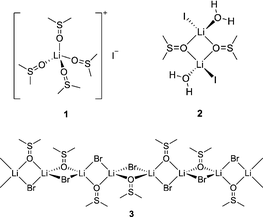
Here, we report the crystal structure of the first mononuclear homoleptic lithium DMSO complex. In this compound, the lithium cation is coordinated by four DMSO ligands in a distorted tetrahedral fashion. The unit cell contains an iodide counter-anion, which is not coordinated. Upon addition of water, a dimeric structure is formed in which two lithium ions are bridged by two DMSO ligands. Each lithium center is further coordinated by one aqua and one iodido ligand. In contrast, using LiBr instead of LiI, leads to the formation of a polymeric structure. This structure is isotypic with the {LiCl·DMSO}n structure reported recently by Valdez et al. (2023).
2. Structural commentary
[{(CH3)2SO}4Li]I (1)
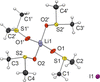
The obtained crystals are colorless. The product crystallizes in the orthorhombic space group Pnc2. The asymmetric unit contains half of the formula unit and is completed by symmetry (Fig. 1). The lithium atom is tetrahedrally coordinated by four DMSO ligands via the oxygen atoms. The Li—O bond lengths are 1.885 (7) and 2.050 (5) Å. The O—Li—O angles deviate from the ideal tetrahedral values with angles in the range from 77.5 (4) to 127.2 (5)°. The homoleptic lithium–DMSO complex reported by Liu et al. (2008) exhibits O—Li bond lengths in the range of 1.890 (9) to 1.96 (1) Å, which are therefore comparable. The iodide acts as a non-coordinating anion. The data obtained here are compromised by a disorder of one of the DMSO ligands.
|
Figure 1
Coordination environment of the Li atom in [{(CH3)2SO}4Li]I (1). Atoms are shown as ellipsoids at the 30% probability level. Hydrogen atoms are displayed as spheres of arbitrary radius. Only one split position of O2 and S2 is shown. Symmetry code; (′) −x, 1 − y, z. |
[I(μ-(CH3)2SO)(H2O)Li]2 (2)
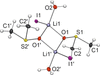
The crystals are colorless. The product crystallizes in the triclinic space group P . The asymmetric unit consists of one lithium atom, the iodido ligand, the DMSO ligand, and one aqua ligand (Fig. 2). Symmetry-imposed inversion leads to the dimeric molecular structure revealing a square of two lithium centers and two oxygen atoms of the two bridging DMSO ligands. Furthermore, each lithium atom is coordinated by one iodido ligand and one aqua ligand. Each Li center exhibits a tetrahedral coordination. The four-membered ring formed by the two lithium ions and two oxygen atoms is constrained to be planar by symmetry with O—Li—O angles of 90.09 (16)°. The Li—O bond lengths 1.928 (4) and 1.921 (4) Å are equal within the esd.
|
Figure 2
Coordination environment of the Li atom in [I(μ-(CH3)2SO)(H2O)Li]2 (2). The second half of the molecule is generated by symmetry. Atoms are shown as ellipsoids at the 30% probability level. Hydrogen atoms are displayed as spheres of arbitrary radius. Symmetry code; (′) 1 − x, 1 − y, 1 − z. |
{LiBr·(CH3)2SO}n (3)
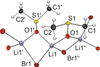
The crystals are colorless. The product crystallizes in the tetragonal space group I41/a. Each lithium atom is coordinated by two DMSO ligands via the oxygen atoms and by two bromido ligands (Fig. 3). Both the DMSO and bromido ligands act as bridging ligands, resulting in a polymeric structure. The Li—O bond lengths are 1.936 (4) and 1.923 (4) Å. The lithium atoms are in a distorted tetrahedral coordination environment with O—Li—Br angles in the range from 97.89 (14) to 119.47 (17)°. This compound is comparable to {LiCl·(CH3)2SO}n, as reported by Valdez et al. (2023), in terms of Li–O bond lengths and O–Li–Cl angles; both compounds also crystallize in the same space group.
|
Figure 3
Detail of the polymeric crystal structure of {LiBr·(CH3)2SO}n (3). Atoms are shown as ellipsoids at the 30% probability level. Hydrogen atoms are displayed as spheres of arbitrary radius. |
3. Supramolecular features
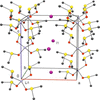
[{(CH3)2SO}4Li]I (1) crystallizes with separate complex cations and iodide anions (Fig. 4).
|
Figure 4
Packing diagram of [{(CH3)2SO}4Li]I (1). The complex cations and iodide anions are separated. |
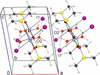
[I(μ-(CH3)2SO)(H2O)Li]2 (2) exhibits an O—H⋯I hydrogen-bonding network in which the iodido ligand acts as a double acceptor (Table 1, Fig. 5), interacting with both hydrogen atoms of the coordinated water molecule (O2—H2A-⋯I = 3.533 (2) Å; O2—H2B-⋯I = 3.522 (2) Å) to form a zigzag chain along the [001] direction.
|
||||||||||||||||||||||
 ; (ii)
 .
|
Figure 5
Packing diagram of [I(μ-(CH3)2SO)(H2O)Li]2 (2). The structure is held together by hydrogen bonding. Hydrogen bonds are shown as dashed lines. |
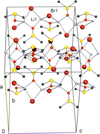
In {LiBr·(CH3)2SO}n (3), hydrogen atoms were added in calculated positions. The resulting distances Br1⋯H1A—C1 3.852 (3) Å and Br1⋯H1B—C1 3.855 (3) Å (Table 2, Fig. 6), suggest that the polymeric units may be held together by hydrogen bonding, analogous to the interactions described for {LiCl·(CH3)2SO}n by Valdez et al. (2023).
|
||||||||||||||||||||||
 .
|
Figure 6
Packing diagram of {LiBr·(CH3)2SO}n (3). The polymeric units may be held together by hydrogen bonding, analogous to the interactions described for {LiCl·(CH3)2SO}n by Valdez et al. (2023 ). |
4. Database survey
A search for different homoleptic DMSO complexes was performed in the Cambridge Structural Database (CSD, version 2026.1.0, February 2026; Groom et al., 2016). The ambidentate nature of DMSO was taken into account. A variety of homoleptic DMSO complexes was identified, but only a few contained alkali metals as central atoms. Only one homoleptic lithium DMSO complex is known (Liu et al., 2008; CSD refcode TOQFIP). This complex is binuclear, with two DMSO molecules acting as bridging ligands. No homoleptic, homonuclear lithium DMSO complex was found.
5. Synthesis and crystallization
The reactions were carried out by using LiBr (Sigma-Aldrich, ≥99%), LiI (TCI, 99.9%), dimethylsulfoxide-d6 (deutero, 99.8%) and o-difluorobenzene (abcr, 98%). Dimethylsulfoxide-d6 (DMSO-d6) and o-difluorobenzene (o-DFB) were stored over molecular sieve (3 Å) before use. All operations involving LiI were carried out with all laboratory lights switched off. The reaction flask was wrapped in aluminum foil.
[{(CH3)2SO}4Li]I (1)
LiI (425 mg, 3.18 mmol) was dissolved in DMSO-d6 (3 mL, 41.5 mmol). After stirring for 30 min, volatile components were removed in vacuo. A few single crystals suitable for X-ray diffraction analysis were obtained from the colorless solid, which was isolated in quantitative yield.
7Li NMR (194 MHz, 298 K, DMSO-d6) δ: −1.1 ppm.
[I(μ-(CH3)2SO)(H2O)Li]2 (2)
LiI (500 mg, 3.74 mmol) and DMSO-d6 (0.27 mL, 3.74 mmol) were dissolved in H2O (10 mL). The resulting solution was stirred for 30 min before volatile components were removed in vacuo. A few single crystals suitable for X-ray diffraction analysis were obtained from the colorless solid, which was isolated in quantitative yield.
7Li NMR (194 MHz, 298 K, DMSO-d6) δ: −1.1 ppm.
{LiBr·(CH3)2SO}n (3)
LiBr (1000 mg, 11.5 mmol) was suspended in o-DFB (5 mL). DMSO-d6 (0.76 mL, 11.1 mmol) was added, and the suspension was stirred for 20 h. Volatile components were removed in vacuo. Single crystals suitable for X-ray diffraction analysis were obtained from the colorless solid, which was isolated in quantitative yield.
7Li NMR (194 MHz, 298 K, DMSO-d6) δ: −1.1 ppm.
6. Refinement
Crystal data, data collection and structure refinement details are summarized in Table 3. The disorder of one DMSO ligand in 1 was modeled by refinement of two split positions with a fixed occupancy of 0.5 for each position.
|
Supporting information
Crystal structure: contains datablocks 1, 2, 3. DOI: https://doi.org/10.1107/S2056989026011746/dj2092sup1.cif
Structure factors: contains datablock 1. DOI: https://doi.org/10.1107/S2056989026011746/dj20921sup2.hkl
Structure factors: contains datablock 2. DOI: https://doi.org/10.1107/S2056989026011746/dj20922sup3.hkl
Structure factors: contains datablock 3. DOI: https://doi.org/10.1107/S2056989026011746/dj20923sup4.hkl
Supporting information file. DOI: https://doi.org/10.1107/S2056989026011746/dj20923sup5.cml
Supporting information file. DOI: https://doi.org/10.1107/S2056989026011746/dj20922sup6.cml
Supporting information file. DOI: https://doi.org/10.1107/S2056989026011746/dj20921sup7.cml
| Li(C2H6OS)4]I | Dx = 1.576 Mg m−3 |
| Mr = 446.35 | Mo Kα radiation, λ = 0.71073 Å |
| Orthorhombic, Pnc2 | Cell parameters from 12512 reflections |
| a = 9.4961 (7) Å | θ = 2.1–31.5° |
| b = 9.7157 (7) Å | µ = 2.15 mm−1 |
| c = 10.1935 (6) Å | T = 100 K |
| V = 940.47 (11) Å3 | Plate, colorless |
| Z = 2 | 0.23 × 0.16 × 0.07 mm |
| F(000) = 448 |
| Stoe STADIVARI diffractometer | 2726 independent reflections |
| Radiation source: Mo Genix | 2331 reflections with I > 2σ(I) |
| Graded multilayer mirror monochromator | Rint = 0.021 |
| Detector resolution: 5.81 pixels mm-1 | θmax = 31.3°, θmin = 2.2° |
| rotation method, ω scans | h = −13→12 |
| Absorption correction: multi-scan [LANA (Stoe & Cie, 2016), absorption correction by scaling of reflection intensities (Koziskova et al., 2016)] | k = −14→10 |
| Tmin = 0.442, Tmax = 0.780 | l = −12→14 |
| 9875 measured reflections |
| Refinement on F2 | Hydrogen site location: inferred from neighbouring sites |
| Least-squares matrix: full | H-atom parameters constrained |
| R[F2 > 2σ(F2)] = 0.020 | w = 1/[σ2(Fo2) + (0.0212P)2] where P = (Fo2 + 2Fc2)/3 |
| wR(F2) = 0.039 | (Δ/σ)max < 0.001 |
| S = 0.96 | Δρmax = 0.31 e Å−3 |
| 2726 reflections | Δρmin = −0.49 e Å−3 |
| 125 parameters | Absolute structure: Flack x determined using 943 quotients [(I+)-(I-)]/[(I+)+(I-)] (Parsons et al., 2013) |
| 15 restraints | Absolute structure parameter: 0.001 (16) |
| Primary atom site location: dual |
Geometry. All esds (except the esd in the dihedral angle between two l.s. planes) are estimated using the full covariance matrix. The cell esds are taken into account individually in the estimation of esds in distances, angles and torsion angles; correlations between esds in cell parameters are only used when they are defined by crystal symmetry. An approximate (isotropic) treatment of cell esds is used for estimating esds involving l.s. planes. |
| x | y | z | Uiso*/Ueq | Occ. (<1) | |
| I1 | 0.500000 | 1.000000 | 0.52473 (4) | 0.01896 (6) | |
| S1 | 0.21522 (8) | 0.72030 (7) | 0.39164 (7) | 0.02024 (14) | |
| S3 | 0.19760 (17) | 0.30411 (16) | 0.59470 (14) | 0.0227 (3) | 0.5 |
| S2 | 0.12958 (15) | 0.30539 (14) | 0.67128 (14) | 0.0171 (3) | 0.5 |
| O1 | 0.1025 (2) | 0.6197 (2) | 0.35067 (19) | 0.0288 (5) | |
| C1 | 0.3730 (3) | 0.6217 (3) | 0.4114 (3) | 0.0215 (6) | |
| H1A | 0.359794 | 0.554159 | 0.481763 | 0.032* | |
| H1B | 0.451106 | 0.683248 | 0.434088 | 0.032* | |
| H1C | 0.394627 | 0.573723 | 0.329294 | 0.032* | |
| C2 | 0.2638 (4) | 0.8084 (3) | 0.2449 (3) | 0.0277 (7) | |
| H2A | 0.285100 | 0.741156 | 0.176079 | 0.042* | |
| H2B | 0.347265 | 0.865176 | 0.261641 | 0.042* | |
| H2C | 0.185893 | 0.867396 | 0.216435 | 0.042* | |
| Li1 | 0.000000 | 0.500000 | 0.4651 (8) | 0.0277 (16) | |
| O3 | 0.0883 (5) | 0.4146 (4) | 0.6093 (4) | 0.0265 (10) | 0.5 |
| O2 | 0.1628 (5) | 0.3981 (4) | 0.5546 (4) | 0.0205 (10) | 0.5 |
| C5 | 0.104 (3) | 0.148 (2) | 0.5652 (14) | 0.026 (4) | 0.5 |
| H5A | 0.033998 | 0.133971 | 0.634697 | 0.039* | 0.5 |
| H5B | 0.170010 | 0.070576 | 0.564397 | 0.039* | 0.5 |
| H5C | 0.055929 | 0.153570 | 0.480161 | 0.039* | 0.5 |
| C3 | 0.105 (3) | 0.137 (2) | 0.6056 (15) | 0.023 (3) | 0.5 |
| H3A | 0.020824 | 0.136477 | 0.549850 | 0.035* | 0.5 |
| H3B | 0.092891 | 0.071439 | 0.677512 | 0.035* | 0.5 |
| H3C | 0.187379 | 0.111623 | 0.553285 | 0.035* | 0.5 |
| C4 | 0.2957 (17) | 0.274 (3) | 0.751 (3) | 0.029 (4) | 0.5 |
| H4A | 0.365561 | 0.246442 | 0.685042 | 0.043* | 0.5 |
| H4B | 0.284753 | 0.201174 | 0.815881 | 0.043* | 0.5 |
| H4C | 0.327451 | 0.358875 | 0.794144 | 0.043* | 0.5 |
| C6 | 0.2568 (18) | 0.261 (3) | 0.756 (2) | 0.028 (4) | 0.5 |
| H6A | 0.318226 | 0.334128 | 0.789262 | 0.042* | 0.5 |
| H6B | 0.309246 | 0.174060 | 0.753185 | 0.042* | 0.5 |
| H6C | 0.175404 | 0.250783 | 0.814450 | 0.042* | 0.5 |
| U11 | U22 | U33 | U12 | U13 | U23 | |
| I1 | 0.01963 (10) | 0.01998 (10) | 0.01727 (10) | −0.00264 (12) | 0.000 | 0.000 |
| S1 | 0.0202 (3) | 0.0247 (3) | 0.0158 (3) | 0.0017 (3) | 0.0002 (3) | −0.0022 (3) |
| S3 | 0.0243 (8) | 0.0226 (8) | 0.0213 (8) | −0.0029 (7) | −0.0030 (7) | 0.0007 (6) |
| S2 | 0.0162 (7) | 0.0161 (7) | 0.0189 (7) | 0.0020 (6) | 0.0051 (6) | 0.0040 (5) |
| O1 | 0.0206 (11) | 0.0424 (14) | 0.0234 (10) | −0.0105 (11) | −0.0029 (9) | 0.0039 (9) |
| C1 | 0.0199 (15) | 0.0191 (14) | 0.0254 (15) | −0.0001 (12) | 0.0008 (12) | −0.0003 (12) |
| C2 | 0.035 (2) | 0.0281 (17) | 0.0198 (14) | −0.0065 (15) | −0.0042 (13) | 0.0022 (13) |
| Li1 | 0.047 (5) | 0.017 (3) | 0.019 (3) | −0.001 (4) | 0.000 | 0.000 |
| O3 | 0.030 (3) | 0.023 (2) | 0.026 (2) | 0.005 (2) | −0.007 (2) | 0.0023 (18) |
| O2 | 0.021 (2) | 0.015 (2) | 0.026 (3) | −0.0019 (17) | −0.0016 (18) | 0.0123 (17) |
| C5 | 0.020 (4) | 0.018 (5) | 0.039 (10) | −0.002 (4) | 0.003 (8) | −0.003 (6) |
| C3 | 0.023 (4) | 0.019 (5) | 0.027 (8) | −0.004 (4) | −0.001 (7) | 0.006 (5) |
| C4 | 0.028 (9) | 0.027 (5) | 0.031 (6) | 0.001 (6) | −0.009 (6) | 0.003 (4) |
| C6 | 0.034 (9) | 0.032 (7) | 0.018 (5) | 0.007 (8) | −0.006 (6) | −0.001 (5) |
| S1—O1 | 1.509 (2) | Li1—O3i | 1.885 (7) |
| S1—C1 | 1.790 (3) | Li1—O3 | 1.885 (7) |
| S1—C2 | 1.784 (3) | Li1—O2i | 2.050 (5) |
| S3—Li1 | 2.981 (4) | Li1—O2 | 2.050 (5) |
| S3—O3 | 1.500 (5) | C5—H5A | 0.9800 |
| S3—C5 | 1.78 (2) | C5—H5B | 0.9800 |
| S3—C6 | 1.79 (2) | C5—H5C | 0.9800 |
| S2—O2 | 1.525 (4) | C3—H3A | 0.9800 |
| S2—C3 | 1.78 (2) | C3—H3B | 0.9800 |
| S2—C4 | 1.80 (2) | C3—H3C | 0.9800 |
| O1—Li1 | 1.913 (5) | C4—H4A | 0.9800 |
| C1—H1A | 0.9800 | C4—H4B | 0.9800 |
| C1—H1B | 0.9800 | C4—H4C | 0.9800 |
| C1—H1C | 0.9800 | C6—H6A | 0.9800 |
| C2—H2A | 0.9800 | C6—H6B | 0.9800 |
| C2—H2B | 0.9800 | C6—H6C | 0.9800 |
| C2—H2C | 0.9800 | ||
| O1—S1—C1 | 106.18 (13) | O3i—Li1—S3 | 102.5 (3) |
| O1—S1—C2 | 105.22 (13) | O3—Li1—O1 | 121.12 (17) |
| C2—S1—C1 | 97.74 (15) | O3i—Li1—O1 | 115.74 (16) |
| O3—S3—Li1 | 32.0 (2) | O3i—Li1—O3 | 77.5 (4) |
| O3—S3—C5 | 106.2 (8) | O3i—Li1—O2i | 26.46 (17) |
| O3—S3—C6 | 107.1 (8) | O3—Li1—O2i | 101.6 (4) |
| C5—S3—Li1 | 98.9 (6) | O2—Li1—S3i | 125.9 (3) |
| C5—S3—C6 | 96.5 (9) | O2i—Li1—S3i | 11.43 (12) |
| C6—S3—Li1 | 139.0 (8) | O2i—Li1—O2 | 127.2 (5) |
| O2—S2—C3 | 106.0 (5) | S3—O3—Li1 | 123.0 (3) |
| O2—S2—C4 | 105.5 (8) | S2—O2—Li1 | 118.4 (3) |
| C3—S2—C4 | 97.5 (12) | S3—C5—H5A | 109.5 |
| S1—O1—Li1 | 125.9 (2) | S3—C5—H5B | 109.5 |
| S1—C1—H1A | 109.5 | S3—C5—H5C | 109.5 |
| S1—C1—H1B | 109.5 | H5A—C5—H5B | 109.5 |
| S1—C1—H1C | 109.5 | H5A—C5—H5C | 109.5 |
| H1A—C1—H1B | 109.5 | H5B—C5—H5C | 109.5 |
| H1A—C1—H1C | 109.5 | S2—C3—H3A | 109.5 |
| H1B—C1—H1C | 109.5 | S2—C3—H3B | 109.5 |
| S1—C2—H2A | 109.5 | S2—C3—H3C | 109.5 |
| S1—C2—H2B | 109.5 | H3A—C3—H3B | 109.5 |
| S1—C2—H2C | 109.5 | H3A—C3—H3C | 109.5 |
| H2A—C2—H2B | 109.5 | H3B—C3—H3C | 109.5 |
| H2A—C2—H2C | 109.5 | S2—C4—H4A | 109.5 |
| H2B—C2—H2C | 109.5 | S2—C4—H4B | 109.5 |
| S3i—Li1—S3 | 127.4 (3) | S2—C4—H4C | 109.5 |
| O1—Li1—S3 | 109.76 (8) | H4A—C4—H4B | 109.5 |
| O1—Li1—S3i | 101.67 (8) | H4A—C4—H4C | 109.5 |
| O1i—Li1—S3 | 101.67 (8) | H4B—C4—H4C | 109.5 |
| O1i—Li1—S3i | 109.76 (8) | S3—C6—H6A | 109.5 |
| O1i—Li1—O1 | 104.9 (4) | S3—C6—H6B | 109.5 |
| O1—Li1—O2i | 111.17 (15) | S3—C6—H6C | 109.5 |
| O1i—Li1—O2i | 100.45 (14) | H6A—C6—H6B | 109.5 |
| O1—Li1—O2 | 100.45 (14) | H6A—C6—H6C | 109.5 |
| O1i—Li1—O2 | 111.17 (15) | H6B—C6—H6C | 109.5 |
| O3—Li1—S3 | 24.95 (15) | ||
| S3i—Li1—O3—S3 | 179.1 (3) | O3i—Li1—O3—S3 | 178.5 (5) |
| O1—Li1—O3—S3 | −68.8 (4) | C5—S3—O3—Li1 | −80.6 (5) |
| O1i—Li1—O3—S3 | 59.7 (4) | C3—S2—O2—Li1 | 93.1 (9) |
| C1—S1—O1—Li1 | 80.3 (2) | C4—S2—O2—Li1 | −164.1 (10) |
| C2—S1—O1—Li1 | −176.76 (17) | C6—S3—O3—Li1 | 177.2 (7) |
| Symmetry code: (i) −x, −y+1, z. |
| [Li2I2(C2H6OS)2(H2O)2] | Z = 1 |
| Mr = 459.97 | F(000) = 216 |
| Triclinic, P1 | Dx = 1.996 Mg m−3 |
| a = 6.2824 (6) Å | Mo Kα radiation, λ = 0.71073 Å |
| b = 7.4147 (8) Å | Cell parameters from 12597 reflections |
| c = 8.3722 (9) Å | θ = 2.5–32.5° |
| α = 96.563 (9)° | µ = 4.37 mm−1 |
| β = 97.701 (8)° | T = 100 K |
| γ = 93.656 (8)° | Plate, colorless |
| V = 382.70 (7) Å3 | 0.29 × 0.22 × 0.09 mm |
| Stoe STADIVARI diffractometer | 2173 independent reflections |
| Radiation source: Mo Genix | 2043 reflections with I > 2σ(I) |
| Graded multilayer mirror monochromator | Rint = 0.020 |
| Detector resolution: 5.81 pixels mm-1 | θmax = 30.0°, θmin = 2.5° |
| rotation method, ω scans | h = −8→8 |
| Absorption correction: multi-scan [LANA (Stoe & Cie, 2016), absorption correction by scaling of reflection intensities (Koziskova et al., 2016)] | k = −10→10 |
| Tmin = 0.282, Tmax = 0.675 | l = −9→11 |
| 4662 measured reflections |
| Refinement on F2 | Primary atom site location: dual |
| Least-squares matrix: full | Hydrogen site location: mixed |
| R[F2 > 2σ(F2)] = 0.020 | H atoms treated by a mixture of independent and constrained refinement |
| wR(F2) = 0.051 | w = 1/[σ2(Fo2) + (0.0356P)2 + 0.0323P] where P = (Fo2 + 2Fc2)/3 |
| S = 1.04 | (Δ/σ)max = 0.001 |
| 2173 reflections | Δρmax = 1.10 e Å−3 |
| 74 parameters | Δρmin = −1.08 e Å−3 |
| 0 restraints |
Geometry. All esds (except the esd in the dihedral angle between two l.s. planes) are estimated using the full covariance matrix. The cell esds are taken into account individually in the estimation of esds in distances, angles and torsion angles; correlations between esds in cell parameters are only used when they are defined by crystal symmetry. An approximate (isotropic) treatment of cell esds is used for estimating esds involving l.s. planes. |
| x | y | z | Uiso*/Ueq | ||
| I1 | 0.13264 (2) | 0.75536 (2) | 0.24545 (2) | 0.01794 (6) | |
| S1 | 0.63060 (8) | 0.38667 (6) | 0.18966 (6) | 0.01450 (10) | |
| O1 | 0.5700 (3) | 0.4373 (2) | 0.35839 (18) | 0.0197 (3) | |
| O2 | 0.7103 (3) | 0.8526 (3) | 0.4711 (3) | 0.0287 (4) | |
| H2A | 0.746 (5) | 0.927 (4) | 0.534 (4) | 0.024 (8)* | |
| H2B | 0.823 (5) | 0.819 (4) | 0.424 (4) | 0.029 (8)* | |
| C1 | 0.8294 (4) | 0.2296 (3) | 0.2201 (3) | 0.0243 (4) | |
| H1A | 0.957584 | 0.291679 | 0.289030 | 0.036* | |
| H1B | 0.868221 | 0.180956 | 0.114980 | 0.036* | |
| H1C | 0.772281 | 0.129574 | 0.273113 | 0.036* | |
| C2 | 0.4138 (4) | 0.2340 (3) | 0.0840 (3) | 0.0228 (4) | |
| H2C | 0.390296 | 0.132616 | 0.146814 | 0.034* | |
| H2D | 0.449144 | 0.186752 | −0.022589 | 0.034* | |
| H2E | 0.282604 | 0.298657 | 0.069706 | 0.034* | |
| Li1 | 0.4847 (6) | 0.6675 (5) | 0.4501 (5) | 0.0198 (7) |
| U11 | U22 | U33 | U12 | U13 | U23 | |
| I1 | 0.01576 (8) | 0.02273 (8) | 0.01467 (8) | 0.00095 (5) | 0.00006 (5) | 0.00234 (5) |
| S1 | 0.0161 (2) | 0.0155 (2) | 0.0124 (2) | 0.00190 (17) | 0.00215 (17) | 0.00344 (16) |
| O1 | 0.0263 (8) | 0.0205 (7) | 0.0137 (7) | 0.0064 (6) | 0.0062 (6) | 0.0012 (5) |
| O2 | 0.0219 (8) | 0.0261 (8) | 0.0355 (10) | −0.0059 (7) | 0.0090 (7) | −0.0088 (8) |
| C1 | 0.0251 (10) | 0.0311 (11) | 0.0189 (10) | 0.0135 (9) | 0.0044 (8) | 0.0049 (8) |
| C2 | 0.0214 (10) | 0.0240 (10) | 0.0208 (11) | −0.0059 (8) | −0.0001 (8) | 0.0017 (8) |
| Li1 | 0.0200 (17) | 0.0193 (16) | 0.0203 (18) | 0.0022 (13) | 0.0020 (14) | 0.0036 (13) |
| I1—Li1 | 2.770 (4) | O2—Li1 | 1.885 (4) |
| S1—O1 | 1.5240 (15) | C1—H1A | 0.9800 |
| S1—C1 | 1.774 (2) | C1—H1B | 0.9800 |
| S1—C2 | 1.781 (2) | C1—H1C | 0.9800 |
| O1—Li1 | 1.928 (4) | C2—H2C | 0.9800 |
| O1—Li1i | 1.921 (4) | C2—H2D | 0.9800 |
| O2—H2A | 0.72 (3) | C2—H2E | 0.9800 |
| O2—H2B | 0.89 (3) | Li1—Li1i | 2.720 (7) |
| O1—S1—C1 | 104.06 (10) | S1—C2—H2D | 109.5 |
| O1—S1—C2 | 105.32 (10) | S1—C2—H2E | 109.5 |
| C1—S1—C2 | 99.29 (12) | H2C—C2—H2D | 109.5 |
| S1—O1—Li1 | 128.17 (15) | H2C—C2—H2E | 109.5 |
| S1—O1—Li1i | 141.67 (15) | H2D—C2—H2E | 109.5 |
| Li1i—O1—Li1 | 89.91 (16) | O1—Li1—I1 | 107.72 (17) |
| H2A—O2—H2B | 108 (3) | O1i—Li1—I1 | 117.58 (17) |
| Li1—O2—H2A | 132 (2) | O1i—Li1—O1 | 90.09 (16) |
| Li1—O2—H2B | 114 (2) | O1i—Li1—Li1i | 45.15 (12) |
| S1—C1—H1A | 109.5 | O1—Li1—Li1i | 44.93 (12) |
| S1—C1—H1B | 109.5 | O2—Li1—I1 | 109.86 (17) |
| S1—C1—H1C | 109.5 | O2—Li1—O1 | 111.3 (2) |
| H1A—C1—H1B | 109.5 | O2—Li1—O1i | 118.1 (2) |
| H1A—C1—H1C | 109.5 | O2—Li1—Li1i | 126.2 (3) |
| H1B—C1—H1C | 109.5 | Li1i—Li1—I1 | 122.9 (2) |
| S1—C2—H2C | 109.5 | ||
| C1—S1—O1—Li1i | −40.9 (3) | C2—S1—O1—Li1 | −109.4 (2) |
| C1—S1—O1—Li1 | 146.7 (2) | C2—S1—O1—Li1i | 63.0 (3) |
| Symmetry code: (i) −x+1, −y+1, −z+1. |
| D—H···A | D—H | H···A | D···A | D—H···A |
| O2—H2A···I1ii | 0.72 (3) | 2.8 (3) | 3.533 (2) | 173 (3) |
| O2—H2B···I1iii | 0.89 (3) | 2.64 (3) | 3.522 (2) | 170 (3) |
| Symmetry codes: (ii) −x+1, −y+2, −z+1; (iii) x+1, y, z. |
| LiBr(C2H6OS)] | Dx = 1.852 Mg m−3 |
| Mr = 164.98 | Cu Kα radiation, λ = 1.54186 Å |
| Tetragonal, I41/a | Cell parameters from 8396 reflections |
| a = 14.6281 (5) Å | θ = 5.0–71.7° |
| c = 11.0592 (4) Å | µ = 11.67 mm−1 |
| V = 2366.46 (18) Å3 | T = 200 K |
| Z = 16 | Block, yellow |
| F(000) = 1280 | 0.14 × 0.11 × 0.1 mm |
| Stoe STADIVARI diffractometer | 1134 independent reflections |
| Radiation source: Cu-Genix | 1105 reflections with I > 2σ(I) |
| Graded multilayer mirror monochromator | Rint = 0.018 |
| Detector resolution: 5.81 pixels mm-1 | θmax = 71.5°, θmin = 5.0° |
| rotation method, ω scans | h = −11→17 |
| Absorption correction: multi-scan [LANA (Stoe & Cie, 2016), absorption correction by scaling of reflection intensities (Koziskova et al., 2016)] | k = −17→10 |
| Tmin = 0.195, Tmax = 0.311 | l = −5→13 |
| 3825 measured reflections |
| Refinement on F2 | Hydrogen site location: inferred from neighbouring sites |
| Least-squares matrix: full | H-atom parameters constrained |
| R[F2 > 2σ(F2)] = 0.024 | w = 1/[σ2(Fo2) + (0.0448P)2 + 2.6713P] where P = (Fo2 + 2Fc2)/3 |
| wR(F2) = 0.067 | (Δ/σ)max = 0.001 |
| S = 1.08 | Δρmax = 0.58 e Å−3 |
| 1134 reflections | Δρmin = −0.34 e Å−3 |
| 58 parameters | Extinction correction: SHELXL-2025/1 (Sheldrick 2015b), Fc*=kFc[1+0.001xFc2λ3/sin(2θ)]-1/4 |
| 0 restraints | Extinction coefficient: 0.00014 (3) |
| Primary atom site location: dual |
Geometry. All esds (except the esd in the dihedral angle between two l.s. planes) are estimated using the full covariance matrix. The cell esds are taken into account individually in the estimation of esds in distances, angles and torsion angles; correlations between esds in cell parameters are only used when they are defined by crystal symmetry. An approximate (isotropic) treatment of cell esds is used for estimating esds involving l.s. planes. |
| x | y | z | Uiso*/Ueq | ||
| Br1 | 0.10586 (2) | 0.43230 (2) | 0.35529 (2) | 0.03321 (15) | |
| S1 | 0.19696 (4) | 0.66089 (4) | 0.62759 (5) | 0.02597 (16) | |
| O1 | 0.20946 (11) | 0.55714 (11) | 0.62543 (13) | 0.0298 (4) | |
| C1 | 0.11884 (16) | 0.68087 (15) | 0.7477 (2) | 0.0324 (5) | |
| H1A | 0.064721 | 0.642234 | 0.736820 | 0.049* | |
| H1B | 0.100494 | 0.745303 | 0.747540 | 0.049* | |
| H1C | 0.148187 | 0.666091 | 0.824886 | 0.049* | |
| Li1 | 0.2330 (2) | 0.4758 (3) | 0.4924 (3) | 0.0293 (7) | |
| C2 | 0.12427 (17) | 0.68524 (16) | 0.5030 (2) | 0.0365 (5) | |
| H2A | 0.157618 | 0.674927 | 0.427333 | 0.055* | |
| H2B | 0.104400 | 0.749146 | 0.507005 | 0.055* | |
| H2C | 0.070695 | 0.645070 | 0.505827 | 0.055* |
| U11 | U22 | U33 | U12 | U13 | U23 | |
| Br1 | 0.03019 (18) | 0.03499 (19) | 0.0344 (2) | −0.00953 (9) | −0.00390 (8) | 0.00083 (9) |
| S1 | 0.0238 (3) | 0.0260 (3) | 0.0281 (3) | −0.0009 (2) | −0.00096 (18) | 0.00102 (19) |
| O1 | 0.0366 (8) | 0.0282 (8) | 0.0245 (7) | 0.0088 (7) | −0.0021 (6) | −0.0014 (6) |
| C1 | 0.0355 (11) | 0.0283 (10) | 0.0335 (12) | 0.0026 (8) | 0.0028 (9) | −0.0039 (8) |
| Li1 | 0.0345 (18) | 0.0312 (18) | 0.0224 (16) | −0.0024 (15) | −0.0009 (14) | 0.0001 (13) |
| C2 | 0.0440 (12) | 0.0334 (12) | 0.0323 (12) | 0.0075 (10) | −0.0061 (10) | 0.0034 (9) |
| Br1—Li1 | 2.482 (4) | C1—H1B | 0.9800 |
| Br1—Li1i | 2.485 (4) | C1—H1C | 0.9800 |
| S1—O1 | 1.5288 (16) | Li1—Li1ii | 2.8318 (12) |
| S1—C1 | 1.776 (2) | Li1—Li1i | 2.8318 (11) |
| S1—C2 | 1.777 (2) | C2—H2A | 0.9800 |
| O1—Li1ii | 1.936 (4) | C2—H2B | 0.9800 |
| O1—Li1 | 1.923 (4) | C2—H2C | 0.9800 |
| C1—H1A | 0.9800 | ||
| Li1—Br1—Li1i | 69.52 (9) | Br1—Li1—Li1i | 55.28 (11) |
| O1—S1—C1 | 104.60 (10) | O1—Li1—Br1 | 119.47 (17) |
| O1—S1—C2 | 104.98 (10) | O1i—Li1—Br1 | 97.89 (14) |
| C1—S1—C2 | 99.32 (12) | O1i—Li1—Br1ii | 113.68 (17) |
| S1—O1—Li1ii | 127.19 (14) | O1—Li1—Br1ii | 98.14 (14) |
| S1—O1—Li1 | 130.35 (14) | O1—Li1—O1i | 107.98 (18) |
| Li1—O1—Li1ii | 94.41 (12) | O1—Li1—Li1i | 127.48 (19) |
| S1—C1—H1A | 109.5 | O1i—Li1—Li1ii | 120.98 (19) |
| S1—C1—H1B | 109.5 | O1i—Li1—Li1i | 42.63 (10) |
| S1—C1—H1C | 109.5 | O1—Li1—Li1ii | 42.96 (10) |
| H1A—C1—H1B | 109.5 | Li1ii—Li1—Li1i | 162.41 (15) |
| H1A—C1—H1C | 109.5 | S1—C2—H2A | 109.5 |
| H1B—C1—H1C | 109.5 | S1—C2—H2B | 109.5 |
| Br1—Li1—Br1ii | 119.98 (15) | S1—C2—H2C | 109.5 |
| Br1ii—Li1—Li1i | 131.27 (15) | H2A—C2—H2B | 109.5 |
| Br1ii—Li1—Li1ii | 55.19 (11) | H2A—C2—H2C | 109.5 |
| Br1—Li1—Li1ii | 139.95 (16) | H2B—C2—H2C | 109.5 |
| C1—S1—O1—Li1 | 148.03 (19) | C2—S1—O1—Li1ii | −175.54 (19) |
| C1—S1—O1—Li1ii | −71.5 (2) | C2—S1—O1—Li1 | 44.0 (2) |
| Symmetry codes: (i) y−1/4, −x+3/4, z−1/4; (ii) −y+3/4, x+1/4, z+1/4. |
| D—H···A | D—H | H···A | D···A | D—H···A |
| C1—H1A···Br1iii | 0.98 | 2.91 | 3.852 (3) | 162 |
| C1—H1B···Br1iii | 0.98 | 2.96 | 3.852 (3) | 152 |
| Symmetry code: (iii) −x, −y, −z+1. |
Acknowledgements
We thank Astrid Pilz for technical support in the X-ray lab.
References
 Bobicz, D., Kristiansson, O. & Persson, I. (2002). J. Chem. Soc. Dalton Trans. pp. 4201–4205.
Web of Science
CrossRef
Google Scholar
Bushkova, O. V., Yaroslavtseva, T. V. & Dobrovolsky, Y. A. (2017). Russ. J. Electrochem. 53, 677–699.
Web of Science
CrossRef
CAS
Google Scholar
Dolomanov, O. V., Bourhis, L. J., Gildea, R. J., Howard, J. A. K. & Puschmann, H. (2009). J. Appl. Cryst. 42, 339–341.
Web of Science
CrossRef
CAS
IUCr Journals
Google Scholar
Duarte-Ruiz, A., Nuñez-Dallos, N., Garzón-Tovar, L., Wurst, K., Avella-Moreno, E. & Gómez-Baquero, F. (2011). Chem. Commun. 47, 7110–7112.
CAS
Google Scholar
Farrugia, L. J. (2012). J. Appl. Cryst. 45, 849–854.
Web of Science
CrossRef
CAS
IUCr Journals
Google Scholar
Groom, C. R., Bruno, I. J., Lightfoot, M. P. & Ward, S. C. (2016). Acta Cryst. B72, 171–179.
Web of Science
CrossRef
IUCr Journals
Google Scholar
Koziskova, J., Hahn, F., Richter, J. & Kozisek, J. (2016). Acta Chim. Slovaca 9, 136–140.
CrossRef
CAS
Google Scholar
Liu, L., Zakharov, L. N., Golen, J. A., Rheingold, A. L. & Hanna, T. A. (2008). Inorg. Chem. 47, 11143–11153.
CSD
CrossRef
PubMed
CAS
Google Scholar
Liu, Y., Zhang, J., Gong, L. & Zhang, C. (2016). J. Clust Sci. 27, 1353–1364.
CSD
CrossRef
CAS
Google Scholar
Mauger, A., Julien, C. M., Paolella, A., Armand, M. & Zaghib, K. (2018). Mater. Sci. Eng. Rep. 134, 1–21.
Web of Science
CrossRef
Google Scholar
Parsons, S., Flack, H. D. & Wagner, T. (2013). Acta Cryst. B69, 249–259.
Web of Science
CSD
CrossRef
CAS
IUCr Journals
Google Scholar
Persson, I. (1982). Acta Chem. Scand. A36, 7–13.
CSD
CrossRef
CAS
Google Scholar
Plata, R. E., Hill, D. E., Haines, B. E., Musaev, D. G., Chu, L., Hickey, D. P., Sigman, M. S., Yu, J.-Q. & Blackmond, D. G. (2017). J. Am. Chem. Soc. 139, 9238–9245.
CSD
CrossRef
CAS
PubMed
Google Scholar
Sharutin, V. (2016). CSD Communication (CCDC 1035080, refcode AZOCUP). CCDC, Cambridge, England.
Google Scholar
Sheldrick, G. M. (2015a). Acta Cryst. A71, 3–8.
Web of Science
CrossRef
IUCr Journals
Google Scholar
Sheldrick, G. M. (2015b). Acta Cryst. C71, 3–8.
Web of Science
CrossRef
IUCr Journals
Google Scholar
Stoe & Cie (2016). X-AREA software suite. Stoe & Cie, Darmstadt, Germany.
Google Scholar
Takemoto, S., Tsujimoto, T. & Matsuzaka, H. (2018). Organometallics 37, 1591–1597.
CSD
CrossRef
CAS
Google Scholar
Valdez, N. R., Herman, D. J., Nemer, M. B., Rodriguez, M. A. & Allcorn, E. (2023). Acta Cryst. E79, 33–37.
CSD
CrossRef
IUCr Journals
Google Scholar
Wu, X., Wang, P., Turner, P., Lewis, W., Catal, O., Thomas, D. S. & Gale, P. A. (2019). Chem 5, 1210–1222.
CSD
CrossRef
CAS
Google Scholar
Yang, X., Qaid, S. M. H., Wang, B., Cai, W., Qian, Q. & Zang, Z. (2023). Inorg. Chem. 62, 18591–18598.
CSD
CrossRef
PubMed
Google Scholar
Younesi, R., Veith, G. M., Johansson, P., Edström, K. & Vegge, T. (2015). Energy Environ. Sci. 8, 1905–1922.
Web of Science
CrossRef
CAS
Google Scholar
This is an open-access article distributed under the terms of the Creative Commons Attribution (CC-BY) Licence, which permits unrestricted use, distribution, and reproduction in any medium, provided the original authors and source are cited.
| CRYSTALLOGRAPHIC COMMUNICATIONS |