
Acta Crystallographica
Section E CRYSTALLOGRAPHIC COMMUNICATIONS


 menu


research communications
| CRYSTALLOGRAPHIC COMMUNICATIONS |
 access
Synthesis and structure of 2,4-di-tert-butyl-6-[(naphthalen-2-ylimino)methyl]phenol

aPG & Research Department of Chemistry, Seethalakshmi Ramaswami College (Autonomous), (Affiliated to Bharathidasan University), Tiruchirappalli-620 002, Tamil Nadu, India, and bPG & Research Department of Physics, Thanthai Periyar Government Arts & Science College (Autonomous), (Affiliated to Bharathidasan University), Tiruchirappalli-620 023, Tamil Nadu, India
*Correspondence e-mail: [email protected]
In the title compound, C25H29NO, the dihedral angle between the naphthyl ring system and the phenol ring is 16.41 (4)°. An intramolecular O—H⋯N hydrogen bond is observed. The extended structure features a weak C—H⋯O interaction. Hirshfeld surface analysis showed that H⋯H contacts contribute the highest contact percentage (69.3%), followed by C⋯H/H⋯C (23.1%), C⋯C (2.9%), N⋯H/H⋯N (2.6%), and O⋯H/H⋯O (2.1%).
Keywords: crystal structure.
CCDC reference: 2597481
1. Chemical context
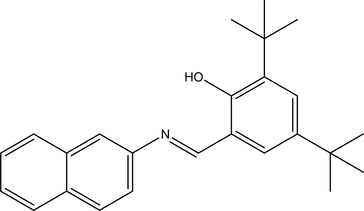
Salicylaldimine-type Schiff bases with a hydroxyl group ortho to the azomethine (–C=N–) linkage are known for their photochromic behaviour, and Schiff bases of this type usually feature an intramolecular O—H⋯N hydrogen bond (Carreño et al., 2025 ; Kansiz et al., 2018). Schiff bases derived from 3,5-di-tert-butyl-2-hydroxybenzaldehyde can show proton tautomerization, which plays an important role in chemistry and biochemistry (Mason et al., 2021; Carreno et al., 2025). The bulky tert-butyl groups at the 3- and 5-positions add steric protection around the phenolic oxygen atom. They also improve solubility in organic solvents and stabilize the resulting complexes (Cozzi, 2004; Çelik et al., 2009). Its crystal structure exhibits intramolecular hydrogen-bonding interactions between the phenol OH grouping and the carbonyl oxygen atom that generates a six-membered ring (Chu et al., 2004;), while the steric repulsion of the tert-butyl groups prevents aromatic π–π stacking between the otherwise parallel aromatic rings (Ng, 2013; Gayathri et al., 2026). As part of our studies in this area, we now describe the synthesis and structure of the title compound, C25H29NO (I).
2. Structural commentary
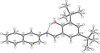
Compound (I) crystallizes in space group P21/c with one molecule in the asymmetric unit. Fig. 1 shows that the expected condensation product has arisen and the C11=N1 bond length of 1.2879 (12) Å agrees well with those observed in other azomethines. The dihedral angle between the C1–C10 naphthyl ring system (r.m.s. deviation = 0.014 Å) and the C12–C17 phenol ring is 16.41 (4)°. The near parallel orientation of these rings is supported by an intramolecular O1—H1A⋯N1 hydrogen bond (Table 1). The key torsion angles associated with the C=N bond are 176.93 (9)° (C9—N1—C11—C12), −176.25 (9)° (N1—C11—C12—C17) and 1.49 (15)° (N1—C11—C12—C13). For the C18 t-butyl group, one methyl C atom lies close to the plane of the aromatic ring [C22, deviation = 0.067 (1) Å], one above [C23, 1.229 (1) Å] and one below [C19, −1.288 (1) Å]. A similar situation occurs for the C20 group, with C25 close to coplanar [–0.223 (1) Å], C21 above [1.411 (1) Å] and C24 below [–1.050 (1) Å].
|
||||||||||||||||||||||
 .
|
Figure 1
The molecular structure of (I) showing 50% displacement ellipsoids. |
3. Supramolecular features
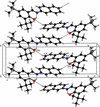
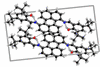
The extended structure of (I) is shown in Fig. 2. A weak C4—H4⋯O1 hydrogen bond (Table 1) links the molecules into [010] chains. The molecules adopt an offset-stacked, antiparallel arrangements, with the bulky tert-butyl groups influencing their packing. A π–π stacking interaction occurs between inversion-related C1–C6 rings with a centroid-to-centroid distance of 3.6146 (6) Å and a slippage of 1.190 Å (Fig. 3). In contrast, there no stacking interactions were observed between the phenyl rings, presumably due to the steric repulsions of the tert-butyl groups.
|
Figure 2
C—H⋯O hydrogen bonding interactions in (I). |
|
Figure 3
The packing of (I). |
4. Hirshfeld surface analyses
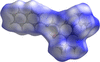
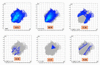
The Hirshfeld surface of (I), calculated with Crystal Explorer 17 (Turner et al., 2017; Arunagiri et al., 2025), is shown in Fig. 4. The two-dimensional fingerprint plots (Fig. 5) reveal that H⋯H contacts contribute the highest percentage (69.3%) to the intermolecular interactions followed by C⋯H/H⋯C contacts (23.1%). The O⋯H/H⋯O, C⋯C and N⋯H/H⋯N contacts contributed 2.1%, 2.9% and 2.6%, respectively. The predominance of H⋯H contacts may be related to the presence of the tert-butyl groups in (I).
|
Figure 4
The Hirshfeld surface of (I) plotted over dnorm. |
|
Figure 5
Two-dimensional fingerprint plots with the relative contributions of the various interactions to the Hirshfeld surface of (I). |
5. Database survey
The crystal structure of the starting material, 3,5-di-tert-butyl-2-hydroxybenzaldehyde (DTBHB; CCDC reference code: 239143) was reported by Tooke & Spek (2004). The crystal structure of a second monoclinic polymorph of DTBHB has also been described (Chu et al. 2004; Ng, 2013).
6. Synthesis and crystallization
Compound (I) was synthesized by the condensation of 3,5-di-tert-butyl-2-hydroxybenzaldehyde (0.234 g, 1.0 mmol) and 2-naphthylamine (0.143 g, 1.0 mmol) in ethanol solution. The reaction mixture was refluxed with continuous stirring for 4 h. Upon completion of the reaction, the mixture was allowed to cool to room temperature, resulting in the formation of a flaky yellow precipitate. It was collected by filtration and subsequently purified by recrystallization from ethanol solution. Slow cooling of the recrystallized solution afforded yellow block-shaped single crystals suitable for further characterization and crystallographic studies. Yield = 85% (0.306 g), with a melting point of 393 K.
FT–IR (KBr, cm−1): 3378 [ν(O—H)], 2952 [ν(C—H)], 2868 [ν(aliphatic C—H)], 1631 [ν(C=N)], 1607, 1571 [ν(C=C)], 1273, 1248 [ν(C—O)]. UV–Vis (λmax, nm): 329 [π → π*], 373 [π → π*], 417 [n → π*].
7. Refinement
Crystal data, data collection and structure refinement details are summarized in Table 2. The C-bound H atoms were placed in calculated positions (C—H = 0.95–0.98 Å) and refined using a riding model, while the O-bound H atom was refined independently. The constraint Uiso(H) = 1.2Ueq(aromatic) or 1.5Ueq(methyl carrier) was applied as appropriate.
|
Supporting information
CCDC reference: 2597481
Crystal structure: contains datablocks global, I. DOI: https://doi.org/10.1107/S2056989026011783/hb8271sup1.cif
Structure factors: contains datablock I. DOI: https://doi.org/10.1107/S2056989026011783/hb8271Isup2.hkl
Comment on Figure 4: The figure has been revised to show only the d_norm Hirshfeld surface, as suggested. The original six-panel Hirshfeld surface representation has been provided as supplementary information (Figure S1). DOI: https://doi.org/10.1107/S2056989026011783/hb8271sup3.tif
Supporting information file. DOI: https://doi.org/10.1107/S2056989026011783/hb8271Isup4.cml
| C25H29NO | F(000) = 776 |
| Mr = 359.49 | Dx = 1.168 Mg m−3 |
| Monoclinic, P21/c | Mo Kα radiation, λ = 0.71073 Å |
| Hall symbol: -P 2ybc | Cell parameters from 9848 reflections |
| a = 22.8874 (7) Å | θ = 2.7–28.3° |
| b = 7.4765 (2) Å | µ = 0.07 mm−1 |
| c = 11.9540 (3) Å | T = 120 K |
| β = 91.183 (1)° | Block, clear light yellow |
| V = 2045.10 (10) Å3 | 0.45 × 0.45 × 0.09 mm |
| Z = 4 |
| Bruker D8 QUEST diffractometer | 5049 independent reflections |
| Radiation source: fine-focus sealed tube | 4399 reflections with I > 2σ(I) |
| Multilayer mirror monochromator | Rint = 0.041 |
| Detector resolution: 7.391 pixels mm-1 | θmax = 28.3°, θmin = 2.7° |
| ω and φ scans | h = −30→30 |
| Absorption correction: multi-scan (SADABS; Krause et al., 2015) | k = −9→8 |
| Tmin = 0.969, Tmax = 0.994 | l = −15→14 |
| 30189 measured reflections |
| Refinement on F2 | Secondary atom site location: difference Fourier map |
| Least-squares matrix: full | Hydrogen site location: inferred from neighbouring sites |
| R[F2 > 2σ(F2)] = 0.046 | H atoms treated by a mixture of independent and constrained refinement |
| wR(F2) = 0.128 | W = 1/[Σ2(FO2) + (0.0754P)2 + 0.4688P] WHERE P = (FO2 + 2FC2)/3 |
| S = 1.05 | (Δ/σ)max = 0.001 |
| 5049 reflections | Δρmax = 0.33 e Å−3 |
| 252 parameters | Δρmin = −0.35 e Å−3 |
| Primary atom site location: dual |
Geometry. Bond distances, angles etc. have been calculated using the rounded fractional coordinates. All su's are estimated from the variances of the (full) variance-covariance matrix. The cell esds are taken into account in the estimation of distances, angles and torsion angles |
Refinement. Refinement on F2 for ALL reflections except those flagged by the user for potential systematic errors. Weighted R-factors wR and all goodnesses of fit S are based on F2, conventional R-factors R are based on F, with F set to zero for negative F2. The observed criterion of F2 > 2sigma(F2) is used only for calculating -R-factor-obs etc. and is not relevant to the choice of reflections for refinement. R-factors based on F2 are statistically about twice as large as those based on F, and R-factors based on ALL data will be even larger. |
| x | y | z | Uiso*/Ueq | ||
| O1 | 0.69672 (3) | 0.39417 (10) | 0.54909 (6) | 0.0222 (2) | |
| N1 | 0.66106 (3) | 0.58900 (11) | 0.71116 (7) | 0.0181 (2) | |
| C1 | 0.51379 (4) | 0.61573 (13) | 0.83164 (8) | 0.0162 (3) | |
| C2 | 0.45586 (4) | 0.55852 (14) | 0.80585 (8) | 0.0194 (3) | |
| C3 | 0.41103 (4) | 0.60045 (14) | 0.87557 (9) | 0.0215 (3) | |
| C4 | 0.42176 (4) | 0.69893 (15) | 0.97448 (9) | 0.0215 (3) | |
| C5 | 0.47707 (4) | 0.75707 (14) | 1.00091 (8) | 0.0198 (3) | |
| C6 | 0.52431 (4) | 0.71860 (13) | 0.92993 (8) | 0.0168 (3) | |
| C7 | 0.58225 (4) | 0.77638 (14) | 0.95507 (8) | 0.0196 (3) | |
| C8 | 0.62730 (4) | 0.73712 (14) | 0.88588 (8) | 0.0199 (3) | |
| C9 | 0.61686 (4) | 0.63488 (13) | 0.78724 (8) | 0.0169 (3) | |
| C10 | 0.56147 (4) | 0.57282 (13) | 0.76266 (8) | 0.0168 (3) | |
| C11 | 0.71084 (4) | 0.66933 (13) | 0.71153 (8) | 0.0186 (3) | |
| C12 | 0.75712 (4) | 0.61599 (13) | 0.63701 (8) | 0.0172 (3) | |
| C13 | 0.74898 (4) | 0.47636 (13) | 0.55916 (8) | 0.0173 (3) | |
| C14 | 0.79554 (4) | 0.41979 (13) | 0.49161 (8) | 0.0179 (3) | |
| C15 | 0.84829 (4) | 0.50992 (13) | 0.50581 (8) | 0.0186 (3) | |
| C16 | 0.85784 (4) | 0.65199 (13) | 0.58121 (8) | 0.0171 (3) | |
| C17 | 0.81152 (4) | 0.70232 (13) | 0.64641 (8) | 0.0176 (3) | |
| C18 | 0.78743 (4) | 0.26614 (13) | 0.40741 (9) | 0.0204 (3) | |
| C19 | 0.74122 (5) | 0.31876 (15) | 0.31793 (9) | 0.0267 (3) | |
| C20 | 0.91848 (4) | 0.73828 (14) | 0.59082 (8) | 0.0203 (3) | |
| C21 | 0.96095 (5) | 0.60389 (18) | 0.64548 (11) | 0.0320 (3) | |
| C22 | 0.84412 (5) | 0.22322 (15) | 0.34694 (10) | 0.0288 (3) | |
| C23 | 0.76827 (5) | 0.09486 (14) | 0.46771 (9) | 0.0257 (3) | |
| C24 | 0.94031 (5) | 0.78844 (16) | 0.47440 (9) | 0.0266 (3) | |
| C25 | 0.91786 (5) | 0.90864 (16) | 0.66166 (10) | 0.0270 (3) | |
| H1A | 0.6718 (4) | 0.4379 (15) | 0.6033 (11) | 0.0330* | |
| H2 | 0.44814 | 0.49083 | 0.73993 | 0.0230* | |
| H3 | 0.37238 | 0.56280 | 0.85705 | 0.0260* | |
| H4 | 0.39050 | 0.72503 | 1.02295 | 0.0260* | |
| H5 | 0.48386 | 0.82389 | 1.06751 | 0.0240* | |
| H7 | 0.58982 | 0.84360 | 1.02124 | 0.0240* | |
| H8 | 0.66565 | 0.77823 | 0.90375 | 0.0240* | |
| H10 | 0.55507 | 0.50004 | 0.69843 | 0.0200* | |
| H11 | 0.71749 | 0.76595 | 0.76181 | 0.0220* | |
| H15 | 0.88011 | 0.47304 | 0.46153 | 0.0220* | |
| H17 | 0.81653 | 0.79714 | 0.69864 | 0.0210* | |
| H19A | 0.75508 | 0.42245 | 0.27591 | 0.0400* | |
| H19B | 0.70455 | 0.34914 | 0.35431 | 0.0400* | |
| H19C | 0.73463 | 0.21820 | 0.26662 | 0.0400* | |
| H21A | 0.96234 | 0.49520 | 0.59980 | 0.0480* | |
| H21B | 0.94756 | 0.57370 | 0.72050 | 0.0480* | |
| H21C | 1.00005 | 0.65696 | 0.65105 | 0.0480* | |
| H22A | 0.83713 | 0.12523 | 0.29389 | 0.0430* | |
| H22B | 0.87431 | 0.18756 | 0.40184 | 0.0430* | |
| H22C | 0.85718 | 0.32943 | 0.30643 | 0.0430* | |
| H23A | 0.76630 | −0.00429 | 0.41414 | 0.0390* | |
| H23B | 0.72968 | 0.11345 | 0.49979 | 0.0390* | |
| H23C | 0.79662 | 0.06627 | 0.52762 | 0.0390* | |
| H24A | 0.94370 | 0.68014 | 0.42882 | 0.0400* | |
| H24B | 0.97864 | 0.84620 | 0.48180 | 0.0400* | |
| H24C | 0.91254 | 0.87100 | 0.43826 | 0.0400* | |
| H25A | 0.95715 | 0.96076 | 0.66481 | 0.0400* | |
| H25B | 0.90558 | 0.87947 | 0.73756 | 0.0400* | |
| H25C | 0.89046 | 0.99484 | 0.62799 | 0.0400* |
| U11 | U22 | U33 | U12 | U13 | U23 | |
| O1 | 0.0157 (3) | 0.0269 (4) | 0.0241 (4) | −0.0044 (3) | 0.0025 (3) | −0.0055 (3) |
| N1 | 0.0157 (4) | 0.0210 (4) | 0.0177 (4) | 0.0022 (3) | 0.0022 (3) | 0.0007 (3) |
| C1 | 0.0160 (4) | 0.0162 (5) | 0.0165 (4) | 0.0012 (3) | 0.0013 (3) | 0.0025 (3) |
| C2 | 0.0189 (4) | 0.0199 (5) | 0.0193 (5) | −0.0009 (4) | −0.0001 (3) | 0.0005 (4) |
| C3 | 0.0152 (4) | 0.0243 (5) | 0.0251 (5) | 0.0004 (4) | 0.0008 (4) | 0.0049 (4) |
| C4 | 0.0191 (5) | 0.0245 (5) | 0.0212 (5) | 0.0064 (4) | 0.0049 (4) | 0.0045 (4) |
| C5 | 0.0214 (5) | 0.0206 (5) | 0.0175 (5) | 0.0044 (4) | 0.0029 (4) | 0.0007 (4) |
| C6 | 0.0176 (4) | 0.0171 (5) | 0.0158 (4) | 0.0026 (3) | 0.0017 (3) | 0.0021 (3) |
| C7 | 0.0203 (5) | 0.0225 (5) | 0.0160 (5) | 0.0004 (4) | −0.0003 (3) | −0.0024 (4) |
| C8 | 0.0161 (4) | 0.0240 (5) | 0.0197 (5) | −0.0010 (4) | −0.0004 (3) | −0.0005 (4) |
| C9 | 0.0166 (4) | 0.0181 (5) | 0.0162 (4) | 0.0020 (3) | 0.0024 (3) | 0.0015 (3) |
| C10 | 0.0179 (4) | 0.0169 (5) | 0.0157 (4) | 0.0006 (3) | 0.0014 (3) | −0.0002 (3) |
| C11 | 0.0190 (4) | 0.0175 (5) | 0.0193 (5) | 0.0013 (3) | 0.0022 (3) | 0.0000 (4) |
| C12 | 0.0160 (4) | 0.0177 (5) | 0.0180 (4) | 0.0013 (3) | 0.0020 (3) | 0.0012 (3) |
| C13 | 0.0157 (4) | 0.0184 (5) | 0.0179 (4) | −0.0008 (3) | −0.0001 (3) | 0.0019 (4) |
| C14 | 0.0194 (4) | 0.0171 (5) | 0.0171 (4) | 0.0002 (3) | 0.0014 (3) | 0.0002 (3) |
| C15 | 0.0174 (4) | 0.0195 (5) | 0.0189 (5) | 0.0014 (4) | 0.0032 (3) | 0.0002 (4) |
| C16 | 0.0155 (4) | 0.0180 (5) | 0.0177 (4) | 0.0000 (3) | 0.0002 (3) | 0.0018 (4) |
| C17 | 0.0180 (4) | 0.0171 (5) | 0.0178 (5) | 0.0000 (3) | 0.0004 (3) | −0.0005 (4) |
| C18 | 0.0233 (5) | 0.0170 (5) | 0.0209 (5) | −0.0015 (4) | 0.0030 (4) | −0.0023 (4) |
| C19 | 0.0362 (6) | 0.0229 (5) | 0.0208 (5) | 0.0001 (4) | −0.0026 (4) | −0.0031 (4) |
| C20 | 0.0158 (4) | 0.0238 (5) | 0.0214 (5) | −0.0021 (4) | 0.0014 (3) | −0.0021 (4) |
| C21 | 0.0199 (5) | 0.0388 (7) | 0.0371 (6) | 0.0037 (4) | −0.0036 (4) | 0.0020 (5) |
| C22 | 0.0310 (6) | 0.0234 (5) | 0.0324 (6) | −0.0024 (4) | 0.0107 (5) | −0.0086 (4) |
| C23 | 0.0314 (5) | 0.0181 (5) | 0.0277 (5) | −0.0030 (4) | 0.0020 (4) | 0.0008 (4) |
| C24 | 0.0261 (5) | 0.0292 (6) | 0.0247 (5) | −0.0085 (4) | 0.0067 (4) | −0.0025 (4) |
| C25 | 0.0220 (5) | 0.0310 (6) | 0.0279 (6) | −0.0066 (4) | 0.0007 (4) | −0.0082 (4) |
| O1—C13 | 1.3479 (12) | C20—C21 | 1.5346 (16) |
| N1—C9 | 1.4164 (12) | C2—H2 | 0.9500 |
| N1—C11 | 1.2879 (12) | C3—H3 | 0.9500 |
| O1—H1A | 0.931 (12) | C4—H4 | 0.9500 |
| C1—C2 | 1.4209 (13) | C5—H5 | 0.9500 |
| C1—C10 | 1.4181 (13) | C7—H7 | 0.9500 |
| C1—C6 | 1.4207 (14) | C8—H8 | 0.9500 |
| C2—C3 | 1.3715 (14) | C10—H10 | 0.9500 |
| C3—C4 | 1.4101 (15) | C11—H11 | 0.9500 |
| C4—C5 | 1.3692 (13) | C15—H15 | 0.9500 |
| C5—C6 | 1.4176 (13) | C17—H17 | 0.9500 |
| C6—C7 | 1.4209 (13) | C19—H19A | 0.9800 |
| C7—C8 | 1.3670 (13) | C19—H19B | 0.9800 |
| C8—C9 | 1.4213 (14) | C19—H19C | 0.9800 |
| C9—C10 | 1.3760 (13) | C21—H21A | 0.9800 |
| C11—C12 | 1.4538 (13) | C21—H21B | 0.9800 |
| C12—C17 | 1.4049 (13) | C21—H21C | 0.9800 |
| C12—C13 | 1.4083 (14) | C22—H22A | 0.9800 |
| C13—C14 | 1.4149 (13) | C22—H22B | 0.9800 |
| C14—C15 | 1.3900 (13) | C22—H22C | 0.9800 |
| C14—C18 | 1.5361 (14) | C23—H23A | 0.9800 |
| C15—C16 | 1.4072 (14) | C23—H23B | 0.9800 |
| C16—C17 | 1.3810 (13) | C23—H23C | 0.9800 |
| C16—C20 | 1.5327 (13) | C24—H24A | 0.9800 |
| C18—C22 | 1.5322 (15) | C24—H24B | 0.9800 |
| C18—C23 | 1.5378 (15) | C24—H24C | 0.9800 |
| C18—C19 | 1.5397 (15) | C25—H25A | 0.9800 |
| C20—C24 | 1.5349 (15) | C25—H25B | 0.9800 |
| C20—C25 | 1.5297 (16) | C25—H25C | 0.9800 |
| C9—N1—C11 | 121.90 (8) | C4—C5—H5 | 120.00 |
| C13—O1—H1A | 109.4 (6) | C6—C5—H5 | 120.00 |
| C2—C1—C6 | 118.94 (8) | C6—C7—H7 | 119.00 |
| C2—C1—C10 | 122.11 (9) | C8—C7—H7 | 119.00 |
| C6—C1—C10 | 118.95 (8) | C7—C8—H8 | 120.00 |
| C1—C2—C3 | 120.38 (9) | C9—C8—H8 | 120.00 |
| C2—C3—C4 | 120.62 (9) | C1—C10—H10 | 119.00 |
| C3—C4—C5 | 120.23 (9) | C9—C10—H10 | 119.00 |
| C4—C5—C6 | 120.69 (9) | N1—C11—H11 | 119.00 |
| C1—C6—C5 | 119.11 (8) | C12—C11—H11 | 119.00 |
| C1—C6—C7 | 118.75 (8) | C14—C15—H15 | 118.00 |
| C5—C6—C7 | 122.12 (9) | C16—C15—H15 | 118.00 |
| C6—C7—C8 | 121.27 (9) | C12—C17—H17 | 119.00 |
| C7—C8—C9 | 120.10 (9) | C16—C17—H17 | 119.00 |
| N1—C9—C10 | 116.64 (8) | C18—C19—H19A | 109.00 |
| C8—C9—C10 | 119.79 (9) | C18—C19—H19B | 109.00 |
| N1—C9—C8 | 123.56 (8) | C18—C19—H19C | 109.00 |
| C1—C10—C9 | 121.08 (9) | H19A—C19—H19B | 109.00 |
| N1—C11—C12 | 121.71 (9) | H19A—C19—H19C | 109.00 |
| C11—C12—C13 | 121.34 (8) | H19B—C19—H19C | 109.00 |
| C13—C12—C17 | 119.89 (9) | C20—C21—H21A | 109.00 |
| C11—C12—C17 | 118.73 (9) | C20—C21—H21B | 109.00 |
| O1—C13—C12 | 120.13 (8) | C20—C21—H21C | 109.00 |
| C12—C13—C14 | 120.52 (8) | H21A—C21—H21B | 109.00 |
| O1—C13—C14 | 119.35 (8) | H21A—C21—H21C | 109.00 |
| C13—C14—C15 | 116.61 (9) | H21B—C21—H21C | 109.00 |
| C13—C14—C18 | 121.02 (8) | C18—C22—H22A | 109.00 |
| C15—C14—C18 | 122.38 (8) | C18—C22—H22B | 109.00 |
| C14—C15—C16 | 124.55 (9) | C18—C22—H22C | 109.00 |
| C15—C16—C17 | 117.15 (8) | H22A—C22—H22B | 109.00 |
| C17—C16—C20 | 123.20 (9) | H22A—C22—H22C | 109.00 |
| C15—C16—C20 | 119.62 (8) | H22B—C22—H22C | 109.00 |
| C12—C17—C16 | 121.27 (9) | C18—C23—H23A | 109.00 |
| C14—C18—C19 | 109.64 (8) | C18—C23—H23B | 109.00 |
| C14—C18—C22 | 111.95 (8) | C18—C23—H23C | 109.00 |
| C19—C18—C22 | 107.58 (9) | H23A—C23—H23B | 109.00 |
| C19—C18—C23 | 109.88 (8) | H23A—C23—H23C | 109.00 |
| C14—C18—C23 | 110.33 (8) | H23B—C23—H23C | 109.00 |
| C22—C18—C23 | 107.41 (8) | C20—C24—H24A | 109.00 |
| C16—C20—C24 | 110.25 (8) | C20—C24—H24B | 109.00 |
| C16—C20—C25 | 111.92 (8) | C20—C24—H24C | 109.00 |
| C16—C20—C21 | 108.72 (9) | H24A—C24—H24B | 109.00 |
| C21—C20—C25 | 108.81 (9) | H24A—C24—H24C | 109.00 |
| C24—C20—C25 | 107.78 (9) | H24B—C24—H24C | 109.00 |
| C21—C20—C24 | 109.32 (9) | C20—C25—H25A | 109.00 |
| C1—C2—H2 | 120.00 | C20—C25—H25B | 109.00 |
| C3—C2—H2 | 120.00 | C20—C25—H25C | 109.00 |
| C2—C3—H3 | 120.00 | H25A—C25—H25B | 109.00 |
| C4—C3—H3 | 120.00 | H25A—C25—H25C | 109.00 |
| C3—C4—H4 | 120.00 | H25B—C25—H25C | 109.00 |
| C5—C4—H4 | 120.00 | ||
| C9—N1—C11—C12 | 176.93 (9) | C17—C12—C13—O1 | −179.40 (9) |
| C11—N1—C9—C10 | 164.75 (9) | C17—C12—C13—C14 | 1.20 (14) |
| C11—N1—C9—C8 | −16.20 (15) | C11—C12—C17—C16 | 177.17 (9) |
| C2—C1—C6—C5 | 1.68 (14) | C13—C12—C17—C16 | −0.60 (15) |
| C10—C1—C2—C3 | 179.01 (10) | O1—C13—C14—C15 | 179.93 (9) |
| C10—C1—C6—C7 | 0.60 (14) | O1—C13—C14—C18 | −0.16 (14) |
| C2—C1—C10—C9 | 177.74 (9) | C12—C13—C14—C15 | −0.67 (14) |
| C6—C1—C2—C3 | −0.73 (15) | C12—C13—C14—C18 | 179.25 (9) |
| C6—C1—C10—C9 | −2.53 (14) | C13—C14—C15—C16 | −0.48 (15) |
| C10—C1—C6—C5 | −178.07 (9) | C18—C14—C15—C16 | 179.61 (9) |
| C2—C1—C6—C7 | −179.65 (9) | C13—C14—C18—C19 | 62.90 (12) |
| C1—C2—C3—C4 | −0.78 (16) | C13—C14—C18—C22 | −177.80 (9) |
| C2—C3—C4—C5 | 1.33 (16) | C13—C14—C18—C23 | −58.24 (12) |
| C3—C4—C5—C6 | −0.34 (16) | C15—C14—C18—C19 | −117.19 (10) |
| C4—C5—C6—C7 | −179.78 (10) | C15—C14—C18—C22 | 2.12 (13) |
| C4—C5—C6—C1 | −1.16 (15) | C15—C14—C18—C23 | 121.67 (10) |
| C5—C6—C7—C8 | 179.64 (10) | C14—C15—C16—C17 | 1.05 (15) |
| C1—C6—C7—C8 | 1.01 (15) | C14—C15—C16—C20 | 178.80 (9) |
| C6—C7—C8—C9 | −0.75 (15) | C15—C16—C17—C12 | −0.48 (14) |
| C7—C8—C9—C10 | −1.17 (15) | C20—C16—C17—C12 | −178.14 (9) |
| C7—C8—C9—N1 | 179.82 (9) | C15—C16—C20—C21 | −69.27 (12) |
| N1—C9—C10—C1 | −178.10 (9) | C15—C16—C20—C24 | 50.56 (12) |
| C8—C9—C10—C1 | 2.82 (15) | C15—C16—C20—C25 | 170.51 (9) |
| N1—C11—C12—C13 | 1.49 (15) | C17—C16—C20—C21 | 108.33 (11) |
| N1—C11—C12—C17 | −176.25 (9) | C17—C16—C20—C24 | −131.84 (10) |
| C11—C12—C13—O1 | 2.89 (14) | C17—C16—C20—C25 | −11.89 (13) |
| C11—C12—C13—C14 | −176.51 (9) |
| D—H···A | D—H | H···A | D···A | D—H···A |
| O1—H1A···N1 | 0.93 (1) | 1.74 (1) | 2.5704 (11) | 148 (1) |
| C4—H4···O1i | 0.95 | 2.50 | 3.0874 (12) | 120 |
| Symmetry code: (i) −x+1, y+1/2, −z+3/2. |
Acknowledgements
The authors thank the Department of Chemistry, Seethalakshmi Ramaswami College, Tiruchirappalli, Tamil Nadu, for providing necessary facilities and support required for this work.
References
 Arunagiri, C., Selvakumar, S., Jeyavijayan, S., Karthik, N., Rama, I. & Subashini, A. (2025). J. Mater. Sci. Mater. Electron. 36, 1032, 1–19.
Google Scholar
Bruker (2016). SAINT. Bruker AXS Inc., Madison, Wisconsin, USA.
Google Scholar
Carreño, A., Ancede-Gallardo, E., Suárez, A. G., Cepeda-Plaza, M., Duque-Noreña, M., Arce, R., Gacitúa, M., Lavín, R., Inostroza, O., Gil, F., Fuentes, I. & Fuentes, J. A. (2025). Chemistry 7, 135,
Google Scholar
Çelik, Ö., Kasumov, V. T. & Şahin, E. (2009). Acta Cryst. E65, o2786.
Web of Science
CSD
CrossRef
IUCr Journals
Google Scholar
Chu, Z.-L., Huang, W., Cui, K. & Gou, S.-H. (2004). Acta Cryst. E60, o1043–o1045.
Web of Science
CSD
CrossRef
CAS
IUCr Journals
Google Scholar
Cozzi, P. G. (2004). Chem. Soc. Rev. 33, 410–421.
Web of Science
CrossRef
PubMed
CAS
Google Scholar
Gayathri, A. N. S., Panneerselvam, M., Costa, L. T., Subashini, A. & Rama, I. (2026). ChemistrySelect 11, e74675, 1–25.
Google Scholar
Kansiz, S., Macit, M., Dege, N. & Pavlenko, V. A. (2018). Acta Cryst. E74, 1887–1890.
Web of Science
CSD
CrossRef
IUCr Journals
Google Scholar
Krause, L., Herbst-Irmer, R., Sheldrick, G. M. & Stalke, D. (2015). J. Appl. Cryst. 48, 3–10.
Web of Science
CSD
CrossRef
ICSD
CAS
IUCr Journals
Google Scholar
Mason, H. E., Howard, J. A. K. & Sparkes, H. A. (2021). Acta Cryst. C77, 659–667.
CrossRef
IUCr Journals
Google Scholar
Ng, S. W. (2013). Acta Cryst. E69, o1427.
CrossRef
IUCr Journals
Google Scholar
Sheldrick, G. M. (2015a). Acta Cryst. A71, 3–8.
Web of Science
CrossRef
IUCr Journals
Google Scholar
Sheldrick, G. M. (2015b). Acta Cryst. C71, 3–8.
Web of Science
CrossRef
IUCr Journals
Google Scholar
Spek, A. L. (2020). Acta Cryst. E76, 1–11.
Web of Science
CrossRef
IUCr Journals
Google Scholar
Tooke, D. M. & Spek, A. L. (2004). Acta Cryst. E60, o766–o767.
Web of Science
CSD
CrossRef
CAS
IUCr Journals
Google Scholar
Turner, M. J., McKinnon, J. J., Wolff, S. K., Grimwood, D. J., Spackman, P. R., Jayatilaka, D. & Spackman, M. A. (2017). CrystalExplorer17. University of Western Australia.
Google Scholar
This is an open-access article distributed under the terms of the Creative Commons Attribution (CC-BY) Licence, which permits unrestricted use, distribution, and reproduction in any medium, provided the original authors and source are cited.
| CRYSTALLOGRAPHIC COMMUNICATIONS |