
Acta Crystallographica
Section E CRYSTALLOGRAPHIC COMMUNICATIONS


 menu


research communications
| CRYSTALLOGRAPHIC COMMUNICATIONS |
 access
Crystal structure and Hirshfeld surface analysis of (2,7-dihydroxynaphthalen-1-yl)(4-methylphenyl)methanone

aDepartment of Applied Chemistry, Tokyo University of Agriculture and Technology, 2-24-16, Nakamachi, Koganei, Tokyo 184-8588, Japan, and bInstrumentation Analysis Center, Tokyo University of Agriculture and Technology, 2-24-16, Nakamachi, Koganei, Tokyo 184-8588, Japan
*Correspondence e-mail: [email protected]
In the title compound, C18H14O3, an intramolecular O—H⋯O=C hydrogen bond is formed between the hydroxy and carbonyl groups on the naphthalene ring system, resulting in an S(6) ring. An intramolecular C—H⋯π interaction between the C—H group at the 8-position of the naphthalene ring and the 4-methylphenyl ring is also observed. The torsion angles between the C=O group and the 4-methylphenyl and naphthalene rings are 142.58 (13) and 149.32 (12)°, respectively, and the dihedral angle between the two aromatic rings is 58.98 (5)°. In the crystal, two molecules are connected via a pair of intermolecular O—H⋯O=C hydrogen bonds between the carbonyl and 2-hydroxy groups, forming a centrosymmetric dimer with an R22(4) graph-set motif. These dimers are further linked into tetrameric aggregates through O—H⋯O hydrogen bonds between the 7-hydroxy and 2-hydroxy groups, and bifurcated C—H⋯π interactions. These tetramers are subsequently arranged into a crystal packing network via additional C—H⋯π interactions.
Keywords: non-coplanar aromatic rings; centrosymmetric dimer; C—H⋯π interaction; Hirshfeld surface analysis; crystal structure.
CCDC reference: 2604023
1. Chemical context
The design and control of crystal architectures via non-covalent interactions remain a central theme in crystal engineering and supramolecular chemistry.
Traditionally, the construction of predictable crystal structures has relied on the arrangement of robust supramolecular synthons sustained by classical strong hydrogen bonds (Desiraju, 1995 ). However, to precisely engineer and tailor desired crystalline architectures, a comprehensive understanding of the cooperativity and synergy among diverse weak interactions has become indispensable (Roman et al., 2010).
Among these, C—H⋯π interactions play a pivotal role in determining molecular orientation and packing motifs in organic crystals. Generally, the investigation of weak interactions can be challenging in planar aromatic systems due to the dominance of strong parallel π–π stacking (Nishio et al., 2014; Hunter et al., 1990). To overcome this limitation, designing molecular systems with non-coplanar assembled aromatic rings offers an effective strategy; the steric hindrance inherently suppresses traditional π–π stacking, providing an ideal platform to clearly observe and analyze weaker, C—H-mediated interactions. When strong hydrogen-bonding components are intentionally integrated into such non-coplanar platforms, it becomes possible to systematically investigate the interplay, competition or cooperativity between strong and weak non-covalent networks.
In this context, the authors have extensively investigated the formation reactions and spatial structures of compounds bearing sterically congested non-coplanar aromatic rings (Okamoto & Yonezawa, 2009; Okamoto et al., 2011). Notably, peri-aroylnaphthalene compounds and their homologues usually exhibit an excellent tendency toward single crystallinity, and the crystal structures of over 100 homologues and related compounds have been successfully determined by our group (Okamoto et al., 2015). By systematically comparing the molecular conformations and crystal packing across these homologous series, the authors have clarified the relationships between molecular structure and intermolecular interactions. This accumulated body of work strongly suggests that weak interactions involving C—H hydrogens play critical roles in determining the crystalline spatial placement of molecules (Iida et al., 2023; Li et al., 2024; Li et al., 2025).
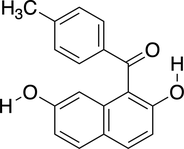
Herein, as part of our ongoing research into these non-coplanar aromatic ring systems, we report the crystal structure and Hirshfeld surface analysis of the title 1-(4-methylbenzoyl)naphthalene compound, namely, (2,7-dihydroxynaphthalen-1-yl)(4-methylphenyl)methanone.
2. Structural commentary
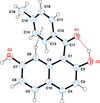
The molecular structure of the title molecule is shown in Fig. 1. Two types of intramolecular interactions are observed. An intramolecular O—H⋯O=C hydrogen bond is formed between the hydroxy and carbonyl groups on the naphthalene ring system (O2—H2⋯O1, 1.68 Å; Table 1), resulting in an S(6) ring (Etter et al., 1990; Bernstein et al., 1995). In addition, an intramolecular C—H⋯π interaction is observed between the H atom at the 8-position of the naphthalene ring and the benzene ring (C8—H8⋯Cg3, 2.97 Å). The benzene and naphthalene rings are tilted to a similar extent relative to the central carbonyl moiety [torsion angles: O1—C11—C12—C13 = 142.58 (13) and C9—C1—C11—O1 = 149.32 (12)°. The dihedral angle between the benzene and naphthalene rings is 58.98 (5)°.
|
 ; (ii)
 ; (iii)
 ; (iv)
 ; (v)
 .
|
Figure 1
The molecular structure of the title compound, showing 50% probability displacement ellipsoids. Two types of intramolecular interactions are shown as dashed lines. |
3. Supramolecular features
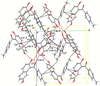
In the crystal, two molecules are connected via pairs of intermolecular O—H⋯O=C hydrogen bonds between the carbonyl group and adjacent hydroxy group (2-hydroxy group) (O2—H2⋯O1, 2.53 Å; Table 1 and Fig. 2), forming centrosymmetric dimers with an
R22(4) graph-set motif (Etter et al., 1990; Bernstein et al., 1995). The two hydroxy groups involved in the four-membered H⋯O⋯H⋯O hydrogen-bonded ring of the centrosymmetric dimer each act as hydrogen-bond acceptors to form O—H⋯O hydrogen bonds with neighbouring molecules (O3—H3⋯O2, 1.88 Å). These four molecules are further stabilized via bifurcated C—H⋯π interactions (C16—H16⋯Cg2, 2.85 Å; C16—H16⋯Cg4, 2.97 Å). Furthermore, this tetrameric assembly is linked by two types of C—H⋯π interactions, forming a three-dimensional supramolecular network (C4—H4⋯Cg3, 2.84 Å; C18—H18B⋯Cg2, 2.85 Å).
|
Figure 2
The crystal packing of the title compound, viewed down the a axis, illustrating the intermolecular O—H⋯O hydrogen-bonding interactions and C—H⋯π interactions, shown as red dashed lines and black dashed lines, respectively. |
4. Database survey
A search of the Cambridge Structural Database (CSD, Version 6.00, update August 2025; Groom et al., 2016) found 22 instances of molecules involving the 1-benzoylnaphthalene skeleton, most of which possessed substituents at the 8-, 2,7- or 3,6-positions of the naphthalene ring core (CSD refcode LESLUS: Sakamoto et al., 2013; VABLAT: Hijikata et al., 2010; PUKGIM: Mitsui et al., 2010; SOLXIB: Mitsui et al., 2009; LANWEE: Sakthivel et al., 2012; BOMRIG: Mohri et al., 2014; AXAMES: Muto et al., 2011). Among them, five compounds possessed a hydroxy group at the 2-position (OBOGEW: Li, 2026; VOJFOQ: Mitsui et al., 2008; UCUHAE: Okamoto et al., 2014; KABJUU: Nagasawa, Mitsui, Kato et al., 2010; VABBEH: Nagasawa, Mitsui, Okamoto & Yonezawa, 2010). On the other hand, while two examples of 1,8-dibenzoylnaphthalene compounds with hydroxy groups at the 2,7-positions have been reported (LESLOM: Hijikata et al., 2013; CIQBUB: Mohri et al., 2013), no such reports exist for the corresponding 1-benzoylnaphthalene derivatives.
The title compound is compared with its 7-methoxy homologue, (2-hydroxy-7-methoxynaphthalen-1-yl)(4-methylphenyl)methanone (VABBEH), in which a methoxy group replaces the 7-hydroxy group. Both compounds have an intramolecular hydrogen bond between the carbonyl and 2-hydroxy groups, forming a six-membered O—H⋯O ring. In contrast to the 7-methoxy homologue, the naphthalene and 4-methylphenyl rings in the title compound are arranged with a more pronounced twist relative to the carbonyl moiety [the torsion angles between the C=O moiety and the two aromatic rings (benzene and the naphthalene rings): 142.58 (13) and 149.32 (12)° for the title compound, and 128.33 (13) and 158.84 (12)° for the 7-methoxy homologue].
In the crystal structures, both compounds form centrosymmetric dimers linked by intermolecular O—H⋯O=C hydrogen bonds between the hydroxy and carbonyl groups. The H⋯O distance of this intermolecular O—H⋯O=C hydrogen bond is shorter in the 7-methoxy homologue than in the title compound [2.33 versus 2.53 Å]. In the title compound, these centrosymmetric dimers are further connected into tetrameric aggregates via intermolecular O—H⋯O—H hydrogen bonds involving the 7-hydroxy group (1.88 Å) and bifurcated C—H⋯π interactions (2.85 and 2.97 Å); these tetramers are subsequently arranged through two types of C—H⋯π interactions (2.84 and 2.85 Å). In contrast, in the 7-methoxy homologue, the centrosymmetric dimers are directly linked into a three-dimensional packing network by three types of C—H⋯π interactions: (i) between a naphthalene C—H group and the benzene moiety of the naphthalene ring system (2.71 Å), (ii) between an aromatic C—H group of the 4-methylphenyl ring and the benzene moiety of the naphthalene system (2.76 Å), and (iii) between a methyl C—H group and the benzene ring of a 4-methylphenyl group (2.88 Å). Notably, these C—H⋯π interaction distances in the 7-methoxy homologue are generally shorter than those observed in the title compound.
5. Hirshfeld surface analysis
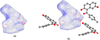
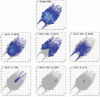
A Hirshfeld surface analysis was performed using CrystalExplorer21 to examine and quantify the intermolecular contacts governing the crystal packing (Spackman et al., 2021). The Hirshfeld surface of the title compound mapped over dnorm in the range −0.6253 to 1.3655 a.u. is shown in Fig. 3. On the dnorm surface, red, white and blue regions correspond to contacts shorter than, approximately equal to and longer than the sum of the van der Waals radii, respectively. Here, the two intense red spots result from the O3—H3⋯O2 hydrogen bonds (1.88 Å; Table 1). A pair of adjacent small red spots arises from a pair of O2—H2⋯O1 hydrogen bonds (2.53 Å; Table 1). The percentage contributions of the intermolecular interactions to the total Hirshfeld surface were computed by two-dimensional fingerprint plots. As illustrated in Fig. 4, the di versus de plots show that H⋯H contacts make the largest contribution (39.9%). The C⋯H/H⋯C contacts (33.7%) are present as a relatively large contributor. The O⋯H/H⋯O contacts contribute 24.2% to the total Hirshfeld surface and are characterized by a pair of prominent spikes in the two-dimensional fingerprint plot. These features are consistent with several kinds of C—H⋯π interactions and the O2—H2⋯O1 hydrogen bonding interaction observed in the crystal (Fig. 2 and Table 1). Other contacts contribute to a lesser extent, namely, C⋯C (1.9%), O⋯C/C⋯O (0.2%) and O⋯O (0.1%).
|
Figure 3
(a) The Hirshfeld surface of the title compound mapped over dnorm. (b) Several large red points are assigned as O1⋯H2 and O2⋯H3 short contacts. |
|
Figure 4
The full two-dimensional fingerprint plot for the title compound, and those delineated into (a) H⋯H, (b) C⋯H/H⋯C, (c) O⋯H/H⋯O, (d) C⋯C, (e) O⋯C/C⋯O and (f) O⋯O contacts. |
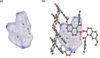
For comparison, a Hirshfeld surface analysis was also examined for the 7-methoxy homologue (VABBEH). Although both compounds form centrosymmetric dimers via intermolecular O—H⋯O=C hydrogen bonds (2.33 (2) Å in VABBEH), the influence of the dimeric motif on the overall molecular packing differs markedly from that in the title compound. On the dnorm surface of VABBEH (mapped over the range −0.2838 to 1.8299 a.u.), the largest red spots are located adjacent to each other in the vicinity of the carbonyl and hydroxy groups (Fig. 5, left), while several small red spots are observed around the naphthalene ring core and the 4-methylbenzoyl group. Collectively, these close contacts involve a total of seven neighbouring molecules around the central unit, a number significantly larger than the three observed for the title compound (Fig. 5 versus Fig. 3, right). In the two-dimensional fingerprint plots, H⋯H contacts are the major contributor (49.4%), while C⋯H/H⋯C contacts (28.1%) and O⋯H/H⋯O contacts (17.7%) make smaller contributions. Although the order of contribution from these three interactions remains unchanged compared to the title compound, the combined contribution of H⋯H and C⋯H/H⋯C contacts is notably larger relative to the O⋯H/H⋯O contacts. This feature further confirms that the O⋯H/H⋯O interactions in VABBEH are confined to the dimeric unit, whereas weaker interactions, such as C—H⋯π and van der Waals contacts, govern the three-dimensional crystal packing in the case of the 7-methoxy homologue.
|
Figure 5
(a) The Hirshfeld surface of the 7-methoxy homologue mapped over dnorm. (b) Several close contacts involve a total of seven neighbouring molecules around the central unit. |
6. Synthesis and crystallization
To a solution of 2,7-dihydroxynaphthalene (320 mg, 2.0 mmol) and 4-methylbenzoyl chloride (309 mg, 2.0 mmol) was added TiCl4 (1.14 g, 6.0 mmol). The reaction mixture was stirred for 3 h to give a dark-red solution, which was then poured into ice–water (30 ml). The aqueous layer was extracted with CHCl3 (30 ml × 3). The combined organic layers were washed with saturated NaHCO3(aq), followed by brine (30 ml × 3), and dried over MgSO4 overnight. The solvent was removed in vacuo. The crude material was dissolved in hexane, heated on an oil bath for 15–20 min and then allowed to stand undisturbed for slow evaporation at room temperature to give the title compound as yellow platelets (yield: 239 mg, 43%; m.p. 439–440 K). 1H NMR (300 MHz, CDCl3) δ 11.14 (1H, s), 7.84 (1H, d, J = 9.0 Hz), 7.65 (1H, d, J = 8.4 Hz), 7.56 (2H, d, J = 8.1 Hz), 7.22 (2H, d, J = 8.1 Hz), 7.07 (1H, d, J = 9.0 Hz), 6.88 (1H, dd, J = 8.7 and 2.4 Hz), 6.66 (1H, ds, J = 2.4 Hz), 4.85 (1H, s), 2.43 (3H, s) ppm. 13C NMR (75 MHz, CDCl3) δ 199.92, 161.77, 154.20, 143.68, 137.20, 135.92, 134.12, 130.53, 129.69, 129.29, 123.75, 116.51, 114.86, 109.70, 21.730 ppm. IR (KBr): ν = 3391 (O—H), 1632 (C=O), 1602 (Ar), 1582 (Ar) cm−1. HRMS (FAB): m/z calculated for C18H15O3 = 279.1016 [M + H]+; found: 279.1055.
7. Refinement
Crystal data, data collection and structure refinement details are summarized in Table 2. The hydroxy H atoms (H2 and H3) were located from residual electron-density peaks in a difference Fourier map and refined freely with isotropic displacement parameters. The resulting O—H bond lengths were found to be O2—H2 = 0.97 (2) Å and O3—H3 = 0.91 (2) Å. The H atoms attached to C atoms were introduced in calculated positions and treated as riding on their parent atoms, with C—H = 0.98 (methyl) or 0.95 Å (aromatic), with Uiso(H) = 1.2Ueq(aromatic) or Uiso(H) = 1.5Ueq(methyl).
|
Supporting information
CCDC reference: 2604023
Crystal structure: contains datablock I. DOI: https://doi.org/10.1107/S2056989026012041/jp2039sup1.cif
Structure factors: contains datablock I. DOI: https://doi.org/10.1107/S2056989026012041/jp2039Isup2.hkl
1H NMR, 13C NMR, IR, and MS spectra are included. DOI: https://doi.org/10.1107/S2056989026012041/jp2039sup3.pdf
| C18H14O3 | F(000) = 584 |
| Mr = 278.29 | Dx = 1.351 Mg m−3 |
| Monoclinic, P21/n | Cu Kα radiation, λ = 1.54187 Å |
| a = 6.6476 (1) Å | Cell parameters from 18243 reflections |
| b = 14.2658 (3) Å | θ = 3.1–68.3° |
| c = 14.5476 (3) Å | µ = 0.74 mm−1 |
| β = 97.5163 (13)° | T = 193 K |
| V = 1367.74 (5) Å3 | Platelet, yellow |
| Z = 4 | 0.50 × 0.25 × 0.10 mm |
| Rigaku R-AXIS RAPID diffractometer | 2162 reflections with I > 2σ(I) |
| Detector resolution: 10.000 pixels mm-1 | Rint = 0.052 |
| ω scans | θmax = 68.3°, θmin = 4.4° |
| Absorption correction: numerical (NUMABS; Rigaku, 1999) | h = −7→8 |
| Tmin = 0.712, Tmax = 0.928 | k = −17→17 |
| 23674 measured reflections | l = −17→17 |
| 2494 independent reflections |
| Refinement on F2 | 0 restraints |
| Least-squares matrix: full | Hydrogen site location: mixed |
| R[F2 > 2σ(F2)] = 0.038 | H atoms treated by a mixture of independent and constrained refinement |
| wR(F2) = 0.113 | w = 1/[σ2(Fo2) + (0.0669P)2 + 0.1455P] where P = (Fo2 + 2Fc2)/3 |
| S = 1.10 | (Δ/σ)max < 0.001 |
| 2494 reflections | Δρmax = 0.26 e Å−3 |
| 199 parameters | Δρmin = −0.21 e Å−3 |
Geometry. All esds (except the esd in the dihedral angle between two l.s. planes) are estimated using the full covariance matrix. The cell esds are taken into account individually in the estimation of esds in distances, angles and torsion angles; correlations between esds in cell parameters are only used when they are defined by crystal symmetry. An approximate (isotropic) treatment of cell esds is used for estimating esds involving l.s. planes. |
| x | y | z | Uiso*/Ueq | ||
| O1 | 0.05916 (15) | 0.02730 (7) | 0.40390 (6) | 0.0372 (3) | |
| O3 | 0.19612 (15) | 0.27544 (8) | 0.05987 (7) | 0.0415 (3) | |
| O2 | −0.29747 (16) | 0.08074 (6) | 0.43134 (6) | 0.0347 (3) | |
| C9 | −0.13829 (19) | 0.18908 (9) | 0.22016 (8) | 0.0277 (3) | |
| C1 | −0.13930 (19) | 0.12412 (9) | 0.29672 (8) | 0.0283 (3) | |
| C8 | 0.02779 (19) | 0.19993 (9) | 0.16972 (8) | 0.0299 (3) | |
| H8 | 0.1423 | 0.1600 | 0.1826 | 0.036* | |
| C10 | −0.3070 (2) | 0.25068 (9) | 0.19884 (9) | 0.0296 (3) | |
| C6 | −0.1436 (2) | 0.32582 (9) | 0.07895 (9) | 0.0332 (3) | |
| H6 | −0.1451 | 0.3708 | 0.0307 | 0.040* | |
| C4 | −0.4679 (2) | 0.24842 (9) | 0.25358 (9) | 0.0322 (3) | |
| H4 | −0.5827 | 0.2876 | 0.2374 | 0.039* | |
| C11 | 0.01716 (19) | 0.05177 (9) | 0.32176 (8) | 0.0289 (3) | |
| C12 | 0.1199 (2) | 0.00263 (9) | 0.25062 (8) | 0.0289 (3) | |
| C7 | 0.0263 (2) | 0.26741 (9) | 0.10224 (9) | 0.0313 (3) | |
| C3 | −0.4620 (2) | 0.19149 (9) | 0.32878 (9) | 0.0336 (3) | |
| H3A | −0.5703 | 0.1920 | 0.3654 | 0.040* | |
| C15 | 0.3254 (2) | −0.09102 (10) | 0.12113 (10) | 0.0372 (3) | |
| C2 | −0.2945 (2) | 0.13176 (9) | 0.35206 (8) | 0.0297 (3) | |
| C13 | 0.0207 (2) | −0.01846 (9) | 0.16231 (9) | 0.0333 (3) | |
| H13 | −0.1165 | −0.0001 | 0.1455 | 0.040* | |
| C5 | −0.3056 (2) | 0.31693 (9) | 0.12665 (9) | 0.0324 (3) | |
| H5 | −0.4205 | 0.3562 | 0.1111 | 0.039* | |
| C17 | 0.3201 (2) | −0.02630 (9) | 0.27421 (9) | 0.0318 (3) | |
| H17 | 0.3872 | −0.0152 | 0.3350 | 0.038* | |
| C14 | 0.1219 (2) | −0.06598 (10) | 0.09941 (9) | 0.0374 (3) | |
| H14 | 0.0517 | −0.0819 | 0.0404 | 0.045* | |
| C16 | 0.4215 (2) | −0.07086 (10) | 0.20990 (10) | 0.0369 (3) | |
| H16 | 0.5595 | −0.0882 | 0.2264 | 0.044* | |
| C18 | 0.4392 (3) | −0.13897 (13) | 0.05151 (12) | 0.0581 (5) | |
| H18A | 0.5601 | −0.1023 | 0.0432 | 0.087* | |
| H18B | 0.3514 | −0.1440 | −0.0079 | 0.087* | |
| H18C | 0.4800 | −0.2018 | 0.0739 | 0.087* | |
| H3 | 0.179 (3) | 0.3261 (15) | 0.0211 (14) | 0.070 (6)* | |
| H2 | −0.163 (3) | 0.0527 (13) | 0.4423 (13) | 0.063 (5)* |
| U11 | U22 | U33 | U12 | U13 | U23 | |
| O1 | 0.0451 (6) | 0.0383 (6) | 0.0281 (5) | 0.0060 (4) | 0.0039 (4) | 0.0054 (4) |
| O3 | 0.0385 (6) | 0.0470 (6) | 0.0404 (6) | 0.0014 (5) | 0.0105 (4) | 0.0140 (5) |
| O2 | 0.0423 (6) | 0.0344 (5) | 0.0284 (5) | 0.0014 (4) | 0.0089 (4) | 0.0020 (4) |
| C9 | 0.0313 (7) | 0.0234 (6) | 0.0274 (6) | −0.0011 (5) | −0.0001 (5) | −0.0023 (5) |
| C1 | 0.0314 (7) | 0.0250 (7) | 0.0279 (6) | −0.0020 (5) | 0.0016 (5) | −0.0022 (5) |
| C8 | 0.0307 (7) | 0.0272 (7) | 0.0310 (7) | 0.0017 (5) | 0.0015 (5) | 0.0011 (5) |
| C10 | 0.0319 (7) | 0.0256 (7) | 0.0302 (7) | −0.0004 (5) | −0.0004 (5) | −0.0034 (5) |
| C6 | 0.0407 (8) | 0.0282 (7) | 0.0296 (6) | −0.0006 (6) | −0.0003 (5) | 0.0034 (5) |
| C4 | 0.0305 (7) | 0.0284 (7) | 0.0369 (7) | 0.0026 (5) | 0.0009 (5) | −0.0039 (5) |
| C11 | 0.0319 (7) | 0.0248 (7) | 0.0295 (6) | −0.0040 (5) | 0.0023 (5) | 0.0016 (5) |
| C12 | 0.0340 (7) | 0.0215 (6) | 0.0307 (6) | −0.0003 (5) | 0.0026 (5) | 0.0026 (5) |
| C7 | 0.0344 (7) | 0.0300 (7) | 0.0291 (6) | −0.0037 (5) | 0.0027 (5) | −0.0004 (5) |
| C3 | 0.0333 (7) | 0.0333 (7) | 0.0351 (7) | −0.0002 (6) | 0.0082 (5) | −0.0043 (5) |
| C15 | 0.0461 (8) | 0.0295 (7) | 0.0372 (7) | 0.0023 (6) | 0.0094 (6) | −0.0025 (6) |
| C2 | 0.0359 (7) | 0.0254 (7) | 0.0277 (6) | −0.0033 (5) | 0.0033 (5) | −0.0026 (5) |
| C13 | 0.0355 (7) | 0.0297 (7) | 0.0334 (7) | 0.0027 (6) | −0.0005 (5) | 0.0009 (5) |
| C5 | 0.0350 (7) | 0.0264 (7) | 0.0339 (7) | 0.0023 (6) | −0.0024 (5) | −0.0003 (5) |
| C17 | 0.0364 (7) | 0.0266 (7) | 0.0316 (7) | 0.0011 (5) | 0.0011 (5) | 0.0011 (5) |
| C14 | 0.0486 (8) | 0.0317 (8) | 0.0305 (7) | 0.0016 (6) | −0.0001 (6) | −0.0028 (5) |
| C16 | 0.0344 (7) | 0.0325 (7) | 0.0437 (8) | 0.0047 (6) | 0.0046 (6) | 0.0003 (6) |
| C18 | 0.0629 (11) | 0.0611 (11) | 0.0519 (10) | 0.0097 (9) | 0.0137 (8) | −0.0166 (8) |
| O1—C11 | 1.2411 (15) | C11—C12 | 1.4878 (18) |
| O3—C7 | 1.3601 (16) | C12—C17 | 1.3930 (19) |
| O3—H3 | 0.91 (2) | C12—C13 | 1.3978 (17) |
| O2—C2 | 1.3661 (15) | C3—C2 | 1.4081 (19) |
| O2—H2 | 0.97 (2) | C3—H3A | 0.9500 |
| C9—C8 | 1.4118 (18) | C15—C16 | 1.394 (2) |
| C9—C10 | 1.4266 (18) | C15—C14 | 1.395 (2) |
| C9—C1 | 1.4496 (17) | C15—C18 | 1.505 (2) |
| C1—C2 | 1.3932 (17) | C13—C14 | 1.3823 (19) |
| C1—C11 | 1.4768 (18) | C13—H13 | 0.9500 |
| C8—C7 | 1.3741 (18) | C5—H5 | 0.9500 |
| C8—H8 | 0.9500 | C17—C16 | 1.3781 (19) |
| C10—C5 | 1.4137 (18) | C17—H17 | 0.9500 |
| C10—C4 | 1.4151 (18) | C14—H14 | 0.9500 |
| C6—C5 | 1.3614 (19) | C16—H16 | 0.9500 |
| C6—C7 | 1.4088 (19) | C18—H18A | 0.9800 |
| C6—H6 | 0.9500 | C18—H18B | 0.9800 |
| C4—C3 | 1.3589 (19) | C18—H18C | 0.9800 |
| C4—H4 | 0.9500 | ||
| C7—O3—H3 | 107.8 (12) | C4—C3—H3A | 120.2 |
| C2—O2—H2 | 104.0 (11) | C2—C3—H3A | 120.2 |
| C8—C9—C10 | 117.74 (11) | C16—C15—C14 | 118.07 (13) |
| C8—C9—C1 | 123.50 (11) | C16—C15—C18 | 120.49 (13) |
| C10—C9—C1 | 118.57 (12) | C14—C15—C18 | 121.44 (13) |
| C2—C1—C9 | 118.18 (11) | O2—C2—C1 | 122.67 (12) |
| C2—C1—C11 | 117.58 (11) | O2—C2—C3 | 115.28 (12) |
| C9—C1—C11 | 124.22 (11) | C1—C2—C3 | 122.03 (12) |
| C7—C8—C9 | 121.00 (12) | C14—C13—C12 | 120.15 (12) |
| C7—C8—H8 | 119.5 | C14—C13—H13 | 119.9 |
| C9—C8—H8 | 119.5 | C12—C13—H13 | 119.9 |
| C5—C10—C4 | 120.80 (12) | C6—C5—C10 | 121.55 (12) |
| C5—C10—C9 | 119.48 (12) | C6—C5—H5 | 119.2 |
| C4—C10—C9 | 119.62 (12) | C10—C5—H5 | 119.2 |
| C5—C6—C7 | 119.02 (12) | C16—C17—C12 | 120.40 (12) |
| C5—C6—H6 | 120.5 | C16—C17—H17 | 119.8 |
| C7—C6—H6 | 120.5 | C12—C17—H17 | 119.8 |
| C3—C4—C10 | 121.49 (12) | C13—C14—C15 | 121.14 (13) |
| C3—C4—H4 | 119.3 | C13—C14—H14 | 119.4 |
| C10—C4—H4 | 119.3 | C15—C14—H14 | 119.4 |
| O1—C11—C1 | 119.77 (11) | C17—C16—C15 | 121.23 (13) |
| O1—C11—C12 | 118.11 (11) | C17—C16—H16 | 119.4 |
| C1—C11—C12 | 122.02 (10) | C15—C16—H16 | 119.4 |
| C17—C12—C13 | 118.89 (12) | C15—C18—H18A | 109.5 |
| C17—C12—C11 | 118.61 (11) | C15—C18—H18B | 109.5 |
| C13—C12—C11 | 122.45 (12) | H18A—C18—H18B | 109.5 |
| O3—C7—C8 | 117.00 (12) | C15—C18—H18C | 109.5 |
| O3—C7—C6 | 121.87 (12) | H18A—C18—H18C | 109.5 |
| C8—C7—C6 | 121.13 (12) | H18B—C18—H18C | 109.5 |
| C4—C3—C2 | 119.60 (12) | ||
| C8—C9—C1—C2 | 168.19 (11) | C5—C6—C7—O3 | −177.23 (12) |
| C10—C9—C1—C2 | −6.74 (17) | C5—C6—C7—C8 | 2.26 (19) |
| C8—C9—C1—C11 | −9.98 (19) | C10—C4—C3—C2 | −1.37 (19) |
| C10—C9—C1—C11 | 175.09 (11) | C9—C1—C2—O2 | −172.94 (11) |
| C10—C9—C8—C7 | −0.20 (18) | C11—C1—C2—O2 | 5.35 (17) |
| C1—C9—C8—C7 | −175.17 (11) | C9—C1—C2—C3 | 8.46 (18) |
| C8—C9—C10—C5 | 2.46 (17) | C11—C1—C2—C3 | −173.25 (11) |
| C1—C9—C10—C5 | 177.68 (11) | C4—C3—C2—O2 | 176.83 (11) |
| C8—C9—C10—C4 | −173.90 (11) | C4—C3—C2—C1 | −4.47 (19) |
| C1—C9—C10—C4 | 1.32 (17) | C17—C12—C13—C14 | −1.0 (2) |
| C5—C10—C4—C3 | −173.50 (12) | C11—C12—C13—C14 | −178.65 (12) |
| C9—C10—C4—C3 | 2.81 (19) | C7—C6—C5—C10 | 0.08 (19) |
| C2—C1—C11—O1 | −28.86 (17) | C4—C10—C5—C6 | 173.88 (12) |
| C9—C1—C11—O1 | 149.32 (12) | C9—C10—C5—C6 | −2.44 (19) |
| C2—C1—C11—C12 | 147.68 (12) | C13—C12—C17—C16 | 3.2 (2) |
| C9—C1—C11—C12 | −34.14 (18) | C11—C12—C17—C16 | −179.08 (12) |
| O1—C11—C12—C17 | −35.09 (18) | C12—C13—C14—C15 | −2.2 (2) |
| C1—C11—C12—C17 | 148.32 (12) | C16—C15—C14—C13 | 3.1 (2) |
| O1—C11—C12—C13 | 142.58 (13) | C18—C15—C14—C13 | −177.25 (14) |
| C1—C11—C12—C13 | −34.01 (18) | C12—C17—C16—C15 | −2.2 (2) |
| C9—C8—C7—O3 | 177.32 (11) | C14—C15—C16—C17 | −0.9 (2) |
| C9—C8—C7—C6 | −2.18 (19) | C18—C15—C16—C17 | 179.45 (14) |
| Cg2 is the centroid of the C5–C10 ring, Cg3 of the C12–C17 ring and Cg4 of the C1–C4/C10/C5–C9 ring. |
| D—H···A | D—H | H···A | D···A | D—H···A |
| O2—H2···O1 | 0.97 | 1.68 | 2.5708 (1) | 149 |
| O2—H2···O1i | 0.97 | 2.53 | 3.1043 (1) | 118 |
| O3—H3···O2ii | 0.91 | 1.88 | 2.7800 (1) | 166 |
| C8—H8···Cg3 | 0.95 | 2.97 | 3.7209 (1) | 137 |
| C4—H4···Cg3iii | 0.95 | 2.84 | 3.5610 (1) | 134 |
| C16—H16···Cg2iv | 0.95 | 2.85 | 3.3853 (1) | 117 |
| C16—H16···Cg4iv | 0.95 | 2.97 | 3.6257 (1) | 127 |
| C18—H18B···Cg2v | 0.98 | 2.85 | 3.7250 (1) | 149 |
| Symmetry codes: (i) −x, −y, −z+1; (ii) x+1/2, −y+1/2, z−1/2; (iii) −x−1/2, y+1/2, −z+1/2; (iv) −x+1/2, y−1/2, −z+1/2; (v) −x, −y, −z. |
Acknowledgements
The authors are grateful to Mr Genta Takahara (Graduate school student, Tokyo University of Agriculture and Technology) for technical advice with respect to the X-ray diffraction analyses.
Funding information
The following funding is acknowledged: JSPS KAKENHI (grant No. JP20K05473; grant No. JP25K08762); Tokyo Ohka Foundation for The Promotion of Science and Technology (grant No. 266111).
References
 Bernstein, J., Davis, R. E., Shimoni, L. & Chang, N.-L. (1995). Angew. Chem. Int. Ed. Engl. 34, 1555–1573.
CrossRef
CAS
Web of Science
Google Scholar
Burla, M. C., Caliandro, R., Camalli, M., Carrozzini, B., Cascarano, G. L., De Caro, L., Giacovazzo, C., Polidori, G. & Spagna, R. (2005). J. Appl. Cryst. 38, 381–388.
Web of Science
CrossRef
CAS
IUCr Journals
Google Scholar
Burnett, M. N. & Johnson, C. K. (1996). ORTEPIII. Report ORNL-6895. Oak Ridge National Laboratory, Tennessee, USA.
Google Scholar
Desiraju, G. R. (1995). Angew. Chem. Int. Ed. Engl. 34, 2311–2327.
CrossRef
CAS
Web of Science
Google Scholar
Etter, M. C., MacDonald, J. C. & Bernstein, J. (1990). Acta Cryst. B46, 256–262.
CrossRef
ICSD
CAS
Web of Science
IUCr Journals
Google Scholar
Groom, C. R., Bruno, I. J., Lightfoot, M. P. & Ward, S. C. (2016). Acta Cryst. B72, 171–179.
Web of Science
CrossRef
IUCr Journals
Google Scholar
Hijikata, D., Sasagawa, K., Yoshiwaka, S., Okamoto, A. & Yonezawa, N. (2013). Acta Cryst. E69, o208–o209.
CSD
CrossRef
IUCr Journals
Google Scholar
Hijikata, D., Takada, T., Nagasawa, A., Okamoto, A. & Yonezawa, N. (2010). Acta Cryst. E66, o2902–o2903.
Web of Science
CrossRef
CAS
IUCr Journals
Google Scholar
Hunter, C. A. & Sanders, J. K. (1990). J. Am. Chem. Soc. 112, 5525–5534.
CrossRef
CAS
Web of Science
Google Scholar
Iida, K., Doi, T., Isogai-Koda, A., Noguchi, K., Yonezawa, N. & Okamoto, A. (2023). J. Chem. Crystallogr. 53, 483–499.
CrossRef
Google Scholar
Li, K. (2026). CCDC 2256884: Experimental Crystal Structure Determination. https://doi.org/10.5517/ccdc.csd.cc2frgqd.
Google Scholar
Li, K., Iitsuka, H., Tsumuki, T., Noguchi, K., Yonezawa, N. & Okamoto, A. (2025). J. Chem. Crystallogr. 55, 157–174.
CrossRef
Google Scholar
Li, K., Yao, J., Iitsuka, H., Yonezawa, N. & Okamoto, A. (2024). Acta Cryst. E80, 1313–1317.
CrossRef
IUCr Journals
Google Scholar
Mitsui, R., Nakaema, K., Nagasawa, A., Noguchi, K. & Yonezawa, N. (2010). Acta Cryst. E66, o676.
Web of Science
CSD
CrossRef
IUCr Journals
Google Scholar
Mitsui, R., Nakaema, K., Noguchi, K. & Yonezawa, N. (2008). Acta Cryst. E64, o2497.
Web of Science
CSD
CrossRef
IUCr Journals
Google Scholar
Mitsui, R., Noguchi, K. & Yonezawa, N. (2009). Acta Cryst. E65, o543.
Web of Science
CrossRef
IUCr Journals
Google Scholar
Mohri, S., Ohisa, S., Tsumuki, T., Yonezawa, N. & Okamoto, A. (2014). Acta Cryst. E70, 278–280.
CrossRef
IUCr Journals
Google Scholar
Mohri, S., Yoshiwaka, S., Isozaki, K., Yonezawa, N. & Okamoto, A. (2013). Acta Cryst. C69, 1541–1544.
Web of Science
CSD
CrossRef
IUCr Journals
Google Scholar
Muto, T., Hijikata, D., Okamoto, A., Oike, H. & Yonezawa, N. (2011). Acta Cryst. E67, o2040.
Web of Science
CrossRef
IUCr Journals
Google Scholar
Nagasawa, A., Mitsui, R., Kato, Y., Okamoto, A. & Yonezawa, N. (2010). Acta Cryst. E66, o2677.
Web of Science
CSD
CrossRef
IUCr Journals
Google Scholar
Nagasawa, A., Mitsui, R., Okamoto, A. & Yonezawa, N. (2010). Acta Cryst. E66, o2820–o2821.
Web of Science
CSD
CrossRef
IUCr Journals
Google Scholar
Nishio, M., Umezawa, Y., Fantini, J., Weiss, M. S. & Chakrabarti, P. (2014). Phys. Chem. Chem. Phys. 16, 12648–12683.
Web of Science
CrossRef
CAS
PubMed
Google Scholar
Okamoto, A., Mitsui, R., Oike, H. & Yonezawa, N. (2011). Chem. Lett. 40, 1283–1284.
Web of Science
CrossRef
CAS
Google Scholar
Okamoto, A., Nagasawa, A. & Yonezawa, N. (2014). Eur. Chem. Bull. 3, 263.
Google Scholar
Okamoto, A. & Yonezawa, N. (2009). Chem. Lett. 38, 914–915.
Web of Science
CrossRef
CAS
Google Scholar
Okamoto, A. & Yonezawa, N. (2015). J. Syn. Org. Chem. Jpn. 73, 339–360.
Web of Science
CrossRef
CAS
Google Scholar
Rigaku (1998). PROCESS-AUTO. Rigaku Corporation, Tokyo, Japan.
Google Scholar
Rigaku (1999). NUMABS. Rigaku Corporation, Tokyo, Japan.
Google Scholar
Roman, M., Cannizzo, C., Pinault, T., Isare, B., Andrioletti, B., van der Schoot, P. & Bouteiller, L. (2010). J. Am. Chem. Soc. 132, 16818–16824.
CrossRef
PubMed
Google Scholar
Sakamoto, R., Sasagawa, K., Hijikata, D., Okamoto, A. & Yonezawa, N. (2013). Acta Cryst. E69, o210.
CrossRef
IUCr Journals
Google Scholar
Sakthivel, K., Srinivasan, K. & Natarajan, S. (2012). Acta Cryst. E68, o652–o652.
CrossRef
IUCr Journals
Google Scholar
Sheldrick, G. M. (2015). Acta Cryst. C71, 3–8.
Web of Science
CrossRef
IUCr Journals
Google Scholar
Spackman, P. R., Turner, M. J., McKinnon, J. J., Wolff, S. K., Grimwood, D. J., Jayatilaka, D. & Spackman, M. A. (2021). J. Appl. Cryst. 54, 1006–1011.
Web of Science
CrossRef
CAS
IUCr Journals
Google Scholar
This is an open-access article distributed under the terms of the Creative Commons Attribution (CC-BY) Licence, which permits unrestricted use, distribution, and reproduction in any medium, provided the original authors and source are cited.
| CRYSTALLOGRAPHIC COMMUNICATIONS |