
Acta Crystallographica
Section E CRYSTALLOGRAPHIC COMMUNICATIONS


 menu


research communications
| CRYSTALLOGRAPHIC COMMUNICATIONS |
 access
Synthesis, and Hirshfeld surface analysis of a dinuclear zinc(II) complex with 1-[3-(pyridin-2-yl)-1H-1,2,4-triazol-5-yl]methanamine

aDepartment of Chemistry, Taras Shevchenko National University of Kyiv, 12 Hetman Pavlo Skoropadsky Str., Kyiv 01033, Ukraine, bEnamine Ltd (www.enamine.net), Winston Churchill Str. 78, 02094 Kyiv, Ukraine, and c`PetruPoni' Institute of Macromolecular Chemistry, Aleea Gr., Ghica Voda 41A, 700487 Iasi, Romania
*Correspondence e-mail: [email protected]
The of the title compound, bis[μ-5-(azaniumylmethyl)-3-(pyridin-2-yl)-1H-1,2,4-triazol-1-ido]bis{aqua[5-(azaniumylmethyl)-3-(pyridin-2-yl)-1H-1,2,4-triazol-1-ido]zinc(II)} bis(hexafluoridosilicate) 4.8-hydrate, [Zn2(C8H9N5)4(H2O)2](SF6)2·4.8H2O, consists of a centrosymmetric dinuclear complex cation, two hexafluoridosilicate anions and two water molecules of crystallization. Each Zn2+ ion adopts a distorted octahedral ZnN5O coordination geometry, being coordinated by five N atoms from three anionic 1-[3-(pyridin-2-yl)-1H-1,2,4-triazol-5-yl]methanamine ligands and one water molecule. Two triazole-based ligands bridge the two Zn2+ centres, giving rise to a dinuclear unit. Hirshfeld surface analysis revealed that the most important contributions to the crystal packing are from H⋯H (35.2%), F⋯H/H⋯F (28.0%) and C⋯H/H⋯C (13.3%) interactions.
Keywords: crystal structure; triazole-based ligand; binuclear complex; zinc(II).
CCDC reference: 2585523
1. Chemical context
Polynuclear zinc(II) complexes have been actively investigated for their enzyme-inhibitory and anticancer activities (Zhang et al., 2021 ; Su et al., 2025), as well as for their potential applications as luminescent materials (Zhang et al., 2013; Wang et al., 2018b) and photoluminescent sensors (Wang et al., 2018a; Cao et al., 2020). The properties of zinc-based materials are largely determined by the nature of the organic ligand. Coordination of ligands to metal centers increases the overall rigidity of the framework, thereby minimizing non-radiative energy losses and enhancing the luminescence properties of these compounds (Cao et al., 2020). In this context, multidentate N-donor heterocycles, particularly 3-(pyridin-2-yl)-1,2,4-triazole derivatives, are considered as effective building blocks for the construction of stable coordination architectures (Zhang et al., 2021; Wang et al., 2018a).
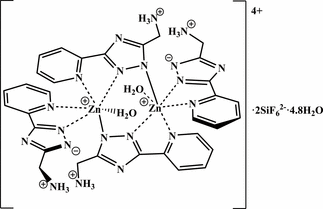
Recently, we reported the synthesis and magnetochemical characterization of a series of copper(II) complexes based on 1-[(5R)-1,2,4-triazol-3-yl]methanamines (Petrenko et al., 2026). In all cases, we observed coordination of the amino group to the metal center, resulting in the formation of a five-membered metallacycle. Here, we extend this approach to the more complex ligand 1-[3-(pyridin-2-yl)-1H-1,2,4-triazol-5-yl]methanamine (Vashchenko et al., 2025), which contains two potential chelating sites, i.e. pyridyl–triazole and methylamino–triazole moieties.
Owing to the propensity of the pyridyl–triazole moiety to adopt chelating bidentate and bridging coordination modes (Pang et al., 2017; Petrenko et al., 2020; Petrenko et al., 2023), the amino group may remain uninvolved in coordination. Nevertheless, its ability to form hydrogen bonds can give rise to an extended network of intermolecular interactions involving both the complex molecules and lattice water molecules. In this work, we report the synthesis, crystal structure and Hirshfeld surface analysis of the title compound, a new binuclear zinc(II) complex with 1-[3-(pyridin-2-yl)-1H-1,2,4-triazol-5-yl]methanamine.
2. Structural commentary
The title compound exhibits an ionic which is built up from centrosymmetric dinuclear [Zn2(HL)4(H2O)2]4+ cations, SiF62− anions and interstitial water molecules in a 1:2:4.8 ratio (Fig. 1 and Table 1). Each ZnII ion is coordinated by five N atoms provided by three ligands and one O atom from a coordinated water molecule. The ZnN5O coordination environment is best described as a distorted octahedron, as indicated by continuous shape measure (CShM) calculations performed with the program SHAPE (Version 2.1; Llunell et al., 2013), which yielded the lowest value of 1.723 for an ideal octahedron (OC-6).
|
 .
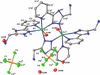 | Figure 1 The molecular structure of [Zn2(HL)4(H2O)2](SiF6)2·4.8H2O. H atoms have been omitted for clarity. |
Two ligands adopt a μ2-bridging coordination mode, linking the ZnII centres into a centrosymmetric dinuclear cation with a Zn⋯Zn separation of 4.2054 (3) Å, whereas the remaining two ligands act as terminal N,N′-chelating ligands. The Zn—N bond lengths fall in the range 2.0943 (17)–2.2556 (18) Å (Table 1), which is comparable with those reported for related dinuclear ZnII complexes containing pyridyl–triazole ligands (Zhang et al., 2021; Klingele et al., 2007; Klingele et al., 2006; Wang et al., 2018b; Gusev et al., 2011). The Zn—O bond distance of 2.1581 (18) Å is comparable with the corresponding Zn—O distances reported for related dinuclear ZnII complexes, where oxygen coordination arises either from coordinated solvent molecules or from oxygen-donor ligand functionalities. These distances lie in the range 1.9228 (18)–2.1412 (18) Å (Zhang et al., 2021; Klingele et al., 2007; Klingele et al., 2006; Wang et al., 2018b; Gusev et al., 2011).
The octahedral coordination environment is distorted, as evidenced by the cis-N/O—Zn—N angles ranging from 74.80 (6) to 100.82 (8)° and the trans angles ranging from 157.79 (7) to 169.06 (8)° (Table 1). The smallest cis angle corresponds to the bite angle of the terminal N,N′-chelating ligand, while the deviations of the remaining angles from the ideal values reflect the constraints associated with the bridging coordination mode of the μ2-triazole ligands.
The five-membered ZnN2C2 chelate rings generated by coordination of the terminal and bridging ligands exhibit comparable internal geometries, as indicated by the similar internal bond angles of the metallacycles (Table 1). The absolute values of the torsion angles do not exceed 4.3 (2)° for the terminal-ligand chelate rings and 10.3 (2)° for the bridging-ligand chelate rings, confirming that both metallacycles are close to planar. The terminal chelate ring (Zn1/N1/C5/C6/N2) is the more planar of the two, with a maximum deviation of 0.0317 (19) Å from the least-squares plane (atom N1), whereas the corresponding metallacycle (Zn1/N6/C13/C14/N7) involving the μ2-bridging ligand displays a maximum deviation of 0.0804 (19) Å (atom N6).
The pyridyl and triazole rings of the ligands are nearly coplanar, forming interplanar angles of 4.41 (12) and 2.88 (9)° in the terminal and bridging ligands, respectively (Table 2). The corresponding torsion angles C4—C5—C6—N4 [6.2 (3)°] and N1—C5—C6—N2 [2.7 (3)°] in the terminal, and C12—C13—C14—N9 [2.4 (3)°] and N6—C13—C14—N7 [2.7 (3)°] in the bridging ligands indicate that both ligands adopt similar conformations, differing only slightly in the degree of twisting between the two heterocyclic rings (Table 2).
| ||||||||||||
The five-membered metallacycle formed by the terminal N,N′-chelating ligand is nearly perpendicular to the six-membered Zn2N4 metallacycle. The dihedral angle between the least-squares planes of these metallacycles is 89.1 (4)° (Table 2). The six-membered metallacycle formed by the two ZnII centres and the donor N atoms of the triazole rings of the two μ2-bridging ligands is essentially planar, with the maximum deviation from the least-squares plane being 0.0733 (18) Å for atom N7. This metallacycle exhibits only a slight twist along the Zn1—N7—N8—Zn1 fragment, as reflected by the corresponding torsion angle of 16.3 (3)° (Table 2).
3. Supramolecular features
The crystal packing is governed by an extensive hydrogen-bonding network involving the complex cations, hexafluoridosilicate anions and water molecules (Table 3). The coordinated water molecule O1W acts as a hydrogen-bond donor towards a water molecule of crystallization [O1W—H1WA⋯O3W: O⋯O = 2.764 (3) Å] and towards F atoms of the [SiF6]2− anion. The lattice water molecules participate both as donors and as acceptors, forming O—H⋯O contacts with one another, as well as O—H⋯N and O—H⋯F hydrogen bonds to the organic ligands and hexafluoridosilicate anions, respectively. Particularly short O—H⋯O and O—H⋯F contacts include O4W—H4WA⋯O2W [O⋯O = 2.728 (5) Å] and O4W—H4WB⋯F6 [O⋯F = 2.889 (4) Å].
|
 ; (iii)
 ; (iv)
 ; (v)
 ; (vi)
 ; (vii)
 ; (viii)
 ; (ix)
 .
The N—H groups of the aminomethyl substituents provide additional hydrogen-bond donors. They form N—H⋯F contacts with the [SiF6]2− anions, including the nearly linear N5—H5A⋯F3 and N10—H10B⋯F1 interactions, with N⋯F separations of 2.829 (3) and 2.831 (3) Å, respectively, and N—H⋯F angles of 171 (3) and 174 (3)°, respectively. N—H⋯O and N—H⋯N hydrogen bonds further connect the ligand fragments with water molecules of crystallization and neighbouring complex cations. Thus, the [SiF6]2− anions and water molecules act as important hydrogen-bonding linkers between the cationic coordination units, generating an extended supramolecular assembly. Weaker C—H⋯F and C—H⋯N contacts provide further consolidation of the crystal packing.
The crystal packing of [Zn2(HL)4(H2O)2](SiF6)2·4.8H2O viewed down the a axis is illustrated in Fig. 2.
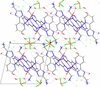 | Figure 2 The crystal packing of [Zn2(HL)4(H2O)2](SiF6)2·4.8H2O, viewed down the a axis. |
To gain further insight into the intermolecular interactions governing the crystal packing, a Hirshfeld surface analysis was performed using CrystalExplorer21.5 (Spackman et al., 2021). The Hirshfeld surface mapped over dnorm (Fig. 3) exhibits several intense red spots corresponding to close intermolecular contacts.
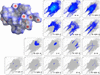 | Figure 3 The Hirshfeld surface mapped over dnorm, with red, white and blue regions representing contacts shorter than, equal to and longer than the sum of the van der Waals radii, respectively, and the corresponding two-dimensional fingerprint plots showing all intermolecular contacts and their delineated contributions (blue regions) in [Zn2(HL)4(H2O)2](SiF6)2·4.8H2O. The relative contributions of individual contact types for the asymmetric unit are: H⋯H 35.2%, F⋯H/H⋯F 28%, C⋯H/H⋯C 13.3%, N⋯H/H⋯N 8%, O⋯H/H⋯O 7.9%, N⋯C/C⋯N 3.1%, C⋯C 2.2%, O⋯C/C⋯O 1.3%, O⋯O 0.3%, F⋯C/C⋯F 0.3%, N⋯F/F⋯N 0.1%, N⋯N 0.1%, F⋯O/O⋯F 0.1% and N⋯O/O⋯N 0.1%. |
The two-dimensional fingerprint plots derived from the Hirshfeld surface are shown in Fig. 3 and indicate that the crystal packing is dominated by H⋯H contacts, which contribute 35.2% of the total Hirshfeld surface, reflecting the prevalence of van der Waals interactions. The second largest contribution arises from F⋯H/H⋯F contacts (28%), consistent with the O—H⋯F hydrogen-bonding network involving the coordinated/uncoordinated water molecules and the hexafluoridosilicate anions. C⋯H/H⋯C contacts account for 13.3% of the surface, and smaller contributions originate from N⋯H/H⋯N (8%), O⋯H/H⋯O (7.9%) and N⋯C/C⋯N (3.1%) contacts. The contribution from C⋯C contacts is 2.2%, suggesting only weak π–π stacking interactions between neighbouring aromatic rings. The remaining contact types, including O⋯C/C⋯O (1.3%), O⋯O (0.3%), F⋯C/C⋯F (0.3%), N⋯F/F⋯N (0.1%), N⋯N (0.1%), F⋯O/O⋯F (0.1%) and N⋯O/O⋯N (0.1%), each contribute only marginally to the Hirshfeld surface.
4. Database survey
A search of the Cambridge Structural Database (CSD, Version 6.01, update of February 2026; Groom et al., 2016) for dinuclear ZnII complexes containing bridging ligands with a 3-(pyridin-2-yl)-1H-1,2,4-triazole framework similar to that of the title compound revealed five closely related structures, with CSD refcodes ASAYEB (Zhang et al., 2021), JEYBOF (Klingele et al., 2007), KEFGUY (Klingele et al., 2006), MIKKEZ (Wang et al., 2018b) and UZIDUD (Gusev et al., 2011). In each of these compounds, two pyridyl–triazole ligands bridge two ZnII centres to form dinuclear complexes. The title compound [Zn2(HL)4(H2O)2](SiF6)2·4.8H2O is distinguished by the simultaneous presence of two μ2-bridging ligands with two terminal N,N′-chelating ligands within the same molecule. The coordination modes of the pyridyl–triazole ligands vary among the related structures. In JEYBOF, KEFGUY and UZIDUD, each ZnII centre is coordinated by two N atoms from each of two ligands, giving a symmetric N,N′-chelating environment. In contrast, ASAYEB and MIKKEZ exhibit an unsymmetrical coordination mode, in which one ligand coordinates through a single N atom, whereas the second ligand binds through two N atoms. The title compound differs from both coordination patterns, since each ZnII centre is coordinated by five N atoms originating from three ligands. The compounds represented by ASAYEB, MIKKEZ and UZIDUD contain neutral coordination entities, whereas JEYBOF and KEFGUY comprise tetracationic complex cations, with perchlorate and tetrafluoridoborate counter-anions, respectively. In ASAYEB, the octahedral coordination sphere is completed by one coordinated water molecule, one coordinated methanol molecule and a donor O atom of the ligand substituent; one additional methanol molecule is present as a solvent molecule. In JEYBOF, each ZnII centre is coordinated by two water molecules, whereas in KEFGUY, the remaining coordination sites are occupied by one water and one acetonitrile molecule. In MIKKEZ, the octahedral coordination sphere is completed by two coordinated water molecules and one nicotinate ligand. In contrast to the rest of the mentioned compounds, UZIDUD contains a five-coordinate ZnII centre, in which the coordination sphere is completed by a donor atom of the ligand substituent, while one ethanol molecule is present as a solvent molecule. The title compound differs from all these analogues in that each ZnII centre is coordinated by only one water molecule, with the remaining coordination sites occupied exclusively by neutral pyridyl–triazole ligands.
5. Synthesis and crystallization
[3-(Pyridin-2-yl)-1H-1,2,4-triazol-5-yl]methanamine (HL) was obtained according to the procedure described by Vashchenko et al. (2025).
A solution of 563 mg (0.78 mmol) of zinc hexafluorosilicate in 4 ml of water was added to a solution of 311 mg (1.78 mmol) of [3-(pyridin-2-yl)-1H-1,2,4-triazol-5-yl]methanamine in 4 ml of water. X-ray-quality colourless crystals of [Zn2(HL)4(H2O)2](SiF6)2·4.8H2O were obtained by slow crystallization from the reaction mixture over one week (yield: 365 mg, 40.3%). IR data (in KBr, cm−1): 3445, 3119, 2603, 1992, 1605, 1531, 1475, 1435, 1408, 1373, 1333, 1279, 1130, 1055, 1014, 960, 892, 749, 627, 532.
The phase purity of [Zn2(HL)4(H2O)2](SiF6)2·4.8H2O was confirmed by comparing the observed and calculated powder X-ray diffraction patterns (Fig. 4). The PXRD pattern was acquired on a Shimadzu XRD-6000 diffractometer using Cu Kα radiation over the 5–50° 2θ range with a step size of 0.05°.
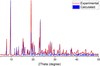 | Figure 4 Experimental powder X-ray diffraction pattern (red) and calculated Bragg reflection positions (blue) of [Zn2(HL)4(H2O)2](SiF6)2·4.8H2O. |
The UV–Vis of [Zn2(HL)4(H2O)2](SiF6)2·4.8H2O was measured in diffuse reflectance mode using a Shimadzu UV-2600i spectrophotometer and a powdered microcrystalline sample at ambient temperature (Fig. 5). The absorption bands at 265 and 302 nm are attributed to intraligand π–π* transitions.
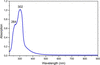 | Figure 5 The solid-state UV–Vis absorption spectrum of [Zn2(HL)4(H2O)2](SiF6)2·4.8H2O at room temperature. |
6. Refinement
Crystal data, data collection and structure details are summarized in Table 4.
|

Supporting information
CCDC reference: 2585523
contains datablock I. DOI: https://doi.org/10.1107/S2056989026012028/dj2094sup1.cif
Structure factors: contains datablock I. DOI: https://doi.org/10.1107/S2056989026012028/dj2094Isup3.hkl
| [Zn2(C8H9N5)4(H2O)2](SF6)2·4.8H2O | Z = 1 |
| Mr = 1238.23 | F(000) = 632 |
| Triclinic, P1 | Dx = 1.696 Mg m−3 |
| a = 9.1980 (2) Å | Cu Kα radiation, λ = 1.54184 Å |
| b = 11.6301 (3) Å | Cell parameters from 10928 reflections |
| c = 11.7906 (3) Å | θ = 3.8–76.4° |
| α = 76.611 (2)° | µ = 2.72 mm−1 |
| β = 87.293 (2)° | T = 300 K |
| γ = 81.214 (2)° | Prism, clear dark colourless |
| V = 1212.51 (5) Å3 | 0.15 × 0.1 × 0.1 mm |
| Rigaku XtaLAB Synergy Dualflex diffractometer with a HyPix detector | 4796 independent reflections |
| Radiation source: micro-focus sealed X-ray tube, PhotonJet (Cu) X-ray Source | 4499 reflections with I > 2σ(I) |
| Mirror monochromator | Rint = 0.025 |
| Detector resolution: 10.0000 pixels mm-1 | θmax = 76.8°, θmin = 4.0° |
| ω scans | h = −11→11 |
| Absorption correction: multi-scan (CrysAlis PRO; Rigaku OD, 2024) | k = −14→14 |
| Tmin = 0.766, Tmax = 1.000 | l = −14→11 |
| 14372 measured reflections |
| Refinement on F2 | Hydrogen site location: mixed |
| Least-squares matrix: full | H atoms treated by a mixture of independent and constrained refinement |
| R[F2 > 2σ(F2)] = 0.037 | w = 1/[σ2(Fo2) + (0.0659P)2 + 0.7516P] where P = (Fo2 + 2Fc2)/3 |
| wR(F2) = 0.108 | (Δ/σ)max < 0.001 |
| S = 1.04 | Δρmax = 0.89 e Å−3 |
| 4796 reflections | Δρmin = −0.35 e Å−3 |
| 380 parameters | Extinction correction: SHELXL2018 (Sheldrick, 2015b), Fc*=kFc[1+0.001xFc2λ3/sin(2θ)]-1/4 |
| 22 restraints | Extinction coefficient: 0.0016 (3) |
| Primary atom site location: dual |
Geometry. All esds (except the esd in the dihedral angle between two l.s. planes) are estimated using the full covariance matrix. The cell esds are taken into account individually in the estimation of esds in distances, angles and torsion angles; correlations between esds in cell parameters are only used when they are defined by crystal symmetry. An approximate (isotropic) treatment of cell esds is used for estimating esds involving l.s. planes. |
| x | y | z | Uiso*/Ueq | Occ. (<1) | |
| Zn1 | 0.43245 (3) | 0.34258 (2) | 0.60085 (2) | 0.02794 (12) | |
| Si1 | 1.000000 | 0.000000 | 1.000000 | 0.0352 (2) | |
| Si2 | 0.500000 | 0.500000 | 1.000000 | 0.0331 (2) | |
| F1 | 0.8962 (3) | 0.09294 (18) | 1.07193 (18) | 0.0835 (7) | |
| F2 | 1.06214 (18) | 0.11756 (14) | 0.91383 (15) | 0.0550 (4) | |
| F3 | 0.8593 (2) | 0.01640 (18) | 0.90929 (19) | 0.0786 (7) | |
| F4 | 0.4744 (2) | 0.37224 (15) | 0.96651 (18) | 0.0655 (5) | |
| F5 | 0.66812 (19) | 0.43637 (17) | 1.04985 (14) | 0.0585 (4) | |
| F6 | 0.5731 (2) | 0.54124 (17) | 0.86720 (13) | 0.0625 (5) | |
| O1W | 0.3356 (2) | 0.4088 (2) | 0.74794 (18) | 0.0549 (5) | |
| H1WA | 0.250 (2) | 0.423 (4) | 0.764 (3) | 0.082* | |
| H1WB | 0.386 (3) | 0.424 (4) | 0.799 (3) | 0.082* | |
| O2W | 0.9029 (4) | −0.1582 (3) | 0.7425 (3) | 0.0740 (9) | 0.75 |
| H2WA | 0.817037 | −0.120957 | 0.725428 | 0.111* | 0.75 |
| H2WB | 0.939170 | −0.116960 | 0.781807 | 0.111* | 0.75 |
| O3W | 1.0698 (3) | 0.4300 (3) | 0.8662 (3) | 0.0665 (8) | 0.75 |
| H3WA | 1.006901 | 0.489560 | 0.871103 | 0.100* | 0.75 |
| H3WB | 1.103302 | 0.391757 | 0.930970 | 0.100* | 0.75 |
| O4W | 0.8400 (4) | 0.6366 (3) | 0.8893 (3) | 0.0730 (9) | 0.75 |
| H4WA | 0.866261 | 0.703594 | 0.849679 | 0.110* | 0.75 |
| H4WB | 0.764578 | 0.603369 | 0.880398 | 0.110* | 0.75 |
| O5W | 0.7325 (15) | 0.7334 (11) | 0.7586 (16) | 0.067 (4) | 0.15 |
| H5WA | 0.674743 | 0.678709 | 0.779794 | 0.100* | 0.15 |
| H5WB | 0.696632 | 0.808055 | 0.733663 | 0.100* | 0.15 |
| N1 | 0.5535 (2) | 0.24347 (16) | 0.47317 (15) | 0.0294 (4) | |
| N2 | 0.4946 (2) | 0.16270 (15) | 0.69984 (15) | 0.0296 (4) | |
| N3 | 0.4706 (2) | 0.09658 (17) | 0.80929 (15) | 0.0335 (4) | |
| N4 | 0.6042 (2) | −0.02445 (17) | 0.70680 (16) | 0.0363 (4) | |
| N5 | 0.6631 (2) | −0.15231 (18) | 0.98282 (17) | 0.0378 (4) | |
| H5A | 0.730 (3) | −0.105 (2) | 0.966 (3) | 0.045* | |
| H5B | 0.708 (3) | −0.2229 (15) | 0.978 (3) | 0.045* | |
| H5C | 0.647 (3) | −0.152 (3) | 1.0565 (13) | 0.045* | |
| N6 | 0.78621 (19) | 0.70081 (16) | 0.42228 (16) | 0.0296 (4) | |
| N7 | 0.65809 (19) | 0.51555 (15) | 0.54254 (15) | 0.0273 (4) | |
| N8 | 0.61912 (19) | 0.41805 (15) | 0.62223 (15) | 0.0272 (3) | |
| N9 | 0.8292 (2) | 0.45952 (16) | 0.68110 (16) | 0.0317 (4) | |
| N10 | 0.8147 (2) | 0.30411 (19) | 0.89896 (17) | 0.0375 (4) | |
| H10A | 0.896 (2) | 0.331 (3) | 0.871 (2) | 0.045* | |
| H10B | 0.833 (3) | 0.2380 (17) | 0.953 (2) | 0.045* | |
| H10C | 0.766 (3) | 0.355 (2) | 0.937 (2) | 0.045* | |
| C1 | 0.5859 (3) | 0.2895 (2) | 0.36169 (19) | 0.0360 (5) | |
| H1 | 0.547328 | 0.368366 | 0.328967 | 0.043* | |
| C2 | 0.6741 (3) | 0.2252 (2) | 0.2931 (2) | 0.0408 (5) | |
| H2 | 0.696107 | 0.260732 | 0.216436 | 0.049* | |
| C3 | 0.7292 (3) | 0.1073 (2) | 0.3402 (2) | 0.0416 (5) | |
| H3 | 0.787378 | 0.061843 | 0.295155 | 0.050* | |
| C4 | 0.6966 (3) | 0.0578 (2) | 0.4550 (2) | 0.0367 (5) | |
| H4 | 0.731835 | −0.021546 | 0.488648 | 0.044* | |
| C5 | 0.6099 (2) | 0.12924 (18) | 0.51910 (18) | 0.0282 (4) | |
| C6 | 0.5724 (2) | 0.08791 (18) | 0.64243 (17) | 0.0282 (4) | |
| C7 | 0.5369 (3) | −0.0132 (2) | 0.80884 (19) | 0.0341 (5) | |
| C8 | 0.5283 (3) | −0.1170 (2) | 0.9097 (2) | 0.0436 (6) | |
| H8A | 0.444766 | −0.097330 | 0.958573 | 0.052* | |
| H8B | 0.510832 | −0.184903 | 0.880290 | 0.052* | |
| C9 | 0.8498 (3) | 0.7896 (2) | 0.3555 (2) | 0.0358 (5) | |
| H9 | 0.803146 | 0.834104 | 0.287671 | 0.043* | |
| C10 | 0.9822 (3) | 0.8177 (2) | 0.3838 (2) | 0.0424 (5) | |
| H10 | 1.023030 | 0.880781 | 0.336630 | 0.051* | |
| C11 | 1.0525 (3) | 0.7503 (3) | 0.4832 (3) | 0.0468 (6) | |
| H11 | 1.141183 | 0.767960 | 0.504388 | 0.056* | |
| C12 | 0.9900 (3) | 0.6562 (2) | 0.5513 (2) | 0.0407 (5) | |
| H12 | 1.036538 | 0.608811 | 0.618016 | 0.049* | |
| C13 | 0.8571 (2) | 0.63434 (18) | 0.51770 (18) | 0.0289 (4) | |
| C14 | 0.7822 (2) | 0.53614 (18) | 0.58198 (18) | 0.0284 (4) | |
| C15 | 0.7247 (2) | 0.38854 (18) | 0.70160 (18) | 0.0283 (4) | |
| C16 | 0.7297 (3) | 0.2839 (2) | 0.80353 (19) | 0.0339 (5) | |
| H16A | 0.630416 | 0.272948 | 0.830655 | 0.041* | |
| H16B | 0.775424 | 0.211974 | 0.780083 | 0.041* |
| U11 | U22 | U33 | U12 | U13 | U23 | |
| Zn1 | 0.02818 (17) | 0.02679 (17) | 0.02729 (17) | −0.00577 (11) | −0.00294 (11) | −0.00133 (11) |
| Si1 | 0.0342 (4) | 0.0307 (4) | 0.0344 (4) | −0.0030 (3) | −0.0019 (3) | 0.0048 (3) |
| Si2 | 0.0445 (5) | 0.0284 (4) | 0.0242 (4) | 0.0000 (3) | −0.0027 (3) | −0.0045 (3) |
| F1 | 0.1137 (17) | 0.0529 (11) | 0.0654 (12) | 0.0152 (11) | 0.0309 (12) | −0.0001 (9) |
| F2 | 0.0491 (9) | 0.0454 (8) | 0.0579 (9) | −0.0101 (7) | 0.0005 (7) | 0.0157 (7) |
| F3 | 0.0779 (13) | 0.0676 (12) | 0.0792 (13) | −0.0308 (10) | −0.0412 (11) | 0.0269 (10) |
| F4 | 0.0863 (13) | 0.0427 (9) | 0.0744 (12) | −0.0148 (9) | 0.0031 (10) | −0.0245 (8) |
| F5 | 0.0530 (9) | 0.0693 (11) | 0.0474 (9) | 0.0114 (8) | −0.0125 (7) | −0.0123 (8) |
| F6 | 0.0738 (11) | 0.0711 (11) | 0.0312 (8) | 0.0001 (9) | 0.0088 (7) | 0.0027 (7) |
| O1W | 0.0412 (10) | 0.0880 (15) | 0.0482 (11) | −0.0144 (10) | 0.0057 (8) | −0.0391 (11) |
| O2W | 0.0652 (19) | 0.072 (2) | 0.084 (2) | 0.0042 (16) | 0.0050 (16) | −0.0252 (17) |
| O3W | 0.0256 (11) | 0.0735 (19) | 0.099 (2) | −0.0069 (12) | 0.0062 (13) | −0.0181 (17) |
| O4W | 0.076 (2) | 0.068 (2) | 0.079 (2) | −0.0271 (16) | −0.0060 (17) | −0.0148 (17) |
| O5W | 0.046 (7) | 0.028 (6) | 0.127 (14) | −0.004 (5) | −0.001 (8) | −0.019 (7) |
| N1 | 0.0339 (9) | 0.0270 (8) | 0.0254 (8) | −0.0045 (7) | −0.0015 (7) | −0.0018 (7) |
| N2 | 0.0331 (9) | 0.0289 (9) | 0.0244 (8) | −0.0063 (7) | −0.0002 (7) | 0.0001 (7) |
| N3 | 0.0349 (9) | 0.0389 (10) | 0.0243 (8) | −0.0098 (8) | 0.0002 (7) | 0.0002 (7) |
| N4 | 0.0468 (11) | 0.0283 (9) | 0.0299 (9) | −0.0048 (8) | −0.0029 (8) | 0.0011 (7) |
| N5 | 0.0459 (11) | 0.0330 (10) | 0.0308 (9) | −0.0045 (8) | −0.0020 (8) | 0.0002 (8) |
| N6 | 0.0284 (8) | 0.0287 (9) | 0.0309 (9) | −0.0064 (7) | −0.0018 (7) | −0.0034 (7) |
| N7 | 0.0281 (8) | 0.0248 (8) | 0.0273 (8) | −0.0054 (6) | −0.0033 (7) | −0.0005 (6) |
| N8 | 0.0282 (8) | 0.0244 (8) | 0.0273 (8) | −0.0042 (6) | −0.0018 (6) | −0.0016 (6) |
| N9 | 0.0305 (9) | 0.0320 (9) | 0.0302 (9) | −0.0047 (7) | −0.0060 (7) | −0.0011 (7) |
| N10 | 0.0388 (10) | 0.0379 (10) | 0.0316 (10) | 0.0014 (8) | −0.0082 (8) | −0.0028 (8) |
| C1 | 0.0440 (12) | 0.0318 (11) | 0.0281 (10) | −0.0055 (9) | −0.0027 (9) | 0.0015 (8) |
| C2 | 0.0499 (14) | 0.0449 (13) | 0.0258 (10) | −0.0103 (11) | 0.0028 (9) | −0.0031 (9) |
| C3 | 0.0488 (14) | 0.0407 (12) | 0.0355 (12) | −0.0054 (10) | 0.0067 (10) | −0.0112 (10) |
| C4 | 0.0440 (12) | 0.0292 (10) | 0.0349 (11) | −0.0026 (9) | 0.0010 (9) | −0.0056 (9) |
| C5 | 0.0306 (10) | 0.0263 (10) | 0.0278 (10) | −0.0076 (8) | −0.0025 (8) | −0.0037 (8) |
| C6 | 0.0311 (10) | 0.0256 (9) | 0.0265 (10) | −0.0060 (8) | −0.0028 (8) | −0.0018 (8) |
| C7 | 0.0395 (12) | 0.0330 (11) | 0.0275 (10) | −0.0121 (9) | −0.0043 (8) | 0.0028 (8) |
| C8 | 0.0520 (14) | 0.0420 (13) | 0.0331 (12) | −0.0190 (11) | −0.0073 (10) | 0.0083 (10) |
| C9 | 0.0355 (11) | 0.0307 (11) | 0.0387 (12) | −0.0070 (9) | 0.0033 (9) | −0.0019 (9) |
| C10 | 0.0362 (12) | 0.0336 (12) | 0.0564 (15) | −0.0124 (9) | 0.0095 (11) | −0.0057 (10) |
| C11 | 0.0351 (12) | 0.0513 (15) | 0.0573 (15) | −0.0190 (11) | −0.0024 (11) | −0.0104 (12) |
| C12 | 0.0341 (11) | 0.0473 (13) | 0.0414 (12) | −0.0123 (10) | −0.0078 (9) | −0.0059 (10) |
| C13 | 0.0281 (10) | 0.0289 (10) | 0.0302 (10) | −0.0059 (8) | 0.0004 (8) | −0.0068 (8) |
| C14 | 0.0272 (10) | 0.0281 (10) | 0.0290 (10) | −0.0035 (8) | −0.0034 (8) | −0.0044 (8) |
| C15 | 0.0282 (10) | 0.0277 (10) | 0.0274 (10) | −0.0022 (8) | −0.0024 (8) | −0.0040 (8) |
| C16 | 0.0390 (11) | 0.0315 (11) | 0.0285 (10) | −0.0044 (9) | −0.0062 (9) | −0.0007 (8) |
| Zn1—O1W | 2.1581 (18) | N5—H5C | 0.874 (13) |
| Zn1—N1 | 2.2556 (18) | N5—C8 | 1.493 (3) |
| Zn1—N2 | 2.1523 (17) | N6—C9 | 1.339 (3) |
| Zn1—N6i | 2.1907 (18) | N6—C13 | 1.342 (3) |
| Zn1—N7i | 2.1669 (17) | N7—N8 | 1.377 (2) |
| Zn1—N8 | 2.0943 (17) | N7—C14 | 1.327 (3) |
| Si1—F1ii | 1.6827 (19) | N8—C15 | 1.331 (3) |
| Si1—F1 | 1.6827 (19) | N9—C14 | 1.340 (3) |
| Si1—F2 | 1.6640 (14) | N9—C15 | 1.339 (3) |
| Si1—F2ii | 1.6640 (14) | N10—H10A | 0.874 (13) |
| Si1—F3ii | 1.6781 (18) | N10—H10B | 0.876 (13) |
| Si1—F3 | 1.6781 (18) | N10—H10C | 0.881 (13) |
| Si2—F4 | 1.6754 (16) | N10—C16 | 1.482 (3) |
| Si2—F4iii | 1.6754 (16) | C1—H1 | 0.9300 |
| Si2—F5iii | 1.6790 (16) | C1—C2 | 1.380 (3) |
| Si2—F5 | 1.6790 (16) | C2—H2 | 0.9300 |
| Si2—F6 | 1.6690 (15) | C2—C3 | 1.381 (4) |
| Si2—F6iii | 1.6690 (15) | C3—H3 | 0.9300 |
| O1W—H1WA | 0.805 (17) | C3—C4 | 1.381 (3) |
| O1W—H1WB | 0.845 (18) | C4—H4 | 0.9300 |
| O2W—H2WA | 0.8500 | C4—C5 | 1.389 (3) |
| O2W—H2WB | 0.8500 | C5—C6 | 1.464 (3) |
| O3W—H3WA | 0.8430 | C7—C8 | 1.494 (3) |
| O3W—H3WB | 0.8357 | C8—H8A | 0.9700 |
| O4W—H4WA | 0.8728 | C8—H8B | 0.9700 |
| O4W—H4WB | 0.8653 | C9—H9 | 0.9300 |
| O5W—H5WA | 0.8752 | C9—C10 | 1.382 (4) |
| O5W—H5WB | 0.8678 | C10—H10 | 0.9300 |
| N1—C1 | 1.338 (3) | C10—C11 | 1.377 (4) |
| N1—C5 | 1.345 (3) | C11—H11 | 0.9300 |
| N2—N3 | 1.368 (2) | C11—C12 | 1.383 (4) |
| N2—C6 | 1.328 (3) | C12—H12 | 0.9300 |
| N3—C7 | 1.329 (3) | C12—C13 | 1.380 (3) |
| N4—C6 | 1.347 (3) | C13—C14 | 1.464 (3) |
| N4—C7 | 1.351 (3) | C15—C16 | 1.496 (3) |
| N5—H5A | 0.874 (13) | C16—H16A | 0.9700 |
| N5—H5B | 0.873 (13) | C16—H16B | 0.9700 |
| O1W—Zn1—N1 | 169.06 (8) | C13—N6—Zn1i | 114.91 (13) |
| O1W—Zn1—N6i | 85.67 (7) | N8—N7—Zn1i | 140.81 (13) |
| O1W—Zn1—N7i | 100.82 (8) | C14—N7—Zn1i | 112.70 (13) |
| N2—Zn1—O1W | 94.68 (8) | C14—N7—N8 | 105.28 (16) |
| N2—Zn1—N1 | 74.80 (6) | N7—N8—Zn1 | 121.87 (13) |
| N2—Zn1—N6i | 89.24 (7) | C15—N8—Zn1 | 132.96 (14) |
| N2—Zn1—N7i | 157.79 (7) | C15—N8—N7 | 105.11 (16) |
| N6i—Zn1—N1 | 97.00 (7) | C15—N9—C14 | 101.48 (17) |
| N7i—Zn1—N1 | 90.12 (6) | H10A—N10—H10B | 111 (3) |
| N7i—Zn1—N6i | 76.29 (6) | H10A—N10—H10C | 108 (3) |
| N8—Zn1—O1W | 87.53 (7) | H10B—N10—H10C | 103 (3) |
| N8—Zn1—N1 | 91.39 (7) | C16—N10—H10A | 110 (2) |
| N8—Zn1—N2 | 100.42 (7) | C16—N10—H10B | 110 (2) |
| N8—Zn1—N6i | 168.62 (7) | C16—N10—H10C | 114 (2) |
| N8—Zn1—N7i | 96.08 (6) | N1—C1—H1 | 118.6 |
| F1ii—Si1—F1 | 180.00 (12) | N1—C1—C2 | 122.9 (2) |
| F2ii—Si1—F1ii | 89.00 (9) | C2—C1—H1 | 118.6 |
| F2—Si1—F1 | 89.00 (9) | C1—C2—H2 | 120.5 |
| F2—Si1—F1ii | 91.00 (9) | C1—C2—C3 | 119.0 (2) |
| F2ii—Si1—F1 | 91.00 (9) | C3—C2—H2 | 120.5 |
| F2ii—Si1—F2 | 180.0 | C2—C3—H3 | 120.4 |
| F2ii—Si1—F3ii | 89.92 (8) | C2—C3—C4 | 119.1 (2) |
| F2ii—Si1—F3 | 90.08 (8) | C4—C3—H3 | 120.4 |
| F2—Si1—F3 | 89.92 (8) | C3—C4—H4 | 120.8 |
| F2—Si1—F3ii | 90.08 (8) | C3—C4—C5 | 118.4 (2) |
| F3ii—Si1—F1 | 91.20 (13) | C5—C4—H4 | 120.8 |
| F3—Si1—F1ii | 91.20 (13) | N1—C5—C4 | 122.77 (19) |
| F3—Si1—F1 | 88.80 (13) | N1—C5—C6 | 113.90 (18) |
| F3ii—Si1—F1ii | 88.80 (13) | C4—C5—C6 | 123.34 (19) |
| F3ii—Si1—F3 | 180.00 (9) | N2—C6—N4 | 113.69 (18) |
| F4iii—Si2—F4 | 180.0 | N2—C6—C5 | 120.16 (18) |
| F4—Si2—F5 | 89.83 (10) | N4—C6—C5 | 126.08 (19) |
| F4iii—Si2—F5 | 90.17 (10) | N3—C7—N4 | 114.32 (18) |
| F4—Si2—F5iii | 90.17 (10) | N3—C7—C8 | 122.7 (2) |
| F4iii—Si2—F5iii | 89.83 (10) | N4—C7—C8 | 122.8 (2) |
| F5iii—Si2—F5 | 180.0 | N5—C8—C7 | 114.1 (2) |
| F6—Si2—F4 | 88.43 (10) | N5—C8—H8A | 108.7 |
| F6—Si2—F4iii | 91.57 (10) | N5—C8—H8B | 108.7 |
| F6iii—Si2—F4iii | 88.43 (10) | C7—C8—H8A | 108.7 |
| F6iii—Si2—F4 | 91.57 (10) | C7—C8—H8B | 108.7 |
| F6—Si2—F5 | 89.18 (9) | H8A—C8—H8B | 107.6 |
| F6—Si2—F5iii | 90.82 (9) | N6—C9—H9 | 118.8 |
| F6iii—Si2—F5 | 90.82 (9) | N6—C9—C10 | 122.4 (2) |
| F6iii—Si2—F5iii | 89.18 (9) | C10—C9—H9 | 118.8 |
| F6—Si2—F6iii | 180.0 | C9—C10—H10 | 120.6 |
| Zn1—O1W—H1WA | 128 (2) | C11—C10—C9 | 118.7 (2) |
| Zn1—O1W—H1WB | 123 (2) | C11—C10—H10 | 120.6 |
| H1WA—O1W—H1WB | 109 (3) | C10—C11—H11 | 120.3 |
| H2WA—O2W—H2WB | 104.5 | C10—C11—C12 | 119.5 (2) |
| H3WA—O3W—H3WB | 112.9 | C12—C11—H11 | 120.3 |
| H4WA—O4W—H4WB | 129.4 | C11—C12—H12 | 120.8 |
| H5WA—O5W—H5WB | 121.0 | C13—C12—C11 | 118.4 (2) |
| C1—N1—Zn1 | 126.75 (15) | C13—C12—H12 | 120.8 |
| C1—N1—C5 | 117.82 (19) | N6—C13—C12 | 122.7 (2) |
| C5—N1—Zn1 | 115.09 (13) | N6—C13—C14 | 114.27 (18) |
| N3—N2—Zn1 | 137.82 (14) | C12—C13—C14 | 123.1 (2) |
| C6—N2—Zn1 | 115.90 (13) | N7—C14—N9 | 114.09 (18) |
| C6—N2—N3 | 106.18 (17) | N7—C14—C13 | 120.53 (18) |
| C7—N3—N2 | 104.91 (17) | N9—C14—C13 | 125.37 (19) |
| C6—N4—C7 | 100.88 (18) | N8—C15—N9 | 114.03 (18) |
| H5A—N5—H5B | 106 (3) | N8—C15—C16 | 123.58 (19) |
| H5A—N5—H5C | 100 (3) | N9—C15—C16 | 122.38 (19) |
| H5B—N5—H5C | 108 (3) | N10—C16—C15 | 109.84 (18) |
| C8—N5—H5A | 116 (2) | N10—C16—H16A | 109.7 |
| C8—N5—H5B | 112 (2) | N10—C16—H16B | 109.7 |
| C8—N5—H5C | 114 (2) | C15—C16—H16A | 109.7 |
| C9—N6—Zn1i | 126.66 (15) | C15—C16—H16B | 109.7 |
| C9—N6—C13 | 118.31 (19) | H16A—C16—H16B | 108.2 |
| Zn1—N1—C1—C2 | 172.83 (18) | N8—C15—C16—N10 | −155.2 (2) |
| Zn1—N1—C5—C4 | −175.27 (17) | N9—C15—C16—N10 | 26.4 (3) |
| Zn1—N1—C5—C6 | 4.3 (2) | C1—N1—C5—C4 | −1.5 (3) |
| Zn1—N2—N3—C7 | 176.15 (17) | C1—N1—C5—C6 | 178.13 (19) |
| Zn1—N2—C6—N4 | −177.76 (15) | C1—C2—C3—C4 | −1.1 (4) |
| Zn1—N2—C6—C5 | −0.4 (2) | C2—C3—C4—C5 | −0.4 (4) |
| Zn1i—N6—C9—C10 | 173.26 (18) | C3—C4—C5—N1 | 1.7 (3) |
| Zn1i—N6—C13—C12 | −174.24 (18) | C3—C4—C5—C6 | −177.8 (2) |
| Zn1i—N6—C13—C14 | 6.5 (2) | C4—C5—C6—N2 | 176.9 (2) |
| Zn1i—N7—N8—Zn1 | 16.3 (3) | C4—C5—C6—N4 | −6.2 (3) |
| Zn1i—N7—N8—C15 | −166.12 (17) | C5—N1—C1—C2 | −0.2 (3) |
| Zn1i—N7—C14—N9 | 170.58 (14) | C6—N2—N3—C7 | 0.3 (2) |
| Zn1i—N7—C14—C13 | −10.3 (2) | C6—N4—C7—N3 | −0.8 (3) |
| Zn1—N8—C15—N9 | 177.85 (14) | C6—N4—C7—C8 | 174.9 (2) |
| Zn1—N8—C15—C16 | −0.7 (3) | C7—N4—C6—N2 | 1.0 (2) |
| N1—C1—C2—C3 | 1.5 (4) | C7—N4—C6—C5 | −176.1 (2) |
| N1—C5—C6—N2 | −2.7 (3) | C9—N6—C13—C12 | 2.0 (3) |
| N1—C5—C6—N4 | 174.2 (2) | C9—N6—C13—C14 | −177.32 (19) |
| N2—N3—C7—N4 | 0.4 (3) | C9—C10—C11—C12 | 0.6 (4) |
| N2—N3—C7—C8 | −175.4 (2) | C10—C11—C12—C13 | −1.1 (4) |
| N3—N2—C6—N4 | −0.8 (2) | C11—C12—C13—N6 | −0.2 (4) |
| N3—N2—C6—C5 | 176.47 (18) | C11—C12—C13—C14 | 179.0 (2) |
| N3—C7—C8—N5 | −102.4 (3) | C12—C13—C14—N7 | −176.6 (2) |
| N4—C7—C8—N5 | 82.2 (3) | C12—C13—C14—N9 | 2.4 (3) |
| N6—C9—C10—C11 | 1.2 (4) | C13—N6—C9—C10 | −2.5 (3) |
| N6—C13—C14—N7 | 2.7 (3) | C14—N7—N8—Zn1 | −178.23 (13) |
| N6—C13—C14—N9 | −178.3 (2) | C14—N7—N8—C15 | −0.6 (2) |
| N7—N8—C15—N9 | 0.6 (2) | C14—N9—C15—N8 | −0.3 (2) |
| N7—N8—C15—C16 | −177.95 (19) | C14—N9—C15—C16 | 178.2 (2) |
| N8—N7—C14—N9 | 0.4 (2) | C15—N9—C14—N7 | −0.1 (2) |
| N8—N7—C14—C13 | 179.53 (18) | C15—N9—C14—C13 | −179.1 (2) |
| Symmetry codes: (i) −x+1, −y+1, −z+1; (ii) −x+2, −y, −z+2; (iii) −x+1, −y+1, −z+2. |
| D—H···A | D—H | H···A | D···A | D—H···A |
| O1W—H1WA···O3Wiv | 0.81 (2) | 2.01 (2) | 2.764 (3) | 157 (4) |
| O1W—H1WB···F4 | 0.85 (2) | 2.09 (3) | 2.844 (3) | 149 (4) |
| O1W—H1WB···F6 | 0.85 (2) | 2.61 (2) | 3.383 (3) | 153 (4) |
| O2W—H2WA···N4 | 0.85 | 2.10 | 2.941 (4) | 172 |
| O2W—H2WB···F1ii | 0.85 | 2.44 | 3.218 (5) | 153 |
| O2W—H2WB···F3 | 0.85 | 2.41 | 3.111 (4) | 140 |
| O3W—H3WA···O4W | 0.84 | 2.16 | 3.002 (5) | 177 |
| O3W—H3WB···O4Wv | 0.84 | 2.15 | 2.932 (5) | 157 |
| O4W—H4WA···O2Wvi | 0.87 | 1.87 | 2.728 (5) | 169 |
| O4W—H4WB···F6 | 0.87 | 2.03 | 2.889 (4) | 173 |
| O5W—H5WA···F6 | 0.88 | 2.02 | 2.877 (14) | 165 |
| O5W—H5WB···N4vi | 0.87 | 1.96 | 2.821 (13) | 170 |
| N5—H5A···F2ii | 0.87 (1) | 2.40 (3) | 2.977 (3) | 124 (2) |
| N5—H5A···F3 | 0.87 (1) | 1.96 (1) | 2.829 (3) | 171 (3) |
| N5—H5B···O4Wvii | 0.87 (1) | 2.31 (2) | 3.123 (4) | 156 (3) |
| N5—H5C···N3viii | 0.87 (1) | 2.05 (2) | 2.854 (3) | 153 (3) |
| N10—H10A···O3W | 0.87 (1) | 2.10 (2) | 2.915 (3) | 155 (3) |
| N10—H10B···F1 | 0.88 (1) | 1.96 (1) | 2.831 (3) | 174 (3) |
| N10—H10B···F2 | 0.88 (1) | 2.43 (3) | 2.876 (3) | 112 (2) |
| N10—H10C···F5 | 0.88 (1) | 1.92 (2) | 2.785 (3) | 167 (3) |
| N10—H10C···F6 | 0.88 (1) | 2.58 (2) | 3.227 (3) | 131 (2) |
| C1—H1···F6i | 0.93 | 2.54 | 3.214 (3) | 130 |
| C2—H2···F5ix | 0.93 | 2.48 | 3.313 (3) | 150 |
| C8—H8B···F4viii | 0.97 | 2.48 | 2.993 (3) | 113 |
| C8—H8B···O5Wvii | 0.97 | 2.62 | 3.139 (15) | 114 |
| C9—H9···F2x | 0.93 | 2.61 | 3.216 (3) | 123 |
| C16—H16A···F4 | 0.97 | 2.47 | 3.165 (3) | 129 |
| C16—H16A···N2 | 0.97 | 2.68 | 3.183 (3) | 113 |
| C16—H16B···F3 | 0.97 | 2.46 | 3.140 (3) | 127 |
| Symmetry codes: (i) −x+1, −y+1, −z+1; (ii) −x+2, −y, −z+2; (iv) x−1, y, z; (v) −x+2, −y+1, −z+2; (vi) x, y+1, z; (vii) x, y−1, z; (viii) −x+1, −y, −z+2; (ix) x, y, z−1; (x) −x+2, −y+1, −z+1. |
| C1–C5/N1 C6/N4/C7/N3/N2 | 4.41 (12) |
| C9–C13/N6 C14/N9/C15/N8/N7 | 2.88 (9) |
| N2/C6/C5/N1/Zn1 Zn1/N7/N8/Zn1/N7/N8 | 89.1 (4) |
| N6/C13/C14/N7/Zn1 Zn1/N7/N8/Zn1/N7/N8 | 4.8 (4) |
Acknowledgements
The authors are grateful to the FAIRE programme provided by the Cambridge Crystallographic Data Centre (CCDC) for the opportunity to use the Cambridge Structural Database (CSD) and associated software. AB is grateful for support by a grant of the Ministry of Research, Innovation and Digitization, CCCDI–UEFISCDI, project No. PN-IV-P8–8.3-PM-RO-TR-2024-0046, within PNCDI IV, Contract ctr.8 BMTR/2025 (SynTioPOSS).
Funding information
Funding for this research was provided by: Ministry of Education and Science of Ukraine (grant No. 26BF037-02M).
References
 Cao, Y., Zhang, Y., Gu, L., Qin, X., Li, H.-Y., Bian, H.-D. & Huang, F.-P. (2020). New J. Chem. 44, 10681–10688. CrossRef Google Scholar
Dolomanov, O. V., Bourhis, L. J., Gildea, R. J., Howard, J. A. K. & Puschmann, H. (2009). J. Appl. Cryst. 42, 339–341. Web of Science CrossRef CAS IUCr Journals Google Scholar
Groom, C. R., Bruno, I. J., Lightfoot, M. P. & Ward, S. C. (2016). Acta Cryst. B72, 171–179. Web of Science CrossRef IUCr Journals Google Scholar
Gusev, A. N., Shul'gin, V. F., Konnic, O. V., Meshkova, S. B., Aleksandrov, G. G., Kiskin, M. A., Eremenko, I. L. & Linert, W. (2011). Inorg. Chim. Acta 376, 509–514. CrossRef Google Scholar
Klingele, M. H., Boyd, P. D. W., Moubaraki, B., Murray, K. S. & Brooker, S. (2006). Eur. J. Inorg. Chem. 2006, 573–589. CrossRef Google Scholar
Klingele, M. H., Noble, A., Boyd, P. D. W. & Brooker, S. (2007). Polyhedron 26, 479–485. CrossRef Google Scholar
Llunell, M., Casanova, D., Cirera, J., Alemany, P. & Alvarez, S. (2013). SHAPE. Barcelona, Spain. Google Scholar
Pang, X., Shu, C., Li, H., Bian, H., Liu, H. & Huang, F.-P. (2017). Transition Met. Chem. 42, 533–542. CrossRef Google Scholar
Petrenko, Y. P., Khomenko, D. M., Doroshchuk, R. O., Raspertova, I. V., Shova, S. & Lampeka, R. D. (2023). Acta Cryst. E79, 432–435. CrossRef IUCr Journals Google Scholar
Petrenko, Y. P., Khomenko, D. M., Doroshchuk, R. O., Shova, S., Novitchi, G., Piasta, K., Gumienna-Kontecka, E. & Lampeka, R. D. (2020). Inorg. Chim. Acta 500, 119216. CrossRef Google Scholar
Petrenko, Y. P., Khomenko, D. M., Doroshchuk, R. O., Vassilyeva, O. Y., Shova, S., Novitchi, G. & Lampeka, R. D. (2026). Inorg. Chim. Acta 602, 123302. CrossRef Google Scholar
Rigaku OD (2024). CrysAlis PRO. Rigaku Oxford Diffraction Ltd, Yarnton, Oxfordshire, England. Google Scholar
Sheldrick, G. M. (2015a). Acta Cryst. A71, 3–8. Web of Science CrossRef IUCr Journals Google Scholar
Sheldrick, G. M. (2015b). Acta Cryst. C71, 3–8. Web of Science CrossRef IUCr Journals Google Scholar
Spackman, P. R., Turner, M. J., McKinnon, J. J., Wolff, S. K., Grimwood, D. J., Jayatilaka, D. & Spackman, M. A. (2021). J. Appl. Cryst. 54, 1006–1011. Web of Science CrossRef CAS IUCr Journals Google Scholar
Su, Q., Jiang, L., Li, Q., Zhang, J., Qin, L.-Q., Tan, M., Liang, H. & Qin, Q.-P. (2025). Bioorg. Chem. 166, 109163. CrossRef PubMed Google Scholar
Vashchenko, O. V., Ivanova, H. V., Bondarchuk, T. V., Doroshchuk, R. O., Raspertova, I. V., Rozhenko, A. B., Volochnyuk, D. M., Ryabukhin, S. V., Lampeka, R. D. & Khomenko, D. M. (2025). Eur. J. Org. Chem. 28, e202500646. CrossRef Google Scholar
Wang, X. R., Wang, X. Z., Li, Y., Du, J., Liu, S. X., Luo, Y., Huo, J. Z., Liu, Y. Y., Wu, X. X. & Ding, B. (2018a). Z. Anorg. Allg. Chem. 644, 357–366. CrossRef Google Scholar
Wang, Y.-F., Wang, L.-P., Wang, S.-P., Li, Y.-L. & Zhou, X.-L. (2018b). Z. Anorg. Allg. Chem. 644, 1164–1171. CrossRef Google Scholar
Zhang, X., Xing, N., Bai, F., Wan, L., Shan, H., Hou, Y., Xing, Y. & Shi, Z. (2013). CrystEngComm 15, 9135–9147. CrossRef Google Scholar
Zhang, Y., Li, Y.-H., Jiang, S.-B., Wang, S.-L., Qian, S.-S., Qin, J., Ma, J.-P. & Li, J. (2021). J. Coord. Chem. 74, 1522–1533. CrossRef Google Scholar
This is an open-access article distributed under the terms of the Creative Commons Attribution (CC-BY) Licence, which permits unrestricted use, distribution, and reproduction in any medium, provided the original authors and source are cited.
| CRYSTALLOGRAPHIC COMMUNICATIONS |