
Acta Crystallographica
Section E CRYSTALLOGRAPHIC COMMUNICATIONS


 menu


research communications
| CRYSTALLOGRAPHIC COMMUNICATIONS |
 access
Synthesis, Hirshfeld analysis and spectroscopic characterization of a norbornene-N-hydroxysuccinimide bifunctional linker

aDepartment of Chemistry, University of Puerto Rico, Rio Piedras Campus, San Juan, 00927, Puerto Rico
*Correspondence e-mail: [email protected]
The title compound, 2,5-dioxopyrrolidin-1-yl 6-[(3aR,4S,7R,7aS)-1,3-dioxo-1,3,3a,4,7,7a-hexahydro-2H-4,7-methanoisoindol-2-yl]hexanoate, C19H22N2O6, containing norbornene and N-hydroxysuccinimide ester moieties was synthesized by a Diels–Alder reaction followed by an esterification reaction. The compound yielded single crystals upon recrystallization in boiling aqueous solution, which crystallizes in the monoclinic space group P21/n with one molecule as the According to the Hirshfeld surface analysis, it exhibits several intermolecular interactions including one H⋯H, one C⋯O, two C⋯H, and six O⋯H interactions. In the extended structure, two norbornene units of neighboring molecules interact via C—H⋯C contacts, while the same norbornene unit interacts through one of the H atoms of the bridge to one in connection to the succinimide. The title compound was also characterized through common spectroscopic methods such as NMR and IR spectroscopy.
Keywords: norbornene; N-hydroxysuccinimide; Diels–Alder; esterification; crystal structure.
CCDC reference: 2598044
1. Chemical context
Chemical modification of proteins at specific sites is essential for advancing biological and biopharmaceutical applications (Abbas et al., 2024 ; Haque et al., 2021). The most targeted amino acid residues for protein modification include lysine and cysteine because of their nucleophilic nature (Wan et al., 2024). Among the most widely employed reagents for protein modification are N-hydroxysuccinimide (NHS) esters, which readily react with lysine residues and primary amines to form stable amide linkages (Ward et al., 2017). In parallel, norbornene derivatives have emerged as valuable dienophiles in bioorthogonal chemistry (Scinto et al., 2024) because of their reaction with diene moieties. Norbornene-containing compounds efficiently participate in inverse electron-demand Diels–Alder (IEDDA) reactions with tetrazines because of their rapid reaction rates (García-Aznar et al., 2022). This makes norbornene derivatives particularly useful for enabling rapid and selective conjugation processes in complex biological environments. The preparation of a norbornene-containing NHS ester was previously reported for the compound 5-norbornene-2-N-hydroxysuccinimide ester via an esterification reaction using 5-exo-norbornene carboxylic acid, N-hydroxysuccinimide with N,N′-dicyclohexylcarbodiimide as the coupling reagent in anhydrous dimethylformamide (Kim et al., 2023). The incorporation of both NHS esters and norbornene moieties in a single molecule is therefore attractive for the preparation of bifunctional linkers capable of protein modification followed by subsequent bioorthogonal functionalization for numerous applications such as catalysis, protein labeling, and enzyme immobilization.
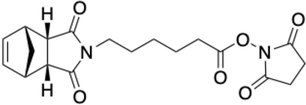
Herein, we report the of the title compound, which bears both norbornene and NHS ester moieties. The was determined to confirm the molecular connectivity and examine the structural features associated with the rigid bicyclic alkene and activated succinimidyl ester. The and spectral data evidenced the formation of only the endo product for the Diels–Alder reaction, as well as successful synthesis of the succinimidyl ester from the esterification reaction.
2. Structural commentary
The title compound crystallizes in the primitive monoclinic P21/n with one molecule as the (Fig. 1). The molecule adopts an extended conformation, with the hexyl chain in an all-trans arrangement to minimize steric repulsion between the norbornene and the succinimidyl moiety. The norbornene is strained due to the rigid bicyclic bridgehead framework caused by the formation of the endo isomer in the Diels–Alder reaction, where the C9—C10—C11—C12 torsion angle is 0.2 (2)°, C9—C8—C13—C12 = 1.17 (15)° and C7—C8—C13—C14 of 1.40 (16)°. The five-membered (N2/C16–C19) succinimidyl ring deviates slight from planarity, evidenced by the C16—C17—C18—C19 torsion angle of 6.4 (2)°. This indicates a slightly twist conformation, likely driven by the of the N-substituted aliphatic chain and the crystal packing.
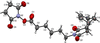 | Figure 1 Crystal structure of the title compound with displacement ellipsoids at 50% probability level. |
3. Supramolecular features
The title compound exhibits several intermolecular interactions, including one H⋯H van der Waals, one C⋯O, two C⋯H, and six non-classical C—H⋯O interactions (Table 1, Figs. 2, 3 and 4). A broader comparison with the Cambridge Structural Database (CSD) survey confirms that these non-classical C—H⋯O and hydrophobic packing features are highly characteristic, recurring motifs for this family of molecules. Structurally, the succinimidyl moiety lies gauche to the norbornene core, while a deviation in the linking carbon chain shifts the succinimidyl off-center. Despite this asymmetric conformation, the elongated molecules pack efficiently into parallel horizontal rows (Fig. 3), along the [010] direction. Two norbornene moieties of neighboring molecules interact via C10—H10⋯C7 and C11—H11⋯C14 contacts, while the same norbornene group interacts through one of the H atoms of the bridgehead to one in connection to the succinimidyl, C8—H8⋯H15B. Furthermore, the six interactions form a primary non-classical hydrogen-bonding network consolidating the three-dimensional structure. These weak interactions feature distances ranging from 2.46 to 2.71 Å and angles between 136 and 172°, with C5—H5B⋯O3 and C6—H6⋯O5 exhibiting high linearity (>170°), providing essential directional cohesion to the supramolecular assembly alongside broader van der Waals close contacts (Desiraju et al., 1999). While C—H⋯O networks typically tolerate significant angular bending in the solid state (frequently falling between 130 and 160°), this distinct near-linear geometry approaches the ideal theoretical limit of 180° (Desiraju et al., 1999).
|
 ; (ii)
 ; (iii)
 ; (iv)
 ; (v)
 ; (vi)
 .
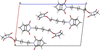 | Figure 2 Crystal packing of title compound along the b axis. |
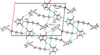 | Figure 3 Crystal packing of the title compound, indicating the intermolecular O⋯H and C⋯O contacts, viewed along the b axis. |
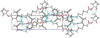 | Figure 4 Crystal packing of the title compound, indicating the intermolecular C⋯H and C⋯O contacts, viewed along the a axis. |
4. Hirshfeld surface analysis
The Hirshfeld surface of the title compound (Spackman & Jayatilaka, 2009) mapped over dnorm in the color range −0.19 and 1.44 a.u. is shown in Fig. 5 and the two-dimensional fingerprint plots (McKinnon et al., 2007) in Fig. 6. The Hirshfeld surface analysis and fingerprint plots were generated using TONTO integrated in CrystalExplorer17 (Turner et al., 2017). The contributions to the Hirshfeld surface are shown in (Fig. 6a–h). The largest contributions to the Hirshfeld surface correspond to the H⋯H and the O⋯H interactions, of which the O⋯H interactions are the most prominent interactions, as shown by red spots in the dnorm plot and blue spots in the deformation density (Fig. 7).
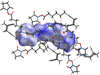 | Figure 5 Hirshfeld surface mapped over dnorm with the three main intermolecular interactions in the crystal shown: H⋯H (green), O⋯H (red) and C⋯H (blue). |
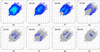 | Figure 6 (a) The full two-dimensional fingerprint plot calculated for the title compound and those delineated into (b) H⋯H, (c) O⋯H/H⋯O, (d) C⋯H/H⋯C, (e) C⋯O/O⋯C, (f) N⋯H/H⋯N, (g) N⋯O/O⋯N and O⋯O contacts. |
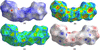 | Figure 7 Hirshfeld surface for title compound mapped over (a) dnorm, (b) shape-index, (c) curvedness and (d) deformation density. |
5. Database survey
A search of the Cambridge Structural Database (CSD Version 6.01, Nov. 2025, Feb. and May 2026 updates; Groom et al., 2016) for the title compound revealed no hits. Two searches were done of the individual moieties with no ions, applying only organics and only single-crystal structure filters for which we obtained 18 hits for N-methyl-5-norbornene-2,3-dicarboximide and seven for the N-acetoxysuccinimide, including: N-methylbicyclo(2.2.1)hept-2-ene-endo-5,6-dicarboximide, which crystallizes in the Pnma (IFILIS; Birney et al. 2002) and 1-(acetyloxy) pyrrolidine-2,5-dione (P21/c, MODDAN; Lis 2019). The torsion angles exhibited by IFILIS deviate by almost 1°, showing more torsion than the title compound, while MODDAN shows no torsion due to not having any substituents. From both searches, 18 compounds crystallize in a monoclinic space group and nine of those have structurally similar substituents, N-(2-{[N6-(t-butoxycarbonyl)adeninyl]methylcarbonylamino}ethyl)-5-norbornene-endo-2,3-dicarboximide (ACUHOV; Davies, et al., 2001), N-[7-(2-{[2-(3,5-dioxo-4-azatricyclo[5.2.1.02,6]dec-8-en-4-yl)ethyl]amino}-2-oxoethyl)-6-oxo-6,7-dihydro-1H-purin-2-yl]-2-methylpropanamide (TIHNIJ; North et al., 1998), (3-carbamoyl-1,4,5,6,7-pentamethyl-2-oxa-3-azabicyclo[2.2.1]hept-5-en-7-yl)methyl(3,5-dioxo-4-azatricyclo[5.2.1.02,6]dec-8-en-4-yl)acetate and (3-carbamoyl-1,4,5,6,7-pentamethyl-2-oxa-3-azabicyclo[2.2.1]hept-5-en-7-yl)methyl(3,5-dioxo-4-azatricyclo[5.2.1.02,6]dec-8-en-4-yl)acetate (WADVOP and WADVUV; Kensy et al., 2016), 4,4′-ethane-1,2-diylbis(4-azatricyclo[5.2.1.02,6]dec-8-ene-3,5-dione) (XUWWES; Fernández et al., 2010), N-(t-butyloxycarbonyl)gabapentin succinimidyl ester (AWUXOF: Ananda et al., 2003), 1,1′-(1,6-dioxohexane-1,6-diyl)bis(oxy)dipyrrolidine-2,5-dione (WALPEH; Zhang et al., 2014) The first five compounds correspond to the norbornene moiety analogs, and the last two are N-acetoxysuccinimide analogs. ACUHOV is the only norbornene analog to show comparable torsion angles to the title compound, and WALPEH is the only N-acetoxysuccinimide analog. The norbornene analogs all showed at least one H⋯H short contact, specifically with the H atoms of the bridgehead, although the O⋯H short contacts were the most abundant. In the N-acetoxysuccinimide analogs, no H⋯H interactions were present, while the most predominant short contact was for the O⋯H substituent. Both groups of analogs exhibit similar short-contact behaviour to the title compound where the H⋯H interaction is at the norbornene bridgehead, and O⋯H interactions consolidate the crystal structure.
6. Synthesis and crystallization
The synthesis of the title compound was carried out by a two-step synthetic route (Fig. 8). The first step was a Diels–Alder reaction between 6-maleimidohexanoic acid with cyclopentadiene dissolved in toluene at 373 K for 1 h. The solvent was removed under reduced pressure to yield the norbornene carboxylic acid intermediate in an 86% yield. The second step was an esterification reaction between the norbornene carboxylic acid intermediate, N-hydroxysuccinimide with EDC·HCl [1-ethyl-3-(3-dimethylaminopropyl) carbodiimide hydrochloride] as the coupling reagent and 4-dimethylaminopyridine (DMAP) as the catalyst in dichloromethane at 298 K for 3 h. The solvent was removed under reduced pressure and the mixture was transferred to a separatory funnel and extracted using ethyl acetate as the organic phase. The organic phase was extracted with nanopure water (2 × 25 mL), 10% NaHCO3 (2 × 25 mL), and brine (2 × 25 mL). The organic phase was collected and dried with anhydrous Na2SO4. The organic crude product was purified with flash chromatography using silica as the stationary phase and a mobile phase of hexanes/ethyl acetate. The compound eluted at 65% ethyl acetate and was recovered as a white powder. The title compound was recrystallized with boiling aqueous solution; cooling of the solution afforded white crystals (41% yield).
 | Figure 8 Synthetic route used for the title compound. |
7. Spectroscopic characterization
NMR analyses were performed on a Bruker AV-500 MHz spectrometer using dimethyl sulfoxide-d6 (DMSO-d6) as the solvent. The solvent signals at 2.50 ppm and 39.5 ppm were used as internal standards for 1H NMR (Fig. 9) and 13C APT (Fig. 10), respectively. The characterization of the title compound is the following: white solid with a melting point of (380–384 K) 1H NMR (500 MHz, DMSO-d6) δ 6.06 (s, J = 1.9 Hz, 2H), 3.30 (s, 2H), 3.24 (s, 2H), 3.20 (t, J = 7.0 Hz, 2H), 2.81 (s, 4H), 2.64 (t, J = 7.3 Hz, 2H), 1.63–1.51 (m, 4H), 1.37 (p, J = 7.1 Hz, 2H), 1.26 (ddd, J = 15.2, 9.0, 6.0 Hz, 2H). 13C NMR (126 MHz, DMSO) δ 177.91, 170.72, 169.36, 134.79, 52.25, 45.64, 44.71, 37.68, 30.49, 27.22, 25.91, 25.71, 24.21. The title compound is characterized by the appearance of a sharp singlet peak corresponding to the methylene protons of the N-hydroxysuccinimide moiety at 2.8 ppm. IR peaks (Fig. 11) at 3061.6 and 2943 cm−1 correspond to the =C—H stretch of the alkene double bond in the norbornene moiety, and to the C—H bond stretch of sp3 methylene carbon atoms between the norbornene and the NHS ester, respectively. IR peak at 1734 cm−1 corresponds to the N-hydroxysuccinimide ester bond formed in the esterification reaction and the peak at 1683 cm−1 corresponds to the two cyclic for both moieties.
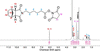 | Figure 9 1H NMR (500 MHz, DMSO-d6, 298 K) of the title compound (10 mM). |
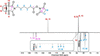 | Figure 10 13C APT NMR (126 MHz, DMSO-d6, 298 K) of the title compound (10 mM). |
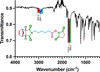 | Figure 11 Infrared spectrum with diamond-attenuated total reflection (ATR-FTIR) of the title compound with 32 scans. |
8. Refinement
Crystal data, data collection and structure details for the title compound are summarized in Table 2. H atoms were positioned geometrically (–H = 0.93–0.98 Å) and refined as riding with Uiso(H) = 1.2Ueq(C).
|
Supporting information
CCDC reference: 2598044
contains datablock I. DOI: https://doi.org/10.1107/S2056989026011047/ny2022sup1.cif
Structure factors: contains datablock I. DOI: https://doi.org/10.1107/S2056989026011047/ny2022Isup2.hkl
Supporting information file. DOI: https://doi.org/10.1107/S2056989026011047/ny2022Isup3.cml
| C19H22N2O6 | Dx = 1.335 Mg m−3 |
| Mr = 374.38 | Melting point = 380.15–384.15 K |
| Monoclinic, P21/n | Cu Kα radiation, λ = 1.54184 Å |
| a = 14.1628 (3) Å | Cell parameters from 3918 reflections |
| b = 5.95502 (13) Å | θ = 3.5–68.1° |
| c = 22.2452 (5) Å | µ = 0.84 mm−1 |
| β = 96.859 (2)° | T = 298 K |
| V = 1862.73 (8) Å3 | Needle, clear colourless |
| Z = 4 | 0.13 × 0.05 × 0.04 mm |
| F(000) = 792 |
| SuperNova, Single source at offset/far, HyPix3000 diffractometer | 3419 independent reflections |
| Radiation source: micro-focus sealed X-ray tube, SuperNova (Cu) X-ray Source | 2626 reflections with I > 2σ(I) |
| Mirror monochromator | Rint = 0.024 |
| Detector resolution: 10.0000 pixels mm-1 | θmax = 68.3°, θmin = 3.5° |
| ω scans | h = −16→17 |
| Absorption correction: multi-scan (CrysAlisPro; Rigaku OD, 2025) | k = −7→3 |
| Tmin = 0.951, Tmax = 0.967 | l = −26→26 |
| 8970 measured reflections |
| Refinement on F2 | Primary atom site location: structure-invariant direct methods |
| Least-squares matrix: full | Hydrogen site location: inferred from neighbouring sites |
| R[F2 > 2σ(F2)] = 0.041 | H-atom parameters constrained |
| wR(F2) = 0.118 | w = 1/[σ2(Fo2) + (0.0566P)2 + 0.2435P] where P = (Fo2 + 2Fc2)/3 |
| S = 1.07 | (Δ/σ)max < 0.001 |
| 3389 reflections | Δρmax = 0.18 e Å−3 |
| 244 parameters | Δρmin = −0.18 e Å−3 |
| 0 restraints |
Geometry. All esds (except the esd in the dihedral angle between two l.s. planes) are estimated using the full covariance matrix. The cell esds are taken into account individually in the estimation of esds in distances, angles and torsion angles; correlations between esds in cell parameters are only used when they are defined by crystal symmetry. An approximate (isotropic) treatment of cell esds is used for estimating esds involving l.s. planes. |
| x | y | z | Uiso*/Ueq | ||
| N1 | 0.43206 (9) | 1.0920 (2) | 0.78357 (6) | 0.0419 (3) | |
| O4 | 0.29365 (10) | 0.5479 (2) | 0.43138 (6) | 0.0637 (4) | |
| O2 | 0.59368 (8) | 1.0621 (3) | 0.80492 (6) | 0.0636 (4) | |
| O3 | 0.27093 (8) | 1.0832 (2) | 0.78773 (6) | 0.0619 (4) | |
| C7 | 0.51516 (11) | 1.0558 (3) | 0.82122 (7) | 0.0430 (4) | |
| N2 | 0.28981 (11) | 0.3656 (3) | 0.39232 (6) | 0.0526 (4) | |
| C13 | 0.38197 (11) | 1.0189 (3) | 0.87842 (7) | 0.0445 (4) | |
| H13 | 0.360668 | 1.135720 | 0.904744 | 0.053* | |
| C14 | 0.35115 (11) | 1.0686 (3) | 0.81296 (7) | 0.0432 (4) | |
| C8 | 0.49067 (11) | 1.0064 (3) | 0.88385 (7) | 0.0446 (4) | |
| H8 | 0.520237 | 1.114889 | 0.913451 | 0.054* | |
| O1 | 0.39885 (11) | 0.3474 (3) | 0.49381 (6) | 0.0764 (4) | |
| C1 | 0.35792 (14) | 0.5190 (4) | 0.48303 (8) | 0.0573 (5) | |
| C6 | 0.42811 (14) | 1.1262 (3) | 0.71837 (7) | 0.0523 (4) | |
| H6A | 0.484975 | 1.204086 | 0.709503 | 0.063* | |
| H6B | 0.373579 | 1.218789 | 0.704296 | 0.063* | |
| O6 | 0.19049 (11) | 0.1520 (3) | 0.44258 (7) | 0.0822 (5) | |
| C3 | 0.39375 (14) | 0.7041 (4) | 0.58446 (8) | 0.0602 (5) | |
| H3A | 0.452880 | 0.620471 | 0.590554 | 0.072* | |
| H3B | 0.345607 | 0.617596 | 0.601742 | 0.072* | |
| C16 | 0.32616 (13) | 0.3812 (3) | 0.33793 (8) | 0.0535 (4) | |
| C11 | 0.37733 (14) | 0.6223 (3) | 0.84969 (9) | 0.0571 (5) | |
| H11 | 0.334414 | 0.547199 | 0.821782 | 0.069* | |
| C10 | 0.47119 (15) | 0.6109 (3) | 0.85378 (10) | 0.0617 (5) | |
| H10 | 0.506027 | 0.526175 | 0.829068 | 0.074* | |
| C19 | 0.23388 (13) | 0.1806 (3) | 0.39998 (8) | 0.0548 (4) | |
| C5 | 0.42044 (13) | 0.9026 (3) | 0.68542 (7) | 0.0504 (4) | |
| H5A | 0.477706 | 0.816135 | 0.697190 | 0.061* | |
| H5B | 0.367134 | 0.819218 | 0.697719 | 0.061* | |
| C17 | 0.29518 (14) | 0.1723 (4) | 0.30439 (8) | 0.0608 (5) | |
| H17A | 0.349868 | 0.089716 | 0.293781 | 0.073* | |
| H17B | 0.254304 | 0.208299 | 0.267508 | 0.073* | |
| O5 | 0.37210 (12) | 0.5367 (3) | 0.32315 (7) | 0.0835 (5) | |
| C12 | 0.35285 (13) | 0.7793 (3) | 0.89857 (8) | 0.0546 (4) | |
| H12 | 0.288729 | 0.764881 | 0.910510 | 0.066* | |
| C9 | 0.51169 (13) | 0.7584 (3) | 0.90527 (8) | 0.0595 (5) | |
| H9 | 0.577133 | 0.725859 | 0.922648 | 0.071* | |
| C4 | 0.40697 (16) | 0.9288 (4) | 0.61716 (8) | 0.0636 (5) | |
| H4A | 0.462002 | 1.004509 | 0.604585 | 0.076* | |
| H4B | 0.351730 | 1.022344 | 0.605525 | 0.076* | |
| C15 | 0.43522 (15) | 0.7330 (4) | 0.94790 (9) | 0.0711 (6) | |
| H15A | 0.433110 | 0.583244 | 0.964858 | 0.085* | |
| H15B | 0.440508 | 0.844497 | 0.979914 | 0.085* | |
| C18 | 0.24188 (15) | 0.0352 (3) | 0.34614 (9) | 0.0613 (5) | |
| H18A | 0.179308 | −0.004516 | 0.326417 | 0.074* | |
| H18B | 0.276297 | −0.101611 | 0.358068 | 0.074* | |
| C2 | 0.36440 (17) | 0.7336 (4) | 0.51750 (8) | 0.0705 (6) | |
| H2A | 0.302998 | 0.807731 | 0.511642 | 0.085* | |
| H2B | 0.409976 | 0.830900 | 0.501148 | 0.085* |
| U11 | U22 | U33 | U12 | U13 | U23 | |
| N1 | 0.0466 (7) | 0.0435 (7) | 0.0357 (6) | −0.0034 (6) | 0.0059 (5) | −0.0027 (5) |
| O4 | 0.0825 (9) | 0.0574 (7) | 0.0464 (7) | 0.0115 (7) | −0.0115 (6) | −0.0094 (6) |
| O2 | 0.0457 (7) | 0.0918 (10) | 0.0552 (7) | −0.0134 (6) | 0.0139 (6) | −0.0105 (7) |
| O3 | 0.0466 (7) | 0.0674 (9) | 0.0699 (8) | 0.0131 (6) | −0.0005 (6) | 0.0030 (6) |
| C7 | 0.0436 (8) | 0.0444 (8) | 0.0412 (8) | −0.0078 (7) | 0.0060 (6) | −0.0099 (7) |
| N2 | 0.0632 (9) | 0.0540 (8) | 0.0395 (7) | −0.0012 (7) | 0.0012 (6) | −0.0075 (6) |
| C13 | 0.0487 (9) | 0.0449 (8) | 0.0419 (8) | −0.0018 (7) | 0.0135 (7) | −0.0076 (7) |
| C14 | 0.0448 (9) | 0.0356 (8) | 0.0496 (9) | 0.0039 (6) | 0.0066 (7) | −0.0044 (7) |
| C8 | 0.0455 (8) | 0.0514 (9) | 0.0364 (8) | −0.0083 (7) | 0.0028 (6) | −0.0072 (7) |
| O1 | 0.0905 (10) | 0.0689 (9) | 0.0637 (8) | 0.0186 (8) | −0.0164 (7) | −0.0089 (7) |
| C1 | 0.0651 (11) | 0.0623 (11) | 0.0425 (9) | 0.0044 (9) | −0.0027 (8) | −0.0040 (8) |
| C6 | 0.0655 (11) | 0.0546 (10) | 0.0366 (8) | −0.0071 (8) | 0.0058 (7) | 0.0005 (7) |
| O6 | 0.0842 (10) | 0.1017 (12) | 0.0668 (9) | −0.0088 (9) | 0.0339 (8) | −0.0021 (8) |
| C3 | 0.0656 (11) | 0.0702 (12) | 0.0442 (9) | −0.0014 (10) | 0.0037 (8) | −0.0094 (9) |
| C16 | 0.0511 (9) | 0.0624 (11) | 0.0463 (9) | 0.0003 (8) | 0.0035 (7) | 0.0034 (8) |
| C11 | 0.0645 (11) | 0.0379 (8) | 0.0659 (11) | −0.0080 (8) | −0.0052 (9) | 0.0041 (8) |
| C10 | 0.0694 (12) | 0.0404 (9) | 0.0735 (13) | 0.0084 (8) | 0.0008 (9) | 0.0013 (8) |
| C19 | 0.0521 (10) | 0.0623 (11) | 0.0503 (10) | 0.0035 (8) | 0.0074 (8) | 0.0020 (8) |
| C5 | 0.0516 (9) | 0.0585 (10) | 0.0412 (9) | −0.0070 (8) | 0.0055 (7) | −0.0061 (8) |
| C17 | 0.0606 (11) | 0.0709 (12) | 0.0524 (10) | 0.0026 (9) | 0.0131 (8) | −0.0098 (9) |
| O5 | 0.0919 (11) | 0.0795 (11) | 0.0816 (10) | −0.0235 (9) | 0.0206 (9) | 0.0067 (8) |
| C12 | 0.0533 (10) | 0.0591 (11) | 0.0520 (10) | −0.0121 (8) | 0.0080 (8) | 0.0070 (8) |
| C9 | 0.0520 (10) | 0.0667 (11) | 0.0561 (10) | 0.0019 (9) | −0.0086 (8) | 0.0114 (9) |
| C4 | 0.0784 (13) | 0.0701 (12) | 0.0413 (9) | −0.0011 (10) | 0.0029 (9) | −0.0059 (9) |
| C15 | 0.0772 (13) | 0.0818 (14) | 0.0521 (10) | −0.0140 (11) | −0.0016 (9) | 0.0219 (10) |
| C18 | 0.0636 (11) | 0.0590 (11) | 0.0622 (11) | −0.0023 (9) | 0.0112 (9) | −0.0086 (9) |
| C2 | 0.0918 (15) | 0.0670 (12) | 0.0487 (10) | 0.0078 (11) | −0.0080 (10) | −0.0103 (9) |
| N1—C7 | 1.377 (2) | C16—C17 | 1.490 (3) |
| N1—C14 | 1.392 (2) | C16—O5 | 1.200 (2) |
| N1—C6 | 1.459 (2) | C11—H11 | 0.9300 |
| O4—N2 | 1.3875 (19) | C11—C10 | 1.323 (3) |
| O4—C1 | 1.389 (2) | C11—C12 | 1.506 (3) |
| O2—C7 | 1.2107 (19) | C10—H10 | 0.9300 |
| O3—C14 | 1.209 (2) | C10—C9 | 1.502 (3) |
| C7—C8 | 1.505 (2) | C19—C18 | 1.493 (3) |
| N2—C16 | 1.373 (2) | C5—H5A | 0.9700 |
| N2—C19 | 1.379 (2) | C5—H5B | 0.9700 |
| C13—H13 | 0.9800 | C5—C4 | 1.516 (2) |
| C13—C14 | 1.499 (2) | C17—H17A | 0.9700 |
| C13—C8 | 1.532 (2) | C17—H17B | 0.9700 |
| C13—C12 | 1.565 (2) | C17—C18 | 1.505 (3) |
| C8—H8 | 0.9800 | C12—H12 | 0.9800 |
| C8—C9 | 1.569 (3) | C12—C15 | 1.528 (3) |
| O1—C1 | 1.185 (2) | C9—H9 | 0.9800 |
| C1—C2 | 1.488 (3) | C9—C15 | 1.530 (3) |
| C6—H6A | 0.9700 | C4—H4A | 0.9700 |
| C6—H6B | 0.9700 | C4—H4B | 0.9700 |
| C6—C5 | 1.517 (2) | C15—H15A | 0.9700 |
| O6—C19 | 1.202 (2) | C15—H15B | 0.9700 |
| C3—H3A | 0.9700 | C18—H18A | 0.9700 |
| C3—H3B | 0.9700 | C18—H18B | 0.9700 |
| C3—C4 | 1.524 (3) | C2—H2A | 0.9700 |
| C3—C2 | 1.508 (3) | C2—H2B | 0.9700 |
| H11···C14 | 2.869 | H5B···O3 | 2.461 |
| H10···C7 | 2.81 | O2···H17A | 2.588 |
| H18B···O4 | 2.642 | H6A···O5 | 2.713 |
| H18B···O5 | 2.708 | H8···H15B | 2.383 |
| H11···O3 | 2.709 | C19···O2 | 3.124 |
| C7—N1—C14 | 112.97 (13) | O6—C19—N2 | 124.49 (18) |
| C7—N1—C6 | 123.69 (14) | O6—C19—C18 | 130.18 (19) |
| C14—N1—C6 | 123.00 (14) | C6—C5—H5A | 109.0 |
| N2—O4—C1 | 113.19 (14) | C6—C5—H5B | 109.0 |
| N1—C7—C8 | 108.59 (13) | H5A—C5—H5B | 107.8 |
| O2—C7—N1 | 124.18 (15) | C4—C5—C6 | 112.76 (16) |
| O2—C7—C8 | 127.22 (15) | C4—C5—H5A | 109.0 |
| C16—N2—O4 | 120.54 (15) | C4—C5—H5B | 109.0 |
| C16—N2—C19 | 116.36 (15) | C16—C17—H17A | 110.4 |
| C19—N2—O4 | 121.85 (14) | C16—C17—H17B | 110.4 |
| C14—C13—H13 | 111.4 | C16—C17—C18 | 106.45 (15) |
| C14—C13—C8 | 105.05 (12) | H17A—C17—H17B | 108.6 |
| C14—C13—C12 | 113.71 (13) | C18—C17—H17A | 110.4 |
| C8—C13—H13 | 111.4 | C18—C17—H17B | 110.4 |
| C8—C13—C12 | 103.29 (13) | C13—C12—H12 | 116.2 |
| C12—C13—H13 | 111.4 | C11—C12—C13 | 105.54 (13) |
| N1—C14—C13 | 108.38 (13) | C11—C12—H12 | 116.2 |
| O3—C14—N1 | 123.73 (16) | C11—C12—C15 | 100.63 (16) |
| O3—C14—C13 | 127.87 (15) | C15—C12—C13 | 99.53 (14) |
| C7—C8—C13 | 104.96 (13) | C15—C12—H12 | 116.2 |
| C7—C8—H8 | 111.5 | C8—C9—H9 | 116.2 |
| C7—C8—C9 | 114.14 (14) | C10—C9—C8 | 106.12 (14) |
| C13—C8—H8 | 111.5 | C10—C9—H9 | 116.2 |
| C13—C8—C9 | 102.83 (13) | C10—C9—C15 | 100.40 (16) |
| C9—C8—H8 | 111.5 | C15—C9—C8 | 99.13 (15) |
| O4—C1—C2 | 108.28 (16) | C15—C9—H9 | 116.2 |
| O1—C1—O4 | 122.06 (17) | C3—C4—H4A | 109.1 |
| O1—C1—C2 | 129.65 (18) | C3—C4—H4B | 109.1 |
| N1—C6—H6A | 109.6 | C5—C4—C3 | 112.43 (17) |
| N1—C6—H6B | 109.6 | C5—C4—H4A | 109.1 |
| N1—C6—C5 | 110.48 (14) | C5—C4—H4B | 109.1 |
| H6A—C6—H6B | 108.1 | H4A—C4—H4B | 107.9 |
| C5—C6—H6A | 109.6 | C12—C15—C9 | 94.19 (14) |
| C5—C6—H6B | 109.6 | C12—C15—H15A | 112.9 |
| H3A—C3—H3B | 107.9 | C12—C15—H15B | 112.9 |
| C4—C3—H3A | 109.2 | C9—C15—H15A | 112.9 |
| C4—C3—H3B | 109.2 | C9—C15—H15B | 112.9 |
| C2—C3—H3A | 109.2 | H15A—C15—H15B | 110.3 |
| C2—C3—H3B | 109.2 | C19—C18—C17 | 105.79 (16) |
| C2—C3—C4 | 111.90 (17) | C19—C18—H18A | 110.6 |
| N2—C16—C17 | 105.43 (15) | C19—C18—H18B | 110.6 |
| O5—C16—N2 | 124.46 (18) | C17—C18—H18A | 110.6 |
| O5—C16—C17 | 130.11 (17) | C17—C18—H18B | 110.6 |
| C10—C11—H11 | 126.3 | H18A—C18—H18B | 108.7 |
| C10—C11—C12 | 107.36 (17) | C1—C2—C3 | 113.70 (18) |
| C12—C11—H11 | 126.3 | C1—C2—H2A | 108.8 |
| C11—C10—H10 | 125.9 | C1—C2—H2B | 108.8 |
| C11—C10—C9 | 108.14 (18) | C3—C2—H2A | 108.8 |
| C9—C10—H10 | 125.9 | C3—C2—H2B | 108.8 |
| N2—C19—C18 | 105.33 (15) | H2A—C2—H2B | 107.7 |
| N1—C7—C8—C13 | −0.19 (17) | C8—C9—C15—C12 | 59.45 (16) |
| N1—C7—C8—C9 | 111.62 (15) | O1—C1—C2—C3 | −27.2 (4) |
| N1—C6—C5—C4 | 174.73 (15) | C1—O4—N2—C16 | −109.14 (19) |
| O4—N2—C16—C17 | −170.63 (14) | C1—O4—N2—C19 | 84.1 (2) |
| O4—N2—C16—O5 | 8.8 (3) | C6—N1—C7—O2 | 4.7 (3) |
| O4—N2—C19—O6 | −6.2 (3) | C6—N1—C7—C8 | −174.72 (14) |
| O4—N2—C19—C18 | 174.53 (15) | C6—N1—C14—O3 | −3.0 (2) |
| O4—C1—C2—C3 | 154.03 (18) | C6—N1—C14—C13 | 175.72 (14) |
| O2—C7—C8—C13 | −179.56 (17) | C6—C5—C4—C3 | −176.77 (16) |
| O2—C7—C8—C9 | −67.7 (2) | O6—C19—C18—C17 | 172.8 (2) |
| C7—N1—C14—O3 | −176.56 (15) | C16—N2—C19—O6 | −173.45 (18) |
| C7—N1—C14—C13 | 2.19 (17) | C16—N2—C19—C18 | 7.3 (2) |
| C7—N1—C6—C5 | 87.73 (19) | C16—C17—C18—C19 | 6.4 (2) |
| C7—C8—C9—C10 | −47.17 (19) | C11—C10—C9—C8 | −70.26 (19) |
| C7—C8—C9—C15 | −150.87 (14) | C11—C10—C9—C15 | 32.5 (2) |
| N2—O4—C1—O1 | −5.6 (3) | C11—C12—C15—C9 | 49.18 (17) |
| N2—O4—C1—C2 | 173.30 (16) | C10—C11—C12—C13 | 70.28 (18) |
| N2—C16—C17—C18 | −2.3 (2) | C10—C11—C12—C15 | −32.85 (19) |
| N2—C19—C18—C17 | −8.0 (2) | C10—C9—C15—C12 | −48.93 (18) |
| C13—C8—C9—C10 | 65.92 (17) | C19—N2—C16—C17 | −3.2 (2) |
| C13—C8—C9—C15 | −37.78 (15) | C19—N2—C16—O5 | 176.21 (19) |
| C13—C12—C15—C9 | −58.76 (17) | O5—C16—C17—C18 | 178.3 (2) |
| C14—N1—C7—O2 | 178.15 (16) | C12—C13—C14—N1 | −114.37 (15) |
| C14—N1—C7—C8 | −1.24 (18) | C12—C13—C14—O3 | 64.3 (2) |
| C14—N1—C6—C5 | −85.11 (19) | C12—C13—C8—C7 | 120.83 (14) |
| C14—C13—C8—C7 | 1.40 (16) | C12—C13—C8—C9 | 1.17 (15) |
| C14—C13—C8—C9 | −118.27 (14) | C12—C11—C10—C9 | 0.2 (2) |
| C14—C13—C12—C11 | 45.24 (18) | C4—C3—C2—C1 | 175.54 (18) |
| C14—C13—C12—C15 | 149.19 (15) | C2—C3—C4—C5 | 170.56 (17) |
| C8—C13—C14—N1 | −2.15 (17) | C9—C10—C11—C12 | 0.2 (2) |
| C8—C13—C14—O3 | 176.52 (16) | C9—C8—C13—C12 | 1.17 (15) |
| C8—C13—C12—C11 | −68.03 (16) | C7—C8—C13—C14 | 1.40 (16) |
| C8—C13—C12—C15 | 35.91 (16) | C16—C17—C18—C19 | 6.4 (2) |
| Note: (a). The two values correspond to the angles and lengths calculated relative to the individual tetrahedral centers (C8/C15) of the contact. |
| D—H···A | D—H | H···A | D···A | D—H···A |
| C11—H11···C14i | 0.93 | 2.87 | 3.407 (3) | 118 |
| C10—H10···C7i | 0.93 | 2.81 | 3.456 (3) | 128 |
| C18—H18B···O4i | 0.97 | 2.64 | 3.496 (3) | 147 |
| C18—H18B···O5i | 0.97 | 2.71 | 3.564 (3) | 147 |
| C11—H11···O3ii | 0.93 | 2.71 | 3.504 (2) | 144 |
| C5—H5B···O3ii | 0.97 | 2.46 | 3.564 (3) | 171 |
| C17—H17A···O2iii | 0.97 | 2.59 | 3.354 (2) | 136 |
| C6—H6A···O5iv | 0.97 | 2.71 | 3.676 (2) | 172 |
| C8—H8···C15v | 0.98 | 2.38 | 3.196 (2) | 140 |
| C19···O2vi | - | - | 3.124 (2) | ? |
| Symmetry codes: (i) x−1, y, z; (ii) −x+1/2, y−1/2, −z+3/2; (iii) −x+1, −y+1, −z+1; (iv) −x+1, −y+2, −z+1; (v) −x+1, −y+2, −z+2; (vi) x−1/2, −y+3/2, z−1/2. |
| Contact | Length (Å) | Symm. op. 1 | Symm. op. 2 |
| C11—H11···C14 | 2.869 | x, y, z | x, -1 + y, z |
| C10—H10···C7 | 2.810 | x, y, z | x, -1 + y, z |
| C18—H18B···O4 | 2.642 | x, y, z | x, -1 + y, z |
| C18—H18B···O5 | 2.708 | x, y, z | x, -1 + y, z |
| C11—H11···O3 | 2.709 | x, y, z | 1/2 - x, -1/2 + y, 3/2 - z |
| C5—H5B···O3 | 2.461 | x, y, z | 1/2 - x, -1/2 + y, 3/2 - z |
| C17—H17A···O2 | 2.588 | x, y, z | 1 - x, 1 - y, 1 - z |
| C6—H6A···O5 | 2.713 | x, y, z | 1 - x, 2 - y, 1 - z |
| C8—H8···H15B—C15 | 2.383 | x, y, z | 1 - x, 2 - y, 2 - z |
| C19···O2 | 3.124 | x, y, z | -1/2 + x, 3/2 - y, -1/2 + z |
Acknowledgements
The crystallographic data presented herein was made possible thanks to the University of Puerto Rico – Molecular Sciences Research Center Single X-ray Diffraction Facility through the National Science Foundation Grant No. 1626103. The authors acknowledge the Materials Characterization Center (MCC) for their assistance and instrumentation facilities.
Funding information
GPC acknowledges the NSF PR-LSAMP Bridge to the Doctorate Fellowship grant No. EES-2306079 and the NSF Graduate Research Fellowship grant No. 2136522.
References
 Abbas, S. J., Yesmin, S., Vittala, S. K., Sepay, N., Xia, F., Ali, S. I., Chang, W.-C., Hung, Y.-C. & Ma, W.-L. (2024). Metabolites. 14, 668. CrossRef PubMed Google Scholar
Ananda, K., Aravinda, S., Vasudev, P. G., Raja, K. M. P., Sivaramakrishnan, H., Nagarajan, K., Shamala, N. & Balaram, P. (2003). Curr. Sci. 85, 1002–1011. CAS Google Scholar
Birney, D., Lim, T. K., Koh, J. H. P., Pool, B. R. & White, J. M. (2002). J. Am. Chem. Soc. 124, 5091–5099. Web of Science CSD CrossRef PubMed CAS Google Scholar
Davies, R. G., Gibson, V. C., Hursthouse, M. B., Light, M. E., Marshall, E. L., North, M., Robson, D. A., Thompson, I., White, A. J. P., Williams, D. J. & Williams, P. J. (2001). J. Chem. Soc. Perkin Trans. 1 4, 3365–3381. Google Scholar
Desiraju, G. R. & Steiner, T. (1999). The Weak Hydrogen Bond In Structural Chemistry and Biology. Oxford University Press. Google Scholar
Dolomanov, O. V., Bourhis, L. J., Gildea, R. J., Howard, J. A. K. & Puschmann, H. (2009). J. Appl. Cryst. 42, 339–341. Web of Science CrossRef CAS IUCr Journals Google Scholar
Fernández, F., Gual, A., Claver, C., Castillón, S., Muller, G. & Gómez, M. (2010). Eur. J. Inorg. Chem. pp. 758–766. Google Scholar
García-Aznar, P. & Escorihuela, J. (2022). Org. Biomol. Chem. 20, 6400–6412. PubMed Google Scholar
Groom, C. R., Bruno, I. J., Lightfoot, M. P. & Ward, S. C. (2016). Acta Cryst. B72, 171–179. Web of Science CrossRef IUCr Journals Google Scholar
Haque, M., Forte, N. & Baker, J. R. (2021). Chem. Commun. 57, 10689–10702. CrossRef CAS Google Scholar
Kensy, V. K., Peterson, G. I., Church, D. C., Yakelis, N. A. & Boydston, A. J. (2016). Org. Biomol. Chem. 14, 5617–5621. CrossRef CAS PubMed Google Scholar
Kim, B., Lee, B., Mandakhbayar, N., Kim, Y., Song, Y., Doh, J., Lee, J. H., Jeong, B. & Song, K. H. (2023). Mater. Today Bio 23, 100868. CrossRef PubMed Google Scholar
Lis, T. (2019). CSD Communication (CCDC 1900515). CCDC, Cambridge, England. Google Scholar
McKinnon, J. J., Jayatilaka, D. & Spackman, M. A. (2007). Chem. Commun. pp. 3814. Google Scholar
North, M., Light, M. E. & Hursthouse, M. B. (1998). University of Southampton, Crystal Structure Report Archive 749. Google Scholar
Rigaku OD (2025). CrysAlis PRO. Rigaku Oxford Diffraction, Yarnton, England. Google Scholar
Scinto, S. L., Bilodeau, D. A., Hincapie, R., Lee, W., Nguyen, S. S., Xu, M., Am Ende, C. W., Finn, M. G., Lang, K., Lin, Q., Pezacki, J. P., Prescher, J. A., Robillard, M. S. & Fox, J. M. (2021). Nat. Rev. Method. Prim. 1, 30. CrossRef Google Scholar
Sheldrick, G. M. (2008). Acta Cryst. A64, 112–122. Web of Science CrossRef CAS IUCr Journals Google Scholar
Sheldrick, G. M. (2015). Acta Cryst. C71, 3–8. Web of Science CrossRef IUCr Journals Google Scholar
Spackman, M. A. & Jayatilaka, D. (2009). CrystEngComm 11, 19–32. Web of Science CrossRef CAS Google Scholar
Turner, M. J., McKinnon, J. J., Wolff, S. K., Grimwood, D. J., Spackman, P. R., Jayatilaka, D. & Spackman, M. A. (2017). CrystalExplorer17.5. The University of Western Australia. Google Scholar
Wan, C., Yang, D., An, Y., Kong, L., Zhou, Z., Tang, L., Zhang, Z., Dai, Y. & Wang, R. (2024). Anal. Chem. 96, 18377–18383. CrossRef CAS PubMed Google Scholar
Ward, C. C., Kleinman, J. I. & Nomura, D. K. (2017). Chem. Biol. 12, 1478–1483. CAS Google Scholar
Zhang, J., Zhao, X. & Hou, X. (2014). Asian J. Chem. 26, 8569–8571. CrossRef Google Scholar
This is an open-access article distributed under the terms of the Creative Commons Attribution (CC-BY) Licence, which permits unrestricted use, distribution, and reproduction in any medium, provided the original authors and source are cited.
| CRYSTALLOGRAPHIC COMMUNICATIONS |