Acta Crystallographica
Section E CRYSTALLOGRAPHIC COMMUNICATIONS


 menu


research communications
| CRYSTALLOGRAPHIC COMMUNICATIONS |
 access
1,4-Diiodoperchlorobenzene behaves as a dual π-type halogen-bond donor to stilbene in the organic solid state

aDepartment of Chemistry and Biochemistry, Missouri State University, Springfield, MO 65897, USA, bRigaku American Holding, The Woodlands, TX 77381, USA, cOffice of the Vice President for Research, University of Iowa, Iowa City, IA 52242, USA, and dDepartment of Natural Sciences and Mathematics, Webster University, St. Louis, MO 63119, USA
*Correspondence e-mail: [email protected], [email protected]
The synthesis and of a halogen-bonded based upon 1,4-diiodoperchlorobenzene (C6I2Cl4) and stilbene (stil) are described. The resulting co-crystal {systematic name: 1,4-diiodo-2,3,5,6-tetrachlorobenzene–1,1′-[(E)-ethene-1,2-diyl]dibenzene (2/1)}, 2C6I2Cl4·stil is held together primarily by two varieties of π-type halogen bonds between the molecular components. Each aromatic ring within stil accepts two C—I⋯π halogen bonds on opposite sides to form a two-dimensional offset bordered stacked pattern. In addition, the donor C6I2Cl4 also engages in a C—Cl⋯π halogen bond to the ethylene group. Lastly, neighbouring molecules of C6I2Cl4 interact by means of Type I chlorine–chlorine contacts, which results in a three-dimensional extended structure.
CCDC reference: 2592173
1. Chemical context
Co-crystals remain an important class of organic solids where at least two molecular components are found in a fixed and whole number ratio within the (Corpinot & Bučar, 2019 ). The formation of these multi-component molecular solids relies on supramolecular interactions between complementary donor and acceptor sites as a driving force to the self-assembly process. In particular, halogen bonding has proven to be a reliable non-covalent interaction to facilitate co-crystal formation (Gilday et al., 2015). Halogen bonds are defined as an attractive interaction between an electrophilic region at the tip of the halogen atom bond to a carbon atom (i.e. the σ-hole) and a nucleophilic region usually on a second molecule (Cavallo et al., 2016). Analysis of previously reported crystal structures revealed that the most common variety of halogen bonds is classified as n-type involving a polarizable halogen atom and a lone pair of electrons on oxygen or nitrogen (Walsh et al., 2001). Despite the prevalence of n-type interactions, a less reported class of halogen bonding interactions is called π-type involving a halogen atom and an electron-rich surface such as a polycyclic aromatic (Vainauskas & Friščić, 2026; Vainauskas et al., 2020, 2023; d'Agostino et al., 2015; Shen et al., 2012).
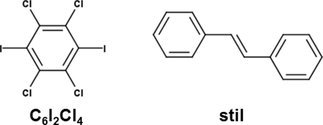
A continued focus between our research groups has been the intentional design of co-crystals that utilize π-type halogen bonds as the primary non-covalent interaction in the formation of multi-component molecular solids. To this end, we have reported on the ability of 1,4-diiodoperchlorobenzene (C6I2Cl4) to behave as a π-type halogen-bond donor to various aromatics including benzene (Bosch, 2019), naphthalene (Bosch et al., 2023), benzamide (Feld et al., 2026), as well as benzoic and cinnamic acids (Feld et al., 2025) to generate co-crystals. With the goal to expand this research to other related aromatic systems, herein, we report the synthesis, crystal structure, and Hirshfeld surface analysis of a co-crystal based upon C6I2Cl4 along with stilbene (stil). In particular, the 2C6I2Cl4·stil is sustained by the combination of C—I⋯π and C—Cl⋯π halogen bonds along with Type I chlorine–chlorine contacts that results in a three-dimensional extended molecular solid.
2. Structural commentary
Crystallographic analysis reveals that 2C6I2Cl4·stil crystallizes in the centrosymmetric triclinic space group Pī. The asymmetric unit contains two molecules of C6I2Cl4 and one of stil (Fig. 1). The co-crystal is sustained by four unique C—I⋯π halogen bonds with distances of 3.393 (1), 3.401 (1), 3.540 (1), and 3.569 (1) Å between an I atom and an aromatic ring. These halogen-bond distances were determined by using the I atom on C6I2Cl4 and the calculated plane for the nearest aromatic ring on stil. Further support of the formation of these C—I⋯π halogen bonds are the nearly perpendicular angles for this non-covalent interaction with values of 84.96 (7), 86.25 (6), 96.39 (6), and 106.38 (6)° (Fig. 2). As expected, both crystallographically unique C6I2Cl4 molecules form two C—I⋯π halogen bonds with two different stil molecules, generating a two-dimensional sheet-like structure that can be classified as an offset bordered stack pattern (Fig. 2). In addition, these molecular components also engage in C—Cl⋯π halogen bonds between C6I2Cl4 and the ethylene group within stil at a distance of 3.264 (7) Å. This value was determined by using a Cl atom and the centroid of the ethylene group. The stil molecule is found to be positionally disordered over two locations, which is common for similarly shaped molecules (Harada & Ogawa, 2014). A free-variable refinement determined the occupancies for this observed disorder and returned values of 0.55 and 0.45 at 100 K. These bond distances for each π-type halogen bonds were determined by using the major configuration for the disordered benzene rings.
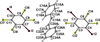 | Figure 1 The labelled asymmetric unit of 2C6I2Cl4·stil. Displacement ellipsoids are drawn at the 50% probability level for non-hydrogen atoms while hydrogen atoms are shown as spheres of arbitrary size. The crystallographic disorder within stil was omitted for clarity. |
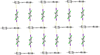 | Figure 2 X-ray crystal structure 2C6I2Cl4·stil illustrating the offset bordered stack pattern along with C—I⋯π halogen bonds. The crystallographic disorder within stil was omitted for clarity. |
3. Supramolecular features
In addition to the two different π-type halogen bonds, the halogen-bond donor C6I2Cl4 is also found to engage in Type I chlorine–chlorine contacts within 2C6I2Cl4·stil (Fig. 3). Each donor is engaged in two unique Type I chlorine–chlorine contacts found between Cl6⋯Cl8 at a distance of 3.460 (1) Å with C—Cl⋯Cl bond angles of 132.05 (10) and 132.13 (11)° [symmetry code: Cl8 (x − 1, y, z)] as well as between Cl2⋯Cl4 with a bond length of 3.488 (1) Å with angles of 131.11 (13) and 131.33 (11)° [symmetry code: Cl4 (1 + x, y, z)] (Mukherjee et al., 2014). By definition, a Type I halogen–halogen contact will have nearly identical C—X⋯X bond angles while a Type II halogen–halogen contact will have C—X⋯X bond angles near 90 and 180° (Scheiner, 2022).
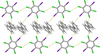 | Figure 3 X-ray crystal structure of 2C6I2Cl4·stil illustrating Type I chlorine–chlorine contacts along with both C—I⋯π and C—Cl⋯π halogen bonds. The crystallographic disorder within stil was omitted for clarity. |
The different π-type halogen bonds were also investigated and visualized by utilizing a Hirshfeld surface analysis (Spackman et al., 2021) where dnorm is mapped onto the calculated surface (Fig. 4). The red spots on the Hirshfeld surface represent both examples for these π-type halogen bonds. This Hirshfeld surface analysis along with the observed bond lengths confirms the presence of both C—I⋯π and C—Cl⋯π halogen bonds within 2C6I2Cl4·stil.
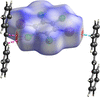 | Figure 4 Hirshfeld surface of 2C6I2Cl4·stil where dnorm is mapped onto the surface illustrating the C—I⋯π halogen bonds (light blue dashes) and C—Cl⋯π halogen bonds (light pink dashes). The crystallographic disorder within stil was omitted for clarity. |
4. Database survey
A search of the Cambridge Structural Database (CSD Version 2026.2.0 Build 506344; Groom et al., 2016) using Conquest (Bruno et al., 2002) for structures containing 1,4-diiodoperchlorobenzene (C6I2Cl4) in which the I atom is within the van der Waals radius of an aromatic surface revealed only five structures that are classified as a co-crystal. These π-type halogen-bonded co-crystals contained benzene (refcode HONBIY; Bosch, 2019), naphthalene (GOCCUA; Bosch et al., 2023), benzoic acid (PAHQID; Feld et al., 2025), cinnamic acid (PAHQOJ; Feld et al., 2025), and benzamide (WADJOF; Feld et al., 2026). In all of these co-crystals, the solid is primarily held together by C—I⋯π halogen bonds. A similar was reported based upon 1,4-diiodoperfluorobenzene and stil, which resulted in a related, but not isostructural, two-dimensional offset bordered stacked pattern (GUFNUS; d'Agostino et al., 2015).
5. Synthesis and crystallization
Materials and general methods
Toluene and the halogen-bond acceptor stilbene (stil) were purchased from Sigma-Aldrich Chemical (St. Louis, MO, USA) and used as received. The halogen-bond donor 1,4-diiodoperchlorobenzene (C6I2Cl4) was synthesized utilizing a previously published method (Reddy et al., 2006).
Synthesis and crystallization
The formation of 2C6I2Cl4·stil was achieved by dissolving 50.0 mg of C6I2Cl4 in 2.0 mL of toluene and then combining the resulting solution with 9.6 mg of stil (2:1 molar ratio) under ambient conditions. Within two days, single crystals suitable for X-ray diffraction were formed upon loss of solvent by slow evaporation at room temperature.
6. Refinement
Crystal data, data collection, and structure details are summarized in Table 1. The stilbene molecule (C13–C26) was positionally disordered and modeled as split sites A and B. The occupancies for the A and B sites refined to 0.545 (9) and 0.455 (9), respectively. To help maintain reasonable ADP and bond length values for the disordered atom sites, the rigid-bond restraint RIGU and C—C bond-length constraint AFIX 66 were applied. Hydrogen atoms were located in difference-Fourier maps and were geometrically constrained using the appropriate AFIX commands.
|

Supporting information
CCDC reference: 2592173
contains datablock I. DOI: https://doi.org/10.1107/S2056989026011333/ev2033sup1.cif
Structure factors: contains datablock I. DOI: https://doi.org/10.1107/S2056989026011333/ev2033Isup3.hkl
Supporting information file. DOI: https://doi.org/10.1107/S2056989026011333/ev2033Isup3.cml
| C14H12·2C6Cl4I2 | Z = 2 |
| Mr = 1115.56 | F(000) = 1032 |
| Triclinic, P1 | Dx = 2.415 Mg m−3 |
| a = 8.9485 (7) Å | Mo Kα radiation, λ = 0.71073 Å |
| b = 13.459 (1) Å | Cell parameters from 9838 reflections |
| c = 14.3024 (10) Å | θ = 2.8–30.5° |
| α = 63.799 (2)° | µ = 4.78 mm−1 |
| β = 83.697 (3)° | T = 100 K |
| γ = 89.960 (3)° | Irregular, clear colourless |
| V = 1534.0 (2) Å3 | 0.20 × 0.18 × 0.13 mm |
| Bruker D8 Venture Duo with Photon III diffractometer | 7508 reflections with I > 2σ(I) |
| ω and φ scans | Rint = 0.067 |
| Absorption correction: numerical (SADABS; Krause et al., 2015) | θmax = 30.5°, θmin = 2.3° |
| Tmin = 0.477, Tmax = 0.746 | h = −12→12 |
| 81922 measured reflections | k = −19→19 |
| 9290 independent reflections | l = −20→20 |
| Refinement on F2 | Hydrogen site location: inferred from neighbouring sites |
| Least-squares matrix: full | H-atom parameters constrained |
| R[F2 > 2σ(F2)] = 0.030 | w = 1/[σ2(Fo2) + 3.9009P] where P = (Fo2 + 2Fc2)/3 |
| wR(F2) = 0.066 | (Δ/σ)max = 0.001 |
| S = 1.08 | Δρmax = 1.08 e Å−3 |
| 9290 reflections | Δρmin = −1.05 e Å−3 |
| 423 parameters | Extinction correction: SHELXL2025/1 (Sheldrick 2015b), Fc*=kFc[1+0.001xFc2λ3/sin(2θ)]-1/4 |
| 198 restraints | Extinction coefficient: 0.0036 (2) |
| Primary atom site location: dual |
Geometry. All esds (except the esd in the dihedral angle between two l.s. planes) are estimated using the full covariance matrix. The cell esds are taken into account individually in the estimation of esds in distances, angles and torsion angles; correlations between esds in cell parameters are only used when they are defined by crystal symmetry. An approximate (isotropic) treatment of cell esds is used for estimating esds involving l.s. planes. |
Refinement. Intensity data were corrected for Lorentz, polarization, and background effects using the APEX5 (Bruker, 2023). A numerical absorption correction was applied based on a Gaussian integration over a multifaceted crystal and followed by a semi-empirical correction for adsorption applied using SADABS (Bruker, 2023). The program SHELXT (Sheldrick, 2015a) was used for the initial structure solution and SHELXL (Sheldrick, 2015b) was used for the refinement of the structure. Both programs were utilized within the OLEX2 software (Dolomanov et al., 2009). |
| x | y | z | Uiso*/Ueq | Occ. (<1) | |
| I1 | −0.04912 (2) | 0.20487 (2) | 0.47628 (2) | 0.01794 (5) | |
| I2 | 0.55655 (2) | 0.02741 (2) | 0.24486 (2) | 0.01832 (5) | |
| Cl1 | 0.31062 (8) | 0.21810 (7) | 0.51139 (6) | 0.01932 (15) | |
| Cl2 | 0.57843 (8) | 0.14273 (7) | 0.40908 (6) | 0.01868 (14) | |
| Cl3 | 0.19653 (9) | 0.01174 (7) | 0.21137 (6) | 0.02307 (16) | |
| Cl4 | −0.07171 (8) | 0.08774 (7) | 0.31359 (6) | 0.02010 (15) | |
| C1 | 0.1313 (3) | 0.1496 (3) | 0.4082 (2) | 0.0146 (5) | |
| C2 | 0.2780 (3) | 0.1605 (2) | 0.4294 (2) | 0.0138 (5) | |
| C3 | 0.3997 (3) | 0.1262 (2) | 0.3822 (2) | 0.0138 (5) | |
| C4 | 0.3760 (3) | 0.0801 (2) | 0.3143 (2) | 0.0150 (5) | |
| C5 | 0.2297 (3) | 0.0692 (3) | 0.2940 (2) | 0.0153 (6) | |
| C6 | 0.1073 (3) | 0.1035 (3) | 0.3406 (2) | 0.0154 (5) | |
| I3 | 0.56573 (2) | 0.55378 (2) | 0.77449 (2) | 0.01940 (6) | |
| I4 | −0.03827 (2) | 0.72402 (2) | 1.01342 (2) | 0.02170 (6) | |
| Cl5 | 0.20522 (9) | 0.53666 (7) | 0.74433 (6) | 0.02139 (15) | |
| Cl6 | −0.06169 (8) | 0.60976 (7) | 0.84944 (6) | 0.02174 (15) | |
| Cl7 | 0.32291 (9) | 0.74258 (7) | 1.04409 (6) | 0.02217 (15) | |
| Cl8 | 0.59085 (8) | 0.67057 (7) | 0.93758 (6) | 0.02108 (15) | |
| C7 | 0.3863 (3) | 0.6059 (3) | 0.8459 (2) | 0.0165 (6) | |
| C8 | 0.2392 (3) | 0.5933 (3) | 0.8271 (2) | 0.0156 (5) | |
| C9 | 0.1182 (3) | 0.6269 (3) | 0.8748 (2) | 0.0159 (6) | |
| C10 | 0.1424 (3) | 0.6738 (3) | 0.9420 (2) | 0.0167 (6) | |
| C11 | 0.2894 (3) | 0.6857 (3) | 0.9612 (2) | 0.0162 (6) | |
| C12 | 0.4110 (3) | 0.6525 (3) | 0.9132 (2) | 0.0165 (6) | |
| C13A | 0.2242 (8) | 0.2358 (5) | 0.7545 (5) | 0.0164 (13) | 0.545 (9) |
| C18A | 0.3236 (9) | 0.2389 (5) | 0.8215 (6) | 0.0191 (14) | 0.545 (9) |
| H18A | 0.384475 | 0.304224 | 0.802594 | 0.023* | 0.545 (9) |
| C17A | 0.3338 (12) | 0.1462 (7) | 0.9161 (6) | 0.0205 (18) | 0.545 (9) |
| H17A | 0.401751 | 0.148287 | 0.961933 | 0.025* | 0.545 (9) |
| C16A | 0.2447 (14) | 0.0506 (7) | 0.9438 (7) | 0.021 (2) | 0.545 (9) |
| H16A | 0.251736 | −0.012732 | 1.008487 | 0.025* | 0.545 (9) |
| C15A | 0.1453 (12) | 0.0476 (6) | 0.8768 (7) | 0.0198 (16) | 0.545 (9) |
| H15A | 0.084444 | −0.017815 | 0.895704 | 0.024* | 0.545 (9) |
| C14A | 0.1351 (9) | 0.1402 (6) | 0.7822 (6) | 0.0191 (14) | 0.545 (9) |
| H14A | 0.067165 | 0.138121 | 0.736365 | 0.023* | 0.545 (9) |
| C19A | 0.2082 (7) | 0.3332 (5) | 0.6522 (5) | 0.0185 (12) | 0.545 (9) |
| H19A | 0.123192 | 0.329812 | 0.619117 | 0.022* | 0.545 (9) |
| C20A | 0.3000 (6) | 0.4254 (5) | 0.6012 (5) | 0.0195 (13) | 0.545 (9) |
| H20A | 0.384581 | 0.430205 | 0.634061 | 0.023* | 0.545 (9) |
| C21A | 0.2815 (7) | 0.5209 (4) | 0.4979 (4) | 0.0208 (13) | 0.545 (9) |
| C26A | 0.1931 (8) | 0.5089 (4) | 0.4291 (5) | 0.0235 (14) | 0.545 (9) |
| H26A | 0.144999 | 0.438933 | 0.446753 | 0.028* | 0.545 (9) |
| C25A | 0.1752 (9) | 0.5992 (6) | 0.3344 (5) | 0.0260 (17) | 0.545 (9) |
| H25A | 0.114810 | 0.591022 | 0.287317 | 0.031* | 0.545 (9) |
| C24A | 0.2456 (12) | 0.7016 (5) | 0.3085 (5) | 0.0252 (18) | 0.545 (9) |
| H24A | 0.233377 | 0.763354 | 0.243741 | 0.030* | 0.545 (9) |
| C23A | 0.3340 (10) | 0.7136 (5) | 0.3773 (6) | 0.0273 (18) | 0.545 (9) |
| H23A | 0.382134 | 0.783597 | 0.359600 | 0.033* | 0.545 (9) |
| C22A | 0.3519 (8) | 0.6233 (6) | 0.4720 (5) | 0.0234 (14) | 0.545 (9) |
| H22A | 0.412325 | 0.631509 | 0.519036 | 0.028* | 0.545 (9) |
| C13B | 0.2661 (10) | 0.2484 (6) | 0.7610 (6) | 0.0162 (16) | 0.455 (9) |
| C18B | 0.3513 (12) | 0.2286 (7) | 0.8425 (7) | 0.0212 (18) | 0.455 (9) |
| H18B | 0.422665 | 0.283894 | 0.836732 | 0.025* | 0.455 (9) |
| C17B | 0.3322 (16) | 0.1280 (9) | 0.9324 (8) | 0.023 (2) | 0.455 (9) |
| H17B | 0.390444 | 0.114475 | 0.988145 | 0.027* | 0.455 (9) |
| C16B | 0.2278 (17) | 0.0471 (8) | 0.9409 (8) | 0.022 (3) | 0.455 (9) |
| H16B | 0.214753 | −0.021672 | 1.002361 | 0.026* | 0.455 (9) |
| C15B | 0.1426 (14) | 0.0669 (7) | 0.8594 (9) | 0.021 (2) | 0.455 (9) |
| H15B | 0.071282 | 0.011600 | 0.865165 | 0.026* | 0.455 (9) |
| C14B | 0.1617 (11) | 0.1675 (7) | 0.7695 (7) | 0.0177 (17) | 0.455 (9) |
| H14B | 0.103502 | 0.181018 | 0.713752 | 0.021* | 0.455 (9) |
| C19B | 0.2907 (8) | 0.3570 (6) | 0.6645 (6) | 0.0185 (15) | 0.455 (9) |
| H19B | 0.375813 | 0.402484 | 0.658540 | 0.022* | 0.455 (9) |
| C20B | 0.2055 (8) | 0.3969 (6) | 0.5854 (6) | 0.0202 (15) | 0.455 (9) |
| H20B | 0.120806 | 0.351490 | 0.590572 | 0.024* | 0.455 (9) |
| C21B | 0.2312 (9) | 0.5063 (5) | 0.4899 (5) | 0.0185 (15) | 0.455 (9) |
| C26B | 0.1556 (8) | 0.5220 (6) | 0.4050 (6) | 0.0223 (16) | 0.455 (9) |
| H26B | 0.091480 | 0.463885 | 0.408493 | 0.027* | 0.455 (9) |
| C25B | 0.1737 (12) | 0.6226 (7) | 0.3150 (6) | 0.025 (2) | 0.455 (9) |
| H25B | 0.122032 | 0.633257 | 0.256987 | 0.030* | 0.455 (9) |
| C24B | 0.2675 (14) | 0.7075 (6) | 0.3099 (7) | 0.029 (3) | 0.455 (9) |
| H24B | 0.279923 | 0.776299 | 0.248434 | 0.035* | 0.455 (9) |
| C23B | 0.3432 (12) | 0.6919 (6) | 0.3949 (7) | 0.025 (2) | 0.455 (9) |
| H23B | 0.407264 | 0.749971 | 0.391387 | 0.030* | 0.455 (9) |
| C22B | 0.3250 (9) | 0.5913 (6) | 0.4849 (5) | 0.0200 (16) | 0.455 (9) |
| H22B | 0.376714 | 0.580600 | 0.542894 | 0.024* | 0.455 (9) |
| U11 | U22 | U33 | U12 | U13 | U23 | |
| I1 | 0.01274 (9) | 0.02108 (11) | 0.02154 (10) | 0.00238 (7) | 0.00084 (7) | −0.01153 (8) |
| I2 | 0.01449 (9) | 0.02051 (11) | 0.02214 (10) | 0.00274 (7) | 0.00125 (7) | −0.01222 (8) |
| Cl1 | 0.0171 (3) | 0.0269 (4) | 0.0206 (3) | 0.0017 (3) | −0.0034 (3) | −0.0162 (3) |
| Cl2 | 0.0113 (3) | 0.0247 (4) | 0.0232 (3) | 0.0009 (3) | −0.0034 (3) | −0.0132 (3) |
| Cl3 | 0.0200 (4) | 0.0316 (4) | 0.0275 (4) | 0.0025 (3) | −0.0050 (3) | −0.0216 (4) |
| Cl4 | 0.0121 (3) | 0.0266 (4) | 0.0261 (4) | 0.0011 (3) | −0.0049 (3) | −0.0151 (3) |
| C1 | 0.0123 (13) | 0.0169 (14) | 0.0153 (13) | 0.0006 (11) | 0.0012 (10) | −0.0085 (12) |
| C2 | 0.0124 (13) | 0.0153 (14) | 0.0147 (13) | 0.0013 (10) | −0.0022 (10) | −0.0074 (11) |
| C3 | 0.0114 (13) | 0.0146 (14) | 0.0155 (13) | 0.0018 (10) | −0.0020 (10) | −0.0067 (11) |
| C4 | 0.0142 (13) | 0.0133 (14) | 0.0167 (13) | 0.0029 (10) | −0.0005 (10) | −0.0061 (11) |
| C5 | 0.0159 (14) | 0.0158 (14) | 0.0155 (13) | −0.0011 (11) | −0.0007 (10) | −0.0082 (12) |
| C6 | 0.0121 (13) | 0.0173 (15) | 0.0167 (13) | 0.0007 (11) | −0.0031 (10) | −0.0072 (12) |
| I3 | 0.01607 (10) | 0.01981 (11) | 0.02102 (10) | 0.00361 (7) | 0.00331 (7) | −0.00915 (8) |
| I4 | 0.01700 (10) | 0.02612 (12) | 0.02600 (11) | 0.00460 (8) | 0.00189 (8) | −0.01622 (9) |
| Cl5 | 0.0212 (4) | 0.0259 (4) | 0.0223 (4) | 0.0025 (3) | −0.0011 (3) | −0.0159 (3) |
| Cl6 | 0.0147 (3) | 0.0272 (4) | 0.0271 (4) | 0.0026 (3) | −0.0018 (3) | −0.0157 (3) |
| Cl7 | 0.0218 (4) | 0.0258 (4) | 0.0244 (4) | 0.0035 (3) | −0.0030 (3) | −0.0161 (3) |
| Cl8 | 0.0140 (3) | 0.0253 (4) | 0.0243 (4) | 0.0020 (3) | −0.0023 (3) | −0.0114 (3) |
| C7 | 0.0156 (14) | 0.0149 (14) | 0.0165 (13) | 0.0029 (11) | 0.0010 (11) | −0.0054 (12) |
| C8 | 0.0169 (14) | 0.0146 (14) | 0.0155 (13) | 0.0013 (11) | 0.0003 (10) | −0.0074 (12) |
| C9 | 0.0120 (13) | 0.0172 (15) | 0.0194 (14) | 0.0010 (11) | −0.0001 (10) | −0.0094 (12) |
| C10 | 0.0164 (14) | 0.0159 (15) | 0.0166 (13) | 0.0041 (11) | 0.0008 (11) | −0.0068 (12) |
| C11 | 0.0175 (14) | 0.0151 (14) | 0.0163 (13) | 0.0014 (11) | −0.0011 (11) | −0.0074 (12) |
| C12 | 0.0132 (13) | 0.0159 (15) | 0.0173 (13) | 0.0018 (11) | −0.0011 (10) | −0.0048 (12) |
| C13A | 0.012 (4) | 0.021 (2) | 0.023 (2) | −0.0007 (17) | 0.0002 (18) | −0.0162 (16) |
| C18A | 0.017 (3) | 0.021 (3) | 0.026 (3) | −0.001 (2) | −0.003 (2) | −0.017 (2) |
| C17A | 0.016 (4) | 0.024 (3) | 0.027 (3) | 0.002 (2) | −0.001 (3) | −0.016 (2) |
| C16A | 0.020 (4) | 0.023 (3) | 0.023 (3) | 0.001 (3) | 0.001 (3) | −0.014 (2) |
| C15A | 0.015 (3) | 0.024 (3) | 0.023 (3) | −0.002 (2) | 0.005 (2) | −0.014 (2) |
| C14A | 0.016 (3) | 0.023 (3) | 0.023 (3) | −0.006 (2) | 0.002 (2) | −0.016 (2) |
| C19A | 0.015 (3) | 0.022 (2) | 0.023 (2) | 0.0006 (17) | 0.0006 (17) | −0.0144 (15) |
| C20A | 0.015 (3) | 0.022 (2) | 0.024 (2) | 0.0005 (17) | 0.0016 (17) | −0.0139 (16) |
| C21A | 0.015 (3) | 0.023 (2) | 0.024 (2) | −0.0002 (18) | 0.0037 (18) | −0.0118 (16) |
| C26A | 0.020 (3) | 0.025 (3) | 0.025 (3) | 0.001 (2) | 0.001 (2) | −0.012 (2) |
| C25A | 0.029 (4) | 0.024 (3) | 0.026 (3) | 0.006 (2) | −0.001 (3) | −0.013 (2) |
| C24A | 0.027 (4) | 0.023 (3) | 0.025 (3) | 0.005 (3) | 0.006 (2) | −0.013 (2) |
| C23A | 0.030 (4) | 0.024 (3) | 0.024 (3) | −0.005 (3) | 0.009 (2) | −0.010 (2) |
| C22A | 0.019 (3) | 0.023 (3) | 0.025 (3) | −0.004 (2) | 0.008 (2) | −0.011 (2) |
| C13B | 0.015 (4) | 0.018 (2) | 0.021 (2) | −0.003 (2) | 0.001 (2) | −0.0139 (18) |
| C18B | 0.016 (4) | 0.028 (3) | 0.024 (3) | −0.003 (3) | −0.003 (2) | −0.014 (2) |
| C17B | 0.023 (5) | 0.028 (4) | 0.020 (3) | −0.002 (3) | 0.000 (3) | −0.014 (2) |
| C16B | 0.020 (5) | 0.022 (4) | 0.026 (4) | 0.000 (3) | 0.000 (3) | −0.014 (3) |
| C15B | 0.020 (4) | 0.020 (3) | 0.027 (4) | −0.003 (3) | 0.000 (3) | −0.013 (3) |
| C14B | 0.014 (4) | 0.018 (3) | 0.026 (3) | −0.002 (2) | −0.001 (3) | −0.015 (2) |
| C19B | 0.018 (3) | 0.018 (2) | 0.023 (2) | −0.002 (2) | 0.0001 (19) | −0.0128 (17) |
| C20B | 0.020 (3) | 0.021 (3) | 0.021 (2) | −0.002 (2) | −0.0002 (19) | −0.0114 (18) |
| C21B | 0.014 (4) | 0.020 (2) | 0.022 (2) | 0.002 (2) | 0.004 (2) | −0.0102 (17) |
| C26B | 0.019 (4) | 0.023 (3) | 0.023 (3) | 0.003 (3) | 0.000 (2) | −0.010 (2) |
| C25B | 0.020 (4) | 0.027 (4) | 0.023 (3) | 0.003 (3) | 0.002 (3) | −0.006 (2) |
| C24B | 0.027 (5) | 0.025 (4) | 0.025 (4) | 0.000 (3) | −0.001 (3) | −0.003 (3) |
| C23B | 0.018 (4) | 0.025 (3) | 0.021 (3) | −0.001 (3) | 0.004 (3) | −0.003 (3) |
| C22B | 0.017 (4) | 0.020 (3) | 0.019 (3) | −0.001 (2) | 0.005 (2) | −0.007 (2) |
| I1—C1 | 2.097 (3) | C20A—C21A | 1.497 (7) |
| I2—C4 | 2.089 (3) | C21A—C26A | 1.3900 |
| Cl1—C2 | 1.715 (3) | C21A—C22A | 1.3900 |
| Cl2—C3 | 1.722 (3) | C26A—H26A | 0.9500 |
| Cl3—C5 | 1.723 (3) | C26A—C25A | 1.3900 |
| Cl4—C6 | 1.723 (3) | C25A—H25A | 0.9500 |
| C1—C2 | 1.401 (4) | C25A—C24A | 1.3900 |
| C1—C6 | 1.394 (4) | C24A—H24A | 0.9500 |
| C2—C3 | 1.402 (4) | C24A—C23A | 1.3900 |
| C3—C4 | 1.397 (4) | C23A—H23A | 0.9500 |
| C4—C5 | 1.393 (4) | C23A—C22A | 1.3900 |
| C5—C6 | 1.402 (4) | C22A—H22A | 0.9500 |
| I3—C7 | 2.094 (3) | C13B—C18B | 1.3900 |
| I4—C10 | 2.088 (3) | C13B—C14B | 1.3900 |
| Cl5—C8 | 1.719 (3) | C13B—C19B | 1.498 (9) |
| Cl6—C9 | 1.727 (3) | C18B—H18B | 0.9500 |
| Cl7—C11 | 1.720 (3) | C18B—C17B | 1.3900 |
| Cl8—C12 | 1.723 (3) | C17B—H17B | 0.9500 |
| C7—C8 | 1.397 (4) | C17B—C16B | 1.3900 |
| C7—C12 | 1.396 (4) | C16B—H16B | 0.9500 |
| C8—C9 | 1.397 (4) | C16B—C15B | 1.3900 |
| C9—C10 | 1.396 (4) | C15B—H15B | 0.9500 |
| C10—C11 | 1.396 (4) | C15B—C14B | 1.3900 |
| C11—C12 | 1.401 (4) | C14B—H14B | 0.9500 |
| C13A—C18A | 1.3900 | C19B—H19B | 0.9500 |
| C13A—C14A | 1.3900 | C19B—C20B | 1.342 (11) |
| C13A—C19A | 1.494 (8) | C20B—H20B | 0.9500 |
| C18A—H18A | 0.9500 | C20B—C21B | 1.497 (9) |
| C18A—C17A | 1.3900 | C21B—C26B | 1.3900 |
| C17A—H17A | 0.9500 | C21B—C22B | 1.3900 |
| C17A—C16A | 1.3900 | C26B—H26B | 0.9500 |
| C16A—H16A | 0.9500 | C26B—C25B | 1.3900 |
| C16A—C15A | 1.3900 | C25B—H25B | 0.9500 |
| C15A—H15A | 0.9500 | C25B—C24B | 1.3900 |
| C15A—C14A | 1.3900 | C24B—H24B | 0.9500 |
| C14A—H14A | 0.9500 | C24B—C23B | 1.3900 |
| C19A—H19A | 0.9500 | C23B—H23B | 0.9500 |
| C19A—C20A | 1.348 (9) | C23B—C22B | 1.3900 |
| C20A—H20A | 0.9500 | C22B—H22B | 0.9500 |
| C2—C1—I1 | 120.0 (2) | C26A—C21A—C20A | 121.0 (5) |
| C6—C1—I1 | 120.7 (2) | C26A—C21A—C22A | 120.0 |
| C6—C1—C2 | 119.3 (3) | C22A—C21A—C20A | 119.0 (5) |
| C1—C2—Cl1 | 120.2 (2) | C21A—C26A—H26A | 120.0 |
| C1—C2—C3 | 120.3 (3) | C25A—C26A—C21A | 120.0 |
| C3—C2—Cl1 | 119.4 (2) | C25A—C26A—H26A | 120.0 |
| C2—C3—Cl2 | 118.8 (2) | C26A—C25A—H25A | 120.0 |
| C4—C3—Cl2 | 120.8 (2) | C26A—C25A—C24A | 120.0 |
| C4—C3—C2 | 120.4 (3) | C24A—C25A—H25A | 120.0 |
| C3—C4—I2 | 120.6 (2) | C25A—C24A—H24A | 120.0 |
| C5—C4—I2 | 120.5 (2) | C23A—C24A—C25A | 120.0 |
| C5—C4—C3 | 118.8 (3) | C23A—C24A—H24A | 120.0 |
| C4—C5—Cl3 | 120.0 (2) | C24A—C23A—H23A | 120.0 |
| C4—C5—C6 | 121.2 (3) | C24A—C23A—C22A | 120.0 |
| C6—C5—Cl3 | 118.9 (2) | C22A—C23A—H23A | 120.0 |
| C1—C6—Cl4 | 120.7 (2) | C21A—C22A—H22A | 120.0 |
| C1—C6—C5 | 119.9 (3) | C23A—C22A—C21A | 120.0 |
| C5—C6—Cl4 | 119.4 (2) | C23A—C22A—H22A | 120.0 |
| C8—C7—I3 | 120.0 (2) | C18B—C13B—C14B | 120.0 |
| C12—C7—I3 | 120.9 (2) | C18B—C13B—C19B | 118.8 (5) |
| C12—C7—C8 | 119.1 (3) | C14B—C13B—C19B | 121.2 (5) |
| C7—C8—Cl5 | 120.2 (2) | C13B—C18B—H18B | 120.0 |
| C7—C8—C9 | 120.6 (3) | C17B—C18B—C13B | 120.0 |
| C9—C8—Cl5 | 119.2 (2) | C17B—C18B—H18B | 120.0 |
| C8—C9—Cl6 | 119.0 (2) | C18B—C17B—H17B | 120.0 |
| C10—C9—Cl6 | 120.4 (2) | C18B—C17B—C16B | 120.0 |
| C10—C9—C8 | 120.5 (3) | C16B—C17B—H17B | 120.0 |
| C9—C10—I4 | 120.6 (2) | C17B—C16B—H16B | 120.0 |
| C11—C10—I4 | 120.6 (2) | C15B—C16B—C17B | 120.0 |
| C11—C10—C9 | 118.8 (3) | C15B—C16B—H16B | 120.0 |
| C10—C11—Cl7 | 120.0 (2) | C16B—C15B—H15B | 120.0 |
| C10—C11—C12 | 120.8 (3) | C16B—C15B—C14B | 120.0 |
| C12—C11—Cl7 | 119.2 (2) | C14B—C15B—H15B | 120.0 |
| C7—C12—Cl8 | 120.6 (2) | C13B—C14B—H14B | 120.0 |
| C7—C12—C11 | 120.1 (3) | C15B—C14B—C13B | 120.0 |
| C11—C12—Cl8 | 119.3 (2) | C15B—C14B—H14B | 120.0 |
| C18A—C13A—C14A | 120.0 | C13B—C19B—H19B | 116.5 |
| C18A—C13A—C19A | 122.1 (4) | C20B—C19B—C13B | 127.0 (7) |
| C14A—C13A—C19A | 117.9 (4) | C20B—C19B—H19B | 116.5 |
| C13A—C18A—H18A | 120.0 | C19B—C20B—H20B | 116.9 |
| C13A—C18A—C17A | 120.0 | C19B—C20B—C21B | 126.2 (7) |
| C17A—C18A—H18A | 120.0 | C21B—C20B—H20B | 116.9 |
| C18A—C17A—H17A | 120.0 | C26B—C21B—C20B | 117.7 (6) |
| C16A—C17A—C18A | 120.0 | C26B—C21B—C22B | 120.0 |
| C16A—C17A—H17A | 120.0 | C22B—C21B—C20B | 122.3 (6) |
| C17A—C16A—H16A | 120.0 | C21B—C26B—H26B | 120.0 |
| C17A—C16A—C15A | 120.0 | C21B—C26B—C25B | 120.0 |
| C15A—C16A—H16A | 120.0 | C25B—C26B—H26B | 120.0 |
| C16A—C15A—H15A | 120.0 | C26B—C25B—H25B | 120.0 |
| C14A—C15A—C16A | 120.0 | C24B—C25B—C26B | 120.0 |
| C14A—C15A—H15A | 120.0 | C24B—C25B—H25B | 120.0 |
| C13A—C14A—H14A | 120.0 | C25B—C24B—H24B | 120.0 |
| C15A—C14A—C13A | 120.0 | C25B—C24B—C23B | 120.0 |
| C15A—C14A—H14A | 120.0 | C23B—C24B—H24B | 120.0 |
| C13A—C19A—H19A | 116.1 | C24B—C23B—H23B | 120.0 |
| C20A—C19A—C13A | 127.7 (6) | C24B—C23B—C22B | 120.0 |
| C20A—C19A—H19A | 116.1 | C22B—C23B—H23B | 120.0 |
| C19A—C20A—H20A | 116.9 | C21B—C22B—H22B | 120.0 |
| C19A—C20A—C21A | 126.3 (6) | C23B—C22B—C21B | 120.0 |
| C21A—C20A—H20A | 116.9 | C23B—C22B—H22B | 120.0 |
| I1—C1—C2—Cl1 | 0.3 (4) | C10—C11—C12—C7 | −0.6 (5) |
| I1—C1—C2—C3 | −178.5 (2) | C12—C7—C8—Cl5 | 179.8 (2) |
| I1—C1—C6—Cl4 | −1.5 (4) | C12—C7—C8—C9 | 0.1 (5) |
| I1—C1—C6—C5 | 178.6 (2) | C13A—C18A—C17A—C16A | 0.0 |
| I2—C4—C5—Cl3 | 0.1 (4) | C13A—C19A—C20A—C21A | 179.1 (7) |
| I2—C4—C5—C6 | 179.6 (2) | C18A—C13A—C14A—C15A | 0.0 |
| Cl1—C2—C3—Cl2 | 0.3 (4) | C18A—C13A—C19A—C20A | 13.5 (9) |
| Cl1—C2—C3—C4 | −179.3 (2) | C18A—C17A—C16A—C15A | 0.0 |
| Cl2—C3—C4—I2 | 1.0 (4) | C17A—C16A—C15A—C14A | 0.0 |
| Cl2—C3—C4—C5 | −179.4 (2) | C16A—C15A—C14A—C13A | 0.0 |
| Cl3—C5—C6—Cl4 | −0.2 (4) | C14A—C13A—C18A—C17A | 0.0 |
| Cl3—C5—C6—C1 | 179.6 (2) | C14A—C13A—C19A—C20A | −166.8 (6) |
| C1—C2—C3—Cl2 | 179.1 (2) | C19A—C13A—C18A—C17A | 179.7 (7) |
| C1—C2—C3—C4 | −0.5 (4) | C19A—C13A—C14A—C15A | −179.7 (7) |
| C2—C1—C6—Cl4 | 179.4 (2) | C19A—C20A—C21A—C26A | −20.1 (8) |
| C2—C1—C6—C5 | −0.4 (5) | C19A—C20A—C21A—C22A | 158.7 (5) |
| C2—C3—C4—I2 | −179.4 (2) | C20A—C21A—C26A—C25A | 178.8 (6) |
| C2—C3—C4—C5 | 0.2 (4) | C20A—C21A—C22A—C23A | −178.8 (6) |
| C3—C4—C5—Cl3 | −179.5 (2) | C21A—C26A—C25A—C24A | 0.0 |
| C3—C4—C5—C6 | −0.1 (5) | C26A—C21A—C22A—C23A | 0.0 |
| C4—C5—C6—Cl4 | −179.7 (2) | C26A—C25A—C24A—C23A | 0.0 |
| C4—C5—C6—C1 | 0.2 (5) | C25A—C24A—C23A—C22A | 0.0 |
| C6—C1—C2—Cl1 | 179.4 (2) | C24A—C23A—C22A—C21A | 0.0 |
| C6—C1—C2—C3 | 0.6 (4) | C22A—C21A—C26A—C25A | 0.0 |
| I3—C7—C8—Cl5 | −0.8 (4) | C13B—C18B—C17B—C16B | 0.0 |
| I3—C7—C8—C9 | 179.5 (2) | C13B—C19B—C20B—C21B | 179.4 (8) |
| I3—C7—C12—Cl8 | 1.1 (4) | C18B—C13B—C14B—C15B | 0.0 |
| I3—C7—C12—C11 | −179.3 (2) | C18B—C13B—C19B—C20B | −169.6 (7) |
| I4—C10—C11—Cl7 | −0.2 (4) | C18B—C17B—C16B—C15B | 0.0 |
| I4—C10—C11—C12 | −179.8 (2) | C17B—C16B—C15B—C14B | 0.0 |
| Cl5—C8—C9—Cl6 | 0.3 (4) | C16B—C15B—C14B—C13B | 0.0 |
| Cl5—C8—C9—C10 | −179.7 (2) | C14B—C13B—C18B—C17B | 0.0 |
| Cl6—C9—C10—I4 | 0.0 (4) | C14B—C13B—C19B—C20B | 11.3 (11) |
| Cl6—C9—C10—C11 | 179.6 (2) | C19B—C13B—C18B—C17B | −179.2 (8) |
| Cl7—C11—C12—Cl8 | −0.6 (4) | C19B—C13B—C14B—C15B | 179.1 (9) |
| Cl7—C11—C12—C7 | 179.8 (2) | C19B—C20B—C21B—C26B | 164.2 (6) |
| C7—C8—C9—Cl6 | −180.0 (2) | C19B—C20B—C21B—C22B | −16.8 (10) |
| C7—C8—C9—C10 | 0.0 (5) | C20B—C21B—C26B—C25B | 179.0 (7) |
| C8—C7—C12—Cl8 | −179.4 (2) | C20B—C21B—C22B—C23B | −179.0 (7) |
| C8—C7—C12—C11 | 0.2 (5) | C21B—C26B—C25B—C24B | 0.0 |
| C8—C9—C10—I4 | −180.0 (2) | C26B—C21B—C22B—C23B | 0.0 |
| C8—C9—C10—C11 | −0.4 (5) | C26B—C25B—C24B—C23B | 0.0 |
| C9—C10—C11—Cl7 | −179.7 (2) | C25B—C24B—C23B—C22B | 0.0 |
| C9—C10—C11—C12 | 0.7 (5) | C24B—C23B—C22B—C21B | 0.0 |
| C10—C11—C12—Cl8 | 179.0 (2) | C22B—C21B—C26B—C25B | 0.0 |
Acknowledgements
RHG gratefully acknowledges financial support from Webster University in the form of various Faculty Research Grants.
References
 Bosch, E. (2019). IUCrData 4, x190993. Google Scholar
Bosch, E., Reinheimer, E. W., Unruh, D. K. & Groeneman, R. H. (2023). Acta Cryst. E79, 958–961. CrossRef IUCr Journals Google Scholar
Bruker (2024). APEX5 and SAINT. Bruker AXS Inc., Madison, Wisconsin, USA. Google Scholar
Bruno, I. J., Cole, J. C., Edgington, P. R., Kessler, M., Macrae, C. F., McCabe, P., Pearson, J. & Taylor, R. (2002). Acta Cryst. B58, 389–397. Web of Science CrossRef CAS IUCr Journals Google Scholar
Cavallo, G., Metrangolo, P., Milani, R., Pilati, T., Priimagi, A., Resnati, G. & Terraneo, G. (2016). Chem. Rev. 116, 2478–2601. Web of Science CrossRef CAS PubMed Google Scholar
Corpinot, M. K. & Bučar, D.-K. (2019). Cryst. Growth Des. 19, 1426–1453. Web of Science CrossRef CAS Google Scholar
d'Agostino, S., Grepioni, F., Braga, D. & Ventura, B. (2015). Cryst. Growth Des. 15, 2039–2045. CAS Google Scholar
Dolomanov, O. V., Bourhis, L. J., Gildea, R. J., Howard, J. A. K. & Puschmann, H. (2009). J. Appl. Cryst. 42, 339–341. Web of Science CrossRef CAS IUCr Journals Google Scholar
Feld, E. H., Bosch, E., Unruh, D. K., Krueger, H. R. & Groeneman, R. H. (2025). CrystEngComm 27, 5100–5103. CrossRef CAS Google Scholar
Feld, E. H., Bosch, E., Unruh, D. K., Krueger, H. R. & Groeneman, R. H. (2026). CrystEngComm 28, 1770–1774. CrossRef CAS Google Scholar
Gilday, L. C., Robinson, S. W., Barendt, T. A., Langton, M. J., Mullaney, B. R. & Beer, P. D. (2015). Chem. Rev. 115, 7118–7195. Web of Science CrossRef CAS PubMed Google Scholar
Groom, C. R., Bruno, I. J., Lightfoot, M. P. & Ward, S. C. (2016). Acta Cryst. B72, 171–179. Web of Science CrossRef IUCr Journals Google Scholar
Harada, J. & Ogawa, K. (2014). Cryst. Growth Des. 14, 5182–5188. CrossRef CAS Google Scholar
Krause, L., Herbst-Irmer, R., Sheldrick, G. M. & Stalke, D. (2015). J. Appl. Cryst. 48, 3–10. Web of Science CSD CrossRef ICSD CAS IUCr Journals Google Scholar
Macrae, C. F., Sovago, I., Cottrell, S. J., Galek, P. T. A., McCabe, P., Pidcock, E., Platings, M., Shields, G. P., Stevens, J. S., Towler, M. & Wood, P. A. (2020). J. Appl. Cryst. 53, 226–235. Web of Science CrossRef CAS IUCr Journals Google Scholar
Mukherjee, A., Tothadi, S. & Desiraju, G. R. (2014). Acc. Chem. Res. 47, 2514–2524. Web of Science CrossRef CAS PubMed Google Scholar
Reddy, C. M., Kirchner, M. T., Gundakaram, R. C., Padmanabhan, K. A. & Desiraju, G. R. (2006). Chem. Eur. J. 12, 2222–2234. Web of Science CSD CrossRef PubMed CAS Google Scholar
Scheiner, S. (2022). Cryst. Growth Des. 22, 2692–2702. CrossRef CAS Google Scholar
Sheldrick, G. M. (2015a). Acta Cryst. A71, 3–8. Web of Science CrossRef IUCr Journals Google Scholar
Sheldrick, G. M. (2015b). Acta Cryst. C71, 3–8. Web of Science CrossRef IUCr Journals Google Scholar
Shen, Q. J., Pang, X., Zhao, X. R., Gao, H. Y., Sun, H.-L. & Jin, W. J. (2012). CrystEngComm 14, 5027–5034. CrossRef CAS Google Scholar
Spackman, P. R., Turner, M. J., McKinnon, J. J., Wolff, S. K., Grimwood, D. J., Jayatilaka, D. & Spackman, M. A. (2021). J. Appl. Cryst. 54, 1006–1011. Web of Science CrossRef CAS IUCr Journals Google Scholar
Vainauskas, J., Borchers, T. H., Arhangelskis, M., McCormick McPherson, L. J., Spilfogel, T. S., Hamzehpoor, E., Topić, F., Coles, S. J., Perepichka, D. F., Barrett, C. J. & Friščić, T. (2023). Chem. Sci. 14, 13031–13041. CrossRef CAS PubMed Google Scholar
Vainauskas, J. & Friščić, T. (2026). Chem. Commun. 62, 5780–5803. CrossRef CAS Google Scholar
Vainauskas, J., Topić, F., Bushuyev, O. S., Barrett, C. J. & Friščić, T. (2020). Chem. Commun. 56, 15145–15148. Web of Science CSD CrossRef CAS Google Scholar
Walsh, R. B., Padgett, C. W., Metrangolo, P., Resnati, G., Hanks, T. W. & Pennington, W. T. (2001). Cryst. Growth Des. 1, 165–175. Web of Science CSD CrossRef CAS Google Scholar
This is an open-access article distributed under the terms of the Creative Commons Attribution (CC-BY) Licence, which permits unrestricted use, distribution, and reproduction in any medium, provided the original authors and source are cited.
| CRYSTALLOGRAPHIC COMMUNICATIONS |