
Acta Crystallographica
Section E CRYSTALLOGRAPHIC COMMUNICATIONS


 menu


research communications
| CRYSTALLOGRAPHIC COMMUNICATIONS |
 access
Synthesis and of (E)-4-(benzo[d]thiazol-2-ylimino)-1-cyclohexyl-1,3,5-triazinane-2-thione

aChemistry of Natural and Microbial Products Department, Pharmaceutical and Drug Industries Research Institute, National Research Centre, Cairo, Egypt, bChemistry Department, Faculty of Science, Capital University, Helwan, Egypt, and cInstitut für Anorganische und Analytische Chemie, Technische Universität Braunschweig, Hagenring 30, D-38106 Braunschweig, Germany
*Correspondence e-mail: [email protected]
The title compound, C16H19N5S2, crystallizes in space group P1 with Z = 2. The two heterocyclic systems are bridged by a nitrogen atom and further connected via an intramolecular hydrogen bond N—H⋯N, associated with an E configuration around the exocyclic C=N double bond at the thiazole ring. The associated Nthiazole—Cthiazole= N angle of 129.58 (4)° is very wide. The triazinane ring displays a flattened boat conformation. The double bond lengths C=N and C=S at this ring are 1.3215 (5) and 1.6679 (4) Å, respectively. In the crystal, molecules are linked into inversion-symmetric dimers by a classical N—H⋯N hydrogen bond from the other NH group at the triazinane ring to the nitrogen atom that links the ring systems.
Keywords: crystal structure; benzothiazole; triazinane; hydrogen bonding.
CCDC reference: 2599346
1. Chemical context
Triazines represent one of the key heterocyclic cores for drug discovery because of their molecular structural significance and broad-spectrum bioactivity (Mohamed-Ezzat et al., 2024 , 2025). Triazines, as nitrogen-enriched analogues of pyrimidine, have been developed in parallel with the synthesis of various antimetabolite pyrimidine derivatives (Elgemeie et al., 2015). They have been widely exploited in designing antimetabolite agents because of their structural similarity to nucleic acid bases (Parker et al., 2009; Brown, 2002; Jordheim et al., 2013). Notably, there are various naturally occurring compounds that contain a triazine ring (Cascioferro et al., 2017). Many triazines are potent compounds with inhibitory activity towards metalloproteinases (Cheng et al., 2008), histone deacetylases (Bouchain & Delorme, 2003), tubulin (Lu et al., 2012), urease and tyrosinase (Mojzych et al., 2017).
Similarly to triazines, benzothiazoles are considered as privileged scaffolds widely explored for their pharmacological potential. Benzothiazoles are nitrogen- and sulfur-containing heterocycles contributing significantly to modern therapeutic chemistry because of their successful applications, such as their incorporation into various pharmaceutical agents for the treatment of several diseases (Mohamed-Ezzat & Elgemeie, 2024, 2025; Bulsara et al., 2026; Elboshi et al., 2026).
The triazine–benzothiazole combination thus represents a considerable potential for improving molecular diversity and biological efficacy in drug design. Although such materials have been studied (Bulsara et al., 2026; Yurttas et al., 2017), the number of investigations remains limited, and these have mainly explored their therapeutic applications, thus providing impetus for further development of these combined scaffolds. In this context, syntheses of new benzothiazole–triazine systems have been developed to provide promising materials for bioactive compound systems. We have now synthesized a novel ‘triazine'–benzothiazole system, the title compound 5, via a new synthetic pathway (Fig. 1) that utilizes the reaction of O-ethyl N-cyclohexylcarbamothioate 3 with 2-(benzo[d]thiazol-2-yl)guanidine 4 in refluxing dimethyl formamide containing sodium ethoxide. However, the triazine ring in 5 is formally saturated and it is thus more properly described as a triazinane. The has been determined to confirm the structure of product 5 (as deduced from spectroscopic results) and is presented here.
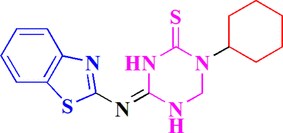
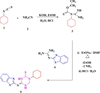 | Figure 1 Synthesis scheme of compound 5. |
2. Structural commentary
The molecular structure of the title compound 5 is shown in Fig. 2, with selected bond lengths and angles in Table 1. Standard numbering is used for the triazine ring and for the benzathiazole unit, the latter however with primes (′). A side view (Fig. 3) shows that a substantial proportion of the molecule is approximately planar. The two heterocyclic systems are connected via the nitrogen atom N7, whereby the atom sequence S1′—C2′—N7—C4—N3 has an extended conformation, and also by the intramolecular hydrogen bond N5—H05⋯N3′ (Table 2), which is associated with the E configuration around the exocyclic double bond C2′=N7. The benzothiazine system is planar [root-mean-square (r.m.s.) deviation of nine atoms 0.018 Å]; its dimensions are much as expected, e.g. the large exocyclic angles at C3A′ and C7A′, but the wide angle N3′—C2′—N7 of 129.58 (4)° is perhaps surprising (but see Database survey). The triazinane ring displays a flattened boat conformation (cf. torsion angles in Table 1), with C2 and N5 lying 0.594 (1) and 0.307 (1) Å, respectively, to the same side of the plane of the other four atoms (r.m.s. deviation < 0.001 Å); the puckering parameters (Cremer & Pople, 1975) are Q = 0.5322 (5) Å, θ = 103.05 (5)°, φ = 240.13 (5)°. The bond lengths and angles suggest a good deal of delocalization in most of the ring, although C2 essentially shows sp3 with a N1—C2—N3 angle of 108.40 (3)°. The angle sums at C4 and C6 are both 360.0°, and the double bonds C4=N7 and C6=S2 are, at 1.3215 (5) and 1.6679 (4) Å, respectively, not significantly lengthened. In their extensive table of bond lengths, Allen et al. (1987) give a standard value of 1.681 (20) Å for the C=S bond length in thioureas, but no direct value for a system corresponding to C4=N7, although their general value for pyrimidines, 1.336 (14) Å, may be comparable.
| ||||||||||||||||||||||||||||||||||||||||||||||||||||||||||||||||||||||||||||||||||||||||||||||||||
|
 ; (ii)
 ; (iii)
 ; (iv)
 .
 | Figure 2 The molecule of the title compound 5 in the crystal. Ellipsoids represent 50% probability levels. The dashed line indicates the intramolecular hydrogen bond. |
 | Figure 3 Side view of the molecule of 5 (H atoms omitted, radii arbitrary). |
3. Supramolecular features
Hydrogen bonds are listed in Table 2, which includes several borderline C—H⋯S contacts that we do not discuss further. In the crystal, molecules of 5 are linked to form inversion-symmetric dimers by the classical N3—H03⋯N7 hydrogen bond, supported by the weak C2—H2A⋯S1′ hydrogen bond (Fig. 4). The dimers are further linked via x-axis translation by the weak C16—H16B⋯S2 hydrogen bond (Fig. 5).
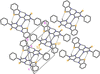 | Figure 4 Packing of compound 5 viewed perpendicular to (  01), showing the formation of dimers via classical (thick) and weak (thin) hydrogen bonds. Sulfur atom labels indicate the Hydrogen atoms not involved in these hydrogen bonds are omitted for clarity. |
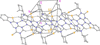 | Figure 5 Packing of compound 5 viewed perpendicular to (0 1), showing the linking of dimers parallel to the x axis via further C—H⋯S hydrogen bonds (thick dashed lines; hydrogen bonds within the dimers are shown as thin dashed lines). Sulfur atom labels indicate the Hydrogen atoms not involved in these hydrogen bonds are omitted for clarity. |
4. Database survey
Searches were conducted using CSD Version 6.01, update Sept. 2026 (Groom et al., 2016) and the ConQuest routine (Version 2026.2.0; Bruno et al., 2002).
A search for structures of similar benzothiazyl derivatives to 5, with a substituent —N(two-coordinate)—C(three-coordinate) at C2, gave 96 hits, with most showing the same very wide angles as N3′—C2′—N7 in 5. However, a substantial subset showed values much closer to 120°. Closer inspection showed that the majority (74) of the structures, with a mean angle of 128.2 (18)°, has a cis configuration N—C—N—C (absolute torsion angles ca. 0°) about the exocyclic C=N bond, whereas the narrower angles, with a mean value of 120.9 (10)°, are associated with a trans configuration (absolute torsion angles ca. 180°).
A search for triazine/triazinane rings with no restriction on bond order or substituents, with coordination numbers 4 at C2 (based on the numbering of 5) and 3 at all other atoms, showed that 5 may reasonably be described as a ‘novel' compound. There were only 16 hits. All necessarily have formal double bonds from C2 and C4 to their substituents, but none has a C=N and a C=S double bond as in 5. In 14 of the structures, there are two C=O groups [e.g. 3-(4-chlorophenyl)-1-methyl-1,3,5-triazinane-2,4-dione and its 3-(2-chlorophenyl) isomer (XOBLIN and XOBLOT; Panga et al., 2022)]. The two exceptions are 2,4-bis(dinitromethylidene)-1,3,5-triazinane, an explosive compound with two C=C bonds (GOGHOC; Yan et al., 2019) and N′-(4,4-dimethyl-2,6-disulfanylidene-1,3,5-triazinan-1-yl)-N,N-diethyldicarbonimidothioic diamide, with two C=S double bonds (TANXAK; Hussien et al., 2017).
5. Synthesis and crystallization
A mixture of O-ethyl N-cyclohexylcarbamothioate 3 (2.29 g, 0.01 mol) and 2-(benzo[d]thiazol-2-yl)guanidine (1.92 g, 0.01 mol) 4 was reacted for 2 h under reflux in dry dimethylformamide (10 ml) containing sodium ethoxide (0.68 g, 0.01 mol). Following completion of the reaction, the reaction mixture was poured into ice-cold water and neutralized using hydrochloric acid. The precipitate thus formed was collected via filtration, washed thoroughly with water, dried, and then recrystallized from dimethyl sulfoxide, yielding compound 5 as colourless crystals in 42% yield (0.15 g), m.p. 509–510 K; 1H NMR (500 MHz, DMSO-d6): δ (ppm)1.20 (m, 3H, cyclohexyl), 1.44 (m, 2H, cyclohexyl), 1.58 (d, 1H, J = 10 Hz, cyclohexyl), 1.70 (d, 2H, J = 15 Hz, cyclohexyl), 1.77 (d, 2H, J = 10 Hz, cyclohexyl), 4.63 (s, 1H, NH), 4.74 (s, 2H, CH2), 4.86 (s, 1H, NH), 7.17 (t, J = 7.5 Hz, 1H, benzothiazole-CH), 7.33 (t, J = 5 Hz, 1H, benzothiazole-CH), 7.58 (d, J = 8 Hz, 1H, benzothiazole-CH), 7.78 (d, J = 10 Hz, 1H, benzothiazole-CH); Analysis: calculated for C16H19N5S2: C 55.62, H 5.54, N 20.27, S 18.56. Found: C 55.59, H 5.50, N 20.21, S 18.53%.
6. Refinement
Details of data collection and structure are summarized in Table 3. Hydrogen atoms of the NH groups were refined freely. Other hydrogens were introduced at calculated positions and refined using a riding model, with C—H 1.00 (methine), 0.99 (methylene) or 0.95 (aromatic) Å. The Uiso(H) values were fixed at 1.2 × Ueq of the parent carbon atoms. Nine reflections with Δ/σ > 8 were omitted from the refinement.
|
Supporting information
CCDC reference: 2599346
contains datablocks I, global. DOI: https://doi.org/10.1107/S205698902601131X/wm5819sup1.cif
Structure factors: contains datablock I. DOI: https://doi.org/10.1107/S205698902601131X/wm5819Isup2.hkl
| C16H19N5S2 | Z = 2 |
| Mr = 345.48 | F(000) = 364 |
| Triclinic, P1 | Dx = 1.401 Mg m−3 |
| a = 6.97438 (12) Å | Mo Kα radiation, λ = 0.71073 Å |
| b = 10.81958 (19) Å | Cell parameters from 76587 reflections |
| c = 12.3192 (2) Å | θ = 3.0–45.1° |
| α = 114.1800 (18)° | µ = 0.33 mm−1 |
| β = 91.3132 (14)° | T = 100 K |
| γ = 103.0600 (14)° | Prism, colourless |
| V = 819.11 (3) Å3 | 0.2 × 0.1 × 0.1 mm |
| XtaLAB Synergy diffractometer | 13416 independent reflections |
| Radiation source: micro-focus sealed X-ray tube, PhotonJet (Mo) X-ray Source | 11462 reflections with I > 2σ(I) |
| Mirror monochromator | Rint = 0.030 |
| Detector resolution: 10.0000 pixels mm-1 | θmax = 44.9°, θmin = 2.1° |
| ω scans | h = −13→13 |
| Absorption correction: multi-scan (CrysAlisPro; Rigaku OD, 2025) | k = −21→21 |
| Tmin = 0.559, Tmax = 1.000 | l = −24→24 |
| 134638 measured reflections |
| Refinement on F2 | Primary atom site location: dual |
| Least-squares matrix: full | Hydrogen site location: mixed |
| R[F2 > 2σ(F2)] = 0.028 | H atoms treated by a mixture of independent and constrained refinement |
| wR(F2) = 0.089 | w = 1/[σ2(Fo2) + (0.0506P)2 + 0.0934P] where P = (Fo2 + 2Fc2)/3 |
| S = 1.05 | (Δ/σ)max = 0.005 |
| 13416 reflections | Δρmax = 0.62 e Å−3 |
| 216 parameters | Δρmin = −0.59 e Å−3 |
| 0 restraints |
| x | y | z | Uiso*/Ueq | ||
| N1 | 0.40469 (5) | 0.57040 (4) | 0.34132 (3) | 0.01203 (5) | |
| C2 | 0.29528 (6) | 0.66914 (4) | 0.41522 (4) | 0.01326 (6) | |
| H2A | 0.170930 | 0.657958 | 0.367754 | 0.016* | |
| H2B | 0.260448 | 0.650407 | 0.485473 | 0.016* | |
| N3 | 0.41976 (5) | 0.80986 (4) | 0.45469 (4) | 0.01316 (5) | |
| H03 | 0.370 (2) | 0.8756 (15) | 0.4529 (12) | 0.047 (4)* | |
| C4 | 0.60318 (6) | 0.83452 (4) | 0.50621 (4) | 0.01122 (5) | |
| N5 | 0.66216 (5) | 0.71576 (4) | 0.49148 (3) | 0.01237 (5) | |
| H05 | 0.7848 (16) | 0.7305 (11) | 0.5245 (9) | 0.023 (2)* | |
| C6 | 0.58871 (6) | 0.58932 (4) | 0.39008 (4) | 0.01198 (6) | |
| S2 | 0.73359 (2) | 0.47973 (2) | 0.33910 (2) | 0.01797 (3) | |
| N7 | 0.71508 (5) | 0.96423 (4) | 0.56399 (3) | 0.01237 (5) | |
| C11 | 0.31303 (6) | 0.44990 (4) | 0.22608 (4) | 0.01190 (6) | |
| H11 | 0.421766 | 0.428285 | 0.175542 | 0.014* | |
| C12 | 0.21738 (7) | 0.31865 (4) | 0.24372 (4) | 0.01497 (6) | |
| H12A | 0.106864 | 0.335503 | 0.292250 | 0.018* | |
| H12B | 0.316607 | 0.297302 | 0.287489 | 0.018* | |
| C13 | 0.13876 (8) | 0.19412 (5) | 0.12180 (5) | 0.01832 (8) | |
| H13A | 0.251521 | 0.171996 | 0.076744 | 0.022* | |
| H13B | 0.071544 | 0.110918 | 0.134304 | 0.022* | |
| C14 | −0.00719 (8) | 0.22541 (5) | 0.04805 (5) | 0.01931 (8) | |
| H14A | −0.047016 | 0.145971 | −0.032418 | 0.023* | |
| H14B | −0.127927 | 0.235678 | 0.088001 | 0.023* | |
| C15 | 0.08641 (8) | 0.35983 (5) | 0.03479 (4) | 0.01804 (7) | |
| H15A | −0.013537 | 0.381174 | −0.008498 | 0.022* | |
| H15B | 0.197709 | 0.345486 | −0.013470 | 0.022* | |
| C16 | 0.16323 (7) | 0.48397 (4) | 0.15712 (4) | 0.01450 (6) | |
| H16A | 0.227436 | 0.568638 | 0.145888 | 0.017* | |
| H16B | 0.050948 | 0.503456 | 0.203459 | 0.017* | |
| S1' | 1.02952 (2) | 1.16919 (2) | 0.69377 (2) | 0.01327 (2) | |
| C2' | 0.89915 (6) | 0.99074 (4) | 0.62152 (4) | 0.01145 (5) | |
| N3' | 0.99177 (6) | 0.90340 (4) | 0.63392 (4) | 0.01324 (5) | |
| C3A' | 1.17474 (6) | 0.97534 (4) | 0.70407 (4) | 0.01259 (6) | |
| C4' | 1.30722 (7) | 0.91391 (5) | 0.73829 (5) | 0.01677 (7) | |
| H4' | 1.276116 | 0.815309 | 0.713071 | 0.020* | |
| C5' | 1.48491 (7) | 0.99956 (6) | 0.80973 (5) | 0.01940 (8) | |
| H5' | 1.574984 | 0.958792 | 0.833936 | 0.023* | |
| C6' | 1.53349 (7) | 1.14506 (6) | 0.84669 (5) | 0.01934 (8) | |
| H6' | 1.656516 | 1.201398 | 0.894684 | 0.023* | |
| C7' | 1.40353 (7) | 1.20771 (5) | 0.81383 (4) | 0.01657 (7) | |
| H7' | 1.436250 | 1.306223 | 0.838357 | 0.020* | |
| C7A' | 1.22374 (6) | 1.12205 (4) | 0.74386 (4) | 0.01258 (6) |
| U11 | U22 | U33 | U12 | U13 | U23 | |
| N1 | 0.01022 (11) | 0.00954 (11) | 0.01345 (12) | 0.00232 (9) | −0.00271 (9) | 0.00241 (9) |
| C2 | 0.01028 (12) | 0.01091 (13) | 0.01525 (15) | 0.00200 (10) | −0.00118 (11) | 0.00284 (11) |
| N3 | 0.01047 (11) | 0.00942 (11) | 0.01636 (13) | 0.00216 (9) | −0.00363 (10) | 0.00284 (10) |
| C4 | 0.01044 (12) | 0.00970 (12) | 0.01170 (13) | 0.00209 (10) | −0.00193 (10) | 0.00321 (10) |
| N5 | 0.01138 (11) | 0.00958 (11) | 0.01435 (13) | 0.00184 (9) | −0.00377 (9) | 0.00408 (10) |
| C6 | 0.01051 (12) | 0.00951 (12) | 0.01480 (14) | 0.00176 (10) | −0.00203 (10) | 0.00469 (11) |
| S2 | 0.01294 (4) | 0.01257 (4) | 0.02556 (6) | 0.00442 (3) | −0.00118 (4) | 0.00494 (4) |
| N7 | 0.01059 (11) | 0.00960 (11) | 0.01399 (12) | 0.00166 (9) | −0.00336 (9) | 0.00290 (9) |
| C11 | 0.01230 (13) | 0.00914 (12) | 0.01231 (13) | 0.00174 (10) | −0.00215 (10) | 0.00340 (10) |
| C12 | 0.01691 (16) | 0.01051 (13) | 0.01603 (15) | 0.00092 (11) | −0.00368 (12) | 0.00588 (12) |
| C13 | 0.02185 (19) | 0.00968 (13) | 0.01983 (18) | 0.00241 (13) | −0.00615 (14) | 0.00409 (13) |
| C14 | 0.02080 (19) | 0.01146 (14) | 0.01967 (18) | 0.00089 (13) | −0.00858 (15) | 0.00307 (13) |
| C15 | 0.02236 (19) | 0.01440 (15) | 0.01444 (16) | 0.00298 (14) | −0.00569 (14) | 0.00460 (13) |
| C16 | 0.01568 (15) | 0.01070 (13) | 0.01548 (15) | 0.00200 (11) | −0.00446 (12) | 0.00502 (12) |
| S1' | 0.01121 (4) | 0.00949 (4) | 0.01605 (4) | 0.00150 (3) | −0.00309 (3) | 0.00332 (3) |
| C2' | 0.01045 (12) | 0.01008 (12) | 0.01183 (13) | 0.00165 (10) | −0.00190 (10) | 0.00342 (10) |
| N3' | 0.01184 (12) | 0.01099 (11) | 0.01508 (13) | 0.00188 (9) | −0.00368 (10) | 0.00461 (10) |
| C3A' | 0.01077 (13) | 0.01270 (13) | 0.01303 (14) | 0.00247 (10) | −0.00186 (10) | 0.00468 (11) |
| C4' | 0.01419 (15) | 0.01648 (16) | 0.01959 (18) | 0.00463 (12) | −0.00305 (13) | 0.00756 (14) |
| C5' | 0.01348 (15) | 0.02231 (19) | 0.0222 (2) | 0.00522 (14) | −0.00384 (14) | 0.00922 (16) |
| C6' | 0.01149 (14) | 0.02159 (19) | 0.02114 (19) | 0.00159 (13) | −0.00471 (13) | 0.00713 (16) |
| C7' | 0.01120 (14) | 0.01547 (15) | 0.01846 (17) | 0.00011 (12) | −0.00319 (12) | 0.00474 (13) |
| C7A' | 0.00993 (12) | 0.01246 (13) | 0.01306 (14) | 0.00160 (10) | −0.00143 (10) | 0.00402 (11) |
| N1—C6 | 1.3398 (5) | C14—C15 | 1.5293 (7) |
| N1—C2 | 1.4683 (6) | C14—H14A | 0.9900 |
| N1—C11 | 1.4797 (5) | C14—H14B | 0.9900 |
| C2—N3 | 1.4440 (6) | C15—C16 | 1.5304 (6) |
| C2—H2A | 0.9900 | C15—H15A | 0.9900 |
| C2—H2B | 0.9900 | C15—H15B | 0.9900 |
| N3—C4 | 1.3343 (5) | C16—H16A | 0.9900 |
| N3—H03 | 0.865 (14) | C16—H16B | 0.9900 |
| C4—N7 | 1.3215 (5) | S1'—C7A' | 1.7343 (4) |
| C4—N5 | 1.3800 (5) | S1'—C2' | 1.7631 (4) |
| N5—C6 | 1.3958 (5) | C2'—N3' | 1.3127 (5) |
| N5—H05 | 0.890 (11) | N3'—C3A' | 1.3895 (5) |
| C6—S2 | 1.6679 (4) | C3A'—C4' | 1.4008 (6) |
| N7—C2' | 1.3631 (5) | C3A'—C7A' | 1.4094 (6) |
| C11—C16 | 1.5294 (6) | C4'—C5' | 1.3900 (7) |
| C11—C12 | 1.5298 (6) | C4'—H4' | 0.9500 |
| C11—H11 | 1.0000 | C5'—C6' | 1.4018 (8) |
| C12—C13 | 1.5305 (7) | C5'—H5' | 0.9500 |
| C12—H12A | 0.9900 | C6'—C7' | 1.3895 (7) |
| C12—H12B | 0.9900 | C6'—H6' | 0.9500 |
| C13—C14 | 1.5302 (7) | C7'—C7A' | 1.3946 (6) |
| C13—H13A | 0.9900 | C7'—H7' | 0.9500 |
| C13—H13B | 0.9900 | ||
| C6—N1—C2 | 115.40 (3) | C15—C14—H14A | 109.5 |
| C6—N1—C11 | 121.71 (4) | C13—C14—H14A | 109.5 |
| C2—N1—C11 | 122.65 (3) | C15—C14—H14B | 109.5 |
| N3—C2—N1 | 108.40 (3) | C13—C14—H14B | 109.5 |
| N3—C2—H2A | 110.0 | H14A—C14—H14B | 108.0 |
| N1—C2—H2A | 110.0 | C14—C15—C16 | 111.41 (4) |
| N3—C2—H2B | 110.0 | C14—C15—H15A | 109.3 |
| N1—C2—H2B | 110.0 | C16—C15—H15A | 109.3 |
| H2A—C2—H2B | 108.4 | C14—C15—H15B | 109.3 |
| C4—N3—C2 | 116.42 (4) | C16—C15—H15B | 109.3 |
| C4—N3—H03 | 122.9 (9) | H15A—C15—H15B | 108.0 |
| C2—N3—H03 | 120.2 (9) | C11—C16—C15 | 109.63 (4) |
| N7—C4—N3 | 120.58 (4) | C11—C16—H16A | 109.7 |
| N7—C4—N5 | 124.76 (4) | C15—C16—H16A | 109.7 |
| N3—C4—N5 | 114.65 (4) | C11—C16—H16B | 109.7 |
| C4—N5—C6 | 121.37 (3) | C15—C16—H16B | 109.7 |
| C4—N5—H05 | 115.7 (7) | H16A—C16—H16B | 108.2 |
| C6—N5—H05 | 115.9 (7) | C7A'—S1'—C2' | 89.39 (2) |
| N1—C6—N5 | 114.73 (4) | N3'—C2'—N7 | 129.58 (4) |
| N1—C6—S2 | 126.30 (3) | N3'—C2'—S1' | 115.10 (3) |
| N5—C6—S2 | 118.95 (3) | N7—C2'—S1' | 115.29 (3) |
| C4—N7—C2' | 120.95 (4) | C2'—N3'—C3A' | 110.82 (4) |
| N1—C11—C16 | 112.15 (3) | N3'—C3A'—C4' | 125.32 (4) |
| N1—C11—C12 | 111.77 (3) | N3'—C3A'—C7A' | 115.34 (4) |
| C16—C11—C12 | 110.67 (3) | C4'—C3A'—C7A' | 119.33 (4) |
| N1—C11—H11 | 107.3 | C5'—C4'—C3A' | 118.93 (5) |
| C16—C11—H11 | 107.3 | C5'—C4'—H4' | 120.5 |
| C12—C11—H11 | 107.3 | C3A'—C4'—H4' | 120.5 |
| C11—C12—C13 | 109.97 (4) | C4'—C5'—C6' | 121.14 (4) |
| C11—C12—H12A | 109.7 | C4'—C5'—H5' | 119.4 |
| C13—C12—H12A | 109.7 | C6'—C5'—H5' | 119.4 |
| C11—C12—H12B | 109.7 | C7'—C6'—C5' | 120.67 (4) |
| C13—C12—H12B | 109.7 | C7'—C6'—H6' | 119.7 |
| H12A—C12—H12B | 108.2 | C5'—C6'—H6' | 119.7 |
| C14—C13—C12 | 111.52 (4) | C6'—C7'—C7A' | 118.19 (4) |
| C14—C13—H13A | 109.3 | C6'—C7'—H7' | 120.9 |
| C12—C13—H13A | 109.3 | C7A'—C7'—H7' | 120.9 |
| C14—C13—H13B | 109.3 | C7'—C7A'—C3A' | 121.72 (4) |
| C12—C13—H13B | 109.3 | C7'—C7A'—S1' | 128.93 (4) |
| H13A—C13—H13B | 108.0 | C3A'—C7A'—S1' | 109.34 (3) |
| C15—C14—C13 | 110.90 (4) | ||
| C6—N1—C2—N3 | 50.41 (5) | N1—C11—C16—C15 | 175.46 (4) |
| C11—N1—C2—N3 | −135.15 (4) | C12—C11—C16—C15 | −58.99 (5) |
| N1—C2—N3—C4 | −51.16 (5) | C14—C15—C16—C11 | 57.29 (5) |
| C2—N3—C4—N7 | −167.85 (4) | C4—N7—C2'—N3' | −2.30 (7) |
| C2—N3—C4—N5 | 13.28 (6) | C4—N7—C2'—S1' | 179.78 (3) |
| N7—C4—N5—C6 | −149.08 (4) | C7A'—S1'—C2'—N3' | 0.23 (4) |
| N3—C4—N5—C6 | 29.74 (6) | C7A'—S1'—C2'—N7 | 178.46 (4) |
| C2—N1—C6—N5 | −12.44 (5) | N7—C2'—N3'—C3A' | −177.35 (4) |
| C11—N1—C6—N5 | 173.07 (4) | S1'—C2'—N3'—C3A' | 0.58 (5) |
| C2—N1—C6—S2 | 169.16 (3) | C2'—N3'—C3A'—C4' | 177.48 (4) |
| C11—N1—C6—S2 | −5.33 (6) | C2'—N3'—C3A'—C7A' | −1.37 (6) |
| C4—N5—C6—N1 | −29.90 (6) | N3'—C3A'—C4'—C5' | −179.49 (5) |
| C4—N5—C6—S2 | 148.62 (4) | C7A'—C3A'—C4'—C5' | −0.69 (7) |
| N3—C4—N7—C2' | 176.98 (4) | C3A'—C4'—C5'—C6' | −0.58 (8) |
| N5—C4—N7—C2' | −4.27 (7) | C4'—C5'—C6'—C7' | 0.77 (9) |
| C6—N1—C11—C16 | −150.72 (4) | C5'—C6'—C7'—C7A' | 0.33 (8) |
| C2—N1—C11—C16 | 35.19 (5) | C6'—C7'—C7A'—C3A' | −1.63 (7) |
| C6—N1—C11—C12 | 84.33 (5) | C6'—C7'—C7A'—S1' | 177.43 (4) |
| C2—N1—C11—C12 | −89.75 (5) | N3'—C3A'—C7A'—C7' | −179.26 (4) |
| N1—C11—C12—C13 | −175.66 (4) | C4'—C3A'—C7A'—C7' | 1.83 (7) |
| C16—C11—C12—C13 | 58.58 (5) | N3'—C3A'—C7A'—S1' | 1.52 (5) |
| C11—C12—C13—C14 | −56.31 (6) | C4'—C3A'—C7A'—S1' | −177.40 (4) |
| C12—C13—C14—C15 | 54.74 (6) | C2'—S1'—C7A'—C7' | 179.90 (5) |
| C13—C14—C15—C16 | −55.29 (6) | C2'—S1'—C7A'—C3A' | −0.95 (3) |
| D—H···A | D—H | H···A | D···A | D—H···A |
| N3—H03···N7i | 0.865 (14) | 2.039 (14) | 2.8985 (5) | 172.2 (13) |
| N5—H05···N3′ | 0.890 (11) | 2.006 (11) | 2.6968 (5) | 133.5 (9) |
| C2—H2A···S1′i | 0.99 | 2.88 | 3.6836 (4) | 138 |
| C2—H2B···S2ii | 0.99 | 3.03 | 3.9585 (5) | 157 |
| C12—H12B···S2 | 0.99 | 3.01 | 3.5599 (5) | 116 |
| C16—H16B···S2iii | 0.99 | 2.83 | 3.7864 (5) | 162 |
| C4′—H4′···S2iv | 0.95 | 2.97 | 3.9042 (5) | 168 |
| Symmetry codes: (i) −x+1, −y+2, −z+1; (ii) −x+1, −y+1, −z+1; (iii) x−1, y, z; (iv) −x+2, −y+1, −z+1. |
Acknowledgements
The authors acknowledge support by the Open Access Publication Funds of the Technical University of Braunschweig.
References
 Allen, F. H., Kennard, O., Watson, D. G., Brammer, L., Orpen, A. G. & Taylor, R. (1987). J. Chem. Soc. Perkin Trans. 2 pp. S1–S19. Google Scholar
Bouchain, G. & Delorme, D. (2003). Curr. Med. Chem. 10, 2359–2372. Web of Science CrossRef PubMed CAS Google Scholar
Brown, D. J. (2002). The Chemistry of Heterocyclic Compounds vol. 1, 2,4-Triazines. Hoboken, New Jersey, USA: Wiley. Google Scholar
Bruker (1998). XP version 5.1. Bruker Analytical X-Ray Instruments, Madison, Wisconsin, U. S. A. Google Scholar
Bruno, I. J., Cole, J. C., Edgington, P. R., Kessler, M., Macrae, C. F., McCabe, P., Pearson, J. & Taylor, R. (2002). Acta Cryst. B58, 389–397. Web of Science CrossRef CAS IUCr Journals Google Scholar
Bulsara, C. D., Gamit, A. S., Jain, A., Singh, G., Soni, H., Tandon, S., Zaki, M. E. A., Patel, N. B., Shaikh, F. M., Shah, A. B. & Patel, V. M. (2026). J. Mol. Struct. 1368, 146255. CrossRef Google Scholar
Cascioferro, S., Parrino, B., Spanò, V., Carbone, A., Montalbano, A., Barraja, P., Diana, P. & Cirrincione, G. (2017). Eur. J. Med. Chem. 142, 328–375. Web of Science CrossRef CAS PubMed Google Scholar
Cheng, X.-C., Wang, Q., Fang, H. & Xu, W.-F. (2008). Curr. Med. Chem. 15, 368–373. CrossRef PubMed CAS Google Scholar
Cremer, D. A. & Pople, J. A. (1975). J. Am. Chem. Soc. 97, 1354–1358. CrossRef CAS Google Scholar
Elboshi, H. A., Azzam, R. A., Elgemeie, G. H. & Jones, P. G. (2026). Acta Cryst. E82, 182–186. Web of Science CrossRef IUCr Journals Google Scholar
Elgemeie, G. H., Salah, A. M., Mohamed, R. A. & Jones, P. G. (2015). Acta Cryst. E71, 1319–1321. Web of Science CSD CrossRef IUCr Journals Google Scholar
Groom, C. R., Bruno, I. J., Lightfoot, M. P. & Ward, S. C. (2016). Acta Cryst. B72, 171–179. Web of Science CrossRef IUCr Journals Google Scholar
Hussien, N. J., Yusoff, S. F. M., El-Hiti, G. A., Farina, Y., Al-Jeboori, M. J. & Yousif, E. (2017). Z. Kristallogr. New Cryst. Struct. 232, 325–326. CSD CrossRef CAS Google Scholar
Jordheim, L. P., Durantel, D., Zoulim, F. & Dumontet, C. (2013). Nat. Rev. Drug Discov. 12, 447–464. Web of Science CrossRef CAS PubMed Google Scholar
Lu, Y., Chen, J., Xiao, M., Li, W. & Miller, D. D. (2012). Pharm. Res. 29, 2943–2971. Web of Science CrossRef CAS PubMed Google Scholar
Mohamed-Ezzat, R. A. & Elgemeie, G. H. (2024). BMC Chem. 18, article no. 58. Google Scholar
Mohamed-Ezzat, R. A. & Elgemeie, G. H. (2025). RSC Adv. 15, 41724–41832. CAS PubMed Google Scholar
Mohamed-Ezzat, R. A., Elgemeie, G. H. & Jones, P. G. (2024). Acta Cryst. E80, 120–124. Web of Science CSD CrossRef IUCr Journals Google Scholar
Mohamed-Ezzat, R. A., Elgemeie, G. H. & Jones, P. G. (2025). Acta Cryst. E81, 1178–1181. Web of Science CSD CrossRef IUCr Journals Google Scholar
Mojzych, M., Tarasiuk, P., Kotwica-Mojzych, K., Rafiq, M., Seo, S.-Y., Nicewicz, M. & Fornal, E. (2017). J. Enzym. Inhib. Med. Chem. 32, 99–105. CrossRef CAS Google Scholar
Panga, S. R., Hall, R. G., Samant, R. V., Montgomery, M. & Shyadligeri, A. S. (2022). Tetrahedron Lett. 106, 154076. CSD CrossRef Google Scholar
Parker, W. B. (2009). Chem. Rev. 109, 2880–2893. CrossRef PubMed CAS Google Scholar
Rigaku OD (2025). CrysAlis PRO. Rigaku Oxford Diffraction, Yarnton, England. Google Scholar
Sheldrick, G. M. (2015a). Acta Cryst. A71, 3–8. Web of Science CrossRef IUCr Journals Google Scholar
Sheldrick, G. M. (2015b). Acta Cryst. C71, 3–8. Web of Science CrossRef IUCr Journals Google Scholar
Westrip, S. P. (2010). J. Appl. Cryst. 43, 920–925. Web of Science CrossRef CAS IUCr Journals Google Scholar
Yan, C., Cheng, G., Wang, K., Liu, T., Jin, Y., Yang, H. & Zhang, Q. (2019). New J. Chem. 43, 10429–10433. CSD CrossRef CAS Google Scholar
Yurttas, L., Ciftci, G. A., Temel, H. E., Saglik, B. N., Demir, B. & Levent, S. (2017). Anticancer Agents Med. Chem. 17, 1846–1853. CAS PubMed Google Scholar
This is an open-access article distributed under the terms of the Creative Commons Attribution (CC-BY) Licence, which permits unrestricted use, distribution, and reproduction in any medium, provided the original authors and source are cited.
| CRYSTALLOGRAPHIC COMMUNICATIONS |