
Acta Crystallographica
Section E CRYSTALLOGRAPHIC COMMUNICATIONS


 menu


research communications
| CRYSTALLOGRAPHIC COMMUNICATIONS |
 access
First seven-coordinate dinuclear CdII complex featuring bridging 3-aminopyridine and chelating nitrate ligands: and Hirshfeld surface analysis

aUnité de Recherche de Chimie de l'Environnement et Moléculaire Structurale, Université Constantine 1 Frères Mentouri, Algeria, bÉcole Normale Supérieure Assia Djebar (ENS) de Constantine Ville Universitaire, Ain El Bey Ali Mendjeli, 25000 Constantine, Algeria, and cInstitute of Mineralogy and Petrography, University of Innsbruck, Innrain 52, A-6020 Innsbruck, Austria
*Correspondence e-mail: [email protected]
The title complex, bis(μ-3-aminopyridine)-κ2N1:N3;κ2N3:N1-bis[(3-aminopyridine-κN1)bis(nitrato-κ2O,O′)cadmium(II)], [Cd2(NO3)4(3-ampy)4] (3-ampy = 3-aminopyridine, C5H6N2), was obtained under hydrothermal conditions and crystallizes in the monoclinic space group P21/n. The asymmetric unit contains a centrosymmetric dimer formed from two CdII atoms bridged by a pair of 3-ampy ligands. Each ligand coordinates in a bidentate manner via its pyridine N atom and the other through its amino N atom; the second 3-ampy ligand is terminal. Each CdII atom is seven-coordinate, in a distorted pentagonal-bipyramidal CdN3O4 environment completed by two chelating nitrate anions. In the crystal, N—H⋯O and C—H⋯O hydrogen bonds link the dimers into layers, which are connected by weaker hydrogen bonds and π–π stacking interactions into a three-dimensional network. Hirshfeld surface analysis shows that H⋯O/O⋯H contacts dominate the packing. To our knowledge, this is the first discrete dinuclear CdII–3-ampy complex and the first with coordinated nitrate anions.
Keywords: crystal structure; cadmium coordination complex; 3-aminopyridine; distorted pentagonal bipyramidal; hydrogen-bonded networks; Hirshfeld surface; X-ray crystallography.
CCDC reference: 2604330
1. Chemical context
Nitrogen-donor ligands are widely used in the design of coordination compounds with diverse structural architectures and properties. Among them, 3-aminopyridine (3-ampy) is particularly versatile because it possesses two potentially coordinating N atoms: the pyridine and amino N atoms. Depending on the metal centre and the reaction conditions, 3-ampy can coordinate in a terminal monodentate fashion through either N atom or act as a bridging ligand through both donor sites (He et al., 2004 ; Kojima et al., 2009; Goher et al., 2004). Protonated 3-aminopyridinium ions have also been reported in organic–inorganic halocuprate salts containing dinuclear copper(II) anions (Blanchette & Willett, 1988; Willett & Halvorson, 1988). These protonated species are distinct from neutral 3-ampy acting as a coordination ligand.
The coordination chemistry of 3-ampy encompasses compounds with a range of transition-metal centres, including CoII, NiII, CuII, ZnII, CdII, AgI and ReV (He & Zhu, 2003; Bučar & Meštrović, 2003; He et al., 2004; Kochel, 2006; Qian & Huang, 2006; Pan et al., 2007; Yilmaz et al., 2007). In addition to discrete complexes, 3-ampy has been employed in the construction of extended coordination architectures, ranging from one-dimensional chains to two- and three-dimensional networks, often in combination with bridging anionic ligands (Goher et al., 2004; Mautner et al., 2007; Mautner et al., 2019; O'Donovan & LaDuca, 2014; Shen et al., 2015; Wilson et al., 2013; Kartal et al., 2018; Kartal & Şahin, 2021).
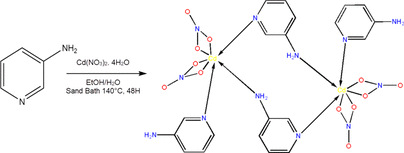
In this context, we report the synthesis and of a new dinuclear cadmium(II) complex, incorporating 3-ampy and nitrate anions. The structure consists of two inversion-related seven-coordinate CdII centres linked by N,N′-bridging 3-ampy ligands. The coordination geometry, supramolecular assembly and intermolecular interactions are discussed, together with a Hirshfeld surface analysis.
2. Structural commentary
The title coordination complex crystallizes in the monoclinic with the P21/n. The asymmetric unit of the complex contains one CdII ion coordinated to two 3-aminopyridine (3-ampy) ligand and chelated by two nitrate anions [Fig. 1(a)]. A dinuclear complex [Cd(NO3)2(3-ampy)2]2 is generated through the presence of an inversion centre at (0,  , ). The two CdII atoms are linked by a double 3-ampy bridge forming a centrosymmetric dimer with a Cd1⋯Cd1i distance of 6.6396 (3) Å [Fig. 1(b)].
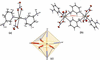 | Figure 1 Views of the title complex, showing (a) the molecular structure of the asymmetric unit of the [Cd(NO3)2(3-ampy)2]2 complex, with displacement ellipsoids drawn at the 50% probability level and H atoms shown as spheres of arbitrary radii, (b) a dinuclear entity and (c) the coordination polyhedra. [Symmetry code: (i) −x + 2, −y + 1, −z + 1.] |
The CdII atom, located in a general position, is heptacoordinated. The coordination sphere incorporates four O atoms and three N atoms [CdO4N3], forming a distorted pentagonal bipyramidal coordination geometry [Fig. 1(c)]. The axial positions are occupied by atoms N1 and N3 from the pyridine rings, with axial distances Cd1—N1 = 2.2859 (12) Å and Cd1—N3 = 2.2726 (13) Å, significantly shorter than the equatorial distances [2.4067 (12)–2.5301 (12) Å]. The geometry deviates from a regular pentagon, with bond angles O—Cd—O [51.84 (4)–77.68 (4)°] and N—Cd—O [87.22 (4)–92.49 (4)°] (Table 1) consistent with literature values for similar cadmium complexes. (Bartholomä et al., 2010; Song et al., 2016; Kovalev et al., 2021; Benahsene et al., 2025).
|
 .
The 3-ampy ligand exhibits two distinct coordination modes (Fig. 2): mode (I), monodentate coordination through the pyridine N atom, and mode (IV), bridging coordination through both the pyridine and amino N atoms. The latter mode leads to the formation of the dimeric assembly.
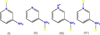 | Figure 2 The coordination modes of the 3-aminopyridine ligand. |
3. Supramolecular features
The crystal packing consists of shifted dimeric layers parallel to the ac plane [Fig. 3(a)]. Within each layer, the dimeric entities are arranged along the crystallographic a and c axes, forming dimeric chains that extend along the a axis [Fig. 3(b)].
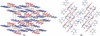 | Figure 3 Packing view of the title coordination complex, showing (a) the crystal packing and (b) the dimeric layers. |
The complex exhibits a total of eight hydrogen bonds, comprising N—H⋯O and C—H⋯O interactions (Table 2). Within the same chain, adjacent dimeric entities are connected through three strong and moderate N—H⋯O hydrogen bonds, giving rise to R12(4), R22(8) and R22(24) ring motifs that propagate parallel to the a-axis direction (Fig. 4).
|
 ; (iii)
 ; (iv)
 ; (v)
 ; (vi)
 .
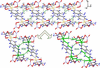 | Figure 4 Part of the crystal structure showing the junction between dimeric entities through N4—H42⋯O3v and N2—H22⋯O6iii hydrogen bonds with R12(4), R22(8) and R22(24) motifs. The ring used for the graph set is shown in green. [Symmetry codes: (iv) x −  , −y +  , z − ; (v) x − 1, y, z.] |
Interlayer connectivity between dimeric layers parallel to the ac plane is established by one moderate N—H⋯O hydrogen bond and two weak C—H⋯O interactions, generating infinite C(6) chains and R21(5) ring motifs, respectively (Fig. 5). These interactions, together with two intermolecular π–π stacking interactions between the pyridine ring centroids, with a centroid-to-centroid distance of 3.674 (2) Å, contribute to the formation of >a three-dimensional supramolecular network (Fig. 5).
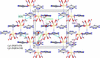 | Figure 5 Part of the crystal structure showing the interactions between dimeric layers through N2—H21⋯O1ii, C4—H4⋯O1vi and C5—H5⋯O1vi hydrogen bonds, and π–π intermolecular interactions. Cg1 is the centroid of the N1/C1–C5 ring and Cg2 of the N3/C6–C10 ring, and the Cg1⋯Cg2 distance is 3.674 (2) Å. [Symmetry codes: (ii) x + , −y + , z + ; (vi) x − , −y + , z + .] |
4. Hirshfeld surface analysis
Hirshfeld surface analysis using CrystalExplorer21 (Spackman et al., 2021) was used to illustrate and quantify the interactions in the crystal structure of the complex. The analysis generated Hirshfeld surfaces mapped over dnorm, shape index and curvedness, alongside two-dimensional fingerprint plots (2D-FPs).
The dnorm surfaces (Fig. 6) were plotted over the range −0.54 to 1.49 a.u. with transparency to allow visualization of the molecular structures. Red spots on the dnorm surface correspond to intermolecular H⋯O contacts, while blue regions indicate regions too distant for interaction.
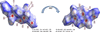 | Figure 6 Hirshfeld surface of the studied complex mapped over dnorm, showing the intermolecular interactions. |
The two-dimensional FPs (Fig. 7) reveals the dominant role of H⋯O/O⋯H contacts (55.4%), followed by H⋯H interactions (19.7%) and C⋯H/H⋯C contacts (9.8%). Analysis in curvedness [Fig. 8(a)] and shape index modes [Fig. 8(b)] identifies π–π interactions (3.8% of surface contacts) between adjacent pyridine rings, confirming aromatic stacking as a secondary contributor to the crystal packing.
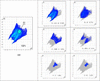 | Figure 7 Two-dimensional fingerprint plots of the different contacts in the studied complex and their contributions to the total surface. |
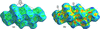 | Figure 8 Hirshfeld surface of the studied complex mapped over (a) curvedness and (b) shape index. |
This quantitative assessment demonstrates that hydrogen bonding is the primary determinant of the supramolecular architecture, with π–π stacking providing structural reinforcement.
5. Database survey
A search of the Cambridge Structural Database (CSD, Version 6.01, November 2025, including the September 2026 updates; Groom et al., 2016) was performed using ConQuest, targeting transition-metal-containing structures featuring 3-aminopyridine (3-ampy). The search returned 142 hits, of which 15 corresponded to cadmium-containing coordination complexes.
The reported CdII–3-ampy structures exhibit a variety of coordination environments and structural arrangements. The mononuclear complex [CdCl2(3-ampy)4] contains six-coordinate CdII, with the 3-ampy ligands coordinated through their pyridine N atoms (He et al., 2004). In the sulfate and azide compounds, {[Cd(3-ampy)(H2O)4](SO4)·H2O}n and [Cd(3-ampy)(N3)2]n, respectively, 3-ampy acts as a bridging ligand through both N atoms, resulting in one- and three-dimensional coordination architectures (Goher et al., 2004). In the Hofmann-type compounds [Cd(3-ampy)2Ni(CN)4] and [Cd(3-ampy)2Cd(μ4-CN)4]n, 3-ampy coordinates in a terminal monodentate fashion through the pyridine N atom (Kartal et al., 2018; Kartal & Şahin, 2021). Other reported CdII–3-ampy coordination polymers incorporate carboxylate ligands (O'Donovan & LaDuca, 2014; Shen et al., 2015; Wilson et al., 2013), as well as thiocyanate, dicyanamide and sulfate anions (Saber et al., 2012; Mautner et al., 2019; Mautner et al., 2021; Goher et al., 2004).
Seven-coordinate CdII centres coordinated by 3-ampy have previously been reported in two polymeric carboxylate structures (Shen et al., 2015; Wilson et al., 2013), in which the high coordination number is achieved through chelating carboxylate groups. Furthermore, although Cd2N2 units occur in the azide-based coordination polymer reported by Goher et al. (2004), these units are linked into an extended three-dimensional network rather than forming discrete dinuclear complexes.
The title compound therefore exhibits a distinct combination of structural features. It consists of a discrete centrosymmetric dinuclear complex in which two symmetry-related 3-ampy ligands bridge the CdII centres through their pyridine and amino N atoms, while additional 3-ampy ligands coordinate terminally through their pyridine N atoms. Each CdII centre is seven-coordinate, with its coordination sphere completed by two chelating nitrate anions. No previously reported CdII–3-ampy structure featuring coordinated nitrate anions was identified in the CSD survey. To the best of our knowledge, the title compound is thus the first reported discrete dinuclear CdII–3-ampy complex combining N:N′-bridging 3-ampy ligands, seven-coordinate CdII centres and coordinated nitrate anions.
6. Synthesis and crystallization
3-Aminopyridine (C5H6N2, 0.5 mmol, 0.04705 g) and cadmium nitrate tetrahydrate [Cd(NO3)2·4H2O, 0.5 mmol, 0.1542 g] were dissolved in a 1:1 (v/v) mixture of ethanol and distilled water (20 ml). The solution was stirred at room temperature for 15 min, then transferred to a sealed tube and heated in a sand bath at 140 °C for 48 h. The tube was subsequently allowed to cool to room temperature over 48 h. Transparent prismatic crystals suitable for single-crystal X-ray diffraction analysis were obtained in approximately 45% yield, based on cadmium nitrate.
7. Refinement
Crystal data, data collection and structure details are summarized in Table 3. Aromatic H atoms were placed at calculated positions and refined using a riding model, with C—H bond lengths fixed at 0.93 Å. The two amino H atoms were initially located in the difference Fourier map and subsequently refined using a geometrically constrained model. The isotropic displacement parameters of all H atoms were set to Uiso(H) = 1.2Ueq(C) and Uiso = 1.5Ueq(N), depending on the atom to which each H atom is bonded.
|
Supporting information
CCDC reference: 2604330
contains datablocks I, global. DOI: https://doi.org/10.1107/S2056989026012119/zn2051sup1.cif
Structure factors: contains datablock I. DOI: https://doi.org/10.1107/S2056989026012119/zn2051Isup2.hkl
| [Cd2(NO3)4(C5H6N2)4] | F(000) = 840 |
| Mr = 849.32 | Dx = 1.981 Mg m−3 |
| Monoclinic, P21/n | Mo Kα radiation, λ = 0.71073 Å |
| a = 8.1799 (2) Å | Cell parameters from 2882 reflections |
| b = 13.0955 (3) Å | θ = 5.1–26.4° |
| c = 13.5180 (3) Å | µ = 1.58 mm−1 |
| β = 100.441 (1)° | T = 273 K |
| V = 1424.07 (6) Å3 | Prism, colorless |
| Z = 2 | 0.2 × 0.2 × 0.1 mm |
| Bruker APEXII CCD diffractometer | 2882 independent reflections |
| Radiation source: fine-focus sealed tube | 2587 reflections with I > 2σ(I) |
| Graphite monochromator | Rint = 0.016 |
| φ and ω scans | θmax = 26.4°, θmin = 5.1° |
| Absorption correction: multi-scan (SADABS; Bruker, 2015) | h = −9→10 |
| Tmin = 0.697, Tmax = 0.746 | k = −16→14 |
| 11199 measured reflections | l = −16→16 |
| Refinement on F2 | Secondary atom site location: difference Fourier map |
| Least-squares matrix: full | Hydrogen site location: mixed |
| R[F2 > 2σ(F2)] = 0.015 | H-atom parameters constrained |
| wR(F2) = 0.038 | w = 1/[σ2(Fo2) + (0.0164P)2 + 0.6403P] where P = (Fo2 + 2Fc2)/3 |
| S = 1.09 | (Δ/σ)max = 0.002 |
| 2882 reflections | Δρmax = 0.44 e Å−3 |
| 210 parameters | Δρmin = −0.24 e Å−3 |
| 0 restraints |
Geometry. All esds (except the esd in the dihedral angle between two l.s. planes) are estimated using the full covariance matrix. The cell esds are taken into account individually in the estimation of esds in distances, angles and torsion angles; correlations between esds in cell parameters are only used when they are defined by crystal symmetry. An approximate (isotropic) treatment of cell esds is used for estimating esds involving l.s. planes. |
| x | y | z | Uiso*/Ueq | ||
| Cd1 | 0.68740 (2) | 0.63024 (2) | 0.36679 (2) | 0.01378 (5) | |
| O4 | 0.52043 (14) | 0.76753 (10) | 0.41279 (8) | 0.0212 (3) | |
| N2 | 1.28163 (15) | 0.55491 (11) | 0.63043 (9) | 0.0154 (3) | |
| H21 | 1.3466 | 0.5789 | 0.6848 | 0.023* | |
| H22 | 1.3205 | 0.5761 | 0.5752 | 0.023* | |
| O2 | 0.82763 (14) | 0.78131 (10) | 0.31546 (8) | 0.0221 (3) | |
| O3 | 0.94568 (15) | 0.63757 (9) | 0.29167 (9) | 0.0209 (3) | |
| O6 | 0.43340 (14) | 0.61791 (9) | 0.44867 (9) | 0.0204 (3) | |
| N3 | 0.52084 (17) | 0.61615 (11) | 0.21342 (10) | 0.0165 (3) | |
| N1 | 0.85218 (16) | 0.62875 (10) | 0.52262 (9) | 0.0145 (3) | |
| O5 | 0.30785 (15) | 0.75465 (11) | 0.48771 (10) | 0.0311 (3) | |
| O1 | 1.04893 (16) | 0.78031 (12) | 0.24830 (10) | 0.0327 (3) | |
| N4 | 0.08435 (17) | 0.56886 (12) | 0.10418 (10) | 0.0217 (3) | |
| H42 | 0.0513 | 0.5870 | 0.1556 | 0.033* | |
| H41 | 0.0295 | 0.5908 | 0.0459 | 0.033* | |
| C6 | 0.3577 (2) | 0.59751 (13) | 0.20409 (11) | 0.0170 (3) | |
| H6 | 0.3129 | 0.5893 | 0.2621 | 0.020* | |
| C10 | 0.5866 (2) | 0.62834 (13) | 0.12995 (12) | 0.0186 (3) | |
| H10 | 0.6996 | 0.6421 | 0.1363 | 0.022* | |
| C1 | 1.01493 (19) | 0.60731 (12) | 0.53263 (11) | 0.0136 (3) | |
| H1 | 1.0630 | 0.6061 | 0.4753 | 0.016* | |
| C8 | 0.3230 (2) | 0.60128 (13) | 0.02486 (11) | 0.0178 (3) | |
| H8 | 0.2577 | 0.5956 | −0.0388 | 0.021* | |
| N6 | 0.94378 (16) | 0.73424 (12) | 0.28473 (9) | 0.0177 (3) | |
| C9 | 0.4907 (2) | 0.62101 (13) | 0.03509 (12) | 0.0186 (3) | |
| H9 | 0.5390 | 0.6293 | −0.0216 | 0.022* | |
| N5 | 0.41755 (16) | 0.71478 (12) | 0.44979 (10) | 0.0178 (3) | |
| C4 | 0.8768 (2) | 0.61716 (13) | 0.70101 (11) | 0.0180 (3) | |
| H4 | 0.8275 | 0.6230 | 0.7576 | 0.022* | |
| C2 | 1.11416 (19) | 0.58686 (12) | 0.62500 (11) | 0.0140 (3) | |
| C5 | 0.7845 (2) | 0.63390 (13) | 0.60592 (12) | 0.0178 (3) | |
| H5 | 0.6721 | 0.6492 | 0.5995 | 0.021* | |
| C7 | 0.2519 (2) | 0.58983 (13) | 0.11054 (11) | 0.0160 (3) | |
| C3 | 1.0427 (2) | 0.59172 (13) | 0.71081 (11) | 0.0158 (3) | |
| H3 | 1.1058 | 0.5780 | 0.7738 | 0.019* |
| U11 | U22 | U33 | U12 | U13 | U23 | |
| Cd1 | 0.01206 (7) | 0.01692 (7) | 0.01223 (6) | 0.00097 (4) | 0.00185 (4) | 0.00119 (4) |
| O4 | 0.0185 (5) | 0.0225 (7) | 0.0242 (6) | −0.0016 (5) | 0.0083 (5) | 0.0036 (5) |
| N2 | 0.0138 (6) | 0.0168 (7) | 0.0151 (6) | −0.0005 (5) | 0.0008 (5) | 0.0012 (5) |
| O2 | 0.0203 (6) | 0.0227 (7) | 0.0244 (6) | 0.0045 (5) | 0.0070 (5) | −0.0003 (5) |
| O3 | 0.0239 (6) | 0.0173 (7) | 0.0229 (6) | 0.0020 (5) | 0.0082 (5) | 0.0032 (5) |
| O6 | 0.0216 (6) | 0.0192 (7) | 0.0212 (5) | −0.0002 (5) | 0.0064 (5) | 0.0006 (5) |
| N3 | 0.0169 (6) | 0.0171 (8) | 0.0149 (6) | 0.0005 (5) | 0.0015 (5) | 0.0010 (5) |
| N1 | 0.0152 (6) | 0.0135 (7) | 0.0143 (6) | 0.0002 (5) | 0.0013 (5) | 0.0005 (5) |
| O5 | 0.0231 (6) | 0.0322 (8) | 0.0427 (8) | 0.0060 (6) | 0.0185 (6) | −0.0032 (6) |
| O1 | 0.0264 (7) | 0.0357 (9) | 0.0398 (7) | −0.0095 (6) | 0.0161 (6) | 0.0078 (6) |
| N4 | 0.0182 (7) | 0.0300 (9) | 0.0162 (6) | −0.0022 (6) | 0.0016 (5) | 0.0002 (6) |
| C6 | 0.0192 (8) | 0.0177 (9) | 0.0144 (7) | 0.0006 (7) | 0.0041 (6) | 0.0011 (6) |
| C10 | 0.0162 (7) | 0.0206 (9) | 0.0191 (7) | 0.0012 (7) | 0.0035 (6) | 0.0019 (7) |
| C1 | 0.0157 (7) | 0.0108 (8) | 0.0144 (7) | −0.0011 (6) | 0.0031 (6) | −0.0006 (6) |
| C8 | 0.0215 (8) | 0.0170 (9) | 0.0138 (7) | 0.0012 (7) | 0.0002 (6) | −0.0005 (6) |
| N6 | 0.0165 (6) | 0.0210 (8) | 0.0149 (6) | −0.0024 (6) | 0.0010 (5) | 0.0025 (5) |
| C9 | 0.0228 (8) | 0.0177 (9) | 0.0163 (7) | 0.0020 (7) | 0.0064 (6) | 0.0013 (6) |
| N5 | 0.0136 (6) | 0.0225 (8) | 0.0171 (6) | 0.0014 (6) | 0.0020 (5) | −0.0005 (6) |
| C4 | 0.0212 (8) | 0.0201 (9) | 0.0133 (7) | −0.0004 (7) | 0.0047 (6) | −0.0028 (6) |
| C2 | 0.0157 (7) | 0.0090 (8) | 0.0171 (7) | −0.0012 (6) | 0.0020 (6) | −0.0006 (6) |
| C5 | 0.0155 (7) | 0.0193 (9) | 0.0188 (7) | 0.0024 (6) | 0.0034 (6) | −0.0024 (6) |
| C7 | 0.0175 (7) | 0.0121 (8) | 0.0176 (7) | 0.0002 (6) | 0.0010 (6) | 0.0002 (6) |
| C3 | 0.0193 (7) | 0.0144 (8) | 0.0125 (7) | −0.0010 (6) | −0.0003 (6) | −0.0002 (6) |
| Cd1—N3 | 2.2726 (13) | O1—N6 | 1.2247 (18) |
| Cd1—N1 | 2.2859 (12) | N4—C7 | 1.385 (2) |
| Cd1—O4 | 2.4067 (12) | N4—H42 | 0.8251 |
| Cd1—N2i | 2.4374 (15) | N4—H41 | 0.8808 |
| Cd1—O2 | 2.4495 (13) | C6—C7 | 1.401 (2) |
| Cd1—O3 | 2.5063 (12) | C6—H6 | 0.9300 |
| Cd1—O6 | 2.5301 (12) | C10—C9 | 1.380 (2) |
| O4—N5 | 1.2601 (18) | C10—H10 | 0.9300 |
| N2—C2 | 1.4215 (19) | C1—C2 | 1.386 (2) |
| N2—Cd1i | 2.4374 (15) | C1—H1 | 0.9300 |
| N2—H21 | 0.8834 | C8—C9 | 1.378 (2) |
| N2—H22 | 0.9062 | C8—C7 | 1.395 (2) |
| O2—N6 | 1.2641 (18) | C8—H8 | 0.9300 |
| O3—N6 | 1.2694 (19) | C9—H9 | 0.9300 |
| O6—N5 | 1.2756 (19) | C4—C3 | 1.380 (2) |
| N3—C6 | 1.340 (2) | C4—C5 | 1.385 (2) |
| N3—C10 | 1.345 (2) | C4—H4 | 0.9300 |
| N1—C1 | 1.343 (2) | C2—C3 | 1.392 (2) |
| N1—C5 | 1.343 (2) | C5—H5 | 0.9300 |
| O5—N5 | 1.2278 (18) | C3—H3 | 0.9300 |
| N3—Cd1—N1 | 174.79 (5) | C7—N4—H41 | 109.2 |
| N3—Cd1—O4 | 91.26 (4) | H42—N4—H41 | 117.9 |
| N1—Cd1—O4 | 92.05 (4) | N3—C6—C7 | 122.67 (14) |
| N3—Cd1—N2i | 88.67 (5) | N3—C6—H6 | 118.7 |
| N1—Cd1—N2i | 86.27 (4) | C7—C6—H6 | 118.7 |
| O4—Cd1—N2i | 143.26 (4) | N3—C10—C9 | 121.65 (15) |
| N3—Cd1—O2 | 92.36 (4) | N3—C10—H10 | 119.2 |
| N1—Cd1—O2 | 92.28 (4) | C9—C10—H10 | 119.2 |
| O4—Cd1—O2 | 77.68 (4) | N1—C1—C2 | 122.61 (14) |
| N2i—Cd1—O2 | 139.04 (4) | N1—C1—H1 | 118.7 |
| N3—Cd1—O3 | 92.49 (4) | C2—C1—H1 | 118.7 |
| N1—Cd1—O3 | 88.52 (4) | C9—C8—C7 | 119.61 (14) |
| O4—Cd1—O3 | 129.47 (4) | C9—C8—H8 | 120.2 |
| N2i—Cd1—O3 | 87.22 (4) | C7—C8—H8 | 120.2 |
| O2—Cd1—O3 | 51.82 (4) | O1—N6—O2 | 121.09 (15) |
| N3—Cd1—O6 | 89.42 (4) | O1—N6—O3 | 121.39 (15) |
| N1—Cd1—O6 | 89.44 (4) | O2—N6—O3 | 117.51 (13) |
| O4—Cd1—O6 | 52.06 (4) | C8—C9—C10 | 119.63 (15) |
| N2i—Cd1—O6 | 91.20 (4) | C8—C9—H9 | 120.2 |
| O2—Cd1—O6 | 129.74 (4) | C10—C9—H9 | 120.2 |
| O3—Cd1—O6 | 177.49 (4) | O5—N5—O4 | 121.59 (15) |
| N5—O4—Cd1 | 98.29 (10) | O5—N5—O6 | 120.76 (14) |
| C2—N2—Cd1i | 112.96 (10) | O4—N5—O6 | 117.63 (13) |
| C2—N2—H21 | 111.5 | C3—C4—C5 | 119.21 (15) |
| Cd1i—N2—H21 | 107.2 | C3—C4—H4 | 120.4 |
| C2—N2—H22 | 110.2 | C5—C4—H4 | 120.4 |
| Cd1i—N2—H22 | 105.5 | C1—C2—C3 | 118.43 (14) |
| H21—N2—H22 | 109.2 | C1—C2—N2 | 120.32 (14) |
| N6—O2—Cd1 | 96.76 (10) | C3—C2—N2 | 121.12 (13) |
| N6—O3—Cd1 | 93.91 (9) | N1—C5—C4 | 122.16 (15) |
| N5—O6—Cd1 | 92.01 (9) | N1—C5—H5 | 118.9 |
| C6—N3—C10 | 119.07 (13) | C4—C5—H5 | 118.9 |
| C6—N3—Cd1 | 121.53 (10) | N4—C7—C8 | 121.77 (14) |
| C10—N3—Cd1 | 119.40 (10) | N4—C7—C6 | 120.84 (14) |
| C1—N1—C5 | 118.51 (13) | C8—C7—C6 | 117.36 (14) |
| C1—N1—Cd1 | 120.19 (10) | C4—C3—C2 | 119.02 (14) |
| C5—N1—Cd1 | 120.56 (10) | C4—C3—H3 | 120.5 |
| C7—N4—H42 | 111.2 | C2—C3—H3 | 120.5 |
| C10—N3—C6—C7 | 0.2 (3) | Cd1—O6—N5—O4 | 1.06 (12) |
| Cd1—N3—C6—C7 | 179.13 (13) | N1—C1—C2—C3 | −1.9 (2) |
| C6—N3—C10—C9 | −0.7 (3) | N1—C1—C2—N2 | 173.86 (15) |
| Cd1—N3—C10—C9 | −179.69 (13) | Cd1i—N2—C2—C1 | −93.71 (15) |
| C5—N1—C1—C2 | 2.3 (2) | Cd1i—N2—C2—C3 | 81.92 (16) |
| Cd1—N1—C1—C2 | −167.83 (12) | C1—N1—C5—C4 | −0.5 (2) |
| Cd1—O2—N6—O1 | 178.44 (12) | Cd1—N1—C5—C4 | 169.63 (13) |
| Cd1—O2—N6—O3 | −0.50 (13) | C3—C4—C5—N1 | −1.7 (3) |
| Cd1—O3—N6—O1 | −178.45 (12) | C9—C8—C7—N4 | −179.30 (16) |
| Cd1—O3—N6—O2 | 0.48 (13) | C9—C8—C7—C6 | −1.1 (3) |
| C7—C8—C9—C10 | 0.6 (3) | N3—C6—C7—N4 | 178.97 (16) |
| N3—C10—C9—C8 | 0.4 (3) | N3—C6—C7—C8 | 0.7 (3) |
| Cd1—O4—N5—O5 | 177.30 (12) | C5—C4—C3—C2 | 2.1 (3) |
| Cd1—O4—N5—O6 | −1.12 (13) | C1—C2—C3—C4 | −0.4 (2) |
| Cd1—O6—N5—O5 | −177.38 (12) | N2—C2—C3—C4 | −176.08 (15) |
| Symmetry code: (i) −x+2, −y+1, −z+1. |
| D—H···A | D—H | H···A | D···A | D—H···A |
| N2—H21···O1ii | 0.88 | 2.52 | 3.273 (2) | 143 |
| N2—H21···O2ii | 0.88 | 2.57 | 3.2645 (18) | 136 |
| N2—H22···O5iii | 0.91 | 2.61 | 3.280 (2) | 131 |
| N2—H22···O6iii | 0.91 | 2.16 | 3.0601 (17) | 175 |
| N4—H41···O4iv | 0.88 | 2.58 | 3.3268 (19) | 144 |
| N4—H42···O3v | 0.83 | 2.27 | 3.0922 (18) | 177 |
| C4—H4···O1vi | 0.93 | 2.59 | 3.166 (2) | 121 |
| C5—H5···O1vi | 0.93 | 2.58 | 3.166 (2) | 122 |
| Symmetry codes: (ii) x+1/2, −y+3/2, z+1/2; (iii) x+1, y, z; (iv) x−1/2, −y+3/2, z−1/2; (v) x−1, y, z; (vi) x−1/2, −y+3/2, z+1/2. |
Acknowledgements
This work was supported by the Unité de Recherche de Chimie de l'Environnement et Moléculaire Structurale (CHEMS), Université Frères Mentouri Constantine, Algeria. Thanks are due to MESRS and ATRST (Ministère de l'Enseignement Supérieur et de la Recherche Scientifique et l'Agence Thématique de Recherche en Sciences et Technologie, Algérie) for financial support via the PNR program.
References
 Bartholomä, M., Cheung, H. & Zubieta, J. (2010). Acta Cryst. E66, m1197. CrossRef IUCr Journals Google Scholar
Benahsene, A. H., Bendjeddou, L., Kahlenberg, V., Zouchoune, B., Carcelli, M., Viappiani, C., Rouag, R., Guenifa, F. & Henchiri, R. (2025). Polyhedron 279, 117606. CrossRef Google Scholar
Blanchette, J. T. & Willett, R. D. (1988). Inorg. Chem. 27, 843–849. CrossRef CAS Web of Science Google Scholar
Bruker (2011). APEX2 and SAINT. Bruker AXS Inc, Madison, Wisconsin, USA. Google Scholar
Bučar, D.-K. & Meštrović, E. (2003). Acta Cryst. E59, m985–m987. Web of Science CrossRef IUCr Journals Google Scholar
Farrugia, L. J. (2012). J. Appl. Cryst. 45, 849–854. Web of Science CrossRef CAS IUCr Journals Google Scholar
Goher, M. A. S., Hafez, A. K., Abu-Youssef, M. A. M., Badr, A. M. A., Gspan, C. & Mautner, F. A. (2004). Polyhedron 23, 2349–2356. CrossRef Google Scholar
Groom, C. R., Bruno, I. J., Lightfoot, M. P. & Ward, S. C. (2016). Acta Cryst. B72, 171–179. Web of Science CrossRef IUCr Journals Google Scholar
He, H.-Y. & Zhu, L.-G. (2003). Acta Cryst. E59, m1192–m1193. CrossRef IUCr Journals Google Scholar
He, X., Lu, C.-Z., Yu, Y.-Q., Chen, S.-M., Wu, X.-Y. & Liu, J.-H. (2004). Acta Cryst. E60, m1639–m1640. CrossRef IUCr Journals Google Scholar
Kartal, Z. & Şahin, O. (2021). Turk. J. Chem. 45, 942–955. CrossRef PubMed Google Scholar
Kartal, Z., Şahin, O. & Yavuz, A. (2018). J. Mol. Struct. 1171, 578–586. CrossRef Google Scholar
Kochel, A. (2006). Acta Cryst. E62, m1740–m1742. Web of Science CrossRef IUCr Journals Google Scholar
Kojima, T., Nakanishi, T., Honda, T., Harada, R., Shiro, M. & Fukuzumi, S. (2009). Eur. J. Inorg. Chem. pp. 727–734. Web of Science CrossRef Google Scholar
Kovalev, V. V., Kokunov, Y. V., Shmelev, M. A., Voronina, Y. K., Kiskin, M. A., Popov, L. D. & Eremenko, I. L. (2021). Russ. J. Coord. Chem. 47, 272–279. CrossRef Google Scholar
Krause, L., Herbst-Irmer, R., Sheldrick, G. M. & Stalke, D. (2015). J. Appl. Cryst. 48, 3–10. Web of Science CSD CrossRef ICSD CAS IUCr Journals Google Scholar
Macrae, C. F., Sovago, I., Cottrell, S. J., Galek, P. T. A., McCabe, P., Pidcock, E., Platings, M., Shields, G. P., Stevens, J. S., Towler, M. & Wood, P. A. (2020). J. Appl. Cryst. 53, 226–235. Web of Science CrossRef CAS IUCr Journals Google Scholar
Mautner, F. A., Goher, M. A. S., Moustafa, H. E., Abu-Youssef, M. A. M. & Öhrström, L. (2007). Polyhedron 26, 2703–2712. CrossRef Google Scholar
Mautner, F. A., Jantscher, P., Fischer, R. C., Torvisco, A., Vicente, R., Karsili, T. N. V. & Massoud, S. S. (2019). Polyhedron 166, 36–43. CrossRef Google Scholar
Mautner, F. A., Jantscher, P. V., Fischer, R. C., Torvisco, A., Reichmann, K., Salem, N. M. H., Gordon, K. J., Louka, F. R. & Massoud, S. S. (2021). Crystals 11, 181. CrossRef Google Scholar
O'Donovan, M. E. & LaDuca, R. L. (2014). J. Mol. Struct. 1070, 1–8. Google Scholar
Pan, W.-L., Niu, X.-L., Tang, W. & Hu, C.-W. (2007). Acta Cryst. E63, m304–m305. CrossRef IUCr Journals Google Scholar
Qian, H.-F. & Huang, W. (2006). Acta Cryst. C62, m349–m351. Web of Science CrossRef CAS IUCr Journals Google Scholar
Saber, M. R., Abu-Youssef, M. A. M., Goher, M. A. S., Sabra, B. A., Hafez, A. K., Badr, A. M. A. & Mautner, F. A. (2012). J. Mol. Struct. 1014, 1–7. Google Scholar
Sheldrick, G. M. (2015a). Acta Cryst. A71, 3–8. Web of Science CrossRef IUCr Journals Google Scholar
Sheldrick, G. M. (2015b). Acta Cryst. C71, 3–8. Web of Science CrossRef IUCr Journals Google Scholar
Shen, Y., Ma, N., Wu, L. & Song, H.-H. (2015). Inorg. Chim. Acta 429, 51–60. CrossRef Google Scholar
Song, X.-Q., Cheng, G.-Q. & Liu, Y.-A. (2016). Inorg. Chim. Acta 450, 386–394. CrossRef Google Scholar
Spackman, P. R., Turner, M. J., McKinnon, J. J., Wolff, S. K., Grimwood, D. J., Jayatilaka, D. & Spackman, M. A. (2021). J. Appl. Cryst. 54, 1006–1011. Web of Science CrossRef CAS IUCr Journals Google Scholar
Willett, R. D. & Halvorson, K. (1988). Acta Cryst. C44, 2068–2071. CrossRef CAS Web of Science IUCr Journals Google Scholar
Wilson, J. A., Uebler, J. W. & LaDuca, R. L. (2013). CrystEngComm 15, 5218–5225. CrossRef Google Scholar
Yilmaz, V. T., Hamamci, S. & Kazak, C. (2007). Acta Cryst. E63, m3000. CrossRef IUCr Journals Google Scholar
This is an open-access article distributed under the terms of the Creative Commons Attribution (CC-BY) Licence, which permits unrestricted use, distribution, and reproduction in any medium, provided the original authors and source are cited.
| CRYSTALLOGRAPHIC COMMUNICATIONS |