
Acta Crystallographica
Section E CRYSTALLOGRAPHIC COMMUNICATIONS


 menu


research communications
| CRYSTALLOGRAPHIC COMMUNICATIONS |
 access
and Hirshfeld surface analysis of 7,7′-{[(pyridin-2-ylmethyl)azanediyl]bis(methylene)}bis(5-chloroquinolin-8-ol)

aOsaka Kyoiku University, 4-698-1 Asahigaoka, Kashiwara, Osaka 582-8582, Japan, and bOsaka Research Institute of Industrial Science and Technology, 1-6-50 Morinomiya, Joto-ku, Osaka 536-8553, Japan
*Correspondence e-mail: [email protected]
In the title compound, C26H20Cl2N4O2, which is a tripodal molecule containing two quinolin-8-ol moieties, one pyridine ring and a tertiary amino group, two intramolecular O—H⋯N hydrogen bonds involving the hydroxy groups and N atoms of quinolin-8-ol moieties generate S(5) ring motifs and stabilize the molecular conformation. In the crystal, two molecules are linked by intermolecular C—H⋯Cl hydrogen bonds, forming an inversion dimer with an R22(16) ring motif. A supramolecular chain structure is formed by intermolecular O—H⋯N hydrogen bonds running parallel to the b-axis direction. The two types of hydrogen-bonding interactions link the molecules into a sheet structure extending parallel to (102). A Hirshfeld surface analysis reveals that the most significant contributions for the crystal packing arise from H⋯H (40.0%), C⋯H/H⋯C (15.6%) and Cl⋯H/H⋯Cl (15.4%) contacts.
Keywords: crystal structure; 8-quinolinol; tripodal molecule; O—H⋯N hydrogen bonds; C—H⋯O interactions.
CCDC reference: 2604049
1. Chemical context
Quinolin-8-ol (Hq) and its derivatives are well-known chelating ligands and analytical reagents (Wiberley & Bassett, 1949 ; Rahier et al., 2016; Meghna et al., 2026). Metal complexes with Hq or its derivatives have wide-ranging applications in diverse areas such as magnetic materials, anticancer agents or organic light-emitting diodes (Zou et al., 2019; Huang et al., 2026; D'Souza et al., 2008; Li et al., 2020). Compounds having two Hq moieties can form polynuclear metal complexes, which have applications as luminescent sensors (Wu et al., 2017). Moreover, polynuclear dimeric Hq complexes can efficiently capture anions, such as pyrophosphate, through their multiple metal ions, thereby offering the potential for use as a fluorescent anion probe.
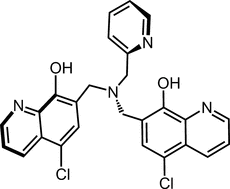
In the context given above, we reported quinolinol-based potentially fluorescent ligands, viz. 7-{[bis(pyridin-2-ylmethyl)amino]methyl}-5-chloroquinolin-8-ol (HClqdpa; its deprotonated anion, Clqdpa−) and 1,1-bis(5-chloro-8-hydroxyquinolin-7-yl)-1-(pyridin-2-yl)methane (Kubono et al., 2015; Kashiwagi et al., 2020). Of these ligands, HClqdpa contains Hq and bis(pyridin-2-ylmethyl)amine moieties, and it can form ZnII complexes with different Zn–ligand ratios, such as the mononuclear Zn–HClqdpa = 1:1 complex, ZnBr2(HClqdpa) (Kubono et al., 2022), the dinuclear Zn–Clqdpa− = 2:1 complex, Zn2Cl3(Clqdpa) (Kubono et al., 2024) and the dinuclear Zn–Clqdpa− = 2:2 complex, [Zn2(Clqdpa)2](ClO4)2 (Kubono et al., 2026). In the crystalline state, Zn2Cl3(Clqdpa) and [Zn2(Clqdpa)2](ClO4)2 exhibit fluorescence, whereas ZnBr2(HClqdpa) is non-fluorescent. In contrast, all three complexes exhibit fluorescence in solution with polar solvents such as methanol, acetone or acetonitrile. Compounds with two Hq moieties are expected to form a wider variety of polynuclear complexes compared to HClqdpa. Herein, we present the molecular and crystal structures and Hirshfeld surface analysis of such a compound, namely, the title compound, 7,7′-{[(pyridin-2-ylmethyl)azanediyl]bis(methylene)}bis(5-chloroquinolin-8-ol).
2. Structural commentary
The title compound is a tripodal molecule possessing two Hq moieties, one pyridine moiety and a tertiary amino group; its molecular structure is shown in Fig. 1. The quinoline rings are almost planar, with r.m.s. deviations of 0.006 (1) Å for N5/C9–C17 and 0.002 (1) Å for N6/C18–C26. There are two intramolecular O—H⋯N hydrogen bonds involving the hydroxy groups and N atoms of Hq moieties (O3—H3⋯N5 and O4—H4⋯N6), generating S(5) ring motifs (Table 1). The N(tertiary amine)—C—C—C(bonded to an OH group) torsion angles N8—C32—C10—C9 and N8—C33—C19—C18 are 146.40 (12) and −170.06 (11)°, respectively. The N(pyridine)—C—C—N(tertiary amine) torsion angle N7—C27—C34—N8 is −102.50 (14)° and the C—N(tertiary amine)—C angles C32—N8—C34, C33—N8—C32 and C33—N8—C34 are 113.45 (10), 112.30 (10) and 112.11 (10)°, respectively. The quinoline rings are almost parallel to one another and have an interplanar dihedral angle of 2.04 (4)°, whereas the dihedral angle between the planes of a quinoline ring and a pyridine ring is 37.44 (6)° for N5/C9–C17 and 39.46 (6)° for N6/C18–C26.
|
 ; (ii)
 ; (iii)
 .
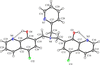 | Figure 1 The molecular structure of the title compound with the atom labelling. Displacement ellipsoids are drawn at the 50% probability level. H atoms are represented by spheres of arbitrary radius and the intramolecular O—H⋯N hydrogen bonds are shown as dashed lines. |
3. Supramolecular features
In the crystal, two molecules are linked by pairwise intermolecular C—H⋯Cl hydrogen bonds (C34—H34A⋯Cl1iii; the symmetry code refers to Table 1), forming an inversion dimer with an R22(16) ring motif (Fig. 2). A supramolecular chain structure is formed by intermolecular O—H⋯N hydrogen bonds (O3—H3⋯N6i and O4—H4⋯N5ii; the symmetry codes refer to Table 1) along the b-axis direction. The two intermolecular hydrogen bonds originate from the same hydroxy groups as the intramolecular interactions, so these the hydrogen bonds are bifurcated (Fig. 3). The N atoms of the pyridine ring and of the tertiary amino group are not involved in hydrogen-bonding interactions. The molecules are linked by the two types of hydrogen bonds, generating a sheet structure extending parallel to (10 ) (Fig. 4).
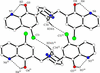 | Figure 2 Formation of a centrosymmetric dimer by C—H⋯Cl hydrogen bonds. The intramolecular O—H⋯N and intermolecular C—H⋯Cl hydrogen bonds are shown as dashed lines. H atoms not involved in the interactions have been omitted for clarity. (The symmetry code refers to Table 1 .) |
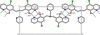 | Figure 3 A packing diagram of the title compound viewed along the a axis, showing the formation of a supramolecular chain structure. The intermolecular and intramolecular O—H⋯N hydrogen bonds are shown as dashed lines. H atoms not involved in the interactions have been omitted for clarity. (The symmetry codes refer to Table 1 .) |
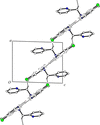 | Figure 4 A portion of the crystal packing of the title compound, viewed along the b axis, showing the hydrogen-bonded sheet structure, with intermolecular O—H⋯N and C—H⋯Cl hydrogen bonds shown as dashed lines. H atoms not involved in the interactions have been omitted for clarity. |
4. Hirshfeld surface analysis
A Hirshfeld surface (HS) analysis (Spackman & Jayatilaka, 2009) was carried out using CrystalExplorer (Spackman et al., 2021) to visualize the intermolecular interactions and contacts in the crystal of the title compound. In the HS plotted over dnorm (Fig. 5), the contact distances equal, shorter and longer than the sum of van der Waals radii are shown by white, red and blue colours, respectively. The percentage contributions of the intermolecular interactions to the total HS were quantified by two-dimensional fingerprint plots (McKinnon et al., 2007). The fingerprint plots of di versus de shown in Fig. 6 reveal that the most significant contributions arise from H⋯H (40.0%), C⋯H/H⋯C (15.6%) and Cl⋯H/H⋯Cl (15.4%) contacts. Smaller contributions are observed for H⋯N/N⋯H (7.2%), C⋯C (6.1%), O⋯H/H⋯O (4.3%), Cl⋯C/C⋯Cl (4.3%), N⋯C/C⋯N (2.9%), O⋯C/C⋯O (2.7%), Cl⋯N/N⋯Cl (0.9%) and N⋯N (0.5%) interactions.
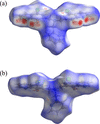 | Figure 5 Hirshfeld surface mapped over dnorm for the title compoud, showing (a) a front view and (b) a back view. |
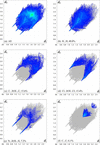 | Figure 6 Two-dimensional fingerprint plots for the title compound, showing (a) all interactions, and delineated into (b) H⋯H, (c) C⋯H/H⋯C, (d) Cl⋯H/H⋯Cl, (e) N⋯H/H⋯N and (f) C⋯C interactions. The di and de values are the closest internal and external distances (in Å) from given points on the Hirshfeld surface. |
5. Database survey
A search of the Cambridge Structural Database (CSD; update of February 2026; Groom et al., 2016) using ConQuest (Bruno et al., 2002) for compounds containing the Hq moiety gave 796 hits. A search for the fragment 7-(aminomethyl)quinolin-8-olate gave 50 hits of which 25 structures are ligands without metal ions, and the remaining 25 structures are metal complexes. Of the 25 ligand structures, 18 stuctures contain a hydroxy group in the Hq moiety, and only one of the 18 structures comprises two Hq moieties and is an azacrown compound (CSD refcode RELNUR; Bordunov et al., 1996). Another of the 18 structures is that of the compound HClqdpa (RUTSIK; Kubono et al., 2015), which is closely related to the title compound. In contrast to the latter, the molecular structure of HClqdpa exhibits an intramolecular O—H⋯N hydrogen bond between the H atom of hydroxy group in the Hq moiety and an N atom of a pyridine ring, generating an S(9) ring motif. Of the remaining seven ligand structures, six structures are quinolin-8-olate esters, and one structure is a zwitterion of Hq. Of the 25 metal complex structures, two structures are catena complexes and 15 are mononuclear complexes, with one of the latter being a Zn–HClqdpa = 1:1 complex, ZnBr2(HClqdpa) (VAXNUH; Kubono et al., 2022). Of the remaining eight metal complexes, six structures are dinuclear ZnII complexes; these include a Zn–Clqdpa− = 2:1 complex, Zn2Cl3(Clqdpa) (PUCTOA; Kubono et al., 2024), and a Zn–Clqdpa− = 2:2 complex acetonitrile clathrate, [Zn2(Clqdpa)2](ClO4)2·CH3CN (IRURAS; Kubono et al., 2026). Of the remaining two complexes, one is trinuclear CuII complex (CIFDEB; Aragoni et al., 2007) and the other is a tetranulear CuII complex (LIJZOV; Bencini et al., 2013). A crystal structure containing an Hq–CH2–N–CH2–Hq fragment like in the title compound has not yet been reported.
6. Synthesis and crystallization
A suspension of paraformaldehyde (0.36 g, 12 mmol), 2-picolyamine (0.504 g, 5 mmol) and 5-chloroquinolin-8-ol (1.80 g, 10 mmol) in 120 ml of methanol was heated for 48 h at 333 K. The solvent was removed in vacuo to give an oily product, which was precipitated by addition of diethyl ether. The crude solid was recrystallized from methanol/diethyl ether solution to obtain colourless crystals of the title compound (yield 11%, m.p. 429.7–431.5 K). 1H NMR (CDCl3, 400 MHz): δ 3.96 (s, 2H), 4.02 (s, 4H), 7.19–7.22 (m, 1H), 7.40 (d, J = 7.6 Hz, 1H), 7.49 (dd, J = 8.4, 4.2 Hz, 2H), 7.51 (s, 2H), 7.65–7.69 (m, 1H), 8.43 (dd, J = 8.4, 1.4 Hz, 2H), 8.67 (d, J = 4.8 Hz, 1H), 8.87 (dd, J = 4.2, 1.4 Hz, 2H).
7. Refinement
Crystal data, data collection and structure details are summarized in Table 2. The hydroxy H atoms were located in a difference Fourier map and refined freely. All H atoms bound to C atoms were positioned geometrically and refined using a riding model, with C—H = 0.95–0.99 Å and Uiso(H) = 1.2Ueq(C).
|
Supporting information
CCDC reference: 2604049
contains datablock I. DOI: https://doi.org/10.1107/S2056989026012065/wm5822sup1.cif
Structure factors: contains datablock I. DOI: https://doi.org/10.1107/S2056989026012065/wm5822Isup2.hkl
Supporting information file. DOI: https://doi.org/10.1107/S2056989026012065/wm5822Isup3.cml
| C26H20Cl2N4O2 | F(000) = 1016 |
| Mr = 491.36 | Dx = 1.504 Mg m−3 |
| Monoclinic, P21/c | Cu Kα radiation, λ = 1.54184 Å |
| a = 8.6388 (1) Å | Cell parameters from 10576 reflections |
| b = 23.6574 (3) Å | θ = 3.7–76.3° |
| c = 10.6210 (1) Å | µ = 2.97 mm−1 |
| β = 91.706 (1)° | T = 100 K |
| V = 2169.67 (4) Å3 | Block, colourless |
| Z = 4 | 0.29 × 0.08 × 0.03 mm |
| Rigaku XtaLAB Synergy Dualflex diffractometer with a HyPix detector | 4344 independent reflections |
| Radiation source: micro-focus sealed X-ray tube, PhotonJet (Cu) X-ray Source | 3986 reflections with I > 2σ(I) |
| Mirror monochromator | Rint = 0.031 |
| Detector resolution: 10.0000 pixels mm-1 | θmax = 76.6°, θmin = 3.7° |
| ω scans | h = −10→10 |
| Absorption correction: multi-scan (CrysAlis PRO; Rigaku OD, 2023) | k = −28→29 |
| Tmin = 0.825, Tmax = 1.000 | l = −13→10 |
| 15927 measured reflections |
| Refinement on F2 | Primary atom site location: dual |
| Least-squares matrix: full | Hydrogen site location: mixed |
| R[F2 > 2σ(F2)] = 0.030 | H atoms treated by a mixture of independent and constrained refinement |
| wR(F2) = 0.087 | w = 1/[σ2(Fo2) + (0.0482P)2 + 0.6088P] where P = (Fo2 + 2Fc2)/3 |
| S = 1.07 | (Δ/σ)max = 0.001 |
| 4344 reflections | Δρmax = 0.30 e Å−3 |
| 315 parameters | Δρmin = −0.28 e Å−3 |
| 0 restraints |
Geometry. All esds (except the esd in the dihedral angle between two l.s. planes) are estimated using the full covariance matrix. The cell esds are taken into account individually in the estimation of esds in distances, angles and torsion angles; correlations between esds in cell parameters are only used when they are defined by crystal symmetry. An approximate (isotropic) treatment of cell esds is used for estimating esds involving l.s. planes. |
| x | y | z | Uiso*/Ueq | ||
| Cl1 | 0.07026 (4) | 0.62698 (2) | 0.28385 (3) | 0.02009 (10) | |
| Cl2 | 0.04938 (4) | 0.35874 (2) | 0.29830 (3) | 0.02006 (10) | |
| O3 | 0.47394 (11) | 0.65359 (4) | 0.73661 (9) | 0.0193 (2) | |
| H3 | 0.478 (3) | 0.6866 (11) | 0.751 (2) | 0.052 (7)* | |
| O4 | 0.48319 (11) | 0.33157 (4) | 0.73117 (9) | 0.0176 (2) | |
| H4 | 0.501 (3) | 0.2986 (10) | 0.7417 (19) | 0.044 (6)* | |
| N5 | 0.35276 (13) | 0.74843 (5) | 0.62451 (10) | 0.0169 (2) | |
| N8 | 0.31763 (13) | 0.49382 (4) | 0.63780 (11) | 0.0155 (2) | |
| N6 | 0.37967 (13) | 0.23619 (5) | 0.60722 (10) | 0.0168 (2) | |
| N7 | 0.15964 (14) | 0.45263 (5) | 0.91091 (11) | 0.0229 (3) | |
| C9 | 0.37995 (15) | 0.64805 (5) | 0.63336 (12) | 0.0150 (3) | |
| C17 | 0.31562 (15) | 0.69706 (5) | 0.57323 (12) | 0.0150 (3) | |
| C16 | 0.29263 (16) | 0.79372 (6) | 0.56996 (13) | 0.0206 (3) | |
| H16 | 0.317608 | 0.829544 | 0.605500 | 0.025* | |
| C15 | 0.19367 (17) | 0.79234 (6) | 0.46228 (13) | 0.0221 (3) | |
| H15 | 0.152689 | 0.826338 | 0.427318 | 0.027* | |
| C14 | 0.15755 (16) | 0.74135 (6) | 0.40893 (13) | 0.0197 (3) | |
| H14 | 0.092357 | 0.739498 | 0.335416 | 0.024* | |
| C13 | 0.21797 (15) | 0.69136 (6) | 0.46400 (12) | 0.0161 (3) | |
| C12 | 0.18772 (15) | 0.63600 (6) | 0.41852 (12) | 0.0164 (3) | |
| C11 | 0.24910 (15) | 0.58974 (6) | 0.47778 (12) | 0.0166 (3) | |
| H11 | 0.225318 | 0.553192 | 0.445582 | 0.020* | |
| C10 | 0.34769 (14) | 0.59482 (5) | 0.58641 (12) | 0.0152 (3) | |
| C32 | 0.42195 (15) | 0.54261 (5) | 0.64432 (12) | 0.0159 (3) | |
| H32A | 0.517729 | 0.533627 | 0.599484 | 0.019* | |
| H32B | 0.451059 | 0.550377 | 0.733507 | 0.019* | |
| C18 | 0.37971 (14) | 0.33659 (5) | 0.63364 (11) | 0.0147 (3) | |
| C26 | 0.32646 (15) | 0.28790 (5) | 0.56690 (12) | 0.0149 (3) | |
| C25 | 0.33229 (16) | 0.19127 (6) | 0.54381 (13) | 0.0202 (3) | |
| H25 | 0.369287 | 0.155360 | 0.571115 | 0.024* | |
| C24 | 0.22986 (16) | 0.19316 (6) | 0.43768 (13) | 0.0201 (3) | |
| H24 | 0.199022 | 0.159386 | 0.395561 | 0.024* | |
| C23 | 0.17619 (15) | 0.24426 (6) | 0.39693 (12) | 0.0184 (3) | |
| H23 | 0.107461 | 0.246448 | 0.325589 | 0.022* | |
| C22 | 0.22304 (14) | 0.29418 (6) | 0.46112 (12) | 0.0155 (3) | |
| C21 | 0.17602 (15) | 0.34958 (6) | 0.42809 (12) | 0.0160 (3) | |
| C20 | 0.22712 (15) | 0.39587 (5) | 0.49410 (12) | 0.0158 (3) | |
| H20 | 0.192449 | 0.432446 | 0.469409 | 0.019* | |
| C19 | 0.33086 (14) | 0.39000 (5) | 0.59859 (12) | 0.0149 (3) | |
| C33 | 0.39747 (15) | 0.44078 (5) | 0.66884 (12) | 0.0161 (3) | |
| H33A | 0.391454 | 0.433928 | 0.760515 | 0.019* | |
| H33B | 0.508195 | 0.444687 | 0.648964 | 0.019* | |
| C31 | 0.17818 (19) | 0.45064 (6) | 1.03634 (14) | 0.0275 (3) | |
| H31 | 0.148197 | 0.416988 | 1.077902 | 0.033* | |
| C30 | 0.2379 (2) | 0.49411 (7) | 1.10939 (15) | 0.0319 (4) | |
| H30 | 0.248406 | 0.490490 | 1.198317 | 0.038* | |
| C29 | 0.2820 (2) | 0.54326 (7) | 1.04912 (15) | 0.0336 (4) | |
| H29 | 0.326388 | 0.573774 | 1.095767 | 0.040* | |
| C28 | 0.26013 (19) | 0.54709 (6) | 0.91951 (14) | 0.0275 (3) | |
| H28 | 0.286291 | 0.580816 | 0.876508 | 0.033* | |
| C27 | 0.19926 (16) | 0.50086 (6) | 0.85279 (14) | 0.0194 (3) | |
| C34 | 0.17597 (16) | 0.50134 (6) | 0.71084 (13) | 0.0184 (3) | |
| H34A | 0.102144 | 0.470897 | 0.686968 | 0.022* | |
| H34B | 0.127431 | 0.537725 | 0.685943 | 0.022* |
| U11 | U22 | U33 | U12 | U13 | U23 | |
| Cl1 | 0.02415 (17) | 0.01778 (18) | 0.01801 (17) | −0.00480 (12) | −0.00494 (12) | 0.00060 (11) |
| Cl2 | 0.02456 (17) | 0.01686 (18) | 0.01837 (17) | 0.00323 (12) | −0.00578 (12) | 0.00063 (11) |
| O3 | 0.0250 (5) | 0.0100 (5) | 0.0223 (5) | −0.0007 (4) | −0.0080 (4) | −0.0009 (4) |
| O4 | 0.0214 (5) | 0.0092 (5) | 0.0218 (5) | 0.0009 (4) | −0.0062 (4) | 0.0010 (4) |
| N5 | 0.0197 (5) | 0.0107 (5) | 0.0202 (5) | −0.0005 (4) | −0.0009 (4) | −0.0006 (4) |
| N8 | 0.0166 (5) | 0.0070 (5) | 0.0229 (6) | −0.0006 (4) | −0.0004 (4) | 0.0003 (4) |
| N6 | 0.0197 (5) | 0.0100 (5) | 0.0205 (5) | 0.0008 (4) | −0.0013 (4) | 0.0004 (4) |
| N7 | 0.0251 (6) | 0.0165 (6) | 0.0272 (6) | 0.0012 (5) | 0.0032 (5) | 0.0048 (5) |
| C9 | 0.0161 (6) | 0.0124 (6) | 0.0165 (6) | −0.0012 (5) | 0.0008 (5) | −0.0002 (5) |
| C17 | 0.0158 (6) | 0.0120 (6) | 0.0174 (6) | −0.0010 (5) | 0.0018 (5) | −0.0001 (5) |
| C16 | 0.0245 (7) | 0.0108 (6) | 0.0265 (7) | 0.0004 (5) | −0.0019 (5) | −0.0012 (5) |
| C15 | 0.0246 (7) | 0.0130 (7) | 0.0285 (7) | 0.0020 (5) | −0.0050 (5) | 0.0041 (5) |
| C14 | 0.0218 (6) | 0.0161 (7) | 0.0209 (6) | −0.0003 (5) | −0.0035 (5) | 0.0031 (5) |
| C13 | 0.0163 (6) | 0.0137 (6) | 0.0183 (6) | −0.0011 (5) | 0.0016 (5) | 0.0015 (5) |
| C12 | 0.0172 (6) | 0.0163 (6) | 0.0155 (6) | −0.0024 (5) | −0.0014 (5) | 0.0002 (5) |
| C11 | 0.0187 (6) | 0.0124 (6) | 0.0188 (6) | −0.0035 (5) | 0.0015 (5) | −0.0020 (5) |
| C10 | 0.0163 (6) | 0.0106 (6) | 0.0188 (6) | −0.0006 (5) | 0.0019 (5) | 0.0007 (5) |
| C32 | 0.0176 (6) | 0.0097 (6) | 0.0203 (6) | −0.0017 (5) | −0.0005 (5) | −0.0002 (5) |
| C18 | 0.0157 (6) | 0.0122 (6) | 0.0162 (6) | −0.0002 (5) | 0.0006 (5) | 0.0008 (5) |
| C26 | 0.0167 (6) | 0.0100 (6) | 0.0179 (6) | 0.0004 (5) | 0.0019 (5) | 0.0014 (5) |
| C25 | 0.0241 (7) | 0.0103 (6) | 0.0259 (7) | 0.0014 (5) | −0.0023 (5) | 0.0004 (5) |
| C24 | 0.0237 (7) | 0.0130 (6) | 0.0234 (7) | −0.0010 (5) | −0.0024 (5) | −0.0038 (5) |
| C23 | 0.0201 (6) | 0.0153 (7) | 0.0198 (6) | 0.0000 (5) | −0.0017 (5) | −0.0013 (5) |
| C22 | 0.0153 (6) | 0.0138 (6) | 0.0175 (6) | 0.0002 (5) | 0.0021 (5) | −0.0002 (5) |
| C21 | 0.0165 (6) | 0.0164 (6) | 0.0153 (6) | 0.0014 (5) | −0.0008 (5) | 0.0011 (5) |
| C20 | 0.0181 (6) | 0.0108 (6) | 0.0185 (6) | 0.0021 (5) | 0.0015 (5) | 0.0027 (5) |
| C19 | 0.0161 (6) | 0.0108 (6) | 0.0179 (6) | −0.0004 (5) | 0.0023 (5) | 0.0000 (5) |
| C33 | 0.0193 (6) | 0.0089 (6) | 0.0200 (6) | 0.0013 (5) | −0.0022 (5) | 0.0001 (5) |
| C31 | 0.0342 (8) | 0.0202 (7) | 0.0285 (7) | 0.0053 (6) | 0.0057 (6) | 0.0063 (6) |
| C30 | 0.0424 (9) | 0.0289 (9) | 0.0247 (8) | 0.0089 (7) | 0.0054 (7) | −0.0020 (6) |
| C29 | 0.0458 (10) | 0.0225 (8) | 0.0329 (8) | 0.0002 (7) | 0.0061 (7) | −0.0107 (6) |
| C28 | 0.0365 (8) | 0.0147 (7) | 0.0318 (8) | 0.0009 (6) | 0.0086 (6) | −0.0026 (6) |
| C27 | 0.0183 (7) | 0.0138 (6) | 0.0265 (7) | 0.0036 (5) | 0.0042 (5) | 0.0013 (5) |
| C34 | 0.0171 (6) | 0.0119 (6) | 0.0262 (7) | 0.0009 (5) | 0.0008 (5) | 0.0031 (5) |
| Cl1—C12 | 1.7420 (13) | C32—H32A | 0.9900 |
| Cl2—C21 | 1.7476 (13) | C32—H32B | 0.9900 |
| O3—H3 | 0.80 (3) | C18—C26 | 1.4217 (17) |
| O3—C9 | 1.3512 (16) | C18—C19 | 1.3798 (18) |
| O4—H4 | 0.80 (2) | C26—C22 | 1.4222 (18) |
| O4—C18 | 1.3531 (15) | C25—H25 | 0.9500 |
| N5—C17 | 1.3659 (17) | C25—C24 | 1.4128 (19) |
| N5—C16 | 1.3175 (17) | C24—H24 | 0.9500 |
| N8—C32 | 1.4648 (16) | C24—C23 | 1.3607 (19) |
| N8—C33 | 1.4647 (16) | C23—H23 | 0.9500 |
| N8—C34 | 1.4791 (17) | C23—C22 | 1.4166 (18) |
| N6—C26 | 1.3712 (16) | C22—C21 | 1.4133 (18) |
| N6—C25 | 1.3167 (17) | C21—C20 | 1.3665 (18) |
| N7—C31 | 1.3378 (19) | C20—H20 | 0.9500 |
| N7—C27 | 1.3464 (18) | C20—C19 | 1.4124 (18) |
| C9—C17 | 1.4283 (18) | C19—C33 | 1.5184 (17) |
| C9—C10 | 1.3800 (18) | C33—H33A | 0.9900 |
| C17—C13 | 1.4204 (18) | C33—H33B | 0.9900 |
| C16—H16 | 0.9500 | C31—H31 | 0.9500 |
| C16—C15 | 1.4077 (19) | C31—C30 | 1.379 (2) |
| C15—H15 | 0.9500 | C30—H30 | 0.9500 |
| C15—C14 | 1.365 (2) | C30—C29 | 1.386 (2) |
| C14—H14 | 0.9500 | C29—H29 | 0.9500 |
| C14—C13 | 1.4125 (18) | C29—C28 | 1.387 (2) |
| C13—C12 | 1.4174 (18) | C28—H28 | 0.9500 |
| C12—C11 | 1.3621 (19) | C28—C27 | 1.397 (2) |
| C11—H11 | 0.9500 | C27—C34 | 1.515 (2) |
| C11—C10 | 1.4187 (18) | C34—H34A | 0.9900 |
| C10—C32 | 1.5138 (17) | C34—H34B | 0.9900 |
| C9—O3—H3 | 105.9 (17) | N6—C25—C24 | 124.08 (12) |
| C18—O4—H4 | 108.0 (16) | C24—C25—H25 | 118.0 |
| C16—N5—C17 | 117.60 (11) | C25—C24—H24 | 120.6 |
| C32—N8—C34 | 113.45 (10) | C23—C24—C25 | 118.77 (12) |
| C33—N8—C32 | 112.30 (10) | C23—C24—H24 | 120.6 |
| C33—N8—C34 | 112.11 (10) | C24—C23—H23 | 120.1 |
| C25—N6—C26 | 117.65 (11) | C24—C23—C22 | 119.85 (12) |
| C31—N7—C27 | 117.51 (13) | C22—C23—H23 | 120.1 |
| O3—C9—C17 | 120.04 (11) | C23—C22—C26 | 117.19 (12) |
| O3—C9—C10 | 119.46 (12) | C21—C22—C26 | 117.51 (12) |
| C10—C9—C17 | 120.50 (12) | C21—C22—C23 | 125.29 (12) |
| N5—C17—C9 | 117.40 (11) | C22—C21—Cl2 | 118.64 (10) |
| N5—C17—C13 | 122.48 (12) | C20—C21—Cl2 | 119.37 (10) |
| C13—C17—C9 | 120.12 (12) | C20—C21—C22 | 121.99 (12) |
| N5—C16—H16 | 118.0 | C21—C20—H20 | 119.6 |
| N5—C16—C15 | 124.08 (12) | C21—C20—C19 | 120.80 (12) |
| C15—C16—H16 | 118.0 | C19—C20—H20 | 119.6 |
| C16—C15—H15 | 120.5 | C18—C19—C20 | 118.94 (12) |
| C14—C15—C16 | 118.93 (12) | C18—C19—C33 | 118.92 (11) |
| C14—C15—H15 | 120.5 | C20—C19—C33 | 122.05 (11) |
| C15—C14—H14 | 120.3 | N8—C33—C19 | 113.46 (10) |
| C15—C14—C13 | 119.40 (12) | N8—C33—H33A | 108.9 |
| C13—C14—H14 | 120.3 | N8—C33—H33B | 108.9 |
| C14—C13—C17 | 117.50 (12) | C19—C33—H33A | 108.9 |
| C14—C13—C12 | 124.77 (12) | C19—C33—H33B | 108.9 |
| C12—C13—C17 | 117.72 (12) | H33A—C33—H33B | 107.7 |
| C13—C12—Cl1 | 119.34 (10) | N7—C31—H31 | 117.8 |
| C11—C12—Cl1 | 119.35 (10) | N7—C31—C30 | 124.44 (14) |
| C11—C12—C13 | 121.31 (12) | C30—C31—H31 | 117.8 |
| C12—C11—H11 | 119.2 | C31—C30—H30 | 121.0 |
| C12—C11—C10 | 121.59 (12) | C31—C30—C29 | 117.97 (15) |
| C10—C11—H11 | 119.2 | C29—C30—H30 | 121.0 |
| C9—C10—C11 | 118.76 (12) | C30—C29—H29 | 120.6 |
| C9—C10—C32 | 121.28 (11) | C30—C29—C28 | 118.82 (15) |
| C11—C10—C32 | 119.88 (11) | C28—C29—H29 | 120.6 |
| N8—C32—C10 | 111.78 (10) | C29—C28—H28 | 120.3 |
| N8—C32—H32A | 109.3 | C29—C28—C27 | 119.36 (14) |
| N8—C32—H32B | 109.3 | C27—C28—H28 | 120.3 |
| C10—C32—H32A | 109.3 | N7—C27—C28 | 121.85 (14) |
| C10—C32—H32B | 109.3 | N7—C27—C34 | 115.75 (12) |
| H32A—C32—H32B | 107.9 | C28—C27—C34 | 122.39 (12) |
| O4—C18—C26 | 120.48 (11) | N8—C34—C27 | 115.70 (11) |
| O4—C18—C19 | 118.47 (11) | N8—C34—H34A | 108.4 |
| C19—C18—C26 | 121.03 (12) | N8—C34—H34B | 108.4 |
| N6—C26—C18 | 117.82 (11) | C27—C34—H34A | 108.4 |
| N6—C26—C22 | 122.46 (11) | C27—C34—H34B | 108.4 |
| C18—C26—C22 | 119.72 (11) | H34A—C34—H34B | 107.4 |
| N6—C25—H25 | 118.0 | ||
| Cl1—C12—C11—C10 | 178.85 (10) | C10—C9—C17—N5 | −179.81 (11) |
| Cl2—C21—C20—C19 | −179.29 (9) | C10—C9—C17—C13 | −0.20 (18) |
| O3—C9—C17—N5 | −0.20 (18) | C32—N8—C33—C19 | −147.94 (11) |
| O3—C9—C17—C13 | 179.41 (11) | C32—N8—C34—C27 | −70.42 (14) |
| O3—C9—C10—C11 | −179.85 (11) | C18—C26—C22—C23 | 178.85 (11) |
| O3—C9—C10—C32 | −3.14 (18) | C18—C26—C22—C21 | −0.80 (18) |
| O4—C18—C26—N6 | 1.97 (18) | C18—C19—C33—N8 | −170.06 (11) |
| O4—C18—C26—C22 | −177.20 (11) | C26—N6—C25—C24 | −0.3 (2) |
| O4—C18—C19—C20 | 177.77 (11) | C26—C18—C19—C20 | −0.42 (18) |
| O4—C18—C19—C33 | 1.26 (17) | C26—C18—C19—C33 | −176.94 (11) |
| N5—C17—C13—C14 | −0.56 (19) | C26—C22—C21—Cl2 | 179.83 (9) |
| N5—C17—C13—C12 | 179.70 (11) | C26—C22—C21—C20 | 0.14 (19) |
| N5—C16—C15—C14 | −0.7 (2) | C25—N6—C26—C18 | −178.81 (12) |
| N6—C26—C22—C23 | −0.28 (18) | C25—N6—C26—C22 | 0.34 (18) |
| N6—C26—C22—C21 | −179.93 (11) | C25—C24—C23—C22 | −0.2 (2) |
| N6—C25—C24—C23 | 0.3 (2) | C24—C23—C22—C26 | 0.20 (19) |
| N7—C31—C30—C29 | −0.1 (3) | C24—C23—C22—C21 | 179.82 (13) |
| N7—C27—C34—N8 | −102.50 (14) | C23—C22—C21—Cl2 | 0.21 (18) |
| C9—C17—C13—C14 | 179.85 (12) | C23—C22—C21—C20 | −179.49 (12) |
| C9—C17—C13—C12 | 0.11 (18) | C22—C21—C20—C19 | 0.40 (19) |
| C9—C10—C32—N8 | 146.40 (12) | C21—C20—C19—C18 | −0.26 (19) |
| C17—N5—C16—C15 | −0.3 (2) | C21—C20—C19—C33 | 176.14 (12) |
| C17—C9—C10—C11 | −0.24 (18) | C20—C19—C33—N8 | 13.54 (17) |
| C17—C9—C10—C32 | 176.48 (11) | C19—C18—C26—N6 | −179.87 (11) |
| C17—C13—C12—Cl1 | −179.32 (9) | C19—C18—C26—C22 | 0.96 (18) |
| C17—C13—C12—C11 | 0.45 (19) | C33—N8—C32—C10 | 168.06 (10) |
| C16—N5—C17—C9 | −179.45 (12) | C33—N8—C34—C27 | 58.09 (14) |
| C16—N5—C17—C13 | 0.95 (19) | C31—N7—C27—C28 | 1.1 (2) |
| C16—C15—C14—C13 | 1.0 (2) | C31—N7—C27—C34 | −179.83 (13) |
| C15—C14—C13—C17 | −0.47 (19) | C31—C30—C29—C28 | 1.8 (3) |
| C15—C14—C13—C12 | 179.26 (13) | C30—C29—C28—C27 | −2.1 (2) |
| C14—C13—C12—Cl1 | 0.96 (18) | C29—C28—C27—N7 | 0.6 (2) |
| C14—C13—C12—C11 | −179.27 (13) | C29—C28—C27—C34 | −178.39 (14) |
| C13—C12—C11—C10 | −0.9 (2) | C28—C27—C34—N8 | 76.56 (17) |
| C12—C11—C10—C9 | 0.81 (19) | C27—N7—C31—C30 | −1.4 (2) |
| C12—C11—C10—C32 | −175.96 (12) | C34—N8—C32—C10 | −63.52 (14) |
| C11—C10—C32—N8 | −36.92 (16) | C34—N8—C33—C19 | 82.95 (13) |
| D—H···A | D—H | H···A | D···A | D—H···A |
| O3—H3···N5 | 0.80 (3) | 2.24 (2) | 2.7337 (15) | 121 (2) |
| O3—H3···N6i | 0.80 (3) | 2.25 (2) | 2.8362 (15) | 131 (2) |
| O4—H4···N6 | 0.80 (2) | 2.29 (2) | 2.7485 (15) | 117 (2) |
| O4—H4···N5ii | 0.80 (2) | 2.22 (2) | 2.8456 (15) | 136 (2) |
| C34—H34A···Cl1iii | 0.99 | 2.78 | 3.7082 (15) | 157 |
| Symmetry codes: (i) −x+1, y+1/2, −z+3/2; (ii) −x+1, y−1/2, −z+3/2; (iii) −x, −y+1, −z+1. |
Funding information
Funding for this research was provided by: JSPS KAKENHI (grant No. 26K08404).
References
 Aragoni, M. C., Arca, M., Bencini, A. J., Blake, A., Caltagirone, C., De Filippo, G., Devillanova, F. A., Garau, A., Gelbrich, T., Hursthouse, M. B., Isaia, F., Lippolis, V., Mameli, M., Mariani, P., Valtancoli, B. & Wilson, C. (2007). Inorg. Chem. 46, 4548–4559. CrossRef PubMed Google Scholar
Bencini, A., Caddeo, F., Caltagirone, C., Garau, A., Hurstouse, M. B., Isaia, F., Lampis, S., Lippolis, V., Lopez, F., Meli, V., Monduzzi, M., Mostallino, M. C., Murgia, S., Puccioni, S., Schmidt, J., Secci, P. P. & Talmon, Y. (2013). Org. Biomol. Chem. 11, 7751–7759. CrossRef PubMed Google Scholar
Bordunov, A. V., Bradshaw, J. S., Zhang, X. X., Dalley, N. K., Kou, X. & Izatt, R. M. (1996). Inorg. Chem. 35, 7229–7240. CrossRef PubMed CAS Web of Science Google Scholar
Bruno, I. J., Cole, J. C., Edgington, P. R., Kessler, M., Macrae, C. F., McCabe, P., Pearson, J. & Taylor, R. (2002). Acta Cryst. B58, 389–397. Web of Science CrossRef CAS IUCr Journals Google Scholar
Dolomanov, O. V., Bourhis, L. J., Gildea, R. J., Howard, J. A. K. & Puschmann, H. (2009). J. Appl. Cryst. 42, 339–341. Web of Science CrossRef CAS IUCr Journals Google Scholar
D'Souza, F., Maligaspe, E., Zandler, M. E., Subbaiyan, N. K., Ohkubo, K. & Fukuzumi, S. (2008). J. Am. Chem. Soc. 130, 16959–16967. PubMed Google Scholar
Groom, C. R., Bruno, I. J., Lightfoot, M. P. & Ward, S. C. (2016). Acta Cryst. B72, 171–179. Web of Science CrossRef IUCr Journals Google Scholar
Huang, X.-M., Xu, Y., Qin, S.-M., Tan, M.-X., Qin, Q.-P., Shao, T.-M. & Liang, H. (2026). J. Inorg. Biochem. 274, 113055. CrossRef PubMed Google Scholar
Kashiwagi, Y., Kubono, K. & Tamai, T. (2020). Acta Cryst. E76, 1271–1274. Web of Science CSD CrossRef IUCr Journals Google Scholar
Kubono, K., Kado, K., Kashiwagi, Y., Tani, K. & Yokoi, K. (2015). Acta Cryst. E71, 1545–1547. CSD CrossRef IUCr Journals Google Scholar
Kubono, K., Kashiwagi, Y., Tani, K. & Yokoi, K. (2022). Acta Cryst. E78, 326–329. Web of Science CSD CrossRef IUCr Journals Google Scholar
Kubono, K., Tanaka, K., Tani, K. & Kashiwagi, Y. (2024). Acta Cryst. E80, 1175–1179. Web of Science CSD CrossRef IUCr Journals Google Scholar
Kubono, K., Tani, K. & Kashiwagi, Y. (2026). Acta Cryst. E82, 5–9. CrossRef IUCr Journals Google Scholar
Li, S., Wen, H., Yuan, N., Xie, P., Qin, J. & Wang, Z. (2020). RSC Adv. 10, 32490–32496. Web of Science CSD CrossRef CAS PubMed Google Scholar
McKinnon, J. J., Jayatilaka, D. & Spackman, M. A. (2007). Chem. Commun. pp. 3814–3816. Web of Science CrossRef Google Scholar
Meghna, K. M., Kumar, M. M. A., Sarkar, S. & Biju, V. M. (2026). Anal. Methods 18, 372–388. CrossRef PubMed Google Scholar
Rahier, R., Noiriel, A. & Abousalham, A. (2016). Anal. Chem. 88, 666–674. CrossRef PubMed Google Scholar
Rigaku OD (2023). CrysAlis PRO. Rigaku Oxford Diffraction Ltd, Yarnton, England. Google Scholar
Sheldrick, G. M. (2015a). Acta Cryst. A71, 3–8. Web of Science CrossRef IUCr Journals Google Scholar
Sheldrick, G. M. (2015b). Acta Cryst. C71, 3–8. Web of Science CrossRef IUCr Journals Google Scholar
Spackman, M. A. & Jayatilaka, D. (2009). CrystEngComm 11, 19–32. Web of Science CrossRef CAS Google Scholar
Spackman, P. R., Turner, M. J., McKinnon, J. J., Wolff, S. K., Grimwood, D. J., Jayatilaka, D. & Spackman, M. A. (2021). J. Appl. Cryst. 54, 1006–1011. Web of Science CrossRef CAS IUCr Journals Google Scholar
Spek, A. L. (2020). Acta Cryst. E76, 1–11. Web of Science CrossRef IUCr Journals Google Scholar
Wiberley, S. E. & Bassett, L. G. (1949). Anal. Chem. 21, 609–612. CrossRef CAS Web of Science Google Scholar
Wu, M.-M., Wang, J.-Y., Sun, R., Zhao, C., Zhao, J.-P., Che, G.-B. & Liu, F.-C. (2017). Inorg. Chem. 56, 9555–9562. Web of Science CSD CrossRef CAS PubMed Google Scholar
Zou, H.-H., Meng, T., Chen, Q., Zhang, Y.-Q., Wang, H.-L., Li, B., Wang, K., Chen, Z.-L. & Liang, F. (2019). Inorg. Chem. 58, 2286–2298. CrossRef PubMed Google Scholar
This is an open-access article distributed under the terms of the Creative Commons Attribution (CC-BY) Licence, which permits unrestricted use, distribution, and reproduction in any medium, provided the original authors and source are cited.
| CRYSTALLOGRAPHIC COMMUNICATIONS |