


 journal menu


issue contents
June 2026 issue
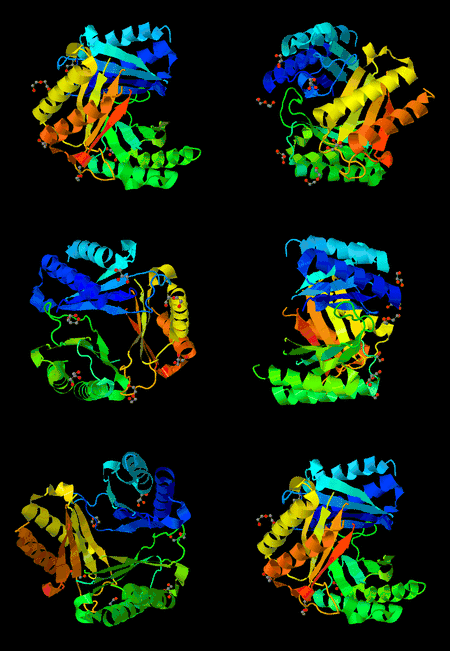
Cover illustration: Macrophage migration inhibitory factor (MIF) regulates both adaptive and innate immune responses and contributes to the pathogenesis of parasitic infections. The structure of MIF from Plasmodium vivax, a major cause of malaria globally, has been determined [Nair et al. (2026), Acta Cryst. F82, 194–200].
early career research


Open  access
access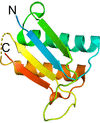
The production, crystallization and 1.8 Å resolution crystal structure of macrophage migratory inhibitory factor from P. vivax are reported.
PDB reference: P. vivax MIF, 9b0m
research communications
Open access
access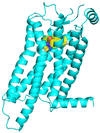
The crystal structure of the human orexin type 2 receptor–vornorexant complex (3.29 Å resolution) and orexin type 1 receptor docking revealed a conserved U-shaped binding conformation, explaining the high affinity and balanced dual antagonism of this dual orexin receptor antagonist. The structural data validate the rational design that incorporated a 1,3-oxazinan ring and pyrazole moiety to reduce lipophilicity while maintaining strong receptor affinity, highlighting the potential of vornorexant as an effective insomnia treatment with a lower risk of next-day residual effects.
Open access
access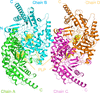
The crystal structure of A. thaliana γ-aminobutyric acid aminotransferase (GABA-T) reveals that plant GABA-T belongs to the class III aminotransferase family and employs a C-terminal arginine residue for γ-aminobutyric acid recognition, in contrast to the N-terminal arginine used by class II enzymes.
PDB reference: GABA aminotransferase from Arabidopsis thaliana, 21ft
Open access
access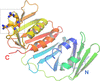
Crystal structures of A. pernix PCNA1 (1.60 Å resolution) and PCNA2 (2.17 Å resolution) are reported. High-resolution analysis reveals a rare nonproline cis-peptide bond in PCNA1 that may cause steric hindrance at the subunit interface, suggesting a distorted or symmetry-broken heterotrimeric PCNA ring.
Open access
access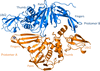
The ubiquitin-like domain 2 (Ubl2) of the SARS-CoV-2 virus is necessary for the stability and catalytic efficiency of its papain-like protease (PLpro). Our crystallographic study reveals that the Ubl2 domain exhibits notable flexibility and can adopt a conformation that places itself away from the PLpro catalytic domain, representing a new conformation from those reported so far for SARS-CoV-1 or SARS-CoV-2. The structural flexibility of Ubl2 could be allosterically related to the stability of the zinc-finger domain.
![[publBio]](/logos/publbio.gif)


