

 journal menu


teaching and education
 | JOURNAL OF APPLIED CRYSTALLOGRAPHY |
A more rational order for the 230 space groups

aDepartment of Physics, University of the Basque Country EHU/UPV, Bilbao, Spain, and bDepartment of Chemistry, University of Kentucky, Lexington, KY 40506-0055, USA
*Correspondence e-mail: [email protected], [email protected]
The order of the space groups in International Tables for Crystallography is full of inconsistencies, all of which can be traced back to the order Schoenflies published in 1891. The many inconsistencies obscure the relationships between the space groups and therefore make teaching about them more difficult. A more rational order based on a small number of principles has been developed. The order of the crystal systems and the order of the (i.e. the point groups) are unchanged; they have been considered carefully and revised in the past. What is new is that groups within are sorted first by (point group plus centering type of the conventional cell) and then by the number and type of symmetry elements for which the defining operations (1) have intrinsic translation parts (i.e. are screw axes or glide planes) and (2) appear in the full Hermann–Mauguin symbol of the While it seems unlikely that the new ordering will replace the current order, it is recommended that it be adopted as an alternative in space-group studies and in teaching of crystallographic symmetry.
Keywords: space-group order; International Tables for Crystallography; Schoenflies; Fedorov; Niggli.
1. Introduction
A list of the crystallographic space groups, such as that found in Vol. A of the series International Tables for Crystallography (1983 and thereafter; 6th edition 2016a,b) (referred to here as ITA), is essential to the study of crystals. The 230 space groups that describe periodic crystals can be built up in a systematic way from the crystallographic rotations and rotoinversions1 that are found in the crystallographic point groups, and from the combinations of those operations with translations. The relationships between the space groups, i.e. the sub- and relationships,2 are important, e.g., for the study of phase relationships and for teaching. Those relationships are, however, obscured in all existing tables (Table 1) by the somewhat illogical order of the groups.
| ||||||||||||||||||||||||||||||||||
A full list of IUCr editions, editors, and reprints (1952 and thereafter) can be found at https://www.iucr.org/resources/commissions/international-tables/editions.
1.1. Inconsistencies in the ordering of the space groups
Careful consideration of the space-group order in any published compilation reveals many inconsistencies in the way the 230 space groups are ordered. The following examples are found in all editions of ITA (1983 and thereafter) and in the previous series of International Tables (1935, 1952). In what follows the space groups are specified by a Hermann–Mauguin (hereafter, HM) symbol normally followed by the ITA number in parentheses. Point groups are always labeled with HM symbols; the Schoenflies symbols are usually given, in parentheses, as well.
Within a geometric crystal class (groups that correspond to the same point group), space groups with a primitive translation lattice (also known as primitive groups) usually precede those with a centered translation lattice (or centered groups) in the order P > C > A > F > I and P > R, where > means before. This sorting rule puts together groups in the same arithmetic crystal class (i.e. the same and centering type of the conventional e.g. C2/m, C2/c in class 2/mC; P3, P31, P32 in class 3P; I4/m, I41/a in class 4/mI). The order of the cubic 23 groups, however, is P23 (No. 195), F23, I23, P213, I213 (No. 199) (two centered groups before a primitive group). Similarly, in the cubic  3m groups the order is P3m (No. 215), F3m, I3m, P3n, F3c, I3d (No. 220). In the monoclinic 2/m groups, C2/m (No. 12) is before P2/c (No. 13) and P21/c (No. 14).
Within a groups that have more screw axes or glide planes in their symbols normally follow those that have fewer (e.g. P2/m before P21/m, P2/c and P21/c). Why then, is C222 (No. 21) after C2221 (No. 20), and why is Ima2 (No. 46) after Iba2 (No. 45)?
For space groups having a screw axis nk, n > 2, the ordering of the space groups by their k values is inconsistent; P31 (No. 144) is before P32 (No. 145) but P4132 (No. 213) is after P4332 (No. 212). In the hexagonal system the P6k groups (Nos. 169–173) are listed in the order k = 1, 5, 2, 4, 3, which pairs enantiomorphic groups like P61 and P65, but in the tetragonal system the P4k groups (No. 76–78) are listed in the order k = 1, 2, 3 so that the enantiomorphic groups P41 and P43 are not contiguous in the list.
For each of the five point groups 32 (D3), 3m (C3v),  2/m (D3d), 2m (D2d) and
  2m (D3h) there are two sets of space groups (i.e. two arithmetic crystal classes) that differ in the orientation of the twofold axes and/or the mirror-plane normals relative to the axes of the (which are the directions of the shortest translations). Sometimes the groups with the same orientation are contiguous and sometimes the two types of groups alternate.
Sometimes the change from a rotation axis to a screw axis takes precedence over a change from a mirror plane to a glide plane [e.g. P2/m (No. 10), P21/m (No. 11), P2/c (No. 13), P21/c (No. 14)] and other times that order is reversed [e.g. P6mm (No. 183), P6cc (No. 184), P63cm (No. 185), P63mc (No. 186)].
How can there be so many inconsistencies in a tabulation published by a scientific community that cares so much about order? A full list of the very large number of inconsistencies can be found in the Supplementary Commentary, which includes additional information related to other sections of this article. Section 1.4.1.6 of ITA 6 (2016) also summarizes problems with the current order. That section notes that it would be preferable to have an ordering in which space groups in the same arithmetic crystal class are grouped together.
1.2. Some history of the tabulations of space groups
Understanding the origin of the inconsistencies in the space-group order requires knowing something of the history of the space-group tabulations. For a very detailed summary of the history before 1900 see ch. 12 of André Authier's 2013 book Early Days of X-ray Crystallography. For a briefer summary see the 2023 paper by Kahr.
The first listing of space groups was of the 65 that, apart from translations, have only rotation and screw axes (Sohncke, 1879); these 65, now called Sohncke groups, are the only ones possible for ordered crystals of enantiopure substances. The difficulties of compiling a complete and correct list for even this limited set of symmetry groups are illustrated by the inclusion of a 66th group (Sohncke's No. 13), which corresponds to no 3D space group and is therefore an error rather than a duplicate. On the other hand, Sohncke recognized that I222 (No. 23) and I212121 (No. 24) differ, even though both have axes 2 and 21 in all three directions.
A set of hand-drawn diagrams showing the symmetry relationships in all the can be found at the end of Sohncke's 1879 book (Fig. 1). Those drawings attest to the effort involved in making the list. Assigning current space-group symbols to them makes clear the absence of a consistent order: for the orthorhombic groups (Sohncke's Nos. 5–14 less his No. 13) the order is P222, P2221, C222, F222, C2221, I222, I212121, P21212, P212121. The manual labor required to make such drawings would have been a strong deterrent to changing the order later.
![[Figure 1]](dv5030fig1thm.gif) | Figure 1 The first page of space-group drawings (Sohncke's groups Nos. 1–12) at the end of Sohncke's 1879 book. Each drawing has been marked in red with the ITA space-group symbol. Sohncke intended all circles drawn to be related by the elements of the symmetry group (including translations). He used shading to indicate height above the plane of the drawing. |
Fedorov (1891) [English translation Fedorov (1971), pp. 50–131] and Schoenflies (1891) were the first to publish complete lists of all 230 3D space groups. They worked independently, but corresponded when their lists were nearly complete, and they resolved several discrepancies. Any rivalry was muted; rather, they seem to have been pleased to have reached a consensus (Fedorov, 1892; Fedorov, 1971, pp. 132–176; Burckhardt, 1967; Burckhardt, 1971; Paufler & Filatov, 2020). In the end it was the list of Schoenflies that became the basis for future publications, perhaps because German was more widely understood than Russian and perhaps because his notation was more accessible.
The order of the geometric crystal classes (i.e. of the point groups, Fig. 2) is not the same in the Schoenflies and Fedorov lists (Fig. 3). Schoenflies put trigonal groups before tetragonal groups because of the higher order of the rotation axis in the latter. The Fedorov order, like the order in all editions of the three series of International Tables (1935, 1952, 1983), puts trigonal groups after tetragonal groups so that all the groups for which the lattice is hexagonal are together. Fedorov, however, interspersed groups with 6 and axes with groups having 3 and axes. The order of the point groups in ITI (1952) and ITA (1983 and thereafter) is different from that in all previous listings.
![[Figure 2]](dv5030fig2thm.gif) | Figure 2 The point groups in both Hermann–Mauguin and Schoenflies notation as classified in ITA [Table 3.2.1.4 in ITA 6 (2016 )]. The entries in the first row and first column give the sequence of the groups in ITA. The cells of the centrosymmetric groups are shaded. This table differs from Table 3.3.1 in ITI (1952) (see the Supplementary Commentary) in the placing of the centrosymmetric groups with n odd. If the ITA table were constructed in the same way as the ITI table the centrosymmetric groups with n odd would be moved one column to the right. |
![[Figure 3]](dv5030fig3thm.gif) | Figure 3 The ordering of the geometric crystal classes (i.e. the point-group classes) in different compilations of the space groups. The background color of the cell indicates the the symbols of the centrosymmetric groups are in boldface. For some groups the color shade is darker to highlight their different placement [e.g. in the orthorhombic system, Schoenflies, Niggli and the 1935 edition of International Tables put C2v before D2, while that order was reversed beginning with the first volume (1952) of the 2nd, or `red', series of International Tables.] |
Nearly 30 years after the Schoenflies and Fedorov tables appeared, Niggli (1919) published a new list. Niggli's ordering within the geometric crystal classes has many fewer inconsistencies than does that of Schoenflies.3 The ordering of the 2/m groups (Table 2) illustrates Niggli's revision. In his table of the 230 space groups, Niggli consistently sorted first on rotations versus screws, and then on mirrors versus glides. Centered groups followed primitive groups.
| ||||||||||||||||||||||||||
Niggli concluded, however, that it was too late to propose adoption of a new ordering.4 The editors of all future published space-group tables seem to have agreed; in all sets of tables the order of the space groups within the is the same as that given by Schoenflies in 1891.5
1.3. Comparing the Schoenflies ordering with that in International Tables
Schoenflies (1891) specified all groups using what is now known as Schoenflies notation, but he rendered the space-group symbols in the now-unfamiliar Fraktur hand. For each space group he gave the Fraktur version of the Schoenflies symbol of the point group plus a superscript showing the number of the space group within that point-group class. In his list of space groups having point group C2h (which he wrote as C2h), the fifth is  [now known as P21/c (No. 14)]. Niggli copied Schoenflies' symbols but made minor formatting changes; his symbol for that group is
  . It is inconvenient that Schoenflies used the Fraktur hand for the space-group symbols, but the number of different letters (C, V, D, S, T, O) is small so that the problem is easily overcome.
In order to compare Schoenflies' order with that of ITA it is necessary to change the entries in Schoenflies' 1891 book into recognizable space-group symbols. That task is not easy. Schoenflies' one table (pp. 555–556) gives only the number of groups in each arithmetic crystal class. More specific information about individual groups is spread out over six chapters (pp. 396–554). It is much easier to start with Niggli's tables (1919, pp. 125–131), in which he gives the Schoenflies symbol for each group along with the symmetries associated with each of the important axes. The linking of the symbols and the symmetries makes it possible to match the Schoenflies and HM symbols, although in some cases information in Niggli's text is also needed.
Part of the first page of Niggli's (1919) tables is shown in Fig. 4. Copies of Niggli's tables annotated with the HM symbols found in ITA 6 (2016) are given as a separate pdf file in the supplementary material. Those tables show that within the geometric crystal classes the order in ITA 6 is the same as the Schoenflies order, as is noted in Section 1.4.1.6 of ITA 6 (2016).
![[Figure 4]](dv5030fig4thm.gif) | Figure 4 Part of the first page of Niggli's (1919 ) tables. The first five geometric crystal classes are shown ( = 1, = 1,  = =  , ,  = m, = m,  = 2, = 2,  = 2/m, where the second symbol in each pair is the HM symbol). Horizontal lines separate the geometric crystal classes as well as the arithmetic crystal classes within each geometric crystal class. = 2/m, where the second symbol in each pair is the HM symbol). Horizontal lines separate the geometric crystal classes as well as the arithmetic crystal classes within each geometric crystal class. |
1.4. Order of the geometric crystal classes
The order of the point groups has varied (Fig. 3); it differed in the 1935 tables from that of Schoenflies, and was revised again for the first IUCr publication in 1952. It has not been changed since.
1.5. First use of Hermann–Mauguin symbols
HM symbols were introduced in IT35 (1935). When that volume was published the axial choices were standardized and a standard symbol for each space group was chosen. The HM symbols are more informative than the Schoenflies symbols. Some of the HM symbols have been changed since 1935, but in most cases the choices of axes have not.
1.6. Comments
It seems likely that the inconsistencies in Schoenflies' 1891 ordering of the space groups are a consequence of the enormity of the task of making a complete and correct list of the groups at a time when all work was done by hand and all sorting was done with pieces of paper. The ordering inconsistencies in Sohncke's much shorter list support that idea, although Fedorov's ordering is largely self-consistent. After Schoenflies and Fedorov had finally agreed on the number and descriptions of the 230 groups, they might well have wanted to move on to other projects.6
Trying to make any change now to the space-group numbers would be met with considerable resistance. The current space-group numbers are embedded in many software packages, in many publications and in many crystallographers' minds. Any more rational order would shift P21/c, the most common space group by far for molecular crystals, from No. 14 to No. 13 because it is currently after C2/m (No. 12). Even so, a revised order is useful for understanding the structure of the 230 groups and therefore for teaching and for describing phase relationships. It is possible to envision adding a second, alternative ordering to the current tables. Modern computer software would allow that to be done in the online version of ITA 6 (2016b).
A revised order based on a small number of principles is described below. We have chosen to follow Niggli's (1919) lead in choosing to sort first on rotation axes versus screw axes and then on mirror planes versus glide planes.7
2. Background information
This section provides information that is needed to understand the later sections but that may be unfamiliar to some crystallographers. A more complete discussion of these topics can be found in the Supplementary Commentary.
2.1. Symmetry elements and symmetry operations
Before 1992, the characters in an HM space-group symbol that follow the symbol for the lattice type referred to symmetry operations (i.e. to a rotation rather than a rotation axis and to a reflection through a plane rather than the mirror plane itself). In 1980 an Ad-Hoc Committee on the Nomenclature of Symmetry was appointed to review all aspects of the terminology of Two interim reports (de Wolff et al., 1985; de Wolff et al., 1989) and a final report (de Wolff et al., 1992) were issued. The committee recommended that the characters in the space-group symbols be defined as symmetry elements rather than as symmetry operations. The revised definition allowed introduction of an e-glide plane (known also as a `double' glide plane) which is a symmetry element characterized by two glide reflections through the same plane with perpendicular glide vectors. Only five space-group symbols were changed. The final report was approved in 1989 by the IUCr's Commission on Crystallographic Nomenclature and in 1992 by the IUCr Executive Committee.
A crystallographic symmetry operation in a crystal that is periodic in three dimensions can be represented by (W, w), where W is a 3 × 3 matrix of a linear transformation that leaves at least one point fixed and w is a 3 × 1 column vector. The components of w differ from 0 if there is a non-zero intrinsic part (i.e. screw or glide vector) and/or a non-zero location part (if the rotation or screw axis or the mirror plane or glide plane does not pass through the origin). For a 31 axis parallel to c at x = y = 0, the elements of w are 0, 0, ⅓. For an axis 2 parallel to b and passing through x = 0, z = ¼, the elements of w are 0, 0, ½.
A crystallographic symmetry element is now defined (de Wolff et al., 1989) as the combination of (1) a geometric element (i.e. a point, line and/or plane) and (2) the set of symmetry operations (i.e. the element set) having that geometric element in common. A geometric element allows a reduced to be located and oriented. Consider a 41 axis that passes through the origin. The is a line, and the element set contains three screw operations around that line: 41+ [or 4+(0, 0, ¼) 0, 0, z in the notation of ITA 6 (2016)], (41+)2 = 41+41+ = 21 and (41+)3 = 41+41+41+.
For a rotoinversion the geometric element consists of a line (the rotation axis) and a specific point on that line (the inversion point). The element set of a axis consists of + and its inverse −, which is (+)5. The powers (+)k, k = 2, 3, 4, are the symmetry operations 3+, and 3−, but those three operations are not part of the element set of the rotoinversion axis because their geometric elements (a point for ; a line for 3+ and 3−) differ from those of +and −.
Note that it is the symmetry operations rather than the symmetry elements that form crystallographic groups.
2.2. Symmetry directions
A direction is considered a symmetry direction if it is parallel to an axis of rotation, screw rotation or rotoinversion, or if it is aligned with the normal of a mirror or glide plane.
The number and types of symmetry directions that need to be specified depend on the In the triclinic system there is no symmetry direction, in all classes of the monoclinic system there is one, and in all classes of the orthorhombic system there are three. All of those directions are parallel to axes of the In the higher-symmetry groups there may be only one (as in I41/a and P63), but there may be three. If there is more than one, the others are in sets of symmetry-related directions (e.g. for the tetragonal system [100] and [010], i.e. 〈100〉). While the directions [110] and [10] have no special significance in a monoclinic or orthorhombic group, at least one of them is a symmetry direction in most of the higher-symmetry geometric crystal classes. In all cubic groups 〈111〉 is a set of symmetry directions.
The primary symmetry direction is the direction of the rotation or screw axis of highest order n of any group in the [e.g. the unique direction (usually b) in a monoclinic cell; the direction c for tetragonal, trigonal and hexagonal cells]. In the orthorhombic system there is no reason (except in class mm2) for preferring one symmetry direction over the other two, but convention designates the direction a as primary.8 In the cubic system the directions 〈100〉 are designated as primary because in some cubic groups there are fourfold axes along them.
2.3. Short, full and extended space-group symbols; priority rules
Each space-group table in ITA shows the full HM symbol that gives the centering type and (except for the two triclinic groups) the symmetry elements along the symmetry directions. The first position in the HM symbol is for the symmetry element(s) of the primary symmetry direction unless the group is monoclinic. In ITA the full HM symbol is located immediately below the Schoenflies symbol for the group. The abbreviated, short HM symbol, which is what is usually used in oral and written communications, is in the upper left-hand corner of the page in a larger font.
For an orthorhombic group the HM symbol gives the symmetry elements along axes a, b and c in that order, with that symbol depending on how the three symmetry directions are labeled (e.g. HM symbols Pna21 and Pbn21 for No. 33 differ only in the switch of the axes a and b). Except for the unique axis of mm2 groups being c, the choices of axial labels for the standard settings of the mm2 and mmm groups reveal no overall plan; on p. 544 of ITI (1952) it is stated that for mm2 and mmm `there has been no consistent choice of the x- and y-axes'. Those choices were made in IT35 (1935) and have been retained since. Sometimes the choices made obscure relationships. Consider the groups Pna21 (No. 33) and Pnma (No. 62), whose relationship would be more obvious if the latter had been chosen as Pnam (axes b and c switched). That switch, however, would not make obvious the group–subgroup relationship of Pnma to Pmn21 or Pmc21.
For tetragonal, trigonal and hexagonal groups that have symmetry directions perpendicular to the primary axis, the symmetries are given for directions [001], 〈100〉 and 〈10〉. For cubic groups the directions are 〈100〉, 〈111〉 and 〈110〉. Trailing 1s are normally, but not always, omitted. For the cubic group No. 198 the symbol is P213 rather than P2131, but for the trigonal group No. 152 the symbol is P3121 to make clear its relationship to P3112 (No. 151).
Examples are:
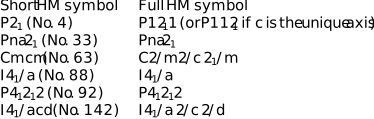
The specific relationships between the short and full symbols are given in Section 2.1.3.4 of ITA 6 (2016) starting at the end of p. 151. While the unique axis in the monoclinic system can be chosen as either b or c, the former choice is much more common.
If there are several types of axes associated with the same symmetry direction then the priority rules specify that the highest-order axis be shown in the HM symbol (e.g. rather than its coincident 2; 63 rather than its coincident 3). If there are two axes of the same order, a rotation axis is shown in preference to a screw or rotoinversion axis. If there are parallel mirror and glide planes, the HM symbol has an m for that direction rather than a character that designates a glide. For more details of the priority rules see Section 4.1.2.3 of ITA 5 (2002), pp. 55 and 543 of ITI (1952), or the Supplementary Commentary.
In a very few pairs of groups the symbols do not obey the general rules because there would be ambiguity if they did. Consider I222 (No. 23) and I212121 (No. 24). Both have axes 2 and 21 in all three directions, but those axes intersect differently in the two groups. Group No. 23 has special positions of symmetry 222 while the highest in No. 24 is 2. The space groups I23 (No. 197) and I213 (No. 199), which are, respectively, supergroups of I222 and I212121, are analogous: No. 197 has sites of symmetry 23 and 222 while No. 199 has sites of symmetry 3 and 2 only. A few additional exceptions are given in the Supplementary Commentary.
Extended HM symbols include information about additional symmetry operations generated by, e.g., lattice centerings, but the extended symbols do not necessarily include all the information in the full symbol. Examples are:
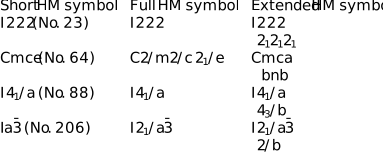
The extended HM symbols for all possible axial choices can be useful when looking for a higher-symmetry group (especially an orthorhombic group) that might approximately describe a pseudosymmetric structure. The extended symbols for both the standard and non-standard settings of space groups can be found in the synoptic tables [Table 1.5.4.4 of ITA 6 (2016)].
2.4. Symmorphic groups
For a symmorphic group, none of the characters in the short HM symbol specifies a screw axis or a glide plane; i.e. the characters in the short HM symbol (other than the first) are the same as those of a In a symmorphic group, and only in a symmorphic group, there is at least one special position that has symmetry corresponding to that of the point group.9 Examples of symmorphic groups are P2/m (No. 10), C222 (No. 21), I4 (No. 79), Pm1 (No. 164) and Fmm (No. 225). The term symmorphic seems to have been introduced by Fedorov (1891).
There is one symmorphic group in each arithmetic crystal class, but there are two different arithmetic crystal classes (apart from those generated by different centerings) for the point groups 32 (D3), 3m (C3v), 2/m (D3d), 2m (D2d) and 2m (D3h). The axes and/or plane normals of these five may be aligned parallel to the axes of the unit cell [as in P321 (No. 150) and P3m1 (No. 156)] or perpendicular to them [as in P312 (No. 149) and P31m (No. 157); Fig. 5].
![[Figure 5]](dv5030fig5thm.gif) | Figure 5 Drawings of space groups P3m1 and P31m taken from ITA 6 (2016 ). |
3. The proposed alternative ordering of space groups
Re-ordering the space groups requires making decisions about the order of the crystal systems, the sequence of within each system and the order of the within the Those decisions are detailed below.
3.1. The order of the crystal systems remains the same
The order of the crystal systems has not changed since the first IT volume was published in 1935. The question of whether trigonal groups should precede or follow tetragonal groups has been considered carefully more than once. It has always been decided that keeping the trigonal and hexagonal systems together, because they both have a hexagonal lattice, should take precedence over a sequence in which the highest-order rotation axis always increases. There was also the question (Hahn, 2006) of whether the hexagonal crystal family should be subdivided into trigonal and hexagonal or rhombohedral and hexagonal systems; that question was resolved in favor of the former choice. We see no reason to change the order of the crystal systems.
3.2. The order of the geometric crystal classes (i.e. of the point groups) does not change
The current order of the was introduced in 1952; it differs (see Fig. 3) from the order in IT35 (1935) and the publications of Schoenflies (1891), Fedorov (1891) and Niggli (1919). We see no reason to change the order chosen in 1952. We do, however, suggest that the point groups be numbered (see Figs. 2 and 3). The rationale for the current order is described in the Supplementary Commentary.
3.3. The standard settings of the space groups do not change
The choice of standard settings for the space groups goes back to 1935. The absence of a consistent set of rules for choosing those standard settings was noted in ITI (1952). Changing any of them now would be a very major project that few crystallographers would support.
3.4. What does change is the order of the space groups within the geometric crystal classes
There are two types of changes. First, the groups in a are sorted by The groups are then sorted by the specific types of symmetry elements.
While it seems logical that space groups in the same should always be kept together, Schoenflies (1891) did not always keep them together and Fedorov (1891) separated them consistently. The proposed order of the arithmetic crystal classes follows the conventional order of the centerings: P > C > A > F > I and P > R. That ordering would change the number of group P21/c, which is widely known to be No. 14 because it occurs so frequently in molecular crystals, to No. 13 because the current No. 12, C2/m, would have to follow P21/c (Fig. 6).
![[Figure 6]](dv5030fig6thm.gif) | Figure 6 Proposed alternative ordering of the triclinic and monoclinic space groups. The only differences from the ITA order are in the 2/m class. For explanation of the indices z1 and z2, see the text. Those indices are only shown when needed to determine the space-group ordering. |
Within the the ordering of the space groups is based on a small number of principles, which are explained below. Examples of the re-ordering are shown in Figs. 6–9, which are excerpts from a complete list available as a pdf file in the supplementary material. A spreadsheet that includes the orderings of Schoenflies, Fedorov and Niggli as well as the ITA and proposed orderings is also available in the supplementary material.
Fig. 7 illustrates the treatment of the five point groups that have two per centering type (P and I for 2m; P only for 32, 3m, m = 2/m1 and 2m) because the axes or planes may be aligned parallel to or perpendicular to the axes of the unit cell (Fig. 5). In the proposed list the arithmetic crystal classes with twofold rotation axes or with the normals of mirror or glide planes along the cell axes are listed first (321P > 312P, 3m1P > 31mP). If both symbols are present the 2 takes precedence (2mP > m2P, 2mP > m2P). Because the distinction between the two 2m classes persists when there is I centering, the proposed order of is therefore 2mP, 2mI, m2P, m2I. In the trigonal cases there is only one class when there is R centering, so that the order of classes is, e.g., 3m1P, 31mP, 3mR.
![[Figure 7]](dv5030fig7thm.gif) | Figure 7 Proposed alternative ordering of the space groups in the class 32. This figure illustrates the treatment of a point group for which there are two primitive arithmetic crystal classes. |
3.5. Within an arithmetic crystal class space groups are sorted so that the number of glide planes and screw axes increases
It is logical that the one symmorphic group be first in each It is proposed that the remaining groups be sorted by the extent to which they differ from the symmorphic group, i.e. by the number and type of symmetry elements that (1) include an intrinsic translation and (2) appear in the full HM symbol. Following Niggli's (1919) lead, all groups having a screw axis in the full HM symbol would follow all groups having none.
To sort in this way, an index z of screw axes and glide planes was defined. It proved necessary to calculate two values of z. The first, z1, is the index for the screw and glide symmetry associated with the primary direction (b for the monoclinic groups; c for the tetragonal, trigonal and hexagonal groups; directions 〈100〉 for the cubic groups). The value z2 is the index for the screw and glide symmetry elements along the secondary and tertiary directions, and for all directions in the orthorhombic groups. Groups in an would be sorted first by increasing z1 and then by increasing z2 (Figs. 8 and 9).
![[Figure 8]](dv5030fig8thm.gif) | Figure 8 Proposed alternative ordering of the space groups in the classes 222 and mm2. The only difference from the ITA order in the 222 class is that C2221 is after C222. The orders in the mm2 classes are changed significantly because of the application of the priority rule for the glide directions. |
![[Figure 9]](dv5030fig9thm.gif) | Figure 9 Proposed alternative ordering of the space groups in the class 422. This figure illustrates the roles of the indices z1 and z2. |
For each glide plane identified in the full HM symbol z1 or z2 would increase by +1 [i.e. z1 = 0 for Pm (No. 6); z1 = 1 for C2/c (No. 15); z2 = 2 for Aea2 (No. 41); z2 = 3 for Fddd = F2/d 2/d 2/d (No. 70); z1 = 0, z2 = 2 for P6cc (No. 184); z1 = 1, z2 = 1 for P4/nbm = P4/n 2/b 2/m (No. 125)].
If the sorting order of Niggli is to be followed, the contribution of a screw axis must be greater than that of a glide plane. For 21 axes the contribution was chosen as +2. The contribution for an axis nk, n > 2, to the index z1 is the larger of the values n/k and n/(n − k) (e.g. 2 for 42 and 63 axes; 3 for 62 and 64 axes; and n for all others). This scheme puts P63 (z1 = 2), which has a coincident axis 3, after P6 (z1 = 0) and before P62 and P64 (z1 = 3), which have a coincident axis 2. Groups P61 and P65 (z1 = 6) are the last in the class.10
If the values of both z1 and z2 are the same for two or more groups, then
(1) if the difference is the handedness of a screw axis nk, the group with the smaller k is listed first (e.g. P41212 > P43212);
(2) if the difference is the orientation of a mirror or glide plane, the group with the mirror-plane normal along a cell direction (rather than along a cell diagonal) is listed first (e.g. P42mc > P42cm);
(3) if the only difference is the direction of a glide vector, the usual ordering is followed (e.g. in the orthorhombic case e > a > b > c > n so that Pba2 > Pcc2 > Pnc2).
One of the manuscript reviewers suggested a redefinition of the values of the indices z1 and z2 for the orthorhombic case. Since as a general rule rotation and screw axes have priority over reflection and glide planes, one can define z1 as the index for the screw axes in all three directions and z2 as the index for the glide planes in all three directions (in the orthorhombic system). The suggested approach would not change the proposed order of space groups but would help to clarify some of the ties which occur. In the arithmetic class mmmP, P2/n 2/n 2/n and P21/m 2/m 2/a both have z2 = 3 in the current approach, but they would have z1 = 0, z2 = 3 and z1 = 1, z2 = 1 in the suggested alternative.
3.6. In the proposed order the multiplicity of the special position having the highest symmetry should not decrease with increasing space-group number
Within an there is no group that has a special position of higher symmetry than that of the most symmetric special position of the symmorphic group. The symmetry of a special position is reflected in its multiplicity. If the indices z1 and z2 describe the extent to which a group differs from the corresponding symmorphic group, then within each the multiplicity of the most symmetric special position in the group should never decrease as the proposed space-group number increases. In the proposed alternative order it does not, except in two small sets of groups (see the Supplementary Commentary).
In the arithmetic crystal class mmmP (or 2/m 2/m 2/mP), group Pbcm (No. 57, with a site of multiplicity 4) is, in the proposed order, after two groups (Pmmn, No. 59, and Pbam, No. 55) having no site of multiplicity greater than 2. In class 4/mmmP (or 4/m 2/m 2/mP), group P42/mbc (No. 135, with a site of multiplicity 4) is after three groups having no site of multiplicity greater than 2. Similarly, P42/nbc (No. 133) is after four such groups. Two factors seem to be responsible: (1) the twofold greater weight given to 21 axes compared with glide planes, which is a consequence of adapting Niggli's precedence given to rotation/screw axes over reflection/glide planes, and (2) the inability of the z values to capture the different ways in which the elements intersect. Despite the two sets of exceptions, the correlation of minimum multiplicity with space-group number is very good.
3.7. The final order
In the supplementary material, we provide a pdf file (16 pp.) in the form of Figs. 6–9, but for all space groups, and a spreadsheet that also includes the space-group numbers given by Fedorov (1891), Schoenflies (1891) and Niggli (1919). Since the orders of the geometric crystal classes in the older lists differ, the orders within the geometric crystal classes are also given to facilitate comparisons.
For the triclinic, monoclinic and orthorhombic systems the space-group order within geometric crystal classes in the final list is quite similar to that of Niggli except for the ordering of glide types (e > a > b > c > n > d in our list; no obvious scheme in Niggli's list). There are so many inconsistencies in Niggli's order for the higher-symmetry systems that no meaningful comparison of his list with ours can be made.
4. How can the alternative ordering be useful in teaching?
Students may wonder how Schoenflies, Fedorhov and Sohncke developed their lists of space groups. The answer is that they started with low-symmetry groups and then worked out where to add symmetry elements so that the addition of the corresponding symmetry operations gives a new Schoenflies outlined the steps in his 1891 book. The proposed new sequence of space groups makes that process more obvious by putting the sets of space-group generators in a more rational order. The generators are a set of symmetry operations that can be combined to generate all the other symmetry operations of the Examples of the generators listed in ITA are shown in Table 3.
‡The symbolic descriptions are as follows: 2 ∥ b at x = z = 0 stands for a twofold rotation around an axis parallel to b at x = z = 0. 21 ∥ b at x = z = 0 stands for a twofold screw rotation around an axis parallel to b at x = z = 0. m ⊥ b at y = 0 stands for a reflection m through a plane with a normal parallel to b at y = 0. a ⊥ b at y = ¼ stands for an a-glide reflection through a plane with a normal parallel to b at y = ¼. | |||||||||||||||||||||||||||||||||||||||||||||||||||||||||||||||||||||||||||||||||||||||||||||||||||||||||||

The set of generators always includes the identity and the translations along a, b and c. The centering vector is included for A, C, I or R lattices; two centering vectors are included if there is F centering. If the group is centrosymmetric, inversion is always included as the last operation in the list.
Each of the 230 crystallographic space groups can be generated from a normal by the addition of a single generator. It is therefore possible to construct for each a chain of normal subgroups that terminates with group P1 (No. 1). The generator for each step in the chain is usually of order 2 (e.g. a twofold rotation, a glide reflection or inversion) but may be of order 3 [e.g. the generation of P3, P31 and P32 (Nos. 143–145) from P1, the generation of P23 (No. 195) from P222 (No. 16), and the generation of P213 (No. 198) from P212121 (No. 19)]. If the added generator is of order 3 (e.g. 3+) then its second power must be applied [i.e. to generate its inverse 3− = (3+)2].
The set of generators is not unique, but if a consistent set of rules is followed the set describes only one space group. The rules for choosing the generators listed in ITA are described in Section 1.4.3 of ITA 6 (2016). The procedure sometimes leads to the inclusion of a generator that may seem redundant but is not. Consider P4 (No. 75). The added generator is 4+ (i.e. {4+001|0}), the operation 2 is (4+)(4+) and the operation 4− is (4+)(4+)(4+). The generator 2 then seems unnecessary, but any tetragonal space group includes P2 or P21 in its chain of normal subgroups and so must include the generator 2 or 21.
The number of generators varies with the symmetry of the arithmetic crystal class (e.g. 5 for P, 6 for 2C, 2/mP and 222P, 7 for mmmP, and 11 for mmF).
When possible, twofold rotations were selected for the ITA list rather than reflections or glides (see entry for Pbca in Table 3). For the monoclinic system that choice allows the generators to be of the same type (as long as the unique axis is not changed) for the different settings of the primitive groups (e.g. for P21/c, P21/n, P21/a). For the different settings of the centered monoclinic groups having the same unique axis only the centering generator changes. For orthorhombic groups the generator for the symmetry operations along the axis c is the first after those for the translations; it is followed, if necessary, by the generator for the symmetry operations along the axis b. In the higher-symmetry groups generators for other directions may be needed (e.g. a threefold rotation along [111] for all cubic groups).
Comparing the generators for different space groups makes clearer their sub- and relationships.
5. What might be done with the proposed alternative space-group ordering?
We believe that it will be possible to incorporate this new, more logical ordering into the online version of ITA 6 (2016b) as an alternative to the existing order. The space-group numbers are simply attributes, of which there could be two sets.
Another possibility (suggested by one of the referees) would be to use the new ordering of space groups for a new space-group numbering scheme inspired by the three-part scheme used for the 4D space groups (Brown et al., 1978). To each space group one could assign a three-part numbering n_m_k, where n is the number of the geometric class (running from 1 to 32), m is the number of the arithmetic class within the geometric class and k is a running number for the within the arithmetic class, with k = 0 indicating the symmorphic group. In the proposed ordering the group I222 (currently No. 23) would be 6_4_0 and the frequent group P21/c (currently No. 14) would be 5_1_3.
We note that other improved orderings of the space groups are possible, such as, for example, those proposed by Kahr (2023) and Souvignier (2025). Kahr suggests a space-group arrangement analogous to the periodic table of elements in which the rows correspond to the geometric classes and the columns to the orders of the point groups (coinciding with the maximal site symmetry in the symmorphic group). Similarly to Fig. 3, the crystal systems in his table are color-coded.
Supporting information
Supplementary Commentary. DOI: https://doi.org/10.1107/S1600576726002360/dv5030sup1.pdf
Annotated copies of Niggli's 1919 tables. DOI: https://doi.org/10.1107/S1600576726002360/dv5030sup2.pdf
The full file from which Figs. 6–9 were taken. DOI: https://doi.org/10.1107/S1600576726002360/dv5030sup3.pdf
Spreadsheet file showing the past and proposed orderings of the space groups. DOI: https://doi.org/10.1107/S1600576726002360/dv5030sup4.xlsx
Footnotes
1A space inversion is the rotoinversion 1. The effects of a reflection through a plane and of a rotoinversion 2 are equivalent.
2Sub- and supergroup relationships are given and discussed in Vol. A1 of International Tables for Crystallography (2011).
3Most of the inconsistencies involve high-symmetry space groups and may be a result of Niggli's having followed Schoenflies' ordering.
4From p. 59 of Niggli (1919): `So wünschenswert auch eine ursprünglich mehr einheitliche und prinzipielle Indexnumerierung gewesen wäre, so unzweckmäßig und verwirrend würde es sein, wenn jetzt ein neuer Bezeichnungsmodus vorgeschlagen würde.'
5A comparison of the order of the space groups in the 1935 and 2016 tables is somewhat complicated by changes in some of the space-group symbols.
6Both Schoenflies and Fedorov were born in 1853; at the time their lists of space groups were finished they were not yet 40.
7This procedure leads to the sequence P2/m, P2/c, P21/m, P21/c. Sorting first on rotation versus screw axes clusters all groups with rotation axes before all groups with screw axes. Then, within those clusters, groups with mirror planes are listed before groups with glide planes. More specific rules, such as the priority order for types of glide planes, are given below.
8Following the conventions of HM symbolism (and ITA), in the orthorhombic system [100] is chosen as the primary, [010] as the secondary and [001] as the tertiary symmetry direction.
9While it is incorrect to say that a special position of a space group has point-group symmetry [see Section 1.4.4.2 of ITA 6 (2016)], writing a correct statement would require more space and more definitions (e.g. of isomorphism) than can be appropriate for this article. It is correct to say, however, that an isolated molecule described by a specific point group can occupy a special position having the same ITA symmetry label, with the molecule retaining all of the symmetry of its point group and without it being disordered.
10Another way of calculating the value of z1 for a screw nk was proposed by one of the referees, namely that z1 = n/gcd(n, k) (where gcd means the greatest common divisor). The change would not affect the proposed space-group order.
Acknowledgements
We thank all the reviewers of this paper for their helpful comments, especially the reviewer who read the text and supplementary material extraordinarily carefully and provided an extensive set of comments and questions. We thank Nicola Ashcroft for finding the differences between the space-group symbols shown in IT35 (1935) and in ITA 6 (2016). That task had to be completed at the IUCr Editorial Office in Chester because it was decided that the IUCr's copy of IT35, which had been P. P. Ewald's personal copy and is also rare, is too valuable and fragile to be scanned.
References
 Authier, A. (2013). Early Days of X-ray Crystallography. Oxford University Press. Google Scholar
Brown, H., Bülow, R., Neubüser, J., Wondratschek, H. & Zassenhaus, H. (1978). Crystallographic Groups of Four-Dimensional Space. New York: Wiley Interscience. Google Scholar
Burckhardt, J. J. (1967). Arch. Hist. Exact Sci. 4, 235–246. CrossRef Google Scholar
Burckhardt, J. J. (1971). Arch. Hist. Exact Sci. 7, 91–141. CrossRef Google Scholar
de Wolff, P. M., Belov, N. V., Bertaut, E. F., Buerger, M. J., Donnay, J. D. H., Fischer, W., Hahn, Th., Koptsik, V. A., Mackay, A. L., Wondratschek, H., Wilson, A. J. C. & Abrahams, S. C. (1985). Acta Cryst. A41, 278–280. CrossRef CAS Web of Science IUCr Journals Google Scholar
de Wolff, P. M., Billiet, Y., Donnay, J. D. H., Fischer, W., Galiulin, R. B., Glazer, A. M., Hahn, T., Senechal, M., Shoemaker, D. P., Wondratschek, H., Wilson, A. J. C. & Abrahams, S. C. (1992). Acta Cryst. A48, 727–732. CrossRef CAS Web of Science IUCr Journals Google Scholar
de Wolff, P. M., Billiet, Y., Donnay, J. D. H., Fischer, W., Galiulin, R. B., Glazer, A. M., Senechal, M., Shoemaker, D. P., Wondratschek, H., Hahn, Th., Wilson, A. J. C. & Abrahams, S. C. (1989). Acta Cryst. A45, 494–499. CrossRef Web of Science IUCr Journals Google Scholar
Fedorov, E. S. (1891). Zap. Miner. Obshch. (Trans. Miner. Soc. Saint Petersburg) 28, 1–146. Google Scholar
Fedorov, E. S. (1892). Z. Kristallogr. 20, 25–75. Google Scholar
Fedorov, E. S. (1971). Symmetry of Crystals, translation by David Harker & Katherine Harker, American Crystallographic Association Monograph No. 7, pp. 50–131. Buffalo: American Crystallographic Association. Google Scholar
Glazer, A. M., Aroyo, M. I. & Authier, A. (2014). Acta Cryst. A70, 300–302. Web of Science CrossRef CAS IUCr Journals Google Scholar
Hahn, T. (2006). International Tables for Crystallography, Vol. A, Space-Group Symmetry, 1st online ed., pp. xvi–xvii, https://it.iucr.org/Ab/pre5v0001/. Chester: International Union of Crystallography. Google Scholar
International Tables for Crystallography (1983). Vol. A, Space-Group Symmetry, 1st ed., edited by Th. Hahn. Dordrecht: Kluwer Academic Publishers. Google Scholar
International Tables for Crystallography (2002). Vol. A, Space-Group Symmetry, 5th ed., edited by Th. Hahn. Dordrecht: Kluwer Academic Publishers. Google Scholar
International Tables for Crystallography (2011). Vol. A1, Symmetry Relations Between Space Groups, 2nd online ed., edited by H. Wondratschek & U. Müller, https://doi.org/10.1107/97809553602060000110. Chester: International Union of Crystallography. Google Scholar
International Tables for Crystallography (2016a). Vol. A, Space-Group Symmetry, 6th ed., edited by M. I. Aroyo. Chichester: Wiley. Google Scholar
International Tables for Crystallography (2016b). Vol. A, Space-Group Symmetry, 2nd online ed., https://doi.org/10.1107/97809553602060000114. Chester: International Union of Crystallography. Google Scholar
International Tables for X-ray Crystallography (1952). Vol. I, Symmetry Groups, 1st ed., edited by N. F. M. Henry & K. Lonsdale. Birmingham: Kynoch Press. Google Scholar
Internationale Tabellen zur Bestimmung von Kristallstrukturen (1935). I. Band, edited by C. Hermann. Berlin: Borntraeger. Google Scholar
Kahr, B. (2023). Acta Cryst. E79, 124–128. Web of Science CrossRef IUCr Journals Google Scholar
Niggli, P. (1919). Geometrische Kristallographie des Diskontinuums. Leipzig: Borntraeger. Google Scholar
Paufler, P. & Filatov, S. K. (2020). Minerals, 10, 181, https://doi.org/10.3390/min10020181. Google Scholar
Schoenflies, A. (1891). Krystallsysteme und Krystallstruktur. Leipzig: Teubner. Google Scholar
Sohncke, L. (1879). Entwicklung einer Theorie der Kristallstruktur. Leipzig: Teubner. Google Scholar
Souvignier, B. (2025). Personal communication. Google Scholar
This article is published by the International Union of Crystallography. Prior permission is not required to reproduce short quotations, tables and figures from this article, provided the original authors and source are cited. For more information, click here.
| JOURNAL OF APPLIED CRYSTALLOGRAPHY |


