

 journal menu


issue contents
June 2026 issue
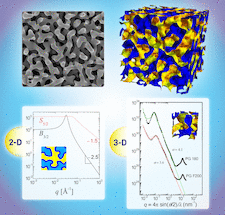
Cover illustration: H. Frielinghaus [J. Appl. Cryst. (2026), 59, 837–844] describes a small-angle scattering fitting function for porous materials with arbitrary fractal dimension. Graphics design by Iris Köhler (Forschungszentrum Jülich GmbH). Micrograph of porous glass provided by SCHOTT AG, reproduced with permission.
research papers


Open  access
access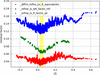
Analysis of more than 8000 published data sets demonstrates that systematic overestimation of observed intensities can deceptively improve common agreement factors and atomic displacement parameters, masking underlying deficiencies in data quality.
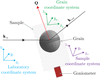
A computational method is developed for the explicit reconstruction of the full deformation gradient tensor from the measurement of three symmetry-equivalent reflections in dark-field X-ray microscopy. The computations are extended to develop the sensitivity and uncertainty analysis methodologies to give a quantitative understanding of the reconstruction.

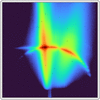
Grazing-incidence small-angle scattering is used as an all-in-one tool for examining blazed gratings. The technique is directly sensitive to optical performance and indirectly to groove profile and reflective surface roughness.
Open access
access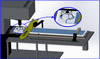
We present a new setup at the FIGARO horizontal neutron reflectometer enabling simultaneous measurement of the structural and mechanical properties of liquid interfaces, combining neutron reflectometry with interfacial shear rheology.
Open access
access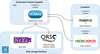
An automated machine-learning-based processing and analysis workflow for neutron reflectometry data is presented. The approach has been successfully used for on-the-fly analysis during an experiment at the Institut Laue–Langevin (Grenoble, France) and can be adapted to work at other neutron facilities seeking to enable real-time feedback-driven reflectometry analysis.
Open access
access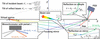
REFocus optics, employing an elliptical mirror and higher-order reflections, enable rapid wide-Q-range neutron reflectometry at reactor sources, achieving up to 100-fold faster measurements compared with conventional methods.
Open access
access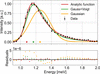
An analytical convoluted gap function is presented for fitting either a linear or a quadratic dispersion gap in a constant-Q cut measured with a focused triple-axis spectrometer. It outperforms previous methods of fitting a gap, without requiring a full resolution convolution.
Open access
access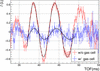
First measurements of the neutron scattering lengths of 3He and 4He using a multilayer-type neutron interferometer at J-PARC are reported, demonstrating the initial feasibility of the method with prospects for improved precision.
Open access
access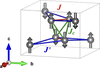
Inelastic neutron scattering on SrCu2(BO3)2 at 4.2 GPa reveals dispersive spin excitations in the antiferromagnetic phase, consistent with linear-spin-wave theory and highlighting the key role of interlayer coupling.

Download citation


Download citation
Open access
access
High-quality single crystals of Fe3GaTe2 were grown using the chemical vapour transport method, allowing for a precise determination of their crystal and magnetic structures. A shortening of the Fei–Fei distance enhances the Fe–Fe exchange interaction, providing a microscopic origin for its higher Curie temperature compared with Fe3GeTe2.
CCDC reference: 2534687
Open access
access
We present an accurate algorithm for simulating neutron scattering from spin waves in the ray-tracing package McStas.
Open access
access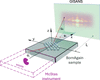
mcstas_gisans is a Python-based framework that enables simulation of grazing-incidence small-angle neutron scattering experiments by integrating McStas and BornAgain into a single workflow.
Open access
access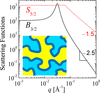
A small-angle scattering fitting function is derived for porous materials with arbitrary fractal dimension. It includes a correlation peak and a power law at higher q.
Open access
access
This study evaluates and compares automated methods for center detection in 2D diffractograms. The methods have been implemented in EDIFF, an open-source user-friendly Python package for the processing of electron diffraction patterns.
Download citation
Download citation
Open access
access
We describe a continuous serial electron diffraction implementation in LibraEDT that enables automated data collection with real-time frame evaluation, together with an accessible workflow for subsequent data processing.
Download citation
Download citation
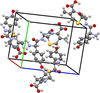
The first cryo-enabled microcrystal electron diffraction (cryo-MicroED) structure of the β-lactam antibiotic cefadroxil is reported, resolving its relative stereochemistry and confirming its known absolute configuration and crystal packing at atomic resolution. This work confirms cryo-MicroED as a nanocrystallographic approach for high-fidelity structural characterization of pharmaceutical small molecules.
CCDC reference: 2496607
Open access
access
A quantitative X-ray diffraction approach is introduced to resolve light-induced halide segregation in mixed-halide perovskite thin films, revealing the formation of Br-rich regions and their slow incomplete relaxation in the dark.
Open access
access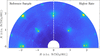
Ultrathin Fe3O4 films grown on SrTiO3(001) were systematically studied with respect to film growth parameters to clarify the coexistence of (111) and (001) orientations. X-ray diffraction analyses reveal the formation of an intermediate (111)-oriented phase during the initial growth stage, which persists even after preferential (001) growth is established.
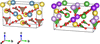
A `fingerprint function' for crystal structures based on a normalized radial distribution function is presented, with a focus on its applications in the field of comparative crystal chemistry.
Open access
access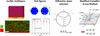
We present a modified crystallite group method that enables reliable X-ray-based residual stress analysis in highly textured nanomultilayers exhibiting strong in-plane orientation relationships and growth twinning. By establishing a robust diffraction-plane selection framework and validating it through high-resolution scanning transmission electron microscopy and texture analysis, we provide a broadly applicable methodology for accurate stress evaluation in epitaxial multilayer systems.
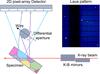
Wire profiling for depth-resolved Laue microdiffraction has been implemented on a conventional beamline with simple auxiliary equipment. An efficient wire geometric calibration method has been developed and the optimal depth reconstruction algorithm has been screened via forward simulation. This upgrade enables non-destructive crystallographic mapping of bulk materials at <10 µm depth resolution, extending the beamline from surface mapping to volumetric characterization.
teaching and education
Free
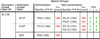
The current ordering of space groups in Vol. A of International Tables for Crystallography is so full of inconsistencies that its basic patterns are obscured. A revised order based on a small number of principles has been developed. It should be especially useful for teaching.
computer programs
Open access
access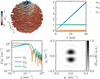
NuMagSANS, a GPU-accelerated software package for the computation of nuclear and magnetic small-angle neutron scattering cross sections and correlation functions of complex systems, is presented.
Open access
access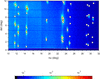
A program is described for visualizing grazing-incidence scattering data and interactive indexing of the observed diffraction spots.
Open access
access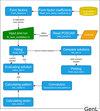
We present GenL, a flexible program utilizing differential evolution within a genetic algorithm that can be used to simulate and/or fit X-ray diffraction data from epitaxial thin films exhibiting Laue oscillations.
laboratory notes
Download citation
Download citation
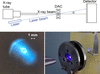
A pocket-portable device for high-pressure photochemical experiments in a diamond anvil cell is described. The device enables irradiation by visible light during single-crystal X-ray diffraction data collection.
addenda and errata
Open access
access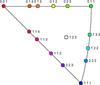
This article presents 45 symmetry-based tables which enable the reindexing of the 15 most common diffraction patterns of cubic materials. These tables are a supplement to the table of standard settings provided by Weirich [J. Appl.Cryst. (2024), 57, 1263–1269].
Free