


 journal menu


issue contents
 access
November 2025 issue

quantum crystallography



This editorial introduces the `Focus on Quantum Crystallography' collection, coinciding with the centenary of quantum mechanics and highlighting the convergence of crystallography and quantum theory. It outlines recent advances and applications of quantum crystallography in areas such as chemical bonding, materials science, drug discovery and theoretical chemistry. It showcases the growing role of quantum crystallography in bridging experimentation and computation.
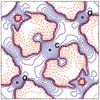
The IUCr's close association with quantum crystallography, rightly celebrated by this focused anniversary issue, has its origins in regular meetings of experimentalists and theoreticians interested in electron charge and spin density back in the 1960s. That ad hoc group was adopted by the IUCr in the 1970s, when a Commission was created and latterly it has been renamed as the Commission on Quantum Crystallography. The history is summarized in this foreword to the issue.
ELECTRON CRYSTALLOGRAPHY

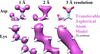
Electrostatic potential maps of proteins are calculated at various resolutions using the transferable aspherical atom model (TAAM) to determine the relations between the electrostatic potential and resolution for different atom types.
scientific commentaries
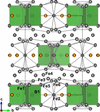
High-energy synchrotron X-ray diffraction reveals the bonding topology and charge distribution in Nd2Fe14B, clarifying the atomic-scale origins of its exceptional magnetic performance. The study by Vosegaard et al. [(2025). IUCrJ 12, 658–669] provides the first detailed charge density analysis of a heavy-rare-earth magnet, guiding future magnet design.
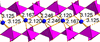
Polyphasic Fe2P2O7 is a prime example of how the temperature-dependent changes in structure shed light on the magnitudes of local interactions. State-of-the-art methods and equipment are prerequisites for the analysis of these, often subtle, effects.
research papers
CRYO | EM
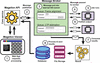
This work presents a new cyberinfrastructure framework for cryo-EM structure determination, Magellon, which offers a robust and flexible approach to cryo-EM data management. We show the power of this platform by building a frontend web interface, Magellon Viewer, on top of Magellon.
CHEMISTRY | CRYSTENG
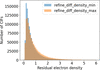
This study examines data extracted from Crystallographic Information Files (CIFs) deposited at the Cambridge Crystallographic Data Centre (CCDC) to gain insight into patterns and trends seen in the quality of structural models obtained from structure refinements. From the results of over 1 300 000 individual datasets, this work aims to show what can be considered as typical values over a variety of experimental conditions.
MATERIALS | COMPUTATION

Download citation


Download citation
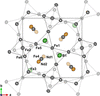
Short-wavelength high-resolution synchrotron single-crystal X-ray diffraction data measured at 25 K are used to model the electron density of the super-strong magnet Nd2Fe14B and quantify its complex chemical interactions.
CHEMISTRY | CRYSTENG
Download citation
Download citation
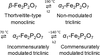
Thortveitite-related Fe2P2O7 shows three reversible phase transitions and has an incommensurately modulated crystal structure at room temperature.
B-IncStrDB reference: T4fHuXDFsyG
NEUTRON | SYNCHROTRON
Download citation
Download citation
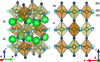
The room-temperature structure of Sr2FeIrO6, a double perovskite with notable magnetic and structural properties, has been debated extensively. Our high-resolution and high-pressure synchrotron-based powder X-ray diffraction findings provide compelling evidence to reconcile these divergent positions, laying groundwork for future research.
CCDC reference: 2457253
BIOLOGY | MEDICINE
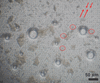
The influence of the X-ray step size on radiation damage occurring in serial data collection from a metalloprotein using sheet-on-sheet fixed-target chips was investigated at fourth-generation synchrotron and XFEL beamlines.
CRYO | EM
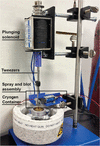
The development of methods for low-cost time-resolved cryo-EM using an on-grid mixing strategy is described.
EMDB references: apoferritin, EMD-70747; aldolase, EMD-70748; CCMV contracted control, EMD-70749; CCMV expanded control, EMD-70750; CCMV pH shift, EMD-70751; GroEL control (no ATP), EMD-70752; GroEL `barrel', 100 ms, EMD-70759; GroEL `barrel', 300 ms, EMD-70753; GroEL `bullet', 300 ms, EMD-70754; GroEL `football', 300 ms, EMD-70755; GroEL `barrel', 700 ms, EMD-70756; GroEL `bullet', 700 ms, EMD-70757; GroEL `football', 700 ms, EMD-70758


