


 menu
menu


issue contents
 access
September 2026 issue
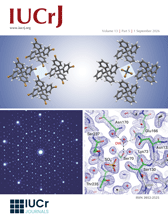
editorial


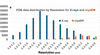
Single-particle cryoEM has made visualization of biological molecules and their complexes at high resolution possible without the need for crystallization. The last decade has seen a rapid growth in the number of structures determined by cryoEM; for membrane proteins, the total number of cryoEM structures has exceeded that determined by crystallography.
lead articles
CHEMISTRY | CRYSTENG

Crystal Engineering, the designed synthesis of functional molecular solids, is poised as a major branch of research in crystallography and chemistry. The centrality of this disciple is illustrated in this lead article.
topical reviews
NEUTRON | SYNCHROTRON
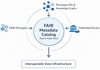
Metadata catalogs are essential for implementing FAIR data principles in photon and neutron (PaN) science, enabling experimental data to become findable, accessible, interoperable and reusable. This work provides an analysis of current catalog systems in the PaN field and offers practical recommendations to advance interoperability and build a federated FAIR-compliant data infrastructure.
PHYSICS | FELS
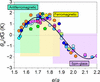
This review summarizes recent experimental and theoretical advances in the magnetism of quasicrystals and their approximant crystals, and formulates three complementary and hierarchical design principles – valence electron concentration, crystal electric field-induced anisotropy and structural control of magnetic frustration – as primary tools for systematically tuning the magnetic ground states in these compounds.
research letters
CRYO | EM

Single-particle cryo-EM will soon equal the number of yearly entries in the Protein Data Bank from structures determined by X-ray crystallography. Considering the growing outreach of cryo-EM, it is timely to remind users of and define typical terms important for understanding the underlying fundamental physical concepts and key basics of single-particle cryo-EM and image processing, which are particularly relevant for the expanding cryo-EM community, including for newcomers and scientists joining from related fields.
research papers
CRYO | EM


Post-acquisition super resolution (PASR) is a pre-processing step which can be utilized to exceed the resolution limit of already-acquired data if the limit is reached. It is designed to be as minimally invasive to all general single particle workflows as possible, allowing users to choose which suite they prefer.
EMDB reference: apoferritin PASR-on-ASR, EMD-65822
PDB reference: apoferritin PASR-on-ASR, 9wal
PHYSICS | FELS
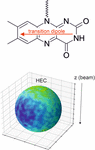
Similar yields of the optically excited fractions of fatty acid photodecarboxylase crystals in pump–probe serial femtosecond crystallography (SFX) experiments using both fixed-target and high-viscosity extrusion (HVE) sample delivery approaches show that pump light scattering reduces the photon flux reaching the crystals in transparent high-viscosity jets by 20–40%, depending on delivery method. This experimental result contradicts previous reports of up to 99% scattering losses, which were argued to justify the use of extremely high pump laser energy densities without entering multiphoton absorption regimes.
MATERIALS | COMPUTATION
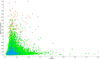
Machine learning interatomic potentials (MLIPs) offer a significantly faster alternative to density functional theory for theoretical crystal structure calculations with comparable accuracy. Geometry-optimized structures generated using the Universal Models for Atoms MLIP, trained on the Open Molecular Crystals 2025 dataset, were used to verify 216 919 selected structures from the Cambridge Structural Database with the aim of detecting issues in both the interpretation of the original X-ray experiments and the performance of the used MLIP.
PHYSICS | FELS

We describe proof-of-concept experiments towards correlated serial synchrotron crystallography (SSX) and X-ray emission spectroscopy (XES) from microcrystals on a microfocus synchrotron beamline. A droplet-on-demand tape drive system delivers microcrystals to the beam within well separated droplets with a volume of hundreds of picolitres, while XES allows validation of the redox states of metals within protein crystals.
PDB reference: serine β-lactamase CTX-M-15, 9yrd
NEUTRON | SYNCHROTRON
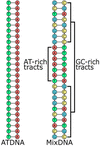
Wide-angle X-ray scattering (WAXS) profiles of DNA duplexes reveal peaks and troughs that reflect real-space periodic structural features. We draw on information-theory-limited Fourier transforms, atomistic modeling and residue-index correlation maps to link the observed WAXS peaks to known structural features of DNA duplexes, introducing a new way to characterize nucleic acid structures.
PHYSICS | FELS
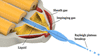
A novel vacuum-compatible liquid sheet jet nozzle, utilizing a second gas sheath, successfully generates stable aqueous films under 100 nm in thickness, overcoming previous freezing limitations in vacuum environments. This development simplifies operations and is demonstrated to be viable for high-repetition-rate X-ray scattering measurements at X-ray free-electron laser sources, broadening the applications for studying matter in solution.
