

 journal menu


- 1. Introduction
- 2. Derivation of equations
- 3. Dependence of the ηh response profile on the time parameters
- 4. Methods for estimating τ
- 5. Conclusions and perspectives
- B1. Asymptotic behavior of f
- B2. Approximation function f~
- B3. Ratio of relative uncertainties ratioσ
- Supporting Information
- References


- 1. Introduction
- 2. Derivation of equations
- 3. Dependence of the ηh response profile on the time parameters
- 4. Methods for estimating τ
- 5. Conclusions and perspectives
- B1. Asymptotic behavior of f
- B2. Approximation function f~
- B3. Ratio of relative uncertainties ratioσ
- Supporting Information
- References
research papers
 | JOURNAL OF SYNCHROTRON RADIATION |
Measuring picosecond excited-state lifetimes at synchrotron sources

aChemistry Department, University at Buffalo, State University of New York, Buffalo, NY 14260-3000, USA
*Correspondence e-mail: [email protected], [email protected]
A new analysis method for the short excited-state lifetime measurement of photosensitive species in crystals is described. Based on photocrystallographic techniques, this method is an alternative to spectroscopic methods and is also valid for non-luminescent excited species. Two different approaches are described depending on the magnitude of the lifetime τ. For very short lifetimes below the width of the synchrotron pulse, an estimated τ can be obtained from the occurrence of the maximal system response as a function of the pump–probe delay time Δt. More precise estimates for both short and longer lifetimes can be achieved by a refinement of a model of the response as a function of the pump–probe delay time. The method also offers the possibility of the structure determination of excited species with lifetimes in the 40–100 ps range.
1. Introduction
Time-resolved photocrystallography allows the collection of dynamic structural information not accessible by other methods. By means of a pump–probe technique, it involves the measurement of light-ON and light-OFF data which are subsequently analyzed to determine time-dependent structural changes following light exposure. The theoretical aspects of ultrafast time-resolved monochromatic X-ray and electron scattering of gas-phase samples have been treated in the 1990s (Ben-Nun et al., 1997![[Ben-Nun, M., Cao, J. & Wilson, K. R. (1997). J. Phys. Chem. A, 101, 8743-8761.]](../../../../../../logos/arrows/s_arr.gif "Ben-Nun, M., Cao, J. & Wilson, K. R. (1997). J. Phys. Chem. A, 101, 8743-8761.") ; Cao & Wilson, 1998). The time dependence of the X-ray response to photo-exposure of solids is treated below. To allow single-pulse diffraction it is imperative to use the polychromatic Laue technique, which makes much more efficient use of the photon flux of the source (Makal et al., 2011). To eliminate the wavelength dependence of the diffraction intensities, of the detector response and of other effects, we have introduced the RATIO method for analysis of time-resolved Laue data (Coppens et al., 2009).
; Cao & Wilson, 1998). The time dependence of the X-ray response to photo-exposure of solids is treated below. To allow single-pulse diffraction it is imperative to use the polychromatic Laue technique, which makes much more efficient use of the photon flux of the source (Makal et al., 2011). To eliminate the wavelength dependence of the diffraction intensities, of the detector response and of other effects, we have introduced the RATIO method for analysis of time-resolved Laue data (Coppens et al., 2009).
With a judicious choice of pump–probe delays such that the laser pulse starts close to or after the start of the X-ray pulse, and thus overlaps with the latter, it is possible to improve the time-resolution below the ∼100 ps limit of the synchrotron source. Haldrup et al. (2011) have measured the excitation fraction as a function of time for a species with a longer 420 ns lifetime in solution. We show here that a scan of the light response as a function of the pump–probe delay can be used for the estimate of lifetimes down to ∼50 ps without knowledge of the structure of the excited species. In favorable cases it should also be possible to determine the structures of species with such short lifetimes.
2. Derivation of equations
2.1. Experimental measurements of system response
The relative intensity response to light exposure is defined by the response ratio

with  the intensity ratio for the reflection
  .
.
We consider here the case of a single pulse without cumulative pumping in which the exposed species has only two possible states: a ground state (GS) and an excited state (ES). The latter occurs when the excitation is still significant at the time of arrival of the following laser pulse, as discussed by Fullagar et al. (2000). Laser exposure can be interpreted as an energy transfer and therefore, elaser, the instantaneous pump laser beam intensity, as an instantaneous energy or power (mW). The instantaneous laser exposure at treference excites a fraction of sample. According to first-order kinetics, this fraction p decays as an exponential function and is given by the following. For  ,
,

in which p0 is the exposure fraction of excited species per laser beam energy unit at treference in units of mJ−1.
At an instant t, the total fraction P(t) of excited species results from instantaneously excited species (treference = t) but also all remains of earlier excitations ( ). P(t) is obtained by integrating p as a function of treference,

The total fraction P is the convolution product of the instantaneous laser beam intensity elaser and the instantaneous exposure response per laser beam energy unit with treference set to zero.
For any reflection  , the laser-ON intensity, diffracted by the sample when exposed to the laser light at time t,
  , depends on the X-ray beam intensity at that instant exray(t) and the excited molecule fraction P(t). The instantaneous intensity depends on the nature of the excited-state species distribution in the sample (Vorontsov & Coppens, 2005).
In the case of an excited-state cluster formation (CF),

Here  and
and  are the ES and GS structure factors, respectively, for the and k is a factor which depends on the volume of the crystal, the optical correction factors and the experimental details.
In the case of a random distribution of the excited-state molecules (RD), which is more commonly encountered,

which can be rewritten as

Assuming small values of the conversion fraction P(t), which is typically the case in many experiments in which the integrity of the crystal is preserved, we neglect the terms in P(t)2 to give

The total intensity  (units mJ) is obtained by integration of the instantaneous intensity
  over t,

If we replace by equations (4) for CF or (7) for RD and combine the terms with P(t), we obtain  as the summation of two integrals,

with, in the CF case,  and, in the RD case with small conversion percentages,
  =
=  .
.
If we assume no variation of thermal effects, the second term of equation (9) corresponds to  , the laser-OFF intensity of the reflection
  . This approximation is valid for single or few-pulse experiments, which are required for the method described here. The equation can be rewritten as

with  a characteristic factor of defined as
  .
.
We note that the factor can be positive or negative depending on the values of  and
and  and is different for the CF and RD cases.
Substituting the expression for P(t) [equation (3)],  becomes
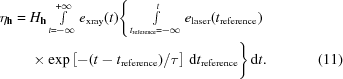
By interchanging integrals,  can be rewritten as

The term between the square brackets is the cross-correlation of the pump and probe pulses. This equation is similar to that obtained by Cerullo et al. (2007) for the pump-induced variation of the probe energy in time-resolved absorption spectroscopy. If the instantaneous laser and X-ray pulse intensities elaser and exray are modeled with time-dependent Gaussian functions with respective maxima elasermax and exraymax at times tlaser and txray, and  and
and  the Gaussian functions' standard deviations, becomes

where  , the pump–probe delay time, and
  are the parameters of the Gaussian cross-correlation function of the pump and probe pulses.
  equals
  . Thus
  is negative when the X-ray maximum preceeds that of the laser pulse and vice versa.
The factor between square brackets can be interpreted as the convolution product of a normalized exponential decay function ( ; treference = 0) and a Gaussian function (
 = 0;
= 0;  =
=  ). Such a convolution product is known as an exponentially modified Gaussian function, used in chromatography for asymmetric peak fitting (Lan & Jorgenson, 2001), in theoretical biology for cell proliferation and differentiation curve fitting (Golubev, 2010) and by Gawelda et al. (2007) in picosecond X-ray absorption spectroscopy of solutions.
2.2. Infinitely sharp laser pulse approximation of the ηh model
The beam pulse lengths can be defined by their half-maximum intensity time windows (FWHM), labelled  , during which
  . The value is related to the FWHM by
  .
.
We obtain, for the ratio of width  of the two functions,

A ratio larger than ∼3.2 corresponds to a  ratio of ∼10.0. For larger ratios, can be approximated by , which is equivalent to modeling the laser beam pulse profile with a
  function.
2.3. Exponential decay limit of the ηh model
When the ES lifetime significantly exceeds the laser and X-ray beam widths the limiting case is reached in which the function in equation (12) approaches an function as shown in the following.
can be rewritten as

In the case that  and
and  , the integral limits become
  and
and  , and
, and

3. Dependence of the ηh response profile on the time parameters
3.1. Normalized ηh function, 
The profile depends on four time parameters: , , and . As in equation (15), all variables are in ratios of parameters; multiplying each by a positive factor does not change the profiles. Thus, the time parameters can be converted to be dimensionless values by division by  . This way all results are valid independent of the absolute time scale,

Similarly, we introduce a relative lifetime  and a relative delay time
  defined as

With typical experimental values for the beam pulse and laser windows  and
and  , such as
  ps and
  ps, we get
  ps and
  ps, which leads to
  ps. According to (17), becomes a function of the relative lifetime and delay time with
  and
and  . is specific for each reflection and can be positive or negative. In the following we normalize by dividing by . This means that the normalized
  , referred to as
  , is always positive.
3.2. Plotting the function
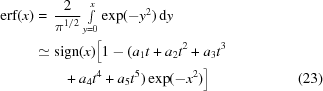
The expression of (13) does not have an analytical solution. However, it can be evaluated by using an approximation of the Gaussian error function, erf,

Several approximations of erf are given by Abramowitz & Stegun (1972). The approximation used in this work, which has been coded in  , has a maximum error of 1.5×10⁻⁷ and is described in Appendix A.
Figs. 1(a) and 1(b) show for and intervals of [0;  ] and [−2.5
 ; ] and illustrate the increase of the maximum intensity with and the dependence of profile skewness as a function of , respectively. These profiles are observed for very short positive and negative delay times when the pump and probe pulses overlap (Fig. 2a). Fig. 2(b) shows that the profile asymmetry becomes more significant as increases.
![[Figure 1]](vv5035fig1thm.gif) | Figure 1 Three-dimensional plot of as a function of the relative delay time  and the relative lifetime and the relative lifetime  . . |
![[Figure 2]](vv5035fig2thm.gif) | Figure 2 Plots of pump–probe signals for different relative delay times (a) and of as a function of for different relative lifetimes (b). In (a) the grey curves (green online) represent the laser pump pulse and the black curves (blue online) the X-ray probe pulse. In (b) the full curves represent the original model, and the dashed ones the approximated  model. The parameter model. The parameter  is ∼40 ps in our experiments. The parameter is the delay time between laser pump and X-ray pump pulse maxima. is ∼40 ps in our experiments. The parameter is the delay time between laser pump and X-ray pump pulse maxima. |
The values for the approximation  are also plotted in Fig. 2(b). The model profiles differ somewhat near their maxima. However, in both cases the maximal intensity is reached at almost the same time point
  even for large .
4. Methods for estimating τ
To assure sufficient precision of the results the estimate of the excited-state lifetimes will require closely spaced sampling of for each of the frames collected and repeated measurements. As single pulse measurements are very rapid, this is entirely feasible.
Depending on the relative lifetime ( ), two different strategies can be used. From a mathematical point of view the model is valid for any reflection. Nevertheless, in practice, reflections for which absolute
  values are large should be selected in order to optimize the precision of .
4.1. Quick estimation of τ based on the position of the maximum
For each reflection used, a estimate can be deduced from the position of the maximum.
The derivative of [equation (13)] as a function of can be expressed by interchanging the derivation and integration operators as
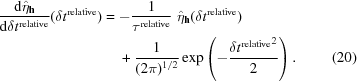
When  ,
,  and at this point the
  value becomes

Knowing  , can be refined to satisfy equation (21) (Fig. 3). We introduce the function f, which relates to . This function cannot be evaluated analytically, but can be approximated as
  as described in Appendix B. Its standard deviation can be obtained from the distribution of the estimates from the individual reflections.
![[Figure 3]](vv5035fig3thm.gif) | Figure 3 Plot of the relative lifetime as a function of the relative delay time  , with the instant at which is maximal. The black line (blue online) corresponds to the original model, and the grey line (orange online) to the approximated model. , with the instant at which is maximal. The black line (blue online) corresponds to the original model, and the grey line (orange online) to the approximated model. |
The relative uncertainty in  ,
,  , is related to the relative uncertainty in ,
  , as explained in Appendix B.
Fig. 4 shows that the ratio of the relative uncertainties in  and
and  ,
,  , plotted as a function of , increases with and
  or
or  . It follows from the
  profile that the uncertainties are different for short- and long-lifetime . Thus the uncertainties in increase with . A more precise estimate can be obtained by refinement of a model of the system response as a function of
  as described in the following section.
![[Figure 4]](vv5035fig4thm.gif) | Figure 4 Plot of  , the ratio of the relative uncertainties in and , with the instant at which is maximal. is drawn as a function of . The corresponding values are also given on the x axis. The orange dotted line corresponds to the constant function , the ratio of the relative uncertainties in and , with the instant at which is maximal. is drawn as a function of . The corresponding values are also given on the x axis. The orange dotted line corresponds to the constant function  . . |
4.2. Least-squares fitting of the ηh function
A more precise procedure is to perform a global least-squares (LS) fitting of the model against the full set of values collected for  different reflections with different , with, as variables, plus multiplicative factors (one per reflection). The minimized LS error function
  will be

If intensities are collected with a significant redundancy, a weighting scheme can be introduced using  to give
  .
.
Finally, if the preliminary plots of values as a function of reveal a monotonic decreasing of , the LS fitting can be based on the simple exponential decay of .
5. Conclusions and perspectives
The measurement of an excited-state lifetime using photocrystallographic techniques is an alternative to spectroscopic methods for subnanosecond lifetimes, provided sufficient precision is achieved by repeated measurement if necessary. Furthermore, it allows the measurement of lifetimes of non-luminescent excited states, which is of importance when the emission is quenched by non-radiative processes. In all cases it is necessary to closely sample .

APPENDIX B
Approximation of τ as a function of δtmax
In §4.1 we introduce a quick estimation method of based on the estimate. The function f which gives, for each , the corresponding is unknown. However, some characteristics of f can be obtained.
B1. Asymptotic behavior of f
The following relation between and can be deduced from equations (15) and (21),

with  .
.
The asymptotic behaviors of f at and at 0+ (the positive side of 0) can be deduced from this expression (see supplementary material1).

and

B2. Approximation function f~
Taking into account the asymptotic behaviors of f, an approximation can be defined as
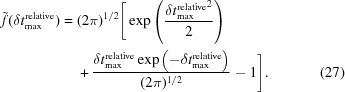
f and  share the same asymptotic behaviors. The absolute error remains reasonable, even for large . For instance, for
  , f(2.65) = 80, while
  . For all
  , the relative error of is smaller than 4%.
 is the derivative of

 as
as
Acknowledgements
Support of this work by the National Science Foundation (CHE0843922) is gratefully acknowledged.
References
 Abramowitz, M. & Stegun, I. A. (1972). Handbook of Mathematical Functions with Formulas, Graphs, and Mathematical Tables. New York: Dover. Google Scholar
Ben-Nun, M., Cao, J. & Wilson, K. R. (1997). J. Phys. Chem. A, 101, 8743–8761. CAS Google Scholar
Cao, J. & Wilson, K. R. (1998). J. Phys. Chem. A, 102, 9523–9530. Web of Science CrossRef CAS Google Scholar
Cerullo, G., Manzoni, C., Luer, L. & Polli, D. (2007). Photochem. Photobiol. Sci. 6, 135–144. Web of Science CrossRef PubMed CAS Google Scholar
Coppens, P., Pitak, M., Gembicky, M., Messerschmidt, M., Scheins, S., Benedict, J., Adachi, S., Sato, T., Nozawa, S., Ichiyanagi, K., Chollet, M. & Koshihara, S. (2009). J. Synchrotron Rad. 16, 226–230. Web of Science CrossRef CAS IUCr Journals Google Scholar
Fullagar, W. K., Wu, G., Kim, C., Ribaud, L., Sagerman, G. & Coppens, P. (2000). J. Synchrotron Rad. 7, 229–235. Web of Science CrossRef CAS IUCr Journals Google Scholar
Gawelda, W., Pham, V.-T., Benfatto, M., Zaushitsyn, Y., Kaiser, M., Grolimund, D., Johnson, S. L., Abela, R., Hauser, A., Bressler, C. & Chergui, M. (2007). Phys. Rev. Lett. 98, 057401. Web of Science CrossRef PubMed Google Scholar
Golubev, A. (2010). J. Theor. Biol. 262, 257–266. Web of Science CrossRef PubMed CAS Google Scholar
Haldrup, K., Harlang, T., Christensen, M., Dohn, A., van Driel, T. B., Kjær, K. S., Harrit, N., Vibenholt, J., Guerin, L., Wulff, M. & Nielsen, M. M. (2011). Inorg. Chem. 50, 9329–9336. Web of Science CrossRef CAS PubMed Google Scholar
Lan, K. & Jorgenson, J. W. (2001). J. Chromatogr. A, 915, 1–13. Web of Science CrossRef PubMed CAS Google Scholar
Makal, A., Trzop, E., Sokolow, J., Kalinowski, J., Benedict, J. & Coppens, P. (2011). Acta Cryst. A67, 319–326. Web of Science CSD CrossRef CAS IUCr Journals Google Scholar
Vorontsov, I. I. & Coppens, P. (2005). J. Synchrotron Rad. 12, 488–493. Web of Science CrossRef CAS IUCr Journals Google Scholar
© International Union of Crystallography. Prior permission is not required to reproduce short quotations, tables and figures from this article, provided the original authors and source are cited. For more information, click here.
| JOURNAL OF SYNCHROTRON RADIATION |


