

 journal menu


research papers
 | JOURNAL OF SYNCHROTRON RADIATION |
Analytic expressions for the angular and the spectral fluxes at Compton X-ray sources

aLaboratoire de l'Accélérateur Linéaire, Orsay, France
*Correspondence e-mail: [email protected]
The goal of this paper is to express simply the number of photons impinging on a target in the framework of accelerator-based Compton X-ray sources. From the basic kinematics of Compton sources, analytic formulas for the angular and the spectral fluxes are established as functions of the energy spread or/and the angular divergence of the electron and the laser beams. Their detailed predictions are compared with Monte Carlo simulations. These analytic expressions allow one to compute in a simple and precise way the X-ray in a given angular acceptance and a given energy bandwidth, knowing the characteristics of the incoming beams.
Keywords: Compton scattering; angular flux; spectral flux; electron beam; divergence; energy spread.
1. Introduction
Today, Compton X-ray sources are in full development thanks to the exceptional improvement of high-power lasers over the last 15 years. The principle is based on the production of X-ray pulses of a few tens of keV in energy by Compton backscattering of intense laser light of micrometric wavelength against an electron bunch of tens of MeV in energy (i.e. about 100 times less energetic than electrons used to produce synchrotron radiation in the X-ray range). Such Compton sources are compact installations (with areas of ∼100 m2) which provide high-intensity, high-quality X-ray beams with a tunable energy. The present most ambitious projects aim at producing a total flux of 1012– 1014 photons s−1 (Jacquet, 2014![[Jacquet, M. (2014). Nucl. Instrum. Methods Phys. Res. B, 331, 1-5.]](../../../../../../logos/arrows/s_arr.gif "Jacquet, M. (2014). Nucl. Instrum. Methods Phys. Res. B, 331, 1-5.") ) that gives access to experimental methods currently used at synchrotron beamlines. For various applications, the development of these sources will allow the use of powerful analysis techniques in such environments as hospitals, laboratories or museums. The diversity of the possible applications of these sources increases the demand for a simple formulation of the X-ray flux available at a target sample with an intuitive understanding of its spectral and spatial properties. Our motivation is to guide the users when evaluating the performances of such sources in their domain of competence (medical, materials, art history, etc.). Indeed, to our knowledge, there is no analytic formulas in the literature describing angular and spectral X-ray fluxes expected from a given Compton source. There are some analogies between synchrotron radiation sources and Compton sources, but the spectral and the spatial properties are different. Thus, Compton backscattering sources need a specific description. Our analytic formulas provide the flux within a finite polar angle around the electron beam direction and within a finite bandwidth around the Compton edge. The energy spread and the angular divergence of the electron beam and of the laser affect the X-ray flux in the chosen kinematic region. The estimation of such effects is the purpose of this article. The analytic expressions are obtained by convolving purely kinematic effects with expressions that characterize the laser and the electron beam properties.
) that gives access to experimental methods currently used at synchrotron beamlines. For various applications, the development of these sources will allow the use of powerful analysis techniques in such environments as hospitals, laboratories or museums. The diversity of the possible applications of these sources increases the demand for a simple formulation of the X-ray flux available at a target sample with an intuitive understanding of its spectral and spatial properties. Our motivation is to guide the users when evaluating the performances of such sources in their domain of competence (medical, materials, art history, etc.). Indeed, to our knowledge, there is no analytic formulas in the literature describing angular and spectral X-ray fluxes expected from a given Compton source. There are some analogies between synchrotron radiation sources and Compton sources, but the spectral and the spatial properties are different. Thus, Compton backscattering sources need a specific description. Our analytic formulas provide the flux within a finite polar angle around the electron beam direction and within a finite bandwidth around the Compton edge. The energy spread and the angular divergence of the electron beam and of the laser affect the X-ray flux in the chosen kinematic region. The estimation of such effects is the purpose of this article. The analytic expressions are obtained by convolving purely kinematic effects with expressions that characterize the laser and the electron beam properties.
The basic principles of a Compton source, the kinematics and our calculation framework are described in §2. The performances of current laser systems are such that the main impact on the Compton source characteristics comes from the angular divergence  and the energy spread
  of the incident electron beam. The latter may vary widely depending on the chosen accelerator complex (see §2.2). Analytic expressions for the total X-ray flux and for its angular and spectral dependences are established in §3 and §4 as functions of these two electron beam parameters and compared with Monte Carlo simulations.
2. Key parameters for the X-ray flux
This section introduces the key parameters needed to understand the analytic developments that follow.
2.1. The Compton process
Fig. 1 describes the Compton scattering between a free relativistic electron of Lorentz factor γ and a photon of energy  which is the basic process exploited in an accelerator-based X-ray source.
![[Figure 1]](yn5010fig1thm.gif) | Figure 1 Schematic drawing of the scattering process between an electron and a laser photon. xyz is the laboratory frame. |
Electrons of a few tens of MeV are used in X-ray sources whereas the laser is usually in the infrared domain. In the laboratory frame, the scattered photon energy  varies quadratically with the electron energy and linearly with the laser photon energy . Assuming
  and the laser photon energy is small compared with the energy, we can derive from the kinematics of the process
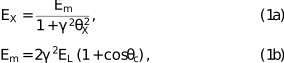
where  is the collision angle and
  the scattering polar angle of the Compton photon with respect to the incoming electron momentum. Equation (1a) implies an univocal dependence between the energy of the backscattered photon and its emission angle . Photons of maximum energy
  are those emitted on-axis ( = 0°). For an X-ray which is produced by an electron of Lorentz factor γ, let ɛ be the ratio of and . The dependence on ɛ of the normalized differential
  can be expressed as (Telnov, 2000)
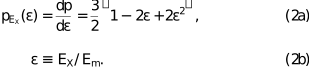
Equations (1a), (1b), (2a) and (2b) will be the key relations used to establish the analytic expressions for the X-ray in a given spectral bandwidth or/and within a given angular acceptance, and to quantify the reduction of the angular and spectral fluxes due to the energy spread and the angular divergence of the two colliding beams.
The Compton X-ray sources involve multi-collisions between a laser pulse and an electron bunch. Thus, to establish the total X-ray we need to take into account the laser pulse and the electron bunch sizes. Let  and
and  be, respectively, the number of electrons per bunch and the number of photons per laser pulse, and let
  ,
,  and
and  be the transverse and longitudinal dimensions (r.m.s.) of the electron bunch and laser pulse at the interaction point. Assuming the electron beam and the laser have Gaussian distributions in the three dimensions, for electron–photon collisions taking place with a crossing angle in the xz plane, the number of X-ray produced per second is (Suzuki, 1976)

 is proportional to the Thomson
  , the luminosity and the repetition frequency of the interactions
  . High X-ray fluxes are foreseen in various projects. For example, ThomX (Variola et al., 2014)) foresees F(0) ≃ 1013 photons s−1 with = 45 keV for a 50 MeV electron bunch (
 = 100) of 1 nC, micrometric wavelength laser pulses of 10 mJ, = 20 MHz, and
  ≃ 40 µm.
Expression (3) will be our reference hereafter referred to as  .
.
2.2. X-ray spectral bandwidth
Relations (1a) and (1b) imply that the X-ray energy spectrum produced by electrons and photons whose energies are single-valued is strictly monochromatic at a given emission angle. But the energy dispersion and the angular divergence of the stored electrons and, to a lesser extent, of the photons at the interaction point lead to a significant broadening of at a given scattering angle .
The relative energy spreads (r.m.s.) of an electron bunch and of a laser pulse will be denoted by and  , while their angular divergences (r.m.s.) will be denoted by and
  (assuming that the horizontal and the vertical divergences are equal). The order of magnitude of the broadening
  of the on-axis Compton spectrum due to each one of these four parameters can be estimated from equations (1a) and (1b) by replacing γ, ,
  and with
  ,
,  ,
,  and
and  , respectively, and performing four Taylor series expansions of equation (1a) in , , and , resulting in:
 , ,
, ,  and
and  due to , , and , respectively.
We will give now orders of magnitude for these , , and parameters for current electron guns and pulsed lasers:
(i) The normalized horizontal and vertical emittances  and
and  of ∼1 nC bunches delivered by good quality current electron guns are 1–5 mm mrad (Arnold & Teichert, 2011; Rao & Dowell, 2013). With these values, transverse sizes and normalized divergences are typically
  ≃ 20–100 µm and
  ≃ 0.01–0.25 rad, respectively.
(ii) Concerning , the electron beam relative energy spread, current values at electron accelerators are of a few  up to a few percent.
(iii) On the laser side, the product of  , the r.m.s. energy bandwidth of the pulse, and
  , its r.m.s. temporal duration, is constrained by the uncertainty principle (Donnelly & Grossman, 1998)

 . Unchirped pulses have the minimum time-bandwidth product, i.e. close to , whereas larger values prevail for chirped pulses. Then, let us consider a laser with a wavelength λ, and an r.m.s. pulse duration . Assuming unchirped pulses, one derives from the uncertainty principle:
 =
=  , where c is the speed of light. It follows that infrared fs–ps pulses have a relative energy spread of a few
  (for 10 ps pulses) up to a few (for 100 fs pulses).
(iv) In good quality lasers with Gaussian pulses, the relation between the r.m.s. transverse pulse sizes  ,
,  and the angular divergence is
  =
=  =
=  (Schmüser et al., 2008), leading to the following typical values:
  ≃ 10–100 µm and ≃ 1–10 mrad (infrared laser).
Table 1 summarizes these orders of magnitude and the corresponding broadening of the Compton spectrum . The spectrum broadening due to the laser bandwidth is negligible, as well as the broadening due to the laser divergence if the product  is smaller than ∼1 mrad, which is the case in almost all current Compton projects where electrons and laser photons collide head-on (Jacquet, 2014). We conclude that is mainly governed by the angular divergence and the relative energy spread of the electron beam.
| |||||||||||||||||||||
 –
–

 –
–

 –
–
 ≃ 1–10 mrad)
 2.3. Input and notations
In this section, we introduce the probability distributions used to establish the analytic expressions of §3 and §4. The nominal Lorentz factor of the electron beam will be referred to as  . Then the Lorentz factor of a given electron is written as =
  , where
  is the difference in energy of this electron with respect to the nominal beam energy ( E0) divided by E0. With being the nominal value of the crossing angle between the electron beam and the laser in the xz plane (see Fig. 1), we define
  ,
,  ,
,  and
and  as the angles to z axis of the projections of the momentum of a given electron and of a given laser photon in the xz and yz planes. The probability distributions of ,
  and
and  are assumed to be Gaussian with standard deviations ,
  and
and  , respectively. We further assume
  =
=  = and
= and  =
=  = .
= .  (
( , respectively) is defined as the convolution of the and
  distributions (of and , respectively) and follows a Gaussian distribution whose standard deviation is
  =
=  .
.
We introduce also the polar and azimuthal angles with respect to the z-axis direction (see Fig. 2),  and
and  , of an electron momentum ( =
  , =
, =  ,
,  =
=  ), and similarly
  and
and  for a photon scattered by this electron. For small and (i.e. when
  ≃ and
≃ and  ≃ ), the polar angle of the backscattered photon with respect to the electron momentum is = +

 . Summing over azimuthal angles we obtain

The angle averaged over and expressed in (4) is the one that appears in equation (1a).
![[Figure 2]](yn5010fig2thm.gif) | Figure 2 Polar angles of an electron momentum ( ) and of a Compton photon () scattered by this electron with respect to the z-axis, and polar angle of the Compton photon with respect to the electron momentum. Note that the electron momentum is practically not affected by the collision. |
Explicitly, the probability distributions of ,  and defined in the ranges
  ,
,  and
and  , respectively, are
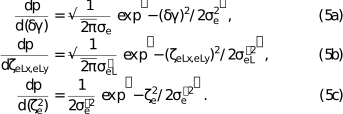
In the following sections we will obtain analytic expressions for the ratios  =
=  ,
,  =
=  ,
,  =
=  and
and  =
=  , where
  is the total
  the in a given angular acceptance α (of a few milliradians) around the z-axis direction,
  the in a given energy bandwidth (bw) centered at the on-axis X-ray energy
  =
=  , and
, and  the in a given angular acceptance and a given energy bandwidth. We will study the dependence of these ratios on the and parameters which govern the broadening of the Compton angular spectrum as discussed in §2.2, and we will confront our formulas with simulations performed with the CAIN code (Yokoya, 2003) generated with several and values, all other parameters (, ,
 ,
,  , , ,
, , ,  and
and  ) remaining fixed. In the CAIN simulations, we use = 100 (i.e. the order of magnitude to produce Compton backscattered photons in the X-ray domain), a laser wavelength
  = 1 µm, and we assume a pulse waist of 40 µm. For a full range coverage of the electron beam parameters in current accelerators (see Table 1), the and ranges used for this work are
  ≃ 0.01–0.25 rad (i.e. ≃ 0–2.5 mrad for ≃ 100) and ≃ 0–2%.
3. Spectral or angular selection
In this section, we will obtain the expression of the X-ray when one selects either the energy or the emission angle of the X-rays.
3.1. Dependence of the total flux Ftot on the electron and the laser beam angular divergences
Since we assume here that no cut is applied to the X-ray energy, the electron beam energy spread does not come into this calculation. Thus we treat here only the electron beam and the laser beam divergences. We consider the collision of an electron with a photon at a nominal crossing angle in the horizontal plane xz. The effect of the two and variables (defined in §2.3) can be treated as an additional contribution to . Indeed, for small and (i.e. when  ≃ and
≃ and  ≃ ) and by making the approximation that and are awarded only to the electron (see Fig. 3), a geometrical calculation leads to an effective electron–photon crossing angle
  such that =
  +
+ 
![[Figure 3]](yn5010fig3thm.gif) | Figure 3 Nominal ( ) and effective () electron–photon crossing angles assuming that and are awarded only to the electron. |
Then, for an electron bunch and a laser pulse of r.m.s. angular divergence and , respectively, the total flux is obtained by integrating  , weighted by the Gaussian probabilities of and [see equation (5b)]. Keeping up to the second-order terms in and results in the following expression for the ratio :
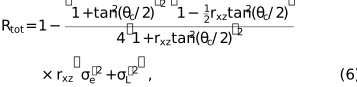
where rxz =  . For = 72 µm, = 40 µm, = 4.8 mm, = 3 mm and = 2 mrad (i.e. the laser beam divergence value corresponding to a 40 µm waist size), is shown in Fig. 4 as a function of , for = 0°, 1° and 2°, and compared with results obtained with the CAIN simulation program. The analytic expression reproduces well the differences between the various collision angle cases. A reduced collision angle amplifies the divergence impact on the total but only to a small extent, less than 1% for head-on collisions.
![[Figure 4]](yn5010fig4thm.gif) | Figure 4 The ratio = as a function of for a laser divergence = 2 mrad, for = 0° (black bullets, black line), 1° (red squares, red line) and 2° (blue open circle, blue line). Points are CAIN simulations. For each point, the error bar indicates the statistical uncertainty calculated from the number of generated events (namely ∼4.7 × 10⁵, 4.1 × 10⁵ and 3.1 × 10⁵ events for each of the eight points generated with = 0°, 1° and 2°, respectively). Lines illustrate the analytic formula [equation (6)] results. |
3.2. X-ray flux in a given energy bandwidth (Fbw)
In this section we look at the number of X-rays produced when an energy cut is applied. For this, the electron energy spread is decisive whereas  is independent of the electron beam angular divergence since no angular selection is assumed here. Also, we do not take into account the broadening of the Compton spectrum ( ≃ –
 ) that occurs in the particular case where both the laser divergence and the collision angle are large (see Table 1).
Let us consider an electron of Lorentz factor =  . The energy of a photon which is backscattered by this electron is and, according to equation (1b), the maximum value of is =
  where =
  . The ratio
  is denoted by
  . is the of photons whose lies in the interval between 1 − bw and 1 + bw. The energy probability distribution (2a) expressed as a function of becomes

Fig. 5 shows this distribution for three different cases: < 0, = 0 and > 0. Since is a quasi-linear function for larger than ∼0.65, the integral of between  and
and  can be approximated by
  . Thus is calculated in the following way (see Fig. 5):
![[Figure 5]](yn5010fig5thm.gif) | Figure 5 Differential cross section for three electron populations: electrons with positive (dotted line), with = 0 (solid line), and with negative (dashed line), as a function of the scattered photon energy = . Also represented are  (green area) and (green area) and  (area hatched in green). (area hatched in green). |
(i) Electrons with such that  < 1 − bw do not contribute to .
(ii) The contribution to of electrons having a relative energy difference such that 1 − bw <  < 1 + bw is denoted by
  and is equal to the integral of between = 1 − bw and = (green area): =
  . These electrons are denoted by
  in Fig. 5.
(iii) The contribution of electrons whose satisfies 1 + bw < is denoted by  and is equal to the integral of between = 1 − bw and = 1 + bw (area hatched in green): =
  . These electrons are denoted by
  in Fig. 5.
Assuming that the variable follows the Gaussian distribution (5a) where ≃ 0–2%, one can make the approximation ≃  and can be written
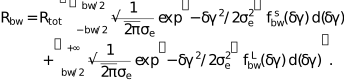
Performing a first-order Taylor expansion in , the calculation of the above integrals leads to

and is shown in Fig. 6 as a function of , for three energy bandwidths: (a) bw = 0.1%, (b) bw = 0.7% and (c) bw = 3%.
![[Figure 6]](yn5010fig6thm.gif) | Figure 6 The ratio = as a function of for three energy bandwidths: (a) bw = 0.1%, (b) bw = 0.7% and (c) bw = 3%. Points are CAIN simulations and the error bars indicate the statistical uncertainties. Lines are obtained using the analytic formula (8). |
First of all, in the absence of any energy spread, one notes a factor 3/2 compared with the classical formula used for synchrotron radiation, showing the need for a proper analytic development when dealing with Compton sources. This factor, which comes from the Compton remains whatever the selected energy acceptance. Fig. 6 shows that a linear behavior of the reduction with prevails if the selected bandwidth is small compared with (as in the 0.1% and 0.7% cases and in the right-hand region of the 3% case), whereas the remains globally constant when the energy acceptance is large with respect to (as in the left-hand region of the 3% case). In the three bandwidth cases, the small systematic difference between the CAIN simulation values and the analytic results for ≃ 2% shows that higher-order terms in have to be taken into account for values larger than 2–3%. In any event, the reduction due to the energy spread is less than 10% in the parameter range considered here.1
3.3. X-ray flux in a given angular acceptance
We now consider the within a given angular acceptance α. In this case, the effect of an energy spread is completely negligible since the mean value of vanishes.
For any value of the polar angle θ, the  product is denoted as
  . Let us consider an electron whose momentum makes a polar angle with respect to the z axis (see Fig. 2) while the photon backscattered by this electron has a polar angle . Using equations (1a), (2a) and (4), the dependence of the normalized differential Compton cross section on
  is given by

This distribution is shown in Fig. 7 for  = 0 and = 0.04. Here again, with
  being a quasi-linear function of for smaller than ∼0.15, its integral between
  and
and  can be approximated by
  . Then, as illustrated by Fig. 7, an electron contribution to is equal to
  and, according to the exponential distribution (5c) of , the ratio for an electron bunch of r.m.s. divergence = = can be simply expressed as

The calculation of equation (10) using a first-order Taylor series expansion in leads to
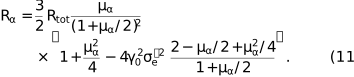
Expression (11) is valid as long as  and
and  are less than ∼0.15 and ∼0.03, respectively. For larger values of , the linear approximation of is no longer valid and the integral between 0 and must be explicitly calculated. For
  0.03, higher-order terms in have to be taken into account in the series expansion of equation (10). and points obtained with CAIN are shown in Fig. 8 as a function of (for = 100) for an anglular acceptance α of 1 mrad and 2 mrad. Equation (11) is represented by the solid lines and is in very good agreement with CAIN simulations up to ≃ 1.5 mrad. The need to take into account higher-order terms in in the modeling of for large values of is highlighted for ≃ 2 mrad. The dotted lines indicate the analytic expression results when the third-order term in is taken into account.2
![[Figure 7]](yn5010fig7thm.gif) | Figure 7 The angular differential cross section as a function of for = 0 (solid line) and for = 0.04 (dashed line). The shaded area shows the contribution to of an electron whose momentum has a polar angle . |
![[Figure 8]](yn5010fig8thm.gif) | Figure 8 The ratio = as a function of for an angular acceptance  of 1 mrad (open red circles and red line) and 2 mrad (black bullets and black line). Points are CAIN simulations (the error bars are too small to be visible). Solid lines are obtained with equation (11), dotted lines show calculated to third order in . of 1 mrad (open red circles and red line) and 2 mrad (black bullets and black line). Points are CAIN simulations (the error bars are too small to be visible). Solid lines are obtained with equation (11), dotted lines show calculated to third order in . |
4. X-ray flux within a given angular acceptance and a given energy bandwidth
In this section we assume that both an angular cut and an energy selection are applied to the backscattered photons and we calculate the consequent reduction of the X-ray In the first two subsections, the electron beam divergence and its energy spread will be treated independently to understand the impact of each one of these parameters. Then we will take into account both of these beam characteristics.
4.1. Dependence on the electron beam angular spread
Our starting point is equation (8) which gives the X-ray yield in a given energy bandwidth, and we will modify this expression to take into account the angular acceptance defined by a maximum value α of the X-ray emission direction with respect to the z axis and the electron beam angular spread. In order to achieve a single formulation, we associate an angle to the energy bandwidth, namely  =
=  . At this stage, we have to treat separately the < case and the > case, as illustrated in Fig. 9. The dashed red line represents the electron momentum direction which makes an angle with respect to the z direction. α defines the angular cut and the energy acceptance translated into an angle. More precisely, to the energy bandwidth (or energy acceptance) bw corresponds an angular acceptance which is a cone whose axis is the momentum of the electron which backscatters the incoming photon and whose half aperture is . In Fig. 9, those X-rays which pass both the angular and the energy cuts are the ones emitted in the green domain. The hatched regions show emission directions which are outside the X-ray angular acceptance cone of aperture α. The accepted region depends on the three angles involved in the following way:
![[Figure 9]](yn5010fig9thm.gif) | Figure 9 Top: the > case where =  . Three configurations are shown: (a) < . Three configurations are shown: (a) <  , (b) < < , (c) < < , (b) < < , (c) < <  . Bottom: the < case. (d) < . Bottom: the < case. (d) <  , (e) < < , (f) < < . , (e) < < , (f) < < . |
(i) For > (see upper panels in Fig. 9) and values of such that < , all the X-rays whose energy belong to the accepted bandwidth pass the angular cut [case (a)]; when increases, the cone intersection diminishes and depends on whether is larger than α or not [(b) and (c) cases];
(ii) For < (see lower panels in Fig. 9), the cone intersection is reduced as the electron angular spread increases and depends on whether is larger than or not [(e) and (f) cases].
To take into account the various cases enumerated above, we introduce the following two angles:  =
=  and
and  =
=  . Then, using the probability distribution of equation (5c), an integration is performed for each of the three cases and the number of X-rays backscattered in the angular acceptance α and within a given energy bandwidth bw is given by the following expression:

where is given by equation (8) with ≃ 0, i.e. =  . Equation (12) leads to the following analytic expression for :
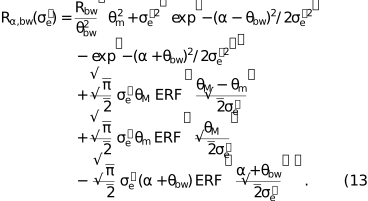
CAIN simulations and results from equation (13) are shown in Fig. 10 where is plotted against the angular divergence for several values of the acceptance angle α and several values of the energy bandwidth bw.
![[Figure 10]](yn5010fig10thm.gif) | Figure 10 The ratio = plotted as a function of (assuming = 0) for = 1 mrad (open circles) and 2 mrad (black bullets) and for (a) bw = 0.1%, (b) bw = 0.7% and (c) bw = 3%. Lines show the results of equation (13) while points illustrate CAIN simulations (the error bars are too small to be visible). |
4.2. Dependence on the electron beam energy spread
We now assume = 0 mrad and we focus on the dependence of on the energy spread of the electrons. We start again with the ratio of the X-ray within a given energy bandwidth bw [see equation (8)] and F0, the X-ray flux in the `ideal' case where = = 0 [see equation (3)]. We assume that an angular selection α is applied. Only the first-order term in will be kept (where is defined in §3.2). The quantities  and
and  are denoted by
  and , respectively. Then, depending on the relative values of and bw, three configurations have to be distinguished: (i) bw < < 2bw, (ii) 2bw < and (iii) < bw. Case (i) is illustrated in Fig. 11. In this figure, the energy bandwidth is assumed to be centered at = 1. The left panels correspond to negative, the right ones to positive. Hatched areas represent X-rays whose energy is within the selected energy bandwidth but which are rejected by the angular cut. As shown in this figure, the size of the overlap between the energy and the angular acceptance one depends on bw, α and in the following way:
![[Figure 11]](yn5010fig11thm.gif) | Figure 11 X-ray energy spectrum. The fraction of this spectrum which falls within the energy acceptance band is shown in green. The hatched bands represent X-rays which are eliminated because of the angular cutoff. Left panels correspond to negative, right ones to positive. (a) and (b) illustrate the cases where 0 < <  , (c) and (d) where < < bw, and (e) and (f) where bw < < bw + . , (c) and (d) where < < bw, and (e) and (f) where bw < < bw + . |
(i) For increasing values of  , as long as + bw < , all X-rays accepted in the energy band are emitted within the angular acceptance α as shown in panels (a) and (b).
(ii) For − bw < < bw, the fraction of X-rays remaining in the angular acceptance band is (bw − +  [see panels (c) and (d)].
(iii) The same fraction of X-rays pass the angular cut when bw < < bw + [panels (e) and (f)].
Similarly, the fraction of X-rays remaining in the band in the configuration (ii) defined above is 1 and  for < − bw and − bw < < bw + , respectively. In the (iii) configuration, this fraction is
  for < bw − and (bw − + for bw − < < bw + .
From this and from equation (5a) which implies the following probability distribution,

the following expression of as a function of can be derived:
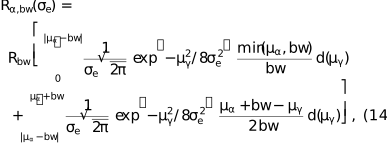
where is given by equation (8). In the calculation of equation (14), a simplification occurs which makes the dependence on min disappear, resulting in
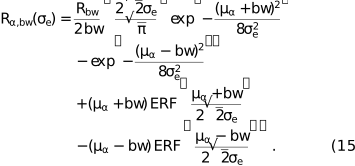
CAIN simulations and results from equation (15) are displayed in Fig. 12 where is plotted as a function of for several values of the angular and the energy acceptances.
![[Figure 12]](yn5010fig12thm.gif) | Figure 12 The ratio = versus , for = 1 mrad (open circles) and 2 mrad (black bullets), and for (a) bw = 0.1%, (b) bw = 0.7% and (c) bw = 3%. = 0 is assumed here. Lines are obtained by using the analytic expression (15) while points are CAIN simulations (the error bars are too small to be visible). |
4.3. Combined effect of the energy spread and the angular divergence of the electron beam
When both and must be taken into account to calculate the ratio  , this analytic formulation encounters a severe limitation for the following reason. When the incoming photons are backscattered by electrons whose energies are distributed according to equation (5a), one may try to compute the X-ray flux in a way similar to that carried out in §4.1. The bw term which comes in the definition would have to be replaced by bweffective = bw +
  , where is defined in §3.2. This would lead to an equation similar to equation (12) with the parameter occurring in the integrants and in the integrals' limits. The integration over could still be performed, but the next step, namely an integral over that takes into account the distribution [equation (5a)], cannot be performed analytically. Nevertheless, very good approximations can be obtained by employing equations previously established in this paper.
Indeed, if the electron beam angular divergence plays a dominant role with respect to the energy spread in the calculation of the X-ray flux within some acceptance cuts, a good approximation of is obtained by using equation (13) and assuming =  , where
  is the quadratic sum of bw and the standard deviation of : bweff =
  . On the contrary, when the electron beam energy spread is dominant with respect to the angular divergence, equation (15) must be used wherein the quantity
  is replaced by the quadratic sum of
  and , resulting in the substitution
  +
+  .
.
CAIN simulations and results of the modified equations (13) or (15) are shown in Fig. 13 for several values of α and bw. The discontinuities seen in the lines mark the use of equations (15) or (13) with the appropriate adaptation described above. When + bw <  , equation (15) is used wherein is replaced by + . Otherwise, equation (13) is used where bw is replaced by .
![[Figure 13]](yn5010fig13thm.gif) | Figure 13 The ratio = as a function of , for an electron energy spread of 0.5% (circles) and 1.5% (squares) and for a selection angle of 1 mrad (open symbols) and 2 mrad (full symbols). (a) bw = 0.1%. (b) bw = 0.7%. (c) bw = 3%. Lines are the analytic calculations (see text), points are CAIN simulations (the error bars are too small to be visible). |
5. Additional comments and conclusion
We have derived analytic expressions for the total, the spectral and the angular X-ray fluxes of a Compton source according to the Compton kinematics and to the characteristics of the incoming electron and laser beams. The two dominant parameters governing the quality of such a source are the electron beam energy spread and its divergence. We point out a limitation of the analytic calculation of the in a given energy bandwidth and a specified solid angle when both the energy spread and the divergence of the electron beam must be taken into account in the calculation. Nevertheless, the expressions of obtained when either the energy spread or the angular divergence of the electron beam is taken into account can still be used with an appropriate modification.
Analytic expressions (11), (13) and (15) provide the photon yield within a given angular acceptance [equation (11)] and the photon yield within both a given angular acceptance and a given energy bandwidth [equations (13) or (15)]. Table 2 summarizes the validity domains of these equations in terms of the selected Compton kinematic region and according to the energy spread and the angular divergence of the two incoming beams as long as they are within the parameters ranges of current electron and laser beams (see Table 1).
 ≃ 1–10 mrad, is valid but is overestimated by ∼0.5–5% via the term (see §3.2). ≃ 1–10 mrad, is valid but is overestimated by ∼0.5–5% via the term (see §3.2). | |||||||||||||||||||||||||||||||||||||||||||
 (rad)
(rad) (rad)
(rad) (mrad)
Within the large spectrum of X-ray applications in biomedical, cultural heritage or material science, specific X-ray beams are required depending on the analysis technique and the sample to be used. For instance, a narrow energy bandwidth is required in most of the X-ray diffraction experiments (Dik et al., 2008) whereas therapy techniques such as stereotactic radiation therapy (Jacquet & Suortti, 2015) can relax the constraint on the spectral width. Thus, for an incoming electron beam with a given emittance, it may be beneficial to minimize its transverse size even at the expense of its divergence. This could be the case for instance in experiments where a large X-ray number is the main requirement, or when an as small as possible source size is needed to carry out some analysis technique (such as phase-contrast imaging techniques). On the other hand, the electron beam divergence may be minimized at the expense of the transverse size when a quasi-monochromatic X-ray beam is required.
Analytic formulas (11), (13) and (15) allow one to compute easily the spectral and spatial properties of an X-ray source based on photon backscattering, and highlight the beam parameters that play a key role for a given application. They should help when studying the feasibility of a particular experiment envisaged at some X-ray source.
Footnotes
1In the particular case of a Compton machine design such that ≃ 1–10 mrad, the effect of the laser divergence leads to a reduction of from a few per million to a few percent depending on , and bw. The largest effect occurs for = 90° and ≃ 10 mrad and would result for instance in a decrease of R0.1% and R3% by about 5% and 1%, respectively.
2We do not give here the expression of this third-order analytic formula since it is relatively heavy and since equation (11) reproduces sufficiently well the simulations in our parameter range.
Acknowledgements
The authors are warmly grateful to Professor Jacques Haissinski for the many discussions and for his careful reading of the paper.
References
 Arnold, A. & Teichert, J. (2011). Phys. Rev. ST Accel. Beams 14, 024801. CrossRef Google Scholar
Dik, J., Janssens, K., Van Der Snickt, G., van der Loeff, L., Rickers, K. & Cotte, M. (2008). Anal. Chem. 80, 6436–6442. Web of Science CrossRef PubMed CAS Google Scholar
Donnelly, T. D. & Grossman, C. (1998). Am. J. Phys. 66, 677. CrossRef Google Scholar
Jacquet, M. (2014). Nucl. Instrum. Methods Phys. Res. B, 331, 1–5. Web of Science CrossRef CAS Google Scholar
Jacquet, M. & Suortti, P. (2015). Phys. Med. 31, 596–600. Web of Science CrossRef PubMed Google Scholar
Rao, T. & Dowell, D. H. (2013). An Engineering Guide to Photoinjectors, https://arxiv.org/ftp/arxiv/papers/1403/1403.7539.pdf. Google Scholar
Schmüser, P., Dohlus, M. & Rossbach, J. (2008). Ultraviolet and Soft X-ray Free-Electron Lasers. Berlin: Springer. Google Scholar
Suzuki, T. (1976). KEK Technical Report 76–3, July 1976. KEK, Tsukuba, Japan. Google Scholar
Telnov, V. (2000). Nucl. Instrum. Methods Phys. Res. A, 455, 80–89. CrossRef CAS Google Scholar
Variola, A., Haissinkski, J., Loulergue, A. & Zomer, F. (2014). ThomX Technical Design Report. LAL/RT 14–21. SOLEIL/SOU-RA-3629. Google Scholar
Yokoya, K. (2003). User's Manual of CAIN, https://lcdev.kek.jp/~yokoya/CAIN/cain235/CainMan235.pdf. Google Scholar
© International Union of Crystallography. Prior permission is not required to reproduce short quotations, tables and figures from this article, provided the original authors and source are cited. For more information, click here.
| JOURNAL OF SYNCHROTRON RADIATION |


