


 menu
menu


issue contents
July 2026 issue
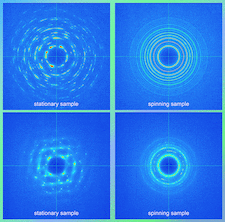
Cover illustration: Diffraction patterns of low-temperature (α) and high-temperature (δ) body-centred cubic phases of pure Fe, processed in electromagnetic levitation facility (see Shuleshova, Kaban, Ziller, Reinhold, Dippel, Gutowski and von Zimmermann, pages 1022–1035). Comparison of stationary and rotating samples illustrates the effect of spinning, where distinct single-crystal or polycrystalline features are averaged into powder-like diffraction rings, improving quantitative analysis while reducing microstructural information.
editorial


Open  access
access
Short Communications articles in Journal of Synchrotron Radiation – rapid dissemination of novel and impactful results.
research papers

Open access
access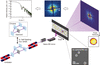
This study demonstrates that the superior coherence of narrow-bandwidth self-seeded X-ray pulses significantly improves the quality and reliability of image reconstruction in coherent diffraction imaging compared with conventional broad-bandwidth SASE pulses. These findings highlight the critical role of spectral purity in achieving high-fidelity lensless imaging with X-ray free-electron lasers.
Open access
access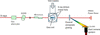
The transmission of air, which is used to contain X-ray beams for radiation safety, is observed to significantly increase with X-ray power.
Open access
access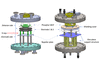
The performance evaluation and improvement of an X-ray ionization beam position monitor for soft X-ray free-electron lasers is presented.
Open access
access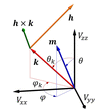
We present a unified analytical framework for Mössbauer synchrotron and X-ray free-electron laser sources that provides exact, rotationally invariant expressions for resonance energies and transition probabilities in mixed magnetic dipole–electric quadrupole interactions without Hamiltonian diagonalization. The invariant formalism enables efficient modeling and quantitative identifiability analysis, demonstrating that polarization control—especially orthogonal linear polarizations—significantly enhances the determination of hyperfine parameters in complex materials.
Open access
access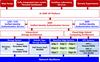
The Big Data Science Center at the Shanghai Synchrotron Radiation Facility has developed a user-friendly centralized superfacility platform that integrates the entire large scientific facility lifecycle into a single accessible solution for users, while ensuring that the data lifecycle remains compliant with the findability, accessibility, interoperability and reuse principles. By leveraging AI-enabled big data frameworks, this unified user-centric platform transforms user experience by shifting focus from complex operations to scientific discovery, thereby considerably enhancing the accessibility of the facility to users and accelerating the pace of their discoveries.
Open access
access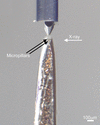
This work presents a software-level integration of nanoindenter control directly into a beamline control system, enabling fully synchronized and automated in situ experiments through unified, real-time coordination of mechanical loading and X-ray nanodiffraction measurements.
Open access
access
For adaptive X-ray optics on high-performance beamline optical systems, we describe an approach to mirror figure and slope control using patterned, shaped electrodes to control the local curvature on a lithium niobate substrate from a single applied voltage. Longitudinally continuous electrode patterns achieve target shapes without discontinuities, and compound electrodes enable multiple target shapes to be achieved on a single substrate.
Open access
access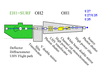
This paper presents a beamline setup that allows the combination of in situ powder X-ray diffraction (PXRD) and X-ray absorption near-edge structure (XANES) measurements within a single experimental cycle to investigate cobalt catalyst structures and properties under real conditions.
Open access
access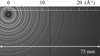
Lapped Si(111) crystals in a double-crystal monochromator provide high-flux, spectrally pure, and moderate-bandwidth X-ray beams at 100 keV, offering a robust and cost-effective alternative to perfect-crystal and multilayer optics.
Open access
access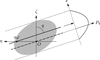
A computed-tomography method using full-rotation rocking curves is developed to characterize 100 keV X-ray beams from lapped Si(111) crystals, revealing systematic wavelength broadening while maintaining constant angular divergence in DuMond space.
Open access
access
The characterization of a silicon carbide free-standing membrane resistive detector for spot-size-independent X-ray beam position monitoring in transmission is presented.
Open access
access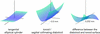
We present the analytic equations for a new grazing-incidence mirror surface, a sagittal collimating diaboloid, and illustrate its advantages for higher-throughput soft X-ray spectrometer design.
Open access
access
Gepta-EX is a compact seven-channel high-purity germanium detector designed to deliver high-resolution fluorescence X-ray absorption fine-structure measurements at photon energies where silicon detectors become effectively transparent. It provides excellent energy resolution across a broad energy range, avoids silicon escape-peak artifacts, and offers uniform multi-channel performance, enabling reliable high-energy X-ray absorption studies of advanced materials.
Open access
access
A mobile electromagnetic levitator combined with time-resolved synchrotron X-ray diffraction enables in situ studies of high-temperature phase transformations without container-induced contamination and reveals the first direct observation of metastable phase formation in undercooled Fe–Co alloys.
Open access
access
Most cancer patients will be treated by radiotherapy, and recent findings suggest that delivering radiation at `FLASH' ultra-high dose rates reduces damage to healthy tissues while still damaging the tumour. This project experimentally validates the reduced healthy tissue damage of FLASH radiotherapy on cells using synchrotron-based beams, which will support future clinical trials and ultimately leading to its application in cancer treatment.
Open access
access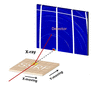
This article demonstrates that microbeam GIWAXS (µ-GIWAXS) effectively overcomes the distorting footprint effects of conventional GIWAXS analysis of perovskite films. This advancement not only delivers higher reciprocal-space resolution data but also unlocks the unique capability to spatially map microstructural inhomogeneity, which is vital for the scalable manufacturing of perovskite optoelectronics.
Open access
access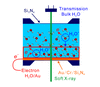
Simultaneous measurement methods have been developed for soft X-ray absorption spectroscopy of solid–liquid interfaces using the electron-yield method and bulk liquids using the transmission method.
Open access
access
Two complementary high- and low-temperature experimental setups have been developed at the AILES beamline of Synchrotron SOLEIL to enable infrared and terahertz spectroscopy of submillimetric samples under extreme and well controlled pressure and temperature conditions (from 10 K to 600 K and from vacuum up to 100 GPa). The ensembles are compatible with a variety of sample environments, as liquid cells, diamond anvil cells and uniaxial strain devices.
Open access
access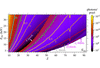
We present calculations on the number of illuminating photons per pixel required for elemental detection using X-ray fluorescence, even with far-from-threshold excitation.
Open access
access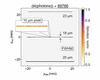
We propose an aberration-corrected, wavelength-dispersive instrument for soft X-ray spectroscopy at an energy-resolving power of (5–6) × 104, designed for, for example, resonant inelastic X-ray scattering at synchrotron beamlines or X-ray free-electron lasers.
Open access
access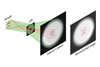
The full-field X-ray fluorescence imaging method, where a Fresnel zone plate is employed as a coded aperture, was tested for the first time at a beamline, and its corresponding reconstruction code was optimized. It was also employed to perform, also for the first time using full-field and fluorescence modes, hyperspectral XANES mapping.
Open access
access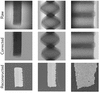
As tomographic datasets from synchrotrons continue to increase in volume, so rises the challenge of reconstructing said data. Here we present a solution utilizing high-performance computing capabilities to split the process into multiple smaller tasks, which can be solved without overwhelming a single compute node. This solution is currently in use at the DanMAX beamline at the MAX IV synchrotron.
Open access
access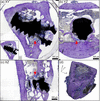
This work demonstrates virtual staining for 3D X-ray histology using a modified CycleGAN trained on paired synchrotron radiation microtomography (SR-µCT) and histology images of bone-implant specimens. The method enables the generation of artificially coloured contrast resembling conventional histological staining from label-free SR-µCT data and is scalable across entire 3D volumes without additional sample preparation.

Open access
access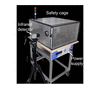
This work presents a compact induction heating system for time-resolved in situ X-ray diffraction imaging. The system enables contact-free volumetric heating up to approximately 1600°C and provides flexible operation in different operating modes. Its performance is demonstrated through representative diffraction imaging experiments.
Open access
access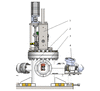
A fluorescent-target imaging and real-time beam diagnostic platform has been developed for the High Energy Photon Source (HEPS), integrating synchronized multi-camera acquisition within the Experimental Physics and Industrial Control System (EPICS) areaDetector framework, online beam-parameter extraction, and Mamba Data Worker enabled data management. The platform demonstrated stable 13-camera operation with sub-20 ms online analysis and end-to-end latency below 50 ms, supporting scalable beamline alignment, diagnostics, and future data-driven optimization at fourth-generation synchrotron facilities.
Open access
access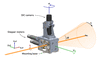
A remote miniature load frame for X-ray diffraction and imaging applications is presented. The load frame has been assessed for mechanical stability and suitability for various synchrotron X-ray-based techniques.
Open access
access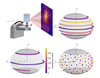
A dynamic sampling strategy is presented to reduce the measurement time required for SAXS tensor tomography while maintaining reconstruction quality.
Open access
access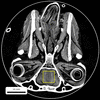
Fast eikonal phase retrieval with complementary local (sub-pixel) and non-local (multi-pixel) solvers strongly suppresses nonlinear streak artefacts in long-distance propagation-based phase-contrast micro-tomography at high computational efficiency.
Open access
access
The evolution of hierarchical phase-contrast tomography (HiP-CT) from its origins at the BM05 beamline to its transition to BM18 (ESRF-EBS) is shown. The novel hardware and scanning approach developments resulted in significantly improved data quality, resolution, sensitivity and speed. The case of whole adult brain imaging is presented to demonstrate the current possibilities of full-organ imaging with local micrometre resolution using HiP-CT.
Open access
access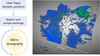
A high-throughput and automated experimental workflow for synchrotron X-ray micro-computed tomography is demonstrated. The system integrates automated robotic sample exchange and data acquisition, enabling large-scale and data-driven research.
Open access
access
Advanced synchrotron-radiation-based imaging and spectroscopic techniques were used to investigate the distribution and nature of mercury in numismatic artifacts, with a particular focus on its role in historical counterfeiting practices.
beamlines
Open access
access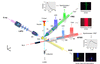
A dedicated beamline at the Advanced Light Source synchrotron has been opened and commissioned for X-ray footprinting mass spectrometry.
Open access
access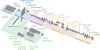
The technical aspects of the Alvra endstation are outlined and its scientific capabilities are demonstrated with commissioning results obtained during the early years of SwissFEL's operation.
computer programs
Open access
access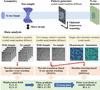
WFSuite is an open-source Python suite for speckle-based X-ray wavefront reconstruction, offering both relative metrology and absolute phase modules. It streamlines wavefront characterization and feedback control for synchrotron and XFEL applications.

