journal menu


issue contents
 | STRUCTURAL BIOLOGY |
ISSN: 2059-7983
CCP4 Study Weekend 2017
From crystal to structure with CCP4
Edited by Charles Ballard, Mike Hough and Keith Wilson
This virtual issue contains articles from the 2017 CCP4 Study Weekend.


Open  access
access
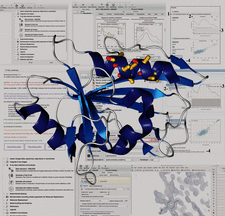
An introduction to the 2017 CCP4 Study Weekend Special Issue.
Open access
access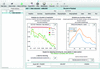
CCP4i2 is a graphical user interface to the CCP4 (Collaborative Computational Project, Number 4) software suite and a Python language framework for software automation.

Open access
access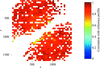
A new X-ray diffraction data-analysis package is presented with a description of the algorithms and examples of its application to biological and chemical crystallography.
Open access
access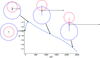
Likelihood-based SAD substructure determination can be initiated using a fast translation-search algorithm based on a linear approximation to the SAD likelihood target, followed by log-likelihood-gradient map completion.
Open access
access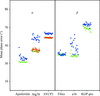
Experimental phasing of macromolecular crystals is described and explained, with the emphasis on its implementation in the programs SHELXC, SHELXD and SHELXE, which are also used in a number of macromolecular structure-solution pipelines.
Open access
access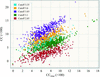
The relaxed averaged alternating reflections (RAAR) phase-retrieval method has been applied to crystallography for the first time and has been shown to outperform charge flipping in anomalous substructure determination.
Open access
access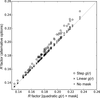
A method is described for the refinement of an electron-density model against a set of structure-factor observations which does not rely on atomic parameters. The effective level of detail in the parameterization can be varied to ensure that the refinement is well determined at any resolution supported by the data.
Open access
access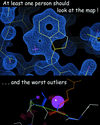
An overview is provided of current crystallographic model validation of proteins and RNA, both foundations and criteria, at all resolution ranges, together with advice on how to correct specific types of problems and when you should not try so hard that you are overfitting.
Open access
access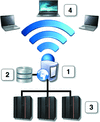
The paper describes recent CCP4 initiatives and projects aimed at bringing software and data services which utilize distributed computational resources to users.
Open access
access
Macromolecular crystallography has provided results that underpin much biological discovery and there is still scope for further development; however, a revolution in electron imaging now means that it can also routinely provide detailed atomic-level descriptions. This article attempts to tease out where crystallography is going and consider what its place might be in the new landscape.
Open access
access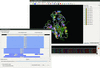
New developments in the MrBUMP pipeline, including graphical interaction with search models using CCP4mg and the use of ensemble search models, are reported.
Open access
access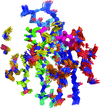
Novel ways to produce search models from distant homologues for molecular replacement are presented.
Open access
access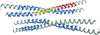
The ARCIMBOLDO method of phasing through the location of small fragments combined with density modification and autotracing is particularly suited to helical structures, but coiled coils remain challenging. Features designed for solving coiled coils at resolutions of up to 3 Å were tested on a pool of 150 structures.
Open access
access
A new pipeline to solve structures by molecular replacement with ideal protein fragments is described and benchmarked against two test sets of mixed α/β and all-β folds at relatively high resolution.
Open access
access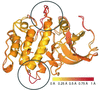
Here, a macromolecule-centred approach to three-dimensional structure determination as implemented in REFMAC5 is considered. The use of restraints to transfer chemical and structural information during macromolecular refinement, and how different sources of information can be combined in order to achieve models that are more consistent with data derived from a variety of experimental techniques, including macromolecular crystallography, cryo-EM and NMR spectroscopy, are discussed.
Open access
access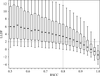
Better metrics are required to be able to assess small-molecule ligands in macromolecular structures in Worldwide Protein Data Bank validation reports. The local ligand density fit (LLDF) score currently used to assess ligand electron-density fit outliers produces a substantial number of false positives and false negatives.
Open access
access
The use of validation metrics to rank macromolecular structures, as well as a web tool to investigate trends in and correlations between different properties and validation metrics, are described.