 | Acta Crystallographica Section E Acta Crystallographica Section E CRYSTALLOGRAPHIC COMMUNICATIONS |


 journal menu


metal-organic compounds
| CRYSTALLOGRAPHIC COMMUNICATIONS |
 access
Bis(2-bromopyridinium) hexachloridostannate(IV)

aDepartment of Chemistry, Al al-Bayt University, Mafraq, Jordan, bFaculty of Science and IT, Al-Balqa'a Applied University, Salt, Jordan, and cDepartment of Chemistry, The University of Jordan, Amman, Jordan
*Correspondence e-mail: [email protected]
The of the title compound, (C5H5BrN)2[SnCl6], contains one cation and one half-anion. The [SnCl6]2− anion is located on an inversion center and forms a quasi-regular octahedral arrangement. Hydrogen-bonding interactions of two kinds, viz. N—H⋯Cl—Sn and C—H⋯Cl—Sn, along with Cl⋯Br interactions [3.4393 (15) Å], connect the ions in the crystal structure into two-dimensional supramolecular arrays. These supramolecular arrays are arranged in layers approximately parallel to (110) built up from anions interacting with six symmetry-related surrounding cations.
Related literature
The title salt is isomorphous with the Te-analogue, see: Fernandes et al. (2004![[Fernandes, R. M. Jr, de Oliveira, G. M., Lang, E. S. & Vázquez-López, E. M. (2004). Z. Anorg. Allg. Chem. 630, 2687-2691.]](../../../../../../logos/arrows/e_arr.gif "Fernandes, R. M. Jr, de Oliveira, G. M., Lang, E. S. & Vázquez-López, E. M. (2004). Z. Anorg. Allg. Chem. 630, 2687-2691.") ). For related literature, see: Al-Far & Ali (2007); Ali, Al-Far & Al-Sou'od (2007); Ali & Al-Far (2007); Ali, Al-Far & Ng (2007); Allen et al. (1987); Aruta et al. (2005); Awwadi et al. (2007); Bouacida et al. (2007); Ellis & Macdonald (2006); Hill (1998); Kagan et al. (1999); Knutson et al. (2005); Li et al. (2005); Mitzi et al. (2001); Raptopoulou et al. (2002); Willett & Haddad (2000).
). For related literature, see: Al-Far & Ali (2007); Ali, Al-Far & Al-Sou'od (2007); Ali & Al-Far (2007); Ali, Al-Far & Ng (2007); Allen et al. (1987); Aruta et al. (2005); Awwadi et al. (2007); Bouacida et al. (2007); Ellis & Macdonald (2006); Hill (1998); Kagan et al. (1999); Knutson et al. (2005); Li et al. (2005); Mitzi et al. (2001); Raptopoulou et al. (2002); Willett & Haddad (2000).
![[Scheme 1]](bh2165scheme1.gif)
Experimental
Crystal data
|
Refinement
|
| |||||||||||||||||||||||
| |||||||||||||||||||||||||||
 .
. Data collection: XSCANS (Siemens, 1996); cell refinement: XSCANS; data reduction: SHELXTL (Sheldrick, 2008); program(s) used to solve structure: SHELXS97 (Sheldrick, 2008); program(s) used to refine structure: SHELXL97 (Sheldrick, 2008); molecular graphics: SHELXTL; software used to prepare material for publication: SHELXTL.
Supporting information
contains datablocks I, global. DOI: 10.1107/S160053680800901X/bh2165sup1.cif
Structure factors: contains datablock I. DOI: 10.1107/S160053680800901X/bh2165Isup2.hkl
Warm solution of SnCl4 (1.0 mmol) dissolved in absolute ethanol (10 ml) and concentrated HCl (1 ml), was added dropwise to a stirred hot solution of 2-bromopyridine (1 mmol) dissolved in ethanol (10 ml). The mixture was treated with another 2 ml of concentrated HCl and refluxed for 2 h, then cooled, filtered off, and allowed to stand undisturbed at room temperature. The salt crystallized over 1 d as nice yellow block crystals (yield: 89.6%).
H atoms were positioned geometrically, with N—H = 0.86 Å (for NH) and C—H = 0.93 Å for aromatic H, and constrained to ride on their parent atoms, with Uiso(H) = 1.2Ueq(C, N).
Data collection: XSCANS (Siemens, 1996); cell XSCANS (Siemens, 1996); data reduction: SHELXTL (Sheldrick, 2008); program(s) used to solve structure: SHELXS97 (Sheldrick, 2008); program(s) used to refine structure: SHELXL97 (Sheldrick, 2008); molecular graphics: SHELXTL (Sheldrick, 2008); software used to prepare material for publication: SHELXTL (Sheldrick, 2008).
![[Figure 1]](./bh2165fig1thm.gif) | Fig. 1. A view of the asymmetric unit of (I), with the atom-numbering scheme. Displacement ellipsoids are drawn at the 50% probability level. |
![[Figure 2]](./bh2165fig2thm.gif) | Fig. 2. A packing diagram of (I). Hydrogen bonds and Cl···Br interactions are shown as dashed lines. |
![[Figure 3]](./bh2165fig3thm.gif) | Fig. 3. Part of the cell contents of (I), showing Cl···Br and (C,N)—H···Cl intermolecular interactions (dashed lines) for one (SnCl6)2- anion and six surrounding cations. |
| (C5H5BrN)2[SnCl6] | F(000) = 612 |
| Mr = 649.41 | Dx = 2.222 Mg m−3 |
| Monoclinic, P21/n | Mo Kα radiation, λ = 0.71073 Å |
| Hall symbol: -P 2yn | Cell parameters from 90 reflections |
| a = 9.0843 (14) Å | θ = 1.6–27.4° |
| b = 10.6827 (9) Å | µ = 6.25 mm−1 |
| c = 10.6345 (17) Å | T = 296 K |
| β = 109.843 (11)° | Block, yellow |
| V = 970.8 (2) Å3 | 0.20 × 0.15 × 0.10 mm |
| Z = 2 |
| Siemens P4 diffractometer | 1791 independent reflections |
| Radiation source: fine-focus sealed tube | 1343 reflections with I > 2σ(I) |
| Graphite monochromator | Rint = 0.048 |
| Detector resolution: 3 pixels mm-1 | θmax = 25.5°, θmin = 2.8° |
| ω scans | h = −1→11 |
| Absorption correction: ψ scan (XSCANS; Siemens, 1996) | k = −12→1 |
| Tmin = 0.340, Tmax = 0.535 | l = −12→12 |
| 2385 measured reflections |
| Refinement on F2 | Secondary atom site location: difference Fourier map |
| Least-squares matrix: full | Hydrogen site location: inferred from neighbouring sites |
| R[F2 > 2σ(F2)] = 0.040 | H-atom parameters constrained |
| wR(F2) = 0.097 | w = 1/[σ2(Fo2) + (0.0417P)2 + 0.8983P] where P = (Fo2 + 2Fc2)/3 |
| S = 1.05 | (Δ/σ)max < 0.001 |
| 1791 reflections | Δρmax = 0.61 e Å−3 |
| 98 parameters | Δρmin = −0.73 e Å−3 |
| 0 restraints | Extinction correction: SHELXL97 (Sheldrick, 2008), Fc*=kFc[1+0.001xFc2λ3/sin(2θ)]-1/4 |
| Primary atom site location: structure-invariant direct methods | Extinction coefficient: 0.0145 (10) |
| (C5H5BrN)2[SnCl6] | V = 970.8 (2) Å3 |
| Mr = 649.41 | Z = 2 |
| Monoclinic, P21/n | Mo Kα radiation |
| a = 9.0843 (14) Å | µ = 6.25 mm−1 |
| b = 10.6827 (9) Å | T = 296 K |
| c = 10.6345 (17) Å | 0.20 × 0.15 × 0.10 mm |
| β = 109.843 (11)° |
| Siemens P4 diffractometer | 1791 independent reflections |
| Absorption correction: ψ scan (XSCANS; Siemens, 1996) | 1343 reflections with I > 2σ(I) |
| Tmin = 0.340, Tmax = 0.535 | Rint = 0.048 |
| 2385 measured reflections |
| R[F2 > 2σ(F2)] = 0.040 | 0 restraints |
| wR(F2) = 0.097 | H-atom parameters constrained |
| S = 1.05 | Δρmax = 0.61 e Å−3 |
| 1791 reflections | Δρmin = −0.73 e Å−3 |
| 98 parameters |
| x | y | z | Uiso*/Ueq | ||
| Sn1 | 0.0000 | 0.0000 | 0.5000 | 0.0271 (2) | |
| Br2 | 0.68293 (9) | 0.00098 (6) | 0.92745 (7) | 0.0595 (3) | |
| Cl1 | 0.15178 (16) | 0.07315 (13) | 0.36630 (13) | 0.0376 (4) | |
| Cl2 | 0.24265 (16) | −0.03276 (15) | 0.68883 (14) | 0.0474 (4) | |
| Cl3 | 0.01440 (19) | −0.21235 (13) | 0.42546 (16) | 0.0500 (4) | |
| N1 | 0.8532 (5) | 0.1873 (5) | 1.0891 (4) | 0.0410 (11) | |
| H1 | 0.7983 | 0.1643 | 1.1369 | 0.049* | |
| C6 | 0.9552 (7) | 0.2804 (5) | 1.1327 (6) | 0.0485 (15) | |
| H6 | 0.9655 | 0.3203 | 1.2130 | 0.058* | |
| C5 | 1.0445 (8) | 0.3170 (7) | 1.0591 (7) | 0.0612 (19) | |
| H5 | 1.1162 | 0.3820 | 1.0881 | 0.073* | |
| C2 | 0.8330 (6) | 0.1285 (5) | 0.9736 (5) | 0.0368 (12) | |
| C4 | 1.0264 (8) | 0.2556 (7) | 0.9409 (7) | 0.0621 (19) | |
| H4 | 1.0880 | 0.2782 | 0.8904 | 0.075* | |
| C3 | 0.9181 (7) | 0.1612 (6) | 0.8968 (6) | 0.0518 (16) | |
| H3 | 0.9039 | 0.1210 | 0.8160 | 0.062* |
| U11 | U22 | U33 | U12 | U13 | U23 | |
| Sn1 | 0.0278 (3) | 0.0278 (3) | 0.0285 (3) | 0.0023 (2) | 0.0134 (2) | 0.0006 (2) |
| Br2 | 0.0574 (5) | 0.0572 (4) | 0.0634 (5) | −0.0230 (3) | 0.0197 (3) | −0.0074 (3) |
| Cl1 | 0.0379 (7) | 0.0438 (7) | 0.0379 (7) | −0.0022 (6) | 0.0216 (6) | 0.0021 (6) |
| Cl2 | 0.0334 (7) | 0.0680 (9) | 0.0382 (8) | −0.0004 (7) | 0.0088 (6) | 0.0147 (7) |
| Cl3 | 0.0604 (10) | 0.0319 (7) | 0.0698 (10) | 0.0009 (7) | 0.0378 (8) | −0.0086 (7) |
| N1 | 0.040 (3) | 0.050 (3) | 0.035 (2) | −0.003 (2) | 0.016 (2) | 0.001 (2) |
| C6 | 0.042 (3) | 0.045 (3) | 0.051 (4) | 0.000 (3) | 0.005 (3) | −0.010 (3) |
| C5 | 0.046 (4) | 0.050 (4) | 0.076 (5) | −0.010 (3) | 0.005 (3) | 0.007 (4) |
| C2 | 0.031 (3) | 0.036 (3) | 0.041 (3) | −0.002 (2) | 0.009 (2) | 0.001 (2) |
| C4 | 0.050 (4) | 0.076 (5) | 0.069 (5) | −0.013 (4) | 0.033 (3) | 0.002 (4) |
| C3 | 0.054 (4) | 0.062 (4) | 0.050 (4) | −0.009 (3) | 0.031 (3) | −0.011 (3) |
| Sn1—Cl1 | 2.4216 (13) | N1—H1 | 0.8600 |
| Sn1—Cl2 | 2.4513 (14) | C6—C5 | 1.362 (9) |
| Sn1—Cl3 | 2.4212 (13) | C6—H6 | 0.9300 |
| Sn1—Cl1i | 2.4216 (13) | C5—C4 | 1.378 (10) |
| Sn1—Cl2i | 2.4513 (14) | C5—H5 | 0.9300 |
| Sn1—Cl3i | 2.4212 (13) | C2—C3 | 1.347 (8) |
| Br2—C2 | 1.871 (5) | C4—C3 | 1.375 (9) |
| N1—C6 | 1.331 (8) | C4—H4 | 0.9300 |
| N1—C2 | 1.336 (7) | C3—H3 | 0.9300 |
| Cl1—Sn1—Cl2 | 89.67 (5) | C2—N1—H1 | 118.9 |
| Cl3—Sn1—Cl1i | 89.70 (5) | N1—C6—C5 | 119.6 (6) |
| Cl3—Sn1—Cl1 | 90.30 (5) | N1—C6—H6 | 120.2 |
| Cl3—Sn1—Cl2 | 90.06 (6) | C5—C6—H6 | 120.2 |
| Cl3—Sn1—Cl2i | 89.94 (6) | C6—C5—C4 | 118.6 (6) |
| Cl1—Sn1—Cl2i | 90.33 (5) | C6—C5—H5 | 120.7 |
| Cl3i—Sn1—Cl3 | 180.0 | C4—C5—H5 | 120.7 |
| Cl3i—Sn1—Cl1i | 90.30 (5) | N1—C2—C3 | 120.5 (5) |
| Cl3i—Sn1—Cl1 | 89.70 (5) | N1—C2—Br2 | 116.4 (4) |
| Cl1i—Sn1—Cl1 | 180.0 | C3—C2—Br2 | 123.1 (5) |
| Cl3i—Sn1—Cl2i | 90.06 (6) | C3—C4—C5 | 120.7 (7) |
| Cl1i—Sn1—Cl2i | 89.67 (5) | C3—C4—H4 | 119.6 |
| Cl3i—Sn1—Cl2 | 89.94 (6) | C5—C4—H4 | 119.6 |
| Cl1i—Sn1—Cl2 | 90.33 (5) | C2—C3—C4 | 118.4 (6) |
| Cl2i—Sn1—Cl2 | 180.0 | C2—C3—H3 | 120.8 |
| C6—N1—C2 | 122.3 (5) | C4—C3—H3 | 120.8 |
| C6—N1—H1 | 118.9 | ||
| C2—N1—C6—C5 | −0.9 (9) | C6—C5—C4—C3 | 1.4 (11) |
| N1—C6—C5—C4 | −0.1 (10) | N1—C2—C3—C4 | 0.6 (9) |
| C6—N1—C2—C3 | 0.7 (9) | Br2—C2—C3—C4 | −179.4 (5) |
| C6—N1—C2—Br2 | −179.4 (4) | C5—C4—C3—C2 | −1.6 (11) |
| Symmetry code: (i) −x, −y, −z+1. |
| D—H···A | D—H | H···A | D···A | D—H···A |
| N1—H1···Cl2ii | 0.86 | 2.45 | 3.234 (5) | 151 |
| C3—H3···Cl1iii | 0.93 | 2.77 | 3.646 (6) | 158 |
| C5—H5···Cl1iv | 0.93 | 2.86 | 3.774 (7) | 170 |
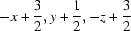
| Symmetry codes: (ii) −x+1, −y, −z+2; (iii) −x+1, −y, −z+1; (iv) −x+3/2, y+1/2, −z+3/2. |
Experimental details
| Crystal data | |
| Chemical formula | (C5H5BrN)2[SnCl6] |
| Mr | 649.41 |
| Crystal system, space group | Monoclinic, P21/n |
| Temperature (K) | 296 |
| a, b, c (Å) | 9.0843 (14), 10.6827 (9), 10.6345 (17) |
| β (°) | 109.843 (11) |
| V (Å3) | 970.8 (2) |
| Z | 2 |
| Radiation type | Mo Kα |
| µ (mm−1) | 6.25 |
| Crystal size (mm) | 0.20 × 0.15 × 0.10 |
| Data collection | |
| Diffractometer | Siemens P4 diffractometer |
| Absorption correction | ψ scan (XSCANS; Siemens, 1996) |
| Tmin, Tmax | 0.340, 0.535 |
| No. of measured, independent and observed [I > 2σ(I)] reflections | 2385, 1791, 1343 |
| Rint | 0.048 |
| (sin θ/λ)max (Å−1) | 0.606 |
| Refinement | |
| R[F2 > 2σ(F2)], wR(F2), S | 0.040, 0.097, 1.05 |
| No. of reflections | 1791 |
| No. of parameters | 98 |
| H-atom treatment | H-atom parameters constrained |
| Δρmax, Δρmin (e Å−3) | 0.61, −0.73 |
Computer programs: XSCANS (Siemens, 1996), SHELXTL (Sheldrick, 2008), SHELXS97 (Sheldrick, 2008), SHELXL97 (Sheldrick, 2008).
| Sn1—Cl1 | 2.4216 (13) | Sn1—Cl3 | 2.4212 (13) |
| Sn1—Cl2 | 2.4513 (14) | ||
| Cl1—Sn1—Cl2 | 89.67 (5) | Cl3—Sn1—Cl2 | 90.06 (6) |
| Cl3—Sn1—Cl1i | 89.70 (5) | Cl3—Sn1—Cl2i | 89.94 (6) |
| Cl3—Sn1—Cl1 | 90.30 (5) |
| Symmetry code: (i) −x, −y, −z+1. |
| D—H···A | D—H | H···A | D···A | D—H···A |
| N1—H1···Cl2ii | 0.86 | 2.45 | 3.234 (5) | 151.4 |
| C3—H3···Cl1iii | 0.93 | 2.77 | 3.646 (6) | 158.3 |
| C5—H5···Cl1iv | 0.93 | 2.86 | 3.774 (7) | 169.7 |
| Symmetry codes: (ii) −x+1, −y, −z+2; (iii) −x+1, −y, −z+1; (iv) −x+3/2, y+1/2, −z+3/2. |
Acknowledgements
Al al-Bayt University and Al-Balqa'a Applied University are thanked for supporting this work
References
 Al-Far, R. & Ali, B. F. (2007). Acta Cryst. C63, m137–m139. Web of Science CSD CrossRef IUCr Journals Google Scholar
Ali, B. F. & Al-Far, R. (2007). Acta Cryst. E63, m892–m894. Web of Science CSD CrossRef IUCr Journals Google Scholar
Ali, B. F., Al-Far, R. & Al-Sou'od, K. (2007). J. Chem. Crystallogr. 37, 265–273. Web of Science CrossRef CAS Google Scholar
Ali, B. F., Al-Far, R. & Ng, S. W. (2007). Acta Cryst. E63, m2102–m2103. Web of Science CSD CrossRef IUCr Journals Google Scholar
Allen, F. H., Kennard, O., Watson, D. G., Brammer, L., Orpen, A. G. & Taylor, R. (1987). J. Chem. Soc. Perkin Trans. 2, pp. S1–19. CrossRef Web of Science Google Scholar
Aruta, C., Licci, F., Zappettini, A., Bolzoni, F., Rastelli, F., Ferro, P. & Besagni, T. (2005). Appl. Phys. A, 81, 963–968. Web of Science CrossRef CAS Google Scholar
Awwadi, F. F., Willett, R. D., Peterson, K. A. & Twamley, B. (2007). J. Phys. Chem. A, 111, 2319–2328. Web of Science CSD CrossRef PubMed CAS Google Scholar
Bouacida, S., Merazig, H., Benard-Rocherulle, P. & Rizzoli, C. (2007). Acta Cryst. E63, m379–m381. Web of Science CSD CrossRef CAS IUCr Journals Google Scholar
Ellis, B. D. & Macdonald, C. L. B. (2006). Acta Cryst. E62, m1235–m1236. Web of Science CSD CrossRef IUCr Journals Google Scholar
Fernandes, R. M. Jr, de Oliveira, G. M., Lang, E. S. & Vázquez-López, E. M. (2004). Z. Anorg. Allg. Chem. 630, 2687–2691. Web of Science CSD CrossRef CAS Google Scholar
Hill, C. L. (1998). Chem. Rev. 98, 1–2. CSD CrossRef PubMed CAS Web of Science Google Scholar
Kagan, C. R., Mitzi, D. B. & Dimitrakopoulos, C. D. (1999). Science, 286, 945–947. Web of Science CrossRef PubMed CAS Google Scholar
Knutson, J. L., Martin, J. D. & Mitzi, D. B. (2005). Inorg. Chem. 44, 4699–4705. Web of Science CrossRef PubMed CAS Google Scholar
Li, H.-T., Sun, R., Shi, H.-P. & Huang, S.-P. (2005). Acta Cryst. E61, m2088–m2089. Web of Science CSD CrossRef IUCr Journals Google Scholar
Mitzi, D. B., Dimitrakopoulos, C. D. & Kosbar, L. L. (2001). Chem. Mater. 13, 3728–3740. Web of Science CSD CrossRef CAS Google Scholar
Raptopoulou, C. P., Terzis, A., Mousdis, G. A. & Papavassiliou, G. C. (2002). Z. Naturforsch. Teil B, 57, 645–650. CAS Google Scholar
Sheldrick, G. M. (2008). Acta Cryst. A64, 112–122. Web of Science CrossRef CAS IUCr Journals Google Scholar
Siemens (1996). XSCANS. Siemens Analytical X-ray Instruments Inc., Madison, Wisconsin, USA. Google Scholar
Willett, R. D. & Haddad, S. F. (2000). Acta Cryst. C56, e438. Web of Science CSD CrossRef IUCr Journals Google Scholar
This is an open-access article distributed under the terms of the Creative Commons Attribution (CC-BY) Licence, which permits unrestricted use, distribution, and reproduction in any medium, provided the original authors and source are cited.
| CRYSTALLOGRAPHIC COMMUNICATIONS |


Noncovalent interactions play an important role in organizing structural units in both natural and artificial systems. Hybrid organic-inorganic compounds are of great interest owing to their ionic, electrical, magnetic and optical properties (Hill, 1998; Kagan et al., 1999; Raptopoulou et al., 2002). Tin metal-halo based hybrids are of particular interest as being materials with interesting optical and magnetic properties (Aruta et al., 2005; Knutson et al., 2005; Mitzi et al., 2001; Kagan et al., 1999). We are currently carrying out studies about lattice including different types of intermolecular interactions. Our strategy is to use aromatic compounds to encourage aryl···aryl packing arrangements of various types, using substituted pyridinium in order to facilitates associations, and halo salts that can involve in X···X interactions as well as X···aryl and X···H interactions. Within our research of hybrid compounds containing tin metal (Al-Far & Ali 2007; Ali, Al-Far & Al-Sou'od, 2007; Ali & Al-Far, 2007; Ali, Al-Far & Ng, 2007), the crystal structure of the title salt, (I), has been investigated.
The asymmetric unit of (I) contains one cation and one-half anion (Fig. 1). The (SnCl6)2- anion lies on an inversion center, in a quasi-octahedral geometry (Table 1). The Sn—Cl bond lengths are almost invariant, but Sn—Cl2 is longer than the others (involved in the shortest hydrogen bonds). These lengths fall within the range of tin-chloride distances reported previously for compounds containing (SnCl6)2- anions (Bouacida et al., 2007; Ellis & Macdonald, 2006; Li et al., 2005; Willett & Haddad, 2000). Bond lengths and angles within the cation are as expected (Allen et al., 1987).
The packing of the structure (Fig. 2) can be described as layers of alternating anions (zigzag orientation) along the face parallel to b-axis and diagonal to ac plane. Each (SnCl6)2- anion is surrounded by six cations via four equatorial (C,N)—H···Cl interactions (Table 2) and two axial Cl···Br interactions [Cl3···Br2i = 3.4393 (15) Å; symmetry code: (i) -1/2 + x, -1/2 - y, -1/2 + z; Fig. 3). This arrangement of molecules appears as layers approximately parallel to [110]. It is noteworthy that structural and theoretical results (Awwadi et al., 2007; and references therein), show the significance of linear C—Y···X- (in this case C—Cl···Br) synthons in influencing structures of crystalline materials and in use as potential building blocks in crystal engineering via supramolecular synthesis.
The intermolecular hydrogen bonds (Table 2) and Cl···Br interactions would therefore add some lattice stability. This is evident in the isostructurality with the reported Te analogue (Fernandes et al., 2004).