 | Acta Crystallographica Section E Acta Crystallographica Section E CRYSTALLOGRAPHIC COMMUNICATIONS |


 journal menu


organic compounds
| CRYSTALLOGRAPHIC COMMUNICATIONS |
 access
Ethyl 4-hydroxymethyl-2-methylpyridine-5-carboxylate

aDepartment of Chemistry, The University of Auckland, Private Bag 92019, Auckland, New Zealand, and bCancer Research Laboratory, The University of Auckland, Private Bag 92019, Auckland, New Zealand
*Correspondence e-mail: [email protected]
The title compound, C10H13NO3, was obtained as a by-product of the aldolization reaction of furo[3,4-c]pyridin-3(1H)-one with thiophene-2-carboxaldehyde. The substituents on the pyridine ring are nearly coplanar, with an 8.1 (2)° rotation of the hydroxmethyl group from this plane. The molecules assemble in the crystal structure as chains via O—H⋯N hydrogen bonding between the pyridine N atom and a neighbouring hydroxymethyl OH group.
Related literature
For related literature, see: Goswami et al. (2006![[Goswami, S., Dey, S., Fun, H.-K. & Chantrapromma, S. (2006). Acta Cryst. E62, o3225-o3227.]](../../../../../../logos/arrows/e_arr.gif "Goswami, S., Dey, S., Fun, H.-K. & Chantrapromma, S. (2006). Acta Cryst. E62, o3225-o3227.") ), Wu et al. (2006). For bond-length data, see: Allen et al., (1987).
), Wu et al. (2006). For bond-length data, see: Allen et al., (1987).
![[Scheme 1]](bt2697scheme1.gif)
Experimental
Crystal data
|
Data collection
|
Refinement
|
| |||||||||||||||||
 .
. Data collection: SMART (Siemens, 1995); cell refinement: SAINT (Siemens, 1995); data reduction: SAINT; program(s) used to solve structure: SIR92 (Altomare et al., 1993); program(s) used to refine structure: SHELXL97 (Sheldrick, 2008); molecular graphics: ORTEP-3 for Windows (Farrugia, 1997) and Mercury (Macrae et al., 2006); software used to prepare material for publication: WinGX (Farrugia, 1999).
Supporting information
contains datablocks global, I. DOI: 10.1107/S160053680801026X/bt2697sup1.cif
Structure factors: contains datablock I. DOI: 10.1107/S160053680801026X/bt2697Isup2.hkl
The title compound was obtained as a by-product of the aldolization reaction of furo[3,4-c]pyridin-3(1H)-one with thiophene-2-carboxaldehyde. The desired product was not isolated, only the starting material and the title compound were characterized after the reaction.
Ethyl 4-(hydroxymethyl)-6-methylnicotinate (I): Furo[3,4-c]pyridin-3(1H)-one (II) (110 mg,0.74 mmol, 1 eq.) was suspended in EtOH (15 ml) at 65°C. Thiophene-2-carboxaldehyde (III) (99 mg, 0.88 mmol) and triethylamine (18 mg,0.18 mmol) were then added and the reaction mixture stirred at 80°C for 6 days. After cooling to room temperature the reaction was quenched with 1M HCl and extracted with EtOAc. The organic layer was rinsed with water and dried over MgSO4. Removal of MgSO4 by filtration and evaporation of solvent under reduced pressure gave the crude product. This product was dissolved in dichloromethane and stored at 4°C to yield colorless crystals (25 mg, 17% yield) which were isolated by filtration and identified as the title compound. 1H NMR (400 MHz, CD3)2SO, 298 K) δ 8.83 (s, 1 H), 7.03 (s, 1 H), 5.43 (s, 1 H), 4.83 (br s, 2 H), 4.30 (q, J = 7.1 Hz, 2 H), 2.54 (s, 3 H), 1.32 (t, J = 7.1 Hz, 3 H). LCMS (APCI+) calcd for C10H13NO3 195 (MH+), found 196.
Hydrogen atoms were placed in calculated positions and refined using the riding model [O—H 0.82 Å, C—H 0.93–0.97 Å), with Uiso(H) = 1.5 times Ueq(O) and Uiso(H) = 1.2 or 1.5 times Ueq(C).
Data collection: SMART (Siemens, 1995); cell SMART (Siemens, 1995); data reduction: SAINT (Siemens, 1995); program(s) used to solve structure: SIR92 (Altomare et al., 1993); program(s) used to refine structure: SHELXL97 (Sheldrick, 2008); molecular graphics: ORTEP-3 for Windows (Farrugia, 1997) and Mercury (Macrae et al., 2006); software used to prepare material for publication: WinGX (Farrugia, 1999).
![[Figure 1]](./bt2697fig1thm.gif) | Fig. 1. Structure of (I) showing 50% probability displacement ellipsoids for non-hydrogen atoms and hydrogen atoms as arbitary spheres. |
![[Figure 2]](./bt2697fig2thm.gif) | Fig. 2. Illustration of the arrangement of the complex (I) in the crystal along the a axis showing pyridine N···H—O hydrogen bonding arrangement. |
![[Figure 3]](./bt2697fig3thm.gif) | Fig. 3. Illustration of the arrangement of the complex (I) in the crystal along the a axis showing stacking of hydrogen bonded chains. |
| C10H13NO3 | F(000) = 416 |
| Mr = 195.21 | Dx = 1.321 Mg m−3 |
| Monoclinic, P21/n | Mo Kα radiation, λ = 0.71073 Å |
| a = 4.4998 (2) Å | Cell parameters from 4149 reflections |
| b = 15.4499 (8) Å | θ = 2.0–26.3° |
| c = 14.2036 (7) Å | µ = 0.10 mm−1 |
| β = 96.417 (1)° | T = 87 K |
| V = 981.27 (8) Å3 | Needle, colourless |
| Z = 4 | 0.32 × 0.18 × 0.12 mm |
| Siemens SMART CCD diffractometer | 1786 reflections with I > 2σ(I) |
| Radiation source: fine-focus sealed tube | Rint = 0.081 |
| Graphite monochromator | θmax = 26.3°, θmin = 2.0° |
| Area–detector ω scans | h = −5→5 |
| 5759 measured reflections | k = −19→17 |
| 1987 independent reflections | l = −17→12 |
| Refinement on F2 | Primary atom site location: structure-invariant direct methods |
| Least-squares matrix: full | Secondary atom site location: difference Fourier map |
| R[F2 > 2σ(F2)] = 0.049 | Hydrogen site location: inferred from neighbouring sites |
| wR(F2) = 0.134 | H-atom parameters constrained |
| S = 1.02 | w = 1/[σ2(Fo2) + (0.0608P)2 + 0.7105P] where P = (Fo2 + 2Fc2)/3 |
| 1987 reflections | (Δ/σ)max < 0.001 |
| 130 parameters | Δρmax = 0.30 e Å−3 |
| 0 restraints | Δρmin = −0.28 e Å−3 |
| C10H13NO3 | V = 981.27 (8) Å3 |
| Mr = 195.21 | Z = 4 |
| Monoclinic, P21/n | Mo Kα radiation |
| a = 4.4998 (2) Å | µ = 0.10 mm−1 |
| b = 15.4499 (8) Å | T = 87 K |
| c = 14.2036 (7) Å | 0.32 × 0.18 × 0.12 mm |
| β = 96.417 (1)° |
| Siemens SMART CCD diffractometer | 1786 reflections with I > 2σ(I) |
| 5759 measured reflections | Rint = 0.081 |
| 1987 independent reflections |
| R[F2 > 2σ(F2)] = 0.049 | 0 restraints |
| wR(F2) = 0.134 | H-atom parameters constrained |
| S = 1.02 | Δρmax = 0.30 e Å−3 |
| 1987 reflections | Δρmin = −0.28 e Å−3 |
| 130 parameters |
Geometry. All e.s.d.'s (except the e.s.d. in the dihedral angle between two l.s. planes) are estimated using the full covariance matrix. The cell e.s.d.'s are taken into account individually in the estimation of e.s.d.'s in distances, angles and torsion angles; correlations between e.s.d.'s in cell parameters are only used when they are defined by crystal symmetry. An approximate (isotropic) treatment of cell e.s.d.'s is used for estimating e.s.d.'s involving l.s. planes. |
Refinement. Refinement of F2 against ALL reflections. The weighted R-factor wR and goodness of fit S are based on F2, conventional R-factors R are based on F, with F set to zero for negative F2. The threshold expression of F2 > σ(F2) is used only for calculating R-factors(gt) etc. and is not relevant to the choice of reflections for refinement. R-factors based on F2 are statistically about twice as large as those based on F, and R- factors based on ALL data will be even larger. |
| x | y | z | Uiso*/Ueq | ||
| N1 | 0.4226 (3) | 0.73560 (9) | 0.54034 (9) | 0.0197 (3) | |
| O1 | 0.7485 (3) | 0.96228 (7) | 0.64708 (8) | 0.0207 (3) | |
| O2 | 0.5468 (3) | 0.95300 (8) | 0.78490 (8) | 0.0255 (3) | |
| O3 | −0.0290 (3) | 0.75164 (8) | 0.84444 (8) | 0.0215 (3) | |
| H3 | −0.0566 | 0.7606 | 0.8997 | 0.032* | |
| C1 | 0.5219 (4) | 0.81023 (11) | 0.58079 (11) | 0.0184 (4) | |
| H1 | 0.6416 | 0.8453 | 0.5474 | 0.022* | |
| C2 | 0.4576 (3) | 0.83885 (10) | 0.66979 (11) | 0.0167 (3) | |
| C3 | 0.2720 (3) | 0.78652 (11) | 0.72042 (10) | 0.0167 (3) | |
| C4 | 0.1707 (4) | 0.70920 (11) | 0.67810 (11) | 0.0189 (4) | |
| H4 | 0.0480 | 0.6732 | 0.7092 | 0.023* | |
| C5 | 0.2507 (4) | 0.68475 (11) | 0.58930 (11) | 0.0191 (4) | |
| C6 | 0.1465 (5) | 0.60006 (12) | 0.54492 (12) | 0.0290 (4) | |
| H6A | −0.0682 | 0.5987 | 0.5366 | 0.044* | |
| H6B | 0.2204 | 0.5532 | 0.5854 | 0.044* | |
| H6C | 0.2206 | 0.5942 | 0.4844 | 0.044* | |
| C7 | 0.1868 (4) | 0.81091 (11) | 0.81720 (11) | 0.0184 (4) | |
| H7A | 0.3629 | 0.8099 | 0.8633 | 0.022* | |
| H7B | 0.1053 | 0.8691 | 0.8152 | 0.022* | |
| C8 | 0.5846 (3) | 0.92273 (11) | 0.70790 (11) | 0.0184 (4) | |
| C9 | 0.8760 (4) | 1.04629 (11) | 0.67761 (12) | 0.0218 (4) | |
| H9A | 1.0137 | 1.0397 | 0.7348 | 0.026* | |
| H9B | 0.7187 | 1.0860 | 0.6906 | 0.026* | |
| C10 | 1.0378 (4) | 1.08024 (12) | 0.59824 (12) | 0.0242 (4) | |
| H10A | 1.1936 | 1.0406 | 0.5864 | 0.036* | |
| H10B | 1.1235 | 1.1357 | 0.6156 | 0.036* | |
| H10C | 0.8994 | 1.0861 | 0.5421 | 0.036* |
| U11 | U22 | U33 | U12 | U13 | U23 | |
| N1 | 0.0253 (7) | 0.0210 (7) | 0.0131 (6) | 0.0006 (5) | 0.0027 (5) | 0.0001 (5) |
| O1 | 0.0250 (6) | 0.0200 (6) | 0.0180 (6) | −0.0041 (5) | 0.0057 (5) | −0.0031 (5) |
| O2 | 0.0332 (7) | 0.0261 (7) | 0.0180 (6) | −0.0048 (5) | 0.0073 (5) | −0.0061 (5) |
| O3 | 0.0263 (6) | 0.0275 (6) | 0.0115 (5) | −0.0033 (5) | 0.0060 (5) | −0.0002 (5) |
| C1 | 0.0216 (8) | 0.0205 (8) | 0.0137 (7) | −0.0002 (6) | 0.0043 (6) | 0.0020 (6) |
| C2 | 0.0169 (7) | 0.0200 (8) | 0.0127 (7) | 0.0034 (6) | 0.0001 (6) | 0.0000 (6) |
| C3 | 0.0174 (7) | 0.0216 (8) | 0.0108 (7) | 0.0038 (6) | 0.0005 (6) | 0.0028 (6) |
| C4 | 0.0223 (8) | 0.0220 (8) | 0.0123 (7) | −0.0013 (6) | 0.0022 (6) | 0.0032 (6) |
| C5 | 0.0237 (8) | 0.0206 (8) | 0.0127 (7) | 0.0007 (6) | 0.0005 (6) | 0.0001 (6) |
| C6 | 0.0450 (11) | 0.0257 (9) | 0.0170 (8) | −0.0089 (8) | 0.0062 (7) | −0.0030 (7) |
| C7 | 0.0215 (8) | 0.0218 (8) | 0.0123 (7) | −0.0003 (6) | 0.0032 (6) | 0.0003 (6) |
| C8 | 0.0191 (7) | 0.0210 (8) | 0.0151 (7) | 0.0024 (6) | 0.0021 (6) | 0.0006 (6) |
| C9 | 0.0255 (8) | 0.0184 (8) | 0.0217 (8) | −0.0018 (6) | 0.0026 (7) | −0.0035 (6) |
| C10 | 0.0270 (8) | 0.0234 (9) | 0.0219 (8) | −0.0051 (7) | 0.0015 (7) | −0.0014 (7) |
| N1—C1 | 1.342 (2) | C4—H4 | 0.9300 |
| N1—C5 | 1.349 (2) | C5—C6 | 1.504 (2) |
| O1—C8 | 1.344 (2) | C6—H6A | 0.9600 |
| O1—C9 | 1.4649 (19) | C6—H6B | 0.9600 |
| O2—C8 | 1.219 (2) | C6—H6C | 0.9600 |
| O3—C7 | 1.420 (2) | C7—H7A | 0.9700 |
| O3—H3 | 0.8200 | C7—H7B | 0.9700 |
| C1—C2 | 1.400 (2) | C9—C10 | 1.503 (2) |
| C1—H1 | 0.9300 | C9—H9A | 0.9700 |
| C2—C3 | 1.415 (2) | C9—H9B | 0.9700 |
| C2—C8 | 1.493 (2) | C10—H10A | 0.9600 |
| C3—C4 | 1.391 (2) | C10—H10B | 0.9600 |
| C3—C7 | 1.515 (2) | C10—H10C | 0.9600 |
| C4—C5 | 1.402 (2) | ||
| C1—N1—C5 | 117.54 (14) | H6B—C6—H6C | 109.5 |
| C8—O1—C9 | 115.95 (13) | O3—C7—C3 | 109.70 (13) |
| C7—O3—H3 | 109.5 | O3—C7—H7A | 109.7 |
| N1—C1—C2 | 124.43 (15) | C3—C7—H7A | 109.7 |
| N1—C1—H1 | 117.8 | O3—C7—H7B | 109.7 |
| C2—C1—H1 | 117.8 | C3—C7—H7B | 109.7 |
| C1—C2—C3 | 118.16 (15) | H7A—C7—H7B | 108.2 |
| C1—C2—C8 | 119.48 (14) | O2—C8—O1 | 122.94 (15) |
| C3—C2—C8 | 122.36 (14) | O2—C8—C2 | 124.91 (15) |
| C4—C3—C2 | 117.04 (14) | O1—C8—C2 | 112.14 (13) |
| C4—C3—C7 | 120.10 (14) | O1—C9—C10 | 107.08 (13) |
| C2—C3—C7 | 122.86 (14) | O1—C9—H9A | 110.3 |
| C3—C4—C5 | 121.03 (15) | C10—C9—H9A | 110.3 |
| C3—C4—H4 | 119.5 | O1—C9—H9B | 110.3 |
| C5—C4—H4 | 119.5 | C10—C9—H9B | 110.3 |
| N1—C5—C4 | 121.78 (15) | H9A—C9—H9B | 108.6 |
| N1—C5—C6 | 117.43 (14) | C9—C10—H10A | 109.5 |
| C4—C5—C6 | 120.79 (15) | C9—C10—H10B | 109.5 |
| C5—C6—H6A | 109.5 | H10A—C10—H10B | 109.5 |
| C5—C6—H6B | 109.5 | C9—C10—H10C | 109.5 |
| H6A—C6—H6B | 109.5 | H10A—C10—H10C | 109.5 |
| C5—C6—H6C | 109.5 | H10B—C10—H10C | 109.5 |
| H6A—C6—H6C | 109.5 | ||
| C5—N1—C1—C2 | −0.4 (2) | C3—C4—C5—N1 | −1.5 (2) |
| N1—C1—C2—C3 | −0.9 (2) | C3—C4—C5—C6 | 178.53 (15) |
| N1—C1—C2—C8 | 179.21 (14) | C4—C3—C7—O3 | −8.1 (2) |
| C1—C2—C3—C4 | 1.0 (2) | C2—C3—C7—O3 | 172.83 (13) |
| C8—C2—C3—C4 | −179.12 (14) | C9—O1—C8—O2 | −1.5 (2) |
| C1—C2—C3—C7 | −179.91 (14) | C9—O1—C8—C2 | 178.51 (12) |
| C8—C2—C3—C7 | 0.0 (2) | C1—C2—C8—O2 | −178.81 (16) |
| C2—C3—C4—C5 | 0.1 (2) | C3—C2—C8—O2 | 1.3 (2) |
| C7—C3—C4—C5 | −178.98 (14) | C1—C2—C8—O1 | 1.2 (2) |
| C1—N1—C5—C4 | 1.6 (2) | C3—C2—C8—O1 | −178.66 (13) |
| C1—N1—C5—C6 | −178.42 (15) | C8—O1—C9—C10 | −177.70 (13) |
| D—H···A | D—H | H···A | D···A | D—H···A |
| O3—H3···N1i | 0.82 | 2.01 | 2.8227 (17) | 170 |
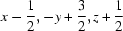
| Symmetry code: (i) x−1/2, −y+3/2, z+1/2. |
Experimental details
| Crystal data | |
| Chemical formula | C10H13NO3 |
| Mr | 195.21 |
| Crystal system, space group | Monoclinic, P21/n |
| Temperature (K) | 87 |
| a, b, c (Å) | 4.4998 (2), 15.4499 (8), 14.2036 (7) |
| β (°) | 96.417 (1) |
| V (Å3) | 981.27 (8) |
| Z | 4 |
| Radiation type | Mo Kα |
| µ (mm−1) | 0.10 |
| Crystal size (mm) | 0.32 × 0.18 × 0.12 |
| Data collection | |
| Diffractometer | Siemens SMART CCD diffractometer |
| Absorption correction | – |
| No. of measured, independent and observed [I > 2σ(I)] reflections | 5759, 1987, 1786 |
| Rint | 0.081 |
| (sin θ/λ)max (Å−1) | 0.624 |
| Refinement | |
| R[F2 > 2σ(F2)], wR(F2), S | 0.049, 0.134, 1.02 |
| No. of reflections | 1987 |
| No. of parameters | 130 |
| H-atom treatment | H-atom parameters constrained |
| Δρmax, Δρmin (e Å−3) | 0.30, −0.28 |
Computer programs: SMART (Siemens, 1995), SAINT (Siemens, 1995), SIR92 (Altomare et al., 1993), SHELXL97 (Sheldrick, 2008), ORTEP-3 for Windows (Farrugia, 1997) and Mercury (Macrae et al., 2006), WinGX (Farrugia, 1999).
| D—H···A | D—H | H···A | D···A | D—H···A |
| O3—H3···N1i | 0.82 | 2.01 | 2.8227 (17) | 169.9 |
| Symmetry code: (i) x−1/2, −y+3/2, z+1/2. |
Acknowledgements
This work was supported by Auckland Division of the Cancer Society of New Zealand, UniServices and The University of Auckland Research Committee.
References
 Allen, F. H., Kennard, O., Watson, D. G., Brammer, L., Orpen, A. G. & Taylor, R. (1987). J. Chem. Soc. Perkin Trans. 2, pp. S1–19. CrossRef Web of Science Google Scholar
Altomare, A., Cascarano, G., Giacovazzo, C. & Guagliardi, A. (1993). J. Appl. Cryst. 26, 343–350. CrossRef Web of Science IUCr Journals Google Scholar
Farrugia, L. J. (1997). J. Appl. Cryst. 30, 565. CrossRef IUCr Journals Google Scholar
Farrugia, L. J. (1999). J. Appl. Cryst. 32, 837–838. CrossRef CAS IUCr Journals Google Scholar
Goswami, S., Dey, S., Fun, H.-K. & Chantrapromma, S. (2006). Acta Cryst. E62, o3225–o3227. Web of Science CSD CrossRef IUCr Journals Google Scholar
Macrae, C. F., Edgington, P. R., McCabe, P., Pidcock, E., Shields, G. P., Taylor, R., Towler, M. & van de Streek, J. (2006). J. Appl. Cryst. 39, 453–457. Web of Science CrossRef CAS IUCr Journals Google Scholar
Sheldrick, G. M. (2008). Acta Cryst. A64, 112–122. Web of Science CrossRef CAS IUCr Journals Google Scholar
Siemens (1995). SMART and SAINT. Siemens Analytical X-ray Instruments Inc., Madison, Wisconsin, USA. Google Scholar
Wu, Y.-M., Dong, C.-C., Liu, S., Zhu, H.-J. & Wu, Y.-Z. (2006). Acta Cryst. E62, o2102–o2103. Web of Science CSD CrossRef IUCr Journals Google Scholar
This is an open-access article distributed under the terms of the Creative Commons Attribution (CC-BY) Licence, which permits unrestricted use, distribution, and reproduction in any medium, provided the original authors and source are cited.
| CRYSTALLOGRAPHIC COMMUNICATIONS |


The molecular structure of the title compound is shown in Fig. 1. The bond lengths and angles are normal (Allen et al., 1987). The ethyl ester group is nearly coplanar with the pyridine ring (C1-C5,N1 rmsd 0.0064 Å; C2,C8,C9,C10,O1,O2 rmsd 0.0064 Å, interplanar angle 2.17 (9)°). The hydroxymethyl group is rotated slightly out of the plane (O3—C7—C3—C4 8.1 (2)°).
The molecules in the crystal are connected via hydrogen bonding between the pyridine N atom and an adjacent OH group (Table 1) to give chains along the c axis (Figure 2a). These chains are stacked along the a axis (Figure 2 b). Similar hydrogen bonding interactions are observed in other hydroxymethyl substituted pyridines (Goswami et al., 2006, Wu et al., 2006).