 | Acta Crystallographica Section E Acta Crystallographica Section E CRYSTALLOGRAPHIC COMMUNICATIONS |


 journal menu


inorganic compounds
| CRYSTALLOGRAPHIC COMMUNICATIONS |
 access
Hafnium germanium telluride

aDivision of Energy Systems Research and Department of Chemistry, Ajou University, Suwon 443-749, Republic of Korea
*Correspondence e-mail: [email protected]
The title hafnium germanium telluride, HfGeTe4, has been synthesized by the use of a halide flux and structurally characterized by X-ray diffraction. HfGeTe4 is isostructural with stoichiometric ZrGeTe4 and the Hf site in this compound is also fully occupied. The of HfGeTe4 adopts a two-dimensional layered structure, each layer being composed of two unique one-dimensional chains of face-sharing Hf-centered bicapped trigonal prisms and corner-sharing Ge-centered tetrahedra. These layers stack on top of each other to complete the three-dimensional structure with undulating van der Waals gaps.
Related literature
For the synthesis, and electronic structure of Hf0.85GeTe4, see: Mar & Ibers (1993![[Mar, A. & Ibers, J. (1993). J. Am. Chem. Soc. 115, 3227-3238.]](../../../../../../logos/arrows/e_arr.gif "Mar, A. & Ibers, J. (1993). J. Am. Chem. Soc. 115, 3227-3238.") ). For the synthesis and structure of ZrGeTe4, see: Lee et al. (2007). The title compound, HfGeTe4, is isostructural with Hf0.85GeTe4 and ZrGeTe4. However the Hf site in HfGeTe4 is fully occupied. For related literature, see: Furuseth et al. (1973); Gelato & Parthé (1987); Smith & Bailey (1957); Zhao & Parthé (1990).
). For the synthesis and structure of ZrGeTe4, see: Lee et al. (2007). The title compound, HfGeTe4, is isostructural with Hf0.85GeTe4 and ZrGeTe4. However the Hf site in HfGeTe4 is fully occupied. For related literature, see: Furuseth et al. (1973); Gelato & Parthé (1987); Smith & Bailey (1957); Zhao & Parthé (1990).
Experimental
Crystal data
|
| |||||||||||||||||||||||||||||||||||||||
 ; (ii)
  ; (iii)
  ; (iv)
  ; (v)
; (v) 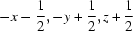 ; (vi)
  .
. Data collection: RAPID-AUTO (Rigaku, 2006); cell refinement: RAPID-AUTO; data reduction: RAPID-AUTO; program(s) used to solve structure: SHELXS97 (Sheldrick, 2008); program(s) used to refine structure: SHELXL97 (Sheldrick, 2008); molecular graphics: locally modified version of ORTEP (Johnson, 1965); software used to prepare material for publication: WinGX (Farrugia, 1999).
Supporting information
contains datablocks global, I. DOI: 10.1107/S1600536808011380/gw2040sup1.cif
Structure factors: contains datablock I. DOI: 10.1107/S1600536808011380/gw2040Isup2.hkl
HfGeTe4 was prepared from a reaction of Hf(CERAC 99.8%), Ge(CERAC 99.999%), and Te(CERAC 99.95%) in an elemental ratio of 1:1:4 in the presence of KCl(Aldrich 99.99%) as The mass ratio of reactants and was 1:3. The starting materials were placed in a fused-silica tube. The tube was evacuated to 10 -3 Torr, sealed, and heated to 973 K at a rate of 15 K/hr, where it was kept for 72 hrs. The tube was cooled at a rate of 10 K/hr to 373 K and the furnace was shut off. Air- and water-stable metallic shiny needle-shaped crystals were isolated after the was removed with water. Qualitative analysis of the crystals with an EDAX-equipped scanning electron microscope indicated the presence of Hf, Ge, and Te. No other element was detected.
Refinement with the positional parameters taken from the ZrGeTe4 structure (Lee et al., 2007) gave the value of the (Flack, 1983) of x=0.96 (4) (wR2=0.128), which suggests that the should be incorrect. of the inverse structure which is in agreement with the selected setting of this work leads to x=-0.02 (6) and significantly better reliability factor (wR2=0.054). The structure was standardized by means of the program STRUCTURE TIDY (Gelato & Parthé, 1987). The nonstoichiometry of the Hf site in the title compound was checked by refining the occupancy and anisotropic displacement parameters of Hf while those of the other atoms were fixed. With the nonstoichiometric model, both parameter were not changed significantly and the residuals (wR2, R1 indices) remained the same. The highest peak(1.55 e/Å-3) and the deepest hole (-2.00 e/ Å-3) are 0.98 Å and 0.78 Å from the atom Hf, respectively.
Data collection: RAPID-AUTO (Rigaku, 2006); cell RAPID-AUTO (Rigaku, 2006); data reduction: RAPID-AUTO (Rigaku, 2006); program(s) used to solve structure: SHELXS97 (Sheldrick, 2008); program(s) used to refine structure: SHELXL97 (Sheldrick, 2008); molecular graphics: locally modified version of ORTEP (Johnson, 1965); software used to prepare material for publication: WinGX (Farrugia, 1999).
![[Figure 1]](./gw2040fig1thm.gif) | Fig. 1. View of HfGeTe4 down the a axis, showing the layered nature of the compound. Filled, grey, and open circles represent Hf, Ge, and Te atoms, respectively. Displacement ellipsoids are drawn at the 90% probability level. |
![[Figure 2]](./gw2040fig2thm.gif) | Fig. 2. View of HfGeTe4 down the b axis, showing a two-dimensional layer. Atoms are as marked in Fig. 1. [Symmetry code: (i) -1/2 + x, -1/2 + y, z] |
| HfGeTe4 | F(000) = 1248 |
| Mr = 761.48 | Dx = 7.26 Mg m−3 |
| Orthorhombic, Cmc21 | Mo Kα radiation, λ = 0.71073 Å |
| Hall symbol: C 2c -2 | Cell parameters from 3229 reflections |
| a = 3.97951 (17) Å | θ = 3.2–27.5° |
| b = 15.9530 (7) Å | µ = 35.50 mm−1 |
| c = 10.9731 (7) Å | T = 290 K |
| V = 696.63 (6) Å3 | Needle, metallic silver |
| Z = 4 | 0.30 × 0.02 × 0.02 mm |
| Rigaku R-AXIS RAPID diffractometer | 878 reflections with I > 2σ(I) |
| ω scans | Rint = 0.060 |
| Absorption correction: numerical (NUMABS; Higashi, 2000) | θmax = 27.5°, θmin = 3.2° |
| Tmin = 0.425, Tmax = 0.510 | h = −4→5 |
| 3348 measured reflections | k = −20→19 |
| 910 independent reflections | l = −14→14 |
| Refinement on F2 | w = 1/[σ2(Fo2) + (0.0001P)2] where P = (Fo2 + 2Fc2)/3 |
| Least-squares matrix: full | (Δ/σ)max = 0.001 |
| R[F2 > 2σ(F2)] = 0.023 | Δρmax = 1.55 e Å−3 |
| wR(F2) = 0.054 | Δρmin = −2.00 e Å−3 |
| S = 0.97 | Extinction correction: SHELXL97 (Sheldrick, 2008), Fc*=kFc[1+0.001xFc2λ3/sin(2θ)]-1/4 |
| 910 reflections | Extinction coefficient: 0.00231 (14) |
| 38 parameters | Absolute structure: Flack (1983), 431 Friedel pairs |
| 1 restraint | Absolute structure parameter: 0.008 (14) |
| HfGeTe4 | V = 696.63 (6) Å3 |
| Mr = 761.48 | Z = 4 |
| Orthorhombic, Cmc21 | Mo Kα radiation |
| a = 3.97951 (17) Å | µ = 35.50 mm−1 |
| b = 15.9530 (7) Å | T = 290 K |
| c = 10.9731 (7) Å | 0.30 × 0.02 × 0.02 mm |
| Rigaku R-AXIS RAPID diffractometer | 910 independent reflections |
| Absorption correction: numerical (NUMABS; Higashi, 2000) | 878 reflections with I > 2σ(I) |
| Tmin = 0.425, Tmax = 0.510 | Rint = 0.060 |
| 3348 measured reflections |
| R[F2 > 2σ(F2)] = 0.023 | 1 restraint |
| wR(F2) = 0.054 | Δρmax = 1.55 e Å−3 |
| S = 0.97 | Δρmin = −2.00 e Å−3 |
| 910 reflections | Absolute structure: Flack (1983), 431 Friedel pairs |
| 38 parameters | Absolute structure parameter: 0.008 (14) |
Geometry. All e.s.d.'s are estimated using the full covariance matrix. The cell e.s.d.'s are taken into account individually in the estimation of e.s.d.'s in distances, angles and torsion angles; correlations between e.s.d.'s in cell parameters are only used when they are defined by crystal symmetry. |
| x | y | z | Uiso*/Ueq | ||
| Hf | 0.0000 | 0.65202 (3) | 0.22820 (5) | 0.01067 (17) | |
| Ge | 0.0000 | 0.22772 (8) | 0.53878 (13) | 0.0113 (3) | |
| Te1 | 0.0000 | 0.01673 (5) | 0.25689 (9) | 0.0129 (2) | |
| Te2 | 0.0000 | 0.10126 (5) | 0.03966 (9) | 0.0126 (2) | |
| Te3 | 0.0000 | 0.27773 (5) | 0.30414 (8) | 0.0102 (2) | |
| Te4 | 0.0000 | 0.38127 (5) | 0.00017 (8) | 0.0106 (2) |
| U11 | U22 | U33 | U12 | U13 | U23 | |
| Hf | 0.0113 (3) | 0.0107 (3) | 0.0100 (3) | 0 | 0 | 0.0000 (2) |
| Ge | 0.0118 (6) | 0.0112 (7) | 0.0108 (8) | 0 | 0 | 0.0012 (6) |
| Te1 | 0.0140 (4) | 0.0100 (4) | 0.0147 (5) | 0 | 0 | 0.0008 (4) |
| Te2 | 0.0142 (4) | 0.0130 (4) | 0.0106 (5) | 0 | 0 | −0.0012 (4) |
| Te3 | 0.0116 (3) | 0.0093 (4) | 0.0097 (4) | 0 | 0 | −0.0010 (3) |
| Te4 | 0.0118 (4) | 0.0087 (4) | 0.0111 (5) | 0 | 0 | 0.0002 (3) |
| Hf—Gei | 2.8286 (15) | Ge—Hfiv | 2.8286 (15) |
| Hf—Te3ii | 2.9454 (8) | Te1—Te2 | 2.7387 (13) |
| Hf—Te3iii | 2.9454 (8) | Te1—Hfvii | 2.9524 (7) |
| Hf—Te1iii | 2.9524 (7) | Te1—Hfviii | 2.9524 (7) |
| Hf—Te1ii | 2.9524 (7) | Te2—Hfvii | 2.9825 (8) |
| Hf—Te2iii | 2.9825 (8) | Te2—Hfviii | 2.9825 (8) |
| Hf—Te2ii | 2.9825 (8) | Te3—Hfviii | 2.9454 (8) |
| Hf—Te4iv | 3.0312 (11) | Te3—Hfvii | 2.9454 (8) |
| Ge—Te4v | 2.6761 (10) | Te4—Geix | 2.6761 (10) |
| Ge—Te4vi | 2.6761 (10) | Te4—Gex | 2.6761 (10) |
| Ge—Te3 | 2.6955 (17) | Te4—Hfi | 3.0312 (11) |
| Gei—Hf—Te3ii | 75.29 (3) | Te3iii—Hf—Te4iv | 80.84 (2) |
| Gei—Hf—Te3iii | 75.29 (3) | Te1iii—Hf—Te4iv | 76.52 (3) |
| Te3ii—Hf—Te3iii | 84.99 (3) | Te1ii—Hf—Te4iv | 76.52 (3) |
| Gei—Hf—Te1iii | 125.04 (3) | Te2iii—Hf—Te4iv | 129.45 (2) |
| Te3ii—Hf—Te1iii | 157.35 (3) | Te2ii—Hf—Te4iv | 129.45 (2) |
| Te3iii—Hf—Te1iii | 90.704 (18) | Te4v—Ge—Te4vi | 96.07 (5) |
| Gei—Hf—Te1ii | 125.04 (3) | Te4v—Ge—Te3 | 92.35 (4) |
| Te3ii—Hf—Te1ii | 90.704 (18) | Te4vi—Ge—Te3 | 92.35 (4) |
| Te3iii—Hf—Te1ii | 157.35 (3) | Te4v—Ge—Hfiv | 123.85 (4) |
| Te1iii—Hf—Te1ii | 84.75 (3) | Te4vi—Ge—Hfiv | 123.85 (4) |
| Gei—Hf—Te2iii | 71.00 (3) | Te3—Ge—Hfiv | 120.07 (5) |
| Te3ii—Hf—Te2iii | 146.29 (3) | Te2—Te1—Hfvii | 63.08 (2) |
| Te3iii—Hf—Te2iii | 86.01 (2) | Te2—Te1—Hfviii | 63.08 (2) |
| Te1iii—Hf—Te2iii | 54.96 (3) | Hfvii—Te1—Hfviii | 84.75 (3) |
| Te1ii—Hf—Te2iii | 108.97 (3) | Te1—Te2—Hfvii | 61.96 (2) |
| Gei—Hf—Te2ii | 71.00 (3) | Te1—Te2—Hfviii | 61.96 (2) |
| Te3ii—Hf—Te2ii | 86.01 (2) | Hfvii—Te2—Hfviii | 83.69 (3) |
| Te3iii—Hf—Te2ii | 146.29 (3) | Ge—Te3—Hfviii | 93.94 (3) |
| Te1iii—Hf—Te2ii | 108.97 (3) | Ge—Te3—Hfvii | 93.94 (3) |
| Te1ii—Hf—Te2ii | 54.96 (3) | Hfviii—Te3—Hfvii | 84.99 (3) |
| Te2iii—Hf—Te2ii | 83.69 (3) | Geix—Te4—Gex | 96.07 (5) |
| Gei—Hf—Te4iv | 147.38 (4) | Geix—Te4—Hfi | 92.41 (4) |
| Te3ii—Hf—Te4iv | 80.84 (2) | Gex—Te4—Hfi | 92.41 (4) |
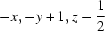
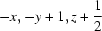
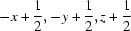
| Symmetry codes: (i) −x, −y+1, z−1/2; (ii) x+1/2, y+1/2, z; (iii) x−1/2, y+1/2, z; (iv) −x, −y+1, z+1/2; (v) −x−1/2, −y+1/2, z+1/2; (vi) −x+1/2, −y+1/2, z+1/2; (vii) x+1/2, y−1/2, z; (viii) x−1/2, y−1/2, z; (ix) −x−1/2, −y+1/2, z−1/2; (x) −x+1/2, −y+1/2, z−1/2. |
Experimental details
| Crystal data | |
| Chemical formula | HfGeTe4 |
| Mr | 761.48 |
| Crystal system, space group | Orthorhombic, Cmc21 |
| Temperature (K) | 290 |
| a, b, c (Å) | 3.97951 (17), 15.9530 (7), 10.9731 (7) |
| V (Å3) | 696.63 (6) |
| Z | 4 |
| Radiation type | Mo Kα |
| µ (mm−1) | 35.50 |
| Crystal size (mm) | 0.30 × 0.02 × 0.02 |
| Data collection | |
| Diffractometer | Rigaku R-AXIS RAPID diffractometer |
| Absorption correction | Numerical (NUMABS; Higashi, 2000) |
| Tmin, Tmax | 0.425, 0.510 |
| No. of measured, independent and observed [I > 2σ(I)] reflections | 3348, 910, 878 |
| Rint | 0.060 |
| (sin θ/λ)max (Å−1) | 0.649 |
| Refinement | |
| R[F2 > 2σ(F2)], wR(F2), S | 0.023, 0.054, 0.97 |
| No. of reflections | 910 |
| No. of parameters | 38 |
| No. of restraints | 1 |
| Δρmax, Δρmin (e Å−3) | 1.55, −2.00 |
| Absolute structure | Flack (1983), 431 Friedel pairs |
| Absolute structure parameter | 0.008 (14) |
Computer programs: RAPID-AUTO (Rigaku, 2006), SHELXS97 (Sheldrick, 2008), SHELXL97 (Sheldrick, 2008), locally modified version of ORTEP (Johnson, 1965), WinGX (Farrugia, 1999).
| Hf—Gei | 2.8286 (15) | Hf—Te2ii | 2.9825 (8) |
| Hf—Te3ii | 2.9454 (8) | Hf—Te4iv | 3.0312 (11) |
| Hf—Te3iii | 2.9454 (8) | Ge—Te4v | 2.6761 (10) |
| Hf—Te1iii | 2.9524 (7) | Ge—Te4vi | 2.6761 (10) |
| Hf—Te1ii | 2.9524 (7) | Ge—Te3 | 2.6955 (17) |
| Hf—Te2iii | 2.9825 (8) | Te1—Te2 | 2.7387 (13) |
| Te4v—Ge—Te4vi | 96.07 (5) | Te4v—Ge—Hfiv | 123.85 (4) |
| Te4v—Ge—Te3 | 92.35 (4) | Te3—Ge—Hfiv | 120.07 (5) |
| Symmetry codes: (i) −x, −y+1, z−1/2; (ii) x+1/2, y+1/2, z; (iii) x−1/2, y+1/2, z; (iv) −x, −y+1, z+1/2; (v) −x−1/2, −y+1/2, z+1/2; (vi) −x+1/2, −y+1/2, z+1/2. |
Acknowledgements
This research was supported by the Korean Research Foundation (KRF-2006–521-C00088). Use was made of the X-ray facilities supported by Ajou University.
References
 Farrugia, L. J. (1999). J. Appl. Cryst. 32, 837–838. CrossRef CAS IUCr Journals Google Scholar
Flack, H. D. (1983). Acta Cryst. A39, 876–881. CrossRef CAS Web of Science IUCr Journals Google Scholar
Furuseth, S., Brattås, L. & Kjekshus, A. (1973). Acta Chem. Scand. 27, 2367–2374. CrossRef CAS Web of Science Google Scholar
Gelato, L. M. & Parthé, E. (1987). J. Appl. Cryst. 20, 139–143. CrossRef Web of Science IUCr Journals Google Scholar
Higashi, T. (2000). NUMABS. Rigaku Corporation, Tokyo, Japan. Google Scholar
Johnson, C. K. (1965). ORTEP. Report ORNL-3794. Oak Ridge National Laboratory, Tennessee, USA. Google Scholar
Lee, C.-H., Jang, G.-J. & Yun, H. (2007). Acta Cryst. E63, i183. Web of Science CrossRef IUCr Journals Google Scholar
Mar, A. & Ibers, J. (1993). J. Am. Chem. Soc. 115, 3227–3238. CrossRef CAS Web of Science Google Scholar
Rigaku (2006). RAPID-AUTO. Rigaku Corporation, Tokyo, Japan. Google Scholar
Sheldrick, G. M. (2008). Acta Cryst. A64, 112–122. Web of Science CrossRef CAS IUCr Journals Google Scholar
Smith, J. F. & Bailey, D. M. (1957). Acta Cryst. 10, 341–342. CrossRef CAS IUCr Journals Web of Science Google Scholar
Zhao, J.-T. & Parthé, E. (1990). J. Less-Common Met. 162, 27–29. CrossRef Web of Science Google Scholar
This is an open-access article distributed under the terms of the Creative Commons Attribution (CC-BY) Licence, which permits unrestricted use, distribution, and reproduction in any medium, provided the original authors and source are cited.
| CRYSTALLOGRAPHIC COMMUNICATIONS |


A view of the structure of HfGeTe4 down the a axis in Fig. 1 shows the layered nature of the compound. Fig 2. shows that an individual layer is composed of two unique one-dimensional chains of face-sharing Hf-centered bicapped trigonal prisms and corner-sharing Ge-centered tetrahedra. The title compound is isostructural with Hf0.85GeTe4 (Mar & Ibers, 1993) and ZrGeTe4 (Lee et al., 2007) and the detailed descriptions of this structural type have been given previously.
The Hf atom is surrounded by six Te atoms in a trigonal prismatic manner. The vertices of two base sides of the prism are composed of six Te atoms. Atoms Te1, Te2, and Te3 form a triangle that is isosceles and the short Te1—Te2 distance (2.739 (1) Å) is typical of (Te—Te)2- pair (Furuseth et al., 1973). An additional Te4 and Ge atoms cap two of the rectangular faces of the trigonal prism to complete the bicapped trigonal prismatic coordination. These trigonal prisms share their triangular faces to form an infinite chain, ∞1[HfGeTe4] along the a axis. The Ge atom is surrounded by three Te and one Hf atoms in distorted tetrahedral fashion. These tetrahedra share their corners through the Te4 atom to form an infinite chain.
These bicapped trigonal prismatic and the tetrahedral chains are fused through Hf—Ge bonds to form a double chain and finally these chains are linked along the c axis to complete the two-dimensional layer. These layers then stack on top of each other to form the three-dimensional structure with undulating van der Waals gaps shown in Fig. 1.
The Hf—Ge bond distance is 2.829 (2) Å, which is comparable with those found in other hafnium germanides (HfGe2, 2.78–2.87 Å (Smith & Bailey, 1957); Hf5Ge4, 2.82 Å (Zhao & Parthé, 1990)).