 | Acta Crystallographica Section E Acta Crystallographica Section E CRYSTALLOGRAPHIC COMMUNICATIONS |


 journal menu


organic compounds
| CRYSTALLOGRAPHIC COMMUNICATIONS |
 access
(E)-3,4-Dihydroxybenzaldehyde 4-ethylthiosemicarbazone

aSchool of Chemical Sciences and Food Technology, Faculty of Science and Technology, Universiti Kebangsaan Malaysia, 43600 UKM Bangi, Selangor, Malaysia, and bDepartment of Chemistry, University of Otago, PO Box 56, Dunedin, New Zealand
*Correspondence e-mail: [email protected]
The title compound, C10H13N3O2S, was prepared by condensation of 3,4-dihydroxybenzaldehyde with 4-ethyl-3-thiosemicarbazide. The molecule adopts an E configuration with respect to the C=N bond. One of the OH substituents on the dihydroxybenzene ring is disordered over the two possible 3-positions on either side of the ordered 4-hydroxy group. The occupancy of the major disorder component refined to 0.633 (7). The molecule is essentially planar, with an r.m.s. deviation through all non-H atoms of 0.0862 Å. An intramolecular N—H⋯N hydrogen bond forms between the outer amine residue and the imine N atom, generating an S(5) ring motif and contributing to the planarity of the molecule. In the crystal structure, an extensive network of classical O—H⋯O, O—H⋯S and N—H⋯S hydrogen bonds and weak C—H⋯O and S⋯O [3.301 (3) Å] interactions link molecules into sheets running approximately parallel to the ab plane.
Related literature
For related structures, see: Swesi et al. (2006![[Swesi, A. T., Farina, Y., Kassim, M. & Ng, S. W. (2006). Acta Cryst. E62, o5457-o5458.]](../../../../../../logos/arrows/e_arr.gif "Swesi, A. T., Farina, Y., Kassim, M. & Ng, S. W. (2006). Acta Cryst. E62, o5457-o5458.") ); Kovala-Demertzi et al. (2004); Jian & Li (2006). For reference structural data, see: Allen et al. (1987). For ring motifs, see: Bernstein et al. (1995).
); Kovala-Demertzi et al. (2004); Jian & Li (2006). For reference structural data, see: Allen et al. (1987). For ring motifs, see: Bernstein et al. (1995).
![[Scheme 1]](hg2389scheme1.gif)
Experimental
Crystal data
|
Refinement
|
|
 ; (ii)
  ; (iii)
  .
. Data collection: APEX2 (Bruker 2006); cell refinement: APEX2 and SAINT (Bruker 2006); data reduction: SAINT; program(s) used to solve structure: SHELXS97 (Sheldrick, 2008) and TITAN2000 (Hunter & Simpson, 1999); program(s) used to refine structure: SHELXL97 (Sheldrick, 2008) and TITAN2000; molecular graphics: SHELXTL (Sheldrick, 2008) and Mercury (Macrae et al., 2006); software used to prepare material for publication: SHELXL97, enCIFer (Allen et al., 2004) and PLATON (Spek, 2003).
Supporting information
contains datablocks global, I. DOI: 10.1107/S1600536808009148/hg2389sup1.cif
Structure factors: contains datablock I. DOI: 10.1107/S1600536808009148/hg2389Isup2.hkl
The title compound C10H13N3O2S was prepared by heating an ethanolic (35 ml) solution of 3,4-dihydroxybenzaldehyde (1.4 g, 10 mmol) and 4-ethyl-3-thiosemicarbazide (1.2 g, 10 mmol) under reflux for 1 h. The resulting product was isolated and recrystallized from ethanol to afford red block-shaped crystals in 71% yield (m.p. 464–467 K).
The aromatic H atoms of the two disorder components were located in a difference Fourier map and refined with fixed isotropic displacement parameters with C—H distances restrained to 0.95 (1) Å. All other H-atoms were positioned geometrically and refined using a riding model with d(C—H) = 0.95 Å, Uiso=1.2Ueq (C) for aromatic 0.99 Å, Uiso = 1.2Ueq (C) for CH2, 0.98 Å, Uiso = 1.5Ueq (C) for CH3 0.88 Å, Uiso = 1.2Ueq (N) for NH and 0.84 Å, Uiso = 1.5Ueq (O) for the OH atoms. Close contacts involving the H atoms of the OH substituents, suggest that there may be unresolved disorder particularly with the location of the H atoms. The highest residual electron density peak is located at 2.56 Å from O5 and the deepest hole is located at 0.81 Å from S1.
Data collection: APEX2 (Bruker 2006); cell APEX2 (Bruker 2006) and SAINT (Bruker 2006); data reduction: SAINT (Bruker 2006); program(s) used to solve structure: SHELXS97 (Sheldrick, 2008) and TITAN2000 (Hunter & Simpson, 1999); program(s) used to refine structure: SHELXL97 (Sheldrick, 2008) and TITAN2000 (Hunter & Simpson, 1999); molecular graphics: SHELXTL (Sheldrick, 2008) and Mercury (Macrae et al., 2006); software used to prepare material for publication: SHELXL97 (Sheldrick, 2008), enCIFer (Allen et al., 2004) and PLATON (Spek, 2003).
![[Figure 1]](./hg2389fig1thm.gif) | Fig. 1. The structure of (I), with atom labels and 50% probability displacement ellipsoids for non-H atoms. The intramolecular N—H···N hydrogen bond is drawn as a dashed line. For clarity only the major disorder component of the disordered OH groups is shown. |
![[Figure 2]](./hg2389fig2thm.gif) | Fig. 2. Crystal packing of (I) viewed down the b axis with hydrogen bonds drawn as dashed lines. |
| C10H13N3O2S | F(000) = 504 |
| Mr = 239.29 | Dx = 1.407 Mg m−3 |
| Monoclinic, P21/c | Mo Kα radiation, λ = 0.71073 Å |
| Hall symbol: -P 2ybc | Cell parameters from 3071 reflections |
| a = 10.6549 (12) Å | θ = 2.6–25.0° |
| b = 12.9020 (16) Å | µ = 0.28 mm−1 |
| c = 8.6375 (11) Å | T = 91 K |
| β = 107.910 (4)° | Block, red |
| V = 1129.9 (2) Å3 | 0.44 × 0.11 × 0.09 mm |
| Z = 4 |
| Bruker APEXII CCD area-detector diffractometer | 1998 independent reflections |
| Radiation source: fine-focus sealed tube | 1507 reflections with I > 2σ(I) |
| Graphite monochromator | Rint = 0.040 |
| ω scans | θmax = 25.1°, θmin = 3.1° |
| Absorption correction: multi-scan (SADABS; Bruker, 2006) | h = −12→12 |
| Tmin = 0.818, Tmax = 0.975 | k = −15→15 |
| 12327 measured reflections | l = −10→8 |
| Refinement on F2 | Primary atom site location: structure-invariant direct methods |
| Least-squares matrix: full | Secondary atom site location: difference Fourier map |
| R[F2 > 2σ(F2)] = 0.059 | Hydrogen site location: inferred from neighbouring sites |
| wR(F2) = 0.168 | H atoms treated by a mixture of independent and constrained refinement |
| S = 1.05 | w = 1/[σ2(Fo2) + (0.0718P)2 + 1.7231P] where P = (Fo2 + 2Fc2)/3 |
| 1998 reflections | (Δ/σ)max < 0.001 |
| 165 parameters | Δρmax = 1.41 e Å−3 |
| 2 restraints | Δρmin = −0.64 e Å−3 |
| C10H13N3O2S | V = 1129.9 (2) Å3 |
| Mr = 239.29 | Z = 4 |
| Monoclinic, P21/c | Mo Kα radiation |
| a = 10.6549 (12) Å | µ = 0.28 mm−1 |
| b = 12.9020 (16) Å | T = 91 K |
| c = 8.6375 (11) Å | 0.44 × 0.11 × 0.09 mm |
| β = 107.910 (4)° |
| Bruker APEXII CCD area-detector diffractometer | 1998 independent reflections |
| Absorption correction: multi-scan (SADABS; Bruker, 2006) | 1507 reflections with I > 2σ(I) |
| Tmin = 0.818, Tmax = 0.975 | Rint = 0.040 |
| 12327 measured reflections |
| R[F2 > 2σ(F2)] = 0.059 | 2 restraints |
| wR(F2) = 0.168 | H atoms treated by a mixture of independent and constrained refinement |
| S = 1.05 | Δρmax = 1.41 e Å−3 |
| 1998 reflections | Δρmin = −0.64 e Å−3 |
| 165 parameters |
Geometry. All e.s.d.'s (except the e.s.d. in the dihedral angle between two l.s. planes) are estimated using the full covariance matrix. The cell e.s.d.'s are taken into account individually in the estimation of e.s.d.'s in distances, angles and torsion angles; correlations between e.s.d.'s in cell parameters are only used when they are defined by crystal symmetry. An approximate (isotropic) treatment of cell e.s.d.'s is used for estimating e.s.d.'s involving l.s. planes. |
Refinement. Refinement of F2 against ALL reflections. The weighted R-factor wR and goodness of fit S are based on F2, conventional R-factors R are based on F, with F set to zero for negative F2. The threshold expression of F2 > σ(F2) is used only for calculating R-factors(gt) etc. and is not relevant to the choice of reflections for refinement. R-factors based on F2 are statistically about twice as large as those based on F, and R- factors based on ALL data will be even larger. |
| x | y | z | Uiso*/Ueq | Occ. (<1) | |
| C1 | 0.7990 (3) | 0.2409 (2) | 0.2636 (3) | 0.0304 (7) | |
| C2 | 0.9009 (3) | 0.1922 (2) | 0.2235 (3) | 0.0342 (7) | |
| H2 | 0.9097 | 0.1190 | 0.2323 | 0.041* | |
| C3 | 0.9897 (3) | 0.2493 (3) | 0.1712 (4) | 0.0382 (8) | |
| H3 | 1.048 (11) | 0.201 (8) | 0.147 (17) | 0.046* | 0.367 (7) |
| O3 | 1.0884 (4) | 0.2059 (4) | 0.1330 (6) | 0.0525 (14) | 0.633 (7) |
| H3A | 1.1301 | 0.2516 | 0.0999 | 0.079* | 0.633 (7) |
| C5 | 0.8761 (3) | 0.4051 (3) | 0.1995 (4) | 0.0394 (8) | |
| H5 | 0.862 (11) | 0.477 (2) | 0.177 (13) | 0.047* | 0.633 (7) |
| O5 | 0.8733 (10) | 0.5042 (5) | 0.1953 (12) | 0.045 (2) | 0.367 (7) |
| H5A | 0.8856 | 0.5248 | 0.1089 | 0.068* | 0.367 (7) |
| C4 | 0.9776 (3) | 0.3557 (3) | 0.1580 (4) | 0.0381 (8) | |
| O4 | 1.0659 (2) | 0.4115 (2) | 0.1053 (3) | 0.0503 (7) | |
| H4 | 1.0294 | 0.4656 | 0.0584 | 0.075* | |
| C6 | 0.7871 (3) | 0.3484 (2) | 0.2514 (3) | 0.0334 (7) | |
| H6 | 0.7178 | 0.3825 | 0.2787 | 0.040* | |
| C7 | 0.7094 (3) | 0.1775 (3) | 0.3225 (3) | 0.0357 (7) | |
| H7 | 0.7228 | 0.1047 | 0.3322 | 0.043* | |
| N1 | 0.6134 (2) | 0.2175 (2) | 0.3612 (3) | 0.0390 (7) | |
| N2 | 0.5403 (3) | 0.1489 (3) | 0.4216 (3) | 0.0442 (7) | |
| H2A | 0.5567 | 0.0819 | 0.4244 | 0.053* | |
| C8 | 0.4433 (3) | 0.1862 (3) | 0.4763 (4) | 0.0458 (9) | |
| S1 | 0.36442 (11) | 0.10262 (10) | 0.56744 (13) | 0.0685 (4) | |
| N3 | 0.4168 (3) | 0.2853 (3) | 0.4565 (3) | 0.0506 (8) | |
| H3B | 0.4660 | 0.3233 | 0.4133 | 0.061* | |
| C9 | 0.3112 (4) | 0.3371 (4) | 0.5010 (5) | 0.0678 (13) | |
| H9A | 0.3118 | 0.3133 | 0.6102 | 0.081* | |
| H9B | 0.2252 | 0.3177 | 0.4224 | 0.081* | |
| C10 | 0.3260 (5) | 0.4506 (5) | 0.5024 (6) | 0.0804 (15) | |
| H10A | 0.4042 | 0.4708 | 0.5917 | 0.121* | |
| H10B | 0.2476 | 0.4831 | 0.5179 | 0.121* | |
| H10C | 0.3361 | 0.4735 | 0.3987 | 0.121* |
| U11 | U22 | U33 | U12 | U13 | U23 | |
| C1 | 0.0251 (14) | 0.0466 (18) | 0.0195 (14) | −0.0048 (12) | 0.0069 (11) | 0.0028 (12) |
| C2 | 0.0353 (16) | 0.0376 (17) | 0.0304 (15) | 0.0009 (13) | 0.0112 (13) | 0.0039 (13) |
| C3 | 0.0292 (16) | 0.057 (2) | 0.0319 (16) | 0.0021 (14) | 0.0146 (13) | 0.0001 (15) |
| O3 | 0.037 (3) | 0.075 (3) | 0.059 (3) | 0.009 (2) | 0.036 (2) | −0.002 (2) |
| C5 | 0.0427 (18) | 0.0392 (18) | 0.0365 (17) | −0.0057 (15) | 0.0122 (14) | 0.0051 (15) |
| O5 | 0.048 (4) | 0.035 (4) | 0.053 (5) | −0.010 (4) | 0.015 (3) | 0.013 (4) |
| C4 | 0.0331 (16) | 0.056 (2) | 0.0265 (15) | −0.0149 (15) | 0.0113 (13) | 0.0037 (14) |
| O4 | 0.0449 (14) | 0.0657 (17) | 0.0471 (14) | −0.0192 (12) | 0.0241 (12) | 0.0093 (12) |
| C6 | 0.0304 (15) | 0.0422 (17) | 0.0295 (16) | 0.0020 (13) | 0.0119 (13) | 0.0009 (13) |
| C7 | 0.0348 (16) | 0.0476 (19) | 0.0252 (15) | −0.0110 (14) | 0.0099 (13) | 0.0018 (13) |
| N1 | 0.0281 (13) | 0.0639 (18) | 0.0267 (13) | −0.0131 (12) | 0.0110 (11) | 0.0059 (12) |
| N2 | 0.0380 (14) | 0.0675 (19) | 0.0319 (14) | −0.0205 (14) | 0.0178 (12) | −0.0021 (13) |
| C8 | 0.0331 (17) | 0.082 (3) | 0.0250 (16) | −0.0237 (18) | 0.0133 (13) | −0.0102 (17) |
| S1 | 0.0738 (7) | 0.0931 (9) | 0.0585 (7) | −0.0513 (6) | 0.0497 (6) | −0.0299 (6) |
| N3 | 0.0305 (14) | 0.092 (3) | 0.0352 (15) | −0.0037 (15) | 0.0181 (12) | 0.0076 (16) |
| C9 | 0.038 (2) | 0.131 (4) | 0.039 (2) | 0.008 (2) | 0.0176 (16) | 0.000 (2) |
| C10 | 0.076 (3) | 0.122 (5) | 0.053 (3) | 0.036 (3) | 0.034 (2) | 0.000 (3) |
| C1—C2 | 1.388 (4) | C7—N1 | 1.278 (4) |
| C1—C6 | 1.395 (5) | C7—H7 | 0.9500 |
| C1—C7 | 1.462 (4) | N1—N2 | 1.384 (3) |
| C2—C3 | 1.380 (4) | N2—C8 | 1.350 (4) |
| C2—H2 | 0.9500 | N2—H2A | 0.8800 |
| C3—O3 | 1.319 (5) | C8—N3 | 1.310 (5) |
| C3—C4 | 1.380 (5) | C8—S1 | 1.702 (3) |
| C3—H3 | 0.950 (10) | S1—O4i | 3.301 (2) |
| O3—H3A | 0.8400 | N3—C9 | 1.457 (5) |
| C5—O5 | 1.279 (7) | N3—H3B | 0.8800 |
| C5—C6 | 1.376 (4) | C9—C10 | 1.473 (7) |
| C5—C4 | 1.394 (5) | C9—H9A | 0.9900 |
| C5—H5 | 0.950 (10) | C9—H9B | 0.9900 |
| O5—H5A | 0.8400 | C10—H10A | 0.9800 |
| C4—O4 | 1.369 (3) | C10—H10B | 0.9800 |
| O4—H4 | 0.8400 | C10—H10C | 0.9800 |
| C6—H6 | 0.9500 | ||
| C2—C1—C6 | 119.4 (3) | N1—C7—C1 | 121.7 (3) |
| C2—C1—C7 | 118.6 (3) | N1—C7—H7 | 119.1 |
| C6—C1—C7 | 121.9 (3) | C1—C7—H7 | 119.1 |
| C3—C2—C1 | 120.6 (3) | C7—N1—N2 | 115.4 (3) |
| C3—C2—H2 | 119.7 | C8—N2—N1 | 119.0 (3) |
| C1—C2—H2 | 119.7 | C8—N2—H2A | 120.5 |
| O3—C3—C4 | 117.6 (3) | N1—N2—H2A | 120.5 |
| O3—C3—C2 | 122.3 (4) | N3—C8—N2 | 117.4 (3) |
| C4—C3—C2 | 120.1 (3) | N3—C8—S1 | 124.2 (3) |
| C4—C3—H3 | 133 (8) | N2—C8—S1 | 118.4 (3) |
| C2—C3—H3 | 107 (8) | C8—N3—C9 | 124.5 (3) |
| C3—O3—H3A | 109.5 | C8—N3—H3B | 117.8 |
| O5—C5—C6 | 121.9 (5) | C9—N3—H3B | 117.8 |
| O5—C5—C4 | 117.6 (5) | N3—C9—C10 | 111.6 (4) |
| C6—C5—C4 | 120.5 (3) | N3—C9—H9A | 109.3 |
| C6—C5—H5 | 120 (7) | C10—C9—H9A | 109.3 |
| C4—C5—H5 | 119 (7) | N3—C9—H9B | 109.3 |
| C5—O5—H5A | 109.5 | C10—C9—H9B | 109.3 |
| O4—C4—C3 | 119.6 (3) | H9A—C9—H9B | 108.0 |
| O4—C4—C5 | 120.8 (3) | C9—C10—H10A | 109.5 |
| C3—C4—C5 | 119.6 (3) | C9—C10—H10B | 109.5 |
| C4—O4—H4 | 109.5 | H10A—C10—H10B | 109.5 |
| C5—C6—C1 | 119.9 (3) | C9—C10—H10C | 109.5 |
| C5—C6—H6 | 120.1 | H10A—C10—H10C | 109.5 |
| C1—C6—H6 | 120.1 | H10B—C10—H10C | 109.5 |
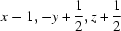
| Symmetry code: (i) x−1, −y+1/2, z+1/2. |
| D—H···A | D—H | H···A | D···A | D—H···A |
| N3—H3B···N1 | 0.88 | 2.23 | 2.626 (4) | 107 |
| O5—H5A···S1ii | 0.84 | 2.82 | 3.106 (9) | 102 |
| C2—H2···O5iii | 0.95 | 2.65 | 3.335 (8) | 129 |
| N2—H2A···S1iv | 0.88 | 2.52 | 3.392 (4) | 172 |
| O4—H4···O4v | 0.84 | 2.16 | 2.988 (5) | 169 |
| C9—H9A···O3i | 0.99 | 2.46 | 2.985 (5) | 113 |
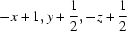
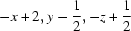
| Symmetry codes: (i) x−1, −y+1/2, z+1/2; (ii) −x+1, y+1/2, −z+1/2; (iii) −x+2, y−1/2, −z+1/2; (iv) −x+1, −y, −z+1; (v) −x+2, −y+1, −z. |
Experimental details
| Crystal data | |
| Chemical formula | C10H13N3O2S |
| Mr | 239.29 |
| Crystal system, space group | Monoclinic, P21/c |
| Temperature (K) | 91 |
| a, b, c (Å) | 10.6549 (12), 12.9020 (16), 8.6375 (11) |
| β (°) | 107.910 (4) |
| V (Å3) | 1129.9 (2) |
| Z | 4 |
| Radiation type | Mo Kα |
| µ (mm−1) | 0.28 |
| Crystal size (mm) | 0.44 × 0.11 × 0.09 |
| Data collection | |
| Diffractometer | Bruker APEXII CCD area-detector diffractometer |
| Absorption correction | Multi-scan (SADABS; Bruker, 2006) |
| Tmin, Tmax | 0.818, 0.975 |
| No. of measured, independent and observed [I > 2σ(I)] reflections | 12327, 1998, 1507 |
| Rint | 0.040 |
| (sin θ/λ)max (Å−1) | 0.596 |
| Refinement | |
| R[F2 > 2σ(F2)], wR(F2), S | 0.059, 0.168, 1.05 |
| No. of reflections | 1998 |
| No. of parameters | 165 |
| No. of restraints | 2 |
| H-atom treatment | H atoms treated by a mixture of independent and constrained refinement |
| Δρmax, Δρmin (e Å−3) | 1.41, −0.64 |
Computer programs: , APEX2 (Bruker 2006) and SAINT (Bruker 2006), SAINT (Bruker 2006), SHELXS97 (Sheldrick, 2008) and TITAN2000 (Hunter & Simpson, 1999), SHELXL97 (Sheldrick, 2008) and TITAN2000 (Hunter & Simpson, 1999), SHELXTL (Sheldrick, 2008) and Mercury (Macrae et al., 2006), SHELXL97 (Sheldrick, 2008), enCIFer (Allen et al., 2004) and PLATON (Spek, 2003).
| D—H···A | D—H | H···A | D···A | D—H···A |
| N3—H3B···N1 | 0.88 | 2.23 | 2.626 (4) | 107 |
| O5—H5A···S1i | 0.84 | 2.82 | 3.106 (9) | 102.3 |
| C2—H2···O5ii | 0.95 | 2.65 | 3.335 (8) | 129.1 |
| N2—H2A···S1iii | 0.88 | 2.52 | 3.392 (4) | 172.0 |
| O4—H4···O4iv | 0.84 | 2.16 | 2.988 (5) | 168.8 |
| C9—H9A···O3v | 0.99 | 2.46 | 2.985 (5) | 112.6 |
| Symmetry codes: (i) −x+1, y+1/2, −z+1/2; (ii) −x+2, y−1/2, −z+1/2; (iii) −x+1, −y, −z+1; (iv) −x+2, −y+1, −z; (v) x−1, −y+1/2, z+1/2. |
Acknowledgements
We thank the Universiti Kebangsaan Malaysia and the Ministry of Higher Education, Malaysia, for supporting this research through grant UKM-ST-01-FRGS0022–2006. We also thank the University of Otago for purchase of the diffractometer.
References
 Allen, F. H., Johnson, O., Shields, G. P., Smith, B. R. & Towler, M. (2004). J. Appl. Cryst. 37, 335–338. Web of Science CrossRef CAS IUCr Journals Google Scholar
Allen, F. H., Kennard, O., Watson, D. G., Brammer, L., Orpen, A. G. & Taylor, R. (1987). J. Chem. Soc. Perkin Trans. 2, pp. S1–S19. CrossRef Web of Science Google Scholar
Bernstein, J., Davis, R. E., Shimoni, L. & Chang, N.-L. (1995). Angew. Chem. Int. Ed. Engl. 34, 1555–1573. CrossRef CAS Web of Science Google Scholar
Bruker (2006). APEX2, SAINT and SADABS. Bruker AXS Inc., Madison, Wisconsin, USA. Google Scholar
Hunter, K. A. & Simpson, J. (1999). TITAN2000. University of Otago, New Zealand. Google Scholar
Jian, F.-F. & Li, Y. (2006). Acta Cryst. E62, o4563–o4564. Web of Science CSD CrossRef IUCr Journals Google Scholar
Kovala-Demertzi, D., Yadav, P. N., Demertzis, M. A., Jasiski, J. P., Andreadaki, F. J. & Kostas, I. D. (2004). Tetrahedron Lett. 45, 2923–2926. Web of Science CSD CrossRef CAS Google Scholar
Macrae, C. F., Edgington, P. R., McCabe, P., Pidcock, E., Shields, G. P., Taylor, R., Towler, M. & van de Streek, J. (2006). J. Appl. Cryst. 39, 453–457. Web of Science CrossRef CAS IUCr Journals Google Scholar
Sheldrick, G. M. (2008). Acta Cryst. A64, 112–122. Web of Science CrossRef CAS IUCr Journals Google Scholar
Spek, A. L. (2003). J. Appl. Cryst. 36, 7–13. Web of Science CrossRef CAS IUCr Journals Google Scholar
Swesi, A. T., Farina, Y., Kassim, M. & Ng, S. W. (2006). Acta Cryst. E62, o5457–o5458. Web of Science CSD CrossRef IUCr Journals Google Scholar
This is an open-access article distributed under the terms of the Creative Commons Attribution (CC-BY) Licence, which permits unrestricted use, distribution, and reproduction in any medium, provided the original authors and source are cited.
| CRYSTALLOGRAPHIC COMMUNICATIONS |


For example the structure of the related molecule 2,3-dihydroxybenzaldehyde thiosemicarbazone hemihydrate has been reported by Swesi et al. (2006) as have the structures of a phenylthiocarbazole with a single hydroxy-substituent on the benzylidene ring (Jian & Li, 2006) and of a palladium(II) complex of an ethylthiosemicarbonate ligand deprotonated at the phenolate ring (Kovala-Demertzi et al., 2004).
The molecule adopts an E configuration with respect to the C=N bond and bond distances and angles are normal (Allen et al., 1987). One of the OH substituents on the dihydroxy benzene ring is disordered over the two possible 3-positions (labelled O3 and O5) on either side of the ordered O4 hydroxo group. Occupancy of the O3 and H5 atoms of the major disorder component refines to 0.633 (7). The molecule is essentially planar with an r.m.s. deviation through all non-hydrogen atoms of 0.0862 Å. An intramolecular N3—H3B···N1 hydrogen bond forms between the outer amine residue and the imine N atom generating an S(5) ring motif (Bernstein et al., 1995) which contributes to the planarity of the molecule.
In the crystal structure N2—H2A···S1 hydrogen bonds, Table 1, generate centrosymmetric R22(8) rings. Other classical O—H···O and O—H···S hydrogen bonds combine with weak C—H···O and S1···O4i interactions (d(S1···O4) = 3.301 (3) Å; i = -1 + x, 1/2 - y, 1/2 + z) to form sheets running approximately parallel to the ac diagonal, Fig 2.