 | Acta Crystallographica Section E Acta Crystallographica Section E CRYSTALLOGRAPHIC COMMUNICATIONS |


 journal menu


organic compounds
| CRYSTALLOGRAPHIC COMMUNICATIONS |
 access
1,8-Dibenzoyl-2,7-dimethoxynaphthalene

aDepartment of Organic and Polymer Materials Chemistry, Tokyo University of Agriculture & Technology, Koganei, Tokyo 184-8588, Japan, and bInstrumentation Analysis Center, Tokyo University of Agriculture & Technology, Koganei, Tokyo 184-8588, Japan
*Correspondence e-mail: [email protected]
The molecule of the title compound, C26H20O4, is located on a twofold rotation axis. The two benzoyl groups are situated in an anti orientation. The dihedral angle between the mean planes of the phenyl ring and the naphthalene ring system is 80.25 (6)°. The phenyl and carbonyl groups in each benzoyl group are almost coplanar. The molecular packing is stabilized by weak C—H⋯O hydrogen bonds and a π–π stacking interaction between the phenyl rings [centroid–centroid and interplanar distances of 3.6383 (10) and 3.294 Å, respectively].
Related literature
For related literature, see: Cohen et al. (2004![[Cohen, S., Thirumalaikumar, M., Pogodin, S. & Agranat, I. (2004). Struct. Chem. 15, 339-345.]](../../../../../../logos/arrows/e_arr.gif "Cohen, S., Thirumalaikumar, M., Pogodin, S. & Agranat, I. (2004). Struct. Chem. 15, 339-345.") ); Gore & Henrick (1980); Nakaema et al. (2007).
); Gore & Henrick (1980); Nakaema et al. (2007).
![[Scheme 1]](is2282scheme1.gif)
Experimental
Crystal data
|
Refinement
|
| ||||||||||||||||||||||
 ; (ii)
 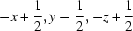 .
. Data collection: PROCESS-AUTO (Rigaku, 1998); cell refinement: PROCESS-AUTO; data reduction: CrystalStructure (Rigaku/MSC, 2004); program(s) used to solve structure: SIR2004 (Burla et al., 2005); program(s) used to refine structure: SHELXL97 (Sheldrick, 2008); molecular graphics: ORTEPIII (Burnett & Johnson, 1996); software used to prepare material for publication: SHELXL97.
Supporting information
contains datablocks global, I. DOI: 10.1107/S1600536808007009/is2282sup1.cif
Structure factors: contains datablock I. DOI: 10.1107/S1600536808007009/is2282Isup2.hkl
The title compound was prepared by electrophilic aromatic diaroylation reaction of 2,7-dimethoxynaphthalene with benzoic acid. White single crystals suitable for X-ray diffraction were obtained by recrystallization from ethanol.
All H atoms were found in a difference map and were subsequently refined as riding atoms, with C—H = 0.95 (aromatic) and 0.98 Å (methyl), and with Uiso(H) = 1.2Ueq(C).
Data collection: PROCESS-AUTO (Rigaku, 1998); cell PROCESS-AUTO (Rigaku, 1998); data reduction: CrystalStructure (Rigaku/MSC, 2004); program(s) used to solve structure: SIR2004 (Burla et al., 2005); program(s) used to refine structure: SHELXL97 (Sheldrick, 2008); molecular graphics: ORTEPIII (Burnett & Johnson, 1996); software used to prepare material for publication: SHELXL97 (Sheldrick, 2008).
![[Figure 1]](./is2282fig1thm.gif) | Fig. 1. Molecular structure of (I), with the atom-labeling scheme and displacement ellipsoids drawn at the 50% probability level. The symbol "_2" refers to symmetry code: -x, y, -z+1/2. |
![[Figure 2]](./is2282fig2thm.gif) | Fig. 2. A partial packing diagram of the title compound, viewed down the b axis. The dashed lines indicate hydrogen bonds (blue dashed lines) and π—π stacking interactions (green dashed lines). |
| C26H20O4 | F(000) = 832 |
| Mr = 396.42 | Dx = 1.334 Mg m−3 |
| Monoclinic, C2/c | Cu Kα radiation, λ = 1.54187 Å |
| Hall symbol: -C 2yc | Cell parameters from 10115 reflections |
| a = 13.9677 (4) Å | θ = 3.2–68.1° |
| b = 10.2145 (3) Å | µ = 0.72 mm−1 |
| c = 14.6966 (4) Å | T = 93 K |
| β = 109.711 (2)° | Needle, colorless |
| V = 1973.95 (10) Å3 | 0.50 × 0.10 × 0.10 mm |
| Z = 4 |
| Rigaku R-AXIS RAPID diffractometer | 1807 independent reflections |
| Radiation source: rotating anode | 1461 reflections with I > 2σ(I) |
| Graphite monochromator | Rint = 0.027 |
| Detector resolution: 10.00 pixels mm-1 | θmax = 68.2°, θmin = 5.5° |
| ω scans | h = −16→16 |
| Absorption correction: numerical (NUMABS; Higashi, 1999) | k = −12→12 |
| Tmin = 0.838, Tmax = 0.930 | l = −17→17 |
| 17362 measured reflections |
| Refinement on F2 | Secondary atom site location: difference Fourier map |
| Least-squares matrix: full | Hydrogen site location: difference Fourier map |
| R[F2 > 2σ(F2)] = 0.039 | H-atom parameters constrained |
| wR(F2) = 0.115 | w = 1/[σ2(Fo2) + (0.0579P)2 + 0.9602P] where P = (Fo2 + 2Fc2)/3 |
| S = 1.08 | (Δ/σ)max < 0.001 |
| 1807 reflections | Δρmax = 0.19 e Å−3 |
| 139 parameters | Δρmin = −0.21 e Å−3 |
| 0 restraints | Extinction correction: SHELXL97 (Sheldrick, 2008), Fc*=kFc[1+0.001xFc2λ3/sin(2θ)]-1/4 |
| Primary atom site location: structure-invariant direct methods | Extinction coefficient: 0.00121 (18) |
| C26H20O4 | V = 1973.95 (10) Å3 |
| Mr = 396.42 | Z = 4 |
| Monoclinic, C2/c | Cu Kα radiation |
| a = 13.9677 (4) Å | µ = 0.72 mm−1 |
| b = 10.2145 (3) Å | T = 93 K |
| c = 14.6966 (4) Å | 0.50 × 0.10 × 0.10 mm |
| β = 109.711 (2)° |
| Rigaku R-AXIS RAPID diffractometer | 1807 independent reflections |
| Absorption correction: numerical (NUMABS; Higashi, 1999) | 1461 reflections with I > 2σ(I) |
| Tmin = 0.838, Tmax = 0.930 | Rint = 0.027 |
| 17362 measured reflections |
| R[F2 > 2σ(F2)] = 0.039 | 0 restraints |
| wR(F2) = 0.115 | H-atom parameters constrained |
| S = 1.08 | Δρmax = 0.19 e Å−3 |
| 1807 reflections | Δρmin = −0.21 e Å−3 |
| 139 parameters |
Geometry. All e.s.d.'s (except the e.s.d. in the dihedral angle between two l.s. planes) are estimated using the full covariance matrix. The cell e.s.d.'s are taken into account individually in the estimation of e.s.d.'s in distances, angles and torsion angles; correlations between e.s.d.'s in cell parameters are only used when they are defined by crystal symmetry. An approximate (isotropic) treatment of cell e.s.d.'s is used for estimating e.s.d.'s involving l.s. planes. |
Refinement. Refinement of F2 against ALL reflections. The weighted R-factor wR and goodness of fit S are based on F2, conventional R-factors R are based on F, with F set to zero for negative F2. The threshold expression of F2 > σ(F2) is used only for calculating R-factors(gt) etc. and is not relevant to the choice of reflections for refinement. R-factors based on F2 are statistically about twice as large as those based on F, and R- factors based on ALL data will be even larger. |
| x | y | z | Uiso*/Ueq | ||
| O1 | 0.11104 (8) | 0.59739 (10) | 0.22559 (7) | 0.0399 (3) | |
| O2 | 0.26822 (8) | 0.39816 (11) | 0.37874 (9) | 0.0530 (4) | |
| C1 | 0.09424 (11) | 0.39621 (13) | 0.29711 (10) | 0.0325 (3) | |
| C2 | 0.18262 (12) | 0.32529 (15) | 0.33814 (11) | 0.0393 (4) | |
| C3 | 0.18231 (14) | 0.18652 (16) | 0.33535 (12) | 0.0470 (4) | |
| H3 | 0.2436 | 0.1385 | 0.3626 | 0.056* | |
| C4 | 0.09246 (14) | 0.12359 (15) | 0.29280 (11) | 0.0463 (4) | |
| H4 | 0.0919 | 0.0306 | 0.2919 | 0.056* | |
| C5 | 0.0000 | 0.19109 (19) | 0.2500 | 0.0383 (5) | |
| C6 | 0.0000 | 0.33146 (18) | 0.2500 | 0.0319 (4) | |
| C7 | 0.10671 (10) | 0.54368 (14) | 0.29822 (10) | 0.0313 (3) | |
| C8 | 0.11341 (10) | 0.61894 (13) | 0.38633 (10) | 0.0316 (3) | |
| C9 | 0.12438 (11) | 0.75478 (14) | 0.38552 (11) | 0.0368 (4) | |
| H9 | 0.1276 | 0.7970 | 0.3291 | 0.044* | |
| C10 | 0.13055 (12) | 0.82794 (16) | 0.46611 (12) | 0.0431 (4) | |
| H10 | 0.1384 | 0.9203 | 0.4652 | 0.052* | |
| C11 | 0.12535 (12) | 0.76686 (17) | 0.54845 (12) | 0.0448 (4) | |
| H11 | 0.1296 | 0.8173 | 0.6040 | 0.054* | |
| C12 | 0.11397 (12) | 0.63233 (17) | 0.54997 (11) | 0.0447 (4) | |
| H12 | 0.1102 | 0.5906 | 0.6064 | 0.054* | |
| C13 | 0.10816 (11) | 0.55857 (15) | 0.46934 (10) | 0.0376 (4) | |
| H13 | 0.1006 | 0.4662 | 0.4707 | 0.045* | |
| C14 | 0.36309 (13) | 0.3343 (2) | 0.42144 (14) | 0.0592 (5) | |
| H14A | 0.4171 | 0.3999 | 0.4447 | 0.071* | |
| H14B | 0.3771 | 0.2783 | 0.3733 | 0.071* | |
| H14C | 0.3606 | 0.2805 | 0.4758 | 0.071* |
| U11 | U22 | U33 | U12 | U13 | U23 | |
| O1 | 0.0505 (6) | 0.0371 (6) | 0.0351 (6) | −0.0020 (4) | 0.0185 (5) | 0.0020 (4) |
| O2 | 0.0393 (6) | 0.0456 (7) | 0.0658 (8) | 0.0087 (5) | 0.0068 (5) | −0.0046 (6) |
| C1 | 0.0421 (8) | 0.0273 (7) | 0.0311 (7) | 0.0034 (6) | 0.0161 (6) | 0.0006 (5) |
| C2 | 0.0446 (9) | 0.0366 (8) | 0.0366 (8) | 0.0058 (6) | 0.0134 (7) | −0.0009 (6) |
| C3 | 0.0591 (10) | 0.0375 (9) | 0.0442 (9) | 0.0160 (7) | 0.0170 (8) | 0.0021 (7) |
| C4 | 0.0708 (12) | 0.0281 (8) | 0.0428 (9) | 0.0076 (7) | 0.0227 (8) | 0.0014 (6) |
| C5 | 0.0583 (13) | 0.0268 (10) | 0.0342 (11) | 0.000 | 0.0212 (10) | 0.000 |
| C6 | 0.0454 (11) | 0.0266 (9) | 0.0278 (10) | 0.000 | 0.0177 (9) | 0.000 |
| C7 | 0.0307 (7) | 0.0306 (7) | 0.0330 (8) | 0.0011 (5) | 0.0116 (6) | 0.0022 (6) |
| C8 | 0.0300 (7) | 0.0312 (7) | 0.0333 (8) | −0.0003 (5) | 0.0101 (6) | −0.0011 (6) |
| C9 | 0.0415 (8) | 0.0320 (7) | 0.0367 (8) | 0.0012 (6) | 0.0130 (6) | 0.0018 (6) |
| C10 | 0.0453 (9) | 0.0353 (8) | 0.0478 (10) | 0.0000 (6) | 0.0143 (7) | −0.0069 (7) |
| C11 | 0.0426 (9) | 0.0515 (10) | 0.0415 (9) | −0.0001 (7) | 0.0157 (7) | −0.0136 (7) |
| C12 | 0.0493 (9) | 0.0534 (10) | 0.0356 (9) | −0.0040 (7) | 0.0199 (7) | −0.0013 (7) |
| C13 | 0.0408 (8) | 0.0359 (8) | 0.0381 (8) | −0.0025 (6) | 0.0159 (6) | 0.0013 (6) |
| C14 | 0.0465 (10) | 0.0653 (11) | 0.0578 (11) | 0.0221 (9) | 0.0070 (8) | −0.0151 (9) |
| O1—C7 | 1.2197 (16) | C8—C9 | 1.396 (2) |
| O2—C2 | 1.3633 (19) | C9—C10 | 1.378 (2) |
| O2—C14 | 1.4194 (19) | C9—H9 | 0.9500 |
| C1—C2 | 1.382 (2) | C10—C11 | 1.385 (2) |
| C1—C6 | 1.4264 (17) | C10—H10 | 0.9500 |
| C1—C7 | 1.5158 (19) | C11—C12 | 1.384 (2) |
| C2—C3 | 1.418 (2) | C11—H11 | 0.9500 |
| C3—C4 | 1.360 (2) | C12—C13 | 1.383 (2) |
| C3—H3 | 0.9500 | C12—H12 | 0.9500 |
| C4—C5 | 1.4110 (19) | C13—H13 | 0.9500 |
| C4—H4 | 0.9500 | C14—H14A | 0.9800 |
| C5—C6 | 1.434 (3) | C14—H14B | 0.9800 |
| C7—C8 | 1.4814 (19) | C14—H14C | 0.9800 |
| C8—C13 | 1.3908 (19) | ||
| C2—O2—C14 | 119.52 (13) | C13—C8—C7 | 122.02 (13) |
| C2—C1—C6 | 120.72 (14) | C9—C8—C7 | 118.88 (13) |
| C2—C1—C7 | 115.70 (13) | C10—C9—C8 | 120.44 (14) |
| C6—C1—C7 | 123.36 (13) | C10—C9—H9 | 119.8 |
| O2—C2—C1 | 115.29 (13) | C8—C9—H9 | 119.8 |
| O2—C2—C3 | 123.51 (14) | C9—C10—C11 | 120.00 (15) |
| C1—C2—C3 | 121.19 (15) | C9—C10—H10 | 120.0 |
| C4—C3—C2 | 118.62 (15) | C11—C10—H10 | 120.0 |
| C4—C3—H3 | 120.7 | C12—C11—C10 | 120.09 (15) |
| C2—C3—H3 | 120.7 | C12—C11—H11 | 120.0 |
| C3—C4—C5 | 122.54 (15) | C10—C11—H11 | 120.0 |
| C3—C4—H4 | 118.7 | C13—C12—C11 | 120.05 (15) |
| C5—C4—H4 | 118.7 | C13—C12—H12 | 120.0 |
| C4i—C5—C4 | 121.50 (19) | C11—C12—H12 | 120.0 |
| C4i—C5—C6 | 119.25 (10) | C12—C13—C8 | 120.31 (14) |
| C4—C5—C6 | 119.25 (10) | C12—C13—H13 | 119.8 |
| C1—C6—C1i | 124.75 (17) | C8—C13—H13 | 119.8 |
| C1—C6—C5 | 117.62 (9) | O2—C14—H14A | 109.5 |
| C1i—C6—C5 | 117.62 (9) | O2—C14—H14B | 109.5 |
| O1—C7—C8 | 121.63 (13) | H14A—C14—H14B | 109.5 |
| O1—C7—C1 | 118.49 (12) | O2—C14—H14C | 109.5 |
| C8—C7—C1 | 119.88 (12) | H14A—C14—H14C | 109.5 |
| C13—C8—C9 | 119.10 (13) | H14B—C14—H14C | 109.5 |
| C14—O2—C2—C1 | −179.05 (14) | C4—C5—C6—C1i | 177.70 (9) |
| C14—O2—C2—C3 | −0.3 (2) | C2—C1—C7—O1 | 97.99 (16) |
| C6—C1—C2—O2 | 178.29 (11) | C6—C1—C7—O1 | −76.73 (16) |
| C7—C1—C2—O2 | 3.43 (18) | C2—C1—C7—C8 | −81.97 (16) |
| C6—C1—C2—C3 | −0.5 (2) | C6—C1—C7—C8 | 103.32 (14) |
| C7—C1—C2—C3 | −175.33 (14) | O1—C7—C8—C13 | 179.76 (13) |
| O2—C2—C3—C4 | −179.86 (14) | C1—C7—C8—C13 | −0.29 (19) |
| C1—C2—C3—C4 | −1.2 (2) | O1—C7—C8—C9 | 0.4 (2) |
| C2—C3—C4—C5 | 1.1 (2) | C1—C7—C8—C9 | −179.69 (12) |
| C3—C4—C5—C4i | −179.31 (17) | C13—C8—C9—C10 | 0.4 (2) |
| C3—C4—C5—C6 | 0.69 (17) | C7—C8—C9—C10 | 179.81 (13) |
| C2—C1—C6—C1i | −177.80 (14) | C8—C9—C10—C11 | −0.3 (2) |
| C7—C1—C6—C1i | −3.35 (9) | C9—C10—C11—C12 | 0.0 (2) |
| C2—C1—C6—C5 | 2.20 (14) | C10—C11—C12—C13 | 0.2 (2) |
| C7—C1—C6—C5 | 176.65 (9) | C11—C12—C13—C8 | −0.2 (2) |
| C4i—C5—C6—C1 | 177.70 (9) | C9—C8—C13—C12 | −0.1 (2) |
| C4—C5—C6—C1 | −2.30 (9) | C7—C8—C13—C12 | −179.53 (13) |
| C4i—C5—C6—C1i | −2.30 (9) |
| Symmetry code: (i) −x, y, −z+1/2. |
| D—H···A | D—H | H···A | D···A | D—H···A |
| C12—H12···O1ii | 0.95 | 2.60 | 3.4987 (19) | 159 |
| C14—H14B···O1iii | 0.98 | 2.39 | 3.344 (2) | 164 |
| Symmetry codes: (ii) x, −y+1, z+1/2; (iii) −x+1/2, y−1/2, −z+1/2. |
Experimental details
| Crystal data | |
| Chemical formula | C26H20O4 |
| Mr | 396.42 |
| Crystal system, space group | Monoclinic, C2/c |
| Temperature (K) | 93 |
| a, b, c (Å) | 13.9677 (4), 10.2145 (3), 14.6966 (4) |
| β (°) | 109.711 (2) |
| V (Å3) | 1973.95 (10) |
| Z | 4 |
| Radiation type | Cu Kα |
| µ (mm−1) | 0.72 |
| Crystal size (mm) | 0.50 × 0.10 × 0.10 |
| Data collection | |
| Diffractometer | Rigaku R-AXIS RAPID diffractometer |
| Absorption correction | Numerical (NUMABS; Higashi, 1999) |
| Tmin, Tmax | 0.838, 0.930 |
| No. of measured, independent and observed [I > 2σ(I)] reflections | 17362, 1807, 1461 |
| Rint | 0.027 |
| (sin θ/λ)max (Å−1) | 0.602 |
| Refinement | |
| R[F2 > 2σ(F2)], wR(F2), S | 0.039, 0.115, 1.08 |
| No. of reflections | 1807 |
| No. of parameters | 139 |
| H-atom treatment | H-atom parameters constrained |
| Δρmax, Δρmin (e Å−3) | 0.19, −0.21 |
Computer programs: PROCESS-AUTO (Rigaku, 1998), CrystalStructure (Rigaku/MSC, 2004), SIR2004 (Burla et al., 2005), SHELXL97 (Sheldrick, 2008), ORTEPIII (Burnett & Johnson, 1996).
| D—H···A | D—H | H···A | D···A | D—H···A |
| C12—H12···O1i | 0.95 | 2.60 | 3.4987 (19) | 159 |
| C14—H14B···O1ii | 0.98 | 2.39 | 3.344 (2) | 164 |
| Symmetry codes: (i) x, −y+1, z+1/2; (ii) −x+1/2, y−1/2, −z+1/2. |
Acknowledgements
This work was partially supported by the Ogasawara Foundation for the Promotion of Science & Engineering, Tokyo, Japan.
References
 Burla, M. C., Caliandro, R., Camalli, M., Carrozzini, B., Cascarano, G. L., De Caro, L., Giacovazzo, C., Polidori, G. & Spagna, R. (2005). J. Appl. Cryst. 38, 381–388. Web of Science CrossRef CAS IUCr Journals Google Scholar
Burnett, M. N. & Johnson, C. K. (1996). ORTEPIII. Report ORNL-6895. Oak Ridge National Laboratory, Tennessee, USA. Google Scholar
Cohen, S., Thirumalaikumar, M., Pogodin, S. & Agranat, I. (2004). Struct. Chem. 15, 339–345. Web of Science CSD CrossRef CAS Google Scholar
Gore, P. H. & Henrick, K. (1980). Acta Cryst. B36, 2462–2465. CSD CrossRef CAS IUCr Journals Web of Science Google Scholar
Higashi, T. (1999). NUMABS. Rigaku Corporation, Tokyo, Japan. Google Scholar
Nakaema, K., Okamoto, A., Noguchi, K. & Yonezawa, N. (2007). Acta Cryst. E63, o4120. Web of Science CSD CrossRef IUCr Journals Google Scholar
Rigaku (1998). PROCESS-AUTO. Rigaku Corporation, Tokyo, Japan. Google Scholar
Rigaku/MSC (2004). CrystalStructure. Rigaku/MSC, The Woodlands, Texas, USA. Google Scholar
Sheldrick, G. M. (2008). Acta Cryst. A64, 112–122. Web of Science CrossRef CAS IUCr Journals Google Scholar
This is an open-access article distributed under the terms of the Creative Commons Attribution (CC-BY) Licence, which permits unrestricted use, distribution, and reproduction in any medium, provided the original authors and source are cited.
| CRYSTALLOGRAPHIC COMMUNICATIONS |


The molecules with naphthalene frame, especially, peri-substituted naphthalenes, have received much attention as unique structured aromatic core compounds for variety of the functional materials. Therefore, structural analyses of peri-substituted naphthalenes have been actively performed (Cohen et al., 2004; Gore & Henrick, 1980). Recently, we have reported the structure of 1,8-bis(4-chlorobenzoyl)-2,7-dimethoxynaphthalene (Nakaema et al., 2007). In this paper, the crystallographical structural characteristics of a 1,8-diphenylated naphthalene derivative having two methoxy groups at the 2,7-positions are described as the most simple homolog of the previously reported compound. The title compound was successfully synthesized by regioselective electrophilic aromatic substitution reaction of 2,7-dimethoxynaphthalene with benzoic acid.
ORTEPIII (Burnett & Johnson, 1996) plot of title compound is displayed in Fig. 1. The molecule of (I) lies across a crystallographic 2-fold axis so that the asymmetric unit contains one-half of the molecules. Thus, the two benzoyl groups are situated in anti orientation. The benzoyl groups are twisted away from the naphthalene moiety, and the dihedral angle is 80.25 (6)°. The torsion angles between the carbonyl groups and the naphthalene ring are -76.73 (18)° [C6—C1—C7—O1], and those between the carbonyl groups and the phenyl groups are 179.75 (15)° [C13—C8—C7—O1].
In the crystal structure, the molecular packing of (I) is mainly stabilized by van der Waals interaction. In addition, the packing of the molecule is stabilized by relatively weak C—H···O hydrogen bonding, namely, C12—H12···O1i [symmetry code: (i) x, -y+1, z + 1/2], C14—H14B···O1ii [symmetry code: (ii) -x+1/2, y - 1/2, -z+1/2], and a π—π stacking interaction. In the packing, the molecules are arranged by C—H···O hydrogen bonding along the c axis of the unit cell, and by a π—π stacking interaction perpendicular the bc plane of the unit cell (Fig. 2).