 | Acta Crystallographica Section E Acta Crystallographica Section E CRYSTALLOGRAPHIC COMMUNICATIONS |


 journal menu


metal-organic compounds
| CRYSTALLOGRAPHIC COMMUNICATIONS |
 access
Tetraaquabis(pyridine-3-sulfonato-κN)nickel(II)

aDepartment of Chemistry, Zhejiang University, Hangzhou 310027, People's Republic of China
*Correspondence e-mail: [email protected]
In the molecule of the title compound, [Ni(C5H4NO3S)2(H2O)4], the NiII cation is located on an inversion center and is coordinated by four water molecules and two pyridine-3-sulfonate anions with an NiN2O4 distorted octahedral geometry. The face-to-face separation of 3.561 (5) Å between parallel pyridine rings indicates the existence of weak π–π stacking between the pyridine rings. The structure also contains intermolecular O—H⋯O hydrogen bonding and weak C—H⋯O hydrogen bonding.
Related literature
For general background, see: Deisenhofer & Michel (1989![[Deisenhofer, J. & Michel, H. (1989). EMBO J. 8, 2149-2170.]](../../../../../../logos/arrows/e_arr.gif "Deisenhofer, J. & Michel, H. (1989). EMBO J. 8, 2149-2170.") ); Su & Xu (2004); Liu et al. (2004); Li et al. (2005). For a related structure, see: Walsh & Hathaway (1980). For related literature, see: Cotton & Wilkinson (1972).
); Su & Xu (2004); Liu et al. (2004); Li et al. (2005). For a related structure, see: Walsh & Hathaway (1980). For related literature, see: Cotton & Wilkinson (1972).
![[Scheme 1]](om2227scheme1.gif)
Experimental
Crystal data
|
Refinement
|
| ||||||||||
|
 ; (ii)
  ; (iii)
  .
. Data collection: PROCESS-AUTO (Rigaku, 1998); cell refinement: PROCESS-AUTO; data reduction: CrystalStructure (Rigaku/MSC, 2002); program(s) used to solve structure: SIR92 (Altomare et al., 1993); program(s) used to refine structure: SHELXL97 (Sheldrick, 2008); molecular graphics: ORTEP-3 for Windows (Farrugia, 1997); software used to prepare material for publication: WinGX (Farrugia, 1999).
Supporting information
contains datablocks I, global. DOI: 10.1107/S1600536808010076/om2227sup1.cif
Structure factors: contains datablock I. DOI: 10.1107/S1600536808010076/om2227Isup2.hkl
Pyridine-3-sulfonic acid (0.159 g, 1 mmol), Na2CO3 (0.053 g, 0.5 mmol), NiCl2.6H2O (0.238 g, 1 mmol) were dissolved in a mixture solution of water (8 ml) and ethanol (2 ml). The solution was placed in a 15 ml Teflon-lined stainless steel autoclave under autogenous pressure at 398 K for 75 h and filtered after cooling to room temperature. The blue single crystals of the title compound were obtained from the filtrate after 3 months.
Water H atoms were located in a difference Fourier map and refined as riding in as-found relative positions with Uiso(H) = 1.5Ueq(O). Aromatic H atoms were placed in calculated positions with C—H = 0.93 Å and refined in riding mode with Uiso(H) = 1.2Ueq(C).
Data collection: PROCESS-AUTO (Rigaku, 1998); cell PROCESS-AUTO (Rigaku, 1998); data reduction: CrystalStructure (Rigaku/MSC, 2002); program(s) used to solve structure: SIR92 (Altomare et al., 1993); program(s) used to refine structure: SHELXL97 (Sheldrick, 2008); molecular graphics: ORTEP-3 for Windows (Farrugia, 1997); software used to prepare material for publication: WinGX (Farrugia, 1999).
![[Figure 1]](./om2227fig1thm.gif) | Fig. 1. The molecular structure of the title compound with 40% probability displacement (arbitrary spheres for H atoms) [symmetry codes: (i)1 - x,1 - y,1 - z]. |
![[Figure 2]](./om2227fig2thm.gif) | Fig. 2. A diagram showing π-π stacking between pyridine rings [symmetry code: (ii) 1 - x,1 - y,-z]. |
| [Ni(C5H4NO3S)2(H2O)4] | F(000) = 460 |
| Mr = 447.08 | Dx = 1.782 Mg m−3 |
| Monoclinic, P21/n | Mo Kα radiation, λ = 0.71073 Å |
| Hall symbol: -P 2yn | Cell parameters from 5256 reflections |
| a = 7.5399 (8) Å | θ = 2.8–24.0° |
| b = 12.6939 (15) Å | µ = 1.47 mm−1 |
| c = 8.7810 (8) Å | T = 295 K |
| β = 97.419 (12)° | Prism, blue |
| V = 833.40 (15) Å3 | 0.32 × 0.22 × 0.20 mm |
| Z = 2 |
| Rigaku R-AXIS RAPID IP diffractometer | 1524 independent reflections |
| Radiation source: fine-focus sealed tube | 1449 reflections with I > 2σ(I) |
| Graphite monochromator | Rint = 0.019 |
| Detector resolution: 10.0 pixels mm-1 | θmax = 25.4°, θmin = 2.8° |
| ω scans | h = −9→9 |
| Absorption correction: multi-scan (ABSCOR; Higashi, 1995) | k = −15→15 |
| Tmin = 0.660, Tmax = 0.745 | l = −9→10 |
| 8877 measured reflections |
| Refinement on F2 | Primary atom site location: structure-invariant direct methods |
| Least-squares matrix: full | Secondary atom site location: difference Fourier map |
| R[F2 > 2σ(F2)] = 0.024 | Hydrogen site location: inferred from neighbouring sites |
| wR(F2) = 0.065 | H-atom parameters constrained |
| S = 1.06 | w = 1/[σ2(Fo2) + (0.0323P)2 + 0.5265P] where P = (Fo2 + 2Fc2)/3 |
| 1524 reflections | (Δ/σ)max < 0.001 |
| 115 parameters | Δρmax = 0.29 e Å−3 |
| 0 restraints | Δρmin = −0.37 e Å−3 |
| [Ni(C5H4NO3S)2(H2O)4] | V = 833.40 (15) Å3 |
| Mr = 447.08 | Z = 2 |
| Monoclinic, P21/n | Mo Kα radiation |
| a = 7.5399 (8) Å | µ = 1.47 mm−1 |
| b = 12.6939 (15) Å | T = 295 K |
| c = 8.7810 (8) Å | 0.32 × 0.22 × 0.20 mm |
| β = 97.419 (12)° |
| Rigaku R-AXIS RAPID IP diffractometer | 1524 independent reflections |
| Absorption correction: multi-scan (ABSCOR; Higashi, 1995) | 1449 reflections with I > 2σ(I) |
| Tmin = 0.660, Tmax = 0.745 | Rint = 0.019 |
| 8877 measured reflections |
| R[F2 > 2σ(F2)] = 0.024 | 0 restraints |
| wR(F2) = 0.065 | H-atom parameters constrained |
| S = 1.06 | Δρmax = 0.29 e Å−3 |
| 1524 reflections | Δρmin = −0.37 e Å−3 |
| 115 parameters |
Geometry. All e.s.d.'s (except the e.s.d. in the dihedral angle between two l.s. planes) are estimated using the full covariance matrix. The cell e.s.d.'s are taken into account individually in the estimation of e.s.d.'s in distances, angles and torsion angles; correlations between e.s.d.'s in cell parameters are only used when they are defined by crystal symmetry. An approximate (isotropic) treatment of cell e.s.d.'s is used for estimating e.s.d.'s involving l.s. planes. |
Refinement. Refinement of F2 against ALL reflections. The weighted R-factor wR and goodness of fit S are based on F2, conventional R-factors R are based on F, with F set to zero for negative F2. The threshold expression of F2 > σ(F2) is used only for calculating R-factors(gt) etc. and is not relevant to the choice of reflections for refinement. R-factors based on F2 are statistically about twice as large as those based on F, and R- factors based on ALL data will be even larger. |
| x | y | z | Uiso*/Ueq | ||
| Ni | 0.5000 | 0.5000 | 0.5000 | 0.02883 (13) | |
| S | 0.45204 (7) | 0.75905 (4) | −0.03581 (6) | 0.03407 (15) | |
| N1 | 0.5850 (2) | 0.54221 (13) | 0.28948 (18) | 0.0307 (3) | |
| O1 | 0.76142 (19) | 0.48676 (11) | 0.60868 (18) | 0.0388 (3) | |
| H1B | 0.8326 | 0.5397 | 0.5900 | 0.058* | |
| H1A | 0.8182 | 0.4333 | 0.5998 | 0.058* | |
| O2 | 0.50231 (19) | 0.34035 (11) | 0.45010 (17) | 0.0411 (3) | |
| H2A | 0.5076 | 0.3156 | 0.3615 | 0.062* | |
| H2B | 0.4194 | 0.3021 | 0.4815 | 0.062* | |
| O3 | 0.5370 (3) | 0.76975 (16) | −0.1732 (2) | 0.0687 (6) | |
| O4 | 0.4828 (2) | 0.85025 (12) | 0.0624 (2) | 0.0554 (5) | |
| O5 | 0.2658 (2) | 0.73019 (12) | −0.06337 (19) | 0.0481 (4) | |
| C1 | 0.7217 (3) | 0.49242 (15) | 0.2368 (3) | 0.0370 (5) | |
| H1 | 0.7768 | 0.4372 | 0.2943 | 0.044* | |
| C2 | 0.7839 (3) | 0.51907 (18) | 0.1020 (3) | 0.0452 (5) | |
| H2 | 0.8783 | 0.4819 | 0.0693 | 0.054* | |
| C3 | 0.7053 (3) | 0.60162 (17) | 0.0150 (3) | 0.0405 (5) | |
| H3 | 0.7461 | 0.6218 | −0.0762 | 0.049* | |
| C4 | 0.5641 (2) | 0.65298 (14) | 0.0684 (2) | 0.0298 (4) | |
| C5 | 0.5074 (3) | 0.62143 (15) | 0.2044 (2) | 0.0320 (4) | |
| H5 | 0.4116 | 0.6565 | 0.2384 | 0.038* |
| U11 | U22 | U33 | U12 | U13 | U23 | |
| Ni | 0.0309 (2) | 0.0273 (2) | 0.0284 (2) | 0.00105 (13) | 0.00426 (14) | 0.00418 (13) |
| S | 0.0419 (3) | 0.0278 (3) | 0.0317 (3) | 0.0027 (2) | 0.0018 (2) | 0.00399 (19) |
| N1 | 0.0329 (8) | 0.0290 (8) | 0.0302 (8) | 0.0016 (7) | 0.0037 (6) | 0.0034 (7) |
| O1 | 0.0336 (7) | 0.0355 (8) | 0.0467 (9) | 0.0018 (6) | 0.0031 (6) | 0.0056 (6) |
| O2 | 0.0512 (9) | 0.0328 (8) | 0.0409 (8) | −0.0017 (6) | 0.0122 (7) | −0.0002 (6) |
| O3 | 0.0861 (14) | 0.0758 (13) | 0.0491 (11) | 0.0261 (11) | 0.0269 (10) | 0.0305 (9) |
| O4 | 0.0591 (10) | 0.0297 (8) | 0.0707 (11) | 0.0048 (7) | −0.0174 (8) | −0.0095 (8) |
| O5 | 0.0441 (9) | 0.0358 (8) | 0.0600 (10) | 0.0039 (7) | −0.0103 (7) | −0.0022 (7) |
| C1 | 0.0360 (11) | 0.0328 (11) | 0.0417 (12) | 0.0064 (8) | 0.0034 (9) | 0.0061 (8) |
| C2 | 0.0417 (12) | 0.0431 (12) | 0.0542 (14) | 0.0126 (10) | 0.0188 (10) | 0.0065 (10) |
| C3 | 0.0455 (12) | 0.0393 (11) | 0.0395 (12) | 0.0036 (9) | 0.0154 (9) | 0.0055 (9) |
| C4 | 0.0337 (9) | 0.0255 (9) | 0.0295 (10) | −0.0002 (7) | 0.0016 (8) | 0.0005 (7) |
| C5 | 0.0333 (9) | 0.0314 (10) | 0.0313 (10) | 0.0041 (8) | 0.0047 (8) | 0.0004 (8) |
| Ni—O1i | 2.0828 (14) | O1—H1B | 0.8886 |
| Ni—O1 | 2.0828 (14) | O1—H1A | 0.8115 |
| Ni—O2i | 2.0739 (14) | O2—H2A | 0.8450 |
| Ni—O2 | 2.0739 (14) | O2—H2B | 0.8642 |
| Ni—N1i | 2.1026 (16) | C1—C2 | 1.370 (3) |
| Ni—N1 | 2.1026 (16) | C1—H1 | 0.9300 |
| S—O5 | 1.4412 (16) | C2—C3 | 1.384 (3) |
| S—O3 | 1.4438 (18) | C2—H2 | 0.9300 |
| S—O4 | 1.4445 (16) | C3—C4 | 1.381 (3) |
| S—C4 | 1.7788 (19) | C3—H3 | 0.9300 |
| N1—C1 | 1.341 (3) | C4—C5 | 1.379 (3) |
| N1—C5 | 1.341 (2) | C5—H5 | 0.9300 |
| O2i—Ni—O2 | 180.0 | C5—N1—Ni | 121.36 (13) |
| O2i—Ni—O1i | 89.12 (6) | Ni—O1—H1B | 114.4 |
| O2—Ni—O1i | 90.88 (6) | Ni—O1—H1A | 120.2 |
| O2i—Ni—O1 | 90.88 (6) | H1B—O1—H1A | 106.0 |
| O2—Ni—O1 | 89.12 (6) | Ni—O2—H2A | 124.1 |
| O1i—Ni—O1 | 180.0 | Ni—O2—H2B | 117.1 |
| O2i—Ni—N1i | 92.95 (6) | H2A—O2—H2B | 101.9 |
| O2—Ni—N1i | 87.05 (6) | N1—C1—C2 | 123.07 (19) |
| O1i—Ni—N1i | 92.61 (6) | N1—C1—H1 | 118.5 |
| O1—Ni—N1i | 87.39 (6) | C2—C1—H1 | 118.5 |
| O2i—Ni—N1 | 87.05 (6) | C1—C2—C3 | 119.6 (2) |
| O2—Ni—N1 | 92.95 (6) | C1—C2—H2 | 120.2 |
| O1i—Ni—N1 | 87.39 (6) | C3—C2—H2 | 120.2 |
| O1—Ni—N1 | 92.61 (6) | C4—C3—C2 | 117.6 (2) |
| N1i—Ni—N1 | 180.0 | C4—C3—H3 | 121.2 |
| O5—S—O3 | 114.30 (12) | C2—C3—H3 | 121.2 |
| O5—S—O4 | 112.45 (10) | C5—C4—C3 | 119.71 (18) |
| O3—S—O4 | 111.67 (12) | C5—C4—S | 119.06 (14) |
| O5—S—C4 | 106.36 (9) | C3—C4—S | 121.23 (15) |
| O3—S—C4 | 105.58 (10) | N1—C5—C4 | 122.60 (18) |
| O4—S—C4 | 105.69 (9) | N1—C5—H5 | 118.7 |
| C1—N1—C5 | 117.40 (17) | C4—C5—H5 | 118.7 |
| C1—N1—Ni | 121.22 (13) |
| Symmetry code: (i) −x+1, −y+1, −z+1. |
| D—H···A | D—H | H···A | D···A | D—H···A |
| O1—H1A···O3ii | 0.81 | 2.39 | 3.162 (3) | 158 |
| O1—H1A···O4ii | 0.81 | 2.44 | 3.119 (2) | 142 |
| O1—H1B···O4iii | 0.89 | 1.83 | 2.722 (2) | 177 |
| O2—H2A···O3iv | 0.84 | 1.97 | 2.787 (2) | 163 |
| O2—H2B···O5v | 0.86 | 1.89 | 2.748 (2) | 174 |
| C1—H1···O4ii | 0.93 | 2.34 | 3.212 (3) | 155 |
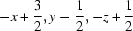
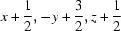
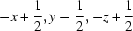
| Symmetry codes: (ii) −x+3/2, y−1/2, −z+1/2; (iii) x+1/2, −y+3/2, z+1/2; (iv) −x+1, −y+1, −z; (v) −x+1/2, y−1/2, −z+1/2. |
Experimental details
| Crystal data | |
| Chemical formula | [Ni(C5H4NO3S)2(H2O)4] |
| Mr | 447.08 |
| Crystal system, space group | Monoclinic, P21/n |
| Temperature (K) | 295 |
| a, b, c (Å) | 7.5399 (8), 12.6939 (15), 8.7810 (8) |
| β (°) | 97.419 (12) |
| V (Å3) | 833.40 (15) |
| Z | 2 |
| Radiation type | Mo Kα |
| µ (mm−1) | 1.47 |
| Crystal size (mm) | 0.32 × 0.22 × 0.20 |
| Data collection | |
| Diffractometer | Rigaku R-AXIS RAPID IP diffractometer |
| Absorption correction | Multi-scan (ABSCOR; Higashi, 1995) |
| Tmin, Tmax | 0.660, 0.745 |
| No. of measured, independent and observed [I > 2σ(I)] reflections | 8877, 1524, 1449 |
| Rint | 0.019 |
| (sin θ/λ)max (Å−1) | 0.603 |
| Refinement | |
| R[F2 > 2σ(F2)], wR(F2), S | 0.024, 0.065, 1.06 |
| No. of reflections | 1524 |
| No. of parameters | 115 |
| H-atom treatment | H-atom parameters constrained |
| Δρmax, Δρmin (e Å−3) | 0.29, −0.37 |
Computer programs: PROCESS-AUTO (Rigaku, 1998), CrystalStructure (Rigaku/MSC, 2002), SIR92 (Altomare et al., 1993), SHELXL97 (Sheldrick, 2008), ORTEP-3 for Windows (Farrugia, 1997), WinGX (Farrugia, 1999).
| D—H···A | D—H | H···A | D···A | D—H···A |
| O1—H1A···O3i | 0.81 | 2.39 | 3.162 (3) | 158 |
| O1—H1A···O4i | 0.81 | 2.44 | 3.119 (2) | 142 |
| O1—H1B···O4ii | 0.89 | 1.83 | 2.722 (2) | 177 |
| O2—H2A···O3iii | 0.84 | 1.97 | 2.787 (2) | 163 |
| O2—H2B···O5iv | 0.86 | 1.89 | 2.748 (2) | 174 |
| C1—H1···O4i | 0.93 | 2.34 | 3.212 (3) | 155 |
| Symmetry codes: (i) −x+3/2, y−1/2, −z+1/2; (ii) x+1/2, −y+3/2, z+1/2; (iii) −x+1, −y+1, −z; (iv) −x+1/2, y−1/2, −z+1/2. |
Acknowledgements
This work was supported by the ZIJIN project of Zhejiang University, China.
References
 Altomare, A., Cascarano, G., Giacovazzo, C. & Guagliardi, A. (1993). J. Appl. Cryst. 26, 343–350. CrossRef Web of Science IUCr Journals Google Scholar
Cotton, F. A. & Wilkinson, G. (1972). Advances in Inorganic Chemistry, p. 120. New York: John Wiley & Sons. Google Scholar
Deisenhofer, J. & Michel, H. (1989). EMBO J. 8, 2149–2170. CAS PubMed Web of Science Google Scholar
Farrugia, L. J. (1997). J. Appl. Cryst. 30, 565. CrossRef IUCr Journals Google Scholar
Farrugia, L. J. (1999). J. Appl. Cryst. 32, 837–838. CrossRef CAS IUCr Journals Google Scholar
Higashi, T. (1995). ABSCOR. Rigaku Corporation, Tokyo, Japan. Google Scholar
Li, H., Liu, J.-G. & Xu, D.-J. (2005). Acta Cryst. E61, m761–m763. Web of Science CSD CrossRef IUCr Journals Google Scholar
Liu, B.-X., Su, J.-R. & Xu, D.-J. (2004). Acta Cryst. C60, m183–m185. Web of Science CSD CrossRef CAS IUCr Journals Google Scholar
Rigaku (1998). PROCESS-AUTO. Rigaku Corporation, Tokyo, Japan. Google Scholar
Rigaku/MSC (2002). CrystalStructure. Rigaku/MSC, The Woodlands, Texas, USA. Google Scholar
Sheldrick, G. M. (2008). Acta Cryst. A64, 112–122. Web of Science CrossRef CAS IUCr Journals Google Scholar
Su, J.-R. & Xu, D.-J. (2004). J. Coord. Chem. 57, 223–229. Web of Science CSD CrossRef CAS Google Scholar
Walsh, B. & Hathaway, B. J. (1980). J. Chem. Soc. Dalton Trans. pp. 681–689. CSD CrossRef Web of Science Google Scholar
This is an open-access article distributed under the terms of the Creative Commons Attribution (CC-BY) Licence, which permits unrestricted use, distribution, and reproduction in any medium, provided the original authors and source are cited.
| CRYSTALLOGRAPHIC COMMUNICATIONS |


As π-π stacking between aromatic rings plays an important role in electron transfer process in some biological system (Deisenhofer & Michel, 1989), π-π stacking has attracted our much attention in past years (Su & Xu, 2004; Liu et al., 2004; Li et al., 2005). In order to investigate the influence of substituents on aromatic stacking, the title pyridine-sulfate complex has recently prepared and its crystal structure is reported here.
The molecular structure of the title compound is shown in Fig. 1. The NiII cation is located in an inversion center and coordinated by four water molecules and two pyridine-3-sulfonate anions with a NiN2O4 distorted octahedral geometry (Table 1), similar to the analogue of ZnII (Walsh & Hathaway, 1980). Partially overlapped arrangement is observed between parallel pyridine rings (Fig. 2). The face-to-face separation of 3.561 (5) Å between parallel pyridine rings is shorter than the van der Waals thickness of an aromatic ring (3.70 Å; Cotton & Wilkinson, 1972), and indicates the existence of weak π–π stacking between the pyridine rings.
The intermolecular O—H···O hydrogen bonding and weak C—H···O hydrogen bonding (Table 2) help to stabilize the crystal structure.