 | Acta Crystallographica Section E Acta Crystallographica Section E CRYSTALLOGRAPHIC COMMUNICATIONS |


 journal menu


metal-organic compounds
| CRYSTALLOGRAPHIC COMMUNICATIONS |
 access
trans-Bis(methanol-κO)bis(quinoline-2-carboxylato-κ2N,O)manganese(II)

aFaculty of Chemistry, Wrocław University of Technology, Wybrzeże Wyspiańskiego 27, 50-37 Wrocław, Poland, and bFaculty of Chemistry, University of Wrocław, Joliot-Curie 14, 50-383 Wrocław, Poland
*Correspondence e-mail: [email protected]
The title compound, [Mn(C10H6NO2)2(CH4O)2], was obtained unintentionally as the product of an attempt to synthesize a polynuclear carboxylate bridged manganese(III/IV) complex, using methanol to reduce the permanganate ion. The molecule is centrosymmetric; the pairs of equivalent ligands coordinate trans to each other in a distorted octahedral geometry. Intramolecular C—H⋯O bonds lying in the equatorial plane stabilize the molecule. In the crystal, molecules are linked by O—H⋯O and C—H⋯O hydrogen bonds, creating a three-dimensional supramolecular structure. π–π and C—H⋯π interactions are also observed. The dihedral angle and centroid-to-centroid distance between the pyridine ring (A) and the benzene ring (Bi) of a symmetrically related molecule [symmetry code: (i) −1 − x, −y, −z] are 1.27 (11)° and 3.974 (2) Å, respectively. For the C—H⋯π interactions, the relevant distances and angles are: C⋯Cg[Aii] = 3.643 (2) Å, H⋯Cg[Aii] = 2.750 (2) Å and C—H⋯Cg[Aii] = 155 (1)° [symmetry code: (ii) x, −1 + y, z].
Related literature
For previously reported MnII complexes with the quinoline-2 carboxylate ligand, see: Okabe &Koizumi (1997![[Okabe, N. & Koizumi, M. (1997). Acta Cryst. C53, 852-854.]](../../../../../../logos/arrows/e_arr.gif "Okabe, N. & Koizumi, M. (1997). Acta Cryst. C53, 852-854.") ); Goher & Mautner (1993); Haendler (1996); Dobrzyńska & Jerzykiewicz (2004); Dobrzyńska et al. (2005, 2006).
); Goher & Mautner (1993); Haendler (1996); Dobrzyńska & Jerzykiewicz (2004); Dobrzyńska et al. (2005, 2006).
![[Scheme 1]](su2065scheme1.gif)
Experimental
Crystal data
|
Refinement
|
| |||||||||||||||||||||||||||
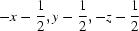 ; (ii)
 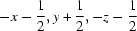 ; (iii)
 Data collection: CrysAlis CCD (Oxford Diffraction, 2006); cell refinement: CrysAlis RED (Oxford Diffraction, 2006); data reduction: CrysAlis RED; program(s) used to solve structure: SHELXTL-NT (Sheldrick, 2008); program(s) used to refine structure: SHELXTL-NT; molecular graphics: SHELXTL-NT; software used to prepare material for publication: SHELXTL-NT.
Supporting information
contains datablocks I, global. DOI: 10.1107/S1600536808031905/su2065sup1.cif
Structure factors: contains datablock I. DOI: 10.1107/S1600536808031905/su2065Isup2.hkl
Compound (I) was obtained unintentionally as the product of an attempt to synthesize the polynuclear, carboxylate bridged manganese(III/IV) complex mixing a methanol solution of quinoline-2-carboxylic acid and potassium permanganate at room temperature.
The hydroxyl H-atom was located in a difference Fourier map and refined isotropically with the O-H distance restrained to 0.80 (3) Å. The C-bound H-atoms were included in calculated positions and treated as riding atoms: C-H = 0.93 - 0.96 Å with Uiso(H) = 1.2 or 1.5Ueq(parent C atom).
Data collection: CrysAlis CCD (Oxford Diffraction, 2006); cell CrysAlis RED (Oxford Diffraction, 2006); data reduction: CrysAlis RED (Oxford Diffraction, 2006); program(s) used to solve structure: SHELXTL-NT (Sheldrick, 2008); program(s) used to refine structure: SHELXTL-NT (Sheldrick, 2008); molecular graphics: SHELXTL-NT (Sheldrick, 2008); software used to prepare material for publication: SHELXTL-NT (Sheldrick, 2008).
![[Figure 1]](./su2065fig1thm.gif) | Fig. 1. The molecular structure of compound (I), with atom labels and 50% probability displacement ellipsoids for non-H atoms. |
![[Figure 2]](./su2065fig2thm.gif) | Fig. 2. The crystal packing of compound (I), showing one layer of molecules connected by O—H···O and C—H···O hydrogen bonds (dashed lines). H and O atoms participating in O—H···O bonds are shown as balls. |
| [Mn(C10H6NO2)2(CH4O)2] | F(000) = 478 |
| Mr = 463.34 | Dx = 1.546 Mg m−3 |
| Monoclinic, P21/n | Mo Kα radiation, λ = 0.71073 Å |
| Hall symbol: -P 2yn | Cell parameters from 3842 reflections |
| a = 10.596 (5) Å | θ = 3–26° |
| b = 7.243 (3) Å | µ = 0.71 mm−1 |
| c = 13.534 (3) Å | T = 100 K |
| β = 106.59 (4)° | Block, yellow |
| V = 995.5 (7) Å3 | 0.43 × 0.12 × 0.09 mm |
| Z = 2 |
| Kuma KM-4-CCD κ-axis diffractometer | 1924 independent reflections |
| Radiation source: fine-focus sealed tube | 1475 reflections with I > 2σ(I) |
| Graphite monochromator | Rint = 0.031 |
| ω scans | θmax = 26.0°, θmin = 3.2° |
| Absorption correction: analytical (CrysAlis RED; Oxford Diffraction, 2006) | h = −13→12 |
| Tmin = 0.873, Tmax = 0.902 | k = −8→6 |
| 5405 measured reflections | l = −16→16 |
| Refinement on F2 | Primary atom site location: structure-invariant direct methods |
| Least-squares matrix: full | Secondary atom site location: difference Fourier map |
| R[F2 > 2σ(F2)] = 0.034 | Hydrogen site location: inferred from neighbouring sites |
| wR(F2) = 0.089 | H atoms treated by a mixture of independent and constrained refinement |
| S = 0.98 | w = 1/[σ2(Fo2) + (0.0573P)2] where P = (Fo2 + 2Fc2)/3 |
| 1924 reflections | (Δ/σ)max < 0.001 |
| 146 parameters | Δρmax = 0.37 e Å−3 |
| 0 restraints | Δρmin = −0.31 e Å−3 |
| [Mn(C10H6NO2)2(CH4O)2] | V = 995.5 (7) Å3 |
| Mr = 463.34 | Z = 2 |
| Monoclinic, P21/n | Mo Kα radiation |
| a = 10.596 (5) Å | µ = 0.71 mm−1 |
| b = 7.243 (3) Å | T = 100 K |
| c = 13.534 (3) Å | 0.43 × 0.12 × 0.09 mm |
| β = 106.59 (4)° |
| Kuma KM-4-CCD κ-axis diffractometer | 1924 independent reflections |
| Absorption correction: analytical (CrysAlis RED; Oxford Diffraction, 2006) | 1475 reflections with I > 2σ(I) |
| Tmin = 0.873, Tmax = 0.902 | Rint = 0.031 |
| 5405 measured reflections |
| R[F2 > 2σ(F2)] = 0.034 | 0 restraints |
| wR(F2) = 0.089 | H atoms treated by a mixture of independent and constrained refinement |
| S = 0.98 | Δρmax = 0.37 e Å−3 |
| 1924 reflections | Δρmin = −0.31 e Å−3 |
| 146 parameters |
Geometry. All e.s.d.'s (except the e.s.d. in the dihedral angle between two l.s. planes) are estimated using the full covariance matrix. The cell e.s.d.'s are taken into account individually in the estimation of e.s.d.'s in distances, angles and torsion angles; correlations between e.s.d.'s in cell parameters are only used when they are defined by crystal symmetry. An approximate (isotropic) treatment of cell e.s.d.'s is used for estimating e.s.d.'s involving l.s. planes. |
Refinement. Refinement of F2 against ALL reflections. The weighted R-factor wR and goodness of fit S are based on F2, conventional R-factors R are based on F, with F set to zero for negative F2. The threshold expression of F2 > σ(F2) is used only for calculating R-factors(gt) etc. and is not relevant to the choice of reflections for refinement. R-factors based on F2 are statistically about twice as large as those based on F, and R- factors based on ALL data will be even larger. |
| x | y | z | Uiso*/Ueq | ||
| Mn1 | 0.0000 | 0.0000 | 0.0000 | 0.01282 (16) | |
| O1 | −0.06256 (14) | 0.0841 (2) | −0.15489 (11) | 0.0151 (3) | |
| O2 | −0.21857 (15) | 0.2157 (2) | −0.28166 (11) | 0.0235 (4) | |
| O3 | −0.08755 (15) | −0.2745 (2) | −0.04702 (12) | 0.0179 (4) | |
| N1 | −0.21067 (17) | 0.1118 (2) | −0.02417 (13) | 0.0126 (4) | |
| C1 | −0.2606 (2) | 0.1766 (3) | −0.11886 (16) | 0.0137 (5) | |
| C2 | −0.3844 (2) | 0.2649 (3) | −0.15224 (16) | 0.0166 (5) | |
| H2A | −0.4157 | 0.3101 | −0.2191 | 0.020* | |
| C3 | −0.4573 (2) | 0.2825 (3) | −0.08415 (17) | 0.0187 (5) | |
| H3A | −0.5391 | 0.3400 | −0.1047 | 0.022* | |
| C4 | −0.4091 (2) | 0.2138 (3) | 0.01703 (16) | 0.0156 (5) | |
| C5 | −0.4793 (2) | 0.2244 (3) | 0.09220 (17) | 0.0184 (5) | |
| H5A | −0.5612 | 0.2818 | 0.0756 | 0.022* | |
| C6 | −0.4280 (2) | 0.1518 (3) | 0.18819 (17) | 0.0196 (5) | |
| H6A | −0.4751 | 0.1600 | 0.2364 | 0.024* | |
| C7 | −0.3044 (2) | 0.0644 (3) | 0.21473 (17) | 0.0184 (5) | |
| H7A | −0.2713 | 0.0136 | 0.2802 | 0.022* | |
| C8 | −0.2318 (2) | 0.0528 (3) | 0.14573 (16) | 0.0153 (5) | |
| H8A | −0.1494 | −0.0031 | 0.1647 | 0.018* | |
| C9 | −0.2833 (2) | 0.1269 (3) | 0.04511 (16) | 0.0132 (5) | |
| C10 | −0.1752 (2) | 0.1571 (3) | −0.19219 (16) | 0.0145 (5) | |
| C11 | −0.1393 (2) | −0.3854 (3) | 0.02034 (17) | 0.0207 (5) | |
| H11A | −0.1730 | −0.4990 | −0.0136 | 0.031* | |
| H11B | −0.2090 | −0.3196 | 0.0373 | 0.031* | |
| H11C | −0.0705 | −0.4118 | 0.0823 | 0.031* | |
| H3 | −0.141 (3) | −0.280 (4) | −0.102 (2) | 0.050 (10)* |
| U11 | U22 | U33 | U12 | U13 | U23 | |
| Mn1 | 0.0121 (2) | 0.0150 (3) | 0.0109 (2) | 0.0008 (2) | 0.00264 (18) | 0.0002 (2) |
| O1 | 0.0141 (8) | 0.0196 (8) | 0.0121 (7) | 0.0013 (6) | 0.0045 (6) | 0.0006 (6) |
| O2 | 0.0180 (8) | 0.0358 (10) | 0.0161 (8) | 0.0018 (7) | 0.0040 (7) | 0.0060 (7) |
| O3 | 0.0188 (8) | 0.0180 (8) | 0.0143 (8) | −0.0024 (7) | 0.0007 (7) | 0.0003 (7) |
| N1 | 0.0132 (9) | 0.0113 (9) | 0.0131 (9) | −0.0014 (7) | 0.0035 (7) | −0.0022 (7) |
| C1 | 0.0121 (10) | 0.0118 (11) | 0.0168 (11) | −0.0023 (8) | 0.0035 (9) | −0.0017 (9) |
| C2 | 0.0149 (11) | 0.0158 (11) | 0.0179 (11) | 0.0003 (9) | 0.0027 (9) | 0.0044 (9) |
| C3 | 0.0150 (11) | 0.0148 (11) | 0.0248 (12) | 0.0041 (9) | 0.0032 (10) | 0.0033 (10) |
| C4 | 0.0154 (11) | 0.0113 (10) | 0.0200 (12) | −0.0015 (8) | 0.0049 (9) | −0.0031 (9) |
| C5 | 0.0141 (11) | 0.0157 (11) | 0.0265 (13) | 0.0004 (9) | 0.0078 (10) | −0.0037 (10) |
| C6 | 0.0197 (12) | 0.0205 (12) | 0.0224 (12) | −0.0037 (10) | 0.0120 (10) | −0.0067 (10) |
| C7 | 0.0206 (12) | 0.0200 (11) | 0.0148 (11) | −0.0023 (9) | 0.0053 (10) | −0.0010 (9) |
| C8 | 0.0144 (11) | 0.0153 (11) | 0.0158 (11) | 0.0013 (8) | 0.0037 (9) | −0.0026 (8) |
| C9 | 0.0142 (11) | 0.0095 (11) | 0.0167 (11) | −0.0022 (8) | 0.0056 (9) | −0.0018 (9) |
| C10 | 0.0144 (11) | 0.0147 (11) | 0.0119 (11) | −0.0028 (9) | −0.0001 (9) | 0.0003 (9) |
| C11 | 0.0228 (12) | 0.0167 (12) | 0.0223 (12) | −0.0006 (10) | 0.0058 (10) | 0.0002 (10) |
| Mn1—O1 | 2.100 (2) | C4—C9 | 1.424 (3) |
| Mn1—O3 | 2.209 (2) | C4—C5 | 1.424 (3) |
| Mn1—N1 | 2.308 (2) | C5—C6 | 1.363 (3) |
| Mn1—O1i | 2.100 (2) | C6—C7 | 1.406 (3) |
| Mn1—O3i | 2.209 (2) | C7—C8 | 1.372 (3) |
| Mn1—N1i | 2.308 (2) | C8—C9 | 1.420 (3) |
| O1—C10 | 1.271 (3) | C2—H2A | 0.93 |
| O2—C10 | 1.241 (3) | C3—H3A | 0.93 |
| O3—C11 | 1.436 (3) | C5—H5A | 0.93 |
| O3—H3 | 0.80 (3) | C6—H6A | 0.93 |
| N1—C1 | 1.325 (3) | C7—H7A | 0.93 |
| N1—C9 | 1.377 (3) | C8—H8A | 0.93 |
| C1—C10 | 1.529 (3) | C11—H11A | 0.96 |
| C1—C2 | 1.413 (3) | C11—H11B | 0.96 |
| C2—C3 | 1.367 (3) | C11—H11C | 0.96 |
| C3—C4 | 1.409 (3) | ||
| O1—Mn1—O3 | 89.23 (7) | C3—C4—C5 | 123.9 (2) |
| O1—Mn1—N1 | 74.93 (7) | C4—C5—C6 | 120.9 (2) |
| O1—Mn1—O1i | 180.00 | C5—C6—C7 | 120.4 (2) |
| O1—Mn1—O3i | 90.77 (7) | C6—C7—C8 | 121.1 (2) |
| O1—Mn1—N1i | 105.07 (7) | C7—C8—C9 | 119.6 (2) |
| O3—Mn1—N1 | 88.01 (7) | N1—C9—C8 | 119.1 (2) |
| O1i—Mn1—O3 | 90.77 (7) | C4—C9—C8 | 119.8 (2) |
| O3—Mn1—O3i | 180.00 | N1—C9—C4 | 121.06 (19) |
| O3—Mn1—N1i | 91.99 (7) | O2—C10—C1 | 118.6 (2) |
| O1i—Mn1—N1 | 105.07 (7) | O1—C10—O2 | 125.0 (2) |
| O3i—Mn1—N1 | 91.99 (7) | O1—C10—C1 | 116.33 (18) |
| N1—Mn1—N1i | 180.00 | C1—C2—H2A | 121.00 |
| O1i—Mn1—O3i | 89.23 (7) | C3—C2—H2A | 121.00 |
| O1i—Mn1—N1i | 74.93 (7) | C2—C3—H3A | 120.00 |
| O3i—Mn1—N1i | 88.01 (7) | C4—C3—H3A | 120.00 |
| Mn1—O1—C10 | 120.67 (14) | C4—C5—H5A | 120.00 |
| Mn1—O3—C11 | 121.70 (13) | C6—C5—H5A | 120.00 |
| C11—O3—H3 | 105 (2) | C5—C6—H6A | 120.00 |
| Mn1—O3—H3 | 116 (2) | C7—C6—H6A | 120.00 |
| Mn1—N1—C9 | 129.59 (14) | C6—C7—H7A | 119.00 |
| C1—N1—C9 | 118.96 (19) | C8—C7—H7A | 119.00 |
| Mn1—N1—C1 | 111.36 (15) | C7—C8—H8A | 120.00 |
| C2—C1—C10 | 120.13 (19) | C9—C8—H8A | 120.00 |
| N1—C1—C2 | 123.2 (2) | O3—C11—H11A | 109.00 |
| N1—C1—C10 | 116.64 (19) | O3—C11—H11B | 109.00 |
| C1—C2—C3 | 118.6 (2) | O3—C11—H11C | 109.00 |
| C2—C3—C4 | 120.3 (2) | H11A—C11—H11B | 109.00 |
| C3—C4—C9 | 117.9 (2) | H11A—C11—H11C | 109.00 |
| C5—C4—C9 | 118.26 (19) | H11B—C11—H11C | 110.00 |
| O3—Mn1—O1—C10 | 89.82 (16) | C1—N1—C9—C4 | −1.3 (3) |
| N1—Mn1—O1—C10 | 1.67 (15) | Mn1—N1—C9—C4 | 174.99 (15) |
| O3i—Mn1—O1—C10 | −90.18 (16) | Mn1—N1—C9—C8 | −5.6 (3) |
| N1i—Mn1—O1—C10 | −178.33 (15) | C10—C1—C2—C3 | −179.0 (2) |
| O1—Mn1—O3—C11 | −149.62 (16) | C2—C1—C10—O1 | 176.7 (2) |
| N1—Mn1—O3—C11 | −74.68 (16) | N1—C1—C10—O1 | −1.5 (3) |
| O1i—Mn1—O3—C11 | 30.38 (16) | N1—C1—C10—O2 | 179.83 (19) |
| N1i—Mn1—O3—C11 | 105.32 (16) | N1—C1—C2—C3 | −0.9 (3) |
| O1—Mn1—N1—C1 | −2.35 (14) | C2—C1—C10—O2 | −1.9 (3) |
| O1—Mn1—N1—C9 | −178.82 (18) | C1—C2—C3—C4 | 0.1 (3) |
| O3—Mn1—N1—C1 | −92.09 (14) | C2—C3—C4—C9 | 0.1 (3) |
| O3—Mn1—N1—C9 | 91.44 (17) | C2—C3—C4—C5 | −179.2 (2) |
| O1i—Mn1—N1—C1 | 177.65 (14) | C3—C4—C9—N1 | 0.5 (3) |
| O1i—Mn1—N1—C9 | 1.18 (18) | C3—C4—C5—C6 | 178.7 (2) |
| O3i—Mn1—N1—C1 | 87.91 (14) | C9—C4—C5—C6 | −0.6 (3) |
| O3i—Mn1—N1—C9 | −88.56 (17) | C5—C4—C9—C8 | 0.4 (3) |
| Mn1—O1—C10—C1 | −0.8 (3) | C3—C4—C9—C8 | −178.9 (2) |
| Mn1—O1—C10—O2 | 177.74 (17) | C5—C4—C9—N1 | 179.8 (2) |
| Mn1—N1—C1—C2 | −175.44 (17) | C4—C5—C6—C7 | −0.1 (3) |
| C9—N1—C1—C2 | 1.5 (3) | C5—C6—C7—C8 | 1.1 (3) |
| C9—N1—C1—C10 | 179.63 (18) | C6—C7—C8—C9 | −1.3 (3) |
| Mn1—N1—C1—C10 | 2.7 (2) | C7—C8—C9—N1 | −178.9 (2) |
| C1—N1—C9—C8 | 178.2 (2) | C7—C8—C9—C4 | 0.5 (3) |
| Symmetry code: (i) −x, −y, −z. |
| D—H···A | D—H | H···A | D···A | D—H···A |
| O3—H3···O2ii | 0.80 (3) | 1.83 (3) | 2.623 (3) | 172 (3) |
| C2—H2A···O1iii | 0.93 | 2.58 | 3.411 (3) | 148 |
| C8—H8A···O1i | 0.93 | 2.36 | 3.241 (3) | 158 |
| Symmetry codes: (i) −x, −y, −z; (ii) −x−1/2, y−1/2, −z−1/2; (iii) −x−1/2, y+1/2, −z−1/2. |
Experimental details
| Crystal data | |
| Chemical formula | [Mn(C10H6NO2)2(CH4O)2] |
| Mr | 463.34 |
| Crystal system, space group | Monoclinic, P21/n |
| Temperature (K) | 100 |
| a, b, c (Å) | 10.596 (5), 7.243 (3), 13.534 (3) |
| β (°) | 106.59 (4) |
| V (Å3) | 995.5 (7) |
| Z | 2 |
| Radiation type | Mo Kα |
| µ (mm−1) | 0.71 |
| Crystal size (mm) | 0.43 × 0.12 × 0.09 |
| Data collection | |
| Diffractometer | Kuma KM-4-CCD κ-axis diffractometer |
| Absorption correction | Analytical (CrysAlis RED; Oxford Diffraction, 2006) |
| Tmin, Tmax | 0.873, 0.902 |
| No. of measured, independent and observed [I > 2σ(I)] reflections | 5405, 1924, 1475 |
| Rint | 0.031 |
| (sin θ/λ)max (Å−1) | 0.617 |
| Refinement | |
| R[F2 > 2σ(F2)], wR(F2), S | 0.034, 0.089, 0.98 |
| No. of reflections | 1924 |
| No. of parameters | 146 |
| H-atom treatment | H atoms treated by a mixture of independent and constrained refinement |
| Δρmax, Δρmin (e Å−3) | 0.37, −0.31 |
Computer programs: CrysAlis CCD (Oxford Diffraction, 2006), CrysAlis RED (Oxford Diffraction, 2006), SHELXTL-NT (Sheldrick, 2008).
| D—H···A | D—H | H···A | D···A | D—H···A |
| O3—H3···O2i | 0.80 (3) | 1.83 (3) | 2.623 (3) | 172 (3) |
| C2—H2A···O1ii | 0.93 | 2.58 | 3.411 (3) | 148 |
| C8—H8A···O1iii | 0.93 | 2.36 | 3.241 (3) | 158 |
| Symmetry codes: (i) −x−1/2, y−1/2, −z−1/2; (ii) −x−1/2, y+1/2, −z−1/2; (iii) −x, −y, −z. |
Acknowledgements
The authors thank Wrocław University of Technology for financial support.
References
 Dobrzyńska, D. & Jerzykiewicz, L. B. (2004). J. Am. Chem. Soc. 126, 11118–11119. Web of Science PubMed Google Scholar
Dobrzyńska, D., Jerzykiewicz, L. B., Jezierska, J. & Duczmal, M. (2005). Cryst. Growth Des. 5, 1945–1951. Google Scholar
Dobrzyńska, D., Jerzykiewicz, L. B., Jezierska, J. & Słoniec, E. (2006). Pol. J. Chem. 80, 1789–1797. Google Scholar
Goher, M. A. S. & Mautner, F. A. (1993). Polyhedron, 12, 1863–1870. CSD CrossRef CAS Web of Science Google Scholar
Haendler, H. M. (1996). Acta Cryst. C52, 801–803. CSD CrossRef CAS Web of Science IUCr Journals Google Scholar
Okabe, N. & Koizumi, M. (1997). Acta Cryst. C53, 852–854. CSD CrossRef CAS Web of Science IUCr Journals Google Scholar
Oxford Diffraction (2006). CrysAlis CCD and CrysAlis RED. Oxford Diffraction Poland, Wrocław, Poland. Google Scholar
Sheldrick, G. M. (2008). Acta Cryst. A64, 112–122. Web of Science CrossRef CAS IUCr Journals Google Scholar
This is an open-access article distributed under the terms of the Creative Commons Attribution (CC-BY) Licence, which permits unrestricted use, distribution, and reproduction in any medium, provided the original authors and source are cited.
| CRYSTALLOGRAPHIC COMMUNICATIONS |


The quinoline-2-carboxylate (quin-2-c) ion is known as an effective chelator. A few Mn(II) complexes with the quin-2-c ion and different coligands have been reported previously (Okabe et al., 1997, Goher et al., 1993, Haendler, 1996, Dobrzyńska et al., 2004, 2005, 2006). The title complex, (I), is centrosymmetric (Fig. 1). The quin-2-c ion coordinates in a typical O,N chelate mode. The pairs of the equivalent ligands lie trans to each other in a distorted octahedral geometry. The bite angle of the chelating ligand is 74.93 (7)° and falls in the range observed for other manganese(II) complexes with the quin-2-c ion (73.1° - 78.5°; see references quoted above). The intramolecular C—H···O bonds lying in the equatorial plane stabilize the molecule (Table 1).
In the crystal molecules are linked by O—H···O and C—H···O hydrogen bonds creating a three-dimensional supramolecular structure (see Table 1 and Fig. 2). π···π and C-H···π interactions are also observed. The dihedral angle and centroid-to-centroid distance between rings A [= N1,C1-C4,C9] and Bi [= (C4-C9)i; symmetry code (i) -1-x, -y,-z)] are 1.27° and 3.974 Å, respectively. For the C-H···π interactions the relevant distances and angles are: d(C11···Cg[Aii] = 3.643 Å, d(H11A···Cg[Aii]) = 2.750 Å with angle (C11-H11A···Cg[Aii] = 155° (symmetry code (ii) x, -1+y, z).