 | Acta Crystallographica Section E Acta Crystallographica Section E CRYSTALLOGRAPHIC COMMUNICATIONS |


 journal menu


inorganic compounds
| CRYSTALLOGRAPHIC COMMUNICATIONS |
 access
of the mixed boracite Fe1.59Zn1.41B7O13Br

aCentro Universitario de Ciencias Exactas e Ingenierá, Universidad de Guadalajara, Laboratorio de Materiales Avanzados del Departamento de Electrónica, Av. Revolución No. 1500, Módulo O, Planta baja, Zona Olímpica, CP 44840, Guadalajara, Jalisco, Mexico, bFacultad de Ingeniería, Universidad Autóoma de Baja California, Blvd. Benito Juarez s/n col. Insurgentes, Mexicali, Baja California, Mexico, cInstituto de Física, Universidad Nacional Autónoma de México, AP 20-364, 01000 México DF, Mexico, and dCentro de Nanociencias y Nanotecnología, Universidad Nacional, Autónoma de México, Apdo. Postal 356, CP 22800, Ensenada, Baja California, Mexico
*Correspondence e-mail: [email protected]
The structural characterization of the new iron–zinc heptaborate bromide with composition Fe1.59Zn1.41B7O13Br, prepared by chemical transport is reported. A rigid-body model with constrained generalized coordinates was defined in order to hold the positions of the B atoms at reasonable interatomic distances that typically would reach unacceptable values because of the weak scattering power of boron. There are three independent sites for the B atoms of which two are tetrahedrally coordinated. The bond-valence sum around the third B atom, located on a threefold rotation axis, was calculated considering two cases of coordination of boron with oxygens: trigonal-planar and tetrahedral. The contribution of the fourth O atom to the bond-valence sum was found to be only 0.06 v.u., indicating the presence of a very weak bond in the right position to have a distorted tetrahedral coordination in favour of the trigonal-planar coordination for the third B atom. X-ray fluorescence (XRF) was used to determinate the Fe/Zn ratio.
Related literature
The method of preparation was based on Schmid (1965![[Schmid, H. (1965). J. Phys. Chem. Solids, 26, 973-988.]](../../../../../../logos/arrows/e_arr.gif "Schmid, H. (1965). J. Phys. Chem. Solids, 26, 973-988.") ). For related structures, see: Mao et al. (1991); Dowty & Clark (1972, 1973); Mendoza-Alvarez et al. (1985); Schindler & Hawthorne (1998); Knorr et al. (2007). For properties and potential applications of boracites, see: Campa-Molina et al. (1994, 2002); Dana (1951); Mathews et al. (1997); Smart & Moore (1992). For bond-valence parameters for oxides, see: Brese & O'Keeffe (1991).
). For related structures, see: Mao et al. (1991); Dowty & Clark (1972, 1973); Mendoza-Alvarez et al. (1985); Schindler & Hawthorne (1998); Knorr et al. (2007). For properties and potential applications of boracites, see: Campa-Molina et al. (1994, 2002); Dana (1951); Mathews et al. (1997); Smart & Moore (1992). For bond-valence parameters for oxides, see: Brese & O'Keeffe (1991).
Experimental
Crystal data
|
Data collection
|
| |||||||||||||||||||||||||||||||||||||||||
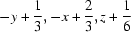 ; (ii)
 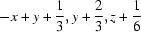 ; (iii)
 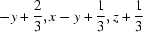 ; (iv)
  ; (v)
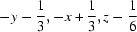
; (v) 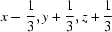 ; (vi)
  ; (vii)
 Data collection: DIFFRAC/AT (Siemens, 1993); cell refinement: FULLPROF (Rodríguez-Carvajal, 2006; Rodriguez & Rodriguez-Carvajal, 1997, a strongly modified version of that described by Wiles & Young, 1981); data reduction: FULLPROF; method used to solve structure: coordinates were taken from an isotypic compound (Mao et al., 1991); program(s) used to refine structure: FULLPROF; software used to prepare material for publication: DIAMOND.
Supporting information
contains datablocks global, I. DOI: https://doi.org/10.1107/S1600536809044407/br2119sup1.cif
Rietveld powder data: contains datablock I. DOI: https://doi.org/10.1107/S1600536809044407/br2119Isup2.rtv
Single crystals of Fe1.59Zn1.41B7O13Br were grown by a chemical vapour transport technique, commonly called the three-crucibles method, reported by Schmid (1965). Growth takes place in a closed quartz ampoule. Chemical transport reactions were carried out by heating the ampoule at about 1173 K in a resistance-heated vertical furnace, with gradients of 850 K (above) and 650 K (below), over a period of 72 h. The reactants were placed in the following order: 1.7 g of B2O3 (which was obtained by dehydrating H3BO3) was placed in the first crucible; 0.5 g of each one of both metal oxides (ZnO and FeO) in the second crucible; and 0.8 g of each one of both divalent metal halides (FeCl2 and ZnCl2) in the third crucible. Crystals of Fe1.59Zn1.41B7O13Br as large as 2 mm in size were commonly obtained. (XRF) spectroscopy was used to estimate the Fe/Zn ratio. A small crystallite was irradiated using the "SANDRA" system developed at Instituto de Fisica, UNAM, equipped with a 75 W Mo X-ray tube (50 kV, 1.5 mA, XTF5011 model from Oxford Instruments) and AmpTeK Si-Pin detector. The system was calibrated using reference standard materials from NIST (SRM 2711). The average percent atomic content with for each element in the sample were 53 (4) % for iron, and 47 (4) % for zinc, and give a Fe:Zn ratio of 1.13. Then the stichiometric formula is Fe1.59 (12)Zn1.41 (12)B7O13Br.
The characterization of powdered Fe1.59Zn1.41B7O13Br mixed boracite by conventional X-ray powder diffraction data indicated the presence of a well crystallized phase showing reflections that matched with the isostructural phase trembathite, Mg1.56Fe1.44Mn0.02B7O13Cl (PDF 01–089-6198) reported by Schindler & Hawthorne (1998). The starting structural parameters to perform a of the Fe1.59Zn1.41B7O13Br boracite were taken from the isostructural data reported for Zn3B7O13Cl (ICSD 55444) by Mao et al. (1991). The following parameters were refined: scale factor, background parameters, dimensions, half-width, pseudo-Voigt and asymmetry parameters for the peak shape; position and thermal isotropic factors. For the case of boron, the thermal isotropic factors were fixed to 0.24 Å2, which is a reasonable value for the boron atom and for obtaining a good The occupation factors for Fe and Zn atoms sharing the same position were fixed to the values of 0.53 and 0.47 respectively, obtained by a quantitative chemical analysis from (XRF) spectroscopy. Due to the very low scattering power of boron atoms to the X-rays, one rigid body group (RBG) containing the boron atoms was defined as ilustrated in figure 1. This RBG has its centre in O(1) atom. Then, eight atoms define the complete RGB (including the centre) and are labelled as B(1), B(2), B(3), O(1), O(2), O(3), O(4) and O(5). Each atom has their spherical internal coordinates (dm, φm, θm) fixed according to the rigid character of the RBG formed by these eight atoms. The parameters χc, Θc, Φc, xo, yo, zo, that were refined in a first step are represented in fig. 1 b, c and were limited by the symmetry allowed movements for the RBG as a whole. At the end of this step, B(1)O4, B(2)O4 tetrahedra, and B(3)O3 triangle kept their interatomic angles and distances. In a second and final step of the spherical internal coordinates for B(3) and O(2) were refined in such a way to allow to bring the B(3)O3 triangle closer to the O(1) atom. The RBG subroutine has been included in the program FULLPROF (Rodriguez & Rodriguez-Carvajal, 1997). The use of the RBG reduced significantly the number of positional parameters in the The results of the are shown in figure 2.
The new iron-zinc heptaborate bromine Fe1.59Zn1.41B7O13Br, belongs to the family of boracites with general formula Me3B7O13X, where Me could be a divalent ion and X a halogen. Boracites have attracted the attention of researchers since Häuy, who observed in the mineral boracite Mg3B7O13Cl (Dana, 1951). Unusual physical properties can be cited for a given cations located in the crystalographic sites for Me and X. Depending on this, potential applications such as an optic stopper (Smart & Moore, 1992); ferroelectric non volatile memory (Mathews, et al., 1997); and infrared (IR) detection (Campa -Molina et al., 1994, 2002) have been reported and in some sense, can be modulated by the presence of some specific types of cations. The aim of this research was to synthesize a new boracite with Zn and Fe in the crystalographic sites for Me in the general formula, in order to stablish in first instance, its structural and crystal chemistry properties. They are needed for the understanding of its physical properties. The representation of the of the Fe1.59Zn1.41B7O13Br mixed boracite appear in figure 3. Bond valence calculations were made using the recommended bond-valence parameters for oxides published by Brese & O'Keeffe (1991) and considering those coordination polyhedra whose bond valence calculations were based on distances and angles that were allowed to refine (this was partially true in some cases). Bond valence sum around Br is found to be 0.82 and 1.10, for BrZn6 and BrFe6 distorted octahedra respectively. The resulting average value is then 0.97 if a composition of 53% Fe and 47% Zn is considered for this site, which is almost equal to the expected value of 1 for Br. Around the Fe/Zn site, four O atoms and Br are coordinated. The bond valence sums that result here are 1.97 and 1.76 when the site is only occupyied by Fe and Zn respectively. The average value for 53% Fe and 47% Zn is then 1.87 with good proximity to the expected value of 2. For the B(3) atom, the contribution of the fourth oxygen atom O(1) to the bond valence sum obtained for the B(3)O3 triangle of 2.8 is increased to 2.86 (i.e. only 0.06 v. u. indicating the presence of a very weak bond in the right position for have a distorted tetrahedral coordination around the planar triangle coordination for the third boron atom B(3). This fact is also a feature for the reported boracites Fe3B7O13Cl (ICSD 60504, Mendoza-Alvarez et al., 1985), and Zn3B7O13Cl (ICSD 55444, Mao et al., 1991).
The method of preparation was based on Schmid (1965). For related structures, see: Mao et al. (1991); Dowty & Clark (1972, 1973); Mendoza-Alvarez et al. (1985); Schindler & Hawthorne (1998); Knorr et al. (2007). For properties and potential applications of boracites, see: Campa-Molina et al. (1994, 2002) Dana (1951); Mathews et al. (1997); Smart & Moore (1992). For bond-valence parameters for oxides, see: Brese & O'Keeffe (1991).
Data collection: please supply; cell please supply; data reduction: please supply; program(s) used to solve structure: please supply; program(s) used to refine structure: FULLPROF (Rodríguez-Carvajal, 2006; Rodriguez & Rodriguez-Carvajal, 1997, a strongly modified version of that described by Wiles & Young (1981); molecular graphics: DIAMOND (Brandenburg, 2009); software used to prepare material for publication: DIAMOND (Brandenburg, 2009).
![[Figure 1]](./br2119fig1thm.gif) | Fig. 1. (a) Rigid body group (RBG) and the coordinate systems defined for performing the movements of the RBG as a whole, are represented in the unit cell of the Fe1.59Zn1.41B7O13Br mixed boracite. (b) Atoms belonging to the RBG: some are labelled and the remainig are related by symmetry (there is a symmetry axis C3 crossing vertically the RBG). (c) Orthogonal coordinate system to perform the rotations of the RBG and orthonormal molecular system. |
![[Figure 2]](./br2119fig2thm.gif) | Fig. 2. Observed (crosses), calculated (solid line) and difference (solid line at the bottom) from the final Rietveld refinement of the X-ray powder diffraction data of Fe1.59Zn1.41B7O13Br mixed boracite at room temperature. Vertical marks correspond to the positions allowed for the Bragg reflections. |
![[Figure 3]](./br2119fig3thm.gif) | Fig. 3. Structural representation of Fe1.59Zn1.41B7O13Br mixed boracite. |
![[Figure 4]](./br2119fig4thm.gif) | Fig. 4. Crystal structure of Fe1.59Zn1.41B7O13Br mixed boracite |
| Fe1.59Zn1.41B7O13Br | F(000) = 1546.0 |
| Mr = 544.65 | Dx = 4.013 Mg m−3 |
| Trigonal, R3c | Cu Kα radiation, λ = 1.54175 Å |
| Hall symbol: R 3 -2"c | T = 300 K |
| a = 8.6081 (1) Å | Particle morphology: irregular |
| c = 21.0703 (3) Å | pale pink |
| V = 1352.12 (3) Å3 | irregular, 20 × 20 mm |
| Z = 6 | Specimen preparation: Prepared at 1173 K |
| Bruker D8 Advance diffractometer | Data collection mode: reflection |
| Radiation source: sealed X-ray tube, Cu Kα | Scan method: step |
| Graphite monochromator | 2θmin = 8.117°, 2θmax = 110.011°, 2θstep = 0.020° |
| Specimen mounting: packed powder sample container |
| Least-squares matrix: full with fixed elements per cycle | 5240 data points |
| Rp = 0.018 | Profile function: pseudo-Voigt modified by Thompson et al. (1987) |
| Rwp = 0.025 | 18 parameters |
| Rexp = 0.014 | Weighting scheme based on measured s.u.'s |
| RBragg = 0.06 | (Δ/σ)max = 0.02 |
| R(F2) = 0.06 | Background function: linear interpolation between a set of 72 background points with refinable heights |
| Fe1.59Zn1.41B7O13Br | V = 1352.12 (3) Å3 |
| Mr = 544.65 | Z = 6 |
| Trigonal, R3c | Cu Kα radiation, λ = 1.54175 Å |
| a = 8.6081 (1) Å | T = 300 K |
| c = 21.0703 (3) Å | irregular, 20 × 20 mm |
| Bruker D8 Advance diffractometer | Scan method: step |
| Specimen mounting: packed powder sample container | 2θmin = 8.117°, 2θmax = 110.011°, 2θstep = 0.020° |
| Data collection mode: reflection |
| Rp = 0.018 | R(F2) = 0.06 |
| Rwp = 0.025 | 5240 data points |
| Rexp = 0.014 | 18 parameters |
| RBragg = 0.06 |
| x | y | z | Uiso*/Ueq | Occ. (<1) | |
| Br | 0.00000 | 0.00000 | 0.26670 | 0.0084 (9) | |
| Zn | 0.1488 (8) | 0.3037 (3) | 0.3347 (2) | 0.0113 (8) | 0.47000 |
| Fe | 0.1488 (8) | 0.3037 (3) | 0.3347 (2) | 0.0113 (8) | 0.53000 |
| B1 | −0.184 (1) | 0.1519 (1) | −0.080 (1) | 0.00304 | |
| B2 | 0.1130 (2) | −0.0902 (1) | −0.0259 (1) | 0.00304 | |
| B3 | 0.00000 | 0.00000 | 0.105 (1) | 0.00304 | |
| O1 | 0.00000 | 0.00000 | −0.008 (1) | 0.0025 (9) | |
| O2 | 0.010 (1) | −0.157 (2) | 0.107 (1) | 0.0025 (9) | |
| O3 | 0.282 (1) | 0.274 (1) | −0.032 (1) | 0.0025 (9) | |
| O4 | 0.206 (1) | −0.006 (1) | −0.085 (1) | 0.0025 (9) | |
| O5 | 0.242 (1) | −0.059 (1) | 0.024 (1) | 0.0025 (9) |
| Zn—Br | 2.680 (3) | B1—O4vii | 1.451 (13) |
| Zn—Bri | 3.412 (1) | B1—O5vi | 1.49 (3) |
| Zn—O2ii | 2.130 (4) | B2—O1 | 1.566 (3) |
| Zn—O3iii | 2.081 (7) | B2—O3viii | 1.452 (8) |
| Zn—O4iv | 2.035 (4) | B2—O4 | 1.463 (18) |
| Zn—O5v | 2.012 (7) | B2—O5 | 1.453 (17) |
| B1—O2vi | 1.506 (14) | B3—O2 | 1.397 (14) |
| B1—O3vii | 1.48 (2) | B3—O1 | 2.38 (3) |
| Zn—Br—Znvii | 94.1 (2) | O2—B3—O2vii | 119.9 (9) |
| Symmetry codes: (i) −y+1/3, −x+2/3, z+1/6; (ii) −x+y+1/3, y+2/3, z+1/6; (iii) −y+2/3, x−y+1/3, z+1/3; (iv) x, x−y, z+1/2; (v) x−1/3, y+1/3, z+1/3; (vi) −y−1/3, −x+1/3, z−1/6; (vii) −y, x−y, z; (viii) −x+y, −x, z. |
Experimental details
| Crystal data | |
| Chemical formula | Fe1.59Zn1.41B7O13Br |
| Mr | 544.65 |
| Crystal system, space group | Trigonal, R3c |
| Temperature (K) | 300 |
| a, c (Å) | 8.6081 (1), 21.0703 (3) |
| V (Å3) | 1352.12 (3) |
| Z | 6 |
| Radiation type | Cu Kα, λ = 1.54175 Å |
| Specimen shape, size (mm) | Irregular, 20 × 20 |
| Data collection | |
| Diffractometer | Bruker D8 Advance |
| Specimen mounting | Packed powder sample container |
| Data collection mode | Reflection |
| Scan method | Step |
| 2θ values (°) | 2θmin = 8.117 2θmax = 110.011 2θstep = 0.020 |
| Refinement | |
| R factors and goodness of fit | Rp = 0.018, Rwp = 0.025, Rexp = 0.014, Bragg = 0.06, R(F2) = 0.06, χ2 = 3.572 |
| No. of parameters | 18 |
| No. of restraints | ? |
Computer programs: please supply, FULLPROF (Rodríguez-Carvajal, 2006; Rodriguez & Rodriguez-Carvajal, 1997, a strongly modified version of that described by Wiles & Young (1981), DIAMOND (Brandenburg, 2009).
| Zn—Br | 2.680 (3) | B1—O4vii | 1.451 (13) |
| Zn—Bri | 3.412 (1) | B1—O5vi | 1.49 (3) |
| Zn—O2ii | 2.130 (4) | B2—O1 | 1.566 (3) |
| Zn—O3iii | 2.081 (7) | B2—O3viii | 1.452 (8) |
| Zn—O4iv | 2.035 (4) | B2—O4 | 1.463 (18) |
| Zn—O5v | 2.012 (7) | B2—O5 | 1.453 (17) |
| B1—O2vi | 1.506 (14) | B3—O2 | 1.397 (14) |
| B1—O3vii | 1.48 (2) | B3—O1 | 2.38 (3) |
| O2—B3—O2vii | 119.9 (9) |
| Symmetry codes: (i) −y+1/3, −x+2/3, z+1/6; (ii) −x+y+1/3, y+2/3, z+1/6; (iii) −y+2/3, x−y+1/3, z+1/3; (iv) x, x−y, z+1/2; (v) x−1/3, y+1/3, z+1/3; (vi) −y−1/3, −x+1/3, z−1/6; (vii) −y, x−y, z; (viii) −x+y, −x, z. |
Acknowledgements
The authors wish to express their thanks to J. C. Carlos Carballo-Bastida from CiCESE-Ensenada, Mexico, for his technical assistance. M. Aguilar-Franco and J. L. Ruvalcaba from Instituto de Fisica, UNAM, Mexico, are acknowledged for their valuable support in performing the XRD and XRF experiments, respectively. Thanks are also due to the Laboratorio Central de Microscopia at Instituto de Fisica, UNAM. IR acknowledges a CONACyT fellowship to support her postdoctoral programme.
References
 Brandenburg, K. (2009). DIAMOND. Crystal Impact GbR, Bonn, Germany. Google Scholar
Brese, N. E. & O'Keeffe, M. (1991). Acta Cryst. B47, 192–197. CrossRef CAS Web of Science IUCr Journals Google Scholar
Campa-Molina, J., Blanco, O., Correa-Gomez, A., Czank, M. & Castellanos-Guzman, A. G. (2002). J. Microsc. 208, 201–211. Web of Science CrossRef PubMed CAS Google Scholar
Campa-Molina, J., Castellanos-Guzmán, A. G., Bárcena-Soto, M. & Reyes-Gómez, J. (1994). Solid State Commun. 89, 963–969. CrossRef CAS Web of Science Google Scholar
Dana, J. D. (1951). Dana's System of Mineralogy, edited by C. Palache, H. Berman & C. Frondel. New York: Wiley. Google Scholar
Dowty, E. & Clark, J. R. (1972). Solid State Commun. 10, 543–548. CrossRef CAS Web of Science Google Scholar
Dowty, E. & Clark, J. R. (1973). Z. Kristallogr. Kristallgeom. Kristallphys. Kristallchem. 138, 64–99. CrossRef CAS Google Scholar
Knorr, K., Peters, L., Winkler, B., Milman, V. & Castellanos-Guzman, A. G. (2007). J. Phys. Condens. Mat. 19, 275207-1–275207-16. Google Scholar
Mao, S. Y., Mendoza-Alvarez, M. E., Depmeier, W., Kubel, F. & Schmid, H. (1991). Ferroelectrics, 115, 91–96. CrossRef CAS Google Scholar
Mathews, S., Ramesh, R., Venkatesan, T. & Benedetto, J. (1997). Science, 276, 238–240. CrossRef CAS PubMed Web of Science Google Scholar
Mendoza-Alvarez, M.-E., Yvon, K., Depmeier, W. & Schmid, H. (1985). Acta Cryst. C41, 1551–1552. CrossRef CAS Web of Science IUCr Journals Google Scholar
Rodríguez, V. & Rodríguez-Carvajal, J. (1997). Guide for the General Rigid Body Constraints/TLS Subroutine for Rietveld Refinements. In Short Reference Guide of the program FULLPROF. http://www.ill.eu/sites/fullprof/php/reference.html. Google Scholar
Rodríguez-Carvajal, J. (2006). FULLPROF. http://www.ill.eu/sites/fullprof/ php/reference.html. Google Scholar
Schindler, M. & Hawthorne, F. C. (1998). Can. Mineral. 36, 1195–1201. CAS Google Scholar
Schmid, H. (1965). J. Phys. Chem. Solids, 26, 973–988. CrossRef CAS Web of Science Google Scholar
Siemens (1993). DIFFRAC/AT. Siemens Analytical X-ray Instruments Inc., Madison, Wisconsin, USA. Google Scholar
Smart, L. & Moore, E. (1992). Solid State Chemistry, an Introduction. London: Chapman and Hall. Google Scholar
Thompson, P., Cox, D. E. & Hastings, J. B. (1987). J. Appl. Cryst. 20, 79–83. CrossRef CAS Web of Science IUCr Journals Google Scholar
Wiles, D. B. & Young, R. A. (1981). J. Appl. Cryst. 14, 149–151. CrossRef CAS Web of Science IUCr Journals Google Scholar
This is an open-access article distributed under the terms of the Creative Commons Attribution (CC-BY) Licence, which permits unrestricted use, distribution, and reproduction in any medium, provided the original authors and source are cited.
| CRYSTALLOGRAPHIC COMMUNICATIONS |
access


The new iron-zinc heptaborate bromine Fe1.59Zn1.41B7O13Br, belongs to the family of boracites with general formula Me3B7O13X, where Me could be a divalent ion and X a halogen. Boracites have attracted the attention of researchers since Häuy, who observed pyroelectricity in the mineral boracite Mg3B7O13Cl (Dana, 1951). Unusual physical properties can be cited for a given cations located in the crystalographic sites for Me and X. Depending on this, potential applications such as an optic stopper (Smart & Moore, 1992); ferroelectric non volatile memory (Mathews, et al., 1997); and infrared (IR) detection (Campa -Molina et al., 1994, 2002) have been reported and in some sense, can be modulated by the presence of some specific types of cations. The aim of this research was to synthesize a new boracite with Zn and Fe in the crystalographic sites for Me in the general formula, in order to stablish in first instance, its structural and crystal chemistry properties. They are needed for the understanding of its physical properties. The representation of the crystal structure of the Fe1.59Zn1.41B7O13Br mixed boracite appear in figure 3. Bond valence calculations were made using the recommended bond-valence parameters for oxides published by Brese & O'Keeffe (1991) and considering those coordination polyhedra whose bond valence calculations were based on distances and angles that were allowed to refine (this was partially true in some cases). Bond valence sum around Br is found to be 0.82 and 1.10, for BrZn6 and BrFe6 distorted octahedra respectively. The resulting average value is then 0.97 if a composition of 53% Fe and 47% Zn is considered for this site, which is almost equal to the expected value of 1 for Br. Around the Fe/Zn site, four O atoms and Br are coordinated. The bond valence sums that result here are 1.97 and 1.76 when the site is only occupyied by Fe and Zn respectively. The average value for 53% Fe and 47% Zn is then 1.87 with good proximity to the expected value of 2. For the B(3) atom, the contribution of the fourth oxygen atom O(1) to the bond valence sum obtained for the B(3)O3 triangle of 2.8 is increased to 2.86 (i.e. only 0.06 v. u. indicating the presence of a very weak bond in the right position for have a distorted tetrahedral coordination around the planar triangle coordination for the third boron atom B(3). This fact is also a feature for the reported boracites Fe3B7O13Cl (ICSD 60504, Mendoza-Alvarez et al., 1985), and Zn3B7O13Cl (ICSD 55444, Mao et al., 1991).