 | Acta Crystallographica Section E Acta Crystallographica Section E CRYSTALLOGRAPHIC COMMUNICATIONS |


 journal menu


metal-organic compounds
| CRYSTALLOGRAPHIC COMMUNICATIONS |
 access
Tetrakis(pyridine-2-carboxylato-κ2N,O)palladium(IV) dihydrate

aSchool of Applied Chemical Engineering, The Research Institute of Catalysis, Chonnam National University, Gwangju 500-757, Republic of Korea
*Correspondence e-mail: [email protected]
The of the title compound, [Pd(C6H4NO2)4]·2H2O, consists of a quarter of a neutral PdIV complex and half of a solvent water molecule. In the complex, the PdIV ion is located on a fourfold inversion axis and eight-coordinated in a distorted dodecahedral environment by four N and four O atoms from four symmetry-related pyridine-2-carboxylate (pic) anionic ligands. In the crystal, the water molecule is involved in O—H⋯O hydrogen bonding, and weak intermolecular C—H⋯O hydrogen bonds occur. There are also intermolecular π–π interactions between adjacent pyridine rings, with a centroid–centroid distance of 3.715 (3) Å.
Related literature
For details of polyhedra with eight, see: Lippard & Russ (1968![[Lippard, S. J. & Russ, B. J. (1968). Inorg. Chem. 7, 1686-1688.]](../../../../../../logos/arrows/e_arr.gif "Lippard, S. J. & Russ, B. J. (1968). Inorg. Chem. 7, 1686-1688.") ); Muetterties & Guggenberger (1974). For the synthesis and structure of the Pd(II)–pic complex, [Pd(pic)2], see: Qin et al. (2002). For the crystal structures of eight-coordinated M(III, IV)–pic complexes (M = Nb, Er or Bi), see: Ooi et al. (1996); Soares-Santos et al. (2003); Callens et al. (2008). For the crystal structures of Pd(II) in an environment of eight O atoms, see: Izarova et al. (2009).
); Muetterties & Guggenberger (1974). For the synthesis and structure of the Pd(II)–pic complex, [Pd(pic)2], see: Qin et al. (2002). For the crystal structures of eight-coordinated M(III, IV)–pic complexes (M = Nb, Er or Bi), see: Ooi et al. (1996); Soares-Santos et al. (2003); Callens et al. (2008). For the crystal structures of Pd(II) in an environment of eight O atoms, see: Izarova et al. (2009).
![[Scheme 1]](is2464scheme1.gif)
Experimental
Crystal data
|
Refinement
|
| |||||||||||||||||||||||||||
 ; (ii)
  ; (iii)
 Data collection: SMART (Bruker, 2000); cell refinement: SAINT (Bruker, 2000); data reduction: SAINT; program(s) used to solve structure: SHELXS97 (Sheldrick, 2008); program(s) used to refine structure: SHELXL97 (Sheldrick, 2008); molecular graphics: ORTEP-3 (Farrugia, 1997) and PLATON (Spek, 2009); software used to prepare material for publication: SHELXL97.
Supporting information
contains datablocks global, I. DOI: https://doi.org/10.1107/S1600536809039270/is2464sup1.cif
Structure factors: contains datablock I. DOI: https://doi.org/10.1107/S1600536809039270/is2464Isup2.hkl
Single crystals of the title compound were unexpectedly obtained by reacting pyridine-2-carboxylic acid (0.721 g, 5.86 mmol), 1,6-diaminohexane (0.160 g, 1.38 mmol) and Na2PdCl4 (0.200 g, 0.68 mmol) in H2O (10 ml) for 24 h at room temperature. Crystals suitable for X-ray analysis were obtained by slow evaporation from a CH3CN solution of the white reaction product.
H atoms were positioned geometrically and allowed to ride on their respective parent atoms [C—H = 0.93 Å, O—H = 0.87 Å and Uiso(H) = 1.2Ueq(C) or 1.5Ueq(O)]].
The of the title compound, [Pd(C6H4NO2)4].2H2O, contains a quarter of a neutral PdIV complex and one half of a solvent water molecule (Fig. 1). In the crystal, the complex has the symmetry elements C2 and S4, and its is S4 and the Pd atom lies on the special position at (1/4, 1/4, 1/4) (Wyckoff letter a). The water molecule is disposed about a twofold rotation axis through O atom with the special position at (3/4, 1/4, z) (Wyckoff letter e). In the complex, the Pd4+ ion is eight-coordinated in a distorted dodecahedral environment (Fig. 2) by four N and four O atoms from four distinct pyridine-2-carboxylate (pic) anionic ligands. All four ligands are coordinated in an N,O-chelation mode with the considerably different Pd—O and Pd—N bond lengths [Pd—O = 2.097 (3) Å, Pd—N = 2.373 (3) Å] and the five-membered chelate ring has an O—Pd—N bite angle of 72.07 (12)°. On the contrary, the Pd—O and Pd—N bond lengths in the Pd(II)-pic complex, [Pd(pic)2], are almost equal [Pd—O = 2.003 (2) Å, Pd—N = 1.998 (2) Å] and the bite angle of the chelate ring is 82.36 (9)° (Qin et al., 2002). The C═O bond length [1.215 (5) Å] and the C—O bond length [1.314 (5) Å] are typical and similar to values in the complex [Pd(pic)2] (Qin et al., 2002). In the crystal structure, the water molecule is involved in O—H···O hydrogen bonding and weak intermolecular C—H···O hydrogen bonds occur (Table 1 and Fig. 3). There are also intermolecular π-π interactions between adjacent pyridine rings, with a centroid-centroid distance of 3.715 (3) Å.
For details of octacoordinate polyhedra, see: Lippard & Russ (1968); Muetterties & Guggenberger (1974). For the synthesis and structure of the Pd(II)–pic complex, [Pd(pic)2], see: Qin et al. (2002). For the crystal structures of eight-coordinated M(III, IV)–pic complexes (M = Nb, Er or Bi), see: Ooi et al. (1996); Soares-Santos et al. (2003); Callens et al. (2008). For the crystal structures of eight-coordinated Pd(II)–oxo clusters, see: Izarova et al. (2009).
Data collection: SMART (Bruker, 2000); cell SAINT (Bruker, 2000); data reduction: SAINT (Bruker, 2000); program(s) used to solve structure: SHELXS97 (Sheldrick, 2008); program(s) used to refine structure: SHELXL97 (Sheldrick, 2008); molecular graphics: ORTEP-3 (Farrugia, 1997) and PLATON (Spek, 2009); software used to prepare material for publication: SHELXL97 (Sheldrick, 2008).
![[Figure 1]](./is2464fig1thm.gif) | Fig. 1. The structure of the title compound, with displacement ellipsoids drawn at the 30% probability level for non-H atoms [Symmetry codes: (a) 1/2 - x, 1/2 - y, z, (b) y, 1/2 - x, 1/2 - z, (c) 1/2 - y, x, 1/2 - z]. H atoms are omitted. |
![[Figure 2]](./is2464fig2thm.gif) | Fig. 2. View of the distorted dodecahedral geometry around the Pd atom. |
![[Figure 3]](./is2464fig3thm.gif) | Fig. 3. View of the unit-cell contents of the title compound. Hydrogen-bond interactions are drawn with dashed lines. |
| [Pd(C6H4NO2)4]·2H2O | Dx = 1.754 Mg m−3 |
| Mr = 630.84 | Mo Kα radiation, λ = 0.71073 Å |
| Tetragonal, P42/n | Cell parameters from 3500 reflections |
| Hall symbol: -P 4bc | θ = 2.6–28.3° |
| a = 11.1621 (5) Å | µ = 0.85 mm−1 |
| c = 9.5880 (9) Å | T = 296 K |
| V = 1194.59 (14) Å3 | Block, colorless |
| Z = 2 | 0.23 × 0.14 × 0.07 mm |
| F(000) = 636 |
| Bruker SMART 1000 CCD diffractometer | 1485 independent reflections |
| Radiation source: fine-focus sealed tube | 1074 reflections with I > 2σ(I) |
| Graphite monochromator | Rint = 0.045 |
| φ and ω scans | θmax = 28.3°, θmin = 2.6° |
| Absorption correction: multi-scan (SADABS; Bruker, 2000) | h = −14→14 |
| Tmin = 0.804, Tmax = 0.942 | k = −14→10 |
| 8399 measured reflections | l = −12→12 |
| Refinement on F2 | Primary atom site location: structure-invariant direct methods |
| Least-squares matrix: full | Secondary atom site location: difference Fourier map |
| R[F2 > 2σ(F2)] = 0.034 | Hydrogen site location: inferred from neighbouring sites |
| wR(F2) = 0.104 | H-atom parameters constrained |
| S = 1.21 | w = 1/[σ2(Fo2) + (0.031P)2 + 2.1364P] where P = (Fo2 + 2Fc2)/3 |
| 1485 reflections | (Δ/σ)max < 0.001 |
| 89 parameters | Δρmax = 0.76 e Å−3 |
| 0 restraints | Δρmin = −1.00 e Å−3 |
| [Pd(C6H4NO2)4]·2H2O | Z = 2 |
| Mr = 630.84 | Mo Kα radiation |
| Tetragonal, P42/n | µ = 0.85 mm−1 |
| a = 11.1621 (5) Å | T = 296 K |
| c = 9.5880 (9) Å | 0.23 × 0.14 × 0.07 mm |
| V = 1194.59 (14) Å3 |
| Bruker SMART 1000 CCD diffractometer | 1485 independent reflections |
| Absorption correction: multi-scan (SADABS; Bruker, 2000) | 1074 reflections with I > 2σ(I) |
| Tmin = 0.804, Tmax = 0.942 | Rint = 0.045 |
| 8399 measured reflections |
| R[F2 > 2σ(F2)] = 0.034 | 0 restraints |
| wR(F2) = 0.104 | H-atom parameters constrained |
| S = 1.21 | Δρmax = 0.76 e Å−3 |
| 1485 reflections | Δρmin = −1.00 e Å−3 |
| 89 parameters |
Geometry. All e.s.d.'s (except the e.s.d. in the dihedral angle between two l.s. planes) are estimated using the full covariance matrix. The cell e.s.d.'s are taken into account individually in the estimation of e.s.d.'s in distances, angles and torsion angles; correlations between e.s.d.'s in cell parameters are only used when they are defined by crystal symmetry. An approximate (isotropic) treatment of cell e.s.d.'s is used for estimating e.s.d.'s involving l.s. planes. |
Refinement. Refinement of F2 against ALL reflections. The weighted R-factor wR and goodness of fit S are based on F2, conventional R-factors R are based on F, with F set to zero for negative F2. The threshold expression of F2 > σ(F2) is used only for calculating R-factors(gt) etc. and is not relevant to the choice of reflections for refinement. R-factors based on F2 are statistically about twice as large as those based on F, and R- factors based on ALL data will be even larger. |
| x | y | z | Uiso*/Ueq | ||
| Pd1 | 0.2500 | 0.2500 | 0.2500 | 0.02277 (17) | |
| O1 | 0.0856 (2) | 0.3186 (3) | 0.3193 (3) | 0.0380 (7) | |
| O2 | −0.0577 (3) | 0.3299 (3) | 0.4796 (4) | 0.0570 (10) | |
| N1 | 0.1892 (3) | 0.1367 (3) | 0.4471 (4) | 0.0334 (8) | |
| C1 | 0.2408 (4) | 0.0371 (4) | 0.4990 (5) | 0.0416 (10) | |
| H1 | 0.3108 | 0.0087 | 0.4581 | 0.050* | |
| C2 | 0.1927 (4) | −0.0243 (4) | 0.6114 (5) | 0.0449 (11) | |
| H2 | 0.2298 | −0.0930 | 0.6454 | 0.054* | |
| C3 | 0.0889 (4) | 0.0180 (5) | 0.6722 (5) | 0.0491 (12) | |
| H3 | 0.0561 | −0.0210 | 0.7489 | 0.059* | |
| C4 | 0.0343 (4) | 0.1187 (4) | 0.6182 (4) | 0.0406 (10) | |
| H4 | −0.0360 | 0.1482 | 0.6574 | 0.049* | |
| C5 | 0.0863 (4) | 0.1755 (4) | 0.5038 (5) | 0.0366 (10) | |
| C6 | 0.0317 (4) | 0.2821 (4) | 0.4335 (5) | 0.0371 (9) | |
| O3 | 0.7500 | 0.2500 | 0.1567 (7) | 0.092 (2) | |
| H3O | 0.7183 | 0.3148 | 0.1215 | 0.137* |
| U11 | U22 | U33 | U12 | U13 | U23 | |
| Pd1 | 0.02072 (19) | 0.02072 (19) | 0.0269 (3) | 0.000 | 0.000 | 0.000 |
| O1 | 0.0315 (15) | 0.0398 (17) | 0.0426 (17) | 0.0077 (12) | −0.0017 (14) | 0.0034 (14) |
| O2 | 0.0388 (19) | 0.066 (2) | 0.066 (2) | 0.0183 (16) | 0.0149 (17) | 0.0011 (19) |
| N1 | 0.0312 (18) | 0.0364 (19) | 0.0326 (18) | 0.0020 (14) | 0.0007 (15) | 0.0005 (15) |
| C1 | 0.040 (3) | 0.035 (2) | 0.049 (3) | 0.0050 (18) | 0.000 (2) | 0.003 (2) |
| C2 | 0.053 (3) | 0.040 (3) | 0.042 (3) | −0.004 (2) | −0.007 (2) | 0.006 (2) |
| C3 | 0.052 (3) | 0.056 (3) | 0.040 (3) | −0.006 (2) | 0.001 (2) | 0.006 (2) |
| C4 | 0.039 (2) | 0.056 (3) | 0.027 (2) | −0.004 (2) | 0.0044 (18) | −0.006 (2) |
| C5 | 0.035 (2) | 0.034 (2) | 0.041 (2) | −0.0023 (17) | −0.0010 (18) | −0.0059 (19) |
| C6 | 0.032 (2) | 0.038 (2) | 0.041 (2) | −0.0005 (18) | 0.0022 (19) | −0.006 (2) |
| O3 | 0.121 (6) | 0.064 (4) | 0.090 (5) | 0.002 (4) | 0.000 | 0.000 |
| Pd1—O1i | 2.097 (3) | N1—C1 | 1.347 (5) |
| Pd1—O1ii | 2.097 (3) | C1—C2 | 1.386 (6) |
| Pd1—O1iii | 2.097 (3) | C1—H1 | 0.9300 |
| Pd1—O1 | 2.097 (3) | C2—C3 | 1.380 (7) |
| Pd1—N1ii | 2.373 (3) | C2—H2 | 0.9300 |
| Pd1—N1iii | 2.373 (3) | C3—C4 | 1.380 (7) |
| Pd1—N1i | 2.373 (3) | C3—H3 | 0.9300 |
| Pd1—N1 | 2.373 (3) | C4—C5 | 1.393 (6) |
| O1—C6 | 1.314 (5) | C4—H4 | 0.9300 |
| O2—C6 | 1.215 (5) | C5—C6 | 1.497 (6) |
| N1—C5 | 1.343 (5) | O3—H3O | 0.87 |
| O1i—Pd1—O1ii | 95.77 (5) | N1ii—Pd1—N1 | 74.42 (17) |
| O1i—Pd1—O1iii | 143.04 (17) | N1iii—Pd1—N1 | 129.37 (10) |
| O1ii—Pd1—O1iii | 95.77 (5) | N1i—Pd1—N1 | 129.37 (10) |
| O1i—Pd1—O1 | 95.77 (5) | C6—O1—Pd1 | 123.4 (3) |
| O1ii—Pd1—O1 | 143.04 (17) | C5—N1—C1 | 118.8 (4) |
| O1iii—Pd1—O1 | 95.77 (5) | C5—N1—Pd1 | 113.3 (3) |
| O1i—Pd1—N1ii | 71.43 (12) | C1—N1—Pd1 | 127.7 (3) |
| O1ii—Pd1—N1ii | 72.07 (12) | N1—C1—C2 | 122.0 (4) |
| O1iii—Pd1—N1ii | 145.42 (12) | N1—C1—H1 | 119.0 |
| O1—Pd1—N1ii | 78.64 (12) | C2—C1—H1 | 119.0 |
| O1i—Pd1—N1iii | 78.64 (12) | C3—C2—C1 | 118.9 (4) |
| O1ii—Pd1—N1iii | 71.43 (12) | C3—C2—H2 | 120.5 |
| O1iii—Pd1—N1iii | 72.07 (12) | C1—C2—H2 | 120.5 |
| O1—Pd1—N1iii | 145.42 (12) | C2—C3—C4 | 119.5 (5) |
| N1ii—Pd1—N1iii | 129.37 (10) | C2—C3—H3 | 120.3 |
| O1i—Pd1—N1i | 72.07 (12) | C4—C3—H3 | 120.3 |
| O1ii—Pd1—N1i | 145.42 (12) | C3—C4—C5 | 118.8 (4) |
| O1iii—Pd1—N1i | 78.64 (12) | C3—C4—H4 | 120.6 |
| O1—Pd1—N1i | 71.43 (12) | C5—C4—H4 | 120.6 |
| N1ii—Pd1—N1i | 129.37 (10) | N1—C5—C4 | 121.9 (4) |
| N1iii—Pd1—N1i | 74.42 (17) | N1—C5—C6 | 115.0 (4) |
| O1i—Pd1—N1 | 145.42 (12) | C4—C5—C6 | 123.1 (4) |
| O1ii—Pd1—N1 | 78.64 (12) | O2—C6—O1 | 122.9 (4) |
| O1iii—Pd1—N1 | 71.43 (12) | O2—C6—C5 | 121.3 (4) |
| O1—Pd1—N1 | 72.07 (12) | O1—C6—C5 | 115.8 (4) |
| O1i—Pd1—O1—C6 | −141.3 (3) | N1iii—Pd1—N1—C1 | 24.3 (4) |
| O1ii—Pd1—O1—C6 | −33.7 (3) | N1i—Pd1—N1—C1 | 127.2 (4) |
| O1iii—Pd1—O1—C6 | 73.9 (3) | C5—N1—C1—C2 | −1.9 (7) |
| N1ii—Pd1—O1—C6 | −71.6 (3) | Pd1—N1—C1—C2 | −176.7 (3) |
| N1iii—Pd1—O1—C6 | 140.4 (3) | N1—C1—C2—C3 | −0.1 (7) |
| N1i—Pd1—O1—C6 | 149.9 (3) | C1—C2—C3—C4 | 1.3 (7) |
| N1—Pd1—O1—C6 | 5.6 (3) | C2—C3—C4—C5 | −0.4 (7) |
| O1i—Pd1—N1—C5 | 71.4 (4) | C1—N1—C5—C4 | 2.8 (6) |
| O1ii—Pd1—N1—C5 | 155.0 (3) | Pd1—N1—C5—C4 | 178.3 (3) |
| O1iii—Pd1—N1—C5 | −104.9 (3) | C1—N1—C5—C6 | −176.3 (4) |
| O1—Pd1—N1—C5 | −2.2 (3) | Pd1—N1—C5—C6 | −0.7 (4) |
| N1ii—Pd1—N1—C5 | 80.7 (3) | C3—C4—C5—N1 | −1.6 (7) |
| N1iii—Pd1—N1—C5 | −150.8 (3) | C3—C4—C5—C6 | 177.4 (4) |
| N1i—Pd1—N1—C5 | −47.9 (3) | Pd1—O1—C6—O2 | 173.0 (3) |
| O1i—Pd1—N1—C1 | −113.6 (4) | Pd1—O1—C6—C5 | −7.9 (5) |
| O1ii—Pd1—N1—C1 | −29.9 (4) | N1—C5—C6—O2 | −175.7 (4) |
| O1iii—Pd1—N1—C1 | 70.2 (4) | C4—C5—C6—O2 | 5.2 (7) |
| O1—Pd1—N1—C1 | 172.9 (4) | N1—C5—C6—O1 | 5.1 (6) |
| N1ii—Pd1—N1—C1 | −104.3 (4) | C4—C5—C6—O1 | −173.9 (4) |
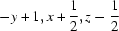
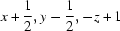
| Symmetry codes: (i) y, −x+1/2, −z+1/2; (ii) −x+1/2, −y+1/2, z; (iii) −y+1/2, x, −z+1/2. |
| D—H···A | D—H | H···A | D···A | D—H···A |
| O3—H3O···O2iv | 0.87 | 2.04 | 2.879 (5) | 161 |
| C1—H1···O2v | 0.93 | 2.55 | 3.233 (5) | 131 |
| C2—H2···O3vi | 0.93 | 2.59 | 3.420 (6) | 149 |
| Symmetry codes: (iv) −y+1, x+1/2, z−1/2; (v) x+1/2, y−1/2, −z+1; (vi) −x+1, −y, −z+1. |
Experimental details
| Crystal data | |
| Chemical formula | [Pd(C6H4NO2)4]·2H2O |
| Mr | 630.84 |
| Crystal system, space group | Tetragonal, P42/n |
| Temperature (K) | 296 |
| a, c (Å) | 11.1621 (5), 9.5880 (9) |
| V (Å3) | 1194.59 (14) |
| Z | 2 |
| Radiation type | Mo Kα |
| µ (mm−1) | 0.85 |
| Crystal size (mm) | 0.23 × 0.14 × 0.07 |
| Data collection | |
| Diffractometer | Bruker SMART 1000 CCD |
| Absorption correction | Multi-scan (SADABS; Bruker, 2000) |
| Tmin, Tmax | 0.804, 0.942 |
| No. of measured, independent and observed [I > 2σ(I)] reflections | 8399, 1485, 1074 |
| Rint | 0.045 |
| (sin θ/λ)max (Å−1) | 0.666 |
| Refinement | |
| R[F2 > 2σ(F2)], wR(F2), S | 0.034, 0.104, 1.21 |
| No. of reflections | 1485 |
| No. of parameters | 89 |
| H-atom treatment | H-atom parameters constrained |
| Δρmax, Δρmin (e Å−3) | 0.76, −1.00 |
Computer programs: SMART (Bruker, 2000), SAINT (Bruker, 2000), SHELXS97 (Sheldrick, 2008), SHELXL97 (Sheldrick, 2008), ORTEP-3 (Farrugia, 1997) and PLATON (Spek, 2009).
| D—H···A | D—H | H···A | D···A | D—H···A |
| O3—H3O···O2i | 0.87 | 2.04 | 2.879 (5) | 160.5 |
| C1—H1···O2ii | 0.93 | 2.55 | 3.233 (5) | 130.7 |
| C2—H2···O3iii | 0.93 | 2.59 | 3.420 (6) | 148.5 |
| Symmetry codes: (i) −y+1, x+1/2, z−1/2; (ii) x+1/2, y−1/2, −z+1; (iii) −x+1, −y, −z+1. |
Acknowledgements
This study was supported financially by the Special Research Program of Chonnam National University, 2009.
References
 Bruker (2000). SADABS, SMART and SAINT. Bruker AXS Inc., Madison, Wisconsin, USA. Google Scholar
Callens, E., Burton, A. J., White, A. J. P. & Barrett, A. G. M. (2008). Tetrahedron Lett. 49, 3709–3712. Web of Science CSD CrossRef CAS Google Scholar
Farrugia, L. J. (1997). J. Appl. Cryst. 30, 565. CrossRef IUCr Journals Google Scholar
Izarova, N. V., Dickman, M. H., Biboum, R. N., Keita, B., Nadjo, L., Ramachandran, V., Dalal, N. S. & Kortz, U. (2009). Inorg. Chem. 48, 7504–7506. Web of Science CSD CrossRef PubMed CAS Google Scholar
Lippard, S. J. & Russ, B. J. (1968). Inorg. Chem. 7, 1686–1688. CrossRef CAS Web of Science Google Scholar
Muetterties, E. L. & Guggenberger, L. J. (1974). J. Am. Chem. Soc. 96, 1748–1756. CrossRef CAS Web of Science Google Scholar
Ooi, B.-L., Sakane, G. & Shibahara, T. (1996). Inorg. Chem. 35, 7452–7454. CSD CrossRef PubMed CAS Web of Science Google Scholar
Qin, Z., Jennings, M. C., Puddephatt, R. J. & Muir, K. W. (2002). Inorg. Chem. 41, 5174–5186. Web of Science CSD CrossRef PubMed CAS Google Scholar
Sheldrick, G. M. (2008). Acta Cryst. A64, 112–122. Web of Science CrossRef CAS IUCr Journals Google Scholar
Soares-Santos, P. C. R., Nogueira, H. I. S., Félix, V., Drew, M. G. B., Sá Ferreira, R. A., Carlos, L. D. & Trindade, T. (2003). Inorg. Chem. Commun. 6, 1234–1238. Web of Science CSD CrossRef CAS Google Scholar
Spek, A. L. (2009). Acta Cryst. D65, 148–155. Web of Science CrossRef CAS IUCr Journals Google Scholar
This is an open-access article distributed under the terms of the Creative Commons Attribution (CC-BY) Licence, which permits unrestricted use, distribution, and reproduction in any medium, provided the original authors and source are cited.
| CRYSTALLOGRAPHIC COMMUNICATIONS |


The asymmetric unit of the title compound, [Pd(C6H4NO2)4].2H2O, contains a quarter of a neutral PdIV complex and one half of a solvent water molecule (Fig. 1). In the crystal, the complex has the symmetry elements C2 and S4, and its point group is S4 and the Pd atom lies on the special position at (1/4, 1/4, 1/4) (Wyckoff letter a). The water molecule is disposed about a twofold rotation axis through O atom with the special position at (3/4, 1/4, z) (Wyckoff letter e). In the complex, the Pd4+ ion is eight-coordinated in a distorted dodecahedral environment (Fig. 2) by four N and four O atoms from four distinct pyridine-2-carboxylate (pic) anionic ligands. All four ligands are coordinated in an N,O-chelation mode with the considerably different Pd—O and Pd—N bond lengths [Pd—O = 2.097 (3) Å, Pd—N = 2.373 (3) Å] and the five-membered chelate ring has an O—Pd—N bite angle of 72.07 (12)°. On the contrary, the Pd—O and Pd—N bond lengths in the Pd(II)-pic complex, [Pd(pic)2], are almost equal [Pd—O = 2.003 (2) Å, Pd—N = 1.998 (2) Å] and the bite angle of the chelate ring is 82.36 (9)° (Qin et al., 2002). The C═O bond length [1.215 (5) Å] and the C—O bond length [1.314 (5) Å] are typical and similar to values in the complex [Pd(pic)2] (Qin et al., 2002). In the crystal structure, the water molecule is involved in O—H···O hydrogen bonding and weak intermolecular C—H···O hydrogen bonds occur (Table 1 and Fig. 3). There are also intermolecular π-π interactions between adjacent pyridine rings, with a centroid-centroid distance of 3.715 (3) Å.