 | Acta Crystallographica Section E Acta Crystallographica Section E CRYSTALLOGRAPHIC COMMUNICATIONS |


 journal menu


metal-organic compounds
| CRYSTALLOGRAPHIC COMMUNICATIONS |
 access
Methanoldinitrato[N-(2-pyridylmethylene)aniline]copper(II)

aDepartment of Chemistry Education, Interdisciplinary Program of Advanced Information and Display Materials, and Center for Plastic Information Systems, Pusan National University, Busan 609-735, Republic of Korea, and bDepartment of Chemistry, Chungnam National University, Daejeon 305-764, Republic of Korea
*Correspondence e-mail: [email protected]
The Cu atom in the title compound, [Cu(NO3)2(C12H10N2)(CH3OH)], adopts a square-pyramidal geometry, being ligated by two N atoms of the bidentate N-(2-pyridylmethylene)aniline (ppma) ligand, two O atoms of NO3 ligands and one O atom of a methanol molecule, which occupies the apical position. The phenyl ring on the ppma ligand is twisted out of the pyridine plane, forming a dihedral angle of 42.9 (1)°. In the crystal, intermolecular O—H⋯O hydrogen bonds between methanol and NO3 ligands form an extensive one-dimensional network extending parallel to [100].
Related literature
For general background on magnetic materials, see: Lu et al. (2007![[Lu, J. W., Huang, Y. H., Lo, S. I. & Wei, H. H. (2007). Inorg. Chem. Commun. 10, 1210-1213.]](../../../../../../logos/arrows/e_arr.gif "Lu, J. W., Huang, Y. H., Lo, S. I. & Wei, H. H. (2007). Inorg. Chem. Commun. 10, 1210-1213.") ); Mukherjee et al. (2008); Tao et al. (2004). For related structures, see: Lee et al. (2008); Addison et al. (1984). For general background on electron paramagnetic resonance spectra, see: Mohapatra et al. (2008).
); Mukherjee et al. (2008); Tao et al. (2004). For related structures, see: Lee et al. (2008); Addison et al. (1984). For general background on electron paramagnetic resonance spectra, see: Mohapatra et al. (2008).
![[Scheme 1]](jh2108scheme1.gif)
Experimental
Crystal data
|
Refinement
|
| |||||||||||||||||
 .
. Data collection: SMART (Bruker, 2002); cell refinement: SAINT (Bruker, 2002); data reduction: SAINT; program(s) used to solve structure: SHELXS97 (Sheldrick, 2008); program(s) used to refine structure: SHELXL97 (Sheldrick, 2008); molecular graphics: ORTEP-3 for Windows (Farrugia, 1997); software used to prepare material for publication: WinGX (Farrugia, 1999).
Supporting information
contains datablocks global, I. DOI: https://doi.org/10.1107/S1600536809041075/jh2108sup1.cif
Structure factors: contains datablock I. DOI: https://doi.org/10.1107/S1600536809041075/jh2108Isup2.hkl
N-(2-pyridylmethylene)aniline was synthesized from the direct reaction of 2-pyridinecarboxyaldehyde and aniline. 2-Pyridinecarboxyaldehyde (2 mmol) dissolved in 20 ml of absolute methanol was added dropwise to a methanolic solution of aniline (2 mmol) and then refluxed overnight. After cooling to room temperature, a solution of Cu(NO3)2 3H2O (2 mmol) in 20 ml of absolute methanol was added to the mixed solution of 2-pyridinecarboxyaldehyde and aniline (ppma solution). The solution was changed to dark green color immediately. The resulting solution was allowed to stand at room temperature. The green crystals were obtained by slow evaporation in methanol.
The H23 atom was located in a difference map and refined freely with O—H = 0.69 (3) Å. Other H atoms were positioned geometrically and refined using a riding model, with C—H = 0.93 - 0.96 Å, and with Uiso(H) = 1.2Ueq(C) for aromatic and 1.5Ueq(C) for methyl H atoms.
Schiff base complexes of transition metal complexes have great importance over the years due to their versatility of the steric and electronic properties and their possible applications as molecular based magnetic materials (Lu et al., 2007; Mukherjee et al., 2008; Tao et al., 2004). As a part of this research, we reported copper halides complexes with N2 bidentate Schiff base ligand derived from 2-pyridinecarboxylaldehyde and benzylamine(Lee et al., 2008), in which the reaction of copper(II) chloride leads to a dimeric complex whereas copper(II) bromide affords a monomeric copper complex. In this study, we reacted copper(II) nitrate with the similar Schiff base in methanol and prepared a monomeric penta-coordinated copper(II) complex, Cu(ppma)(NO3)2(CH3OH) (I).
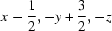
In the title compound, the Cu atom adopts a square pyramidal geometry, being ligated by two N atoms of the bidentate N-(2-pyridylmethylene)aniline (ppma) ligand, two O atoms of NO3 ligands, and one O atom of methanol which occupies the apical position. The angles around Cu atom at the basal position are in the range of 80.8 (1) - 96.6 (1)°. The calculated trigonality index, τ = 0.12, indicates that the Cu atom is in an almost square pyramidal geometry (Addison et al., 1984). The phenyl ring on the ppma ligand is twisted out of the pyridine plane, and forms a dihedral angle of 42.9 (1) °. The intermolecular O23—H23—O18i [symmetry code: (i) x - 1/2, -y + 3/2, -z] hydrogen bond allows to form an extensive one-dimensional network, which stabilizes the crystal structure.
EPR (electron paramagnetic resonance) spectra of I compound were obtained both for solid and for frozen glass samples (toluene/methanol) at 77 K. The powder EPR spectrum exhibits isotropic feature, <g>=2.151. The solution EPR spectrum exhibits well defined hyperfine structure with parallel and perpendicular components, g(parallel) = 2.328, g(perpendicular) = 2.065 and A(parallel) =142x10-4 cm-1, typically indicating a dx2-y2 ground state, g(parallel) > g(perpendicular) > 2.0023 (Mohapatra et al., 2008). The magnetic susceptibilities of the title compound were collected as a function of temperatures (4 - 300 K). The data increases as the temperatures decrease exhibiting a paramagnetic behavior. data follows the Curie-Weiss law showing the features of a discrete monomeric complex. A linear regression results in a Curie-Weiss temperature θ = 0.55 K and a Curie constant C = 0.45 cm3 K mol-1.
For general background on magnetic materials, see: Lu et al. (2007); Mukherjee et al. (2008); Tao et al. (2004). For related structures, see: Lee et al. (2008); Addison et al. (1984). For general background on spectra, see: Mohapatra et al. (2008).
Data collection: SMART (Bruker, 2002); cell SAINT (Bruker, 2002); data reduction: SAINT (Bruker, 2002); program(s) used to solve structure: SHELXS97 (Sheldrick, 2008); program(s) used to refine structure: SHELXL97 (Sheldrick, 2008); molecular graphics: ORTEP-3 for Windows (Farrugia, 1997); software used to prepare material for publication: WinGX (Farrugia, 1999).
![[Figure 1]](./jh2108fig1thm.gif) | Fig. 1. Molecular structure of (I), showing the atom-numbering scheme and 30% probability ellipsoids. |
| [Cu(NO3)2(C12H10N2)(CH4O)] | F(000) = 1640 |
| Mr = 401.82 | Dx = 1.595 Mg m−3 |
| Orthorhombic, Pbca | Mo Kα radiation, λ = 0.71073 Å |
| Hall symbol: -P 2ac 2ab | Cell parameters from 4394 reflections |
| a = 14.5924 (13) Å | θ = 2.4–22.8° |
| b = 13.4826 (12) Å | µ = 1.35 mm−1 |
| c = 17.0060 (13) Å | T = 295 K |
| V = 3345.8 (5) Å3 | Block, green |
| Z = 8 | 0.2 × 0.18 × 0.14 mm |
| Bruker SMART CCD area-detector diffractometer | 2098 reflections with I > 2σ(I) |
| φ and ω scans | Rint = 0.037 |
| Absorption correction: multi-scan (SADABS; Bruker, 2002) | θmax = 26°, θmin = 2.4° |
| Tmin = 0.76, Tmax = 0.823 | h = −11→18 |
| 17118 measured reflections | k = −10→16 |
| 3289 independent reflections | l = −20→14 |
| Refinement on F2 | 0 restraints |
| Least-squares matrix: full | H atoms treated by a mixture of independent and constrained refinement |
| R[F2 > 2σ(F2)] = 0.038 | w = 1/[σ2(Fo2) + (0.0421P)2 + 1.1597P] where P = (Fo2 + 2Fc2)/3 |
| wR(F2) = 0.101 | (Δ/σ)max < 0.001 |
| S = 1.03 | Δρmax = 0.43 e Å−3 |
| 3289 reflections | Δρmin = −0.34 e Å−3 |
| 229 parameters |
| [Cu(NO3)2(C12H10N2)(CH4O)] | V = 3345.8 (5) Å3 |
| Mr = 401.82 | Z = 8 |
| Orthorhombic, Pbca | Mo Kα radiation |
| a = 14.5924 (13) Å | µ = 1.35 mm−1 |
| b = 13.4826 (12) Å | T = 295 K |
| c = 17.0060 (13) Å | 0.2 × 0.18 × 0.14 mm |
| Bruker SMART CCD area-detector diffractometer | 3289 independent reflections |
| Absorption correction: multi-scan (SADABS; Bruker, 2002) | 2098 reflections with I > 2σ(I) |
| Tmin = 0.76, Tmax = 0.823 | Rint = 0.037 |
| 17118 measured reflections |
| R[F2 > 2σ(F2)] = 0.038 | 0 restraints |
| wR(F2) = 0.101 | H atoms treated by a mixture of independent and constrained refinement |
| S = 1.03 | Δρmax = 0.43 e Å−3 |
| 3289 reflections | Δρmin = −0.34 e Å−3 |
| 229 parameters |
Geometry. All e.s.d.'s (except the e.s.d. in the dihedral angle between two l.s. planes) are estimated using the full covariance matrix. The cell e.s.d.'s are taken into account individually in the estimation of e.s.d.'s in distances, angles and torsion angles; correlations between e.s.d.'s in cell parameters are only used when they are defined by crystal symmetry. An approximate (isotropic) treatment of cell e.s.d.'s is used for estimating e.s.d.'s involving l.s. planes. |
| x | y | z | Uiso*/Ueq | ||
| Cu | 0.22734 (3) | 0.80769 (3) | 0.05883 (2) | 0.04304 (16) | |
| N1 | 0.19359 (18) | 0.8656 (2) | −0.04406 (14) | 0.0443 (7) | |
| C2 | 0.2115 (2) | 0.8304 (3) | −0.1155 (2) | 0.0562 (9) | |
| H2 | 0.2447 | 0.7718 | −0.1198 | 0.067* | |
| C3 | 0.1832 (3) | 0.8766 (3) | −0.1831 (2) | 0.0630 (10) | |
| H3 | 0.1961 | 0.8489 | −0.2319 | 0.076* | |
| C4 | 0.1354 (3) | 0.9642 (3) | −0.1777 (2) | 0.0611 (10) | |
| H4 | 0.116 | 0.9971 | −0.2228 | 0.073* | |
| C5 | 0.1169 (2) | 1.0027 (2) | −0.10368 (19) | 0.0529 (9) | |
| H5 | 0.0859 | 1.0626 | −0.0983 | 0.063* | |
| C6 | 0.1449 (2) | 0.9511 (2) | −0.03880 (18) | 0.0416 (8) | |
| C7 | 0.1207 (2) | 0.9783 (2) | 0.04160 (18) | 0.0438 (8) | |
| H7 | 0.0898 | 1.0371 | 0.0522 | 0.053* | |
| N8 | 0.14329 (17) | 0.91931 (18) | 0.09677 (14) | 0.0423 (6) | |
| C9 | 0.1175 (2) | 0.9408 (2) | 0.17667 (18) | 0.0466 (8) | |
| C10 | 0.1211 (2) | 1.0360 (3) | 0.2067 (2) | 0.0627 (10) | |
| H10 | 0.1417 | 1.0883 | 0.1758 | 0.075* | |
| C11 | 0.0938 (3) | 1.0521 (4) | 0.2833 (3) | 0.0858 (14) | |
| H11 | 0.0948 | 1.1161 | 0.3038 | 0.103* | |
| C12 | 0.0653 (3) | 0.9751 (5) | 0.3291 (3) | 0.0951 (16) | |
| H12 | 0.0486 | 0.9867 | 0.3811 | 0.114* | |
| C13 | 0.0611 (3) | 0.8808 (4) | 0.2995 (2) | 0.0864 (14) | |
| H13 | 0.0404 | 0.8291 | 0.331 | 0.104* | |
| C14 | 0.0876 (2) | 0.8620 (3) | 0.2226 (2) | 0.0650 (10) | |
| H14 | 0.0854 | 0.798 | 0.2022 | 0.078* | |
| O15 | 0.32671 (16) | 0.71875 (15) | 0.01603 (14) | 0.0542 (6) | |
| N16 | 0.4040 (2) | 0.7588 (2) | 0.00143 (16) | 0.0540 (7) | |
| O17 | 0.40926 (18) | 0.8491 (2) | −0.00598 (15) | 0.0781 (7) | |
| O18 | 0.47131 (18) | 0.70493 (19) | −0.0054 (2) | 0.0903 (10) | |
| O19 | 0.26151 (16) | 0.75883 (17) | 0.16300 (13) | 0.0561 (6) | |
| N20 | 0.3146 (2) | 0.8210 (2) | 0.19904 (18) | 0.0565 (8) | |
| O21 | 0.33689 (17) | 0.89636 (19) | 0.16336 (14) | 0.0714 (8) | |
| O22 | 0.3405 (2) | 0.80158 (19) | 0.26547 (15) | 0.0846 (9) | |
| O23 | 0.1281 (2) | 0.6864 (2) | 0.0490 (2) | 0.0773 (10) | |
| H23 | 0.084 (2) | 0.704 (3) | 0.042 (2) | 0.049 (13)* | |
| C24 | 0.1395 (3) | 0.5872 (3) | 0.0572 (3) | 0.0998 (16) | |
| H13A | 0.0819 | 0.5543 | 0.0492 | 0.15* | |
| H13B | 0.1616 | 0.5729 | 0.1092 | 0.15* | |
| H13C | 0.183 | 0.5639 | 0.0191 | 0.15* |
| U11 | U22 | U33 | U12 | U13 | U23 | |
| Cu | 0.0416 (3) | 0.0385 (3) | 0.0489 (2) | 0.00253 (18) | 0.00262 (18) | 0.00149 (17) |
| N1 | 0.0430 (17) | 0.0432 (17) | 0.0469 (16) | 0.0001 (13) | 0.0024 (12) | −0.0009 (12) |
| C2 | 0.058 (3) | 0.055 (2) | 0.056 (2) | 0.0043 (18) | 0.0079 (18) | −0.0077 (18) |
| C3 | 0.070 (3) | 0.075 (3) | 0.044 (2) | −0.004 (2) | 0.0028 (19) | −0.0035 (19) |
| C4 | 0.067 (3) | 0.070 (3) | 0.047 (2) | −0.008 (2) | −0.0028 (18) | 0.0109 (18) |
| C5 | 0.054 (2) | 0.048 (2) | 0.057 (2) | 0.0029 (17) | −0.0011 (18) | 0.0079 (17) |
| C6 | 0.0360 (19) | 0.0396 (19) | 0.0491 (19) | −0.0035 (16) | 0.0025 (14) | 0.0018 (15) |
| C7 | 0.040 (2) | 0.0379 (19) | 0.053 (2) | 0.0028 (16) | 0.0016 (15) | −0.0022 (15) |
| N8 | 0.0393 (17) | 0.0423 (16) | 0.0452 (15) | −0.0030 (13) | 0.0036 (12) | −0.0031 (12) |
| C9 | 0.0339 (19) | 0.057 (2) | 0.0483 (18) | 0.0038 (16) | 0.0032 (15) | −0.0020 (17) |
| C10 | 0.052 (2) | 0.072 (3) | 0.064 (2) | −0.003 (2) | 0.0058 (19) | −0.020 (2) |
| C11 | 0.069 (3) | 0.113 (4) | 0.075 (3) | 0.004 (3) | 0.008 (2) | −0.038 (3) |
| C12 | 0.068 (3) | 0.163 (5) | 0.054 (3) | 0.020 (3) | 0.010 (2) | −0.021 (3) |
| C13 | 0.069 (3) | 0.128 (4) | 0.062 (3) | 0.016 (3) | 0.022 (2) | 0.023 (3) |
| C14 | 0.060 (3) | 0.072 (3) | 0.062 (2) | 0.006 (2) | 0.011 (2) | 0.007 (2) |
| O15 | 0.0380 (14) | 0.0448 (14) | 0.0799 (17) | −0.0012 (11) | 0.0119 (12) | 0.0028 (11) |
| N16 | 0.048 (2) | 0.049 (2) | 0.0647 (18) | −0.0012 (18) | 0.0070 (15) | 0.0009 (15) |
| O17 | 0.078 (2) | 0.0534 (16) | 0.103 | −0.0108 (15) | 0.0194 (16) | 0.0031 (15) |
| O18 | 0.0405 (17) | 0.0652 (19) | 0.165 (3) | 0.0090 (14) | 0.0224 (18) | −0.0068 (17) |
| O19 | 0.0627 (16) | 0.0481 (15) | 0.0577 (14) | −0.0049 (13) | −0.0082 (12) | 0.0056 (12) |
| N20 | 0.050 (2) | 0.067 (2) | 0.0519 (18) | 0.0023 (16) | 0.0013 (16) | 0.0093 (17) |
| O21 | 0.072 (2) | 0.0728 (18) | 0.0689 (16) | −0.0241 (15) | −0.0123 (14) | 0.0210 (14) |
| O22 | 0.100 (2) | 0.098 (2) | 0.0556 (16) | −0.0161 (16) | −0.0205 (15) | 0.0193 (14) |
| O23 | 0.0456 (19) | 0.0467 (18) | 0.140 (3) | 0.0003 (15) | −0.0207 (18) | 0.0095 (15) |
| C24 | 0.071 (3) | 0.050 (3) | 0.179 (5) | −0.009 (2) | −0.013 (3) | 0.019 (3) |
| Cu—O19 | 1.955 (2) | C10—C11 | 1.378 (5) |
| Cu—N1 | 1.979 (2) | C10—H10 | 0.93 |
| Cu—O15 | 2.017 (2) | C11—C12 | 1.365 (6) |
| Cu—N8 | 2.046 (2) | C11—H11 | 0.93 |
| Cu—O23 | 2.191 (3) | C12—C13 | 1.369 (6) |
| N1—C2 | 1.330 (4) | C12—H12 | 0.93 |
| N1—C6 | 1.356 (4) | C13—C14 | 1.388 (5) |
| C2—C3 | 1.370 (5) | C13—H13 | 0.93 |
| C2—H2 | 0.93 | C14—H14 | 0.93 |
| C3—C4 | 1.375 (5) | O15—N16 | 1.274 (3) |
| C3—H3 | 0.93 | N16—O17 | 1.226 (3) |
| C4—C5 | 1.388 (4) | N16—O18 | 1.227 (3) |
| C4—H4 | 0.93 | O19—N20 | 1.295 (3) |
| C5—C6 | 1.367 (4) | N20—O22 | 1.220 (3) |
| C5—H5 | 0.93 | N20—O21 | 1.228 (3) |
| C6—C7 | 1.459 (4) | O23—C24 | 1.355 (4) |
| C7—N8 | 1.273 (4) | O23—H23 | 0.69 (3) |
| C7—H7 | 0.93 | C24—H13A | 0.96 |
| N8—C9 | 1.439 (4) | C24—H13B | 0.96 |
| C9—C10 | 1.382 (4) | C24—H13C | 0.96 |
| C9—C14 | 1.389 (4) | ||
| O19—Cu—N1 | 176.44 (10) | C10—C9—N8 | 121.8 (3) |
| O19—Cu—O15 | 86.75 (9) | C14—C9—N8 | 117.3 (3) |
| N1—Cu—O15 | 95.43 (10) | C11—C10—C9 | 119.0 (4) |
| O19—Cu—N8 | 96.60 (10) | C11—C10—H10 | 120.5 |
| N1—Cu—N8 | 80.75 (10) | C9—C10—H10 | 120.5 |
| O15—Cu—N8 | 169.09 (10) | C12—C11—C10 | 120.5 (4) |
| O19—Cu—O23 | 89.20 (11) | C12—C11—H11 | 119.8 |
| N1—Cu—O23 | 93.60 (11) | C10—C11—H11 | 119.8 |
| O15—Cu—O23 | 90.21 (11) | C11—C12—C13 | 120.7 (4) |
| N8—Cu—O23 | 100.20 (11) | C11—C12—H12 | 119.7 |
| C2—N1—C6 | 117.8 (3) | C13—C12—H12 | 119.7 |
| C2—N1—Cu | 128.2 (2) | C12—C13—C14 | 120.3 (4) |
| C6—N1—Cu | 114.0 (2) | C12—C13—H13 | 119.9 |
| N1—C2—C3 | 123.0 (3) | C14—C13—H13 | 119.9 |
| N1—C2—H2 | 118.5 | C13—C14—C9 | 118.5 (4) |
| C3—C2—H2 | 118.5 | C13—C14—H14 | 120.7 |
| C2—C3—C4 | 119.1 (3) | C9—C14—H14 | 120.7 |
| C2—C3—H3 | 120.4 | N16—O15—Cu | 117.0 (2) |
| C4—C3—H3 | 120.4 | O17—N16—O18 | 121.8 (3) |
| C3—C4—C5 | 118.7 (3) | O17—N16—O15 | 119.7 (3) |
| C3—C4—H4 | 120.7 | O18—N16—O15 | 118.4 (3) |
| C5—C4—H4 | 120.7 | N20—O19—Cu | 111.31 (19) |
| C6—C5—C4 | 118.9 (3) | O22—N20—O21 | 123.6 (3) |
| C6—C5—H5 | 120.5 | O22—N20—O19 | 119.0 (3) |
| C4—C5—H5 | 120.5 | O21—N20—O19 | 117.4 (3) |
| N1—C6—C5 | 122.4 (3) | C24—O23—Cu | 130.4 (3) |
| N1—C6—C7 | 113.7 (3) | C24—O23—H23 | 118 (3) |
| C5—C6—C7 | 123.8 (3) | Cu—O23—H23 | 112 (3) |
| N8—C7—C6 | 118.1 (3) | O23—C24—H13A | 109.5 |
| N8—C7—H7 | 121 | O23—C24—H13B | 109.5 |
| C6—C7—H7 | 121 | H13A—C24—H13B | 109.5 |
| C7—N8—C9 | 120.1 (3) | O23—C24—H13C | 109.5 |
| C7—N8—Cu | 112.5 (2) | H13A—C24—H13C | 109.5 |
| C9—N8—Cu | 127.1 (2) | H13B—C24—H13C | 109.5 |
| C10—C9—C14 | 121.0 (3) |
| D—H···A | D—H | H···A | D···A | D—H···A |
| O23—H23···O18i | 0.69 (3) | 2.15 (3) | 2.817 (4) | 162 (4) |
| Symmetry code: (i) x−1/2, −y+3/2, −z. |
Experimental details
| Crystal data | |
| Chemical formula | [Cu(NO3)2(C12H10N2)(CH4O)] |
| Mr | 401.82 |
| Crystal system, space group | Orthorhombic, Pbca |
| Temperature (K) | 295 |
| a, b, c (Å) | 14.5924 (13), 13.4826 (12), 17.0060 (13) |
| V (Å3) | 3345.8 (5) |
| Z | 8 |
| Radiation type | Mo Kα |
| µ (mm−1) | 1.35 |
| Crystal size (mm) | 0.2 × 0.18 × 0.14 |
| Data collection | |
| Diffractometer | Bruker SMART CCD area-detector |
| Absorption correction | Multi-scan (SADABS; Bruker, 2002) |
| Tmin, Tmax | 0.76, 0.823 |
| No. of measured, independent and observed [I > 2σ(I)] reflections | 17118, 3289, 2098 |
| Rint | 0.037 |
| (sin θ/λ)max (Å−1) | 0.617 |
| Refinement | |
| R[F2 > 2σ(F2)], wR(F2), S | 0.038, 0.101, 1.03 |
| No. of reflections | 3289 |
| No. of parameters | 229 |
| H-atom treatment | H atoms treated by a mixture of independent and constrained refinement |
| Δρmax, Δρmin (e Å−3) | 0.43, −0.34 |
Computer programs: SMART (Bruker, 2002), SAINT (Bruker, 2002), SHELXS97 (Sheldrick, 2008), SHELXL97 (Sheldrick, 2008), ORTEP-3 for Windows (Farrugia, 1997), WinGX (Farrugia, 1999).
| D—H···A | D—H | H···A | D···A | D—H···A |
| O23—H23···O18i | 0.69 (3) | 2.15 (3) | 2.817 (4) | 162 (4) |
| Symmetry code: (i) x−1/2, −y+3/2, −z. |
Acknowledgements
This research was supported by the Ministry of Knowledge Economy, Korea, under the Information Technology Research Center support program supervised by the National Industry Promotion Agency [grant No. NIPA-2009-(C1090–0902–0022)].
References
 Addison, A. W., Rao, T. N., Reedjik, J., van Rijin, T. & Verschoor, G. C. (1984). J. Chem. Soc. Dalton Trans. pp. 1349–1356. CSD CrossRef Web of Science Google Scholar
Bruker (2002). SADABS, SAINT and SMART. Bruker AXS Inc., Madison, Wisconsin, USA. Google Scholar
Farrugia, L. J. (1997). J. Appl. Cryst. 30, 565. CrossRef IUCr Journals Google Scholar
Farrugia, L. J. (1999). J. Appl. Cryst. 32, 837–838. CrossRef CAS IUCr Journals Google Scholar
Lee, H. W., Sengottuvelan, N., Seo, H. J., Choi, J. S., Kang, S. K. & Kim, Y. I. (2008). Bull. Korean Chem. Soc. 29, 1711–1716. CAS Google Scholar
Lu, J. W., Huang, Y. H., Lo, S. I. & Wei, H. H. (2007). Inorg. Chem. Commun. 10, 1210–1213. Web of Science CSD CrossRef CAS Google Scholar
Mohapatra, S. C., Tehlan, S., Hundal, M. S. & Mathur, P. (2008). Inorg. Chim. Acta, 361, 1897–1907. Web of Science CSD CrossRef CAS Google Scholar
Mukherjee, P., Drew, M. G. B., Estrader, M., Diaz, C. & Ghosh, A. (2008). Inorg. Chim. Acta, 361, 161–172. Web of Science CSD CrossRef CAS Google Scholar
Sheldrick, G. M. (2008). Acta Cryst. A64, 112–122. Web of Science CrossRef CAS IUCr Journals Google Scholar
Tao, R. J., Mei, C. Z., Zang, S. Q., Wang, Q. L., Niu, J. Y. & Liao, D. Z. (2004). Inorg. Chim. Acta, 357, 1985–1990. Web of Science CSD CrossRef CAS Google Scholar
This is an open-access article distributed under the terms of the Creative Commons Attribution (CC-BY) Licence, which permits unrestricted use, distribution, and reproduction in any medium, provided the original authors and source are cited.
| CRYSTALLOGRAPHIC COMMUNICATIONS |


Schiff base complexes of transition metal complexes have great importance over the years due to their versatility of the steric and electronic properties and their possible applications as molecular based magnetic materials (Lu et al., 2007; Mukherjee et al., 2008; Tao et al., 2004). As a part of this research, we reported copper halides complexes with N2 bidentate Schiff base ligand derived from 2-pyridinecarboxylaldehyde and benzylamine(Lee et al., 2008), in which the reaction of copper(II) chloride leads to a dimeric complex whereas copper(II) bromide affords a monomeric copper complex. In this study, we reacted copper(II) nitrate with the similar Schiff base in methanol and prepared a monomeric penta-coordinated copper(II) complex, Cu(ppma)(NO3)2(CH3OH) (I).
In the title compound, the Cu atom adopts a square pyramidal geometry, being ligated by two N atoms of the bidentate N-(2-pyridylmethylene)aniline (ppma) ligand, two O atoms of NO3 ligands, and one O atom of methanol which occupies the apical position. The angles around Cu atom at the basal position are in the range of 80.8 (1) - 96.6 (1)°. The calculated trigonality index, τ = 0.12, indicates that the Cu atom is in an almost square pyramidal geometry (Addison et al., 1984). The phenyl ring on the ppma ligand is twisted out of the pyridine plane, and forms a dihedral angle of 42.9 (1) °. The intermolecular O23—H23—O18i [symmetry code: (i) x - 1/2, -y + 3/2, -z] hydrogen bond allows to form an extensive one-dimensional network, which stabilizes the crystal structure.
EPR (electron paramagnetic resonance) spectra of I compound were obtained both for solid and for frozen glass samples (toluene/methanol) at 77 K. The powder EPR spectrum exhibits isotropic feature, <g>=2.151. The solution EPR spectrum exhibits well defined hyperfine structure with parallel and perpendicular components, g(parallel) = 2.328, g(perpendicular) = 2.065 and A(parallel) =142x10-4 cm-1, typically indicating a dx2-y2 ground state, g(parallel) > g(perpendicular) > 2.0023 (Mohapatra et al., 2008). The magnetic susceptibilities of the title compound were collected as a function of temperatures (4 - 300 K). The magnetic susceptibility data increases as the temperatures decrease exhibiting a paramagnetic behavior. Magnetic susceptibility data follows the Curie-Weiss law showing the features of a discrete monomeric complex. A linear regression results in a Curie-Weiss temperature θ = 0.55 K and a Curie constant C = 0.45 cm3 K mol-1.