 | Acta Crystallographica Section E Acta Crystallographica Section E CRYSTALLOGRAPHIC COMMUNICATIONS |


 journal menu


metal-organic compounds
| CRYSTALLOGRAPHIC COMMUNICATIONS |
 access
Aqua[N-(2,5-dihydroxybenzyl)iminodiacetato]copper(II)

aKey Laboratory for the Chemistry and Molecular Engineering of Medicinal Resources (Ministry of Education of China), School of Chemistry and Chemical Engineering of Guangxi Normal University, Guilin 541004, People's Republic of China
*Correspondence e-mail: [email protected]
The title complex, [Cu(C11H11NO6)(H2O)], contains a CuII atom in a distorted square-pyramidal geometry. The metal centre is coordinated in the basal sites by one water molecule and two carboxylate O atoms and one N atom of the tetradentate ligand [Cu—O range, 1.9376 (11)–1.9541 (12), Cu—N, 1.9929 (12) Å] while the apical site is occupied by a hydroquinone O donor atom [Cu—O, 2.3746 (12) Å]. Intermolecular hydrogen bonding interactions involving both hydroquinone hydroxy groups and the coordinated water as donors give a three-dimensional framework structure.
Related literature
For general background to p-hydroquinones and their oxidation products p-semiquinones and p-quinones, see: Dooley et al. (1998![[Dooley, D. M., Scott, R. A., Knowles, P. F., Colanglo, C. M., McGuirl, M. A. & Brown, D. E. (1998). J. Am. Chem. Soc. 120, 2599-2605.]](../../../../../../logos/arrows/e_arr.gif "Dooley, D. M., Scott, R. A., Knowles, P. F., Colanglo, C. M., McGuirl, M. A. & Brown, D. E. (1998). J. Am. Chem. Soc. 120, 2599-2605.") ); Wang et al. (1996); Calvo et al. (2000); Iwata et al. (1998); Drouza et al. (2002); Huang et al. (2008); Addison et al. (1984). For the synthesis, see: Fan (1992).
); Wang et al. (1996); Calvo et al. (2000); Iwata et al. (1998); Drouza et al. (2002); Huang et al. (2008); Addison et al. (1984). For the synthesis, see: Fan (1992).
![[Scheme 1]](zs2013scheme1.gif)
Experimental
Crystal data
|
Refinement
|
|
 ; (ii)
  ; (iii)
  ; (iv)
  .
. Data collection: CrystalClear (Rigaku/MSC, 2005); cell refinement: CrystalClear; data reduction: CrystalClear; program(s) used to solve structure: SHELXS97 (Sheldrick, 2008); program(s) used to refine structure: SHELXL97 (Sheldrick, 2008); molecular graphics: SHELXL97; software used to prepare material for publication: CrystalStructure (Rigaku/MSC, 2005).
Supporting information
contains datablocks I, global. DOI: https://doi.org/10.1107/S1600536809042238/zs2013sup1.cif
Structure factors: contains datablock I. DOI: https://doi.org/10.1107/S1600536809042238/zs2013Isup2.hkl
The ligand 2-[N,N-bis(carboxylatomethyl)aminomethyl]hydroquinone was prepared according to a literature procedure (Fan et al., 1992). The title complex was synthesized by the addition of CuCl2.2H2O (0.0850 g, 0.5 mmol) to 20 ml of a methanol solution containing the ligand (0.1275 g, 0.5 mmol). The resulting solution was stirred for 3 h at 60°C, and then cooled and filtered. Blue single crystal blocks were isolated from the solution at room temperature over six days.
H atoms on C atoms were positoned geometrically with C—Haromatic = 0.93 Å and C—Haliphatic = 0.97 Å and treated as riding with Uiso(H) = 1.2Ueq(C).
p-Hydroquinones, along with their oxidation products p-semiquinones and p-quinones, are very important in the oxidative maintenance of biological amine levels (Dooley et al., 1998), tissue formation (Wang et al., 1996), photosynthesis (Calvo et al., 2000) and aerobic respiration (Iwata et al., 1998). These compounds are involved in interesting organic electron- and hydrogen-transfer systems, e.g. electron-transfer reactions between transition metal centers and p-quinone cofactors are vital for all life (Drouza et al., 2002), occurring in key biological processes. As part of a series of the studies (Huang et al., 2008), we report here the synthesis and structure of the title compound, a new CuII complex with the related ligand 2-[N,N-bis(carboxylatomethyl)aminomethyl]hydroquinone. The molecular structure of the title compound [Cu(C11H11NO6)(H2O)] (I) is shown in Fig. 1. The CuII atom has a distorted square-pyramidal geometry with a τ parameter of 0.09 (Addison et al., 1984). The basal sites are occupied by one water molecule, as well as two carboxylate O atoms and one N atom of the ligand. In the apical position, the O atom of the hydroxybenzene coordinates to the CuII atom. All bond distances and bond angles have normal values. The crystal packing of (I) (Fig. 2) involves intermolecular O—H···O hydrogen bonds (Table 1). The non-coordinated carboxylate O2 atom accepts intermolecular hydrogen bonds from the coordinated hydroxy O (O5) of the hydroquinone ligand and from the coordinated water (O7). The non-coordinated carboxylate O4 atom is also an acceptor for a water H donor in an intermolecular hydrogen bond. The coordinated atom O3 accepts a hydrogen bond from the non-coordinated hydroquinone O (O6). These interactions result in a three-dimensional hydrogen-bonded framework structure.
For general background to p-hydroquinones and their oxidation products p-semiquinones and p-quinones, see: Dooley et al. (1998); Wang et al. (1996); Calvo et al. (2000); Iwata et al. (1998); Drouza et al. (2002); Huang et al. (2008); Addison et al. (1984). For the synthesis, see Fan (1992).
Data collection: CrystalClear (Rigaku/MSC, 2005); cell CrystalClear (Rigaku/MSC, 2005); data reduction: CrystalClear (Rigaku/MSC, 2005); program(s) used to solve structure: SHELXS97 (Sheldrick, 2008); program(s) used to refine structure: SHELXL97 (Sheldrick, 2008); molecular graphics: SHELXL97 (Sheldrick, 2008); software used to prepare material for publication: CrystalStructure (Rigaku/MSC, 2005).
![[Figure 1]](./zs2013fig1thm.gif) | Fig. 1. A view of the molecular structure of (I) with the atom-numbering scheme and 30% displacement ellipsoids. |
![[Figure 2]](./zs2013fig2thm.gif) | Fig. 2. The packing for (I), showing hydrogen bonds as dashed lines. |
| [Cu(C11H11NO6)(H2O)] | F(000) = 1368 |
| Mr = 334.76 | Dx = 1.797 Mg m−3 |
| Orthorhombic, Pbca | Mo Kα radiation, λ = 0.71070 Å |
| Hall symbol: -P 2ac 2ab | Cell parameters from 6907 reflections |
| a = 13.0461 (16) Å | θ = 1.6–27.9° |
| b = 9.7919 (12) Å | µ = 1.80 mm−1 |
| c = 19.374 (2) Å | T = 294 K |
| V = 2474.9 (5) Å3 | Block, blue |
| Z = 8 | 0.22 × 0.18 × 0.12 mm |
| Rigaku Saturn diffractometer | 2929 independent reflections |
| Radiation source: rotating anode | 2662 reflections with I > 2σ(I) |
| Confocal monochromator | Rint = 0.026 |
| Detector resolution: 7.31 pixels mm-1 | θmax = 27.9°, θmin = 2.1° |
| ω scans | h = −17→17 |
| Absorption correction: multi-scan (Jacobson, 1998) | k = −12→11 |
| Tmin = 0.693, Tmax = 0.813 | l = −25→22 |
| 17710 measured reflections |
| Refinement on F2 | Primary atom site location: structure-invariant direct methods |
| Least-squares matrix: full | Secondary atom site location: difference Fourier map |
| R[F2 > 2σ(F2)] = 0.025 | Hydrogen site location: inferred from neighbouring sites |
| wR(F2) = 0.070 | H atoms treated by a mixture of independent and constrained refinement |
| S = 1.04 | w = 1/[σ2(Fo2) + (0.0451P)2 + 0.7209P] where P = (Fo2 + 2Fc2)/3 |
| 2929 reflections | (Δ/σ)max = 0.001 |
| 198 parameters | Δρmax = 0.31 e Å−3 |
| 0 restraints | Δρmin = −0.56 e Å−3 |
| [Cu(C11H11NO6)(H2O)] | V = 2474.9 (5) Å3 |
| Mr = 334.76 | Z = 8 |
| Orthorhombic, Pbca | Mo Kα radiation |
| a = 13.0461 (16) Å | µ = 1.80 mm−1 |
| b = 9.7919 (12) Å | T = 294 K |
| c = 19.374 (2) Å | 0.22 × 0.18 × 0.12 mm |
| Rigaku Saturn diffractometer | 2929 independent reflections |
| Absorption correction: multi-scan (Jacobson, 1998) | 2662 reflections with I > 2σ(I) |
| Tmin = 0.693, Tmax = 0.813 | Rint = 0.026 |
| 17710 measured reflections |
| R[F2 > 2σ(F2)] = 0.025 | 0 restraints |
| wR(F2) = 0.070 | H atoms treated by a mixture of independent and constrained refinement |
| S = 1.04 | Δρmax = 0.31 e Å−3 |
| 2929 reflections | Δρmin = −0.56 e Å−3 |
| 198 parameters |
Geometry. All e.s.d.'s (except the e.s.d. in the dihedral angle between two l.s. planes) are estimated using the full covariance matrix. The cell e.s.d.'s are taken into account individually in the estimation of e.s.d.'s in distances, angles and torsion angles; correlations between e.s.d.'s in cell parameters are only used when they are defined by crystal symmetry. An approximate (isotropic) treatment of cell e.s.d.'s is used for estimating e.s.d.'s involving l.s. planes. |
Refinement. Refinement of F2 against ALL reflections. The weighted R-factor wR and goodness of fit S are based on F2, conventional R-factors R are based on F, with F set to zero for negative F2. The threshold expression of F2 > σ(F2) is used only for calculating R-factors(gt) etc. and is not relevant to the choice of reflections for refinement. R-factors based on F2 are statistically about twice as large as those based on F, and R- factors based on ALL data will be even larger. |
| x | y | z | Uiso*/Ueq | ||
| Cu1 | 0.566322 (13) | 0.226573 (19) | 0.381922 (9) | 0.01771 (8) | |
| O1 | 0.68631 (9) | 0.23223 (12) | 0.44079 (6) | 0.0273 (3) | |
| O2 | 0.83131 (8) | 0.34779 (12) | 0.45719 (6) | 0.0275 (3) | |
| O3 | 0.47226 (9) | 0.23658 (11) | 0.30369 (5) | 0.0214 (2) | |
| O4 | 0.43813 (9) | 0.36157 (13) | 0.21087 (6) | 0.0300 (3) | |
| O5 | 0.43629 (9) | 0.31326 (14) | 0.45565 (6) | 0.0259 (3) | |
| H5 | 0.402 (2) | 0.269 (3) | 0.4779 (13) | 0.049 (7)* | |
| O6 | 0.24306 (11) | 0.69678 (15) | 0.29249 (7) | 0.0402 (3) | |
| H4 | 0.179 (2) | 0.700 (3) | 0.3008 (12) | 0.046 (6)* | |
| O7 | 0.54070 (9) | 0.03204 (12) | 0.39637 (7) | 0.0242 (2) | |
| H7A | 0.5782 (16) | −0.006 (2) | 0.4227 (12) | 0.039 (6)* | |
| H7B | 0.5424 (18) | −0.010 (3) | 0.3566 (13) | 0.046 (7)* | |
| N1 | 0.60886 (9) | 0.41382 (12) | 0.35356 (6) | 0.0164 (2) | |
| C1 | 0.74866 (11) | 0.32885 (16) | 0.42719 (7) | 0.0205 (3) | |
| C2 | 0.72035 (11) | 0.42214 (16) | 0.36733 (8) | 0.0225 (3) | |
| H2A | 0.7389 | 0.5155 | 0.3784 | 0.027* | |
| H2B | 0.7581 | 0.3952 | 0.3264 | 0.027* | |
| C3 | 0.48912 (11) | 0.33842 (16) | 0.26298 (7) | 0.0200 (3) | |
| C4 | 0.58171 (11) | 0.42657 (17) | 0.27948 (7) | 0.0209 (3) | |
| H4A | 0.6394 | 0.3983 | 0.2513 | 0.025* | |
| H4B | 0.5665 | 0.5212 | 0.2688 | 0.025* | |
| C5 | 0.55454 (11) | 0.51871 (16) | 0.39631 (8) | 0.0212 (3) | |
| H5A | 0.5788 | 0.6087 | 0.3832 | 0.025* | |
| H5B | 0.5718 | 0.5046 | 0.4445 | 0.025* | |
| C6 | 0.44000 (11) | 0.51419 (17) | 0.38847 (7) | 0.0203 (3) | |
| C7 | 0.38238 (12) | 0.41397 (16) | 0.42132 (7) | 0.0214 (3) | |
| C8 | 0.27640 (12) | 0.41627 (18) | 0.41733 (8) | 0.0268 (3) | |
| H8 | 0.2379 | 0.3530 | 0.4420 | 0.032* | |
| C9 | 0.22764 (13) | 0.51300 (19) | 0.37651 (8) | 0.0288 (4) | |
| H9 | 0.1565 | 0.5149 | 0.3742 | 0.035* | |
| C10 | 0.28474 (13) | 0.60661 (17) | 0.33916 (9) | 0.0275 (3) | |
| C11 | 0.39017 (12) | 0.60955 (16) | 0.34741 (9) | 0.0268 (3) | |
| H11 | 0.4282 | 0.6766 | 0.3251 | 0.032* |
| U11 | U22 | U33 | U12 | U13 | U23 | |
| Cu1 | 0.01778 (12) | 0.01416 (12) | 0.02119 (11) | −0.00129 (6) | −0.00341 (6) | 0.00288 (6) |
| O1 | 0.0249 (6) | 0.0251 (6) | 0.0320 (6) | −0.0065 (5) | −0.0100 (5) | 0.0112 (4) |
| O2 | 0.0206 (5) | 0.0312 (6) | 0.0306 (6) | −0.0049 (5) | −0.0093 (4) | 0.0097 (5) |
| O3 | 0.0218 (5) | 0.0199 (5) | 0.0226 (5) | −0.0030 (4) | −0.0037 (4) | 0.0019 (4) |
| O4 | 0.0303 (6) | 0.0343 (7) | 0.0254 (6) | −0.0017 (5) | −0.0107 (4) | 0.0048 (5) |
| O5 | 0.0266 (6) | 0.0260 (6) | 0.0251 (6) | 0.0021 (5) | 0.0062 (4) | 0.0086 (5) |
| O6 | 0.0264 (7) | 0.0411 (8) | 0.0532 (8) | 0.0104 (6) | −0.0013 (6) | 0.0175 (6) |
| O7 | 0.0251 (5) | 0.0158 (5) | 0.0317 (6) | −0.0001 (5) | −0.0054 (5) | 0.0033 (5) |
| N1 | 0.0135 (5) | 0.0169 (6) | 0.0187 (5) | 0.0001 (4) | −0.0009 (4) | 0.0026 (4) |
| C1 | 0.0194 (6) | 0.0198 (7) | 0.0223 (6) | 0.0012 (6) | −0.0013 (5) | 0.0025 (5) |
| C2 | 0.0150 (6) | 0.0240 (7) | 0.0285 (7) | −0.0019 (6) | −0.0034 (5) | 0.0084 (6) |
| C3 | 0.0190 (7) | 0.0212 (7) | 0.0200 (7) | 0.0024 (5) | 0.0003 (5) | −0.0017 (5) |
| C4 | 0.0200 (7) | 0.0239 (8) | 0.0188 (7) | −0.0013 (6) | −0.0007 (5) | 0.0054 (5) |
| C5 | 0.0212 (7) | 0.0156 (7) | 0.0266 (7) | −0.0005 (5) | −0.0002 (6) | −0.0034 (6) |
| C6 | 0.0199 (7) | 0.0172 (7) | 0.0236 (7) | 0.0014 (5) | 0.0027 (5) | −0.0022 (5) |
| C7 | 0.0248 (7) | 0.0207 (7) | 0.0186 (6) | 0.0031 (6) | 0.0041 (5) | −0.0009 (5) |
| C8 | 0.0231 (7) | 0.0309 (9) | 0.0263 (8) | −0.0033 (7) | 0.0063 (6) | 0.0022 (6) |
| C9 | 0.0190 (7) | 0.0348 (9) | 0.0327 (8) | 0.0027 (7) | 0.0036 (6) | −0.0010 (6) |
| C10 | 0.0250 (8) | 0.0245 (8) | 0.0329 (8) | 0.0074 (6) | 0.0014 (6) | 0.0016 (6) |
| C11 | 0.0239 (8) | 0.0201 (8) | 0.0363 (8) | 0.0020 (6) | 0.0049 (6) | 0.0059 (6) |
| Cu1—O1 | 1.9376 (11) | C1—C2 | 1.522 (2) |
| Cu1—O3 | 1.9526 (11) | C2—H2A | 0.9700 |
| Cu1—O7 | 1.9541 (12) | C2—H2B | 0.9700 |
| Cu1—N1 | 1.9929 (12) | C3—C4 | 1.519 (2) |
| Cu1—O5 | 2.3746 (12) | C4—H4A | 0.9700 |
| O1—C1 | 1.2752 (19) | C4—H4B | 0.9700 |
| O2—C1 | 1.2390 (18) | C5—C6 | 1.503 (2) |
| O3—C3 | 1.2903 (18) | C5—H5A | 0.9700 |
| O4—C3 | 1.2302 (18) | C5—H5B | 0.9700 |
| O5—C7 | 1.3818 (19) | C6—C11 | 1.388 (2) |
| O5—H5 | 0.76 (3) | C6—C7 | 1.390 (2) |
| O6—C10 | 1.376 (2) | C7—C8 | 1.385 (2) |
| O6—H4 | 0.86 (3) | C8—C9 | 1.388 (2) |
| O7—H7A | 0.80 (2) | C8—H8 | 0.9300 |
| O7—H7B | 0.87 (3) | C9—C10 | 1.385 (2) |
| N1—C2 | 1.4810 (18) | C9—H9 | 0.9300 |
| N1—C4 | 1.4834 (17) | C10—C11 | 1.385 (2) |
| N1—C5 | 1.4976 (19) | C11—H11 | 0.9300 |
| O1—Cu1—O3 | 164.41 (5) | O4—C3—O3 | 123.49 (14) |
| O1—Cu1—O7 | 94.69 (5) | O4—C3—C4 | 119.88 (14) |
| O3—Cu1—O7 | 93.01 (5) | O3—C3—C4 | 116.50 (12) |
| O1—Cu1—N1 | 84.90 (5) | N1—C4—C3 | 110.22 (11) |
| O3—Cu1—N1 | 85.11 (5) | N1—C4—H4A | 109.6 |
| O7—Cu1—N1 | 169.72 (5) | C3—C4—H4A | 109.6 |
| O1—Cu1—O5 | 102.29 (5) | N1—C4—H4B | 109.6 |
| O3—Cu1—O5 | 90.00 (5) | C3—C4—H4B | 109.6 |
| O7—Cu1—O5 | 98.05 (5) | H4A—C4—H4B | 108.1 |
| N1—Cu1—O5 | 92.06 (5) | N1—C5—C6 | 113.23 (12) |
| C1—O1—Cu1 | 114.51 (9) | N1—C5—H5A | 108.9 |
| C3—O3—Cu1 | 113.96 (9) | C6—C5—H5A | 108.9 |
| C7—O5—Cu1 | 109.22 (9) | N1—C5—H5B | 108.9 |
| C7—O5—H5 | 112 (2) | C6—C5—H5B | 108.9 |
| Cu1—O5—H5 | 124 (2) | H5A—C5—H5B | 107.7 |
| C10—O6—H4 | 106.8 (16) | C11—C6—C7 | 118.94 (14) |
| Cu1—O7—H7A | 116.0 (17) | C11—C6—C5 | 120.25 (14) |
| Cu1—O7—H7B | 109.1 (17) | C7—C6—C5 | 120.81 (14) |
| H7A—O7—H7B | 109 (2) | O5—C7—C8 | 123.13 (14) |
| C2—N1—C4 | 113.83 (11) | O5—C7—C6 | 116.67 (13) |
| C2—N1—C5 | 109.11 (11) | C8—C7—C6 | 120.18 (14) |
| C4—N1—C5 | 111.37 (11) | C7—C8—C9 | 120.03 (15) |
| C2—N1—Cu1 | 105.92 (9) | C7—C8—H8 | 120.0 |
| C4—N1—Cu1 | 106.12 (9) | C9—C8—H8 | 120.0 |
| C5—N1—Cu1 | 110.28 (9) | C10—C9—C8 | 120.18 (16) |
| O2—C1—O1 | 124.70 (14) | C10—C9—H9 | 119.9 |
| O2—C1—C2 | 118.61 (13) | C8—C9—H9 | 119.9 |
| O1—C1—C2 | 116.62 (13) | O6—C10—C11 | 117.07 (15) |
| N1—C2—C1 | 110.04 (12) | O6—C10—C9 | 123.74 (15) |
| N1—C2—H2A | 109.7 | C11—C10—C9 | 119.17 (15) |
| C1—C2—H2A | 109.7 | C10—C11—C6 | 121.15 (15) |
| N1—C2—H2B | 109.7 | C10—C11—H11 | 119.4 |
| C1—C2—H2B | 109.7 | C6—C11—H11 | 119.4 |
| H2A—C2—H2B | 108.2 | ||
| O3—Cu1—O1—C1 | 36.6 (3) | O2—C1—C2—N1 | −161.79 (13) |
| O7—Cu1—O1—C1 | 155.93 (11) | O1—C1—C2—N1 | 21.11 (19) |
| N1—Cu1—O1—C1 | −13.76 (11) | Cu1—O3—C3—O4 | 179.80 (12) |
| O5—Cu1—O1—C1 | −104.76 (11) | Cu1—O3—C3—C4 | 3.87 (16) |
| O1—Cu1—O3—C3 | −38.9 (2) | C2—N1—C4—C3 | 145.89 (13) |
| O7—Cu1—O3—C3 | −158.44 (11) | C5—N1—C4—C3 | −90.25 (14) |
| N1—Cu1—O3—C3 | 11.43 (10) | Cu1—N1—C4—C3 | 29.79 (13) |
| O5—Cu1—O3—C3 | 103.49 (11) | O4—C3—C4—N1 | 160.38 (13) |
| O1—Cu1—O5—C7 | 130.89 (10) | O3—C3—C4—N1 | −23.53 (18) |
| O3—Cu1—O5—C7 | −39.44 (10) | C2—N1—C5—C6 | −177.33 (12) |
| O7—Cu1—O5—C7 | −132.48 (10) | C4—N1—C5—C6 | 56.17 (16) |
| N1—Cu1—O5—C7 | 45.67 (10) | Cu1—N1—C5—C6 | −61.38 (14) |
| O1—Cu1—N1—C2 | 23.76 (9) | N1—C5—C6—C11 | −102.16 (17) |
| O3—Cu1—N1—C2 | −144.26 (9) | N1—C5—C6—C7 | 77.03 (17) |
| O7—Cu1—N1—C2 | −64.4 (3) | Cu1—O5—C7—C8 | 129.74 (13) |
| O5—Cu1—N1—C2 | 125.92 (9) | Cu1—O5—C7—C6 | −48.69 (15) |
| O1—Cu1—N1—C4 | 145.08 (9) | C11—C6—C7—O5 | 173.46 (14) |
| O3—Cu1—N1—C4 | −22.93 (9) | C5—C6—C7—O5 | −5.7 (2) |
| O7—Cu1—N1—C4 | 56.9 (3) | C11—C6—C7—C8 | −5.0 (2) |
| O5—Cu1—N1—C4 | −112.75 (9) | C5—C6—C7—C8 | 175.78 (14) |
| O1—Cu1—N1—C5 | −94.17 (9) | O5—C7—C8—C9 | −173.82 (15) |
| O3—Cu1—N1—C5 | 97.81 (9) | C6—C7—C8—C9 | 4.6 (2) |
| O7—Cu1—N1—C5 | 177.7 (2) | C7—C8—C9—C10 | 0.6 (3) |
| O5—Cu1—N1—C5 | 7.99 (9) | C8—C9—C10—O6 | 173.45 (16) |
| Cu1—O1—C1—O2 | −177.60 (12) | C8—C9—C10—C11 | −5.2 (3) |
| Cu1—O1—C1—C2 | −0.69 (18) | O6—C10—C11—C6 | −174.02 (15) |
| C4—N1—C2—C1 | −145.39 (13) | C9—C10—C11—C6 | 4.7 (3) |
| C5—N1—C2—C1 | 89.54 (15) | C7—C6—C11—C10 | 0.4 (2) |
| Cu1—N1—C2—C1 | −29.17 (14) | C5—C6—C11—C10 | 179.58 (15) |
| D—H···A | D—H | H···A | D···A | D—H···A |
| O5—H5···O2i | 0.76 (3) | 1.93 (3) | 2.6859 (16) | 172 (3) |
| O6—H4···O3ii | 0.86 (3) | 2.00 (3) | 2.8442 (18) | 168 (2) |
| O7—H7A···O2iii | 0.80 (2) | 1.97 (2) | 2.7261 (16) | 157 (2) |
| O7—H7B···O4iv | 0.87 (3) | 1.83 (3) | 2.6794 (18) | 163 (2) |
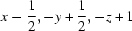
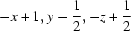
| Symmetry codes: (i) x−1/2, −y+1/2, −z+1; (ii) −x+1/2, y+1/2, z; (iii) −x+3/2, y−1/2, z; (iv) −x+1, y−1/2, −z+1/2. |
Experimental details
| Crystal data | |
| Chemical formula | [Cu(C11H11NO6)(H2O)] |
| Mr | 334.76 |
| Crystal system, space group | Orthorhombic, Pbca |
| Temperature (K) | 294 |
| a, b, c (Å) | 13.0461 (16), 9.7919 (12), 19.374 (2) |
| V (Å3) | 2474.9 (5) |
| Z | 8 |
| Radiation type | Mo Kα |
| µ (mm−1) | 1.80 |
| Crystal size (mm) | 0.22 × 0.18 × 0.12 |
| Data collection | |
| Diffractometer | Rigaku Saturn |
| Absorption correction | Multi-scan (Jacobson, 1998) |
| Tmin, Tmax | 0.693, 0.813 |
| No. of measured, independent and observed [I > 2σ(I)] reflections | 17710, 2929, 2662 |
| Rint | 0.026 |
| (sin θ/λ)max (Å−1) | 0.658 |
| Refinement | |
| R[F2 > 2σ(F2)], wR(F2), S | 0.025, 0.070, 1.04 |
| No. of reflections | 2929 |
| No. of parameters | 198 |
| H-atom treatment | H atoms treated by a mixture of independent and constrained refinement |
| Δρmax, Δρmin (e Å−3) | 0.31, −0.56 |
Computer programs: CrystalClear (Rigaku/MSC, 2005), SHELXS97 (Sheldrick, 2008), SHELXL97 (Sheldrick, 2008), CrystalStructure (Rigaku/MSC, 2005).
| D—H···A | D—H | H···A | D···A | D—H···A |
| O5—H5···O2i | 0.76 (3) | 1.93 (3) | 2.6859 (16) | 172 (3) |
| O6—H4···O3ii | 0.86 (3) | 2.00 (3) | 2.8442 (18) | 168 (2) |
| O7—H7A···O2iii | 0.80 (2) | 1.97 (2) | 2.7261 (16) | 157 (2) |
| O7—H7B···O4iv | 0.87 (3) | 1.83 (3) | 2.6794 (18) | 163 (2) |
| Symmetry codes: (i) x−1/2, −y+1/2, −z+1; (ii) −x+1/2, y+1/2, z; (iii) −x+3/2, y−1/2, z; (iv) −x+1, y−1/2, −z+1/2. |
Acknowledgements
We gratefully acknowledge the Science Foundation of Guangxi (No.0832098, 0731052) and the Teaching and Research Award Programme for Outstanding Young Teachers in Higher Education Institutions of MOE, China.
References
 Addison, A. W., Rao, T. N., Reedijk, J., Rijn, V. J. & Verschoor, G. C. (1984). J. Chem. Soc. Dalton Trans. pp. 1349–1356. CSD CrossRef Web of Science Google Scholar
Calvo, R., Abresch, E. C., Bittl, R., Feher, G., Hofbauer, W., Isaacson, R. A., Lubitz, W., Okamura, M. Y. & Paddock, M. L. (2000). J. Am. Chem. Soc. 122, 7327–7341. Web of Science CrossRef CAS Google Scholar
Dooley, D. M., Scott, R. A., Knowles, P. F., Colanglo, C. M., McGuirl, M. A. & Brown, D. E. (1998). J. Am. Chem. Soc. 120, 2599-2605. Web of Science CrossRef CAS Google Scholar
Drouza, C., Tolis, V., Gramlich, V., Raptopoulou, C., Terzis, A., Sigalas, M. P., Kabanos, T. A. & Keramidas, A. D. (2002). Chem. Commun., pp. 2786–2787. Google Scholar
Fan, N.-T. (1992). Handbook of Organic Synthesis. Beijing Institute of Technology Press. Google Scholar
Huang, F.-P., Wang, Y.-X., Zhao, J., Bian, H.-D., Yu, Q. & Liang, H. (2008). Chin. J. Inorg. Chem. 24, 1523–1526. CAS Google Scholar
Iwata, S., Lee, L. W., Okada, K., Lee, J. K., Iwata, M., Rasmussen, B., Link, T. A., Ramaswamy, S. & Jap, B. K. (1998). Science, 281, 64-71. Web of Science CrossRef CAS PubMed Google Scholar
Jacobson, R. (1998). Private communication to the Rigaku Corporation, Tokyo, Japan. Google Scholar
Rigaku/MSC (2005). CrystalClear and CrystalStructure. Rigaku/MSC, The Woodlands, Texas, USA. Google Scholar
Sheldrick, G. M. (2008). Acta Cryst. A64, 112–122. Web of Science CrossRef CAS IUCr Journals Google Scholar
Wang, S. X., Mure, M., Medzihradsky, K. F., Burlingame, A. L., Brown, D. E., Dooley, D. M., Smith, A. J., Kagan, H. M. & Klinman, J. P. (1996). Science, 273, 1078–1084. CrossRef CAS PubMed Web of Science Google Scholar
This is an open-access article distributed under the terms of the Creative Commons Attribution (CC-BY) Licence, which permits unrestricted use, distribution, and reproduction in any medium, provided the original authors and source are cited.
| CRYSTALLOGRAPHIC COMMUNICATIONS |


p-Hydroquinones, along with their oxidation products p-semiquinones and p-quinones, are very important in the oxidative maintenance of biological amine levels (Dooley et al., 1998), tissue formation (Wang et al., 1996), photosynthesis (Calvo et al., 2000) and aerobic respiration (Iwata et al., 1998). These compounds are involved in interesting organic electron- and hydrogen-transfer systems, e.g. electron-transfer reactions between transition metal centers and p-quinone cofactors are vital for all life (Drouza et al., 2002), occurring in key biological processes. As part of a series of the studies (Huang et al., 2008), we report here the synthesis and structure of the title compound, a new CuII complex with the related ligand 2-[N,N-bis(carboxylatomethyl)aminomethyl]hydroquinone. The molecular structure of the title compound [Cu(C11H11NO6)(H2O)] (I) is shown in Fig. 1. The CuII atom has a distorted square-pyramidal geometry with a τ parameter of 0.09 (Addison et al., 1984). The basal sites are occupied by one water molecule, as well as two carboxylate O atoms and one N atom of the ligand. In the apical position, the O atom of the hydroxybenzene coordinates to the CuII atom. All bond distances and bond angles have normal values. The crystal packing of (I) (Fig. 2) involves intermolecular O—H···O hydrogen bonds (Table 1). The non-coordinated carboxylate O2 atom accepts intermolecular hydrogen bonds from the coordinated hydroxy O (O5) of the hydroquinone ligand and from the coordinated water (O7). The non-coordinated carboxylate O4 atom is also an acceptor for a water H donor in an intermolecular hydrogen bond. The coordinated atom O3 accepts a hydrogen bond from the non-coordinated hydroquinone O (O6). These interactions result in a three-dimensional hydrogen-bonded framework structure.