 | Acta Crystallographica Section E Acta Crystallographica Section E CRYSTALLOGRAPHIC COMMUNICATIONS |


 journal menu


metal-organic compounds
| CRYSTALLOGRAPHIC COMMUNICATIONS |
 access
Diacridinium tetrakis(thiocyanato-κS)platinate(II)

aSchool of Applied Chemical Engineering, The Research Institute of Catalysis, Chonnam National University, Gwangju 500-757, Republic of Korea
*Correspondence e-mail: [email protected]
The of the title compound, (C13H10N)2[Pt(NCS)4], contains a protonated acridine molecule and one half of a [Pt(NCS)4]2− anion. In the complex anion, the PtII ion is located on an inversion centre and is four-coordinated in a slightly distorted square-planar environment by four S atoms from four thiocyanate ligands. The compound displays numerous intermolecular π–π interactions between six-membered rings, with a shortest centroid–centroid distance of 3.682 (3) Å. The component ions interact by means of intermolecular N—H⋯N hydrogen bonds.
Related literature
For related acridinium compounds, see: Hafiz (2006![[Hafiz, H. R. (2006). Phys. Stat. Sol. (A), 203, 878-885.]](../../../../../../logos/arrows/e_arr.gif "Hafiz, H. R. (2006). Phys. Stat. Sol. (A), 203, 878-885.") ); Veldhuizen et al. (1997). For the crystal structures of [M(NCS)4]2− [M = Pt(II), Pd(II)] complexes, see: Aoki et al. (1999); Deplano et al. (2004); Rohde et al. (2000).
); Veldhuizen et al. (1997). For the crystal structures of [M(NCS)4]2− [M = Pt(II), Pd(II)] complexes, see: Aoki et al. (1999); Deplano et al. (2004); Rohde et al. (2000).
![[Scheme 1]](hy2274scheme1.gif)
Experimental
Crystal data
|
Refinement
|
| ||||||||
| |||||||||||||||||
 .
. Data collection: SMART (Bruker, 2007); cell refinement: SAINT (Bruker, 2007); data reduction: SAINT; program(s) used to solve structure: SHELXS97 (Sheldrick, 2008); program(s) used to refine structure: SHELXL97 (Sheldrick, 2008); molecular graphics: ORTEP-3 (Farrugia, 1997) and PLATON (Spek, 2009); software used to prepare material for publication: SHELXL97.
Supporting information
contains datablocks global, I. DOI: https://doi.org/10.1107/S1600536810002485/hy2274sup1.cif
Structure factors: contains datablock I. DOI: https://doi.org/10.1107/S1600536810002485/hy2274Isup2.hkl
To a solution of K2PtCl6 (0.2002 g, 0.412 mmol) in H2O (20 ml) was added KNCS (0.3998 g, 4.114 mmol) and refluxed for 1 h. After cooling of the reaction mixture to room temperature, acridine (0.1479 g, 0.825 mmol) was added and refluxed for 3 h. The precipitate obtained was separated by filtration, washed with H2O and dried at 50 °C, to give an orange powder (0.1894 g). Crystals suitable for X-ray analysis were obtained by slow evaporation from a MeOH solution.
H atoms were positioned geometrically and allowed to ride on their respective parent atoms [C—H = 0.93, N—H = 0.86 Å and Uiso(H) = 1.2Ueq(C, N)].
The of the title compound contains a protonated acridine cation and one half of a [Pt(NCS)4]2- anionic complex (Fig. 1). In the complex, the PtII ion is located on an inversion centre at the special position (1, 1/2, 1/2) and is four-coordinated in a slightly distorted square-planar environment by four S atoms from four NCS- ligands. The Pt—S bond lengths are nearly equivalent [2.3236 (17) and 2.3254 (17) Å] (Table 1). The cis S—Pt—S bond angles are 88.82 (6) and 91.18 (6)°. The thiocyanate anions are almost linear displaying S—C—N bond angles of 175.7 (6) and 176.9 (6)°. The S atoms coordinate to the Pt atom with nearly tetrahedral Pt—S—C bond angles of 105.9 (2) and 104.4 (2)°. The compound displays numerous intermolecular π–π interactions between six-membered rings, with a shortest centroid–centroid distance of 3.682 (3) Å. The component ions interact by means of intermolecular N—H···N hydrogen bonds (Fig. 2 and Table 2).
For related acridinium compounds, see: Hafiz (2006); Veldhuizen et al. (1997). For the crystal structures of [M(NCS)4]2- [M = Pt(II), Pd(II)] complexes, see: Aoki et al. (1999); Deplano et al. (2004); Rohde et al. (2000).
Data collection: SMART (Bruker, 2007); cell SAINT (Bruker, 2007); data reduction: SAINT (Bruker, 2007); program(s) used to solve structure: SHELXS97 (Sheldrick, 2008); program(s) used to refine structure: SHELXL97 (Sheldrick, 2008); molecular graphics: ORTEP-3 (Farrugia, 1997) and PLATON (Spek, 2009); software used to prepare material for publication: SHELXL97 (Sheldrick, 2008).
![[Figure 1]](./hy2274fig1thm.gif) | Fig. 1. The structure of the title compound, with displacement ellipsoids drawn at the 30% probability level. [Symmetry code: (a) 2-x, 1-y, 1-z.] |
![[Figure 2]](./hy2274fig2thm.gif) | Fig. 2. View of the unit-cell contents of the title compound. Hydrogen-bond interactions are drawn with dashed lines. |
| (C13H10N)2[Pt(NCS)4] | F(000) = 768 |
| Mr = 787.85 | Dx = 1.804 Mg m−3 |
| Monoclinic, P21/c | Mo Kα radiation, λ = 0.71073 Å |
| Hall symbol: -P 2ybc | Cell parameters from 720 reflections |
| a = 6.8358 (8) Å | θ = 2.3–20.2° |
| b = 11.9833 (15) Å | µ = 5.16 mm−1 |
| c = 17.737 (2) Å | T = 293 K |
| β = 93.618 (2)° | Block, orange |
| V = 1450.0 (3) Å3 | 0.11 × 0.10 × 0.10 mm |
| Z = 2 |
| Bruker SMART 1000 CCD diffractometer | 2968 independent reflections |
| Radiation source: fine-focus sealed tube | 2003 reflections with I > 2σ(I) |
| Graphite monochromator | Rint = 0.039 |
| φ and ω scans | θmax = 26.4°, θmin = 2.3° |
| Absorption correction: multi-scan (SADABS; Bruker, 2001) | h = −8→8 |
| Tmin = 0.463, Tmax = 1.000 | k = −14→14 |
| 8278 measured reflections | l = −11→22 |
| Refinement on F2 | Primary atom site location: structure-invariant direct methods |
| Least-squares matrix: full | Secondary atom site location: difference Fourier map |
| R[F2 > 2σ(F2)] = 0.040 | Hydrogen site location: inferred from neighbouring sites |
| wR(F2) = 0.068 | H-atom parameters constrained |
| S = 1.03 | w = 1/[σ2(Fo2) + (0.0175P)2] where P = (Fo2 + 2Fc2)/3 |
| 2968 reflections | (Δ/σ)max < 0.001 |
| 187 parameters | Δρmax = 0.89 e Å−3 |
| 0 restraints | Δρmin = −0.50 e Å−3 |
| (C13H10N)2[Pt(NCS)4] | V = 1450.0 (3) Å3 |
| Mr = 787.85 | Z = 2 |
| Monoclinic, P21/c | Mo Kα radiation |
| a = 6.8358 (8) Å | µ = 5.16 mm−1 |
| b = 11.9833 (15) Å | T = 293 K |
| c = 17.737 (2) Å | 0.11 × 0.10 × 0.10 mm |
| β = 93.618 (2)° |
| Bruker SMART 1000 CCD diffractometer | 2968 independent reflections |
| Absorption correction: multi-scan (SADABS; Bruker, 2001) | 2003 reflections with I > 2σ(I) |
| Tmin = 0.463, Tmax = 1.000 | Rint = 0.039 |
| 8278 measured reflections |
| R[F2 > 2σ(F2)] = 0.040 | 0 restraints |
| wR(F2) = 0.068 | H-atom parameters constrained |
| S = 1.03 | Δρmax = 0.89 e Å−3 |
| 2968 reflections | Δρmin = −0.50 e Å−3 |
| 187 parameters |
| x | y | z | Uiso*/Ueq | ||
| Pt1 | 1.0000 | 0.5000 | 0.5000 | 0.05422 (12) | |
| S1 | 0.8814 (3) | 0.44333 (14) | 0.38044 (9) | 0.0807 (5) | |
| S2 | 1.2773 (2) | 0.56944 (17) | 0.44661 (10) | 0.0862 (6) | |
| N1 | 0.6764 (7) | 0.2432 (4) | 0.3972 (3) | 0.0747 (16) | |
| N2 | 1.1409 (9) | 0.6690 (5) | 0.3098 (3) | 0.095 (2) | |
| C1 | 0.7597 (8) | 0.3255 (5) | 0.3932 (3) | 0.0609 (16) | |
| C2 | 1.1910 (9) | 0.6278 (5) | 0.3653 (4) | 0.0686 (19) | |
| N3 | 0.2844 (5) | 0.5161 (3) | 0.0610 (3) | 0.0497 (11) | |
| H3 | 0.2917 | 0.5852 | 0.0740 | 0.060* | |
| C3 | 0.2417 (6) | 0.4939 (5) | −0.0132 (3) | 0.0454 (12) | |
| C4 | 0.2091 (7) | 0.5803 (5) | −0.0660 (4) | 0.0569 (15) | |
| H4 | 0.2199 | 0.6546 | −0.0513 | 0.068* | |
| C5 | 0.1610 (8) | 0.5522 (6) | −0.1395 (4) | 0.0666 (18) | |
| H5 | 0.1365 | 0.6083 | −0.1751 | 0.080* | |
| C6 | 0.1481 (8) | 0.4401 (7) | −0.1621 (4) | 0.0730 (18) | |
| H6 | 0.1161 | 0.4233 | −0.2126 | 0.088* | |
| C7 | 0.1808 (8) | 0.3563 (6) | −0.1124 (4) | 0.0708 (19) | |
| H7 | 0.1722 | 0.2826 | −0.1288 | 0.085* | |
| C8 | 0.2283 (7) | 0.3802 (5) | −0.0354 (3) | 0.0515 (14) | |
| C9 | 0.2682 (7) | 0.2991 (5) | 0.0195 (4) | 0.0611 (17) | |
| H9 | 0.2664 | 0.2245 | 0.0051 | 0.073* | |
| C10 | 0.3109 (7) | 0.3256 (5) | 0.0957 (3) | 0.0521 (14) | |
| C11 | 0.3508 (8) | 0.2451 (5) | 0.1531 (4) | 0.0675 (18) | |
| H11 | 0.3496 | 0.1696 | 0.1411 | 0.081* | |
| C12 | 0.3904 (9) | 0.2780 (6) | 0.2253 (4) | 0.077 (2) | |
| H12 | 0.4196 | 0.2249 | 0.2626 | 0.092* | |
| C13 | 0.3877 (8) | 0.3919 (6) | 0.2445 (4) | 0.0752 (19) | |
| H13 | 0.4116 | 0.4126 | 0.2948 | 0.090* | |
| C14 | 0.3509 (8) | 0.4722 (5) | 0.1915 (3) | 0.0614 (17) | |
| H14 | 0.3488 | 0.5471 | 0.2052 | 0.074* | |
| C15 | 0.3163 (7) | 0.4401 (5) | 0.1159 (3) | 0.0473 (13) |
| U11 | U22 | U33 | U12 | U13 | U23 | |
| Pt1 | 0.0612 (2) | 0.04675 (18) | 0.0540 (2) | −0.00893 (17) | −0.00227 (16) | 0.00275 (19) |
| S1 | 0.1100 (14) | 0.0712 (11) | 0.0591 (11) | −0.0381 (11) | −0.0097 (10) | 0.0064 (10) |
| S2 | 0.0712 (12) | 0.1146 (15) | 0.0721 (12) | −0.0280 (11) | −0.0007 (10) | 0.0130 (12) |
| N1 | 0.090 (4) | 0.052 (3) | 0.081 (4) | −0.013 (3) | −0.005 (3) | 0.006 (3) |
| N2 | 0.105 (5) | 0.113 (5) | 0.069 (4) | −0.034 (4) | 0.008 (4) | 0.014 (4) |
| C1 | 0.071 (4) | 0.054 (4) | 0.056 (4) | −0.001 (3) | −0.011 (3) | 0.003 (3) |
| C2 | 0.072 (5) | 0.068 (5) | 0.067 (5) | −0.029 (4) | 0.020 (4) | −0.017 (4) |
| N3 | 0.043 (2) | 0.048 (3) | 0.058 (3) | 0.004 (2) | 0.007 (2) | −0.004 (3) |
| C3 | 0.032 (3) | 0.053 (3) | 0.053 (3) | 0.000 (3) | 0.011 (2) | −0.006 (3) |
| C4 | 0.042 (3) | 0.060 (4) | 0.069 (4) | 0.001 (3) | 0.005 (3) | 0.003 (4) |
| C5 | 0.043 (3) | 0.092 (5) | 0.066 (5) | 0.006 (3) | 0.010 (3) | 0.011 (4) |
| C6 | 0.062 (4) | 0.097 (5) | 0.060 (4) | 0.006 (4) | 0.009 (4) | −0.015 (5) |
| C7 | 0.054 (4) | 0.073 (5) | 0.086 (5) | −0.005 (3) | 0.015 (4) | −0.027 (4) |
| C8 | 0.039 (3) | 0.058 (4) | 0.060 (4) | −0.005 (3) | 0.015 (3) | −0.013 (3) |
| C9 | 0.044 (3) | 0.048 (4) | 0.093 (5) | −0.003 (3) | 0.021 (4) | −0.011 (4) |
| C10 | 0.042 (3) | 0.056 (4) | 0.060 (4) | 0.006 (3) | 0.009 (3) | −0.001 (3) |
| C11 | 0.053 (4) | 0.051 (4) | 0.099 (6) | 0.010 (3) | 0.012 (4) | 0.011 (4) |
| C12 | 0.073 (5) | 0.081 (5) | 0.078 (5) | 0.010 (4) | 0.014 (4) | 0.027 (5) |
| C13 | 0.062 (4) | 0.102 (6) | 0.062 (4) | 0.009 (4) | 0.006 (4) | 0.008 (5) |
| C14 | 0.060 (4) | 0.063 (4) | 0.061 (4) | 0.005 (3) | 0.003 (3) | −0.003 (3) |
| C15 | 0.038 (3) | 0.048 (3) | 0.057 (4) | 0.003 (3) | 0.009 (3) | 0.001 (3) |
| Pt1—S1 | 2.3236 (17) | C6—H6 | 0.9300 |
| Pt1—S2 | 2.3254 (17) | C7—C8 | 1.414 (7) |
| S1—C1 | 1.661 (6) | C7—H7 | 0.9300 |
| S2—C2 | 1.676 (7) | C8—C9 | 1.390 (7) |
| N1—C1 | 1.143 (6) | C9—C10 | 1.400 (7) |
| N2—C2 | 1.135 (7) | C9—H9 | 0.9300 |
| N3—C15 | 1.341 (6) | C10—C11 | 1.417 (7) |
| N3—C3 | 1.357 (6) | C10—C15 | 1.417 (7) |
| N3—H3 | 0.8600 | C11—C12 | 1.350 (8) |
| C3—C4 | 1.403 (7) | C11—H11 | 0.9300 |
| C3—C8 | 1.419 (7) | C12—C13 | 1.408 (8) |
| C4—C5 | 1.367 (7) | C12—H12 | 0.9300 |
| C4—H4 | 0.9300 | C13—C14 | 1.358 (7) |
| C5—C6 | 1.403 (9) | C13—H13 | 0.9300 |
| C5—H5 | 0.9300 | C14—C15 | 1.402 (7) |
| C6—C7 | 1.345 (8) | C14—H14 | 0.9300 |
| S1i—Pt1—S1 | 180.0 | C6—C7—H7 | 120.0 |
| S1i—Pt1—S2 | 91.18 (6) | C8—C7—H7 | 120.0 |
| S1—Pt1—S2 | 88.82 (6) | C9—C8—C7 | 123.9 (6) |
| S1i—Pt1—S2i | 88.82 (6) | C9—C8—C3 | 118.1 (5) |
| S1—Pt1—S2i | 91.18 (6) | C7—C8—C3 | 118.0 (6) |
| S2—Pt1—S2i | 180.0 | C8—C9—C10 | 122.5 (5) |
| C1—S1—Pt1 | 105.9 (2) | C8—C9—H9 | 118.8 |
| C2—S2—Pt1 | 104.4 (2) | C10—C9—H9 | 118.8 |
| N1—C1—S1 | 175.7 (6) | C9—C10—C11 | 123.9 (6) |
| N2—C2—S2 | 176.9 (7) | C9—C10—C15 | 117.6 (6) |
| C15—N3—C3 | 125.9 (5) | C11—C10—C15 | 118.4 (6) |
| C15—N3—H3 | 117.1 | C12—C11—C10 | 120.1 (6) |
| C3—N3—H3 | 117.1 | C12—C11—H11 | 120.0 |
| N3—C3—C4 | 121.2 (5) | C10—C11—H11 | 120.0 |
| N3—C3—C8 | 117.6 (5) | C11—C12—C13 | 120.5 (6) |
| C4—C3—C8 | 121.2 (5) | C11—C12—H12 | 119.8 |
| C5—C4—C3 | 118.3 (6) | C13—C12—H12 | 119.8 |
| C5—C4—H4 | 120.9 | C14—C13—C12 | 121.7 (6) |
| C3—C4—H4 | 120.9 | C14—C13—H13 | 119.2 |
| C4—C5—C6 | 121.0 (6) | C12—C13—H13 | 119.2 |
| C4—C5—H5 | 119.5 | C13—C14—C15 | 118.7 (6) |
| C6—C5—H5 | 119.5 | C13—C14—H14 | 120.6 |
| C7—C6—C5 | 121.5 (6) | C15—C14—H14 | 120.6 |
| C7—C6—H6 | 119.2 | N3—C15—C14 | 121.2 (5) |
| C5—C6—H6 | 119.2 | N3—C15—C10 | 118.3 (5) |
| C6—C7—C8 | 120.0 (6) | C14—C15—C10 | 120.6 (6) |
| S2—Pt1—S1—C1 | 145.5 (2) | C7—C8—C9—C10 | −178.7 (5) |
| S2i—Pt1—S1—C1 | −34.5 (2) | C3—C8—C9—C10 | 3.3 (8) |
| S1i—Pt1—S2—C2 | −140.0 (2) | C8—C9—C10—C11 | 179.5 (5) |
| S1—Pt1—S2—C2 | 40.0 (2) | C8—C9—C10—C15 | −1.2 (8) |
| C15—N3—C3—C4 | 179.4 (4) | C9—C10—C11—C12 | −179.9 (5) |
| C15—N3—C3—C8 | 0.3 (7) | C15—C10—C11—C12 | 0.8 (8) |
| N3—C3—C4—C5 | −178.1 (5) | C10—C11—C12—C13 | 1.6 (9) |
| C8—C3—C4—C5 | 0.9 (7) | C11—C12—C13—C14 | −1.8 (10) |
| C3—C4—C5—C6 | −1.2 (8) | C12—C13—C14—C15 | −0.4 (9) |
| C4—C5—C6—C7 | 0.5 (9) | C3—N3—C15—C14 | −177.1 (5) |
| C5—C6—C7—C8 | 0.4 (9) | C3—N3—C15—C10 | 1.8 (7) |
| C6—C7—C8—C9 | −178.7 (5) | C13—C14—C15—N3 | −178.2 (5) |
| C6—C7—C8—C3 | −0.7 (8) | C13—C14—C15—C10 | 2.9 (8) |
| N3—C3—C8—C9 | −2.8 (7) | C9—C10—C15—N3 | −1.3 (7) |
| C4—C3—C8—C9 | 178.1 (5) | C11—C10—C15—N3 | 178.0 (5) |
| N3—C3—C8—C7 | 179.0 (4) | C9—C10—C15—C14 | 177.6 (5) |
| C4—C3—C8—C7 | 0.0 (7) | C11—C10—C15—C14 | −3.1 (7) |
| Symmetry code: (i) −x+2, −y+1, −z+1. |
| D—H···A | D—H | H···A | D···A | D—H···A |
| N3—H3···N1ii | 0.86 | 1.97 | 2.829 (6) | 177 |
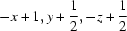
| Symmetry code: (ii) −x+1, y+1/2, −z+1/2. |
Experimental details
| Crystal data | |
| Chemical formula | (C13H10N)2[Pt(NCS)4] |
| Mr | 787.85 |
| Crystal system, space group | Monoclinic, P21/c |
| Temperature (K) | 293 |
| a, b, c (Å) | 6.8358 (8), 11.9833 (15), 17.737 (2) |
| β (°) | 93.618 (2) |
| V (Å3) | 1450.0 (3) |
| Z | 2 |
| Radiation type | Mo Kα |
| µ (mm−1) | 5.16 |
| Crystal size (mm) | 0.11 × 0.10 × 0.10 |
| Data collection | |
| Diffractometer | Bruker SMART 1000 CCD |
| Absorption correction | Multi-scan (SADABS; Bruker, 2001) |
| Tmin, Tmax | 0.463, 1.000 |
| No. of measured, independent and observed [I > 2σ(I)] reflections | 8278, 2968, 2003 |
| Rint | 0.039 |
| (sin θ/λ)max (Å−1) | 0.625 |
| Refinement | |
| R[F2 > 2σ(F2)], wR(F2), S | 0.040, 0.068, 1.03 |
| No. of reflections | 2968 |
| No. of parameters | 187 |
| H-atom treatment | H-atom parameters constrained |
| Δρmax, Δρmin (e Å−3) | 0.89, −0.50 |
Computer programs: SMART (Bruker, 2007), SAINT (Bruker, 2007), SHELXS97 (Sheldrick, 2008), SHELXL97 (Sheldrick, 2008), ORTEP-3 (Farrugia, 1997) and PLATON (Spek, 2009).
| D—H···A | D—H | H···A | D···A | D—H···A |
| N3—H3···N1i | 0.86 | 1.97 | 2.829 (6) | 176.9 |
| Symmetry code: (i) −x+1, y+1/2, −z+1/2. |
Acknowledgements
This research was supported by the Basic Science Research Program through the National Research Foundation of Korea (NRF) funded by the Ministry of Education, Science and Technology (2009–0074570).
References
 Aoki, K., Hu, N.-H., Tokuno, T., Adeyemo, A. O. & Williams, G. N. (1999). Inorg. Chim. Acta, 290, 145–152. Web of Science CrossRef CAS Google Scholar
Bruker (2001). SADABS. Bruker AXS Inc., Madison, Wisconsin, USA. Google Scholar
Bruker (2007). SMART and SAINT. Bruker AXS Inc., Madison, Wisconsin, USA. Google Scholar
Deplano, P., Mercuri, M. L., Marchiò, L., Pilia, L., Salidu, M., Serpe, A. & Tronci, E. (2004). Inorg. Chim. Acta, 357, 1608–1612. Web of Science CSD CrossRef CAS Google Scholar
Farrugia, L. J. (1997). J. Appl. Cryst. 30, 565. CrossRef IUCr Journals Google Scholar
Hafiz, H. R. (2006). Phys. Stat. Sol. (A), 203, 878–885. Web of Science CrossRef CAS Google Scholar
Rohde, J.-U., von Malottki, B. & Preetz, W. (2000). Z. Anorg. Allg. Chem. 626, 905–910. CrossRef CAS Google Scholar
Sheldrick, G. M. (2008). Acta Cryst. A64, 112–122. Web of Science CrossRef CAS IUCr Journals Google Scholar
Spek, A. L. (2009). Acta Cryst. D65, 148–155. Web of Science CrossRef CAS IUCr Journals Google Scholar
Veldhuizen, Y. S. J., Smeets, W. J. J., Veldman, N., Spek, A. L., Faulmann, C., Auban-Senzier, P., Jérome, D., Paulus, P. M., Haasnoot, J. G. & Reedijk, J. (1997). Inorg. Chem. 36, 4930–4937. CSD CrossRef CAS Web of Science Google Scholar
This is an open-access article distributed under the terms of the Creative Commons Attribution (CC-BY) Licence, which permits unrestricted use, distribution, and reproduction in any medium, provided the original authors and source are cited.
| CRYSTALLOGRAPHIC COMMUNICATIONS |


The asymmetric unit of the title compound contains a protonated acridine cation and one half of a [Pt(NCS)4]2- anionic complex (Fig. 1). In the complex, the PtII ion is located on an inversion centre at the special position (1, 1/2, 1/2) and is four-coordinated in a slightly distorted square-planar environment by four S atoms from four NCS- ligands. The Pt—S bond lengths are nearly equivalent [2.3236 (17) and 2.3254 (17) Å] (Table 1). The cis S—Pt—S bond angles are 88.82 (6) and 91.18 (6)°. The thiocyanate anions are almost linear displaying S—C—N bond angles of 175.7 (6) and 176.9 (6)°. The S atoms coordinate to the Pt atom with nearly tetrahedral Pt—S—C bond angles of 105.9 (2) and 104.4 (2)°. The compound displays numerous intermolecular π–π interactions between six-membered rings, with a shortest centroid–centroid distance of 3.682 (3) Å. The component ions interact by means of intermolecular N—H···N hydrogen bonds (Fig. 2 and Table 2).