 | Acta Crystallographica Section E Acta Crystallographica Section E CRYSTALLOGRAPHIC COMMUNICATIONS |


 journal menu


organic compounds
| CRYSTALLOGRAPHIC COMMUNICATIONS |
 access
Ethyl 3-methyl-4-oxo-4,5-dihydro-1H-pyrrolo[2,3-d]pyridazine-2-carboxylate

aKey Laboratory of Tropical Biological Resources of the Ministry of Education, Hainan University, Haikou 570228, People's Republic of China, bExperimental Teaching Center of Marine Biology, Hainan University, Haikou 570228, People's Republic of China, and cSchool of Ocean, Hainan University, Haikou 570228, People's Republic of China
*Correspondence e-mail: [email protected]
The title compound, C10H11N3O3, was synthesized by the reaction of 3,5-bis(ethoxycarbonyl)-2-formyl-4-methyl-1H-pyrrole and hydrazine hydrate. The angle between the pyrrole ring and the pyridazinone ring is 0.93 (9)°. In the crystal, intermolecular N—H⋯O and N—H⋯N hydrogen-bond interactions link the molecules into a two-dimensional network.
Related literature
For the biological activity of pyrrolopyridazine compounds, see: Chen et al. (2006![[Chen, Z., Kim, S. H., Barbosa, S. A., Huynh, T., Tortolani, D. R., Leavitt, K. J., Wei, D. D., Manne, V., Ricca, C. S., Gullo-Brown, J., Poss, M. A., Vaccaro, W. & Salvati, M. E. (2006). Bioorg. Med. Chem. Lett. 16, 628-632.]](../../../../../../logos/arrows/e_arr.gif "Chen, Z., Kim, S. H., Barbosa, S. A., Huynh, T., Tortolani, D. R., Leavitt, K. J., Wei, D. D., Manne, V., Ricca, C. S., Gullo-Brown, J., Poss, M. A., Vaccaro, W. & Salvati, M. E. (2006). Bioorg. Med. Chem. Lett. 16, 628-632.") ); Hu et al. (2004); Swamy et al. (2005). For bond-length data, see Allen et al. (1987).
); Hu et al. (2004); Swamy et al. (2005). For bond-length data, see Allen et al. (1987).
![[Scheme 1]](sj2715scheme1.gif)
Experimental
Crystal data
|
Refinement
|
| ||||||||||||||||||||||
 .
. Data collection: SMART (Bruker 2002); cell refinement: SAINT (Bruker 2002); data reduction: SAINT; program(s) used to solve structure: SHELXS97 (Sheldrick, 2008); program(s) used to refine structure: SHELXL97 (Sheldrick, 2008); molecular graphics: PLATON (Spek, 2009); software used to prepare material for publication: SHELXTL (Sheldrick, 2008).
Supporting information
contains datablocks global, I. DOI: https://doi.org/10.1107/S1600536809055081/sj2715sup1.cif
Structure factors: contains datablock I. DOI: https://doi.org/10.1107/S1600536809055081/sj2715Isup2.hkl
2.39 g (10 mmol) of the 3,5-bis(ethoxycarbonyl)-2,4- dimethyl-1(H)-pyrrole was added to a mixed solvent of 60 ml THF and 60 ml glacial acetic acid at room temperature under stirring until all of the solid was dissolved. Then, 60 ml water and 21.93 g (40 mmol) cerous ammonium nitrate (CAN) were added consecutively and the mixture stirred at room temperature for 1.5 h until the reaction was complete. The reaction mixture was poured into ice water and the white solid was separated (2.13 g, 84%). Recrystallization of the white solid from ethanol gave the compound 3,5-bis(ethoxycarbonyl)-2-formyl-4-methyl-1(H)-pyrrole.
An aqueous solution of hydrazine hydrate (80%, 0.5 ml) was added into a solution of 3,5-bis(ethoxycarbonyl)-2-formyl-4-methyl- 1(H)-pyrrole (0.25 g, 1.0 mmol) in glacial acetic acid (20 ml) under stirring at room temperature. The reaction mixture was refluxed for 3 h till the reaction was complete. The reaction mixture was evaporated to remove the solvent of water and acetic acid at reduced pressure to yield the title compound (1) as a white solid (0.18 g, 82%). Recrystallization of the white solid from hot ethanol yielded colorless plate-like crystals suitable for X-ray diffraction analysis.
The H atoms bound to N1 and N3 were located in a difference Fourier map and refined freely with isotropic displacement parameters. All other H atoms were visible in difference maps and were subsequently treated as riding atoms with distances C—H = 0.93 - 0.97 Å. Uiso(H) was set equal to xUeq(parent atom), where x = 1.2 - 1.5.
Pyridazine and its derivatives play an important role play an important role in medicine and as pesticides. One of the main techniques to synthesize pyridazines is to react 1,4-dicarbonyl compounds with hydrazine hydrate. Recently, the synthesis of pyrrolopyridazine compounds has aroused great interest because of their significant biological activity (Chen et al., 2006; Hu et al., 2004; Swamy et al., 2005). As part of our work to develop new types of pyrrolopyridazine compounds with potential biological activity, we report here the synthesis and structure of the title compound (1). In the molecule of compound (1), the torsion angles are N1—C1—C2—C3 179.21 (14) and N1—C1—C2—C5 0.20 (18)°. The dihedral angle between the pyrrole and pyridazinone rings is 0.93 (9)°, an indication that the pyrrolopyridazine system is reasonably planar. The C4═N2 and C3═O1 bond lengths in the molecule are 1.291 (2) and 1.2397 (19)°, respectively, showing their double-bond character (Allen et al., 1987). In the crystal structure, N—H···O and N—H···N hydrogen bonds form a two-dimensional network structure, Fig. 2.
For the biological activity of pyrrolopyridazine compounds, see: Chen et al. (2006); Hu et al. (2004); Swamy et al. (2005). For bond-length data, see Allen et al. (1987).
Data collection: SMART (Bruker 2002); cell SAINT (Bruker 2002); data reduction: SAINT (Bruker 2002); program(s) used to solve structure: SHELXS97 (Sheldrick, 2008); program(s) used to refine structure: SHELXL97 (Sheldrick, 2008); molecular graphics: PLATON (Spek, 2009); software used to prepare material for publication: SHELXTL (Sheldrick, 2008).
![[Figure 1]](./sj2715fig1thm.gif) | Fig. 1. The structure of the title compound (1), showing 50% probability displacement ellipsoids and the atom-numbering scheme. |
![[Figure 2]](./sj2715fig2thm.gif) | Fig. 2. A packing diagram of compound (1) showing the chain of molecules linked by N3–H3···O1 and N1–H1···N2 hydrogen bonds. Hydrogen bonds are shown as dashed lines. |
| C10H11N3O3 | F(000) = 464 |
| Mr = 221.22 | Dx = 1.405 Mg m−3 |
| Monoclinic, P21/c | Mo Kα radiation, λ = 0.71073 Å |
| Hall symbol: -P 2ybc | Cell parameters from 7501 reflections |
| a = 8.0030 (16) Å | θ = 2.6–26.4° |
| b = 9.774 (2) Å | µ = 0.11 mm−1 |
| c = 13.370 (3) Å | T = 295 K |
| β = 90.17 (3)° | Plate, colourless |
| V = 1045.8 (4) Å3 | 0.40 × 0.26 × 0.06 mm |
| Z = 4 |
| Bruker SMART CCD area-detector diffractometer | 2045 independent reflections |
| Radiation source: fine-focus sealed tube | 1676 reflections with I > 2σ(I) |
| Graphite monochromator | Rint = 0.031 |
| φ and ω scans | θmax = 26.0°, θmin = 2.6° |
| Absorption correction: multi-scan (SADABS; Sheldrick, 1996) | h = −9→9 |
| Tmin = 0.959, Tmax = 0.994 | k = −11→12 |
| 6834 measured reflections | l = −16→15 |
| Refinement on F2 | Secondary atom site location: difference Fourier map |
| Least-squares matrix: full | Hydrogen site location: inferred from neighbouring sites |
| R[F2 > 2σ(F2)] = 0.044 | H atoms treated by a mixture of independent and constrained refinement |
| wR(F2) = 0.120 | w = 1/[σ2(Fo2) + (0.0631P)2 + 0.2196P] where P = (Fo2 + 2Fc2)/3 |
| S = 1.06 | (Δ/σ)max < 0.001 |
| 2045 reflections | Δρmax = 0.27 e Å−3 |
| 156 parameters | Δρmin = −0.21 e Å−3 |
| 0 restraints | Extinction correction: SHELXL97 (Sheldrick, 2008), Fc*=kFc[1+0.001xFc2λ3/sin(2θ)]-1/4 |
| Primary atom site location: structure-invariant direct methods | Extinction coefficient: 0.007 (2) |
| C10H11N3O3 | V = 1045.8 (4) Å3 |
| Mr = 221.22 | Z = 4 |
| Monoclinic, P21/c | Mo Kα radiation |
| a = 8.0030 (16) Å | µ = 0.11 mm−1 |
| b = 9.774 (2) Å | T = 295 K |
| c = 13.370 (3) Å | 0.40 × 0.26 × 0.06 mm |
| β = 90.17 (3)° |
| Bruker SMART CCD area-detector diffractometer | 2045 independent reflections |
| Absorption correction: multi-scan (SADABS; Sheldrick, 1996) | 1676 reflections with I > 2σ(I) |
| Tmin = 0.959, Tmax = 0.994 | Rint = 0.031 |
| 6834 measured reflections |
| R[F2 > 2σ(F2)] = 0.044 | 0 restraints |
| wR(F2) = 0.120 | H atoms treated by a mixture of independent and constrained refinement |
| S = 1.06 | Δρmax = 0.27 e Å−3 |
| 2045 reflections | Δρmin = −0.21 e Å−3 |
| 156 parameters |
Geometry. All e.s.d.'s (except the e.s.d. in the dihedral angle between two l.s. planes) are estimated using the full covariance matrix. The cell e.s.d.'s are taken into account individually in the estimation of e.s.d.'s in distances, angles and torsion angles; correlations between e.s.d.'s in cell parameters are only used when they are defined by crystal symmetry. An approximate (isotropic) treatment of cell e.s.d.'s is used for estimating e.s.d.'s involving l.s. planes. |
Refinement. Refinement of F2 against ALL reflections. The weighted R-factor wR and goodness of fit S are based on F2, conventional R-factors R are based on F, with F set to zero for negative F2. The threshold expression of F2 > σ(F2) is used only for calculating R-factors(gt) etc. and is not relevant to the choice of reflections for refinement. R-factors based on F2 are statistically about twice as large as those based on F, and R- factors based on ALL data will be even larger. |
| x | y | z | Uiso*/Ueq | ||
| C1 | 0.0960 (2) | 0.38216 (17) | 0.86245 (11) | 0.0291 (4) | |
| C2 | 0.14214 (19) | 0.33040 (17) | 0.95543 (11) | 0.0277 (4) | |
| C3 | 0.0970 (2) | 0.19196 (17) | 0.97885 (11) | 0.0295 (4) | |
| C4 | 0.0078 (2) | 0.30214 (18) | 0.79200 (12) | 0.0348 (4) | |
| H2 | −0.0209 | 0.3395 | 0.7303 | 0.042* | |
| C5 | 0.22621 (19) | 0.43535 (17) | 1.00880 (11) | 0.0287 (4) | |
| C6 | 0.2266 (2) | 0.54646 (17) | 0.94508 (11) | 0.0293 (4) | |
| C7 | 0.2897 (2) | 0.68717 (18) | 0.95437 (12) | 0.0324 (4) | |
| C8 | 0.4347 (2) | 0.8457 (2) | 1.05488 (15) | 0.0473 (5) | |
| H8A | 0.3500 | 0.9150 | 1.0436 | 0.057* | |
| H8B | 0.5247 | 0.8602 | 1.0076 | 0.057* | |
| C9 | 0.4995 (3) | 0.8551 (3) | 1.15900 (17) | 0.0665 (7) | |
| H9A | 0.5831 | 0.7860 | 1.1694 | 0.100* | |
| H9B | 0.4094 | 0.8414 | 1.2052 | 0.100* | |
| H9C | 0.5478 | 0.9438 | 1.1696 | 0.100* | |
| C10 | 0.2976 (2) | 0.4242 (2) | 1.11193 (12) | 0.0380 (4) | |
| H10A | 0.2233 | 0.4670 | 1.1587 | 0.057* | |
| H10B | 0.4043 | 0.4690 | 1.1142 | 0.057* | |
| H10C | 0.3111 | 0.3295 | 1.1291 | 0.057* | |
| N1 | 0.14838 (18) | 0.51266 (15) | 0.85690 (10) | 0.0318 (4) | |
| N2 | −0.03348 (19) | 0.17759 (15) | 0.81245 (10) | 0.0362 (4) | |
| N3 | 0.01190 (19) | 0.12734 (16) | 0.90363 (10) | 0.0349 (4) | |
| O1 | 0.12783 (16) | 0.13034 (12) | 1.05782 (8) | 0.0397 (4) | |
| O2 | 0.27522 (18) | 0.77051 (14) | 0.88893 (10) | 0.0506 (4) | |
| O3 | 0.36361 (16) | 0.71015 (13) | 1.04147 (9) | 0.0409 (4) | |
| H1 | 0.132 (2) | 0.565 (2) | 0.8057 (15) | 0.038 (5)* | |
| H3 | −0.028 (3) | 0.042 (3) | 0.9145 (16) | 0.067 (7)* |
| U11 | U22 | U33 | U12 | U13 | U23 | |
| C1 | 0.0348 (9) | 0.0251 (9) | 0.0274 (8) | 0.0005 (7) | −0.0006 (6) | 0.0008 (7) |
| C2 | 0.0313 (8) | 0.0261 (9) | 0.0256 (8) | 0.0013 (7) | −0.0007 (6) | 0.0005 (7) |
| C3 | 0.0342 (9) | 0.0275 (9) | 0.0268 (8) | −0.0004 (7) | −0.0005 (6) | 0.0017 (7) |
| C4 | 0.0503 (10) | 0.0287 (10) | 0.0253 (8) | −0.0019 (8) | −0.0054 (7) | 0.0011 (7) |
| C5 | 0.0299 (8) | 0.0271 (9) | 0.0290 (8) | 0.0013 (6) | −0.0012 (6) | −0.0003 (7) |
| C6 | 0.0321 (8) | 0.0273 (9) | 0.0286 (8) | −0.0002 (7) | −0.0028 (6) | −0.0013 (7) |
| C7 | 0.0347 (9) | 0.0285 (10) | 0.0340 (9) | −0.0017 (7) | −0.0022 (7) | −0.0007 (7) |
| C8 | 0.0492 (11) | 0.0365 (12) | 0.0562 (12) | −0.0114 (9) | −0.0071 (9) | −0.0098 (9) |
| C9 | 0.0655 (14) | 0.0758 (18) | 0.0581 (14) | −0.0170 (13) | −0.0081 (11) | −0.0236 (13) |
| C10 | 0.0447 (10) | 0.0367 (11) | 0.0325 (9) | −0.0025 (8) | −0.0098 (7) | 0.0021 (8) |
| N1 | 0.0432 (8) | 0.0254 (8) | 0.0268 (7) | −0.0024 (6) | −0.0058 (6) | 0.0050 (6) |
| N2 | 0.0515 (9) | 0.0298 (9) | 0.0272 (7) | −0.0048 (7) | −0.0059 (6) | −0.0008 (6) |
| N3 | 0.0502 (9) | 0.0255 (9) | 0.0290 (7) | −0.0063 (6) | −0.0053 (6) | 0.0023 (6) |
| O1 | 0.0569 (8) | 0.0305 (7) | 0.0317 (7) | −0.0077 (6) | −0.0101 (5) | 0.0078 (5) |
| O2 | 0.0723 (10) | 0.0319 (8) | 0.0475 (8) | −0.0113 (6) | −0.0173 (7) | 0.0092 (6) |
| O3 | 0.0514 (8) | 0.0324 (8) | 0.0389 (7) | −0.0092 (6) | −0.0101 (6) | −0.0006 (5) |
| C1—N1 | 1.345 (2) | C7—O3 | 1.324 (2) |
| C1—C2 | 1.391 (2) | C8—O3 | 1.453 (2) |
| C1—C4 | 1.412 (2) | C8—C9 | 1.487 (3) |
| C2—C5 | 1.418 (2) | C8—H8A | 0.9700 |
| C2—C3 | 1.435 (2) | C8—H8B | 0.9700 |
| C3—O1 | 1.2396 (19) | C9—H9A | 0.9600 |
| C3—N3 | 1.368 (2) | C9—H9B | 0.9600 |
| C4—N2 | 1.291 (2) | C9—H9C | 0.9600 |
| C4—H2 | 0.9300 | C10—H10A | 0.9600 |
| C5—C6 | 1.380 (2) | C10—H10B | 0.9600 |
| C5—C10 | 1.495 (2) | C10—H10C | 0.9600 |
| C6—N1 | 1.374 (2) | N1—H1 | 0.86 (2) |
| C6—C7 | 1.470 (2) | N2—N3 | 1.3626 (19) |
| C7—O2 | 1.201 (2) | N3—H3 | 0.90 (3) |
| N1—C1—C2 | 108.20 (14) | O3—C8—H8B | 110.1 |
| N1—C1—C4 | 130.09 (15) | C9—C8—H8B | 110.1 |
| C2—C1—C4 | 121.71 (16) | H8A—C8—H8B | 108.4 |
| C1—C2—C5 | 108.11 (15) | C8—C9—H9A | 109.5 |
| C1—C2—C3 | 118.14 (14) | C8—C9—H9B | 109.5 |
| C5—C2—C3 | 133.74 (14) | H9A—C9—H9B | 109.5 |
| O1—C3—N3 | 119.96 (16) | C8—C9—H9C | 109.5 |
| O1—C3—C2 | 126.47 (15) | H9A—C9—H9C | 109.5 |
| N3—C3—C2 | 113.57 (14) | H9B—C9—H9C | 109.5 |
| N2—C4—C1 | 120.59 (15) | C5—C10—H10A | 109.5 |
| N2—C4—H2 | 119.7 | C5—C10—H10B | 109.5 |
| C1—C4—H2 | 119.7 | H10A—C10—H10B | 109.5 |
| C6—C5—C2 | 105.10 (14) | C5—C10—H10C | 109.5 |
| C6—C5—C10 | 128.68 (15) | H10A—C10—H10C | 109.5 |
| C2—C5—C10 | 126.22 (15) | H10B—C10—H10C | 109.5 |
| N1—C6—C5 | 109.79 (15) | C1—N1—C6 | 108.79 (14) |
| N1—C6—C7 | 116.94 (14) | C1—N1—H1 | 123.8 (13) |
| C5—C6—C7 | 133.26 (15) | C6—N1—H1 | 127.4 (13) |
| O2—C7—O3 | 124.61 (16) | C4—N2—N3 | 117.50 (14) |
| O2—C7—C6 | 122.72 (16) | N2—N3—C3 | 128.49 (16) |
| O3—C7—C6 | 112.68 (14) | N2—N3—H3 | 112.6 (14) |
| O3—C8—C9 | 107.89 (17) | C3—N3—H3 | 118.8 (14) |
| O3—C8—H8A | 110.1 | C7—O3—C8 | 115.92 (14) |
| C9—C8—H8A | 110.1 | ||
| N1—C1—C2—C5 | 0.20 (18) | C10—C5—C6—C7 | −1.4 (3) |
| C4—C1—C2—C5 | −179.24 (15) | N1—C6—C7—O2 | −0.1 (3) |
| N1—C1—C2—C3 | 179.22 (14) | C5—C6—C7—O2 | −178.97 (18) |
| C4—C1—C2—C3 | −0.2 (2) | N1—C6—C7—O3 | −179.76 (14) |
| C1—C2—C3—O1 | −179.84 (16) | C5—C6—C7—O3 | 1.3 (3) |
| C5—C2—C3—O1 | −1.1 (3) | C2—C1—N1—C6 | −0.42 (18) |
| C1—C2—C3—N3 | 0.1 (2) | C4—C1—N1—C6 | 178.97 (17) |
| C5—C2—C3—N3 | 178.82 (16) | C5—C6—N1—C1 | 0.49 (19) |
| N1—C1—C4—N2 | −179.01 (17) | C7—C6—N1—C1 | −178.65 (14) |
| C2—C1—C4—N2 | 0.3 (3) | C1—C4—N2—N3 | −0.3 (2) |
| C1—C2—C5—C6 | 0.09 (18) | C4—N2—N3—C3 | 0.2 (3) |
| C3—C2—C5—C6 | −178.72 (17) | O1—C3—N3—N2 | 179.87 (16) |
| C1—C2—C5—C10 | −179.86 (15) | C2—C3—N3—N2 | −0.1 (2) |
| C3—C2—C5—C10 | 1.3 (3) | O2—C7—O3—C8 | −1.8 (3) |
| C2—C5—C6—N1 | −0.35 (18) | C6—C7—O3—C8 | 177.84 (15) |
| C10—C5—C6—N1 | 179.60 (15) | C9—C8—O3—C7 | 175.68 (16) |
| C2—C5—C6—C7 | 178.60 (17) |
| D—H···A | D—H | H···A | D···A | D—H···A |
| N3—H3···O1i | 0.90 (3) | 1.90 (3) | 2.804 (2) | 175 (2) |
| N1—H1···N2ii | 0.86 (2) | 2.08 (2) | 2.925 (2) | 166.2 (17) |
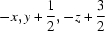
| Symmetry codes: (i) −x, −y, −z+2; (ii) −x, y+1/2, −z+3/2. |
Experimental details
| Crystal data | |
| Chemical formula | C10H11N3O3 |
| Mr | 221.22 |
| Crystal system, space group | Monoclinic, P21/c |
| Temperature (K) | 295 |
| a, b, c (Å) | 8.0030 (16), 9.774 (2), 13.370 (3) |
| β (°) | 90.17 (3) |
| V (Å3) | 1045.8 (4) |
| Z | 4 |
| Radiation type | Mo Kα |
| µ (mm−1) | 0.11 |
| Crystal size (mm) | 0.40 × 0.26 × 0.06 |
| Data collection | |
| Diffractometer | Bruker SMART CCD area-detector |
| Absorption correction | Multi-scan (SADABS; Sheldrick, 1996) |
| Tmin, Tmax | 0.959, 0.994 |
| No. of measured, independent and observed [I > 2σ(I)] reflections | 6834, 2045, 1676 |
| Rint | 0.031 |
| (sin θ/λ)max (Å−1) | 0.617 |
| Refinement | |
| R[F2 > 2σ(F2)], wR(F2), S | 0.044, 0.120, 1.06 |
| No. of reflections | 2045 |
| No. of parameters | 156 |
| H-atom treatment | H atoms treated by a mixture of independent and constrained refinement |
| Δρmax, Δρmin (e Å−3) | 0.27, −0.21 |
Computer programs: SMART (Bruker 2002), SAINT (Bruker 2002), SHELXS97 (Sheldrick, 2008), SHELXL97 (Sheldrick, 2008), PLATON (Spek, 2009), SHELXTL (Sheldrick, 2008).
| D—H···A | D—H | H···A | D···A | D—H···A |
| N3—H3···O1i | 0.90 (3) | 1.90 (3) | 2.804 (2) | 175 (2) |
| N1—H1···N2ii | 0.86 (2) | 2.08 (2) | 2.925 (2) | 166.2 (17) |
| Symmetry codes: (i) −x, −y, −z+2; (ii) −x, y+1/2, −z+3/2. |
Acknowledgements
This research was supported financially by the National Natural Science Foundation of China (30660215).
References
 Allen, F. H., Kennard, O., Watson, D. G., Brammer, L., Orpen, A. G. & Taylor, R. (1987). J. Chem. Soc. Perkin Trans. 2, pp. S1–19. CSD CrossRef Web of Science Google Scholar
Bruker (2002). SAINT and SMART. Bruker AXS Inc., Madison, Wisconsin, USA. Google Scholar
Chen, Z., Kim, S. H., Barbosa, S. A., Huynh, T., Tortolani, D. R., Leavitt, K. J., Wei, D. D., Manne, V., Ricca, C. S., Gullo-Brown, J., Poss, M. A., Vaccaro, W. & Salvati, M. E. (2006). Bioorg. Med. Chem. Lett. 16, 628–632. Web of Science CrossRef PubMed CAS Google Scholar
Hu, T., Stearns, B. A., Campbell, B. T., Arruda, J. M., Chen, C., Aiyar, J., Bezverkov, R. E., Santini, A., Schaffhauser, H., Liu, W., Venkatraman, S. & Munoz, B. (2004). Bioorg. Med. Chem. Lett. 14, 2031–2034. Web of Science CrossRef PubMed CAS Google Scholar
Sheldrick, G. M. (1996). SADABS. University of Göttingen, Germany. Google Scholar
Sheldrick, G. M. (2008). Acta Cryst. A64, 112–122. Web of Science CrossRef CAS IUCr Journals Google Scholar
Spek, A. L. (2009). Acta Cryst. D65, 148–155. Web of Science CrossRef CAS IUCr Journals Google Scholar
Swamy, K. M. K., Park, M. S., Han, S. J., Kim, S. K., Kim, J. H., Lee, C., Bang, H., Kim, Y., Kim, S.-J. & Yoon, J. (2005). Tetrahedron, 61, 10227–10234. Web of Science CSD CrossRef CAS Google Scholar
This is an open-access article distributed under the terms of the Creative Commons Attribution (CC-BY) Licence, which permits unrestricted use, distribution, and reproduction in any medium, provided the original authors and source are cited.
| CRYSTALLOGRAPHIC COMMUNICATIONS |


Pyridazine and its derivatives play an important role play an important role in medicine and as pesticides. One of the main techniques to synthesize pyridazines is to react 1,4-dicarbonyl compounds with hydrazine hydrate. Recently, the synthesis of pyrrolopyridazine compounds has aroused great interest because of their significant biological activity (Chen et al., 2006; Hu et al., 2004; Swamy et al., 2005). As part of our work to develop new types of pyrrolopyridazine compounds with potential biological activity, we report here the synthesis and structure of the title compound (1). In the molecule of compound (1), the torsion angles are N1—C1—C2—C3 179.21 (14) and N1—C1—C2—C5 0.20 (18)°. The dihedral angle between the pyrrole and pyridazinone rings is 0.93 (9)°, an indication that the pyrrolopyridazine system is reasonably planar. The C4═N2 and C3═O1 bond lengths in the molecule are 1.291 (2) and 1.2397 (19)°, respectively, showing their double-bond character (Allen et al., 1987). In the crystal structure, N—H···O and N—H···N hydrogen bonds form a two-dimensional network structure, Fig. 2.