 | Acta Crystallographica Section E Acta Crystallographica Section E CRYSTALLOGRAPHIC COMMUNICATIONS |


 journal menu


organic compounds
| CRYSTALLOGRAPHIC COMMUNICATIONS |
 access
Propane-1,3-diyl bis(pyridine-4-carboxylate)

aDepartamento de Química, Facultad de Ciencias Básicas, Universidad de Antofagasta, Casilla 170, Antofagasta, Chile, bInstitut für Anorganische Chemie der Goethe-Universität Frankfurt, Max-von-Laue-Strasse 7, D-60438 Frankfurt am Main, Germany, cInstituto de Bio-Orgánica 'Antonio González', Universidad de La Laguna, Astrofísico Francisco Sánchez N°2, La Laguna, Tenerife, Spain, and dDepartamento de Física, Facultad de Ciencias Básicas, Universidad de Antofagasta, Casilla 170, Antofagasta, Chile
*Correspondence e-mail: [email protected]
The title compound. C15H14N2O4, (I), has a gauche–gauche (O/C/C/C—O/C/C/C or GG) conformation and is a positional isomer of propane-1,3-diyl bis(pyridine-3-carboxylate), (II). The molecule of (I) lies on a twofold rotation axis, which passes through the central C atom of the aliphatic chain, giving one half-molecule per asymmetric unit. There is excellent agreement of the geometric parameters of (I) and (II). The most obvious differences between them are the O/C/C/C—O/C/C/C torsion angles [56.6 (2)° in (I) and 174.0 (3)/70.2 (3)° in (II) for GG and TG conformations, respectively] and the dihedral angle between the planes of the aromatic rings [80.3 (10)° in (I) and 76.5 (3)° in (II)]. The crystal structure is stabilized by weak C—H⋯ N and C—H⋯ O hydrogen bonding.
Related literature
The title compound can be used as a nucleophilic tecton in self-assembly reactions with metal centres of varying lability. For conformation definitions see: Carlucci et al. (2002![[Carlucci, L., Ciani, G., Proserpio, D. M. & Rizzato, S. (2002). CrystEngComm, 22, 121-129.]](../../../../../../logos/arrows/e_arr.gif "Carlucci, L., Ciani, G., Proserpio, D. M. & Rizzato, S. (2002). CrystEngComm, 22, 121-129.") ). For related structures, see: Brito et al. (2010); Chatterjee et al. (2004).
). For related structures, see: Brito et al. (2010); Chatterjee et al. (2004).
![[Scheme 1]](fl2297scheme1.gif)
Experimental
Crystal data
|
Data collection
|
Refinement
|
|
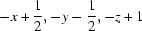 ; (ii)
 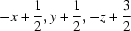 ; (iii)
 Data collection: X-AREA (Stoe & Cie, 2001); cell refinement: X-AREA; data reduction: X-AREA; program(s) used to solve structure: SHELXS97 (Sheldrick, 2008); program(s) used to refine structure: SHELXL97 (Sheldrick, 2008); molecular graphics: XP (Sheldrick, 2008); software used to prepare material for publication: SHELXL97.
Supporting information
contains datablocks I, global. DOI: https://doi.org/10.1107/S1600536810011700/fl2297sup1.cif
Structure factors: contains datablock I. DOI: https://doi.org/10.1107/S1600536810011700/fl2297Isup2.hkl
Isonicotinic acid (15 g, 0.122 mol) was stirred in SOCl2 (40 ml) in the presence of DMF (0.6 ml) at 60°C for 12 h. Excess thionyl chloride was removed in vacuo. Dried 1,3-Propanediol (4.9 ml, 0.061 mol) was added. After the evolution of hydrogen chloride ended, the mixture was heated at 110°C for 2 h. The mixture was then dissolved in water, and NH4OH was added. After filtration, recrystallization in ethyl acetate gave colorless crystals suitable for X-ray analysis. Yield 8.23 g(24%). Analysis calculated for C15H14N2O4:C: 62.9, H: 4.89, N: 9.68; found: C: 62.45, H: 4.85, N: 9.85. IR (KBr, cm-1):(C=O) 1727 s, (C=C) 1596 s, (Ar C—C, C=N) 1408 s, (C—O) 1278 m.
H atoms were placed in idealized positions and treated as riding atoms with C—H distances in the range 0.95-0.99 Å and Uiso(H) = 1.2Ueq(C).
The propanediyl group can adopt four possible conformations: trans-trans (TT), trans-gauche (TG), gauche-gauche (GG), and gauche-gauche' (GG') (Carlucci et al., 2002). The title compound C15H14N2O4, (I) has a gauche-gauche (GG) conformation and is a positional isomer of the previously reported propane-1,3-diyl bis(pyridine-3-carboxylate), (II), (Brito et al., 2010). Similar compounds have also been reported by Chatterjee et al. (2004).
The molecules of the title compound lie on a twofold rotation axis passing through the central carbon atom of the aliphatic chain such that one half of the title compound forms the (Fig. 1). Both compounds shows excellent agreement of their geometric parameters. The most obvious differences between them are in the torsion angles O/C/C/C—O/C/C/C[56.6 (2)° in (I) and 174.0 (3);70.2 (3)° in (II), GG and TG conformation, respectively] and the angle between the planes of aromatics rings [80.3 (10)° (I) and 76.5 (3)° (II)]. The is stabilized by weak C—H··· N and C—H··· O hydrogen bonding (Table 1, Fig. 2). The title compound can be used as a nucleophilic tecton in self-assembly reactions with metal centres of varying lability.
The title compound can be used as a nucleophilic tecton in self-assembly reactions with metal centres of varying lability. For conformation definitions see: Carlucci et al. (2002). For related structures, see: Brito et al. (2010); Chatterjee et al. (2004).
Data collection: X-AREA (Stoe & Cie, 2001); cell X-AREA (Stoe & Cie, 2001); data reduction: X-AREA (Stoe & Cie, 2001); program(s) used to solve structure: SHELXS97 (Sheldrick, 2008); program(s) used to refine structure: SHELXL97 (Sheldrick, 2008); molecular graphics: XP (Sheldrick, 2008); software used to prepare material for publication: SHELXL97 (Sheldrick, 2008).
![[Figure 1]](./fl2297fig1thm.gif) | Fig. 1. Displacement ellipsoid plot at the 50% probability level for the non-H atoms. Symmetry operator for generating equivalent atoms: (A) 1-x, y, -z+3/2. |
![[Figure 2]](./fl2297fig2thm.gif) | Fig. 2. Packing diagram of the title compound with view onto the ab plane. |
![[Figure 3]](./fl2297fig3thm.gif) | Fig. 3. Schematic representations of (I) and (II). |
| C15H14N2O4 | F(000) = 600 |
| Mr = 286.28 | Dx = 1.414 Mg m−3 |
| Monoclinic, C2/c | Mo Kα radiation, λ = 0.71073 Å |
| Hall symbol: -C 2yc | Cell parameters from 2383 reflections |
| a = 23.022 (4) Å | θ = 3.5–25.9° |
| b = 4.9336 (5) Å | µ = 0.10 mm−1 |
| c = 11.9604 (18) Å | T = 173 K |
| β = 98.118 (13)° | Plate, colourless |
| V = 1344.9 (3) Å3 | 0.18 × 0.15 × 0.09 mm |
| Z = 4 |
| Stoe IPDS II two-circle diffractometer | 799 reflections with I > 2σ(I) |
| Radiation source: fine-focus sealed tube | Rint = 0.070 |
| Graphite monochromator | θmax = 25.6°, θmin = 3.4° |
| ω scans | h = −22→28 |
| 4231 measured reflections | k = −5→5 |
| 1251 independent reflections | l = −14→14 |
| Refinement on F2 | Primary atom site location: structure-invariant direct methods |
| Least-squares matrix: full | Secondary atom site location: difference Fourier map |
| R[F2 > 2σ(F2)] = 0.043 | Hydrogen site location: inferred from neighbouring sites |
| wR(F2) = 0.094 | H-atom parameters constrained |
| S = 0.87 | w = 1/[σ2(Fo2) + (0.0427P)2] where P = (Fo2 + 2Fc2)/3 |
| 1251 reflections | (Δ/σ)max < 0.001 |
| 96 parameters | Δρmax = 0.16 e Å−3 |
| 0 restraints | Δρmin = −0.21 e Å−3 |
| C15H14N2O4 | V = 1344.9 (3) Å3 |
| Mr = 286.28 | Z = 4 |
| Monoclinic, C2/c | Mo Kα radiation |
| a = 23.022 (4) Å | µ = 0.10 mm−1 |
| b = 4.9336 (5) Å | T = 173 K |
| c = 11.9604 (18) Å | 0.18 × 0.15 × 0.09 mm |
| β = 98.118 (13)° |
| Stoe IPDS II two-circle diffractometer | 799 reflections with I > 2σ(I) |
| 4231 measured reflections | Rint = 0.070 |
| 1251 independent reflections |
| R[F2 > 2σ(F2)] = 0.043 | 0 restraints |
| wR(F2) = 0.094 | H-atom parameters constrained |
| S = 0.87 | Δρmax = 0.16 e Å−3 |
| 1251 reflections | Δρmin = −0.21 e Å−3 |
| 96 parameters |
Geometry. All esds (except the esd in the dihedral angle between two l.s. planes) are estimated using the full covariance matrix. The cell esds are taken into account individually in the estimation of esds in distances, angles and torsion angles; correlations between esds in cell parameters are only used when they are defined by crystal symmetry. An approximate (isotropic) treatment of cell esds is used for estimating esds involving l.s. planes. |
Refinement. Refinement of F2 against ALL reflections. The weighted R-factor wR and goodness of fit S are based on F2, conventional R-factors R are based on F, with F set to zero for negative F2. The threshold expression of F2 > σ(F2) is used only for calculating R-factors(gt) etc. and is not relevant to the choice of reflections for refinement. R-factors based on F2 are statistically about twice as large as those based on F, and R- factors based on ALL data will be even larger. |
| x | y | z | Uiso*/Ueq | ||
| O1 | 0.43077 (7) | 0.6064 (3) | 0.47123 (12) | 0.0356 (4) | |
| C1 | 0.41465 (9) | 0.5769 (4) | 0.56249 (16) | 0.0270 (5) | |
| O2 | 0.43693 (6) | 0.7138 (3) | 0.65570 (11) | 0.0300 (4) | |
| C3 | 0.48573 (9) | 0.8943 (4) | 0.64276 (16) | 0.0287 (5) | |
| H3A | 0.4748 | 1.0166 | 0.5775 | 0.034* | |
| H3B | 0.5204 | 0.7871 | 0.6291 | 0.034* | |
| C4 | 0.5000 | 1.0584 (6) | 0.7500 | 0.0292 (7) | |
| H4 | 0.4661 | 1.1769 | 0.7579 | 0.035* | |
| C11 | 0.36822 (9) | 0.3801 (4) | 0.58462 (16) | 0.0276 (5) | |
| C12 | 0.34752 (9) | 0.1948 (4) | 0.50109 (17) | 0.0299 (5) | |
| H12 | 0.3621 | 0.1949 | 0.4307 | 0.036* | |
| C13 | 0.30531 (10) | 0.0107 (4) | 0.52223 (17) | 0.0323 (5) | |
| H13 | 0.2921 | −0.1177 | 0.4651 | 0.039* | |
| N14 | 0.28183 (8) | 0.0018 (4) | 0.61815 (14) | 0.0337 (5) | |
| C15 | 0.30185 (10) | 0.1843 (5) | 0.69753 (18) | 0.0360 (5) | |
| H15 | 0.2857 | 0.1832 | 0.7663 | 0.043* | |
| C16 | 0.34464 (10) | 0.3735 (4) | 0.68496 (17) | 0.0326 (5) | |
| H16 | 0.3577 | 0.4971 | 0.7441 | 0.039* |
| U11 | U22 | U33 | U12 | U13 | U23 | |
| O1 | 0.0412 (9) | 0.0404 (9) | 0.0264 (7) | −0.0035 (8) | 0.0090 (6) | −0.0045 (7) |
| C1 | 0.0279 (11) | 0.0268 (11) | 0.0257 (10) | 0.0040 (9) | 0.0018 (8) | −0.0001 (8) |
| O2 | 0.0321 (8) | 0.0326 (8) | 0.0247 (7) | −0.0054 (7) | 0.0021 (6) | −0.0008 (6) |
| C3 | 0.0268 (11) | 0.0321 (11) | 0.0274 (10) | −0.0021 (9) | 0.0045 (8) | 0.0024 (9) |
| C4 | 0.0307 (16) | 0.0280 (16) | 0.0286 (14) | 0.000 | 0.0034 (12) | 0.000 |
| C11 | 0.0281 (11) | 0.0283 (11) | 0.0256 (9) | 0.0053 (9) | 0.0010 (8) | 0.0019 (8) |
| C12 | 0.0352 (12) | 0.0314 (11) | 0.0227 (9) | 0.0009 (10) | 0.0033 (8) | 0.0007 (8) |
| C13 | 0.0338 (12) | 0.0309 (11) | 0.0308 (10) | −0.0012 (10) | −0.0001 (9) | −0.0029 (9) |
| N14 | 0.0343 (11) | 0.0326 (10) | 0.0338 (10) | −0.0010 (9) | 0.0029 (8) | 0.0013 (8) |
| C15 | 0.0396 (13) | 0.0401 (13) | 0.0294 (11) | −0.0008 (11) | 0.0085 (9) | −0.0004 (10) |
| C16 | 0.0364 (13) | 0.0333 (12) | 0.0280 (10) | −0.0018 (10) | 0.0042 (9) | −0.0050 (9) |
| O1—C1 | 1.210 (2) | C11—C12 | 1.388 (3) |
| C1—O2 | 1.342 (2) | C12—C13 | 1.379 (3) |
| C1—C11 | 1.495 (3) | C12—H12 | 0.9500 |
| O2—C3 | 1.459 (2) | C13—N14 | 1.336 (3) |
| C3—C4 | 1.513 (2) | C13—H13 | 0.9500 |
| C3—H3A | 0.9900 | N14—C15 | 1.342 (3) |
| C3—H3B | 0.9900 | C15—C16 | 1.381 (3) |
| C4—C3i | 1.513 (2) | C15—H15 | 0.9500 |
| C4—H4 | 0.9900 | C16—H16 | 0.9500 |
| C11—C16 | 1.386 (3) | ||
| O1—C1—O2 | 124.0 (2) | C12—C11—C1 | 118.80 (18) |
| O1—C1—C11 | 123.76 (18) | C13—C12—C11 | 118.75 (19) |
| O2—C1—C11 | 112.26 (17) | C13—C12—H12 | 120.6 |
| C1—O2—C3 | 115.39 (15) | C11—C12—H12 | 120.6 |
| O2—C3—C4 | 108.35 (15) | N14—C13—C12 | 124.04 (19) |
| O2—C3—H3A | 110.0 | N14—C13—H13 | 118.0 |
| C4—C3—H3A | 110.0 | C12—C13—H13 | 118.0 |
| O2—C3—H3B | 110.0 | C13—N14—C15 | 116.44 (19) |
| C4—C3—H3B | 110.0 | N14—C15—C16 | 123.7 (2) |
| H3A—C3—H3B | 108.4 | N14—C15—H15 | 118.1 |
| C3i—C4—C3 | 115.3 (2) | C16—C15—H15 | 118.1 |
| C3i—C4—H4 | 108.3 | C15—C16—C11 | 118.88 (19) |
| C3—C4—H4 | 108.5 | C15—C16—H16 | 120.6 |
| C16—C11—C12 | 118.1 (2) | C11—C16—H16 | 120.6 |
| C16—C11—C1 | 123.08 (18) | ||
| O1—C1—O2—C3 | −3.7 (3) | C16—C11—C12—C13 | −1.0 (3) |
| C11—C1—O2—C3 | 175.34 (17) | C1—C11—C12—C13 | 179.05 (19) |
| C1—O2—C3—C4 | 172.61 (16) | C11—C12—C13—N14 | 1.4 (3) |
| O2—C3—C4—C3i | 56.56 (11) | C12—C13—N14—C15 | −0.7 (3) |
| O1—C1—C11—C16 | −171.1 (2) | C13—N14—C15—C16 | −0.5 (3) |
| O2—C1—C11—C16 | 9.9 (3) | N14—C15—C16—C11 | 0.8 (3) |
| O1—C1—C11—C12 | 8.9 (3) | C12—C11—C16—C15 | 0.0 (3) |
| O2—C1—C11—C12 | −170.21 (18) | C1—C11—C16—C15 | 179.9 (2) |
| Symmetry code: (i) −x+1, y, −z+3/2. |
| D—H···A | D—H | H···A | D···A | D—H···A |
| C13—H13···N14ii | 0.95 | 2.65 | 3.505 (3) | 151 |
| C15—H15···N14iii | 0.95 | 2.72 | 3.496 (3) | 139 |
| C3—H3A···O1iv | 0.99 | 2.98 | 3.516 (3) | 115 |
| C3—H3B···O1v | 0.99 | 2.62 | 3.521 (3) | 152 |
| Symmetry codes: (ii) −x+1/2, −y−1/2, −z+1; (iii) −x+1/2, y+1/2, −z+3/2; (iv) −x+1, −y+2, −z+1; (v) −x+1, −y+1, −z+1. |
Experimental details
| Crystal data | |
| Chemical formula | C15H14N2O4 |
| Mr | 286.28 |
| Crystal system, space group | Monoclinic, C2/c |
| Temperature (K) | 173 |
| a, b, c (Å) | 23.022 (4), 4.9336 (5), 11.9604 (18) |
| β (°) | 98.118 (13) |
| V (Å3) | 1344.9 (3) |
| Z | 4 |
| Radiation type | Mo Kα |
| µ (mm−1) | 0.10 |
| Crystal size (mm) | 0.18 × 0.15 × 0.09 |
| Data collection | |
| Diffractometer | Stoe IPDS II two-circle |
| Absorption correction | – |
| No. of measured, independent and observed [I > 2σ(I)] reflections | 4231, 1251, 799 |
| Rint | 0.070 |
| (sin θ/λ)max (Å−1) | 0.608 |
| Refinement | |
| R[F2 > 2σ(F2)], wR(F2), S | 0.043, 0.094, 0.87 |
| No. of reflections | 1251 |
| No. of parameters | 96 |
| H-atom treatment | H-atom parameters constrained |
| Δρmax, Δρmin (e Å−3) | 0.16, −0.21 |
Computer programs: X-AREA (Stoe & Cie, 2001), SHELXS97 (Sheldrick, 2008), SHELXL97 (Sheldrick, 2008), XP (Sheldrick, 2008).
| D—H···A | D—H | H···A | D···A | D—H···A |
| C13—H13···N14i | 0.95 | 2.65 | 3.505 (3) | 150.6 |
| C15—H15···N14ii | 0.95 | 2.72 | 3.496 (3) | 139.3 |
| C3—H3A···O1iii | 0.99 | 2.98 | 3.516 (3) | 115.1 |
| C3—H3B···O1iv | 0.99 | 2.62 | 3.521 (3) | 151.7 |
| Symmetry codes: (i) −x+1/2, −y−1/2, −z+1; (ii) −x+1/2, y+1/2, −z+3/2; (iii) −x+1, −y+2, −z+1; (iv) −x+1, −y+1, −z+1. |
Acknowledgements
We thank the Spanish Research Council (CSIC) for providing us with a free-of-charge licence for the CSD system. JV thanks the Universidad de Antofagasta for PhD fellowships.
References
 Brito, I., Vallejos, J., Bolte, M. & López-Rodríguez, M. (2010). Acta Cryst. E66, o792. Web of Science CrossRef IUCr Journals Google Scholar
Carlucci, L., Ciani, G., Proserpio, D. M. & Rizzato, S. (2002). CrystEngComm, 22, 121–129. CSD CrossRef Google Scholar
Chatterjee, B., Noveron, J. C., Resendiz, M., Liu, J., Yamamoto, T., Parker, D., Cinke, M., Nguyen, C., Arif, A. & Stang, P. (2004). J. Am. Chem. Soc. 126, 10645–10656. Web of Science CrossRef PubMed CAS Google Scholar
Sheldrick, G. M. (2008). Acta Cryst. A64, 112–122. Web of Science CrossRef CAS IUCr Journals Google Scholar
Stoe & Cie (2001). X-AREA. Stoe & Cie, Darmstadt, Germany. Google Scholar
This is an open-access article distributed under the terms of the Creative Commons Attribution (CC-BY) Licence, which permits unrestricted use, distribution, and reproduction in any medium, provided the original authors and source are cited.
| CRYSTALLOGRAPHIC COMMUNICATIONS |


The propanediyl group can adopt four possible conformations: trans-trans (TT), trans-gauche (TG), gauche-gauche (GG), and gauche-gauche' (GG') (Carlucci et al., 2002). The title compound C15H14N2O4, (I) has a gauche-gauche (GG) conformation and is a positional isomer of the previously reported propane-1,3-diyl bis(pyridine-3-carboxylate), (II), (Brito et al., 2010). Similar compounds have also been reported by Chatterjee et al. (2004).
The molecules of the title compound lie on a twofold rotation axis passing through the central carbon atom of the aliphatic chain such that one half of the title compound forms the asymmetric unit (Fig. 1). Both compounds shows excellent agreement of their geometric parameters. The most obvious differences between them are in the torsion angles O/C/C/C—O/C/C/C[56.6 (2)° in (I) and 174.0 (3);70.2 (3)° in (II), GG and TG conformation, respectively] and the angle between the planes of aromatics rings [80.3 (10)° (I) and 76.5 (3)° (II)]. The crystal structure is stabilized by weak C—H··· N and C—H··· O hydrogen bonding (Table 1, Fig. 2). The title compound can be used as a nucleophilic tecton in self-assembly reactions with metal centres of varying lability.