 | Acta Crystallographica Section E Acta Crystallographica Section E CRYSTALLOGRAPHIC COMMUNICATIONS |


 journal menu


organic compounds
| CRYSTALLOGRAPHIC COMMUNICATIONS |
 access
2-Amino-5-bromopyridinium 2-hydroxybenzoate

aX-ray Crystallography Unit, School of Physics, Universiti Sains Malaysia, 11800 USM, Penang, Malaysia
*Correspondence e-mail: [email protected]
In the title compound, C5H6BrN2+·C7H5O3−, the 2-amino-5-bromopyridinium cation and 2-hydroxybenzoate anion are essentially planar with maximum deviations of 0.020 (1) and 0.018 (2) Å, respectively. The anion is stabilized by an intramolecular O—H⋯O hydrogen bond, which generates an S(6) ring motif. In the crystal, the cations and anions are linked by N—H⋯O hydrogen bonds into chains propagating along [010]. The chains contain R22(8) ring motifs. The structure is further stabilized by π–π stacking interactions [centroid–centroid distances = 3.4908 (10) and 3.5927 (10) Å] and also features short Br⋯O contacts [2.9671 (13) Å].
Related literature
For details of non-covalent interactions, see: Remenar et al. (2003![[Remenar, J. F., Morissette, S. L., Peterson, M. L., Moulton, B., MacPhee, J. M., Guzmaàn, H. R. & Almarsson, Ö. (2003). J. Am. Chem. Soc. 125, 8456-8457.]](../../../../../../logos/arrows/e_arr.gif "Remenar, J. F., Morissette, S. L., Peterson, M. L., Moulton, B., MacPhee, J. M., Guzmaàn, H. R. & Almarsson, Ö. (2003). J. Am. Chem. Soc. 125, 8456-8457.") ); Sokolov et al. (2006). For the importance of salicylic acid, see: Sticher et al. (1997); Rairdan & Delaney (2002); Nawrath & Métraux (1999); Wildermuth et al. (2001). For related structures, see: Quah et al. (2008, 2010a,b). For the stability of the temperature controller used in the data collection, see: Cosier & Glazer (1986). For bond-length data, see: Allen et al. (1987). For hydrogen-bond motifs, see: Bernstein et al. (1995).
); Sokolov et al. (2006). For the importance of salicylic acid, see: Sticher et al. (1997); Rairdan & Delaney (2002); Nawrath & Métraux (1999); Wildermuth et al. (2001). For related structures, see: Quah et al. (2008, 2010a,b). For the stability of the temperature controller used in the data collection, see: Cosier & Glazer (1986). For bond-length data, see: Allen et al. (1987). For hydrogen-bond motifs, see: Bernstein et al. (1995).
![[Scheme 1]](ci5140scheme1.gif)
Experimental
Crystal data
|
Refinement
|
|
 .
. Data collection: APEX2 (Bruker, 2009); cell refinement: SAINT (Bruker, 2009); data reduction: SAINT; program(s) used to solve structure: SHELXTL (Sheldrick, 2008); program(s) used to refine structure: SHELXTL; molecular graphics: SHELXTL; software used to prepare material for publication: SHELXTL and PLATON (Spek, 2009).
Supporting information
contains datablocks global, I. DOI: https://doi.org/10.1107/S1600536810029855/ci5140sup1.cif
Structure factors: contains datablock I. DOI: https://doi.org/10.1107/S1600536810029855/ci5140Isup2.hkl
A hot methanol solution (20 ml) of 2-amino-5-bromopyridine (43 mg, Aldrich) and salicylic acid (34.5 mg, Merck) was mixed and warmed over a magnetic stirrer hotplate for a few minutes. The resulting solution was allowed to cool slowly at room temperature and crystals of the title compound appeared after a few days.
O- and N-bound H atoms were located in a difference Fourier map and allowed to refine freely [O1–H1O1 = 0.89 (3) Å and N–H = 0.82 (2)–0.96 (2) Å]. The remaining H atoms were positioned geometrically and refined using a riding model with C-H = 0.93 Å and Uiso(H) = 1.2 Ueq(C).
Recently, much attention has been devoted to the design and synthesis of supramolecular architectures assembled via various weak noncovalent interactions, such as hydrogen bonds, π···π stacking and C—H···π interactions (Remenar et al., 2003; Sokolov et al., 2006). Salicylic acid (SA) plays a central role in resistance and defense induction in responses from pathogen attacks and also its role in the activation of the hypersensitive response (HR), a form of programmed cell death associated with resistance of plants. Mutants or transgenic plants impaired in the accumulation of SA cannot mount efficient defense responses to pathogens after infection (Sticher et al., 1997). SA depletion by transgenic expression of a bacterial SA hydroxylase encoded by NahG abolishes local and systemic resistance responses to various pathogens (Rairdan & Delaney, 2002). This has been confirmed by the use of Arabidopsis mutants impaired in SA accumulation after pathogen infection (sid1/eds5, sid2), showing higher susceptibility to fungal and bacterial pathogens (Nawrath & Métraux 1999; Wildermuth et al., 2001). The present study is aimed at understanding the hydrogen-bonding networks in the title compound, (I).
The of title compound (Fig. 1), contains a 2-amino-5-bromopyridinium cation and a 2-hydroxybenzoate anion. In the 2-amino-5-bromopyridinium cation, a wide angle [122.29 (15)°] is subtended at the protonated N1 atom. The 2-amino-5-bromopyridinium cation and 2-hydroxybenzoate anion are essentially planar, with maximum a deviation of 0.020 (1) Å for atom Br1 and 0.018 (2) Å for atom C11, respectively. The anion is stabilized by an intramolecular O1—H1O1···O2 hydrogen bond which generates an S(6) ring motif (Bernstein et al., 1995).
In the crystal packing (Fig. 2), the protonated N1 atom and the 2-amino group (N2) are hydrogen-bonded to the carboxylate oxygen atoms (O3 and O2) via intermolecular N1—H1N···O3 and N2—H1N2..O2 hydrogen bonds forming R22(8) ring motifs. The cation-anion pairs are linked by N2—H2N2···O1 hydrogen bonds into chains propagating along [010]. The is further consolidated by π-π interactions between the pyridinium rings at (x,y,z) and (1-x, 1-y, 2-z) [centroid-centroid distance = 3.4908 (10) Å], and that between benzene and pyridinium rings at (x,y,z) and (2-x, 1-y, 2-z), respectively [centroid-centroid distance = 3.5927 (10) Å]. There is a Br1···O3(1-x, 1/2+y, 3/2-z) contact [2.9671 (13) Å] which is shorter than the sum of van der Waals radii of the oxygen and bromine atoms.
For details of non-covalent interactions, see: Remenar et al. (2003); Sokolov et al. (2006). For the importance of salicylic acid, see: Sticher et al. (1997); Rairdan & Delaney (2002); Nawrath & Métraux (1999); Wildermuth et al. (2001). For related structures, see: Quah et al. (2008, 2010a,b). For the stability of the temperature controller used in the data collection, see: Cosier & Glazer (1986). For bond-length data, see: Allen et al. (1987). For hydrogen-bond motifs, see: Bernstein et al. (1995).
Data collection: APEX2 (Bruker, 2009); cell SAINT (Bruker, 2009); data reduction: SAINT (Bruker, 2009); program(s) used to solve structure: SHELXTL (Sheldrick, 2008); program(s) used to refine structure: SHELXTL (Sheldrick, 2008); molecular graphics: SHELXTL (Sheldrick, 2008); software used to prepare material for publication: SHELXTL (Sheldrick, 2008) and PLATON (Spek, 2009).
![[Figure 1]](./ci5140fig1thm.gif) | Fig. 1. The two ionic units of the title compound, showing 50% probability displacement ellipsoids for non-H atoms and the atom-numbering scheme. Dashed lines indicate hydrogen bonds. |
![[Figure 2]](./ci5140fig2thm.gif) | Fig. 2. The crystal structure of the title compound, viewed along the a axis. H atoms not involved in hydrogen bonds (dashed lines) have been omitted for clarity. |
| C5H6BrN2+·C7H5O3− | F(000) = 624 |
| Mr = 311.14 | Dx = 1.709 Mg m−3 |
| Monoclinic, P21/c | Mo Kα radiation, λ = 0.71073 Å |
| Hall symbol: -P 2ybc | Cell parameters from 6239 reflections |
| a = 8.9498 (2) Å | θ = 2.4–30.1° |
| b = 10.8673 (2) Å | µ = 3.40 mm−1 |
| c = 13.1277 (3) Å | T = 100 K |
| β = 108.704 (1)° | Block, yellow |
| V = 1209.37 (4) Å3 | 0.48 × 0.27 × 0.19 mm |
| Z = 4 |
| Bruker SMART APEXII CCD area-detector diffractometer | 3559 independent reflections |
| Radiation source: fine-focus sealed tube | 2942 reflections with I > 2σ(I) |
| Graphite monochromator | Rint = 0.023 |
| φ and ω scans | θmax = 30.1°, θmin = 2.4° |
| Absorption correction: multi-scan (SADABS; Bruker, 2009) | h = −11→12 |
| Tmin = 0.291, Tmax = 0.572 | k = −12→15 |
| 13299 measured reflections | l = −17→18 |
| Refinement on F2 | Primary atom site location: structure-invariant direct methods |
| Least-squares matrix: full | Secondary atom site location: difference Fourier map |
| R[F2 > 2σ(F2)] = 0.025 | Hydrogen site location: inferred from neighbouring sites |
| wR(F2) = 0.070 | H atoms treated by a mixture of independent and constrained refinement |
| S = 1.12 | w = 1/[σ2(Fo2) + (0.0315P)2 + 0.5751P] where P = (Fo2 + 2Fc2)/3 |
| 3559 reflections | (Δ/σ)max = 0.001 |
| 179 parameters | Δρmax = 0.62 e Å−3 |
| 0 restraints | Δρmin = −0.48 e Å−3 |
| C5H6BrN2+·C7H5O3− | V = 1209.37 (4) Å3 |
| Mr = 311.14 | Z = 4 |
| Monoclinic, P21/c | Mo Kα radiation |
| a = 8.9498 (2) Å | µ = 3.40 mm−1 |
| b = 10.8673 (2) Å | T = 100 K |
| c = 13.1277 (3) Å | 0.48 × 0.27 × 0.19 mm |
| β = 108.704 (1)° |
| Bruker SMART APEXII CCD area-detector diffractometer | 3559 independent reflections |
| Absorption correction: multi-scan (SADABS; Bruker, 2009) | 2942 reflections with I > 2σ(I) |
| Tmin = 0.291, Tmax = 0.572 | Rint = 0.023 |
| 13299 measured reflections |
| R[F2 > 2σ(F2)] = 0.025 | 0 restraints |
| wR(F2) = 0.070 | H atoms treated by a mixture of independent and constrained refinement |
| S = 1.12 | Δρmax = 0.62 e Å−3 |
| 3559 reflections | Δρmin = −0.48 e Å−3 |
| 179 parameters |
Experimental. The crystal was placed in the cold stream of an Oxford Cyrosystems Cobra open-flow nitrogen cryostat (Cosier & Glazer, 1986) operating at 100.0 (1) K. |
Geometry. All e.s.d.'s (except the e.s.d. in the dihedral angle between two l.s. planes) are estimated using the full covariance matrix. The cell e.s.d.'s are taken into account individually in the estimation of e.s.d.'s in distances, angles and torsion angles; correlations between e.s.d.'s in cell parameters are only used when they are defined by crystal symmetry. An approximate (isotropic) treatment of cell e.s.d.'s is used for estimating e.s.d.'s involving l.s. planes. |
Refinement. Refinement of F2 against ALL reflections. The weighted R-factor wR and goodness of fit S are based on F2, conventional R-factors R are based on F, with F set to zero for negative F2. The threshold expression of F2 > σ(F2) is used only for calculating R-factors(gt) etc. and is not relevant to the choice of reflections for refinement. R-factors based on F2 are statistically about twice as large as those based on F, and R- factors based on ALL data will be even larger. |
| x | y | z | Uiso*/Ueq | ||
| O3 | 0.88434 (14) | 0.35437 (12) | 0.92381 (10) | 0.0225 (3) | |
| O2 | 0.98836 (15) | 0.30956 (12) | 1.09830 (10) | 0.0237 (3) | |
| O1 | 1.18787 (16) | 0.14189 (12) | 1.16207 (10) | 0.0235 (3) | |
| C11 | 1.07156 (18) | 0.19199 (15) | 0.97440 (13) | 0.0161 (3) | |
| C6 | 1.1749 (2) | 0.12215 (15) | 1.05740 (13) | 0.0189 (3) | |
| C10 | 1.06367 (18) | 0.16877 (16) | 0.86826 (13) | 0.0181 (3) | |
| H10 | 0.9957 | 0.2149 | 0.8130 | 0.022* | |
| C9 | 1.1556 (2) | 0.07793 (17) | 0.84408 (14) | 0.0215 (3) | |
| H9 | 1.1489 | 0.0625 | 0.7731 | 0.026* | |
| C12 | 0.97397 (19) | 0.29196 (16) | 0.99973 (13) | 0.0178 (3) | |
| C8 | 1.2582 (2) | 0.00999 (18) | 0.92745 (15) | 0.0257 (4) | |
| H8 | 1.3207 | −0.0507 | 0.9117 | 0.031* | |
| C7 | 1.2685 (2) | 0.03150 (17) | 1.03343 (14) | 0.0244 (4) | |
| H7 | 1.3377 | −0.0143 | 1.0884 | 0.029* | |
| H1O1 | 1.121 (3) | 0.204 (3) | 1.158 (2) | 0.049 (8)* | |
| Br1 | 0.370641 (18) | 0.746039 (15) | 0.758163 (13) | 0.01948 (6) | |
| C5 | 0.71709 (18) | 0.56266 (15) | 1.06422 (13) | 0.0164 (3) | |
| C1 | 0.61778 (19) | 0.58819 (16) | 0.87434 (13) | 0.0178 (3) | |
| H1 | 0.6220 | 0.5662 | 0.8069 | 0.021* | |
| N2 | 0.81671 (17) | 0.50520 (14) | 1.14774 (12) | 0.0196 (3) | |
| N1 | 0.71750 (16) | 0.53391 (13) | 0.96389 (11) | 0.0169 (3) | |
| C3 | 0.5063 (2) | 0.70608 (16) | 0.98575 (14) | 0.0191 (3) | |
| H3 | 0.4333 | 0.7637 | 0.9926 | 0.023* | |
| C2 | 0.51201 (18) | 0.67430 (15) | 0.88258 (13) | 0.0174 (3) | |
| C4 | 0.60740 (19) | 0.65257 (16) | 1.07473 (13) | 0.0192 (3) | |
| H4 | 0.6050 | 0.6747 | 1.1426 | 0.023* | |
| H1N | 0.784 (3) | 0.468 (2) | 0.9560 (19) | 0.038 (7)* | |
| H1N2 | 0.878 (3) | 0.452 (2) | 1.1347 (17) | 0.027 (6)* | |
| H2N2 | 0.820 (2) | 0.5260 (19) | 1.2082 (18) | 0.021 (5)* |
| U11 | U22 | U33 | U12 | U13 | U23 | |
| O3 | 0.0232 (6) | 0.0249 (6) | 0.0173 (6) | 0.0073 (5) | 0.0036 (5) | −0.0019 (5) |
| O2 | 0.0309 (6) | 0.0257 (7) | 0.0153 (6) | 0.0064 (5) | 0.0085 (5) | −0.0012 (5) |
| O1 | 0.0318 (7) | 0.0240 (7) | 0.0143 (6) | 0.0055 (5) | 0.0070 (5) | 0.0035 (5) |
| C11 | 0.0163 (7) | 0.0153 (8) | 0.0166 (7) | −0.0016 (6) | 0.0053 (6) | −0.0021 (6) |
| C6 | 0.0236 (8) | 0.0165 (8) | 0.0166 (8) | −0.0021 (6) | 0.0063 (6) | 0.0006 (6) |
| C10 | 0.0181 (7) | 0.0187 (8) | 0.0158 (7) | 0.0003 (6) | 0.0031 (6) | −0.0003 (6) |
| C9 | 0.0247 (8) | 0.0235 (9) | 0.0165 (8) | 0.0025 (7) | 0.0067 (6) | −0.0026 (7) |
| C12 | 0.0173 (7) | 0.0184 (7) | 0.0175 (8) | −0.0007 (6) | 0.0052 (6) | −0.0021 (6) |
| C8 | 0.0322 (9) | 0.0220 (9) | 0.0237 (9) | 0.0087 (7) | 0.0100 (8) | −0.0008 (7) |
| C7 | 0.0307 (9) | 0.0210 (9) | 0.0196 (8) | 0.0077 (7) | 0.0054 (7) | 0.0048 (7) |
| Br1 | 0.02043 (9) | 0.01984 (10) | 0.01686 (9) | 0.00136 (6) | 0.00414 (6) | 0.00213 (6) |
| C5 | 0.0174 (7) | 0.0165 (7) | 0.0153 (7) | −0.0037 (6) | 0.0051 (6) | −0.0022 (6) |
| C1 | 0.0194 (7) | 0.0205 (8) | 0.0140 (7) | −0.0023 (6) | 0.0059 (6) | −0.0012 (6) |
| N2 | 0.0209 (7) | 0.0213 (7) | 0.0158 (7) | 0.0039 (6) | 0.0048 (6) | −0.0009 (6) |
| N1 | 0.0184 (6) | 0.0178 (7) | 0.0145 (6) | 0.0003 (5) | 0.0054 (5) | −0.0016 (5) |
| C3 | 0.0203 (7) | 0.0183 (8) | 0.0207 (8) | 0.0018 (6) | 0.0094 (6) | −0.0004 (7) |
| C2 | 0.0172 (7) | 0.0175 (8) | 0.0161 (7) | −0.0002 (6) | 0.0035 (6) | 0.0010 (6) |
| C4 | 0.0216 (7) | 0.0193 (8) | 0.0175 (8) | −0.0004 (6) | 0.0073 (6) | −0.0029 (6) |
| O3—C12 | 1.259 (2) | Br1—C2 | 1.8844 (16) |
| O2—C12 | 1.273 (2) | C5—N2 | 1.327 (2) |
| O1—C6 | 1.358 (2) | C5—N1 | 1.355 (2) |
| O1—H1O1 | 0.89 (3) | C5—C4 | 1.423 (2) |
| C11—C10 | 1.395 (2) | C1—C2 | 1.360 (2) |
| C11—C6 | 1.404 (2) | C1—N1 | 1.361 (2) |
| C11—C12 | 1.497 (2) | C1—H1 | 0.93 |
| C6—C7 | 1.393 (2) | N2—H1N2 | 0.86 (2) |
| C10—C9 | 1.386 (2) | N2—H2N2 | 0.82 (2) |
| C10—H10 | 0.93 | N1—H1N | 0.96 (2) |
| C9—C8 | 1.393 (2) | C3—C4 | 1.358 (2) |
| C9—H9 | 0.93 | C3—C2 | 1.414 (2) |
| C8—C7 | 1.384 (3) | C3—H3 | 0.93 |
| C8—H8 | 0.93 | C4—H4 | 0.93 |
| C7—H7 | 0.93 | ||
| C6—O1—H1O1 | 102.4 (18) | N2—C5—N1 | 118.96 (15) |
| C10—C11—C6 | 119.14 (15) | N2—C5—C4 | 123.01 (15) |
| C10—C11—C12 | 120.45 (15) | N1—C5—C4 | 118.02 (15) |
| C6—C11—C12 | 120.40 (15) | C2—C1—N1 | 120.65 (15) |
| O1—C6—C7 | 118.53 (15) | C2—C1—H1 | 119.7 |
| O1—C6—C11 | 121.39 (15) | N1—C1—H1 | 119.7 |
| C7—C6—C11 | 120.07 (15) | C5—N2—H1N2 | 117.4 (14) |
| C9—C10—C11 | 120.93 (15) | C5—N2—H2N2 | 118.5 (15) |
| C9—C10—H10 | 119.5 | H1N2—N2—H2N2 | 124 (2) |
| C11—C10—H10 | 119.5 | C5—N1—C1 | 122.29 (15) |
| C10—C9—C8 | 119.19 (16) | C5—N1—H1N | 118.3 (14) |
| C10—C9—H9 | 120.4 | C1—N1—H1N | 119.2 (14) |
| C8—C9—H9 | 120.4 | C4—C3—C2 | 120.04 (15) |
| O3—C12—O2 | 123.71 (16) | C4—C3—H3 | 120.0 |
| O3—C12—C11 | 118.98 (15) | C2—C3—H3 | 120.0 |
| O2—C12—C11 | 117.31 (15) | C1—C2—C3 | 118.94 (15) |
| C7—C8—C9 | 120.98 (17) | C1—C2—Br1 | 120.45 (12) |
| C7—C8—H8 | 119.5 | C3—C2—Br1 | 120.58 (12) |
| C9—C8—H8 | 119.5 | C3—C4—C5 | 120.05 (15) |
| C8—C7—C6 | 119.69 (16) | C3—C4—H4 | 120.0 |
| C8—C7—H7 | 120.2 | C5—C4—H4 | 120.0 |
| C6—C7—H7 | 120.2 | ||
| C10—C11—C6—O1 | 179.45 (15) | O1—C6—C7—C8 | −179.66 (17) |
| C12—C11—C6—O1 | 0.9 (2) | C11—C6—C7—C8 | −0.5 (3) |
| C10—C11—C6—C7 | 0.3 (2) | N2—C5—N1—C1 | 179.40 (15) |
| C12—C11—C6—C7 | −178.24 (16) | C4—C5—N1—C1 | 0.2 (2) |
| C6—C11—C10—C9 | 0.2 (2) | C2—C1—N1—C5 | −0.3 (2) |
| C12—C11—C10—C9 | 178.82 (16) | N1—C1—C2—C3 | −0.5 (2) |
| C11—C10—C9—C8 | −0.6 (3) | N1—C1—C2—Br1 | −178.37 (12) |
| C10—C11—C12—O3 | 0.3 (2) | C4—C3—C2—C1 | 1.2 (3) |
| C6—C11—C12—O3 | 178.84 (15) | C4—C3—C2—Br1 | 179.13 (13) |
| C10—C11—C12—O2 | −179.02 (15) | C2—C3—C4—C5 | −1.3 (3) |
| C6—C11—C12—O2 | −0.4 (2) | N2—C5—C4—C3 | −178.60 (16) |
| C10—C9—C8—C7 | 0.4 (3) | N1—C5—C4—C3 | 0.5 (2) |
| C9—C8—C7—C6 | 0.1 (3) |
| D—H···A | D—H | H···A | D···A | D—H···A |
| O1—H1O1···O2 | 0.89 (3) | 1.66 (3) | 2.500 (2) | 157 (2) |
| N1—H1N···O3 | 0.96 (2) | 1.66 (2) | 2.611 (2) | 172 (2) |
| N2—H1N2···O2 | 0.85 (3) | 1.98 (2) | 2.818 (2) | 170 (2) |
| N2—H2N2···O1i | 0.82 (2) | 2.14 (2) | 2.917 (2) | 160 (2) |
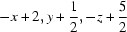
| Symmetry code: (i) −x+2, y+1/2, −z+5/2. |
Experimental details
| Crystal data | |
| Chemical formula | C5H6BrN2+·C7H5O3− |
| Mr | 311.14 |
| Crystal system, space group | Monoclinic, P21/c |
| Temperature (K) | 100 |
| a, b, c (Å) | 8.9498 (2), 10.8673 (2), 13.1277 (3) |
| β (°) | 108.704 (1) |
| V (Å3) | 1209.37 (4) |
| Z | 4 |
| Radiation type | Mo Kα |
| µ (mm−1) | 3.40 |
| Crystal size (mm) | 0.48 × 0.27 × 0.19 |
| Data collection | |
| Diffractometer | Bruker SMART APEXII CCD area-detector diffractometer |
| Absorption correction | Multi-scan (SADABS; Bruker, 2009) |
| Tmin, Tmax | 0.291, 0.572 |
| No. of measured, independent and observed [I > 2σ(I)] reflections | 13299, 3559, 2942 |
| Rint | 0.023 |
| (sin θ/λ)max (Å−1) | 0.706 |
| Refinement | |
| R[F2 > 2σ(F2)], wR(F2), S | 0.025, 0.070, 1.12 |
| No. of reflections | 3559 |
| No. of parameters | 179 |
| H-atom treatment | H atoms treated by a mixture of independent and constrained refinement |
| Δρmax, Δρmin (e Å−3) | 0.62, −0.48 |
Computer programs: APEX2 (Bruker, 2009), SAINT (Bruker, 2009), SHELXTL (Sheldrick, 2008) and PLATON (Spek, 2009).
| D—H···A | D—H | H···A | D···A | D—H···A |
| O1—H1O1···O2 | 0.89 (3) | 1.66 (3) | 2.500 (2) | 157 (2) |
| N1—H1N···O3 | 0.96 (2) | 1.66 (2) | 2.611 (2) | 172 (2) |
| N2—H1N2···O2 | 0.85 (3) | 1.98 (2) | 2.818 (2) | 170 (2) |
| N2—H2N2···O1i | 0.82 (2) | 2.14 (2) | 2.917 (2) | 160 (2) |
| Symmetry code: (i) −x+2, y+1/2, −z+5/2. |
Acknowledgements
The authors thank Universiti Sains Malaysia (USM) for the Research University Golden Goose Grant (1001/PFIZIK/811012). CKQ also thanks USM for the award of a USM fellowship and HM also thanks USM for the award of postdoctoral fellowship.
References
 Allen, F. H., Kennard, O., Watson, D. G., Brammer, L., Orpen, A. G. & Taylor, R. (1987). J. Chem. Soc. Perkin Trans. 2, pp. S1–19. CSD CrossRef Web of Science Google Scholar
Bernstein, J., Davis, R. E., Shimoni, L. & Chang, N.-L. (1995). Angew. Chem. Int. Ed. Engl. 34, 1555–1573. CrossRef CAS Web of Science Google Scholar
Bruker (2009). APEX2, SAINT and SADABS. Bruker AXS Inc., Madison, Wisconsin, USA. Google Scholar
Cosier, J. & Glazer, A. M. (1986). J. Appl. Cryst. 19, 105–107. CrossRef CAS Web of Science IUCr Journals Google Scholar
Nawrath, C. & Métraux, J.-P. (1999). Plant Cell, 11, 1393–1404. CrossRef PubMed CAS Google Scholar
Quah, C. K., Hemamalini, M. & Fun, H.-K. (2010a). Acta Cryst. E66, o1932. Web of Science CSD CrossRef IUCr Journals Google Scholar
Quah, C. K., Hemamalini, M. & Fun, H.-K. (2010b). Acta Cryst. E66, o1935–o1936. Web of Science CSD CrossRef IUCr Journals Google Scholar
Quah, C. K., Jebas, S. R. & Fun, H.-K. (2008). Acta Cryst. E64, o1878–o1879. Web of Science CSD CrossRef CAS IUCr Journals Google Scholar
Rairdan, G. J. & Delaney, T. P. (2002). Genetics, 161, 803–811. Web of Science PubMed CAS Google Scholar
Remenar, J. F., Morissette, S. L., Peterson, M. L., Moulton, B., MacPhee, J. M., Guzmaàn, H. R. & Almarsson, Ö. (2003). J. Am. Chem. Soc. 125, 8456–8457. Web of Science CSD CrossRef PubMed CAS Google Scholar
Sheldrick, G. M. (2008). Acta Cryst. A64, 112–122. Web of Science CrossRef CAS IUCr Journals Google Scholar
Sokolov, A. N., Friŝĉić, T. & MacGillivray, L. R. (2006). J. Am. Chem. Soc. 128, 2806–2807. Web of Science CSD CrossRef PubMed CAS Google Scholar
Spek, A. L. (2009). Acta Cryst. D65, 148–155. Web of Science CrossRef CAS IUCr Journals Google Scholar
Sticher, L., Mauch-Mani, B. & Métraux, J.-P. (1997). Annu. Rev. Phytopathol. 35, 235–270. CrossRef PubMed CAS Web of Science Google Scholar
Wildermuth, M. C., Dewdney, J., Wu, G. & Ausubel, F. M. (2001). Nature (London), 414, 562–565. Web of Science CrossRef PubMed CAS Google Scholar
This is an open-access article distributed under the terms of the Creative Commons Attribution (CC-BY) Licence, which permits unrestricted use, distribution, and reproduction in any medium, provided the original authors and source are cited.
| CRYSTALLOGRAPHIC COMMUNICATIONS |
access


Recently, much attention has been devoted to the design and synthesis of supramolecular architectures assembled via various weak noncovalent interactions, such as hydrogen bonds, π···π stacking and C—H···π interactions (Remenar et al., 2003; Sokolov et al., 2006). Salicylic acid (SA) plays a central role in resistance and defense induction in responses from pathogen attacks and also its role in the activation of the hypersensitive response (HR), a form of programmed cell death associated with resistance of plants. Mutants or transgenic plants impaired in the accumulation of SA cannot mount efficient defense responses to pathogens after infection (Sticher et al., 1997). SA depletion by transgenic expression of a bacterial SA hydroxylase encoded by NahG abolishes local and systemic resistance responses to various pathogens (Rairdan & Delaney, 2002). This has been confirmed by the use of Arabidopsis mutants impaired in SA accumulation after pathogen infection (sid1/eds5, sid2), showing higher susceptibility to fungal and bacterial pathogens (Nawrath & Métraux 1999; Wildermuth et al., 2001). The present study is aimed at understanding the hydrogen-bonding networks in the title compound, (I).
The asymmetric unit of title compound (Fig. 1), contains a 2-amino-5-bromopyridinium cation and a 2-hydroxybenzoate anion. In the 2-amino-5-bromopyridinium cation, a wide angle [122.29 (15)°] is subtended at the protonated N1 atom. The 2-amino-5-bromopyridinium cation and 2-hydroxybenzoate anion are essentially planar, with maximum a deviation of 0.020 (1) Å for atom Br1 and 0.018 (2) Å for atom C11, respectively. The anion is stabilized by an intramolecular O1—H1O1···O2 hydrogen bond which generates an S(6) ring motif (Bernstein et al., 1995).
In the crystal packing (Fig. 2), the protonated N1 atom and the 2-amino group (N2) are hydrogen-bonded to the carboxylate oxygen atoms (O3 and O2) via intermolecular N1—H1N···O3 and N2—H1N2..O2 hydrogen bonds forming R22(8) ring motifs. The cation-anion pairs are linked by N2—H2N2···O1 hydrogen bonds into chains propagating along [010]. The crystal structure is further consolidated by π-π interactions between the pyridinium rings at (x,y,z) and (1-x, 1-y, 2-z) [centroid-centroid distance = 3.4908 (10) Å], and that between benzene and pyridinium rings at (x,y,z) and (2-x, 1-y, 2-z), respectively [centroid-centroid distance = 3.5927 (10) Å]. There is a Br1···O3(1-x, 1/2+y, 3/2-z) contact [2.9671 (13) Å] which is shorter than the sum of van der Waals radii of the oxygen and bromine atoms.