 | Acta Crystallographica Section E Acta Crystallographica Section E CRYSTALLOGRAPHIC COMMUNICATIONS |


 journal menu


organic compounds
| CRYSTALLOGRAPHIC COMMUNICATIONS |
 access
5,11-Diisopropyl-2,8-dimethyl-1H,7H-diimidazo[c,h][1,6]diazecine dihydrate

aUniversidad de Guanajuato, División de Ciencias e Ingeniería, Departamento de Ingeniería Física, Lomas del Bosque No. 103, Col. Lomas del Campestre, 37150 Leon, Gto., Mexico, bUniversidad de Guanajuato, División de Ciencias Naturales y Exactas, Departamento de Química, Noria Alta s/n, 36050 Guanajuato, Gto., Mexico, and cDEP Facultad de Ciencias Químicas, UANL, Guerrero y Progreso S/N, Col. Treviño, 64570 Monterrey, N.L., Mexico
*Correspondence e-mail: [email protected]
Crystals of the title compound, C18H30N6·2H2O, are composed of units of diimidazo[c,h][1,6]diazecine and two water molecules. The asymmetric unit contains one half-molecule of diazecine and one uncoordinated water molecule in a general position. The complete ten-membered heterocycle is generated by an inversion center.The organic residue and water molecules form a two-dimensional hydrogen-bonded network. The 1,6-diazecine ring shows a chair conformation, with angles and distances in normal ranges.
Related literature
For background to imidazoles, see: Bouwman et al. (1990![[Bouwman, E., Driessen, W. L. & Reedijk, J. (1990). Coord. Chem. Rev. 104, 143-172.]](../../../../../../logos/arrows/e_arr.gif "Bouwman, E., Driessen, W. L. & Reedijk, J. (1990). Coord. Chem. Rev. 104, 143-172.") ). For the Mannich reaction, see: Stocker et al. (1970). The reaction of formaldehyde, or other aldehydes, with different substrates and conditions has been widely used in organic synthesis, see: Teo et al. (1993); Berndt (1970); Geue et al. (1994); Karunakaran & Kandaswamy (1994); Baumann et al. (1984); Stocker et al. (1970); Mendoza-Díaz et al. (1996). For a similar structure, see: Mendoza-Díaz et al. (2002). For the structures of copper complexes with different diazecine derivatives, see: Gasque, Mijangos & Ortiz-Frade (2005); Gasque, Olguín & Bernès (2005); Luna-Ramírez et al. (2008).
). For the Mannich reaction, see: Stocker et al. (1970). The reaction of formaldehyde, or other aldehydes, with different substrates and conditions has been widely used in organic synthesis, see: Teo et al. (1993); Berndt (1970); Geue et al. (1994); Karunakaran & Kandaswamy (1994); Baumann et al. (1984); Stocker et al. (1970); Mendoza-Díaz et al. (1996). For a similar structure, see: Mendoza-Díaz et al. (2002). For the structures of copper complexes with different diazecine derivatives, see: Gasque, Mijangos & Ortiz-Frade (2005); Gasque, Olguín & Bernès (2005); Luna-Ramírez et al. (2008).
![[Scheme 1]](pb2033scheme1.gif)
Experimental
Crystal data
|
Data collection
|
Refinement
|
|
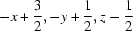 ; (iii)
  ; (iv)
 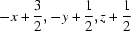 .
. Data collection: XSCANS (Siemens, 1996); cell refinement: XSCANS; data reduction: XSCANS; program(s) used to solve structure: SHELXS97 (Sheldrick, 2008); program(s) used to refine structure: SHELXL97 (Sheldrick, 2008); molecular graphics: Mercury (Macrae et al., 2006), PLUTON (Spek, 1992, 1993) and PLATON (Spek, 2009); ; software used to prepare material for publication: SHELXL97.
Supporting information
contains datablocks I, global. DOI: https://doi.org/10.1107/S1600536810025808/pb2033sup1.cif
Structure factors: contains datablock I. DOI: https://doi.org/10.1107/S1600536810025808/pb2033Isup2.hkl
4.10 g (0.05 mol) of 2-methyl-imidazole and 3.01 g (0.05 mol) of iso-propylamine were added into 20 ml of distilled water. Into this mixture, a solution of 3.13 g of para-formaldehyde, (0.1 mol)previously dissolved in 20 ml of water was slowly added with stirring. The pH was adjusted between 11–12 and then it was allowed 8 days under stirring. A first microcrystalline white precipitated was filtered off and washed with cold water. Yield 3.56 g (14%). The remain solution was allowed to slow evaporation, after two weeks a second crop of a crystalline product was isolated, washed with cold water and dried in air, yielding another 7.35 g (total yield 51%). The two crops were dissolved together into 25 ml of hot methanol and then a small amount of water (about 1 ml) was added. The final solution was cooled in the refrigerator. After three weeks colorless crystals with needle shape and well formed were filtered off. Single crystals were selected for X-ray data collection.
The deviation of the goodness-of-fit from the expected value s=1 arises from systematic errors due to a poor alignment of the crystal on the goniometer, as also reflected in rather high standard uncertainties for cell parameters. However, althoug final s.u.'s for positional and displacement parameters are probably underestimated, reported bond lenghts and angles seem to be reliable.
Imidazole chemistry is of great interest because their wide occurrences in biological systems like a component in the aminoacid histidine or other metabolites as histamine. Also, synthetic imidazole derivatives have found useful in medicine as antihistaminic, antielmitic, antifungiic or amebicide drugs, some of these compounds are 4-disubstituted aminomethyl imidazoles and has been prepared for different multistep process.
The development of new imidazole containing compounds, that could help in the understanding of their properties and the role that imidazole plays in different enzymes, it has been of great interests since many years (Bouwman et al., 1990). Therefore, the continuous develop for easy synthetic processes to obtain new imidazole derivatives is a matter of permanent research.
Mannich reaction is one of those powerful and easy reactions. This reaction is a one-step method to attach aminomethyl groups to the imidazole ring (Stocker et al., 1970). The reaction of formaldehyde, or other with different substrates and conditions has been widely used in organic synthesis. Some of these reactions involve coordinated amino acids (Teo et al., 1993; Berndt, 1970), coordinate (Geue et al., 1994), aromatic rings and secondary (Karunakaran & Kandaswamy, 1994), 2,4(5)disubtituted imidazoles and secondary (Baumann et al., 1984; Stocker et al., 1970). Previously, we have used this reaction under basic conditions to condense propylamine, formaldehyde and 2-methylimidazole (Mendoza-Díaz, Driessen & Reedijk, 1996). The product obtained by the double addition of the formaldehyde on the imidazole ring at the 4 and 5 positions was the heterocyclic 10 member ring: 1,6-diazecine with the imidazole rings fused through the bond between the carbons 4 and 5. In the of that compound, an interesting hydrogen bond network was observed, where a cluster of six water molecules in a flat-hexagonal arrangement is in between the diazecine molecules, making a three dimensional network. Also, of a similar compound, where instead of propyl substituent an ethanoic acid residue is present has been reported, (Mendoza-Díaz, Driessen, Reedijk, Gorter, Gasque & Thomson, 2002). In this case the water molecules conform an ice-type ring that binds the organic residue in a two dimensional network. Several crystal structures of copper complexes with different diazecine derivatives has been reported (Gasque, Mijangos & Ortiz-Frade, 2005), (Gasque, Olguín & Bernès, 2005), (Luna-Ramírez, Bernès & Gasque, 2008). In all cases the chair conformation of the diazecine ring has been observed.
In this paper, we report the crystal and molecular structure of the title compound, (hereafter referred as isopromeim).
The ORTEP plot showing the molecular structure of isopromeim is shown in figure 1 and bond lengths and angles are in the table of selected geometrical data. The 2-methyl group and the methylene carbons attached directly to the imidazole ring are essentially in the same least squere plane of the imidazole. A slight twist of the C(6) and C(8a) is observed due to their participation in the 1,6-diazecine ring. These deviations from the least squares plane of the imidazole are 0.068 (2) and 0.046 (2) Å, respectively; whereas for the 2-methyl group is -0.009 (3) Å out of plane. These values indicate that there is a slight difference with the n-propyl derivative previously reported. The angle formed between the bond C(5)—C(6) and the least squares plane of the imidazole is 2.71 (15)° and for the bond C(4)—C(8a) and the same plane is only of 1.77 (15)°, whereas for the bond between the methyl group and the imidazole ring (the bond C(2)—C(6)) is 0.49 (18)°.
The 10-member ring of the 1,6-diazecine has a chair -type conformation, linking the two imidazole rings. The angles at the nitrogen bridge in the 1,6-diazecine sum 334.6° indicating a pyramidal conformation.
Isopromeim crystals consist of units of the title compound and two water molecules. These water molecules form a two dimensional network along the crystallographic planes (010) and (100). Particularly, these water molecules link the molecules of isopromeim in a two dimensional structure, as it is illustrated in figure 2. In this hydrogen-bond-bridge are involved the corresponding waters molecules and the nitrogen atoms of the organic residue. Water molecule is acting as a proton-donor and also as a proton-acceptor.
The differences between crystal packing of the propyl and isopropyl derivative indicates that even the diazecine ring is essentially the same in these compounds. Residues attached will drive and control the way that water crystallize. This finding could help in the understanding of how in some imidazole-enzymes may activate water for hydrolysis processes.
For related literature, see: Baumann et al. (1984); Berndt (1970); Bouwman et al. (1990); Gasque, Mijangos & Ortiz-Frade (2005); Gasque, Olguín & Bernès (2005); Geue et al. (1994); Karunakaran & Kandaswamy (1994); Luna-Ramírez, Bernès & Gasque (2008); Mendoza-Díaz, Driessen & Reedijk (1996); Stocker et al. (1970); Teo et al. (1993). Mendoza-Díaz, Driessen, Reedijk, Gorter, Gasque & Thomson (2002).
Data collection: XSCANS (Siemens, 1996); cell XSCANS (Siemens, 1996); data reduction: XSCANS (Siemens, 1996); program(s) used to solve structure: SHELXS97 (Sheldrick, 2008); program(s) used to refine structure: SHELXL97 (Sheldrick, 2008); molecular graphics: Mercury (Macrae et al., 2006), PLUTON (Spek, 1992, 1993) and PLATON (Spek, 2009); software used to prepare material for publication: SHELXL97 (Sheldrick, 2008).
![[Figure 1]](./pb2033fig1thm.gif) | Fig. 1. ORTEP plot (Spek, 2009) of isopromeim, showing the atomic numbering scheme. Observe that the diazecine ring is in a chair conformation. |
![[Figure 2]](./pb2033fig2thm.gif) | Fig. 2. PLUTON98 (Spek, 1992, 1993) plot showing a partial view of the hydrogen bond network in the isopromeim crystal. |
| C18H30N6·2H2O | F(000) = 800 |
| Mr = 366.51 | Dx = 1.214 Mg m−3 |
| Orthorhombic, Pbcn | Mo Kα radiation, λ = 0.71073 Å |
| Hall symbol: -P 2n 2ab | Cell parameters from 100 reflections |
| a = 12.571 (3) Å | θ = 5.0–12.2° |
| b = 14.665 (3) Å | µ = 0.08 mm−1 |
| c = 10.877 (4) Å | T = 300 K |
| V = 2005.3 (9) Å3 | Needle, colourless |
| Z = 4 | 0.6 × 0.2 × 0.2 mm |
| Siemens P4 diffractometer | Rint = 0.022 |
| Radiation source: fine-focus sealed tube | θmax = 25.0°, θmin = 2.1° |
| Graphite monochromator | h = −2→14 |
| ω scans | k = −17→1 |
| 2495 measured reflections | l = −1→12 |
| 1768 independent reflections | 3 standard reflections every 97 reflections |
| 1126 reflections with I > 2σ(I) | intensity decay: 1% |
| Refinement on F2 | Secondary atom site location: difference Fourier map |
| Least-squares matrix: full | Hydrogen site location: inferred from neighbouring sites |
| R[F2 > 2σ(F2)] = 0.056 | H atoms treated by a mixture of independent and constrained refinement |
| wR(F2) = 0.157 | w = 1/[σ2(Fo2) + (0.05P)2] where P = (Fo2 + 2Fc2)/3 |
| S = 1.72 | (Δ/σ)max < 0.001 |
| 1768 reflections | Δρmax = 0.19 e Å−3 |
| 131 parameters | Δρmin = −0.24 e Å−3 |
| 0 restraints | Extinction correction: SHELXL97 (Sheldrick, 2008), Fc*=kFc[1+0.001xFc2λ3/sin(2θ)]-1/4 |
| Primary atom site location: structure-invariant direct methods | Extinction coefficient: 0.027 (3) |
| C18H30N6·2H2O | V = 2005.3 (9) Å3 |
| Mr = 366.51 | Z = 4 |
| Orthorhombic, Pbcn | Mo Kα radiation |
| a = 12.571 (3) Å | µ = 0.08 mm−1 |
| b = 14.665 (3) Å | T = 300 K |
| c = 10.877 (4) Å | 0.6 × 0.2 × 0.2 mm |
| Siemens P4 diffractometer | Rint = 0.022 |
| 2495 measured reflections | 3 standard reflections every 97 reflections |
| 1768 independent reflections | intensity decay: 1% |
| 1126 reflections with I > 2σ(I) |
| R[F2 > 2σ(F2)] = 0.056 | 0 restraints |
| wR(F2) = 0.157 | H atoms treated by a mixture of independent and constrained refinement |
| S = 1.72 | Δρmax = 0.19 e Å−3 |
| 1768 reflections | Δρmin = −0.24 e Å−3 |
| 131 parameters |
| x | y | z | Uiso*/Ueq | ||
| N1 | 0.78914 (15) | 0.45225 (13) | −0.09908 (19) | 0.0590 (6) | |
| H1 | 0.774 (2) | 0.3945 (16) | −0.128 (2) | 0.071* | |
| C2 | 0.7545 (2) | 0.53228 (16) | −0.1446 (2) | 0.0593 (7) | |
| N3 | 0.80031 (14) | 0.60155 (12) | −0.08879 (17) | 0.0572 (6) | |
| C4 | 0.86930 (18) | 0.56315 (14) | −0.0031 (2) | 0.0522 (6) | |
| C5 | 0.86320 (18) | 0.47026 (14) | −0.0089 (2) | 0.0539 (6) | |
| C6 | 0.91226 (18) | 0.39548 (14) | 0.0627 (2) | 0.0569 (6) | |
| H6A | 0.9597 | 0.4214 | 0.1237 | 0.068* | |
| H6B | 0.8568 | 0.3625 | 0.1060 | 0.068* | |
| N7 | 0.97232 (14) | 0.33121 (11) | −0.01421 (16) | 0.0529 (5) | |
| C8 | 1.06008 (17) | 0.38073 (15) | −0.0766 (2) | 0.0570 (6) | |
| H8A | 1.0291 | 0.4204 | −0.1384 | 0.068* | |
| H8B | 1.1038 | 0.3364 | −0.1193 | 0.068* | |
| C9 | 0.6734 (2) | 0.53789 (17) | −0.2431 (3) | 0.0764 (8) | |
| H9A | 0.6610 | 0.6007 | −0.2637 | 0.115* | |
| H9B | 0.6083 | 0.5107 | −0.2151 | 0.115* | |
| H9C | 0.6984 | 0.5059 | −0.3145 | 0.115* | |
| C10 | 1.00890 (19) | 0.25037 (14) | 0.0567 (2) | 0.0611 (7) | |
| H10A | 1.0537 | 0.2714 | 0.1248 | 0.073* | |
| C11 | 1.0735 (2) | 0.18781 (17) | −0.0234 (3) | 0.0848 (9) | |
| H11A | 1.1404 | 0.2161 | −0.0423 | 0.127* | |
| H11B | 1.0355 | 0.1760 | −0.0983 | 0.127* | |
| H11C | 1.0859 | 0.1314 | 0.0191 | 0.127* | |
| C12 | 0.9152 (2) | 0.19821 (17) | 0.1096 (3) | 0.0739 (8) | |
| H12A | 0.8770 | 0.2366 | 0.1658 | 0.111* | |
| H12B | 0.9405 | 0.1452 | 0.1522 | 0.111* | |
| H12C | 0.8687 | 0.1798 | 0.0441 | 0.111* | |
| O1 | 0.70233 (15) | 0.23151 (12) | 0.32676 (16) | 0.0700 (6) | |
| H11 | 0.742 (2) | 0.284 (2) | 0.362 (3) | 0.105* | |
| H12 | 0.639 (2) | 0.2290 (19) | 0.372 (3) | 0.105* |
| U11 | U22 | U33 | U12 | U13 | U23 | |
| N1 | 0.0540 (12) | 0.0480 (12) | 0.0750 (14) | −0.0032 (10) | −0.0048 (11) | 0.0004 (10) |
| C2 | 0.0537 (14) | 0.0502 (14) | 0.0739 (15) | 0.0007 (12) | −0.0024 (12) | −0.0009 (12) |
| N3 | 0.0513 (11) | 0.0508 (12) | 0.0694 (13) | 0.0023 (9) | −0.0020 (10) | 0.0001 (10) |
| C4 | 0.0485 (12) | 0.0487 (12) | 0.0594 (13) | 0.0030 (11) | 0.0034 (12) | 0.0008 (11) |
| C5 | 0.0471 (12) | 0.0533 (14) | 0.0614 (13) | −0.0013 (11) | 0.0040 (12) | 0.0021 (12) |
| C6 | 0.0577 (13) | 0.0527 (13) | 0.0601 (13) | 0.0022 (11) | 0.0065 (12) | 0.0038 (11) |
| N7 | 0.0569 (10) | 0.0459 (10) | 0.0560 (10) | 0.0003 (9) | −0.0004 (9) | 0.0033 (9) |
| C8 | 0.0585 (14) | 0.0544 (13) | 0.0580 (13) | −0.0003 (11) | 0.0030 (12) | −0.0022 (11) |
| C9 | 0.0684 (16) | 0.0679 (16) | 0.0928 (18) | −0.0031 (13) | −0.0230 (15) | 0.0016 (15) |
| C10 | 0.0640 (14) | 0.0486 (13) | 0.0705 (16) | −0.0009 (12) | −0.0115 (13) | 0.0066 (11) |
| C11 | 0.0915 (19) | 0.0565 (15) | 0.107 (2) | 0.0182 (15) | 0.0023 (18) | 0.0028 (16) |
| C12 | 0.0824 (17) | 0.0592 (15) | 0.0801 (17) | −0.0076 (14) | −0.0075 (15) | 0.0177 (14) |
| O1 | 0.0766 (13) | 0.0569 (11) | 0.0765 (12) | −0.0053 (9) | 0.0098 (10) | −0.0044 (9) |
| N1—C2 | 1.346 (3) | C8—H8B | 0.9700 |
| N1—C5 | 1.378 (3) | C9—H9A | 0.9600 |
| N1—H1 | 0.92 (2) | C9—H9B | 0.9600 |
| C2—N3 | 1.316 (3) | C9—H9C | 0.9600 |
| C2—C9 | 1.481 (4) | C10—C11 | 1.504 (3) |
| N3—C4 | 1.392 (3) | C10—C12 | 1.518 (3) |
| C4—C5 | 1.366 (3) | C10—H10A | 0.9800 |
| C4—C8i | 1.489 (3) | C11—H11A | 0.9600 |
| C5—C6 | 1.480 (3) | C11—H11B | 0.9600 |
| C6—N7 | 1.469 (3) | C11—H11C | 0.9600 |
| C6—H6A | 0.9700 | C12—H12A | 0.9600 |
| C6—H6B | 0.9700 | C12—H12B | 0.9600 |
| N7—C8 | 1.485 (3) | C12—H12C | 0.9600 |
| N7—C10 | 1.487 (3) | O1—H11 | 0.99 (3) |
| C8—C4i | 1.489 (3) | O1—H12 | 0.94 (3) |
| C8—H8A | 0.9700 | ||
| C2—N1—C5 | 108.25 (19) | H8A—C8—H8B | 107.3 |
| C2—N1—H1 | 127.6 (16) | C2—C9—H9A | 109.5 |
| C5—N1—H1 | 123.7 (16) | C2—C9—H9B | 109.5 |
| N3—C2—N1 | 111.2 (2) | H9A—C9—H9B | 109.5 |
| N3—C2—C9 | 126.3 (2) | C2—C9—H9C | 109.5 |
| N1—C2—C9 | 122.5 (2) | H9A—C9—H9C | 109.5 |
| C2—N3—C4 | 105.62 (19) | H9B—C9—H9C | 109.5 |
| C5—C4—N3 | 109.7 (2) | N7—C10—C11 | 110.64 (19) |
| C5—C4—C8i | 127.7 (2) | N7—C10—C12 | 110.98 (19) |
| N3—C4—C8i | 122.53 (19) | C11—C10—C12 | 109.4 (2) |
| C4—C5—N1 | 105.2 (2) | N7—C10—H10A | 108.6 |
| C4—C5—C6 | 133.7 (2) | C11—C10—H10A | 108.6 |
| N1—C5—C6 | 120.95 (19) | C12—C10—H10A | 108.6 |
| N7—C6—C5 | 112.94 (18) | C10—C11—H11A | 109.5 |
| N7—C6—H6A | 109.0 | C10—C11—H11B | 109.5 |
| C5—C6—H6A | 109.0 | H11A—C11—H11B | 109.5 |
| N7—C6—H6B | 109.0 | C10—C11—H11C | 109.5 |
| C5—C6—H6B | 109.0 | H11A—C11—H11C | 109.5 |
| H6A—C6—H6B | 107.8 | H11B—C11—H11C | 109.5 |
| C6—N7—C8 | 109.17 (15) | C10—C12—H12A | 109.5 |
| C6—N7—C10 | 112.00 (16) | C10—C12—H12B | 109.5 |
| C8—N7—C10 | 113.41 (18) | H12A—C12—H12B | 109.5 |
| N7—C8—C4i | 116.58 (19) | C10—C12—H12C | 109.5 |
| N7—C8—H8A | 108.1 | H12A—C12—H12C | 109.5 |
| C4i—C8—H8A | 108.1 | H12B—C12—H12C | 109.5 |
| N7—C8—H8B | 108.1 | H11—O1—H12 | 105 (2) |
| C4i—C8—H8B | 108.1 | ||
| C5—N1—C2—N3 | −0.7 (3) | C2—N1—C5—C6 | 177.1 (2) |
| C5—N1—C2—C9 | −179.6 (2) | C4—C5—C6—N7 | −123.6 (3) |
| N1—C2—N3—C4 | 0.6 (3) | N1—C5—C6—N7 | 61.1 (3) |
| C9—C2—N3—C4 | 179.4 (2) | C5—C6—N7—C8 | 61.0 (2) |
| C2—N3—C4—C5 | −0.2 (3) | C5—C6—N7—C10 | −172.52 (18) |
| C2—N3—C4—C8i | 177.6 (2) | C6—N7—C8—C4i | 51.4 (2) |
| N3—C4—C5—N1 | −0.2 (3) | C10—N7—C8—C4i | −74.2 (2) |
| C8i—C4—C5—N1 | −177.9 (2) | C6—N7—C10—C11 | −177.84 (18) |
| N3—C4—C5—C6 | −176.1 (2) | C8—N7—C10—C11 | −53.7 (2) |
| C8i—C4—C5—C6 | 6.2 (4) | C6—N7—C10—C12 | 60.6 (2) |
| C2—N1—C5—C4 | 0.6 (3) | C8—N7—C10—C12 | −175.3 (2) |
| Symmetry code: (i) −x+2, −y+1, −z. |
| D—H···A | D—H | H···A | D···A | D—H···A |
| N1—H1···O1ii | 0.92 (2) | 1.94 (2) | 2.815 (3) | 159 (2) |
| O1—H11···N3iii | 0.99 (3) | 1.91 (3) | 2.890 (3) | 169 (3) |
| O1—H12···N7iv | 0.94 (3) | 2.07 (3) | 2.943 (2) | 155 (3) |
| Symmetry codes: (ii) −x+3/2, −y+1/2, z−1/2; (iii) x, −y+1, z+1/2; (iv) −x+3/2, −y+1/2, z+1/2. |
Experimental details
| Crystal data | |
| Chemical formula | C18H30N6·2H2O |
| Mr | 366.51 |
| Crystal system, space group | Orthorhombic, Pbcn |
| Temperature (K) | 300 |
| a, b, c (Å) | 12.571 (3), 14.665 (3), 10.877 (4) |
| V (Å3) | 2005.3 (9) |
| Z | 4 |
| Radiation type | Mo Kα |
| µ (mm−1) | 0.08 |
| Crystal size (mm) | 0.6 × 0.2 × 0.2 |
| Data collection | |
| Diffractometer | Siemens P4 |
| Absorption correction | – |
| No. of measured, independent and observed [I > 2σ(I)] reflections | 2495, 1768, 1126 |
| Rint | 0.022 |
| (sin θ/λ)max (Å−1) | 0.596 |
| Refinement | |
| R[F2 > 2σ(F2)], wR(F2), S | 0.056, 0.157, 1.72 |
| No. of reflections | 1768 |
| No. of parameters | 131 |
| H-atom treatment | H atoms treated by a mixture of independent and constrained refinement |
| Δρmax, Δρmin (e Å−3) | 0.19, −0.24 |
Computer programs: XSCANS (Siemens, 1996), SHELXS97 (Sheldrick, 2008), SHELXL97 (Sheldrick, 2008), Mercury (Macrae et al., 2006), PLUTON (Spek, 1992, 1993) and PLATON (Spek, 2009).
| N1—C2 | 1.346 (3) | C5—C6 | 1.480 (3) |
| N1—C5 | 1.378 (3) | C6—N7 | 1.469 (3) |
| N1—H1 | 0.92 (2) | N7—C8 | 1.485 (3) |
| C2—N3 | 1.316 (3) | N7—C10 | 1.487 (3) |
| C2—C9 | 1.481 (4) | C8—C4i | 1.489 (3) |
| N3—C4 | 1.392 (3) | C10—C11 | 1.504 (3) |
| C4—C5 | 1.366 (3) | C10—C12 | 1.518 (3) |
| C4—C8i | 1.489 (3) | ||
| C2—N1—C5 | 108.25 (19) | C4—C5—N1 | 105.2 (2) |
| C2—N1—H1 | 127.6 (16) | C4—C5—C6 | 133.7 (2) |
| C5—N1—H1 | 123.7 (16) | N1—C5—C6 | 120.95 (19) |
| N3—C2—N1 | 111.2 (2) | N7—C6—C5 | 112.94 (18) |
| N3—C2—C9 | 126.3 (2) | C6—N7—C10 | 112.00 (16) |
| N1—C2—C9 | 122.5 (2) | C8—N7—C10 | 113.41 (18) |
| C2—N3—C4 | 105.62 (19) | N7—C8—C4i | 116.58 (19) |
| C5—C4—N3 | 109.7 (2) | N7—C10—C11 | 110.64 (19) |
| C5—C4—C8i | 127.7 (2) | N7—C10—C12 | 110.98 (19) |
| N3—C4—C8i | 122.53 (19) | C11—C10—C12 | 109.4 (2) |
| Symmetry code: (i) −x+2, −y+1, −z. |
| D—H···A | D—H | H···A | D···A | D—H···A |
| N1—H1···O1ii | 0.92 (2) | 1.94 (2) | 2.815 (3) | 159 (2) |
| O1—H11···N3iii | 0.99 (3) | 1.91 (3) | 2.890 (3) | 169 (3) |
| O1—H12···N7iv | 0.94 (3) | 2.07 (3) | 2.943 (2) | 155 (3) |
| Symmetry codes: (ii) −x+3/2, −y+1/2, z−1/2; (iii) x, −y+1, z+1/2; (iv) −x+3/2, −y+1/2, z+1/2. |
Acknowledgements
The authors are grateful to Dirección de Investigación y Posgrado de la Universidad de Guanajuato for financial support.
References
 Baumann, G. C., Summers, M. F., Hutchinson, J. P., Zubieta, J. & Marzilli, L. G. (1984). Inorg. Chem. 23, 3104–3108. CSD CrossRef CAS Web of Science Google Scholar
Berndt, D. C. (1970). J. Org. Chem. 35, 1129–1131. CrossRef CAS Web of Science Google Scholar
Bouwman, E., Driessen, W. L. & Reedijk, J. (1990). Coord. Chem. Rev. 104, 143–172. CrossRef CAS Web of Science Google Scholar
Gasque, L., Mijangos, E. & Ortiz-Frade, L. (2005). Acta Cryst. E61, m673–m676. Web of Science CSD CrossRef IUCr Journals Google Scholar
Gasque, L., Olguín, J. & Bernès, S. (2005). Acta Cryst. E61, m274–m276. CSD CrossRef IUCr Journals Google Scholar
Geue, R. J., Höhn, A., Ralph, S. F., Sargeson, A. M. & Willis, A. C. (1994). J. Chem. Soc. Chem. Commun. pp. 1513–1515. CrossRef Web of Science Google Scholar
Karunakaran, S. & Kandaswamy, M. (1994). J. Chem. Soc. Dalton Trans. pp. 1595–1598. CrossRef Web of Science Google Scholar
Luna-Ramírez, K. S., Bernès, S. & Gasque, L. (2008). Acta Cryst. E64, m1135–m1136. Web of Science CSD CrossRef IUCr Journals Google Scholar
Macrae, C. F., Edgington, P. R., McCabe, P., Pidcock, E., Shields, G. P., Taylor, R., Towler, M. & van de Streek, J. (2006). J. Appl. Cryst. 39, 453–457. Web of Science CSD CrossRef CAS IUCr Journals Google Scholar
Mendoza-Díaz, G., Driessen, W. L. & Reedijk, J. (1996). Acta Cryst. C52, 960–962. CSD CrossRef Web of Science IUCr Journals Google Scholar
Mendoza-Díaz, G., Driessen, W. L., Reedijk, J., Gorter, S., Gasque, L. & Thomson, K. R. (2002). Inorg. Chim. Acta, 339, 51–59. Google Scholar
Sheldrick, G. M. (2008). Acta Cryst. A64, 112–122. Web of Science CrossRef CAS IUCr Journals Google Scholar
Siemens (1996). XSCANS. Siemens Analytical X-ray Instruments Inc., Madison, Wisconsin, USA. Google Scholar
Spek, A. L. (1992). PLUTON92. Utrecht University, The Netherlands. Google Scholar
Spek, A. L. (1993). PLUTON93. Utrecht University, The Netherlands. Google Scholar
Spek, A. L. (2009). Acta Cryst. D65, 148–155. Web of Science CrossRef CAS IUCr Journals Google Scholar
Stocker, F. B., Kurtz, J. L., Byron, L. G. & Forsyth, D. A. (1970). J. Org. Chem. 35, 883–887. CrossRef CAS Web of Science Google Scholar
Teo, S.-B., Ng, C.-H. & Tiekink, E. R. T. (1993). J. Coord. Chem. 29, 57–63. CrossRef CAS Web of Science Google Scholar
This is an open-access article distributed under the terms of the Creative Commons Attribution (CC-BY) Licence, which permits unrestricted use, distribution, and reproduction in any medium, provided the original authors and source are cited.
| CRYSTALLOGRAPHIC COMMUNICATIONS |
access


Imidazole chemistry is of great interest because their wide occurrences in biological systems like a component in the aminoacid histidine or other metabolites as histamine. Also, synthetic imidazole derivatives have found useful in medicine as antihistaminic, antielmitic, antifungiic or amebicide drugs, some of these compounds are 4-disubstituted aminomethyl imidazoles and has been prepared for different multistep process.
The development of new imidazole containing compounds, that could help in the understanding of their properties and the role that imidazole plays in different enzymes, it has been of great interests since many years (Bouwman et al., 1990). Therefore, the continuous develop for easy synthetic processes to obtain new imidazole derivatives is a matter of permanent research.
Mannich reaction is one of those powerful and easy reactions. This reaction is a one-step method to attach aminomethyl groups to the imidazole ring (Stocker et al., 1970). The reaction of formaldehyde, or other aldehydes, with different substrates and conditions has been widely used in organic synthesis. Some of these reactions involve coordinated amino acids (Teo et al., 1993; Berndt, 1970), coordinate amines (Geue et al., 1994), aromatic rings and secondary amines (Karunakaran & Kandaswamy, 1994), 2,4(5)disubtituted imidazoles and secondary amines (Baumann et al., 1984; Stocker et al., 1970). Previously, we have used this reaction under basic conditions to condense propylamine, formaldehyde and 2-methylimidazole (Mendoza-Díaz, Driessen & Reedijk, 1996). The product obtained by the double addition of the formaldehyde on the imidazole ring at the 4 and 5 positions was the heterocyclic 10 member ring: 1,6-diazecine with the imidazole rings fused through the bond between the carbons 4 and 5. In the crystal structure of that compound, an interesting hydrogen bond network was observed, where a cluster of six water molecules in a flat-hexagonal arrangement is in between the diazecine molecules, making a three dimensional network. Also, crystal structure of a similar compound, where instead of propyl substituent an ethanoic acid residue is present has been reported, (Mendoza-Díaz, Driessen, Reedijk, Gorter, Gasque & Thomson, 2002). In this case the water molecules conform an ice-type ring that binds the organic residue in a two dimensional network. Several crystal structures of copper complexes with different diazecine derivatives has been reported (Gasque, Mijangos & Ortiz-Frade, 2005), (Gasque, Olguín & Bernès, 2005), (Luna-Ramírez, Bernès & Gasque, 2008). In all cases the chair conformation of the diazecine ring has been observed.
In this paper, we report the crystal and molecular structure of the title compound, (hereafter referred as isopromeim).
The ORTEP plot showing the molecular structure of isopromeim is shown in figure 1 and bond lengths and angles are in the table of selected geometrical data. The 2-methyl group and the methylene carbons attached directly to the imidazole ring are essentially in the same least squere plane of the imidazole. A slight twist of the C(6) and C(8a) is observed due to their participation in the 1,6-diazecine ring. These deviations from the least squares plane of the imidazole are 0.068 (2) and 0.046 (2) Å, respectively; whereas for the 2-methyl group is -0.009 (3) Å out of plane. These values indicate that there is a slight difference with the n-propyl derivative previously reported. The angle formed between the bond C(5)—C(6) and the least squares plane of the imidazole is 2.71 (15)° and for the bond C(4)—C(8a) and the same plane is only of 1.77 (15)°, whereas for the bond between the methyl group and the imidazole ring (the bond C(2)—C(6)) is 0.49 (18)°.
The 10-member ring of the 1,6-diazecine has a chair -type conformation, linking the two imidazole rings. The angles at the nitrogen bridge in the 1,6-diazecine sum 334.6° indicating a pyramidal conformation.
Isopromeim crystals consist of units of the title compound and two water molecules. These water molecules form a two dimensional network along the crystallographic planes (010) and (100). Particularly, these water molecules link the molecules of isopromeim in a two dimensional structure, as it is illustrated in figure 2. In this hydrogen-bond-bridge are involved the corresponding waters molecules and the nitrogen atoms of the organic residue. Water molecule is acting as a proton-donor and also as a proton-acceptor.
The differences between crystal packing of the propyl and isopropyl derivative indicates that even the diazecine ring is essentially the same in these compounds. Residues attached will drive and control the way that water crystallize. This finding could help in the understanding of how in some imidazole-enzymes may activate water for hydrolysis processes.