 | Acta Crystallographica Section E Acta Crystallographica Section E CRYSTALLOGRAPHIC COMMUNICATIONS |


 journal menu


organic compounds
| CRYSTALLOGRAPHIC COMMUNICATIONS |
 access
2-(Pyrimidin-2-yloxy)phenol

aDepartment of Chemistry, University of Malaya, 50603 Kuala Lumpur, Malaysia
*Correspondence e-mail: [email protected]
The pyrimidine and benzene rings in the title compound, C10H8N2O2, form a dihedral angle of 71.03 (7)°, with the roughly orthogonal benzene ring being folded towards one of the pyrimidine N atoms. In the crystal, pairs of O—H⋯N hydrogen bonds connect molecules related by twofold symmetry into dimeric aggregates. These associate into a supramolecular chain propagating along the b axis by way of C—H⋯π contacts. The chains are cross-linked by π–π interactions that occur between pyrimidine rings [ring centroid–centroid distances = 3.5393 (9) and 3.5697 (9) Å].
Related literature
For background to the fluorescence properties of compounds related to the title compound, see: Kawai et al. (2001![[Kawai, M., Lee, M. J., Evans, K. O. & Norlund, T. (2001). J. Fluoresc. 11, 23-32.]](../../../../../../logos/arrows/e_arr.gif "Kawai, M., Lee, M. J., Evans, K. O. & Norlund, T. (2001). J. Fluoresc. 11, 23-32.") ); Abdullah (2005). For a related structure, see: Nasir et al. (2010).
); Abdullah (2005). For a related structure, see: Nasir et al. (2010).
![[Scheme 1]](hb5592scheme1.gif)
Experimental
Crystal data
|
Refinement
|
| ||||||||||||||||||||||
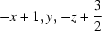 ; (ii)
 Data collection: APEX2 (Bruker, 2009); cell refinement: SAINT (Bruker, 2009); data reduction: SAINT; program(s) used to solve structure: SHELXS97 (Sheldrick, 2008); program(s) used to refine structure: SHELXL97 (Sheldrick, 2008); molecular graphics: ORTEP-3 (Farrugia, 1997) and DIAMOND (Brandenburg, 2006); software used to prepare material for publication: publCIF (Westrip, 2010).
Supporting information
contains datablocks global, I. DOI: https://doi.org/10.1107/S1600536810030448/hb5592sup1.cif
Structure factors: contains datablock I. DOI: https://doi.org/10.1107/S1600536810030448/hb5592Isup2.hkl
1,2-Dihydroxybenzene (12 g, 108 mmol) was mixed with sodium hydroxide (4.32 g, 108 mmol) in several drops of water. The water was then evaporated and the resulting paste heated with 2-chloropyrimidine (2 g, 18 mmol) at 423—433 K for 5 h. The product was dissolved in water and the solution extracted with chloroform. The chloroform phase was dried over sodium sulfate; the evaporation of the solvent gave well shaped colourless blocks of (I).
Carbon-bound H-atoms were placed in calculated positions (C—H 0.93 Å) and were included in the in the riding model approximation, with Uiso(H) set to 1.2Uequiv(C). The O-bound H-atom was located in a difference Fourier map, and was refined with a distance restraint of O–H 0.84±0.01 Å, and with Uiso(H) set to 1.5Uequiv(O).
Interest in the title compound relates to screening for useful fluorescence properties as seen in related compounds (Kawai et al. 2001; Abdullah, 2005). The molecule of (I), Fig. 1, is bent with the dihedral angle formed between the pyrimidine and benzene rings being 71.03 (7) °. The plane through the pyrimidine ring cuts through the orthogonal plane through the benzene ring, which is folded to be disposed towards the N1 atom. The overall conformation resembles that reported recently for 2-(3-methoxyphenoxy)pyrimidine (Nasir et al., 2010). The hydroxy group is directed away from the pyrimidine ring, an orientation that facilitates the formation of a O–H···N hydrogen bond with a molecule related by 2-fold symmetry, Table 1. The dimeric aggregates are linked via C–H···π interactions occurring between a pyrimidine-H and the benzene ring. The result of these interactions is the formation of a supramolecular chain along the b axis, Fig. 2 and Table 1. The chains thus formed are consolidated into the by π–π interactions occurring between the pyrimidine rings that stack along the c axis [ring centroid(N1,N2,C1–C4)···ring centroid(N1,N2,C1–C4)i,ii = 3.5393 (9) and 3.5697 (9) Å, respectively, with inclination angles = 16 and 0 °, respectively, for i: 1 - x, y, 3/2 - z and ii: 3/2 + x, 3/2 + y, 1 + z]; Fig. 3.
For background to the fluorescence properties of compounds related to the title compound, see: Kawai et al. (2001); Abdullah (2005). For a related structure, see: Nasir et al. (2010).
Data collection: APEX2 (Bruker, 2009); cell SAINT (Bruker, 2009); data reduction: SAINT (Bruker, 2009); program(s) used to solve structure: SHELXS97 (Sheldrick, 2008); program(s) used to refine structure: SHELXL97 (Sheldrick, 2008); molecular graphics: ORTEP-3 (Farrugia, 1997) and DIAMOND (Brandenburg, 2006); software used to prepare material for publication: publCIF (Westrip, 2010).
![[Figure 1]](./hb5592fig1thm.gif) | Fig. 1. The molecular structure of (I) showing displacement ellipsoids at the 50% probability level. |
![[Figure 2]](./hb5592fig2thm.gif) | Fig. 2. Supramolecular chain along the b axis in (I) mediated by O–H···O hydrogen bonds and C–H···π interactions, shown as orange and purple dashed lines, respectively. |
![[Figure 3]](./hb5592fig3thm.gif) | Fig. 3. Unit-cell contents shown in projection down the b axis in (I), highlighting the connections, via π–π interactions, between supramolecular chains. The O–H···O hydrogen bonds and π–π interactions are shown as orange and purple dashed lines, respectively. |
| C10H8N2O2 | F(000) = 784 |
| Mr = 188.18 | Dx = 1.409 Mg m−3 |
| Monoclinic, C2/c | Mo Kα radiation, λ = 0.71073 Å |
| Hall symbol: -C 2yc | Cell parameters from 2567 reflections |
| a = 18.0849 (18) Å | θ = 3.0–26.9° |
| b = 7.3293 (8) Å | µ = 0.10 mm−1 |
| c = 13.3983 (14) Å | T = 293 K |
| β = 92.521 (1)° | Block, colourless |
| V = 1774.2 (3) Å3 | 0.32 × 0.30 × 0.10 mm |
| Z = 8 |
| Bruker SMART APEX CCD diffractometer | 2048 independent reflections |
| Radiation source: fine-focus sealed tube | 1569 reflections with I > 2σ(I) |
| Graphite monochromator | Rint = 0.027 |
| ω scans | θmax = 27.5°, θmin = 2.3° |
| Absorption correction: multi-scan (SADABS; Sheldrick, 1996) | h = −23→23 |
| Tmin = 0.901, Tmax = 1.000 | k = −9→9 |
| 8265 measured reflections | l = −17→15 |
| Refinement on F2 | Primary atom site location: structure-invariant direct methods |
| Least-squares matrix: full | Secondary atom site location: difference Fourier map |
| R[F2 > 2σ(F2)] = 0.039 | Hydrogen site location: inferred from neighbouring sites |
| wR(F2) = 0.112 | H atoms treated by a mixture of independent and constrained refinement |
| S = 1.01 | w = 1/[σ2(Fo2) + (0.0586P)2 + 0.4928P] where P = (Fo2 + 2Fc2)/3 |
| 2048 reflections | (Δ/σ)max = 0.001 |
| 130 parameters | Δρmax = 0.17 e Å−3 |
| 1 restraint | Δρmin = −0.18 e Å−3 |
| C10H8N2O2 | V = 1774.2 (3) Å3 |
| Mr = 188.18 | Z = 8 |
| Monoclinic, C2/c | Mo Kα radiation |
| a = 18.0849 (18) Å | µ = 0.10 mm−1 |
| b = 7.3293 (8) Å | T = 293 K |
| c = 13.3983 (14) Å | 0.32 × 0.30 × 0.10 mm |
| β = 92.521 (1)° |
| Bruker SMART APEX CCD diffractometer | 2048 independent reflections |
| Absorption correction: multi-scan (SADABS; Sheldrick, 1996) | 1569 reflections with I > 2σ(I) |
| Tmin = 0.901, Tmax = 1.000 | Rint = 0.027 |
| 8265 measured reflections |
| R[F2 > 2σ(F2)] = 0.039 | 1 restraint |
| wR(F2) = 0.112 | H atoms treated by a mixture of independent and constrained refinement |
| S = 1.01 | Δρmax = 0.17 e Å−3 |
| 2048 reflections | Δρmin = −0.18 e Å−3 |
| 130 parameters |
Geometry. All e.s.d.'s (except the e.s.d. in the dihedral angle between two l.s. planes) are estimated using the full covariance matrix. The cell e.s.d.'s are taken into account individually in the estimation of e.s.d.'s in distances, angles and torsion angles; correlations between e.s.d.'s in cell parameters are only used when they are defined by crystal symmetry. An approximate (isotropic) treatment of cell e.s.d.'s is used for estimating e.s.d.'s involving l.s. planes. |
Refinement. Refinement of F2 against ALL reflections. The weighted R-factor wR and goodness of fit S are based on F2, conventional R-factors R are based on F, with F set to zero for negative F2. The threshold expression of F2 > σ(F2) is used only for calculating R-factors(gt) etc. and is not relevant to the choice of reflections for refinement. R-factors based on F2 are statistically about twice as large as those based on F, and R- factors based on ALL data will be even larger. |
| x | y | z | Uiso*/Ueq | ||
| O1 | 0.44378 (5) | 0.18501 (12) | 0.65018 (7) | 0.0445 (3) | |
| O2 | 0.38586 (6) | 0.06384 (16) | 0.82550 (8) | 0.0622 (3) | |
| H2o | 0.4144 (10) | 0.156 (2) | 0.8229 (16) | 0.093* | |
| N1 | 0.39630 (6) | 0.47232 (14) | 0.61828 (9) | 0.0431 (3) | |
| N2 | 0.52544 (6) | 0.41044 (15) | 0.63993 (8) | 0.0423 (3) | |
| C1 | 0.45408 (7) | 0.36583 (16) | 0.63476 (9) | 0.0356 (3) | |
| C2 | 0.41257 (8) | 0.64865 (19) | 0.60601 (12) | 0.0523 (4) | |
| H2 | 0.3740 | 0.7306 | 0.5935 | 0.063* | |
| C3 | 0.48369 (9) | 0.71379 (19) | 0.61104 (12) | 0.0542 (4) | |
| H3 | 0.4940 | 0.8371 | 0.6031 | 0.065* | |
| C4 | 0.53883 (8) | 0.5881 (2) | 0.62839 (10) | 0.0491 (3) | |
| H4 | 0.5877 | 0.6283 | 0.6323 | 0.059* | |
| C5 | 0.37173 (7) | 0.11373 (16) | 0.64788 (10) | 0.0396 (3) | |
| C6 | 0.33142 (8) | 0.09337 (19) | 0.55923 (12) | 0.0537 (4) | |
| H6 | 0.3495 | 0.1381 | 0.5001 | 0.064* | |
| C7 | 0.26364 (9) | 0.0057 (2) | 0.55871 (14) | 0.0651 (5) | |
| H7 | 0.2356 | −0.0076 | 0.4993 | 0.078* | |
| C8 | 0.23810 (8) | −0.0614 (2) | 0.64619 (15) | 0.0653 (5) | |
| H8 | 0.1927 | −0.1212 | 0.6456 | 0.078* | |
| C9 | 0.27880 (8) | −0.0416 (2) | 0.73537 (13) | 0.0575 (4) | |
| H9 | 0.2609 | −0.0885 | 0.7941 | 0.069* | |
| C10 | 0.34627 (7) | 0.04819 (17) | 0.73708 (11) | 0.0438 (3) |
| U11 | U22 | U33 | U12 | U13 | U23 | |
| O1 | 0.0343 (5) | 0.0366 (5) | 0.0623 (6) | 0.0010 (4) | −0.0025 (4) | 0.0077 (4) |
| O2 | 0.0621 (7) | 0.0705 (7) | 0.0534 (6) | −0.0158 (5) | −0.0041 (5) | 0.0089 (5) |
| N1 | 0.0372 (6) | 0.0360 (6) | 0.0557 (7) | 0.0015 (4) | −0.0036 (5) | −0.0019 (5) |
| N2 | 0.0337 (6) | 0.0490 (6) | 0.0441 (6) | −0.0023 (5) | 0.0010 (4) | 0.0043 (5) |
| C1 | 0.0352 (6) | 0.0372 (6) | 0.0343 (6) | −0.0008 (5) | −0.0012 (5) | 0.0006 (5) |
| C2 | 0.0516 (8) | 0.0359 (7) | 0.0686 (10) | 0.0031 (6) | −0.0070 (7) | −0.0024 (6) |
| C3 | 0.0606 (9) | 0.0385 (7) | 0.0634 (9) | −0.0089 (6) | 0.0005 (7) | 0.0007 (6) |
| C4 | 0.0423 (7) | 0.0553 (8) | 0.0499 (8) | −0.0131 (6) | 0.0026 (6) | 0.0023 (6) |
| C5 | 0.0336 (6) | 0.0292 (6) | 0.0554 (8) | 0.0001 (5) | −0.0040 (5) | 0.0032 (5) |
| C6 | 0.0587 (9) | 0.0440 (8) | 0.0570 (9) | −0.0057 (6) | −0.0124 (7) | 0.0083 (6) |
| C7 | 0.0621 (10) | 0.0485 (8) | 0.0818 (12) | −0.0098 (7) | −0.0306 (9) | 0.0079 (8) |
| C8 | 0.0411 (8) | 0.0475 (8) | 0.1058 (14) | −0.0096 (6) | −0.0125 (8) | 0.0084 (9) |
| C9 | 0.0461 (8) | 0.0508 (9) | 0.0759 (11) | −0.0063 (6) | 0.0066 (7) | 0.0076 (7) |
| C10 | 0.0397 (7) | 0.0364 (6) | 0.0550 (8) | 0.0006 (5) | −0.0014 (6) | 0.0018 (6) |
| O1—C1 | 1.3554 (15) | C4—H4 | 0.9300 |
| O1—C5 | 1.4029 (14) | C5—C6 | 1.3741 (18) |
| O2—C10 | 1.3619 (17) | C5—C10 | 1.385 (2) |
| O2—H2o | 0.852 (16) | C6—C7 | 1.384 (2) |
| N1—C1 | 1.3151 (16) | C6—H6 | 0.9300 |
| N1—C2 | 1.3372 (17) | C7—C8 | 1.370 (3) |
| N2—C1 | 1.3302 (16) | C7—H7 | 0.9300 |
| N2—C4 | 1.3347 (18) | C8—C9 | 1.383 (2) |
| C2—C3 | 1.371 (2) | C8—H8 | 0.9300 |
| C2—H2 | 0.9300 | C9—C10 | 1.3857 (19) |
| C3—C4 | 1.370 (2) | C9—H9 | 0.9300 |
| C3—H3 | 0.9300 | ||
| C1—O1—C5 | 119.64 (9) | C6—C5—O1 | 121.09 (12) |
| C10—O2—H2o | 109.1 (15) | C10—C5—O1 | 116.98 (11) |
| C1—N1—C2 | 114.63 (11) | C5—C6—C7 | 119.40 (14) |
| C1—N2—C4 | 114.48 (11) | C5—C6—H6 | 120.3 |
| N1—C1—N2 | 128.66 (12) | C7—C6—H6 | 120.3 |
| N1—C1—O1 | 119.50 (11) | C8—C7—C6 | 119.62 (15) |
| N2—C1—O1 | 111.84 (10) | C8—C7—H7 | 120.2 |
| N1—C2—C3 | 122.80 (13) | C6—C7—H7 | 120.2 |
| N1—C2—H2 | 118.6 | C7—C8—C9 | 120.99 (14) |
| C3—C2—H2 | 118.6 | C7—C8—H8 | 119.5 |
| C4—C3—C2 | 116.65 (13) | C9—C8—H8 | 119.5 |
| C4—C3—H3 | 121.7 | C8—C9—C10 | 119.92 (15) |
| C2—C3—H3 | 121.7 | C8—C9—H9 | 120.0 |
| N2—C4—C3 | 122.77 (13) | C10—C9—H9 | 120.0 |
| N2—C4—H4 | 118.6 | O2—C10—C5 | 122.64 (12) |
| C3—C4—H4 | 118.6 | O2—C10—C9 | 118.89 (13) |
| C6—C5—C10 | 121.62 (12) | C5—C10—C9 | 118.44 (13) |
| C2—N1—C1—N2 | −0.6 (2) | C10—C5—C6—C7 | 0.1 (2) |
| C2—N1—C1—O1 | 178.72 (12) | O1—C5—C6—C7 | 173.48 (13) |
| C4—N2—C1—N1 | 1.30 (19) | C5—C6—C7—C8 | −0.8 (2) |
| C4—N2—C1—O1 | −178.02 (11) | C6—C7—C8—C9 | 0.5 (3) |
| C5—O1—C1—N1 | 0.31 (17) | C7—C8—C9—C10 | 0.4 (2) |
| C5—O1—C1—N2 | 179.70 (10) | C6—C5—C10—O2 | 178.77 (13) |
| C1—N1—C2—C3 | −0.5 (2) | O1—C5—C10—O2 | 5.17 (18) |
| N1—C2—C3—C4 | 0.7 (2) | C6—C5—C10—C9 | 0.8 (2) |
| C1—N2—C4—C3 | −1.0 (2) | O1—C5—C10—C9 | −172.84 (12) |
| C2—C3—C4—N2 | 0.1 (2) | C8—C9—C10—O2 | −179.10 (14) |
| C1—O1—C5—C6 | 73.64 (16) | C8—C9—C10—C5 | −1.0 (2) |
| C1—O1—C5—C10 | −112.73 (13) |
| Cg1 is the centroid of the C5–C10 ring. |
| D—H···A | D—H | H···A | D···A | D—H···A |
| O2—H2o···N2i | 0.85 (2) | 2.21 (1) | 3.0292 (16) | 163 (2) |
| C2—H2···Cg1ii | 0.93 | 2.62 | 3.4424 (16) | 148 |
| Symmetry codes: (i) −x+1, y, −z+3/2; (ii) x, y+1, z. |
Experimental details
| Crystal data | |
| Chemical formula | C10H8N2O2 |
| Mr | 188.18 |
| Crystal system, space group | Monoclinic, C2/c |
| Temperature (K) | 293 |
| a, b, c (Å) | 18.0849 (18), 7.3293 (8), 13.3983 (14) |
| β (°) | 92.521 (1) |
| V (Å3) | 1774.2 (3) |
| Z | 8 |
| Radiation type | Mo Kα |
| µ (mm−1) | 0.10 |
| Crystal size (mm) | 0.32 × 0.30 × 0.10 |
| Data collection | |
| Diffractometer | Bruker SMART APEX CCD |
| Absorption correction | Multi-scan (SADABS; Sheldrick, 1996) |
| Tmin, Tmax | 0.901, 1.000 |
| No. of measured, independent and observed [I > 2σ(I)] reflections | 8265, 2048, 1569 |
| Rint | 0.027 |
| (sin θ/λ)max (Å−1) | 0.650 |
| Refinement | |
| R[F2 > 2σ(F2)], wR(F2), S | 0.039, 0.112, 1.01 |
| No. of reflections | 2048 |
| No. of parameters | 130 |
| No. of restraints | 1 |
| H-atom treatment | H atoms treated by a mixture of independent and constrained refinement |
| Δρmax, Δρmin (e Å−3) | 0.17, −0.18 |
Computer programs: APEX2 (Bruker, 2009), SAINT (Bruker, 2009), SHELXS97 (Sheldrick, 2008), SHELXL97 (Sheldrick, 2008), ORTEP-3 (Farrugia, 1997) and DIAMOND (Brandenburg, 2006), publCIF (Westrip, 2010).
| Cg1 is the centroid of the C5–C10 ring. |
| D—H···A | D—H | H···A | D···A | D—H···A |
| O2—H2o···N2i | 0.852 (16) | 2.205 (11) | 3.0292 (16) | 163 (2) |
| C2—H2···Cg1ii | 0.93 | 2.62 | 3.4424 (16) | 148 |
| Symmetry codes: (i) −x+1, y, −z+3/2; (ii) x, y+1, z. |
Footnotes
‡Additional correspondence author, e-mail: [email protected].
Acknowledgements
Z Abdullah thanks the Ministry of Higher Education, Malaysia, for research grants (PS341/2010, FP047/2008 C and RG027/09AFR). The authors are also grateful to the University of Malaya for support of the crystallographic facility.
References
 Abdullah, Z. (2005). Int. J. Chem. Sci. 3, 9–15. CAS Google Scholar
Brandenburg, K. (2006). DIAMOND. Crystal Impact GbR, Bonn, Germany. Google Scholar
Bruker (2009). APEX2 and SAINT. Bruker AXS Inc., Madison, Wisconsin, USA. Google Scholar
Farrugia, L. J. (1997). J. Appl. Cryst. 30, 565. CrossRef IUCr Journals Google Scholar
Kawai, M., Lee, M. J., Evans, K. O. & Norlund, T. (2001). J. Fluoresc. 11, 23–32. Web of Science CrossRef CAS Google Scholar
Nasir, S. B., Abdullah, Z., Fairuz, Z. A., Ng, S. W. & Tiekink, E. R. T. (2010). Acta Cryst. E66, o2187. Web of Science CSD CrossRef IUCr Journals Google Scholar
Sheldrick, G. M. (1996). SADABS. University of Göttingen, Germany. Google Scholar
Sheldrick, G. M. (2008). Acta Cryst. A64, 112–122. Web of Science CrossRef CAS IUCr Journals Google Scholar
Westrip, S. P. (2010). J. Appl. Cryst. 43, 920–925. Web of Science CrossRef CAS IUCr Journals Google Scholar
This is an open-access article distributed under the terms of the Creative Commons Attribution (CC-BY) Licence, which permits unrestricted use, distribution, and reproduction in any medium, provided the original authors and source are cited.
| CRYSTALLOGRAPHIC COMMUNICATIONS |


Interest in the title compound relates to screening for useful fluorescence properties as seen in related compounds (Kawai et al. 2001; Abdullah, 2005). The molecule of (I), Fig. 1, is bent with the dihedral angle formed between the pyrimidine and benzene rings being 71.03 (7) °. The plane through the pyrimidine ring cuts through the orthogonal plane through the benzene ring, which is folded to be disposed towards the N1 atom. The overall conformation resembles that reported recently for 2-(3-methoxyphenoxy)pyrimidine (Nasir et al., 2010). The hydroxy group is directed away from the pyrimidine ring, an orientation that facilitates the formation of a O–H···N hydrogen bond with a molecule related by 2-fold symmetry, Table 1. The dimeric aggregates are linked via C–H···π interactions occurring between a pyrimidine-H and the benzene ring. The result of these interactions is the formation of a supramolecular chain along the b axis, Fig. 2 and Table 1. The chains thus formed are consolidated into the crystal structure by π–π interactions occurring between the pyrimidine rings that stack along the c axis [ring centroid(N1,N2,C1–C4)···ring centroid(N1,N2,C1–C4)i,ii = 3.5393 (9) and 3.5697 (9) Å, respectively, with inclination angles = 16 and 0 °, respectively, for i: 1 - x, y, 3/2 - z and ii: 3/2 + x, 3/2 + y, 1 + z]; Fig. 3.