 | Acta Crystallographica Section E Acta Crystallographica Section E CRYSTALLOGRAPHIC COMMUNICATIONS |


 journal menu


organic compounds
| CRYSTALLOGRAPHIC COMMUNICATIONS |
 access
Ethane-1,2-diaminium bis(4-carboxy-2-propyl-1H-imidazole-5-carboxyate) monohydrate

aInstitute of Environmental and Municipal Engineering, North China University of Water Conservancy and Electric Power, Zhengzhou 450011, People's Republic of China, and bHenan Museum, Zhengzhou 450001, People's Republic of China
*Correspondence e-mail: [email protected]
In the title hydrated molecular salt, C2H10N22+·2C8H9N2O4−·H2O, an intramolecular O—H⋯O hydrogen bond occurs in the anion, forming an S(7) ring. The –CO2 and –CO2H groups make dihedral angles of 3.2 (2) and 2.0 (3)°, respectively, with the five-membered ring. In the crystal, N—H⋯O, N—H⋯N and O—H⋯O hydrogen bonds lead to the formation of a three-dimensional supramolecular architecture. The methyl group in the anion is disordered over two sets of sites in a 0.716 (9):0.284 (9) ratio. The ethylenediamine cation is generated by symmetry and the water molecule lies on a twofold axis.
Related literature
For background to studies of supramolecular structures of co-crystals containing organic acids and organic bases resulting from hydrogen bonding, see: Wang & Wei (2005![[Wang, Z.-L. & Wei, L.-H. (2005). Acta Cryst. E61, o3129-o3130.]](../../../../../../logos/arrows/e_arr.gif "Wang, Z.-L. & Wei, L.-H. (2005). Acta Cryst. E61, o3129-o3130.") ).
).
![[Scheme 1]](gg2081scheme1.gif)
Experimental
Crystal data
|
Refinement
|
|
 ; (ii)
  ; (iii)
  .
. Data collection: SMART (Bruker, 2001); cell refinement: SAINT-Plus (Bruker, 2001); data reduction: SAINT-Plus; program(s) used to solve structure: SHELXS97 (Sheldrick, 2008); program(s) used to refine structure: SHELXL97 (Sheldrick, 2008); molecular graphics: PLATON (Spek, 2009); software used to prepare material for publication: PLATON.
Supporting information
contains datablocks global, I. DOI: https://doi.org/10.1107/S1600536812029406/gg2081sup1.cif
Structure factors: contains datablock I. DOI: https://doi.org/10.1107/S1600536812029406/gg2081Isup2.hkl
All reagents were commercially available and of analytical grade. The mixture of DyCl3.6H2O (0.189 g, 0.50 mmol), 2-propyl-1H-imidazole-4,5-dicarboxylic acid (0.197 g, 1.00 mmol), and ethylenediamine (1 ml) was dissolved in 50 ml H2O, and the mixture was stirred and heated to reflux at 80°C for two hours. The resulting solution was filtered, the filtrate was adjusted to pH = 7.5 using 4 M HCl solution, then was placed inside a programmable electric furnace at 130 °C for five days. After cooling the autoclave to room temperature, colorless block crystals of (I) were obtained.
H atoms were treated as riding, with C—H distances of 0.96 Å for methyl, 0.97 Å for methylene, N—H distances in the range of 0.96–0.89 Å and O—H distances of 0.82 Å for hydroxy group and 0.84 Å for water, and were refined as riding with Uiso(H)=1.2Ueq(Cmethylene, O2 and N) and Uiso(H)=1.5Ueq(O1W and (Cmethyl)).
Currently, many groups are studying the supramolecular structures of co-crystals containing organic acids and organic bases resulting from hydrogen bonding (Wang & Wei, 2005).
The of the title complex, (I), is composed of two 2-propyl-1H-imidazole-4-carboxylic acid-5-carboxyate anions, one diprotonated ethylenediaminium cation and one water molecule in general positions (Fig. 1). The C–O bond distances range from 1.221 (3)to 1.289 (3) Å, in which the C1–O1 [1.223 (3) Å], C4–O4 [1.221 (3) Å] and C4–O3 [1.266 (3) Å] are typical for C=O double bonds, whereas the C1–O2 bond length of 1.289 (3) Å indicates a C–O single bond. The elongation of the C4=O3 double bond is affected by the intra-molecular O2—H2···O3 hydrogen bonding interaction. Thus, the 5-carboxyl group of 2-propyl-1H-imidazole-4,5-dicarboxy acid is deprotonated, which must be balanced in charge terms by the presence of half of the diprotonated ethylenediamine. Furthermore, the acidic environment is propitious to the protonation of ethylenediamine.
In the intra-molecular hydrogen bonds are present, with O2–H2 acting as a hydrogen bond donor, and O3 atom as a hydrogen bond acceptor, thereby constructing S(7) rings. In addition, the diprotonated ethylenediaminium cations and 2-propyl-1H-imidazole-4-carboxylic acid-5-carboxyate anions together with water molecules are further linked into a three-dimensional supramolecular framework by multiple N—H···O, N—H···N and O—H···O hydrogen bonds (Fig. 2 and Table 1).
For background to studies of supramolecular structures of co-crystals containing organic acids and organic bases resulting from hydrogen bonding, see: Wang & Wei (2005).
Data collection: SMART (Bruker, 2001); cell SAINT-Plus (Bruker, 2001); data reduction: SAINT-Plus (Bruker, 2001); program(s) used to solve structure: SHELXS97 (Sheldrick, 2008); program(s) used to refine structure: SHELXL97 (Sheldrick, 2008); molecular graphics: PLATON (Spek, 2009); software used to prepare material for publication: PLATON (Spek, 2009).
![[Figure 1]](./gg2081fig1thm.gif) | Fig. 1. The molecular structure of (I), with displacement ellipsoids for the non-hydrogen atoms drawn at the 50% probability level. |
![[Figure 2]](./gg2081fig2thm.gif) | Fig. 2. Three-dimensional structure of (I), with H-bonds indicated by dashed lines. Displacement ellipsoids for the non-hydrogen atoms are drawn at the 50% probability level. |
| C2H10N22+·2C8H9N2O4−·H2O | F(000) = 1008 |
| Mr = 474.48 | Dx = 1.374 Mg m−3 |
| Monoclinic, C2/c | Mo Kα radiation, λ = 0.71073 Å |
| Hall symbol: -C 2yc | Cell parameters from 356 reflections |
| a = 15.234 (4) Å | θ = 2.5–14.8° |
| b = 16.859 (4) Å | µ = 0.11 mm−1 |
| c = 9.699 (3) Å | T = 296 K |
| β = 112.991 (5)° | Block, colorless |
| V = 2293.1 (10) Å3 | 0.36 × 0.28 × 0.16 mm |
| Z = 4 |
| Bruker SMART CCD area-detector diffractometer | 2011 independent reflections |
| Radiation source: fine-focus sealed tube | 1500 reflections with I > 2σ(I) |
| Graphite monochromator | Rint = 0.032 |
| phi and ω scans | θmax = 25.0°, θmin = 1.9° |
| Absorption correction: multi-scan (SADABS; Sheldrick, 2001) | h = −18→17 |
| Tmin = 0.961, Tmax = 0.983 | k = −19→20 |
| 5444 measured reflections | l = −11→8 |
| Refinement on F2 | Primary atom site location: structure-invariant direct methods |
| Least-squares matrix: full | Secondary atom site location: difference Fourier map |
| R[F2 > 2σ(F2)] = 0.060 | Hydrogen site location: inferred from neighbouring sites |
| wR(F2) = 0.182 | H atoms treated by a mixture of independent and constrained refinement |
| S = 1.05 | w = 1/[σ2(Fo2) + (0.1098P)2 + 0.4118P] where P = (Fo2 + 2Fc2)/3 |
| 2011 reflections | (Δ/σ)max < 0.001 |
| 169 parameters | Δρmax = 0.30 e Å−3 |
| 34 restraints | Δρmin = −0.45 e Å−3 |
| C2H10N22+·2C8H9N2O4−·H2O | V = 2293.1 (10) Å3 |
| Mr = 474.48 | Z = 4 |
| Monoclinic, C2/c | Mo Kα radiation |
| a = 15.234 (4) Å | µ = 0.11 mm−1 |
| b = 16.859 (4) Å | T = 296 K |
| c = 9.699 (3) Å | 0.36 × 0.28 × 0.16 mm |
| β = 112.991 (5)° |
| Bruker SMART CCD area-detector diffractometer | 2011 independent reflections |
| Absorption correction: multi-scan (SADABS; Sheldrick, 2001) | 1500 reflections with I > 2σ(I) |
| Tmin = 0.961, Tmax = 0.983 | Rint = 0.032 |
| 5444 measured reflections |
| R[F2 > 2σ(F2)] = 0.060 | 34 restraints |
| wR(F2) = 0.182 | H atoms treated by a mixture of independent and constrained refinement |
| S = 1.05 | Δρmax = 0.30 e Å−3 |
| 2011 reflections | Δρmin = −0.45 e Å−3 |
| 169 parameters |
Geometry. All e.s.d.'s (except the e.s.d. in the dihedral angle between two l.s. planes) are estimated using the full covariance matrix. The cell e.s.d.'s are taken into account individually in the estimation of e.s.d.'s in distances, angles and torsion angles; correlations between e.s.d.'s in cell parameters are only used when they are defined by crystal symmetry. An approximate (isotropic) treatment of cell e.s.d.'s is used for estimating e.s.d.'s involving l.s. planes. |
Refinement. Refinement of F2 against ALL reflections. The weighted R-factor wR and goodness of fit S are based on F2, conventional R-factors R are based on F, with F set to zero for negative F2. The threshold expression of F2 > σ(F2) is used only for calculating R-factors(gt) etc. and is not relevant to the choice of reflections for refinement. R-factors based on F2 are statistically about twice as large as those based on F, and R- factors based on ALL data will be even larger. |
| x | y | z | Uiso*/Ueq | Occ. (<1) | |
| N1 | 0.21377 (15) | 0.37000 (13) | 0.0929 (2) | 0.0456 (6) | |
| N2 | 0.35960 (14) | 0.32244 (13) | 0.1911 (2) | 0.0433 (6) | |
| H2A | 0.4125 | 0.3057 | 0.2578 | 0.052* | |
| N3 | 0.00885 (15) | 0.38982 (11) | 0.0087 (2) | 0.0402 (5) | |
| H3A | 0.0712 | 0.3859 | 0.0313 | 0.048* | |
| H3B | −0.0229 | 0.3808 | −0.0887 | 0.048* | |
| H3C | −0.0083 | 0.3542 | 0.0613 | 0.048* | |
| O1 | 0.10537 (13) | 0.39974 (12) | −0.2035 (2) | 0.0555 (6) | |
| O2 | 0.21678 (14) | 0.35742 (13) | −0.2760 (2) | 0.0566 (6) | |
| H2 | 0.2714 | 0.3404 | −0.2372 | 0.068* | |
| O3 | 0.37886 (14) | 0.30257 (13) | −0.1635 (2) | 0.0578 (6) | |
| O4 | 0.48440 (12) | 0.27422 (11) | 0.0614 (2) | 0.0509 (5) | |
| O1W | 0.5000 | 0.20888 (16) | −0.2500 | 0.0544 (7) | |
| H1W | 0.460 (2) | 0.2394 (18) | −0.236 (4) | 0.082* | |
| C1 | 0.18526 (18) | 0.37268 (15) | −0.1732 (3) | 0.0420 (6) | |
| C2 | 0.24741 (17) | 0.35651 (13) | −0.0175 (3) | 0.0381 (6) | |
| C3 | 0.33827 (17) | 0.32705 (13) | 0.0420 (3) | 0.0383 (6) | |
| C4 | 0.40669 (18) | 0.29940 (14) | −0.0224 (3) | 0.0427 (6) | |
| C5 | 0.28372 (19) | 0.34863 (17) | 0.2174 (3) | 0.0483 (7) | |
| C6 | 0.2826 (3) | 0.3534 (2) | 0.3692 (4) | 0.0794 (11) | |
| H6A | 0.2221 | 0.3324 | 0.3638 | 0.095* | |
| H6B | 0.3321 | 0.3185 | 0.4343 | 0.095* | |
| C7 | 0.2958 (4) | 0.4296 (3) | 0.4395 (5) | 0.1099 (14) | |
| H7A | 0.2500 | 0.4671 | 0.3743 | 0.132* | 0.716 (9) |
| H7B | 0.2863 | 0.4261 | 0.5325 | 0.132* | 0.716 (9) |
| H7C | 0.2345 | 0.4451 | 0.4399 | 0.132* | 0.284 (9) |
| H7D | 0.3065 | 0.4642 | 0.3676 | 0.132* | 0.284 (9) |
| C8 | 0.3826 (5) | 0.4534 (3) | 0.4659 (8) | 0.095 (2) | 0.716 (9) |
| H8A | 0.3969 | 0.4436 | 0.3794 | 0.142* | 0.716 (9) |
| H8B | 0.4268 | 0.4248 | 0.5500 | 0.142* | 0.716 (9) |
| H8C | 0.3879 | 0.5091 | 0.4877 | 0.142* | 0.716 (9) |
| C8' | 0.3712 (10) | 0.4585 (7) | 0.5926 (14) | 0.074 (4) | 0.284 (9) |
| H8'A | 0.4097 | 0.4994 | 0.5756 | 0.111* | 0.284 (9) |
| H8'B | 0.4110 | 0.4147 | 0.6435 | 0.111* | 0.284 (9) |
| H8'C | 0.3393 | 0.4791 | 0.6529 | 0.111* | 0.284 (9) |
| C9 | −0.0132 (2) | 0.46962 (15) | 0.0454 (3) | 0.0439 (6) | |
| H9A | 0.0219 | 0.4798 | 0.1513 | 0.053* | |
| H9B | −0.0807 | 0.4735 | 0.0245 | 0.053* |
| U11 | U22 | U33 | U12 | U13 | U23 | |
| N1 | 0.0374 (12) | 0.0566 (13) | 0.0414 (12) | 0.0062 (10) | 0.0139 (10) | 0.0008 (10) |
| N2 | 0.0337 (11) | 0.0519 (12) | 0.0387 (12) | 0.0060 (9) | 0.0081 (9) | 0.0002 (9) |
| N3 | 0.0384 (12) | 0.0418 (12) | 0.0415 (12) | 0.0015 (9) | 0.0168 (9) | 0.0007 (8) |
| O1 | 0.0392 (11) | 0.0788 (13) | 0.0444 (11) | 0.0144 (9) | 0.0120 (8) | 0.0084 (9) |
| O2 | 0.0443 (11) | 0.0833 (14) | 0.0414 (11) | 0.0144 (10) | 0.0160 (9) | 0.0085 (9) |
| O3 | 0.0480 (11) | 0.0825 (15) | 0.0470 (12) | 0.0123 (10) | 0.0230 (9) | 0.0021 (9) |
| O4 | 0.0334 (10) | 0.0600 (11) | 0.0520 (12) | 0.0067 (8) | 0.0088 (8) | −0.0088 (8) |
| O1W | 0.0606 (19) | 0.0557 (17) | 0.0575 (17) | 0.000 | 0.0347 (15) | 0.000 |
| C1 | 0.0373 (14) | 0.0487 (14) | 0.0387 (14) | −0.0001 (11) | 0.0134 (11) | 0.0057 (10) |
| C2 | 0.0347 (13) | 0.0398 (13) | 0.0390 (14) | 0.0000 (10) | 0.0135 (11) | 0.0001 (10) |
| C3 | 0.0362 (13) | 0.0375 (12) | 0.0401 (13) | −0.0014 (10) | 0.0137 (11) | −0.0004 (10) |
| C4 | 0.0388 (15) | 0.0417 (13) | 0.0482 (16) | −0.0007 (11) | 0.0176 (12) | −0.0028 (11) |
| C5 | 0.0401 (14) | 0.0608 (16) | 0.0419 (15) | 0.0049 (12) | 0.0138 (12) | −0.0007 (12) |
| C6 | 0.070 (2) | 0.121 (3) | 0.0458 (18) | 0.025 (2) | 0.0207 (16) | −0.0054 (18) |
| C7 | 0.118 (3) | 0.114 (3) | 0.086 (3) | 0.023 (3) | 0.027 (3) | −0.003 (2) |
| C8 | 0.130 (4) | 0.069 (3) | 0.109 (5) | 0.012 (3) | 0.073 (4) | −0.005 (3) |
| C8' | 0.108 (9) | 0.052 (6) | 0.061 (7) | 0.002 (6) | 0.030 (6) | −0.002 (5) |
| C9 | 0.0491 (15) | 0.0442 (14) | 0.0442 (14) | −0.0007 (11) | 0.0245 (12) | −0.0034 (10) |
| N1—C5 | 1.311 (3) | C6—C7 | 1.433 (6) |
| N1—C2 | 1.375 (3) | C6—H6A | 0.9700 |
| N2—C5 | 1.351 (3) | C6—H6B | 0.9700 |
| N2—C3 | 1.355 (3) | C7—C8 | 1.309 (7) |
| N2—H2A | 0.8600 | C7—C8' | 1.558 (13) |
| N3—C9 | 1.464 (3) | C7—H7A | 0.9700 |
| N3—H3A | 0.8900 | C7—H7B | 0.9700 |
| N3—H3B | 0.8900 | C7—H7C | 0.9699 |
| N3—H3C | 0.8900 | C7—H7D | 0.9698 |
| O1—C1 | 1.223 (3) | C8—H7D | 1.1934 |
| O2—C1 | 1.289 (3) | C8—H8A | 0.9600 |
| O2—H2 | 0.8200 | C8—H8B | 0.9600 |
| O3—C4 | 1.266 (3) | C8—H8C | 0.9600 |
| O4—C4 | 1.221 (3) | C8'—H8'A | 0.9600 |
| O1W—H1W | 0.849 (10) | C8'—H8'B | 0.9600 |
| C1—C2 | 1.461 (4) | C8'—H8'C | 0.9600 |
| C2—C3 | 1.368 (3) | C9—C9i | 1.505 (5) |
| C3—C4 | 1.484 (4) | C9—H9A | 0.9700 |
| C5—C6 | 1.481 (4) | C9—H9B | 0.9700 |
| C5—N1—C2 | 104.8 (2) | C6—C7—H7A | 110.1 |
| C5—N2—C3 | 108.4 (2) | C8'—C7—H7A | 119.5 |
| C5—N2—H2A | 125.8 | C8—C7—H7B | 110.1 |
| C3—N2—H2A | 125.8 | C6—C7—H7B | 110.1 |
| C9—N3—H3A | 109.5 | C8'—C7—H7B | 57.0 |
| C9—N3—H3B | 109.5 | H7A—C7—H7B | 108.4 |
| H3A—N3—H3B | 109.5 | C8—C7—H7C | 144.9 |
| C9—N3—H3C | 109.5 | C6—C7—H7C | 106.7 |
| H3A—N3—H3C | 109.5 | C8'—C7—H7C | 105.3 |
| H3B—N3—H3C | 109.5 | H7A—C7—H7C | 51.7 |
| C1—O2—H2 | 109.5 | H7B—C7—H7C | 61.3 |
| O1—C1—O2 | 121.7 (2) | C8—C7—H7D | 61.0 |
| O1—C1—C2 | 120.0 (2) | C6—C7—H7D | 103.2 |
| O2—C1—C2 | 118.4 (2) | C8'—C7—H7D | 103.3 |
| C3—C2—N1 | 110.8 (2) | H7A—C7—H7D | 54.6 |
| C3—C2—C1 | 130.1 (2) | H7B—C7—H7D | 146.5 |
| N1—C2—C1 | 119.1 (2) | H7C—C7—H7D | 105.9 |
| N2—C3—C2 | 104.6 (2) | C7—C8—H7D | 45.3 |
| N2—C3—C4 | 121.1 (2) | C7—C8—H8A | 109.5 |
| C2—C3—C4 | 134.3 (2) | H7D—C8—H8A | 79.0 |
| O4—C4—O3 | 124.2 (2) | C7—C8—H8B | 109.5 |
| O4—C4—C3 | 119.2 (2) | H7D—C8—H8B | 153.6 |
| O3—C4—C3 | 116.6 (2) | C7—C8—H8C | 109.5 |
| N1—C5—N2 | 111.3 (2) | H7D—C8—H8C | 89.9 |
| N1—C5—C6 | 125.5 (3) | C7—C8'—H8'A | 109.5 |
| N2—C5—C6 | 123.2 (3) | C7—C8'—H8'B | 109.5 |
| C7—C6—C5 | 117.9 (4) | H8'A—C8'—H8'B | 109.5 |
| C7—C6—H6A | 107.8 | C7—C8'—H8'C | 109.5 |
| C5—C6—H6A | 107.8 | H8'A—C8'—H8'C | 109.5 |
| C7—C6—H6B | 107.8 | H8'B—C8'—H8'C | 109.5 |
| C5—C6—H6B | 107.8 | N3—C9—C9i | 110.1 (2) |
| H6A—C6—H6B | 107.2 | N3—C9—H9A | 109.6 |
| C8—C7—C6 | 108.1 (5) | C9i—C9—H9A | 109.6 |
| C8—C7—C8' | 53.5 (6) | N3—C9—H9B | 109.6 |
| C6—C7—C8' | 130.3 (6) | C9i—C9—H9B | 109.6 |
| C8—C7—H7A | 110.1 | H9A—C9—H9B | 108.2 |
| Symmetry code: (i) −x, −y+1, −z. |
| D—H···A | D—H | H···A | D···A | D—H···A |
| N2—H2A···O4ii | 0.86 | 1.92 | 2.759 (3) | 166 |
| N3—H3A···N1 | 0.89 | 2.03 | 2.921 (3) | 176 |
| N3—H3A···O1 | 0.89 | 2.54 | 2.964 (3) | 110 |
| N3—H3B···O1iii | 0.89 | 1.94 | 2.792 (3) | 160 |
| N3—H3C···O1Wiv | 0.89 | 2.08 | 2.917 (3) | 157 |
| O2—H2···O3 | 0.82 | 1.64 | 2.457 (3) | 177 |
| O1W—H1W···O3 | 0.85 (1) | 1.96 (1) | 2.795 (2) | 169 (4) |
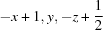
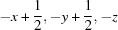
| Symmetry codes: (ii) −x+1, y, −z+1/2; (iii) −x, y, −z−1/2; (iv) −x+1/2, −y+1/2, −z. |
Experimental details
| Crystal data | |
| Chemical formula | C2H10N22+·2C8H9N2O4−·H2O |
| Mr | 474.48 |
| Crystal system, space group | Monoclinic, C2/c |
| Temperature (K) | 296 |
| a, b, c (Å) | 15.234 (4), 16.859 (4), 9.699 (3) |
| β (°) | 112.991 (5) |
| V (Å3) | 2293.1 (10) |
| Z | 4 |
| Radiation type | Mo Kα |
| µ (mm−1) | 0.11 |
| Crystal size (mm) | 0.36 × 0.28 × 0.16 |
| Data collection | |
| Diffractometer | Bruker SMART CCD area-detector |
| Absorption correction | Multi-scan (SADABS; Sheldrick, 2001) |
| Tmin, Tmax | 0.961, 0.983 |
| No. of measured, independent and observed [I > 2σ(I)] reflections | 5444, 2011, 1500 |
| Rint | 0.032 |
| (sin θ/λ)max (Å−1) | 0.595 |
| Refinement | |
| R[F2 > 2σ(F2)], wR(F2), S | 0.060, 0.182, 1.05 |
| No. of reflections | 2011 |
| No. of parameters | 169 |
| No. of restraints | 34 |
| H-atom treatment | H atoms treated by a mixture of independent and constrained refinement |
| Δρmax, Δρmin (e Å−3) | 0.30, −0.45 |
Computer programs: SMART (Bruker, 2001), SAINT-Plus (Bruker, 2001), SHELXS97 (Sheldrick, 2008), SHELXL97 (Sheldrick, 2008), PLATON (Spek, 2009).
| D—H···A | D—H | H···A | D···A | D—H···A |
| N2—H2A···O4i | 0.86 | 1.92 | 2.759 (3) | 166.2 |
| N3—H3A···N1 | 0.89 | 2.03 | 2.921 (3) | 175.7 |
| N3—H3A···O1 | 0.89 | 2.54 | 2.964 (3) | 110.2 |
| N3—H3B···O1ii | 0.89 | 1.94 | 2.792 (3) | 159.6 |
| N3—H3C···O1Wiii | 0.89 | 2.08 | 2.917 (3) | 156.8 |
| O2—H2···O3 | 0.82 | 1.64 | 2.457 (3) | 177.4 |
| O1W—H1W···O3 | 0.849 (10) | 1.957 (13) | 2.795 (2) | 169 (4) |
| Symmetry codes: (i) −x+1, y, −z+1/2; (ii) −x, y, −z−1/2; (iii) −x+1/2, −y+1/2, −z. |
Acknowledgements
This work was supported financially by the North China University of Water Conservancy and Electric Power, China.
References
 Bruker (2001). SAINT-Plus and SMART. Bruker AXS, Inc., Madison, Wisconsin, USA. Google Scholar
Sheldrick, G. M. (2001). SADABS. Bruker AXS Inc., Madison, Wisconsin, USA. Google Scholar
Sheldrick, G. M. (2008). Acta Cryst. A64, 112–122. Web of Science CrossRef CAS IUCr Journals Google Scholar
Spek, A. L. (2009). Acta Cryst. D65, 148–155. Web of Science CrossRef CAS IUCr Journals Google Scholar
Wang, Z.-L. & Wei, L.-H. (2005). Acta Cryst. E61, o3129–o3130. Web of Science CSD CrossRef IUCr Journals Google Scholar
This is an open-access article distributed under the terms of the Creative Commons Attribution (CC-BY) Licence, which permits unrestricted use, distribution, and reproduction in any medium, provided the original authors and source are cited.
| CRYSTALLOGRAPHIC COMMUNICATIONS |


Currently, many groups are studying the supramolecular structures of co-crystals containing organic acids and organic bases resulting from hydrogen bonding (Wang & Wei, 2005).
The asymmetric unit of the title complex, (I), is composed of two 2-propyl-1H-imidazole-4-carboxylic acid-5-carboxyate anions, one diprotonated ethylenediaminium cation and one water molecule in general positions (Fig. 1). The C–O bond distances range from 1.221 (3)to 1.289 (3) Å, in which the C1–O1 [1.223 (3) Å], C4–O4 [1.221 (3) Å] and C4–O3 [1.266 (3) Å] are typical for C=O double bonds, whereas the C1–O2 bond length of 1.289 (3) Å indicates a C–O single bond. The elongation of the C4=O3 double bond is affected by the intra-molecular O2—H2···O3 hydrogen bonding interaction. Thus, the 5-carboxyl group of 2-propyl-1H-imidazole-4,5-dicarboxy acid is deprotonated, which must be balanced in charge terms by the presence of half of the diprotonated ethylenediamine. Furthermore, the acidic environment is propitious to the protonation of ethylenediamine.
In the crystal structure, intra-molecular hydrogen bonds are present, with O2–H2 acting as a hydrogen bond donor, and O3 atom as a hydrogen bond acceptor, thereby constructing S(7) rings. In addition, the diprotonated ethylenediaminium cations and 2-propyl-1H-imidazole-4-carboxylic acid-5-carboxyate anions together with water molecules are further linked into a three-dimensional supramolecular framework by multiple N—H···O, N—H···N and O—H···O hydrogen bonds (Fig. 2 and Table 1).