issue contents
July 2026 issue
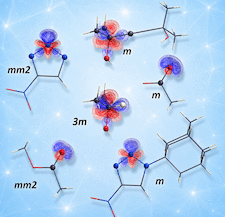
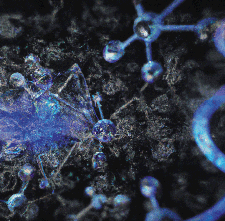
Cover illustration: The symmetry assigned to a central atom from its nearest neighbors (represented here as spheres) does not always reflect its actual electron-density symmetry (indicated here by black labels). Challenging these conventional geometric assumptions, work by Rybicka et al. [ Acta Cryst. (2026), A82, 256–275] presents a systematic, data-driven approach that captures the true, nuanced shapes of atoms and atom types representing them. Ultimately, these optimized atomic blueprints enhance the accuracy of electron-density modeling, bridging the gap between complex quantum mechanics and transferable big data in chemistry. The cover image shows the deformation electron densities of various atom types from the MATTS2021 data bank, mapped onto the crystal structures of representative molecules: C430 in isopropanol [Ridout & Probert (2014). CrystEngComm 16, 7397]; C464c in 1,1,4,4-tetramethylbut-2-yne-1,4-diol [Braga et al. (1997). Organometallics 16, 4910]; O101 in acetate [Dongjing Hong (2024). CSD Communication]; O103 in methyl acetate [Barrow et al. (1981). J. Chem. Soc., Dalton Trans. 1988]; N207a in 1-(adamantan-1-yl)-4-nitro-1H-1,2,3-triazole [Sukhanov et al. (2019). Khim. Get. Soedin., SSSR 64, 1197]; and N207b in 4-nitro-1,2,3-triazol-1-ide [Smiglak et al. (2013). New J. Chem. 37, 1461].
feature articles
Open Science is the movement to make scientific research, the data and their dissemination available to any member of an inquiring society, from professionals to citizens, irrespective of their economic situation. The IUCr provides fully open educational resources to Global South and Global North readers and authors.
advances
research papers
This paper details the complete methodological framework implemented in the MIDAS software for processing high-energy diffraction microscopy (HEDM) data. We describe the specific algorithms, coordinate systems and physical models used for both far-field and near-field HEDM analysis. The framework is designed to handle the large and complex datasets from modern synchrotrons, enabling efficient and accurate extraction of microstructural information.
This work focuses on the electron density of atoms modeled with a multipolar approach. We investigate how the refinement of the multipole models with/without symmetry constraints and optimization of the orientation of the local coordinate system and pseudosymmetry assignment improves the accuracy of electron-density representations for atoms and atom types in a pseudoatom data bank.
foundations
research papers
We present a simple linear-algebra-based condition for identifying all coincidence-site lattice orientation relationships in cubic crystals by testing the commensurability of (hkl) planes with (001).
The study characterizes the symmetries of a symbolic dynamical system arising from
k-free integers in the biquadratic field
![[K= {\bb Q}(\sqrt{2}, i)]](/a/issues/2026/04/00/gau5004/teximages/gau5004fi1.svg)
. It proves that the extended symmetry group is a semi-direct product
![[{\bb Z}^4 \times\!\!\hbox{\vrule height 4.6pt depth -0.1pt}\ {\rm Stab}(V_k)]](/a/issues/2026/04/00/gau5004/teximages/gau5004fi2.svg)
, with the stabilizer explicitly linked to the field's unit and Galois groups. The analysis demonstrates how these number-theoretic shifts mirror the complex symmetry structures typically seen in aperiodic order.
In this work, renormalization methods for quantities related to the diffraction of inflation systems are surveyed.
This paper experimentally establishes the accuracy, robustness and performance limits of the high-energy diffraction microscopy data reduction methodology. Using dedicated far-field and near-field datasets, it quantifies the influence of key analysis parameters, demonstrates computational efficiency, and establishes a framework of best practices to guide the community towards more reproducible results.
This study introduces and validates a novel methodological paradigm that transforms extended X-ray absorption fine structure (EXAFS) spectroscopy from a complementary local probe into a primary, stand-alone tool for determining complete crystal structures.
A small protein structure has been successfully solved by the single-atom R1 method after accounting for the hidden solvent diffraction effects.
short communications
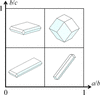
We discuss a method for describing the geometry and habit of distorted rhombic dodecahedral crystals. The proposed method serves as the basis for analyzing the relationship between the asymmetry of the environment and the mineral individuals of crystals of a wide variety of shapes in any distortion range.
international union of crystallography
book reviews



 journal menu


 access