


 journal menu


issue contents
July 2025 issue
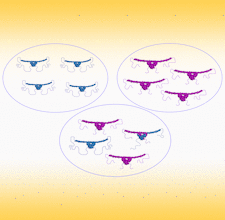
Cover illustration: Partner swapping between full-length DBHS proteins is likely to allow neofunctionalization of the different subsets of dimers and also the direct modulation of phase properties via the combinations of the different dimers within condensates and the variable intrinsically disordered regions that they contribute to phase separation [Koning et al. (2025), Acta Cryst. D81, 357–379].
image processing for cryoem


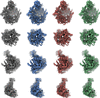
In the context of cryo-EM reconstruction, we provide a theoretical analysis showing that the condition number of the optimization problem is particularly large at high resolution, leading to slow convergence of gradient-based methods such as stochastic gradient descent. We then propose a method to overcome this issue by computing a preconditioner using Hutchinson's estimator, which results in improved convergence speed, as evidenced by numerical experiments.
research papers
Open  access
access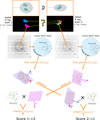
A method for multi-crystal data collection and the software programs Dozor, Dozor-m2 and Resheteau for the detection of individual crystals, the determination of their positions on a sample holder and the estimation of their dimensions and shapes based on double raster X-ray scans are presented.

Open access
access
SFPQ and NONO are DBHS-family proteins that are essential for transcriptional regulation and the assembly of paraspeckles, which are subnuclear structures built on the long noncoding RNA NEAT1. Through SAXS, SANS and XL-MS analyses, we reveal that the disordered regions of SFPQ surrounding its DBHS domain enable flexible interactions and that the full-length proteins are capable of dimer partner exchange, highlighting how these dynamics may contribute to phase separation and impact disease processes.

Download citation


Download citation
Open access
access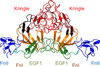
Factor XII (FXII) is a plasma serine protease which becomes activated by interactions with polyanions such as polyphosphates from bacteria, with Zn2+ as a critical cofactor. The crystal structure of FXII domains 1–5, coupled with a second crystal structure of the isolated FnII domain in complex with Zn2+ ions, advances our understanding of FXII structure and ligand recognition.