


 journal menu


issue contents
October 2025 issue
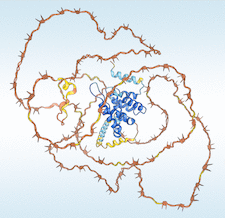
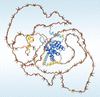
Cover illustration: A stylized representation of the AlphaFold Protein Structure Database prediction of UniProt Q14677, human clathrin interactor I. The well-predicted core, in blue, is surrounded by coils of disordered regions, in orange, resembling barbed wire. Coils of barbed wire, remembered from fence repair in Dave Richardson's early history, influenced our understanding and description of low-pLDDT regions in AlphaFold2 predictions [Williams et al. (2025), Acta Cryst. D81, 558–572]. Here we make the metaphor literal. Drawn by Christopher Williams, inspired by the style of Jane Richardson.
research papers


Open  access
access
This article reports a systematic validation of the consistency between the deposited helical parameters and the density maps of helical structures in the EMDB. Multiple parameter errors were identified and corrected.
Open access
access
Estimating structural heterogeneity in cryo-EM remains difficult due to noise, misclassification and algorithmic biases that obscure subtle conformational differences. This work introduces a statistical framework based on p-values to assess whether a given classification reflects meaningful structural variation or is indistinguishable from random partitioning.

Open access
access
This study highlights that cryo-EM can reveal structural information beyond the intended target, and that overexpression of membrane proteins involved in quality control may lead to the co-purification of proteins such as ArnA and AcrB.
Open access
access
Behavioral modes of AlphaFold2 predictions at low pLDDT are identified and described, ranging from unprotein-like `barbed wire' to near-predictive folds, and a tool to automate this identification is provided. Associations between prediction modes and features of interest, such as regions of conditional folding and signal peptides, are discussed.
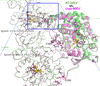
Room-temperature X-ray data collection enabled the structural determination of statin-bound CYP105A1
The comparison of CYP105A1–statin complex structures obtained from data collected at cryogenic and room temperature revealed release of the statin from the active site under cryogenic conditions. It was found that shrinkage of the c axis caused a cis–trans conversion of Pro142, resulting in changes to the active-site conformation.
scientific commentaries
Free
Low-confidence regions in computational protein models have been identified to represent a largely untapped resource that may contain valuable structural information.
book reviews
Free